Tag Archives: energy

Should big corporations pay for clean energy? Portland voters will decide.

A new ballot initiative in Portland would raise $30 million a year for clean energy through a tax on giant retailers. Sound unusual? It is.

The campaign for the Portland Clean Energy Fund is led by groups representing communities of color and grassroots environmental organizations. The local branches of the Sierra Club, 350.org, and the NAACP are all involved, too.

“It’s groundbreaking,” says Jenny Lee, advocacy director at the Coalition of Communities of Color, another organization spearheading the measure. “It’s the first environmental or climate initiative, as far as we know, that’s been led by organizations of color in Oregon.”

The campaign officially qualified for the November ballot on Friday after gathering 60,000 signatures from Portland voters (it only needed 34,000.) Lee says the volume of signatures speaks to the public enthusiasm for the measure, which would place a 1 percent charge on mega-retailers on revenue from Portland sales, excluding groceries and medicine.

So who would be paying up? We’re talking Wells Fargo, Apple, Comcast, and Banana Republic — companies that make over $1 billion in revenue a year and over $500,000 in Portland alone.

Between 40 and 60 percent of the money in the fund would be directed toward renewable energy and energy efficiency projects — half of which must be specifically intended to benefit low-income residents and communities of color. The fund devotes 20-25 percent to clean-energy jobs training that prioritizes women, people of color, and people with disabilities; 10-15 percent to greenhouse gas sequestration programs; and 5 percent to a flexible “future innovation” fund.

It’s the latest instance of social justice advocates and grassroots organizers calling for climate action in the Northwest. In Washington state, a wide coalition introduced a “carbon fee” that’s almost certainly headed to the ballot this November. If passed, it would become the first state law that looks anything like a carbon tax.

This recent wave of ballot initiatives followed some legislative letdowns in the region. Right after a carbon-tax proposal fizzled out in the Washington Senate in March, Oregon lawmakers set aside their plans for a cap-and-trade program. “Maybe Blue States Won’t Take Serious Action on Climate Change,” ran a headline in The Atlantic at the time. The article called into question the narrative we keep hearing — you know, the one about progressive cities and states fighting for climate action when the federal government refuses to.

While elected officials are one way to change policy, ballot initiatives are another — and they’re beginning to look like a hallmark of the Northwest’s climate justice movement.

“We knew that we couldn’t count on our legislators, both at the state and city level,” says Khanh Pham, manager of immigrant organizing at the Asian Pacific American Network of Oregon, who served on the steering committee for the Portland Clean Energy Fund.

Initially, Pham says, her group wanted to take the measure to city council — an easier, more familiar way to pass city legislation. But without strong support from their local elected officials, they decided to try and put something on the ballot instead.

She says the Portland Clean Energy Fund would be complementary to other climate policies, such as a statewide carbon price. It’s meant to address the hidden carbon emissions in the products we buy.

“When I buy clothing that comes from China or Vietnam, or food from Peru, there’s a lot of carbon emissions that are baked into those supply chains from these global retailers that are unaccounted for,” Pham says.

Reverend E.D. Mondainé, president of the NAACP Portland Branch and chief petitioner of the Portland Clean Energy Fund.Rick Rappaport / Portland Clean Energy Fund

It’s challenging to raise revenue in Oregon, especially to meet the needs of vulnerable communities, says Tony DeFalco, Verde executive director and one of the initiative’s organizers.

In 2016, Oregon voters shot down Measure 97, an attempt to place a 2.5 percent tax on corporations with more than $25 million a year in Oregon sales. DeFalco says the new initiative wasn’t inspired by that attempt. Measure 97 did, however, suggest that Portland has some appetite for a tax on corporations: 60 percent of the city voted for the measure, which would have spent the money on education, health care, and senior services.

Still, the groups behind the measure know they’re up against a challenge. There’s already a PAC, Keep Portland Affordable, that’s fighting the new initiative.

“We knew that we needed to be organizing in communities beyond our own to win this,” Pham says. “It’s been really eye-opening to see the power that a coalition like ours can build — a green-brown coalition.”

Portland is 78 percent white, making it the whitest big city in America. But communities of color have always been in Portland, says Lee, and her group is seeking to make them more visible. This ballot initiative is one such effort, she says:

“It’s a very clear statement that we are here, we are leading on policy, and we are also building political power.”

Visit site: 

Should big corporations pay for clean energy? Portland voters will decide.

Posted in alo, Anchor, FF, GE, ONA, The Atlantic, Uncategorized | Tagged , , , , , , , , , , | Comments Off on Should big corporations pay for clean energy? Portland voters will decide.

WeWork kicks meat to the curb in the name of climate change

WeWork announced a company-wide meat ban on Thursday: Poultry, pork, and red meat are officially no longer on the menu at WeWork events. And employees can’t charge meals that contain meat to the company card, either. That’s because the coworking Goliath seems to be moderately concerned that the human race is hurtling toward ecological collapse.

Like it or not, eliminating meat and dairy from your diet is probably the No. 1 thing you can do for the planet. Cutting out plastic straws? Sea turtles the world ’round appreciate it, but in terms of addressing climate change on a planetary scale, it doesn’t cut the mustard. That’s why the folks here at Grist dot org didn’t throw a party when Starbucks made plans to ditch straws and replace them with … plastic sippy cup lids. Perhaps it should take some inspiration from WeWork?

The company’s cofounder dropped the meat ban announcement on his employees in a memo. WeWork, valued at $20 billion, serves 253,000 members across the globe, and none of them will be nibbling on pigs-in-a-blanket on company premises anymore — unless they bring them from home, I guess.

The new meat ban will do the following by 2023, according to the company’s estimates:

Save 16.6 billion gallons of water
Prevent 445.1 million pounds of CO2 from entering the atmosphere
Spare the lives of more than 15,000,000 animals

While WeWork’s meat-free commitment is no doubt the most environmentally impactful step it’s taking, the company is also working to reduce its energy consumption by installing LED lights, automatic light switches, and a “global energy consumption dashboard,” something it hopes will help employees keep track of energy usage. It’s also working to reduce construction waste, increase the density of its real estate, and minimize additional construction. The company says its spaces are already 2.5 times more efficient than a typical office.

That’s pretty impressive! And to those of you who say you can’t give up meat, I ask you: Would you rather drink from a plastic sippy cup like a giant baby, or forgo the chicken skewers at your next company picnic like a well-adjusted grownup? The choice is yours. Unless you’re at WeWork, because your bosses already decided for you.

See the article here:

WeWork kicks meat to the curb in the name of climate change

Posted in alo, Anchor, Citizen, FF, GE, ONA, Uncategorized | Tagged , , , , , , , , , , | Comments Off on WeWork kicks meat to the curb in the name of climate change

8 ways resigning EPA Administrator Scott Pruitt suppressed science

This story was originally published by Reveal and is reproduced here as part of the Climate Desk collaboration.

EPA Administrator Scott Pruitt, who announced on Thursday that he is resigning, leaves a legacy of suppressing the role of science at the agency.

Blocking science in the name of transparency

In March, Pruitt proposed a new “science transparency policy.” Under the proposed rule, when the EPA designs pollution standards and rules, it would use only studies in which the underlying data is public. Pruitt said his policy would prevent the EPA from using “secret science” that cannot be tested by other researchers. But scientists say important findings could be excluded.

One example is research by Harvard University that linked fine particle pollution in U.S. cities with an increase in deaths from lung and heart diseases. The data for the 1993 study was key to the EPA’s setting of health standards that regulate air pollution. But the study’s underlying data is not public because researchers promised confidentiality to their subjects, 8,000 adults and 14,000 children in six cities.

Firing academic science advisers

Pruitt fired Science Advisory Board members who receive EPA grants for their research, saying they cannot remain objective if they accept agency money. In replacing them, Pruitt transformed the board from a panel of the nation’s top environmental experts to one dominated by industry-funded scientists and state government officials who have fought federal regulations.

Pruitt removed 21 members of the advisory board, mostly academics, and replaced them with 16 experts with ties to industries regulated by the agency and two with no industry ties. Fourteen of the new members consulted or worked for the fossil fuel or chemical industries, which gave Pruitt nearly $320,000 for his campaigns in Oklahoma as a state senator and attorney general. Eleven new members of the EPA’s board have a history of downplaying the health risks of secondhand smoke, air pollution, and other hazards, including two who have spun science for tobacco companies, according to an investigation by Reveal from the Center for Investigative Reporting.

Misrepresenting climate science

Pruitt repeatedly cast doubt on the scientific consensus that human activities are the primary cause of climate change. For instance, in a 2017 interview on CNBC’s “Squawk Box,” Pruitt said: “I think that measuring with precision human activity on the climate is something very challenging to do, and there’s tremendous disagreement about the degree of impact, so no, I would not agree that it’s [carbon dioxide] a primary contributor to the global warming that we see.”

Along the same lines, the Huffington Post in March published leaked talking points from the EPA’s public affairs office. The memorandum seemed designed to downplay humans’ role in climate change.

This contradicts the overwhelming science that people are causing climate change.

The Intergovernmental Panel on Climate Change in its 2013 summary for policymakers found that it is “extremely likely that more than half of the observed increase in global average surface temperature from 1951 to 2010 was caused by the anthropogenic increase in greenhouse gas concentrations,” or human activity. By “extremely likely,” the group of international scientists means a probability of 95 to 100 percent.

Ignoring science to reduce protections for waterways

Pruitt took steps toward repealing Obama-era protections for waterways and wetlands to fulfill a Trump executive order to roll back the reach of the Clean Water Act. That rollback would strip federal protection from seasonal streambeds, isolated pools, and other transitory wetlands, exposing them to damage, pollution, or destruction from housing developments, energy companies, and farms.

In June, Pruitt sent his proposal to redefine which waters are protected to the Office of Management and Budget, which is the final step before it is made public. Trump had ordered Pruitt to incorporate a definition put forth by late Supreme Court Justice Antonin Scalia, which defines protected waters as relatively permanent and continuously connected by surface water to navigable bays, rivers or lakes. If that definition is incorporated, it could allow damage to waterways that provide drinking water for more than 117 million Americans.

EPA brain drain

Pruitt’s hostility toward science fueled a brain drain at the EPA. The New York Times reported that out of 700 employees who left the agency in 2017, more than 200, or 27 percent, were scientists.

Among those leaving were 34 biologists and microbiologists, 19 chemists, 81 environmental engineers, and environmental scientists, and more than a dozen toxicologists, life scientists, and geologists. Few of these scientists have been replaced. According to the report, seven of the 129 people hired by the agency in 2017 were scientists.

Website goes light on science

After first removing the EPA’s Climate and Energy Resources for State, Local, and Tribal Governments web page, the agency relaunched it with a new name: Energy Resources for State, Local, and Tribal Governments. The new web page omits many links to EPA information that was designed to help local officials prepare for climate change and reduce climate change emissions, according to an October study by the Environmental Data and Governance Initiative.

Dirty power plants

Pruitt took steps to repeal the Clean Power Plan, the Obama-era regulation intended to reduce greenhouse gas emissions from power plants 32 percent by 2030 compared with 2005.

Pruitt also was revamping an earlier Obama administration rule that required that all new power plants meet greenhouse gas standards that roughly equate to emissions from modern natural gas plants.

Budget cuts to tribes

Pruitt proposed deep cuts in the EPA’s budget that could slow the cleanup of the Navajo Nation’s uranium mines. So far, Congress has resisted much of the cuts. But Pruitt kept proposing them. For instance, the $2.9 billion he proposed in state and tribal assistance grants for fiscal 2019 would provide $574 million less than the current budget.

Navajo Nation President Russell Begaye worries that such cuts could derail the EPA’s efforts to identify the companies responsible for cleaning up old mines and supervise the projects.

Read article here: 

8 ways resigning EPA Administrator Scott Pruitt suppressed science

Posted in alo, Anchor, FF, GE, LG, ONA, Uncategorized | Tagged , , , , , , , , , , , | Comments Off on 8 ways resigning EPA Administrator Scott Pruitt suppressed science

Minnesota just approved a new tar-sands pipeline. Activists say they will fight it.

On Thursday, the Minnesota Public Utility Commission gave the green light to Enbridge Energy’s Line 3 — a new Canadian tar-sands pipeline that would replace a deteriorating pipeline that’s currently running at half capacity. It’s the most recent development in an ongoing dispute over the Canadian energy company’s plan.

The decision isn’t totally final, according to the state’s governor. But it allows Enbridge to now apply for 29 other permits it needs to build the pipeline, which would run from Superior, Wisconsin, to Alberta, Canada.

Despite Minnesota’s decision, pipeline resisters say they’ll keep fighting.

In the early ’90s, a pipeline spilled 1.7 million gallons of oil in northern Minnesota. Activists worry that a major spill could happen again, potentially affecting river health and indigenous practices. Although the proposed route doesn’t go through reservations, it would cut through places where indigenous groups harvest wild rice and hunt.

Environmental and indigenous rights activist Winona LaDuke has been fighting the Line 3 project for five years. She tells Grist she’s disappointed in the public utility commission’s decision. But she’s still optimistic that the new line won’t happen: LaDuke called the project “Enbridge’s most expensive pipeline that will never be built.”

Margaret Breen of Youth Climate Intervenors — a group of young activists who have been working to oppose the pipeline — says that her organization remains motivated to stop the project, too.

There’s also the possibility of legal action. Cathy Collentine of the Sierra Club’s Beyond Dirty Fuels Campaign says that the Sierra Club is exploring options to halt the pipeline’s progress, such as petitioning for a reconsideration of the decision.

LaDuke says her group, Honor the Earth, has a legal team that plans to take action. The group is inviting water protectors to come to Minnesota.

LaDuke expects more resisters to join in the wake of the most recent decision. “We think water protector tourism should be at an all time high,” she says, and warns that a Standing Rock-like protest may be on the way.

View this article:

Minnesota just approved a new tar-sands pipeline. Activists say they will fight it.

Posted in alo, ALPHA, Anchor, Casio, FF, GE, Green Light, ONA, solar, Uncategorized | Tagged , , , , , , , , , , , | Comments Off on Minnesota just approved a new tar-sands pipeline. Activists say they will fight it.

The Aliens Are Coming! – Ben Miller

READ GREEN WITH E-BOOKS

The Aliens Are Coming!

The Extraordinary Science Behind Our Search for Life in the Universe

Ben Miller

Genre: Science & Nature

Price: $1.99

Publish Date: November 1, 2016

Publisher: The Experiment

Seller: Workman Publishing Co., Inc.


Actor and bestselling science writer Ben Miller takes readers to the cutting edge of one of the greatest questions of all: Is there life beyond Earth?   For millennia, we have looked up at the stars and wondered whether we are alone in the universe, but in the last few years—as our probes begin to escape the solar system, and our telescopes reveal thousands of Earthlike planets—scientists have taken huge leaps toward an answer. “Forget science fiction,” author Ben Miller writes. “We are living through one of the most extraordinary revolutions in the history of science: the emergent belief of a generation of physicists, biologists, and chemists that we are not alone.”   The Aliens Are Coming! is a refreshingly clear, hugely entertaining guide to the search for alien life. Miller looks everywhere for insight, from the Big Bang’s sea of energy that somehow became living matter, to the equations that tell us Earth is not so rare, to the clues bacteria hold to how life started. And he makes the case that our growing understanding of life itself will help us predict whether it exists elsewhere, what it might look like, and when we might find it.  

Link: 

The Aliens Are Coming! – Ben Miller

Posted in alo, Anchor, FF, GE, LAI, Mop, ONA, PUR, solar, Uncategorized | Tagged , , , , , , , | Comments Off on The Aliens Are Coming! – Ben Miller

This natural gas plant could be a big breakthrough

Yesterday, the startup Net Power switched on its 50-megawatt power plant, proving it could burn natural gas without releasing greenhouse gases. If this technology works at scale, it could be the flexible, emissions-free lynchpin the world needs to reverse climate change.

That’s a big “if” of course. After the engineering challenge comes the market challenge: We could make a laundry list of promising energy sources that launch to great excitement, then struggle for years to compete against the incumbent technologies (see cellulosic ethanol).

Net Power captures the carbon dioxide given off as gas burns. That’s the same thing done by carbon capture and sequestration plants already in existence. But the crucial difference here is that carbon capture and sequestration usually uses a lot of energy (and money) to separate the carbon molecules out of all the other gases and particles in a plant’s exhaust.

Net Power uses an elegant trick to simplify the process (David Roberts explains the basics here) so that its exhaust is nearly pure carbon dioxide, which it can capture in its entirety. And the company says it can do all that while operating more cheaply than the best existing gas plants.

The next step? The company is in the process of developing a 300-megawatt plant, which would start providing electricity by 2021 at the earliest.

As the United States has built solar panels and wind turbines, natural gas has expanded even more. The fuel’s ability to cheaply ramp up and down with fluctuations in electric supply and demand have made it an apt partner for renewable energy. If it could do that without adding insulation to the Earth’s heat-trapping jacket, it would provide us a much-needed reprieve.

Original source – 

This natural gas plant could be a big breakthrough

Posted in alo, ALPHA, Anchor, FF, GE, LAI, ONA, PUR, solar, solar panels, Uncategorized | Tagged , , , , , , , , , , | Comments Off on This natural gas plant could be a big breakthrough

Republican mayors push climate action without saying ‘climate change’

Leadership in addressing climate change in the United States has shifted away from Washington, D.C. Cities across the country are organizing, networking, and sharing resources to reduce their greenhouse gas emissions and tackle related challenges ranging from air pollution to heat island effects.

But group photos at climate change summits typically feature big-city Democratic mayors rubbing shoulders. Republicans are rarer, with a few notable exceptions, such as Kevin Faulconer of San Diego and James Brainard of Carmel, Indiana.

Faulconer co-chairs the Sierra Club’s Mayors for 100 Percent Clean Energy Initiative, which rallies mayors around a shared commitment to power their cities entirely with clean and renewable energy. Brainard is a longtime champion of the issue within the U.S. Conference of Mayors and the Climate Mayors network.

In our research at the Boston University Initiative on Cities, we found that large-city Republican mayors shy away from climate network memberships and their associated framing of the problem. But in many cases they advocate locally for policies that help advance climate goals for other reasons, such as fiscal responsibility and public health. In short, the United States is making progress on this issue in some surprising places.

Climate network members are mainly Democrats

In our initiative’s recent report, “Cities Joining Ranks,” we systematically reviewed which U.S. cities belong to 10 prominent city climate networks. These networks, often founded by mayors themselves, provide platforms to exchange information, advocate for urban priorities and strengthen city goverments’ technical capacities.

The networks we assessed included Climate Mayors; We Are Still In, which represents organizations that continue to support action to meet the targets in the Paris climate agreement; and ICLEI USA.

We found a clear partisan divide between Republican and Democrat mayors. On average, Republican-led cities with more than 75,000 residents belong to less than one climate network. In contrast, cities with Democratic mayors belonged to an average of four networks. Among the 100 largest U.S. cities, of which 29 have Republican mayors and 63 have Democrats, Democrat-led cities are more than four times more likely to belong to at least one climate network.

This split has implications for city-level climate action. Joining these networks sends a very public signal to constituents about the importance of safeguarding the environment, transitioning to cleaner forms of energy, and addressing climate change. Some networks require cities to plan for or implement specific greenhouse gas reduction targets and report on their progress, which means that mayors can be held accountable.

Constituents in Republican-led cities support climate policies

Cities can also reduce their carbon footprints and stay under the radar — a strategy that is popular with Republican mayors. Taking the findings of the “Cities Joining Ranks” report as a starting point, I explored support for climate policies in Republican-led cities and the level of ambition and transparency in their climate plans.

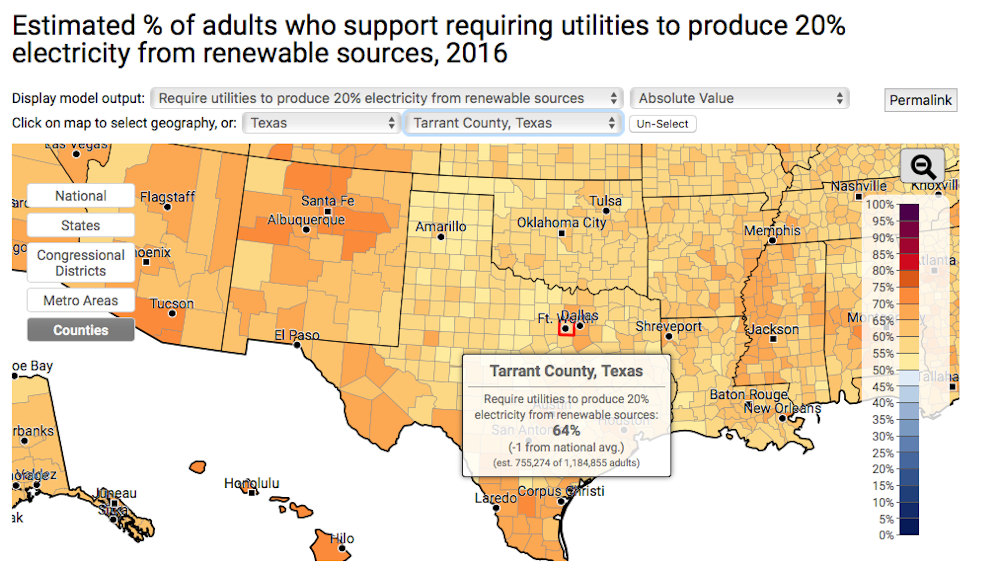
To tackle these questions, I cross-referenced Republican-led cities with data from the Yale Climate Opinion maps, which provide insight into county-level support for four climate policies:

Regulating carbon dioxide as a pollutant
Imposing strict carbon dioxide emission limits on existing coal-fired power plants
Funding research into renewable energy sources
Requiring utilities to produce 20 percent of their electricity from renewable sources

In all of the 10 largest U.S. cities that have Republican mayors and also voted Republican in the 2008 presidential election, county-level polling data showed majority support for all four climate policies. Examples included Jacksonville, Florida, and Fort Worth, Texas. None of these cities participated in any of the 10 climate networks that we reviewed in our report.

Yale Program on Climate Change Communication, CC BY-ND

This finding suggests that popular support exists for action on climate change, and that residents of these cities who advocate acting could lobby their elected officials to join climate networks. Indeed, we have found that one of the top three reasons mayors join city policy networks is because it signals their priorities. A mayor of a medium-sized West Coast city told us: “Your constituents are expecting you to represent them, so we are trying politically to be their voice.”

Mayors join networks to amplify their message, signal priorities to constituents, and share information. BU Initiative on Cities, CC BY-ND.

Climate-friendly strategies, but few emissions targets

Next, I reviewed planning documents from the 29 largest U.S. cities that are led by Republican mayors. Among this group, 15 have developed or are developing concrete goals that guide their efforts to improve local environmental quality. Many of these actions reduce cities’ carbon footprints, although they are not primarily framed that way.

Rather, these cities most frequently cast targets for achieving energy savings and curbing local air pollution as part of their master plans. Some package them as part of dedicated sustainability strategies.

These agendas often evoke images of disrupted ecosystems that need to be conserved, or that endanger human health and quality of life. Some also spotlight cost savings from designing infrastructure to cope with more extreme weather events.

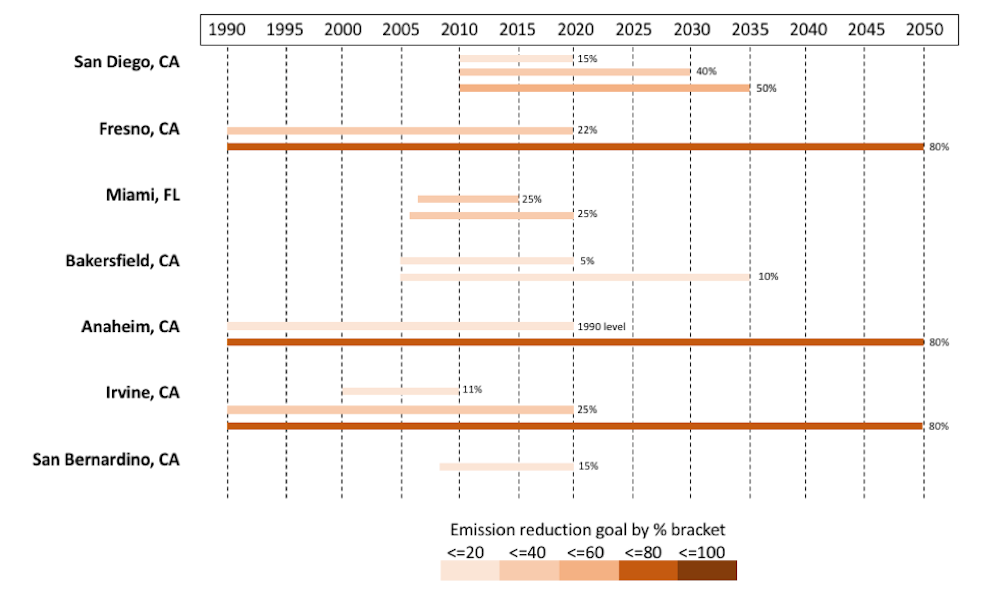
In contrast, only seven cities in this group had developed quantitative greenhouse gas reduction targets. Except for Miami, all of them are in California, which requires its cities to align their greenhouse gas reduction targets with state plans. From planning documents, it appears that none of the six Californian cities goes far beyond minimum mandated emission reductions set by the state for 2020.

Greenhouse gas reductions goals, with baselines, for the seven largest Republican-led cities. Nicolas Gunkel, CC BY-ND.

Watch what they do, not what they say

The real measure of Republican mayors taking action on climate change is not the number of networks they join but the policy steps they take, often quietly, at home. While few Republican mayors may attend the next round of subnational climate summits, many have set out policy agendas that mitigate climate change, without calling a lot of attention to it — much like a number of rural U.S. communities. Focusing narrowly on policy labels and public commitments by mayors fails to capture the various forms of local climate action, especially in GOP-led cities.

Carmel, Indiana Mayor James Brainard has suggested that some of his less-outspoken counterparts may fear a backlash from conservative opinion-makers. “There is a lot of Republicans out there that think like I do. They have been intimidated, to some extent, by the Tea Party and the conservative talk show hosts,” Brainard has said.

Indeed, studies show that the news environment has become increasingly polarized around accepting or denying climate science. Avoiding explicit mention of climate change is enabling a sizable number of big-city GOP mayors to pursue policies that advance climate goals.

See the original post:  

Republican mayors push climate action without saying ‘climate change’

Posted in alo, ALPHA, Anchor, FF, GE, LG, ONA, PUR, solar, Uncategorized | Tagged , , , , , , , , , | Comments Off on Republican mayors push climate action without saying ‘climate change’

This EPA spokesperson is done defending Scott Pruitt.

First: Toxic coal ash, which was a problem on the territory well before Maria’s landfall. A coal-fired power plant in the southeastern city of Guayama produces 220 thousand tons of the stuff each year, which studies have linked to an increased risk of cancer, heart, and respiratory ailments.

Puerto Rico’s Environmental Quality Board directed the plant, operated by multinational corporation Applied Energy Systems (AES), to cover its giant pile of coal ash prior to the storm. This weekend, PBS News reported that never happened.

Researchers and community members had worried that the heavy rainfall heightened the risk of coal ash toxins leaching into the soil and contaminating drinking water. Now, AES’ own groundwater monitoring report showed a sharp increase in the levels of arsenic, chromium, and two radioactive isotopes in groundwater near the plant after Hurricane Maria. Federal and local government have historically ignored this region of the island, experts told Grist shortly after the storm.

Second: Statehood! A disaster response nearly as chaotic as the storm itself has highlighted the real risks of the United States’ colonial relationship with the island.

Puerto Rico’s Resident Commissioner Jenniffer González plans to introduce a bill to the House this spring petitioning for Puerto Rico to become a state, the Washington Post reports.

“Ask yourself, if New Jersey or Connecticut had been without power for six months, what would have happened?” she asked, “This is about spotlighting inequities and helping Congress understand why we are treated differently.”

Originally posted here: 

This EPA spokesperson is done defending Scott Pruitt.

Posted in alo, Anchor, Brita, Everyone, FF, G & F, GE, LAI, Landmark, LG, ONA, Ringer, Uncategorized | Tagged , , , , , , , , , | Comments Off on This EPA spokesperson is done defending Scott Pruitt.

An oil refinery exploded in Wisconsin, forcing thousands to evacuate.

The EPA administrator has racked up more than 40 scandals and 10 federal investigations since he took office last February. Nonetheless, Scott Pruitt was smiling when he walked in to testify in front of the House Energy and Commerce subcommittee on Thursday.

Prior to the hearing, the New York Times reported that Pruitt had a plan to deal with tough questions: Blame his staff instead.

He stuck to it. When New York Democratic Representative Paul Tonko confronted him about raises given to two aides without White House approval, Pruitt said, “I was not aware of the amount, nor was I aware of the bypassing, or the PPO process not being respected.”

And Pruitt’s $43,000 soundproof phone booth? Again, not his fault. As Pruitt told California Democratic Representative Antonio Cárdenas: “I was not involved in the approval of the $43,000, and if I had known about it, Congressman, I would have refused it.”

“That seems a bit odd,” Cárdenas commented. “If something happened in my office, especially to the degree of $43,000, I know about it before, during, and after.”

Democratic Representative from New Mexico Ben Ray Luján pointed out that Pruitt was repeatedly blaming others during the hearing. “Yes or no: Are you responsible for the many, many scandals plaguing the EPA?” he asked.

Pruitt dodged the question: “I’ve responded to many of those questions here today with facts and information.” When Luján pressed him futher, Pruitt replied, “That’s not a yes or no answer, congressman.”

Well … it wasn’t a “no.”

View article: 

An oil refinery exploded in Wisconsin, forcing thousands to evacuate.

Posted in alo, Anchor, Brita, Everyone, FF, G & F, GE, LAI, LG, ONA, PUR, Ringer, solar, solar panels, Uncategorized | Tagged , , , , , , , , , , | Comments Off on An oil refinery exploded in Wisconsin, forcing thousands to evacuate.

The French president gave America the climate change speech that Trump never will.

The EPA administrator has racked up more than 40 scandals and 10 federal investigations since he took office last February. Nonetheless, Scott Pruitt was smiling when he walked in to testify in front of the House Energy and Commerce subcommittee on Thursday.

Prior to the hearing, the New York Times reported that Pruitt had a plan to deal with tough questions: Blame his staff instead.

He stuck to it. When New York Democratic Representative Paul Tonko confronted him about raises given to two aides without White House approval, Pruitt said, “I was not aware of the amount, nor was I aware of the bypassing, or the PPO process not being respected.”

And Pruitt’s $43,000 soundproof phone booth? Again, not his fault. As Pruitt told California Democratic Representative Antonio Cárdenas: “I was not involved in the approval of the $43,000, and if I had known about it, Congressman, I would have refused it.”

“That seems a bit odd,” Cárdenas commented. “If something happened in my office, especially to the degree of $43,000, I know about it before, during, and after.”

Democratic Representative from New Mexico Ben Ray Luján pointed out that Pruitt was repeatedly blaming others during the hearing. “Yes or no: Are you responsible for the many, many scandals plaguing the EPA?” he asked.

Pruitt dodged the question: “I’ve responded to many of those questions here today with facts and information.” When Luján pressed him futher, Pruitt replied, “That’s not a yes or no answer, congressman.”

Well … it wasn’t a “no.”

See the original article here: 

The French president gave America the climate change speech that Trump never will.

Posted in alo, Anchor, Brita, Everyone, FF, G & F, GE, LAI, LG, ONA, PUR, Ringer, solar, solar panels, Uncategorized | Tagged , , , , , , , , , , , | Comments Off on The French president gave America the climate change speech that Trump never will.