Tag Archives: kansas

Leave it to West Virginia to confuse its students about science

Leave it to West Virginia to confuse its students about science

By on 5 Jan 2015commentsShare

The campaign by special interests and right-wing politicians to inject climate skepticism into public school classrooms has gone on for years. In 2014, it hit Texas, Kansas, and Wyoming. Now West Virginia has become the latest science-education battleground.

Members of the state school board were unhappy with the national Next Generation Science Standards, a blueprint for teaching science in schools, even though it had already been watered down on the topic of climate change to the satisfaction of the climate change–denying Heartland Institute.

One board member was concerned about the effect that teaching climate science would have on the coal industry, reports The Charleston Gazette. Another took issue with the science itself: “There was a question in there that said: ‘Ask questions to clarify evidence of the factors that have caused the rise in global temperatures over the past century,’” school board member Wade Linger told the newspaper. “If you have that as a standard, then that presupposes that global temperatures have risen over the past century, and, of course, there’s debate about that.”

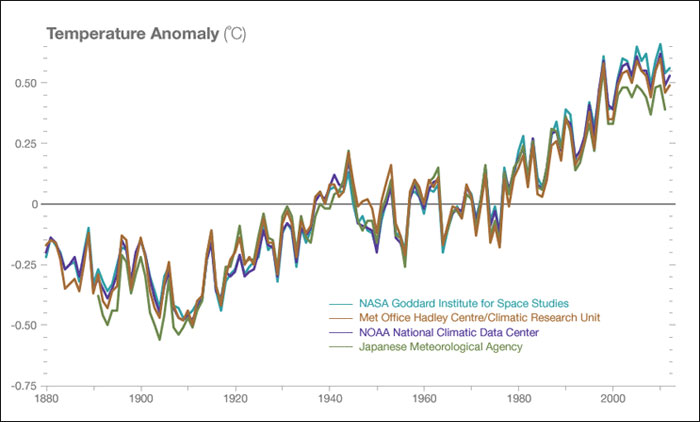
No, there’s not. There’s no question that temperatures have risen over the past century. Any “debate” is over why temperatures have risen — and it’s hardly much of a debate, as 97 percent of climate scientists agree that human activity is the primary cause.

Well so anyway, because the opinions of the world’s scientists are, cumulatively, worth slightly less than those of Mr. Wade Linger, the board made some changes, detailed here by Ryan Quinn of The Charleston Gazette:

The changes, for example, added “and fall” after “rise” to a proposed standard requiring that sixth-graders “ask questions to clarify evidence of the factors that have caused the rise in global temperatures over the past century.”

The other changes West Virginia Department of Education staff members made in response to Linger’s concerns were:

Original ninthgrade science requirement: “Analyze geoscience data and the results from global climate models to make an evidence-based forecast of the current rate of global or regional climate change and associated future impacts to Earth systems.”
Adopted version: “Analyze geoscience data and the predictions made by computer climate models to assess their creditability [sic] for predicting future impacts on the Earth System.”
Original high school elective Environmental Science requirement: “Debate climate changes as it [sic] relates to greenhouse gases, human changes in atmospheric concentrations of greenhouse gases, and relevant laws and treaties.”
Adopted version: “Debate climate changes as it relates to natural forces such as Milankovitch cycles, greenhouse gases, human changes in atmospheric concentrations of greenhouse gases, and relevant laws and treaties.”

Milankovitch cycles are long-term changes in Earth’s orbit around the sun, and some who do not believe in man-made global warming use that theory as the basis of their assertion that the Earth is simply in a natural warming period.

Never a good sign when a newspaper has to insert “sic” more than once into a state’s teaching requirements.

The school board’s break with mainstream science is concerning to education advocates and many parents. One nonprofit, Climate Parents, will petition the school board to throw out its inaccurate changes before they’re implemented in 2016.

Source:
Climate change learning standards for W.Va. students altered

, The Charleston Gazette.

Climate groups oppose changes to W.Va. science standards

, The Charleston Gazette.

Share

Please

enable JavaScript

to view the comments.

Find this article interesting?

Donate now to support our work.

Get stories like this in your inbox

AdvertisementAdvertisement

Source: 

Leave it to West Virginia to confuse its students about science

Posted in Anchor, FF, GE, LG, ONA, Uncategorized | Tagged , , , , , , , , | Comments Off on Leave it to West Virginia to confuse its students about science

Why Did the Enclosed Mall Die?

Mother Jones

<!DOCTYPE html PUBLIC “-//W3C//DTD HTML 4.0 Transitional//EN” “http://www.w3.org/TR/REC-html40/loose.dtd”>

Alex Tabarrok links today to a BBC piece on the death of the American shopping mall. But it’s really about the death of the enclosed American shopping mall. So why did enclosed malls go the way of the dodo starting in the early 90s? Here’s the author’s crack at an explanation:

When the 35-year-old Cloverleaf Mall in Chesterfield, Virginia, closed in 2007, the Chesterfield Observer noted that while it had been a popular hangout for families in the 1970s and ’80s, “That all changed in the 1990s. Cloverleaf’s best customers, women, began staying away from the mall, fearful of the youth who were beginning to congregate there. People said a former Cloverleaf manager started seeing kids with huge baggy pants and chains hanging off their belts, and people were intimidated, and they would say there were gangs.”

OK. How about Amy Merrick in the New Yorker earlier this year? What does she think?

As any cubicle dweller knows, people like natural light and fresh air and, when deprived of them, feel oppressed. So are people alienated by those older malls, with their raw concrete, brutalist architecture and fretful, defensive air? Developers have a shorthand for this style: the “classic graybox.” In his talk, Rick Caruso flashed grim photos of their façades. He lingered on a picture of a deserted food court; you could practically smell the stale grease. “Does this look like the future to you?” he asked.

Here’s Neil Howe in USA Today:

There is a generational story behind what’s happening to shopping malls. And if you want to know how it will end, you have to pay attention to each generation’s role….What most impressed the G.I.s (and the Silent Generation who succeeded them) about malls was their enormous efficiency….Then came suburban Boomers, who grew up with these newly minted malls as kids. As they matured, many Boomers soured on what they regarded as the soulless and artificial consumerism of malls and began to champion what business author Joseph Pine calls the “experience economy” — turning stores and restaurants from mere retail outlets into places that mean something (think Rainforest Cafe or Build-a-Bear Workshop or L.L. Bean). That thinking not only inspired more stores to include a “tourism” component, but it also drove the surging popularity of lifestyle centers in the early 1990s.

….But Xers soon changed the mall scene. This strapped-for-cash generation helped popularize “category killers” and was the first to adopt online shopping. Millennial teens who arrived in the late 1990s began to show less interest in malls in part because their parents deemed malls too dangerous.

The lack of reasonable explanations suggests that nobody really knows the answer. It certainly remains a mystery to me. There’s no question that shopping spaces of all kinds have been hurt in recent years by the rise of online retail, and that mall development in particular was hurt by the Great Recession. But the switch away from enclosed malls began in the 90s, and it wasn’t because people were tired of shopping. Nor was it because suburbs started to die. It was because enclosed malls were replaced by outdoor “power centers” and “lifestyle centers.”

But why? I still don’t know. Is it due to the decline of traditional department stores, which served as anchors for enclosed malls? Are stores like Target and Best Buy simply unsuited to be anchors for enclosed malls? Is it cheaper to build outdoor malls? Was it really because people started to see malls as dangerous, as two of the stories above imply?

And how does this play out in less temperate climes than Southern California? No new enclosed mall has been built near me since (I think) 1987. That’s not too big a deal, since even in winter it’s no chore to shop at an outdoor shopping center. But what about in the suburbs of Chicago? Or Detroit? Or Kansas City? Do people really want to shop at outdoor lifestyle malls when it’s ten below zero? Do enclosed malls make a sudden comeback when the weather is bone-chillingly cold and then die again in the spring? Or what?

Perhaps this is just one of those mysteries: consumer tastes changed in the early 90s, and they changed because that’s what consumer tastes do. Radio Shack used to be pretty popular too.

Still, it’s an interesting mystery. I wish there were a good explanation, not just a few obvious guesses that amount to little more than a shrug of the shoulders. Why did enclosed malls die? Somebody needs to come up with a definitive answer.

POSTSCRIPT: One thing I should note is that although few (no?) new enclosed malls are being built, older malls that have been shut down don’t all turn into the infamous dead malls that have gotten so much attention lately. A fair number of them are renovated and reopened. I’m not sure what, if anything, that means. Just thought I’d mention it.

More:  

Why Did the Enclosed Mall Die?

Posted in Anchor, FF, GE, LG, Natural Light, ONA, Uncategorized, Venta | Tagged , , , , , , , , | Comments Off on Why Did the Enclosed Mall Die?

President Obama Acted Unilaterally on Immigration and the Right Is Predictably Outraged

Mother Jones

<!DOCTYPE html PUBLIC “-//W3C//DTD HTML 4.0 Transitional//EN” “http://www.w3.org/TR/REC-html40/loose.dtd”>

President Barack Obama, who has issued fewer executive orders than any president since Grover Cleveland, issued a set of directives this week to protect 5 million undocumented residents from deportation. The new executive actions will allow undocumented parents of US citizens to stay in the country, and allow children who were brought to the United States by their parents to apply for employment visas. It also, according to various Republican critics, cements Obama’s status as a dictator, a king, an emperor, and maybe even a maniac bent on ethnic cleansing:

Obama is a king. “The president acts like he’s a king,” Sen. Rand Paul (R-Ky.) said. “He ignores the Constitution. He arrogantly says, ‘If Congress will not act, then I must.’ These are not the words of a great leader. These are the words that sound more like the exclamations of an autocrat.”

This will lead to anarchy. “The country’s going to go nuts, because they’re going to see it as a move outside the authority of the president, and it’s going to be a very serious situation,” retiring Sen. Tom Coburn (R-Okla.) told USA Today. “You’re going to see—hopefully not—but you could see instances of anarchy. … You could see violence.”

He could go to jail. Rep. Mo Brooks (R-Ala.) told Slate that the president might be committing a felony: “At some point, you have to evaluate whether the president’s conduct aids or abets, encourages, or entices foreigners to unlawfully cross into the United States of America. That has a five-year in-jail penalty associated with it.”

Is ethnic cleansing next? When asked by a talk-radio called on Thursday if the new executive actions would lead to “ethnic cleansing,” Kansas Republican Secretary of State Kris Kobach said it just might:

What protects us in America from any kind of ethnic cleansing is the rule of law, of course. And the rule of law used to be unassailable, used to be taken for granted in America. And now, of course, we have a President who disregards the law when it suits his interests. And, so, you know, while I normally would answer that by saying, ‘Steve, of course we have the rule of law, that could never happen in America,’ I wonder what could happen. I still don’t think it’s going to happen in America, but I have to admit, that things are, things are strange and they’re happening.

Kobach is hardly a fringe figure. He was the architect of the self-deportation strategy at the core some of the nation’s harshest immigration laws.

See the original article here – 

President Obama Acted Unilaterally on Immigration and the Right Is Predictably Outraged

Posted in alo, Anchor, Citizen, FF, G & F, GE, LG, ONA, Radius, Uncategorized, Venta | Tagged , , , , , , , , , , , | Comments Off on President Obama Acted Unilaterally on Immigration and the Right Is Predictably Outraged

These Laws Let Accused Rapists Off the Hook

Mother Jones

On January 23, 2014, Bart Bareither walked into the Marion County Sheriff’s Department in Indianapolis. The 39-year-old computer engineer confessed to having raped a nursing student nine years earlier, while he was a teaching assistant at Indiana University. “He had a sincere demeanor. His head was bowed. It was clearly eating at him; he was apologizing,” recalls university detective Kimberly Minor, who was brought in to take his statement. Minor then contacted Jenny Wendt, who had been 26 at the time of the assault. She had not originally reported the crime because she thought it would be difficult to prove since she’d been on dates with Bareither. But even now, she soon learned, Bareither would not face any charges.

Indiana law classifies sexual assaults into two categories: Class A felony rape, in which an assailant causes serious bodily injury, uses deadly force, or drugs the victim; and Class B felony rape, which includes other types of sexual assault. There is no statute of limitations for Class A offenses, so charges may be filed anytime after a crime is committed. The statute of limitations for Class B offenses—like what happened to Wendt—is five years. Minor says she and the Marion County prosecutor searched for a way to bring Bareither to trial, but it was soon clear that the opportunity had passed. “I think he knew about the statute,” Minor says. (Bareither did not respond to emails and calls from Mother Jones.)

Continue Reading »

Continue at source:

These Laws Let Accused Rapists Off the Hook

Posted in alo, Anchor, FF, GE, LAI, LG, ONA, PUR, Radius, Smith's, Uncategorized, Venta | Tagged , , , , , , , , , | Comments Off on These Laws Let Accused Rapists Off the Hook

The War on Voting May Have Swung These 4 Races

Mother Jones

<!DOCTYPE html PUBLIC “-//W3C//DTD HTML 4.0 Transitional//EN” “http://www.w3.org/TR/REC-html40/loose.dtd”>

In several races around the country on Tuesday, the victors won by razor-thin margins. Many of these races were in states that had recently enacted voting restrictions expected to depress turnout amongst minorities, young voters, and the poor, according to a new report released Wednesday by the Brennan Center. No one knows how many of the newly disenfranchised may have voted. Nevertheless, the report’s author Wendy Weiser notes, “In several key races, the margin of victory came very close to the likely margin of disenfranchisement.” Here’s look at the numbers in some of those elections, all via Brennan:

Kansas Governor: Republican Gov. Sam Brownback got 33,000 more votes than his Democratic challenger Paul Davis.

In 2011, Kansas implemented a requirement that voters provide documentation of citizenship to vote, and just before the 2012 election, the state enacted a strict photo ID law.

More than 24,000 Kansas voters tried to register this year, but couldn’t because of the state’s proof of citizenship law. In addition, it’s estimated that the state’s photo ID law reduces turnout by about 2 percent, or 17,000 voters.

North Carolina Senate: Republican House state speaker Thom Tillis beat incumbent Democratic Sen. Kay Hagan by 48,000 votes.

In 2013, North Carolina enacted a law—which Tillis helped write—limiting early voting and same-day registration, which the Justice Department warned would likely depress minority turnout. During the last midterms in 2010, about 200,000 North Carolinians cast their ballots during early voting days that the state’s new voting law eliminated.

Virginia Senate: Democratic Sen. Mark Warner beat GOPer Ed Gillespie by a margin of just over 12,000 votes.

Voters this year faced a new voter ID law that the state enacted in 2013. This type of law tends to reduce turnout by about 2.4 percent, according to New York Times pollster Nate Silver. Applied to the Virginia Senate race this year, that would mean that turnout was reduced by over 52,000 voters.

Florida Governor: Republican Gov. Rick Scott eked out a victory over former Democratic Gov. Charlie Crist by roughly 72,000 votes.

In 2011, Florida reduced the early voting period. The same year, Scott imposed a measure making it nearly impossible to vote for convicts who have already served their time. The move essentially disenfranchised nearly 1.3 million formerly incarcerated Floridians, about one in three of whom are African-American.

See original: 

The War on Voting May Have Swung These 4 Races

Posted in Anchor, Citizen, FF, GE, LAI, LG, ONA, Radius, Uncategorized, Venta | Tagged , , , , , , , , , | Comments Off on The War on Voting May Have Swung These 4 Races

The Tom Steyer campaigns you haven’t heard about yet

The Tom Steyer campaigns you haven’t heard about yet

4 Nov 2014 6:29 AM

Share

Share

The Tom Steyer campaigns you haven’t heard about yet

×

You already know about the huge amount of money being spent to get voters to care a bit more about climate change, and to prod those who already care into polling places today. Leading the charge, of course, has been Tom Steyer, the hedge-fund billionaire turned political moneyman who is forcing candidates for Senate and governor to address an issue they really, really don’t want to talk about.

But even though those congressional and gubernatorial races get the bulk of the attention, Steyer and like-minded donors have been active at the state level too. The New York Times’ Kirk Johnson reported recently on Steyer’s spending in Washington state:

The effort by a California billionaire named Thomas F. Steyer to bolster global climate change measures in Washington has turned the battle over the State Senate into one of the most expensive legislative elections in state history.

Money has poured into the handful of legislative races that Mr. Steyer’s political action committee identified as central to shifting the Senate’s leadership from a Republican-led coalition to a Democratic majority that would support the ambitious climate goals set by Gov. Jay Inslee, a Democrat.

… The Democrats need a net gain of two seats to achieve a Senate majority, and Mr. Steyer’s political action committee, Nextgen Climate Action, has contributed $1.25 million to that goal.

“We want to make climate change a local issue,” a spokesperson for Nextgen Climate told the Times. The PAC is also spending on state legislature races in Oregon, California, and Iowa, though the biggest money is going to Washington state.

At the moment, Gov. Inslee is waiting on his legislature’s approval to launch a greenhouse gas reduction plan — including a cap-and-trade program — that will help the state meet future targets that the legislature itself set in 2008.

There’s also a bigger picture: In 2013, governors of Washington, Oregon, and California, and a proxy for the premier of British Columbia, signed the Pacific Coast Action Plan on Climate and Energy. Steyer is a big supporter of the plan — he even helped broker it — but for it to be realized, he told the conservative Washington Examiner, governors will “need stronger majorities in Oregon and Washington.” Cue the dump trucks full of cash.

Other groups are fighting it out at the state level as well. The League of Conservation Voters has a network of state-level affiliates, which are active in this year’s election cycle (though, as is often the case with electoral money trails, we won’t know quite how active until long after the results of the elections are in). LCV’s Colorado affiliate is behind a big push to elect two state-level democrats in Colorado, one to the state Senate and one to the House. The Environmental Defense Action Fund, earlier this year, backed four candidates in the Kansas GOP primary who had supported the state’s mandate requiring utilities to use more renewables. And state-level political action committees like California’s Leadership for a Clean Economy have sprung up to help direct money to worthy politicians.

It’s a smart strategy. Conservative groups like the American Legislative Exchange Council and the State Policy Network have long recognized that while Congress moves slowly — and, in recent years, has not really moved much at all — it’s very often at the state level that the policies that affect day-to-day life are debated and implemented. So fighting battles for the statehouse and city hall makes sense — and it’s much cheaper. Climate hawks appear to now have that page in their playbook too.

Find this article interesting?
Donate now to support our work.Share

Please

enable JavaScript

to view the comments.

Get stories like this in your inbox

AdvertisementAdvertisement

Visit site – 

The Tom Steyer campaigns you haven’t heard about yet

Posted in Anchor, FF, G & F, GE, global climate change, LG, ONA, Uncategorized | Tagged , , , , , , , | Comments Off on The Tom Steyer campaigns you haven’t heard about yet

Momentum for Next Generation Fuel

back

Momentum for Next Generation Fuel

Posted 14 October 2014 in

National

The momentum is building for the renewable fuels industry in America. For the second month in a row, a new cellulosic ethanol facility is coming online — one of four new cellulosic ethanol facilities opening in the U.S. before the end of the year.

Located in Hugoton, Kansas, Abengoa Bioenergy’s new biomass-to-ethanol biorefinery will produce 25 million gallons of ethanol derived from nearly 300,000 tons of biomass annually. In addition, the facility will use the residue from the advanced ethanol production process to produce 21 megawatts of electricity — making the facility environmentally friendly and energy efficient.

Cellulosic ethanol is a low-emission, sustainable biofuel produced from agricultural waste. Blending that ethanol into our fuel will help to reduce our dependence on foreign oil — and make our air cleaner.

Learn about the Abengoa facility and the other new cellulosic ethanol plants in our infographic above.

Fuels America News & Stories

Fuels
Source article:  

Momentum for Next Generation Fuel

Posted in Anchor, FF, GE, ONA, Uncategorized | Tagged , , , , , , , , | Comments Off on Momentum for Next Generation Fuel

Election Rule #34: Process Gaffes Matter. Policy Gaffes Don’t.

Mother Jones

Last year, it was conventional wisdom that Republicans had a very good shot at gaining control of the Senate in this year’s midterm election. But then GOP candidates started to falter a bit in Kansas, North Dakota, and other swing states. Charles Pierce comments on how this has played out with Joni Ernst in Iowa and Cory Gardner in Colorado:

The meme looked a little weak and faltering. It was time to make it strong again. And then we saw one of those remarkable moments in which the keepers of Our National Dialogue moved to shore up their own endangered credibility, thereby reviving the meme. Instead of being a demonstration that Joni Ernst’s entire previous political career was built on fringe bushwah, her ability to “distance” herself from these positions was presented as a demonstration of how politically deft she is. Out in Colorado, Cory Gardner, who has spent every second of his time in politics as a proud anti-choice loon, is now ahead of incumbent Mark Udall at least in part because of the credit Gardner has accrued for shrewdly “softening” his long history of extremism. That this might be naked opportunism seems lost in the narrative somewhere. I don’t think it’s entirely out of line to believe that a lot of people in my business need the Senate to change hands in November to vindicate how smart they were in February.

Maybe. Or it might just be the usual preoccupation that political reporters have with process over substance. For example, Steve Benen notes today that Kentucky Democrat Alison Lundergan Grimes recently dodged “a straightforward question about whom she voted for in the 2012 presidential election” and got hammered for it. But in Iowa, when Ernst refused to say if she wants to shut down the Environmental Protection Agency or what she’d do for those who’d lose health care coverage if Obamacare is repealed, the reaction was mostly crickets.

The difference is that Grimes was clumsy over her handling of a process issue: her support for a president of her own party. Reporters feel free to go after that. Ernst, by contrast, was crafty over her handling of policy issues: in this case, environmental policy and health care policy. Likewise, Gardner is being crafty about his handling of abortion and contraceptive policy. That sort of craftiness generally invites little censure because political reporters don’t want to be seen taking sides on an issue of policy—or even rendering judgment about whether a candidate’s policy positions have changed. In fact, being crafty on policy is often viewed as actively praiseworthy because it shows how politically savvy a candidate is.

There are exceptions to this rule if a candidate says something truly loony. But the bar is pretty high for that. Generally speaking, policy views are out of bounds for political reporters, regardless of whether they’ve changed or whether they’re transparently absurd. Ernst knows that. Grimes apparently didn’t.

Excerpt from: 

Election Rule #34: Process Gaffes Matter. Policy Gaffes Don’t.

Posted in alo, FF, GE, LG, ONA, Uncategorized, Venta | Tagged , , , , , , , , , , | Comments Off on Election Rule #34: Process Gaffes Matter. Policy Gaffes Don’t.

Scientists Dissected the Brains of 79 NFL Players. What They Found Is Disturbing.

Mother Jones

Yesterday, the country’s leading investigators of sports-related brain injuries released what could be their most shocking finding yet: Of the 79 deceased NFL players examined, 76 showed evidence of chronic traumatic encephalopathy, or CTE. The researchers at the Boston University CTE Center have examined, in total, the brains of 128 people who played football at all levels—from high school to the pros—and 101 showed evidence of CTE. The numbers buttress a growing body of evidence that suggests that playing football at any level can lead to grave health consequences.

In case you haven’t been following the story, here’s how CTE works: When the brain is subjected to repeated trauma—from the severe (and rare) concussion-causing hits to the repetitive, smaller impacts a lineman might absorb thousands of times in his career—its tissue starts to deteriorate. That causes the buildup of abnormal tau proteins, which interfere with a whole host of critical brain functions. In the short term, it can lead to memory loss and impaired judgment; in the long term, it can lead to severe depression and dementia. Ex-players describe its symptoms as crushing, and in many cases, the pain, unpredictable outbursts of rage, and memory loss becomes too much to bear.

Three images of brain tissue, with tau protein in brown. The left sample is from a nonplayer subject, the middle comes from a football player, and the right belongs to a boxer. Courtesy of the Boston University Center for the Study of Traumatic Encephalopathy.

In the past few years, several former NFL players have committed suicide and were later found to have had CTE. On Monday, researchers found that Jovan Belcher—the Kansas City Chiefs linebacker who killed his girlfriend and himself in 2012—also had been suffering from CTE.

Two decades ago, when players began to link their health problems with their football careers, the NFL denied the prevalence and severity of brain injuries. In the 2000s, the league’s (now-defunct, and poorly named) Mild Traumatic Brain Injury Committee frequently stated that not one NFL player suffered from chronic brain damage. In 2009, years after the first player had been diagnosed with CTE, Dr. Ann McKee—a leading Boston University researcher—presented her findings before an NFL committee, which reportedly attacked the scientific rigor of her research. Meanwhile, right-wing media like Breitbart have been downplaying CTE and attacking doctors’ credibility for years, often referring to their work as “junk science.”

Currently, there’s no way to definitively know if a living player has CTE. (Traumatic brain injury, which may lead to CTE, can be identified in living people.) Leading researchers are the first to point out that their sample population is skewed: Brain bank donations come disproportionately from players who suspected they had CTE while alive. CTE sufferers who commit suicide have tended to shoot themselves in the chest; in some cases, they’ve left notes asking that their brains be used for research.

Still, the more CTE researchers study players’ brains, the grimmer the findings get. While they admit the shortcomings of their research, CTE experts overwhelmingly insist that football increases risk of traumatic brain injury. The outcry has pushed the NFL to backpedal on its previous position: It recently opted to settle in a massive class action suit filed by former players suffering from CTE-like symptoms. It will likely pay out hundreds of millions of dollars, if not more. An internal study commissioned by the NFL found that 30 percent of players will develop brain trauma complications sooner, and more frequently, than the general population. (The league didn’t dispute the findings.)

Just how the developing research will affect other levels of football remains to be seen. The hit sustained by University of Michigan quarterback Shane Morris last weekend—and coach Brady Hoke’s decision to let him keep playing—was shocking.

We know the NFL has a brain injury problem. Given the outcry over what happened to Morris—and the $70 million concussion settlement the NCAA reached in July—it’s obvious that college football does too.

Link to article: 

Scientists Dissected the Brains of 79 NFL Players. What They Found Is Disturbing.

Posted in alo, Anchor, FF, G & F, GE, LAI, LG, ONA, Radius, Uncategorized, Venta | Tagged , , , , , , , | Comments Off on Scientists Dissected the Brains of 79 NFL Players. What They Found Is Disturbing.

Is It “Madness” to Rebuild a Flu Virus That Wiped Out 50 Million People?

Mother Jones

Flu-stricken soldiers at Camp Funston in Kansas. US Army/Wikipedia

Remember the Spanish Flu of 1918? Of course you don’t. That’s the freakishly deadly influenza strain that swept the globe in 1918 and 1919, wiping out 30 million to 50 million people. It infected about one in four Americans and killed about 675,000. It didn’t just kill little kids and the elderly, either, like most flu strains. This one was unusually devastating in young, healthy people—although why the “mother of all pandemics” behaved as it did is not fully understood.

This week, Yoshihiro Kawaoka, an influenza researcher at the University of Wisconsin-Madison (which happens to be my hometown), published a new study—”Circulating Avian Influenza Viruses Closely Related to the 1918 Virus Have Pandemic Potential.” It describes the creation of a highly pathogenic flu virus that varies by just 3 percent from the Spanish Flu. “To assess the risk of emergence of a 1918-like virus and to delineate the amino acid changes that are needed for such a virus to become transmissible via respiratory droplets in mammals, we attempted to generate an influenza virus composed of avian influenza viral segments that encoded proteins with high homology to the 1918 viral proteins,” he and his coauthors wrote.

Needless to say, some of Kawaoka’s scientific peers think he’s insane to do such a thing. As Harvard epidemiologist Mark Lipsitch told the Guardian, “I am worried that this signals a growing trend to make transmissible novel viruses willy-nilly, without strong public health rationale. This is a risky activity, even in the safest labs. Scientists should not take such risks without strong evidence that the work could save lives, which this paper does not provide.”

This isn’t the first time Kawaoka’s work has created a stir. I’ve written previously about how his lab and Ron Fouchier’s came under fire after they created potential pandemic flu strains that could be spread by air between ferrets—a reliable model for human-to-human transmission. Back in 2002, in fact, I telephoned Kawaoka to ask whether, in the wake of 9/11, he felt it might be dangerous to publish techniques for reconstituting killer viruses, as his lab had previously done. His response was prickly. “That has to be published,” he said. “That’s science. If you say you shouldn’t publish this or that, we should say you shouldn’t make knives or guns—or airplanes, because that was used as a weapon in September.”

It would require a high level of expertise to do the work, he argued, and a terrorist would first have to acquire the sequence. When I countered that the sequences were published, he said, “You can do it, but it would take forever.”

Not so long these days, thanks to advances in equipment and methodology. “This is not rocket science,” the Nobel Prize-winning virologist Peter Doherty told me last year. “Anyone with a basic training in molecular virology can do these experiments. People can do it in their garage if they were sophisticated and they had a bit of money.” He added: “We published the sequence of the resurrected 1918 virus with very little controversy around 2000, I think it was. Nobody made much fuss and it’s a deadly virus—anyone could’ve rebuilt that virus.”

It’s been done, actually. And now Kawaoka has come pretty darn close using using gene segments from modern viruses. “It’s madness, folly,” virologist Simon Wain-Hobson told the Guardian. “It shows profound lack of respect for the collective decision-making process we’ve always shown in fighting infections. If society, the intelligent layperson, understood what was going on, they would say ‘What the F are you doing?'”

The debate is no longer even about terrorism. It’s about whether the scientists themselves can keep these things in check. The risk here is accidental infection, perhaps from a laboratory mishap. The scientists who work with these viruses, Doherty assured me, are really top-level people working “under extraordinary security conditions.” And yet, shit happens. In a study published last May in the journal PLOS Medicine, Harvard’s Lipsitch calculated that “a moderate research program of ten laboratories at high safety level standards for a decade would run a nearly 20% risk of resulting in at least one laboratory-acquired infection, which, in turn, may initiate a chain of transmission.”

When the next terrifying flu emerges, we are at least more equipped to deal with it than we were back in 1918. “We’re incredibly better at monitoring it and reacting quickly,” Doherty says. “There’s a great global network of influenza centers, and the technology is infinitely better. A lot of people in 1918 probably died from secondary bacterial infections. We’ve got antibiotics to deal with bacteria, and so we’d do better there. Also, it looks as though we’ll be able to make a lot of flu vaccine very fast. At the moment, it takes us at least six months to get much out there.”

Then again, there’s this.

Clarification: At the suggestion of a reader, a PhD student in virology, I updated the story to note that the actual 1918 flu was reconstituted in a lab in 2005. Kawaoka created a similar virus using modern sequences. “To be honest, even after reading the paper I’m not sure why,” the student noted.

View article:  

Is It “Madness” to Rebuild a Flu Virus That Wiped Out 50 Million People?

Posted in Anchor, FF, GE, LAI, LG, ONA, PUR, Radius, Uncategorized, Venta | Tagged , , , , , , , , , , | Comments Off on Is It “Madness” to Rebuild a Flu Virus That Wiped Out 50 Million People?