Tag Archives: people

Americans feel less empowered to stop climate change — because they’re doing the wrong things

Americans feel less empowered to stop climate change — because they’re doing the wrong things

Last week, the world celebrated: Americans are increasingly concerned about global warming! Hurrah! Four out of five Americans understand that climate change poses a serious threat — up 7 percent from 2009. Which means that by 2020 or so, 100 percent of Americans will be convinced, perhaps even including the 1 percent (Congress).

mulmatsherm

No one looks at these anymore.

But, alas and alack, there are storm clouds brewing. (Figuratively, in addition to whatever the North Atlantic has in store for us next year.) Another poll or survey or whatever suggests that Americans also feel impotent about being able to address the problem. That’s America for you, bouncing from hope to despair between new episodes of Three and a Half Men.

From the Times:

Americans may be buying more compact fluorescent light bulbs these days, but they are less likely to set their thermostats low during the winter than they were four years ago and have less confidence that their actions will help to curb global warming, according to a new survey.

The Yale Project on Climate Change Communication and George Mason University’s Center for Climate Change Communication found that the proportion of people who say their own energy-saving actions can make a difference in arresting global warming dropped to 32 percent in the latest survey, conducted in September, from 37 percent six months earlier.

So, following this trend, by 2015 no one at all will think we can do anything personally. That’s encouraging.

Sixty percent said energy-saving habits could help curb climate change if they were adopted by most Americans, down from 78 percent in 2008; those who say they believe that warming can be slowed by changes in personal habits across the industrialized world dropped to 70 percent from 85 percent over the same period. …

Only 15 percent of respondents say they have volunteered or donated money over the last 12 months to help reduce climate change, while fewer are avoiding buying products made by companies that oppose efforts to curb global warming, according to the survey, for which 1,061 adults across the nation were interviewed between Aug. 31 and Sept. 12.

Happily, our beloved, smart, attractive readers are in that 15 percent.

But, look, here’s the thing. These respondents are largely right! As the Energy Information Agency notes, in 2011 residential customers only used 22 percent of the nation’s energy (which includes fuels and electricity). The bulk of what America consumes is taken up by business and industry and transportation.

EIA

Even if it were just residential customers, there are still 300 million Americans. One person out of 300 million taking action is .00000003 percent. That tiny percent doesn’t make a huge difference, and thousands of accumulated tiny differences are almost impossible to see.

Perhaps the most important line in the Times coverage of the survey is the last one.

[T]he number of people who say they talk about global warming with their family and friends – 29 percent – is heavily outweighed by the 71 percent who “rarely or never” do so.

What Americans really need to do in order to make a difference isn’t only to adjust thermostats and recycle. It’s to engage on the issue politically. Not just some half-hearted petition-signing which spurs the president to nod at you, but actual political engagement and outreach.

Which we will get to right after this show.

Source

Fewer Americans Say Their Actions Can Slow Climate Change, New York Times

Philip Bump writes about the news for Gristmill. He also uses Twitter a whole lot.

Read more:

Climate & Energy

,

Politics

Also in Grist

Please enable JavaScript to see recommended stories

See the article here:

Americans feel less empowered to stop climate change — because they’re doing the wrong things

Posted in GE, Uncategorized | Tagged , , , , , , , | Comments Off on Americans feel less empowered to stop climate change — because they’re doing the wrong things

America’s fastest-growing state: North Frackota

America’s fastest-growing state: North Frackota

According to the weirdly huge text on the Census Bureau’s website, the fastest-growing state in the country in 2011 was North Dakota, which grew at a rate of 2.17 percent. The second fastest-growing state was the District of Columbia, which is not a state.

Your top ten in growth by percent and population:

You’ll notice that the growth in North Dakota was substantially higher than any other state. That’s for three reasons. First, because it had a smaller population to begin with. The state’s population in 2011 was about 684,000; if it were a city, it would be the 19th largest (and by far the least dense). Second, that great tourism ad from January.

The third reason is one we’ve talked about before: the fracking boom.

It’s impossible to argue that fracking doesn’t create jobs. A recent study in Michigan suggested that hydraulic fracturing of natural gas and oil created 38,000 direct or indirect jobs in Michigan this year. People have been pouring into North Dakota, relatively speaking — some 15,000 new residents over 12 months. What is also impossible to dispute is that this has shifted North Dakota culturally, but that’s a debate for a different day. We do, however, encourage everyone to keep arguing about what the fracking boom means environmentally.

ethankan

There was a movie made about this city.

I would take this population data with a grain of salt, however. It was released a day before winter starts, a time of year for which North Dakota is not known as an ideal destination. Though if we frack enough oil, winters will be perfectly pleasant in a few decades. Maybe that’s another reason for the population spike: real estate speculators.

Philip Bump writes about the news for Gristmill. He also uses Twitter a whole lot.

Read more:

Business & Technology

,

Cities

,

Climate & Energy

Also in Grist

Please enable JavaScript to see recommended stories

Continue reading: 

America’s fastest-growing state: North Frackota

Posted in GE, LG, Uncategorized | Tagged , , , , , , , , , | Comments Off on America’s fastest-growing state: North Frackota

For the 36th November in a row, global temperatures were above average

For the 36th November in a row, global temperatures were above average

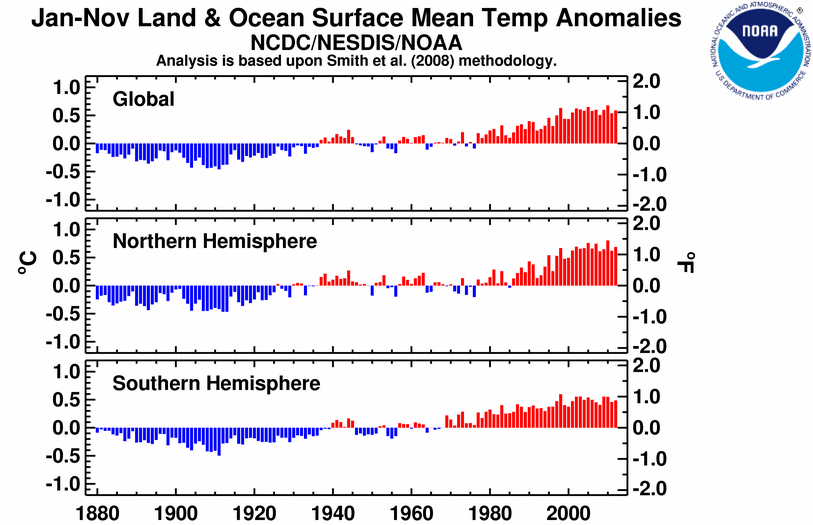
Last month, we had a popular post noting that people 27 years old or younger had never experienced a month of cooler-than-average global temperatures. A lot of people — presumably ones who lead such full, busy lives that they cannot click links and/or read past the first paragraph of an article — were quick to point out that where they lived (invariably somewhere in the northern expanses of Canada) it had in fact been very cold one winter, and that this personal, localized experience trumped 332 months of above-average global air and land temperatures because the world revolves around them.

Anyway, the point is: We’re up to 333 months.

The average November temperature across land and ocean surfaces around the world was 1.21°C (0.67°F) above the 20th century average, marking the fifth warmest November since records began in 1880. … Including this November, the 10 warmest Novembers have occurred in the past 12 years. The 10 coolest Novembers on record all occurred prior to 1920. November 2012 also marks the 36th consecutive November and 333rd consecutive month with global temperature higher than the long-term average. The last month with a below average temperature was February 1985, nearly 28 years ago.

333 months! Halfway to the apocalypse, one can only assume.

The map of variance from average temperatures is amazing. Not a single spot on Earth has seen record cold temperatures this year. Zero. But the U.S. and Europe and broad stretches of ocean have seen the warmest years ever recorded.

Click to embiggen.

And yet that’s still not enough to propel 2012 into position as the hottest year the world as a whole has ever seen. (But it will certainly end up as America’s hottest, as the map above suggests.) Through last month, this year is only the eighth-warmest in history.

Click to embiggen.

Each of the seven warmer years have occurred since 1998.

An important caveat: You will note that the map above is not uniformly red! That is because temperatures are different in different parts of the world. Maybe you can remember 10 Novembers warmer than this last one — that does not mean that the global average for November 2012 is the 11th-warmest! Your mileage may vary, as they say.

And another caveat: August 2040 will (possibly) be the 666th straight month with higher-than-average global temperatures (somewhat undermining the concept of average). The map for that month will likely be a pure splotch of red, as Earth will have been consumed by hellfire. Please prepare appropriately.

Source

State of the Climate, Global Analysis: November 2012, NOAA

Philip Bump writes about the news for Gristmill. He also uses Twitter a whole lot.

Read more:

Climate & Energy

Also in Grist

Please enable JavaScript to see recommended stories

More here: 

For the 36th November in a row, global temperatures were above average

Posted in GE, Uncategorized | Tagged , , , , , , , , , , , | Comments Off on For the 36th November in a row, global temperatures were above average

Global life expectancies increase as infectious diseases and hunger wane

Global life expectancies increase as infectious diseases and hunger wane

Across the world, people are living longer.

Which is good news, of course! Don’t want people dying. And the increase is due largely to improvements in public health programs and access to food. From The New York Times:

A sharp decline in deaths from malnutrition and infectious diseases like measles and tuberculosis has caused a shift in global mortality patterns over the past 20 years, according to a report published on Thursday, with far more of the world’s population now living into old age and dying from diseases mostly associated with rich countries, like cancer and heart disease.

The shift reflects improvements in sanitation, medical services and access to food throughout the developing world, as well as the success of broad public health efforts like vaccine programs. The results are striking: infant mortality declined by more than half from 1990 to 2010, and malnutrition, the No. 1 risk factor for death and years of life lost in 1990, has fallen to No. 8.

At the same time, chronic diseases like cancer now account for about two out of every three deaths worldwide, up from just over half in 1990. Eight million people died of cancer in 2010, 38 percent more than in 1990. Diabetes claimed 1.3 million lives in 2010, double the number in 1990.

julien_harneis

Distributing mosquito nets in the Congo.

As the Times notes, 33 percent of global deaths in 1990 were of people 70 or older. In 2010, that figure was 43 percent.

There are a few dark clouds, of course. Life expectancy in the United States didn’t grow as quickly as in other regions, though expectancy in New York City continues to outpace the rest of the country. Life expectancies in sub-Saharan Africa continue to lag behind the rest of the world, in part due to the spike of AIDS-related deaths over the last two decades. (See this graph comparing causes of death between 1990 and 2010.)

We have a GIF globe in the system, so I’m using it.

As the Telegraph notes, obesity is now responsible for more deaths than hunger in most of the world.

Across the world, there has been significant success in tackling malnutrition, with deaths down two-thirds since 1990 to less than a million by 2010.

But increasing prosperity has led to expanding waistlines in countries from Colombia to Kazakhstan, as people eat more and get less everyday exercise.

Dr Majid Ezzati, chair of global environmental health at Imperial College London, and one of the lead authors of the report, said: “We have gone from a world 20 years ago where people weren’t getting enough to eat to a world now where too much food and unhealthy food — even in developing countries — is making us sick.”

Which leads to another reason the news is a mixed blessing. Increased life expectancy of course means more people on the planet longer — as the world begins to see the increasingly stark effects of global warming on food production. This summer’s drought and its concomitant food shortages are a preview of what’s to come in other food-producing regions (like, say, Europe). The trend of people eating themselves into sickness can be combated with better education and food options. A trend of starvation due to scarcity is much tougher to fight. As is a trend of wider spread of infectious disease facilitated by warmer climates.

A few years ago, I attended an event at which Bill McKibben spoke. Something he said there has stayed with me: What if we are the peak of human civilization, at least for a few centuries? What if right now is as good as it gets? I’m a bit of a pessimist, but it’s easy to see how this life expectancy news might be something of an apex.

And now, to wash that taste out of your mouth, here is a tiny adorable puppy. May he live forever.

Philip Bump writes about the news for Gristmill. He also uses Twitter a whole lot.

Read more:

Climate & Energy

,

Living

Also in Grist

Please enable JavaScript to see recommended stories

Link to article:  

Global life expectancies increase as infectious diseases and hunger wane

Posted in GE, Uncategorized | Tagged , , , , , , , , , , , | Comments Off on Global life expectancies increase as infectious diseases and hunger wane

People aren’t connecting extreme weather to climate change — at least, not on Google

People aren’t connecting extreme weather to climate change — at least, not on Google

This morning, Google unveiled its “Zeitgeist 2012″ report, a look at what the world searched for over the past 12 months. (Well, over the past 11-and-a-third months, anyway.) The No. 1 trending thing people searched for was Whitney Houston, which: OK. But when it came to news events, the most captivating thing was Hurricane Sandy.

Which got us thinking: Did those searches for Sandy prompt more searches on climate change? And the answer is: yes, but not many.

Here’s what search traffic for “Hurricane Sandy” looked like over the course of the year, across the globe. (In all graphs, 100 represents the peak search volume.)
And, here, searches for “climate change” and “global warming.”

See that tiny little tick up at the end of October? Yeah, that’s correlated to Sandy.

The searches for “Hurricane Sandy” were, predictably, centered on the East Coast.

Interestingly, searches for “climate change” were centered in Australia …
… and those for “global warming” in Southeast Asia.
Australia, of course, was battered by floods, as was the Philippines. The only places in the United States that saw much traffic for either term were in the Northeast.

We also wondered if the drought caused any splash on Google. And it did, exactly when you’d have expected.
No doubt thanks to the size of the state’s cities, the searches were centered in Texas.
Google is as close as we can get to gauging the public’s thinking. What we learn, then, is that extreme weather events don’t prompt an immediate, online connection to climate change; or, at least, no connection to the desire to learn more about the issue.

And, if you’re wondering who’s searching for Grist?
Not nearly enough people.

Philip Bump writes about the news for Gristmill. He also uses Twitter a whole lot.

Read more:

Climate & Energy

Also in Grist

Please enable JavaScript to see recommended stories

Originally from:

People aren’t connecting extreme weather to climate change — at least, not on Google

Posted in GE, Uncategorized | Tagged , , , , , , , , , , , | Comments Off on People aren’t connecting extreme weather to climate change — at least, not on Google

Your local beach may be getting slightly cleaner, or maybe not

Your local beach may be getting slightly cleaner, or maybe not

Dehk

Just in time for summer (in Australia), the EPA released new water quality standards for beaches yesterday.

The new guidelines lower the allowable levels of Enterococci and E. coli bacteria — if states choose to participate. From the Los Angeles Times:

The new guidelines, which update standards issued in 1986, may not immediately mean safer beaches and coastal waters. States have the authority to set their own water quality standards.

But federal environmental officials said they hoped the suggested guidance would prompt state leaders to toughen their own oversight of recreational waters where people swim, surf and go boating. California is among the states that may tighten standards. …

The tougher guidelines are expected to keep illnesses down to 32 per 1,000 people, compared with 36 illnesses for the lower standard, the agency said.

So, in short: If states apply the new guidelines, it will potentially reduce illness by about 11 percent. That’s … a little underwhelming? Come on, EPA, Obama won reelection. This is the moment to be bold!

According to the Times, the Natural Resources Defense Council is similarly unimpressed.

“It’s an odd approach,” said Steve Fleischli, the council’s director of water programs.

Fleischli said the two standards could perpetuate inconsistencies between states that adopt the tougher guidelines and those that opt for the more lenient ones.

The NRDC produces an annual report listing the dirtiest beaches in America, which is always a disconcerting read. In its report released this past June, outlining water quality in 2011, the organization found that Delaware and New Hampshire — those oceanside favorites — had the lowest levels of pollution. The most polluted water in 2011 was found in Louisiana — but we’re sure the state will jump at the optional chance to crack down on water pollution.

There is one group that will be pleased about the update: those four people out of 1,000 who don’t become sick because their state chose to allow only a lower level of E. coli at their favorite swimming hole. Yaayyy.

Philip Bump writes about the news for Gristmill. He also uses Twitter a whole lot.

Read more:

Living

,

Politics

Also in Grist

Please enable JavaScript to see recommended stories

View this article: 

Your local beach may be getting slightly cleaner, or maybe not

Posted in GE, Uncategorized | Tagged , , , , , , , , | Comments Off on Your local beach may be getting slightly cleaner, or maybe not

Modern-day Robin Hoods: Stealing construction supplies from the rich to give to the Sandy-hit poor

Modern-day Robin Hoods: Stealing construction supplies from the rich to give to the Sandy-hit poor

Superstorm Sandy not only revealed the massive class divisions in New York City, but also made them worse. As wealthier areas in Manhattan recover, poor and working-class communities in Brooklyn, Queens, and Staten Island are still struggling.

Some New Yorkers have taken a decidedly illegal tack to solving this problem. From their press release:

Over the past two weeks, a group of concerned New Yorkers has been expropriating thousands of dollars worth of tools and materials from luxury residential developments across Manhattan and delivering them to neighborhoods devastated by Superstorm Sandy.

The confiscated materials, some of them never even used, include: shovels, wheelbarrows, hand trucks, pry bars, tarps, buckets, hard bristle brooms, industrial rope, contractor trash bags, particulate masks, work lights, work gloves, flashlights, heat lamps, and gasoline.

Liberated from their role in building multimillion-dollar pieds-à-terre for wealthy CEOs and Hollywood celebrities, these tools are now in the collective hands of some of the hardest-hit communities in the city where they are now being allocated and shared among the people who need them most. These expropriations will continue as long as the demand for them exists.

The project — can I call it a project? — has far bigger ambitions than just wheelbarrows.

Here is New York: a city in which people write rent checks by candlelight, huddle around gas ovens for warmth, and are housed in shelters that are literally prisons — this is a city in which the darkness and misery are indeed all too literal. Luxury up front, desolation behind: this New York is but a cruel Dickensian reboot of a city.

A cold winter is nearly upon us. In the coming days, Bloomberg will doubtless be seen doling out turkeys and vague promises at any variety of overflowing city shelters while the shutters snap away. As the rich and powerful ladle out their meager scraps and twist their faces into caring regard, those of us who envision a better world will be out in the streets, maneuvering in the dark, trying.

Another world is possible, but capital’s scraps won’t get us through this holiday season, let alone the long, hot future ahead.

Susie Cagle writes and draws news for Grist. She also writes and draws tweets for

Twitter

.

Read more:

Living

,

Politics

Also in Grist

Please enable JavaScript to see recommended stories

Link:  

Modern-day Robin Hoods: Stealing construction supplies from the rich to give to the Sandy-hit poor

Posted in GE, oven, Uncategorized | Tagged , , , , , , , , , , | Comments Off on Modern-day Robin Hoods: Stealing construction supplies from the rich to give to the Sandy-hit poor