Tag Archives: plant

A Warming Climate Is Turning the Arctic Green

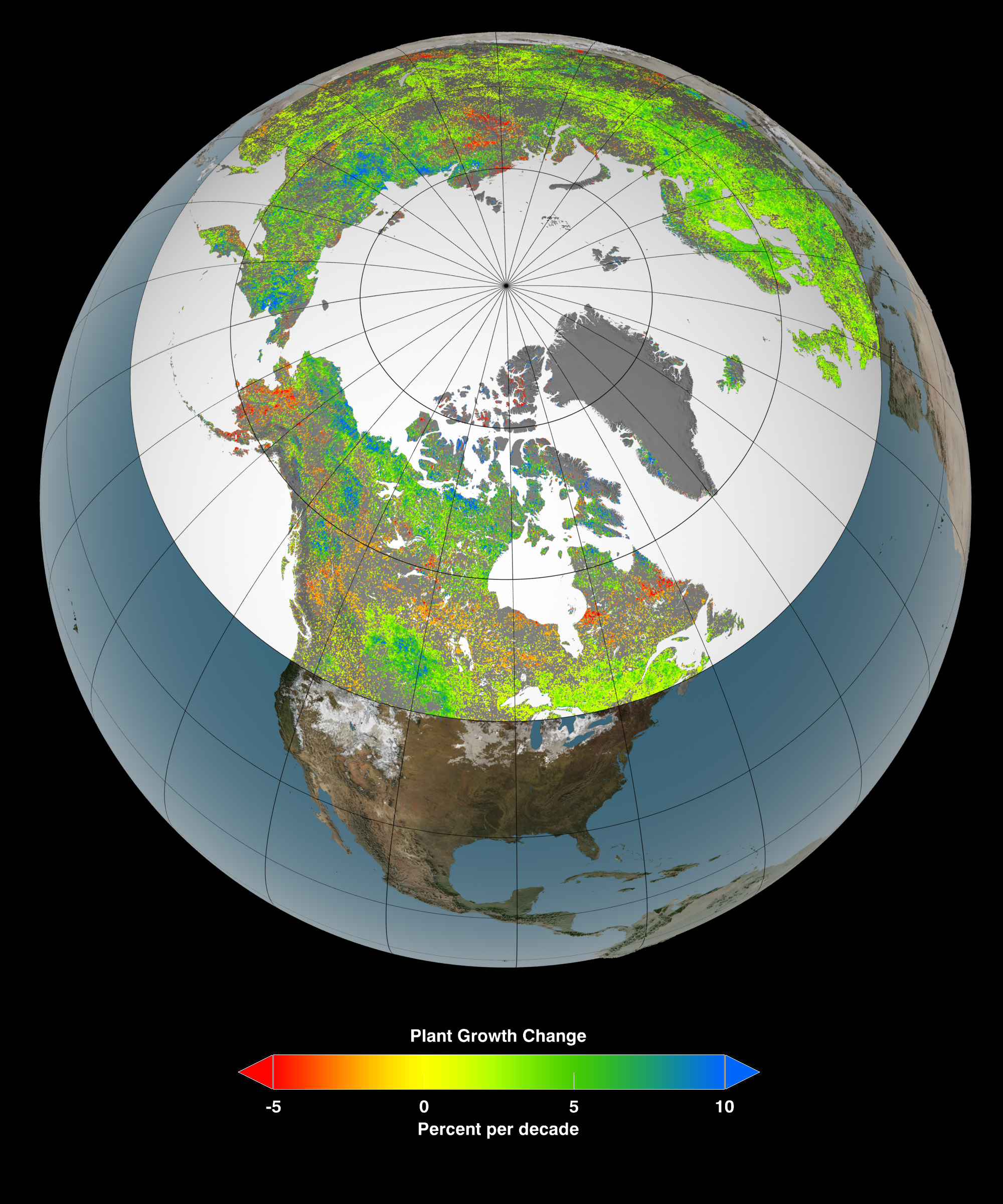
A map showing increasing (blue) and decreasing (red) plant growth over the past 30 years. Photo: NASA’s Goddard Space Flight Center Scientific Visualization Studio

The further you get from the equator, the greater difference there is between summer and winter temperatures. It’s not just the cold or the heat that makes the most extreme environments so hostile, but this “seasonality” in the temperature—the range of conditions to which plants and animals living in these areas can be subjected. A thick layer of fat and a heavy coat of fur can keep you warm in winter, but the same insulation can be dangerous if the summer heat is too high.

But, with global climate change, says a new study, that temperature seasonality is going down. And satellite records and other observations from the past 30 years, says NASA, show that this change in temperature seasonality is already affecting plant growth in higher latitudes. Higher temperatures and longer growing season mean that large portions of the Arctic, subarctic and temperate ecosystems are seeing more plant growth than they did in the past.

In practice, that means the Arctic is turning green. NASA:

The Arctic’s greenness is visible on the ground as an increasing abundance of tall shrubs and trees in locations all over the circumpolar Arctic. Greening in the adjacent boreal areas is more pronounced in Eurasia than in North America.

So far, the effect has been only a small shift in vegetation patterns, with plant growth in one location mimicking how it was 30 years ago in a location five degrees latitude to the south. By the end of the century, however, scientists think that the changes will be equivalent to a 20 degree shift. Think Alaska’s capital Juneau, at 58 °North, acting more like Louisville, Kentucky, at 38 °North.

However, rising temperatures aren’t the only thing to take into account, and the other effects of climate change could actually hurt the increasingly lush Arctic.

Researchers note that plant growth in the north may not continue on its current trajectory. The ramifications of an amplified greenhouse effect, such as frequent forest fires, outbreak of pest infestations and summertime droughts, may slow plant growth.

And, if a nice green Arctic sounds like a pleasant consequence of climate change, just try to imagine what a 20 degree shift in climate would do to somewhere further south.

More from Smithsonian.com:

Arctic Dispatch: Thermokarst and Toolik
The Arctic Is Running Out of Snow Even Faster Than It’s Running Out of Ice

Continue reading – 

A Warming Climate Is Turning the Arctic Green

Posted in GE, Uncategorized | Tagged , , , , , , , | Comments Off on A Warming Climate Is Turning the Arctic Green

Carbon dioxide levels made a big, scary jump in 2012

Carbon dioxide levels made a big, scary jump in 2012

Shutterstock

/ Galyna AndrushkoNOAA’s carbon dioxide measurements are taken at Mauna Loa, Hawaii.

Atmospheric carbon dioxide levels rose to just under 395 parts per million last year, according to new figures from the National Oceanic and Atmospheric Administration. Compare that to the 350 ppm target that many climate scientists and activists say we need to get down to — activists like those at, yes, 350.org.

Global CO2 levels last year jumped by 2.67 parts per million, which might not sound like a dramatic leap, but it’s the second highest one-year increase since record-keeping began in 1959, surpassed only by the 1998 spike of 2.93 ppm.

From the Associated Press:

In 2009, the world’s nations agreed on a voluntary goal of limiting global warming to 3.6 degrees Fahrenheit [2 degrees Celsius] over pre-industrial temperature levels. Since the mid-1800s temperatures have already risen about 1.5 degrees. Current pollution trends translate to another 2.5 to 4.5 degrees of warming within the next several decades, [says John Reilly of MIT’s Joint Program on the Science and Policy of Global Change].

“The prospects of keeping climate change below that [3.6 degree F goal] are fading away,” [NOAA’s Pieter] Tans says.

Why are greenhouse gas levels rising so quickly? From the same article:

More coal-burning power plants, especially in the developing world, are the main reason emissions keep going up — even as they have declined in the U.S. and other places, in part through conservation and cleaner energy.

At the same time, plants and the world’s oceans, which normally absorb some carbon dioxide, last year took in less than they do on average, says [Reilly]. Plant and ocean absorption of carbon varies naturally year to year.

But, Tans tells The Associated Press the major factor is ever-rising fossil fuel burning: “It’s just a testament to human influence being dominant.”

Hurrah for dominance. Maybe now let’s use that dominance to do some actual good?

John Upton is a science aficionado and green news junkie who

tweets

, posts articles to

Facebook

, and

blogs about ecology

. He welcomes reader questions, tips, and incoherent rants:

johnupton@gmail.com

.

Read more:

Climate & Energy

Also in Grist

Please enable JavaScript to see recommended stories

Read more – 

Carbon dioxide levels made a big, scary jump in 2012

Posted in alo, ALPHA, Amana, G & F, GE, LG, Uncategorized | Tagged , , , , , , , , , , , | Comments Off on Carbon dioxide levels made a big, scary jump in 2012

Week in the News: Exciting Progress in Producing Renewable Fuel from Plant Residue, Wood Scraps

Week in the News: Exciting Progress in Producing Renewable Fuel from Plant Residue, Wood Scraps

Posted 1 February 2013 in

National

The week may be over, but February’s just begun! Here are this week’s top stories in renewable fuel:

The Associated Press covers the exciting progress the renewable fuel industry has made toward commercial production of fuels made from plant residue, wood scraps or garbage.
A piece in AOL Energy debunks five myths about renewable fuel.
Jeff Lautt, CEO of POET, writes an op-ed in The Argus Leader on the real truths about ethanol.
The oil lobby released a new study, falsely claiming that 15 percent ethanol blends damage car engines, and the Renewable Fuels Association offered a detailed rebuttal.
Researchers at the University of Minnesota’s BioTechnology Institute have “developed a technique to ‘trick’ common iron-eating bacteria into capturing electrons” as part of a process to create renewable fuel.

That’s all for now – have a happy Friday!

Back to Blog Home
Share:

Join the Fight

Renewable fuel is more important than ever – driving economic growth in communities that need it, improving our nation’s energy security and attracting millions in new technology dollars to invest in America’s future.

Pledge to Support Renewable Fuel

Fuels
Originally posted here – 

Week in the News: Exciting Progress in Producing Renewable Fuel from Plant Residue, Wood Scraps

Posted in Anchor, ATTRA, G & F, GE, Uncategorized | Tagged , , , , , , , , , | Comments Off on Week in the News: Exciting Progress in Producing Renewable Fuel from Plant Residue, Wood Scraps

Crying Fowl on the Chicken Council

Crying Fowl on the Chicken Council

Posted 24 January 2013 in

National

Big Food is running in circles to rehash old – and incorrect – claims about renewable fuel.

This time, it’s the National Chicken Council trying to scare football fans about the supply of chicken wings, and it’s déjà vu all over again: the industry repeatedly ignores the true drivers of food costs.

Despite the Chicken Council’s claims, the poultry industry hardly seems to be cutting back on feed and animal production.

According to market analysts, USDA estimates show more corn going to livestock and poultry feed, implying “that livestock and poultry producers used up more corn than earlier expected.” And, the same analysts noted, producers “do not seem to be cutting back but rather are increasing animal numbers” and animal weights.

Perhaps one reason is that far less of the corn crop is used in creating renewable fuel than the Chicken Council claims. Ethanol is produced from a different type of corn than the crop that people eat. This field corn, fed to livestock, delivers two beneficial products – the ethanol itself from the starch portion of the kernel – and the remaining part of the plant, with nutritious fiber, protein and more, is turned into valuable livestock feed.

(That feed, a beneficial co-product of creating renewable fuel, is increasingly being used by the poultry industry itself, because it packs more energy and protein than other feed sources.) When you look at both products, only 17% of the net corn crop goes to ethanol.

And it’s important to remember, the majority of food costs, nearly 84%, come from non-farm costs like marketing and energy costs. In fact oil prices ultimately drive food prices.

Whether you are rooting for the Ravens or the 49ers, Americans can enjoy their favorite food and the benefits of renewable fuel. The chicken lobby, meanwhile, should keep its eye on the ball and leave fans to enjoy the game.

Back to Blog Home
Share:

Join the Fight

Renewable fuel is more important than ever – driving economic growth in communities that need it, improving our nation’s energy security and attracting millions in new technology dollars to invest in America’s future.

Pledge to Support Renewable Fuel

Fuels
Original post:  

Crying Fowl on the Chicken Council

Posted in Anchor, ATTRA, GE, Uncategorized | Tagged , , , , , , , | Comments Off on Crying Fowl on the Chicken Council

Too much carbon dioxide can have a negative effect on some crops

Too much carbon dioxide can have a negative effect on some crops

Here is a thing dumb people say about carbon dioxide pollution:

lol carbon dioxide isn’t bad for you I totally exhale it and stuff. Also, plants need it to eat I read somewhere, and I hypocritically rely on that bit of science as a counterpoint to your asking that I stop burning tires in my toilet

Here is something you can say in response to such people, if you want to keep talking to them, which you should not: Too much carbon dioxide is bad for plants, too.

From the Max Planck Institute:

[T]he more carbon dioxide the better? The equation is unfortunately not as simple as that. The plants, which ensure our basic food supply today, have not been bred for vertical growth but for short stalks and high grain yields. Scientists from the Max Planck Institute of Molecular Plant Physiology and the University of Potsdam have now discovered that an increase in carbon dioxide levels could cancel out the beneficial effects of dwarf varieties.

IRRI

The story, in short: A variety of rice known as IR8 (pictured above) was bred to have a shorter stalk, allowing it to use its nutrients to produce more rice, and then to better bear that rice’s weight. According to the institute, “Plants like IR8 succeeded in protecting humanity against global famine and were hailed as part of the ‘Green Revolution’ in agriculture.” Unfortunately, increased CO2 levels have blunted the strain’s positive effects:

Although nothing has changed in the genetic makeup of the IR8 rice plant in the past 50 years, its yields have declined continuously. The researchers working with Bernd Müller-Röber from the Max Planck Institute of Molecular Plant Physiology and the University of Potsdam therefore wanted to find out whether this development was possibly linked with the global increase in atmospheric carbon dioxide levels. After all, the current concentration of the greenhouse gas in the atmosphere is 25 percent higher than in the 1960s.

… [R]esearchers were able to observe that a higher carbon dioxide concentration results in the unblocking of the capacity of dwarf plant to form gibberellic acid. The carbon dioxide appears to have the same growth-stimulating effect as that triggered by the gibberellic acid. Thus, in the experiment, the dwarf plants gradually lost their advantage and increasingly resembled the control plants.

So, yes, plants need carbon dioxide. But the lesson we should learn from this experiment is the one we should have learned about the atmosphere: You can have far, far too much of a good thing.

But by the time you explain all of this, the dumb person to whom you were explaining it has probably gone off somewhere to win a Darwin Award. All this preparation, for naught.

Source

Carbon dioxide could reduce crop yields, Max Planck Institute of Molecular Plant Physiology

Philip Bump writes about the news for Gristmill. He also uses Twitter a whole lot.

Read more:

Climate & Energy

,

Food

Also in Grist

Please enable JavaScript to see recommended stories

Link – 

Too much carbon dioxide can have a negative effect on some crops

Posted in GE, Uncategorized | Tagged , , , , , , , , , | Comments Off on Too much carbon dioxide can have a negative effect on some crops