Tag Archives: united

With Alexandria Ocasio-Cortez’s victory, Congress will likely gain a new climate champion

On Tuesday night, 28-year-old Alexandria Ocasio-Cortez toppled a 10-term Congressman from New York City in a landslide Democratic primary victory. The shocking result virtually assures that the U.S. Congress will welcome its youngest female member ever next year.

The upset win also essentially guarantees that Ocasio-Cortez will bring with her the boldest climate platform of any representative in history.

Ocasio-Cortez, who was without a Wikipedia page on Monday, unseated Joe Crowley, the 20-year representative of New York’s 14th Congressional District who was vying to become the next Speaker of the House. The New York Times, her hometown newspaper, didn’t even cover the race. CNN called the victory “a real wakeup call for Democrats.”

Ocasio-Cortez said her triumph was “the start of a movement.” As a millennial woman of color, she’s already been referred to as the future of the Democratic Party.

Since her district, which comprises parts of Queens and the Bronx, is among the most strongly Democratic in the country, the general election in November likely will not be competitive. Pending the results of other elections across the country, Ocasio-Cortez seems almost certain to join Vermont Senator Bernie Sanders as one of the few socialists ever elected to Congress.

Among her many progressive bona fides, it’s really her plan for tackling climate change that deserves the most attention.

In one of her first campaign tweets on the topic of climate change, more than one year ago, Ocasio-Cortez framed the issue as an “existential threat” — one that young people should be taking the lead on.

Ocasio-Cortez is one of the first American politicians to put forward a climate change plan that would keep global warming below 1.5 degrees Celsius.

To meet that goal while leaving space for developing countries to move at a slower pace, independent assessments suggest that the United States needs to reduce its emissions by approximately 75 to 125 percent or more — actually drawing carbon dioxide out of the air — by 2035. Ocasio-Cortez hopes to move the entire country to 100 percent renewable energy by 2035. Even Bernie Sanders’ climate plan didn’t set such an ambitious goal.

The crash carbon diet would require “the complete mobilization of the American workforce to combat climate change,” as Ocasio-Cortez told HuffPost reporter Alexander Kaufman.

On her campaign’s website, she summarizes the danger that climate change poses to the planet:

Climate change is the single biggest national security threat for the United States and the single biggest threat to worldwide industrialized civilization, and the effects of warming can be hard to predict and self-reinforcing. We need to avoid a worldwide refugee crisis by waging a war for climate justice through the mobilization of our population and our government. This starts with the United States being a leader on the actions we take both globally and locally.

According to Ocasio-Cortez, such an effort would cost “trillions of dollars,” but would “not only save our planet from the ravages of climate change but would also lift millions of Americans out of poverty.”

It’s an audacious plan that’s easy to dismiss as wishful thinking. But last night’s results just brought Ocasio-Cortez’s vision a step closer to reality.

Read the article: 

With Alexandria Ocasio-Cortez’s victory, Congress will likely gain a new climate champion

Posted in alo, ALPHA, Anchor, Casio, FF, GE, LG, ONA, Uncategorized | Tagged , , , , , , , , , | Comments Off on With Alexandria Ocasio-Cortez’s victory, Congress will likely gain a new climate champion

Don’t tell Trump, but meeting with North Korea could help environment

You might have heard that Donald Trump and Kim Jong-un had a strange, historic meeting this weekend in Singapore, leading pundits to furiously analyze a resulting joint statement for hints about the future of North Korean denuclearization and U.S. sanctions. But there was one overlooked issue that could have surprising consequences: the summit’s potential impact on the environment and climate change.

A thawing of relations between North Korea and the U.S. could open up opportunities for more research and environmental support. North Korea’s participation in the Paris climate agreement is at least partly due to a desire for access to the United Nations Framework Convention on Climate Change’s agricultural and energy know-how. And the U.S. summit could mark the start of more ecological and technical exchange with the “hermit kingdom.”

“North Korea has a direct existential reason for wanting to address issues of environmental degradation,” says Benjamin Habib, lecturer in international relations at La Trobe University in Melbourne, Australia. Since the mid-1990s, North Korea has endured decades of drought, flooding, and deforestation, at times pushing people in the famine-vulnerable nation to starvation.

Due to poor agricultural techniques and limited sources of fuel — some trucks in the country actually run on wood — North Korea has lost over 25 percent of its forest cover. And in 2016 alone, flooding from Typhoon Lionrock displaced tens of thousands of its citizens.

After Syria’s entry into the Paris agreement in late 2017, the U.S. remains the only country on Earth not in the climate accord. Even North Korea — with its prison camps, rogue nuclear testing, and authoritarian propaganda — has pledged to reduce its CO2 emissions to support global climate goals. Last June, North Korea’s Ministry of Foreign Affairs critiqued Trump for backing out of the agreement, calling it a “silly decision.”

Habib argues that the fight against deforestation can serve as a less-politicized common interest for North Korea, South Korea, and the U.S. to unite behind. “The political window of opportunity is now open for environmental capacity-building in a way that it wasn’t before,” he says.

Of course, the future of U.S./North Korea diplomacy is far from certain, thanks to two wildly unpredictable leaders. And North Korea is sitting on more than 100 billion tons of coal. If sanctions are lifted, those reserves could be sold on the world market, with deleterious effects for the global climate. (China used to buy coal from North Korea but suspended those imports last year over the country’s nuclear testing.)

But still, a meeting between two historically narcissistic world leaders might net a positive effect on environmental outcomes? We’ll take what we can get, 2018.

Continue reading here:

Don’t tell Trump, but meeting with North Korea could help environment

Posted in alo, ALPHA, Anchor, Citizen, FF, GE, LG, ONA, Uncategorized | Tagged , , , , , , , , , , | Comments Off on Don’t tell Trump, but meeting with North Korea could help environment

The Very Best Online Shops for Zero Waste Goodies

According to World Bank researchers, the world generates more than 3.5 million tones of solid waste each day, with the United States contributing a whopping 4.4 pounds of trash per person per day.?In response, many people are embracing a modern, trash-free lifestyle as part of the zero waste movement ? myself included.

The benefits are numerous. Taking trash out of your life entirely has a number of distinct health benefits, both immediate and long term. Zero wasters are also?generally in less contact with plastics, avoid processed foods?and quit using conventional cosmetics that would otherwise wreak havoc on?their bodies.

Instead, the “zero waster” takes reusable bags to the grocery store, stashes bulk goods in glass jars, replaces dangerous toiletry items like conventional deodorant with homemade versions?and uses a safety razor (if anything) instead of a disposable Gillette. Zero wasters also seek out natural, recyclable materials ? the standouts being stainless steel, glass, bamboo and organic cotton.

Sustainable products?like this, while commonplace just 100 years ago, have been majorly replaced by unrecycleable synthetics in most stores (walk down the household cleaning aisle in Walmart and you’ll be hard pressed to find a wooden pot scrubber like this one), which is why zero wasters who don’t have major-city advantages turn to online shops to find what they need.

What makes these shops zero waste?

Zero waste shops like Wild Minimalist and Tiny Yellow Bungalow offer eco goodies to worldwide customers while also maintaining as close to zero waste operations as possible. Package Free Shop in Brooklyn, for example, has a strict packaging policy and works one on one with brands to help them make sustainable changes within their companies, such as reducing plastic use or product packaging.

What products should I buy first?

While most zero wasters would recommend working with what you have, there are a few items?you’ll want to buy if you?plan on pursuing?a zero waste lifestyle. Here’s a quick starter list:

A couple of tote bags
Reusable drawstring bags for produce and bulk goods
A set of storage jars for?your pantry
A reusable cutlery set or multipurpose utensil for while you’re out and about
A hankie or cloth napkin
A reusable glass or steel straw
A lunchbox

Got your shopping list? Let’s take a peek at my favorite online zero waste shops: Package Free Shop, Wild Minimalist, Tiny Yellow Bungalow, Life Without Plastic, Mighty Nest and The Ultimate Green Store.

The Best Zero Waste Shops Online

Package Free Shop

Ever chic, Brooklyn-based Package Free Shop is a great place to start browsing for your collection of eco-friendly reusables. Everything you need you’ll find here, including safety razors, personal care items, toiletries, reusable containers and even joggers made from fabric remnants! Everything shipped will come to you without any plastics.

Wild Minimalist

“Passionate about living a minimal, zero waste lifestyle and helping others do the same,” the founders of Wild Minimalist, Max and Lily, offer timeliness reusable alternatives to disposable products for both home life and travel. Can’t find what you need secondhand? Definitely look?here! There’s tons to choose from.

Tiny Yellow Bungalow

Georgia-based Tiny Yellow Bungalow is a one stop shop for people looking for sustainable products. The shop exclusively features items that the owner, Jessie at the blog Tiny Yellow Bungalow, has tried herself. I especially love their Mason jar pour-over drink kit and handmade items!

Life Without Plastic

Life Without Plastic has been a go-to resource for zero wasters for years ? long before it was gaining popularity. All products are entirely plastic free, so no worries there, and have been well-vetted by their team of eco warriors. Chantal and Jay, the couple that runs the site, are also true activists, working hard to raise awareness about the detriments of plastic by providing solid science- and experience-based information. Love it!

Mighty Nest

Inspired by the birth of their first child, founders Kristen and Chris launched?MightyNest.com ? an online shop dedicated to helping parents find?safe, healthy products for their families. All products on MightyNest are natural, organic, non-toxic, sustainably-sourced and beautifully-designed. Perfect for young families!

The Ultimate Green Store

The Ultimate Green Store is exactly what it sounds like: a one-stop green shopping destination. The Ultimate Green Store goes far beyond household items and to-go kits. They also sell USDA-certified organic cotton bedding, mattresses, baby clothes, and kids toys! This is certainly a shop to bookmark.

Have you tried going zero waste? Where do you do your shopping?

Disclaimer: The views expressed above are solely those of the author and may not reflect those of Care2, Inc., its employees or advertisers.

More – 

The Very Best Online Shops for Zero Waste Goodies

Posted in alo, bamboo, bigo, eco-friendly, FF, G & F, GE, LAI, LG, ONA, organic, PUR, Ultima, Uncategorized | Tagged , , , , , , , , , , | Comments Off on The Very Best Online Shops for Zero Waste Goodies

This natural gas plant could be a big breakthrough

Yesterday, the startup Net Power switched on its 50-megawatt power plant, proving it could burn natural gas without releasing greenhouse gases. If this technology works at scale, it could be the flexible, emissions-free lynchpin the world needs to reverse climate change.

That’s a big “if” of course. After the engineering challenge comes the market challenge: We could make a laundry list of promising energy sources that launch to great excitement, then struggle for years to compete against the incumbent technologies (see cellulosic ethanol).

Net Power captures the carbon dioxide given off as gas burns. That’s the same thing done by carbon capture and sequestration plants already in existence. But the crucial difference here is that carbon capture and sequestration usually uses a lot of energy (and money) to separate the carbon molecules out of all the other gases and particles in a plant’s exhaust.

Net Power uses an elegant trick to simplify the process (David Roberts explains the basics here) so that its exhaust is nearly pure carbon dioxide, which it can capture in its entirety. And the company says it can do all that while operating more cheaply than the best existing gas plants.

The next step? The company is in the process of developing a 300-megawatt plant, which would start providing electricity by 2021 at the earliest.

As the United States has built solar panels and wind turbines, natural gas has expanded even more. The fuel’s ability to cheaply ramp up and down with fluctuations in electric supply and demand have made it an apt partner for renewable energy. If it could do that without adding insulation to the Earth’s heat-trapping jacket, it would provide us a much-needed reprieve.

Original source – 

This natural gas plant could be a big breakthrough

Posted in alo, ALPHA, Anchor, FF, GE, LAI, ONA, PUR, solar, solar panels, Uncategorized | Tagged , , , , , , , , , , | Comments Off on This natural gas plant could be a big breakthrough

Republican mayors push climate action without saying ‘climate change’

Leadership in addressing climate change in the United States has shifted away from Washington, D.C. Cities across the country are organizing, networking, and sharing resources to reduce their greenhouse gas emissions and tackle related challenges ranging from air pollution to heat island effects.

But group photos at climate change summits typically feature big-city Democratic mayors rubbing shoulders. Republicans are rarer, with a few notable exceptions, such as Kevin Faulconer of San Diego and James Brainard of Carmel, Indiana.

Faulconer co-chairs the Sierra Club’s Mayors for 100 Percent Clean Energy Initiative, which rallies mayors around a shared commitment to power their cities entirely with clean and renewable energy. Brainard is a longtime champion of the issue within the U.S. Conference of Mayors and the Climate Mayors network.

In our research at the Boston University Initiative on Cities, we found that large-city Republican mayors shy away from climate network memberships and their associated framing of the problem. But in many cases they advocate locally for policies that help advance climate goals for other reasons, such as fiscal responsibility and public health. In short, the United States is making progress on this issue in some surprising places.

Climate network members are mainly Democrats

In our initiative’s recent report, “Cities Joining Ranks,” we systematically reviewed which U.S. cities belong to 10 prominent city climate networks. These networks, often founded by mayors themselves, provide platforms to exchange information, advocate for urban priorities and strengthen city goverments’ technical capacities.

The networks we assessed included Climate Mayors; We Are Still In, which represents organizations that continue to support action to meet the targets in the Paris climate agreement; and ICLEI USA.

We found a clear partisan divide between Republican and Democrat mayors. On average, Republican-led cities with more than 75,000 residents belong to less than one climate network. In contrast, cities with Democratic mayors belonged to an average of four networks. Among the 100 largest U.S. cities, of which 29 have Republican mayors and 63 have Democrats, Democrat-led cities are more than four times more likely to belong to at least one climate network.

This split has implications for city-level climate action. Joining these networks sends a very public signal to constituents about the importance of safeguarding the environment, transitioning to cleaner forms of energy, and addressing climate change. Some networks require cities to plan for or implement specific greenhouse gas reduction targets and report on their progress, which means that mayors can be held accountable.

Constituents in Republican-led cities support climate policies

Cities can also reduce their carbon footprints and stay under the radar — a strategy that is popular with Republican mayors. Taking the findings of the “Cities Joining Ranks” report as a starting point, I explored support for climate policies in Republican-led cities and the level of ambition and transparency in their climate plans.

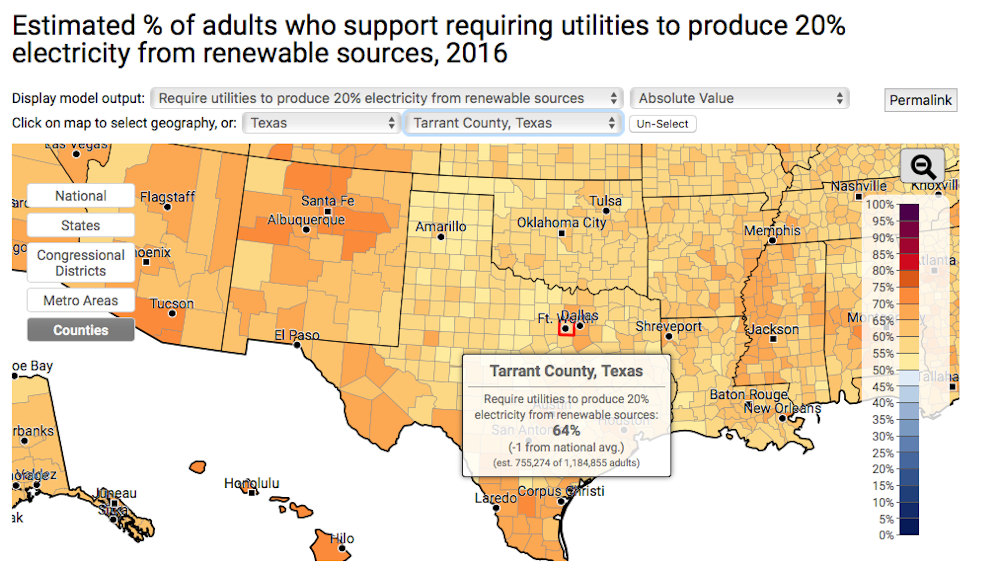
To tackle these questions, I cross-referenced Republican-led cities with data from the Yale Climate Opinion maps, which provide insight into county-level support for four climate policies:

Regulating carbon dioxide as a pollutant
Imposing strict carbon dioxide emission limits on existing coal-fired power plants
Funding research into renewable energy sources
Requiring utilities to produce 20 percent of their electricity from renewable sources

In all of the 10 largest U.S. cities that have Republican mayors and also voted Republican in the 2008 presidential election, county-level polling data showed majority support for all four climate policies. Examples included Jacksonville, Florida, and Fort Worth, Texas. None of these cities participated in any of the 10 climate networks that we reviewed in our report.

Yale Program on Climate Change Communication, CC BY-ND

This finding suggests that popular support exists for action on climate change, and that residents of these cities who advocate acting could lobby their elected officials to join climate networks. Indeed, we have found that one of the top three reasons mayors join city policy networks is because it signals their priorities. A mayor of a medium-sized West Coast city told us: “Your constituents are expecting you to represent them, so we are trying politically to be their voice.”

Mayors join networks to amplify their message, signal priorities to constituents, and share information. BU Initiative on Cities, CC BY-ND.

Climate-friendly strategies, but few emissions targets

Next, I reviewed planning documents from the 29 largest U.S. cities that are led by Republican mayors. Among this group, 15 have developed or are developing concrete goals that guide their efforts to improve local environmental quality. Many of these actions reduce cities’ carbon footprints, although they are not primarily framed that way.

Rather, these cities most frequently cast targets for achieving energy savings and curbing local air pollution as part of their master plans. Some package them as part of dedicated sustainability strategies.

These agendas often evoke images of disrupted ecosystems that need to be conserved, or that endanger human health and quality of life. Some also spotlight cost savings from designing infrastructure to cope with more extreme weather events.

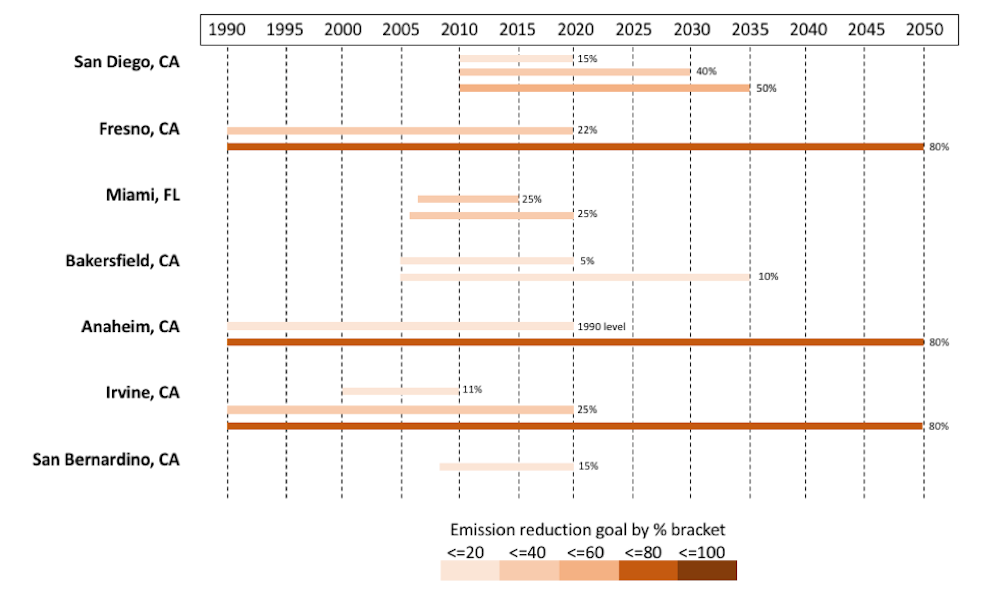
In contrast, only seven cities in this group had developed quantitative greenhouse gas reduction targets. Except for Miami, all of them are in California, which requires its cities to align their greenhouse gas reduction targets with state plans. From planning documents, it appears that none of the six Californian cities goes far beyond minimum mandated emission reductions set by the state for 2020.

Greenhouse gas reductions goals, with baselines, for the seven largest Republican-led cities. Nicolas Gunkel, CC BY-ND.

Watch what they do, not what they say

The real measure of Republican mayors taking action on climate change is not the number of networks they join but the policy steps they take, often quietly, at home. While few Republican mayors may attend the next round of subnational climate summits, many have set out policy agendas that mitigate climate change, without calling a lot of attention to it — much like a number of rural U.S. communities. Focusing narrowly on policy labels and public commitments by mayors fails to capture the various forms of local climate action, especially in GOP-led cities.

Carmel, Indiana Mayor James Brainard has suggested that some of his less-outspoken counterparts may fear a backlash from conservative opinion-makers. “There is a lot of Republicans out there that think like I do. They have been intimidated, to some extent, by the Tea Party and the conservative talk show hosts,” Brainard has said.

Indeed, studies show that the news environment has become increasingly polarized around accepting or denying climate science. Avoiding explicit mention of climate change is enabling a sizable number of big-city GOP mayors to pursue policies that advance climate goals.

See the original post:  

Republican mayors push climate action without saying ‘climate change’

Posted in alo, ALPHA, Anchor, FF, GE, LG, ONA, PUR, solar, Uncategorized | Tagged , , , , , , , , , | Comments Off on Republican mayors push climate action without saying ‘climate change’

New documentaries bring climate change to the big screen

Grist traveled to the tiny mountain town of Telluride, Colorado, to see some of the most talked-about environmental and climate change-related documentaries on the film-festival circuit. The films take on the challenge of addressing migration — both of humans and animals around the world — as well as the startling realities of communities facing climate change and environmental degradation today.

In all, there were more than 150 movies and shorts featured during the long weekend, but here’s the lowdown on a few noteworthy films.

Anote’s Ark

If you type “Kiribati” into Google Maps, it takes a while and requires multiple zooms to find it. That exercise is somewhat symbolic because the tiny Pacific island is literally trying to keep itself on the map. Rising sea levels are quickly drowning the home to almost 115,000 people.

Anote’s Ark


Courtesy of Mountainfilm

Anote’s Ark follows Kiribati’s former president, Anote Tong, and his frantic attempt to save the land for his people. A perfect example of how poorer nations are more likely to feel the brunt of climate change and extreme weather, the film effectively illustrates the heartbreak of losing one’s home to the ocean — as well as the staggering challenge of relocating an entire country’s population.

While the film is a powerful portrayal of how climate change is impacting communities right now, its various storylines don’t quite connect. The documentary also leaves viewers fairly hopeless — which is true of most films dealing with climate change. But for us at Grist, we’re all about holding out hope.

Story continues below

The Human Element

Tangier Island, off the coast of Virginia, is drowning amid rising sea levels. A school in Denver caters exclusively to students with health issues, specifically asthma caused by air pollution. These are two of the examples of how climate change is already impacting Americans that form the theme of James Balog’s (Chasing Ice) latest work, The Human Element.

Balog uses the four elements — air, earth, fire, and water — to frame how we look at the impact of humans on our climate. In addition to the plight of Tangier and the air pollution in the Mile High city, he follows forest firefighters in California and takes a trip back to the coal mines in Pennsylvania that killed his grandfather.

The dramatic realities of climate change are, well, very scary and honestly depressing. And The Human Element does an excellent job making that abundantly clear. It grounds our understanding of warming in real-world, close-to-home examples that don’t sugarcoat the present or the future. Sure it relies on some heavy-handed scare tactics; but upon reflection, that might be exactly what we need to get our asses into gear.

Brothers of Climbing

“If you don’t see any black people or any people of color climbing, you’re not going to think you can do it,” Brothers of Climbing cofounder Mikhail Martin says in this seven-minute minidoc. The organization seeks to reach underrepresented groups and inspire them to take up outdoor activities, starting with climbing.

The short film, presented by REI Co-op, traces the history of the organization, which started with a group of black friends at a New York City gym — not exactly climbing country. It follows the Brothers of Climbing’s trip to the mountains of Chattanooga, Tennessee, where they encounter disbelief from others that they are actually rock climbers.

The film is pretty inspiring, and it’s on YouTube, so you don’t even have to travel all the way to Telluride.

Silas

Silas Siakor is one of those people whose accomplishments, numerous accolades, and genuine humanity makes you feel like you’ve accomplished absolutely nothing in your life. An activist first and foremost, Silas fights relentlessly to hold the government of Liberia accountable for decades of corruption and environmental destruction. The West African country was once rich with forests, but international companies have demolished one-third of its timber for palm oil plantations, grabbing land from far-flung communities with the blessings of Liberian officials.

The film offers a genuine tale of human strength and resilience in a country still recovering from a 25-year civil war. Its intimate scenes of vulnerability leave the viewer invested in Silas’ mission, while its clips of international leaders heaping praise on former President Ellen Johnson Sirleaf leave the viewer awestruck at the outside world’s relatively rosy picture of a Liberian government stained with corruption.

Blue Heart

Blue Heart


Courtesy of Mountainfilm

Hot dam! That’s the crux of Blue Heart, a film about Balkan battles over hydropower. The story centers around activists in three countries fighting a handful of the roughly 3,000 proposed dams in the region.

Blue Heart, produced by the outdoor clothing company Patagonia, captures the struggle between environmental activists and energy developers in Albania, Macedonia, and Bosnia and Herzegovina. In one story, a group of 55 women blocking a construction project on the Kruščica River are violently removed by police — a scene which bears striking resemblance to recent pipeline fights in the United States.

Here’s the thing: If the world wants to transition away from fossil fuels, hydropower will likely play a role. But hydropower’s reliable renewable energy comes at the expense of river ecosystems and the surrounding communities. The film barely scratches the surface of this conflict between fighting climate change and protecting natural world, instead only focusing on the corporate-greed aspect of dam projects. But at its best, Blue Heart tells a classic underdog story of ordinary people fighting back against energy projects that disrupt and endanger communities — a struggle that’s playing out worldwide.

Read more:

New documentaries bring climate change to the big screen

Posted in alo, ALPHA, Anchor, FF, GE, ONA, Safer, Uncategorized | Tagged , , , , , , , | Comments Off on New documentaries bring climate change to the big screen

The tiny country of Fiji has a big plan to fight climate change

After more than a quarter-century of regular meetings to tackle the biggest problem currently facing humanity, the United Nations finds itself treading fresh ground this week — bringing renewed hope for radical climate action.

This week’s meeting is the first to embody the Talanoa Dialogues, an approach led by Fiji to rethink the process of international climate negotiations. (Fiji is the meeting’s official host, but talks are taking place in Bonn, Germany to try to reduce emissions from delegates’ travel.) Representatives from nearly every country on Earth are there to hash out the details of coordinating global climate policy.

It’s no easy task. In fact, this is the 48th such follow-up meeting to a treaty first agreed at the Earth Summit in 1992 in Brazil. Since then, atmospheric carbon dioxide has risen sharply, from about 356 parts per million to the 411 ppm recorded last month. Despite all that talk and all our efforts, the problem is only getting worse — and at a quicker rate each year.

So what’s the answer? Fiji’s representatives think a more inclusive process would be a good start. “We are all in the same canoe, and an effective response to climate change must involve every single person on Earth,” said the island country’s chief negotiator, Luke Daunivalu.

In its first official update on global progress on climate action since the 2015 Paris Agreement, the United Nations said last week that the current diplomatic impasse would lead to warming of more than 3 degrees Celsius. That, said Daunivalu, “would be a catastrophe for all humankind.”

Fiji’s plan is ambitious. It’s designed to ratchet up climate action in line with meeting the Paris Agreement’s stated goals of striving for a world where global warming is held to just 1.5 degrees above pre-industrial levels. In this spirit, talking to each other face-to-face, like actual humans, could be enough to develop a shared vision of a world that, at last, works for everyone.

“It is crucial that these conversations now turn into action on the ground, and result in greater political momentum from governments that leaves no one behind,” says Gebru Jember Endalew, the Ethiopian chair of the Least Developed Countries group, in a email to Grist.

In the Talanoa Dialogues, countries, businesses, cities, scientists, and non-governmental organizations will all meet in person as equals — previously, official negotiations only involved government representatives. The process is centered around personal storytelling to build empathy and trust and aimed at answering three overarching questions, guided by the harsh reality of the science in meeting the 1.5 degree goal: Where are we, where do we want to go, and how do we get there?

The first trial run of this style of negotiation was held Sunday, and met with immediate praise by representatives of countries on the front lines of climate change. Much like translating a weather forecast from impenetrable jargon to plain, urgent language, the dialogues (at least so far) are making the reality of climate change more tangible by introducing delegates to people suffering from it.

“This is the vision the world agreed to in Paris,” said David Paul, environment minister of the Marshall Islands, in a letter posted on Twitter.

The world’s least developed countries have emerged as a powerfully united negotiating bloc in recent years, helping to craft the Paris Agreement to be as ambitious as possible. The trouble is, rich countries like the United States and Germany have pledged less than 10 percent of what’s needed to help fund adaptation to climate change in poorer countries.

Lack of money is the main immediate impediment to bolder action, especially for the countries that didn’t create the problem. Poorer countries simply can’t do this on their own. The money to help protect poorer countries from the increases in extreme weather already taking place will have to come from airlines, oil companies and other polluting industries as well as richer countries that are already well on their way to reducing emissions.

“[1.5 degrees] seems to be a very difficult goal today.” says Anirban Ghosh, who represented the Indian corporation Mahindra at the dialogues, in an email to Grist. “But if we do all that we can do today and keep talking to each other in the Talanoa spirit, we will find our way there.”

At some point, the world will need to rally behind a way of getting things done very different from the official and sluggish U.N. process. The Talanoa Dialogues may at least be a starting point for figuring that out.

Fiji and other island nations are already playing a leading role. If humanity makes it through the next 80 years intact, it will be in large part thanks to the tireless efforts of some of the smallest nations on Earth.

Read the article – 

The tiny country of Fiji has a big plan to fight climate change

Posted in alo, Anchor, Everyone, FF, G & F, GE, LAI, LG, ONA, Uncategorized | Tagged , , , , , , , , | Comments Off on The tiny country of Fiji has a big plan to fight climate change

Hawaii’s coral reefs may be safe from sunscreen — but not climate change.

First: Toxic coal ash, which was a problem on the territory well before Maria’s landfall. A coal-fired power plant in the southeastern city of Guayama produces 220 thousand tons of the stuff each year, which studies have linked to an increased risk of cancer, heart, and respiratory ailments.

Puerto Rico’s Environmental Quality Board directed the plant, operated by multinational corporation Applied Energy Systems (AES), to cover its giant pile of coal ash prior to the storm. This weekend, PBS News reported that never happened.

Researchers and community members had worried that the heavy rainfall heightened the risk of coal ash toxins leaching into the soil and contaminating drinking water. Now, AES’ own groundwater monitoring report showed a sharp increase in the levels of arsenic, chromium, and two radioactive isotopes in groundwater near the plant after Hurricane Maria. Federal and local government have historically ignored this region of the island, experts told Grist shortly after the storm.

Second: Statehood! A disaster response nearly as chaotic as the storm itself has highlighted the real risks of the United States’ colonial relationship with the island.

Puerto Rico’s Resident Commissioner Jenniffer González plans to introduce a bill to the House this spring petitioning for Puerto Rico to become a state, the Washington Post reports.

“Ask yourself, if New Jersey or Connecticut had been without power for six months, what would have happened?” she asked, “This is about spotlighting inequities and helping Congress understand why we are treated differently.”

More here – 

Hawaii’s coral reefs may be safe from sunscreen — but not climate change.

Posted in alo, Anchor, Brita, Everyone, FF, G & F, GE, LAI, Landmark, LG, ONA, Ringer, Uncategorized | Tagged , , , , , , , , , | Comments Off on Hawaii’s coral reefs may be safe from sunscreen — but not climate change.

My No-Nonsense Approach to Meal Planning

Did you know that between 25 and 40 percent of all food that is grown, transported and processed in the United States will never be eaten? I don’t know about you, but that’s extremely difficult for me to hear. How could we let that much food go to waste?

I first heard that statistic about two years ago when I was beginning to explore what it might mean to go zero waste. What I learned was that ? besides keeping reusables handy?and cutting plastic out of my life?? being more intentional with the?food that I buy and eat is a crucial part of keeping?that same food from becoming literal garbage.

Today, I use a very simple meal planning strategy to ensure I shop realistically, buy only what I’ll eat in a week, cook reasonable portions and actually eat the leftovers I save.?Here’s what you’ll need for this meal planning strategy:

1)?A?collection of your favorite recipes. This can be a cookbook, a full recipe box or a Pinterest board like this one.

2) A way to store or mark them.?Because I’m digital all the way, I use Pinterest to store chosen recipes. You may want sticky notes for a cookbook or an envelope for chosen recipes.

3)?Your calendar.?Digital or paper, you’ll want to have your calendar for the week in front of you. You could also use?a printable like this!

Here’s how it works:

Step 1: Choose some recipes that sound yummy

Mark, pull or “pin” recipes that sound good to you from?your cookbook, recipe box or Pinterest boards. Set the recipes?aside as you go, and make sure you’re?selecting a variety of cuisines so you don’t get bored with your meals later on. You’ll want to have a week’s worth with wiggle room for leftovers ? so, approximately 4-5 dinners, 4-5 lunches and some fixings for breakfast.

As you can see, I’ve pinned a variety of options, from dinners to pancake breakfasts, to meals that will stretch easily across 2-3 days of eating ? that burrito bowl, for example.

Step 2: Fill in your calendar

Assuming you shop once a week and purchase?enough food to last you seven-ish days, plan out every meal from Sunday to Saturday using the recipes you’ve pulled for use. Make sure you build in intentional spaces for leftovers, as well as make a list of the snacks you’ll eat throughout. Here’s an example from my Google Sheets calendar:

As you can see, I’ve included a breakfast, lunch and dinner for every single day of the week. I’ve also left spaces marked “Leftovers” where I intend to re-eat the past evening’s dinner for lunch or for dinner again. No food goes to waste! The column labeled “Make Ahead” reminds me to meal prep in my free time, so I don’t get caught in a bind without a prepped ingredient later on (ex: mashed sweet potatoes that I’ll need for the quesadillas).

Step 3: Write out your grocery list

Now’s the time to return to your list of favorite recipes! Go through them one by one, adding ingredients you?know you need to your grocery list, which should be broken down by section (i.e. bakery, produce) for convenience.?Make sure you check your fridge and pantry! Too often we buy duplicates when we already have half of what we need already in the pantry. Have staples you need to restock? Mark them now.

Pro Tip: I save my grocery list to?an event titled “Go Grocery Shopping” in my Google Calendar (see photo above). Once I’ve created the event and set the time, I open the event and add my grocery list to the “Description” section in the details. It’s quick, easy and straightforward. No fancy apps required!

Step 4: Go shopping!

Pull out those reusable grocery bags and head to the store! Stick to your list, buy nothing extra (you probably won’t eat it) and then meal prep as soon as you’re able.?You’ll already have all the recipes you need pulled ahead of time! Want some tips on how to use leftover food scraps? This blog post is a great place to start.?

Do you meal plan? What other strategies do you use to cut down on your food waste?

Related Stories:

10 Ways to Get Plastic Out of Your Kitchen
Here’s What Happens to a Plastic Bag After You Throw it Away
3 Ways Becoming a Minimalist Will Improve Your Life

Disclaimer: The views expressed above are solely those of the author and may not reflect those of Care2, Inc., its employees or advertisers.

Link to original:

My No-Nonsense Approach to Meal Planning

Posted in alo, bigo, FF, GE, LAI, LG, ONA, PUR, Uncategorized | Tagged , , , , , , , , , , | Comments Off on My No-Nonsense Approach to Meal Planning

Lyft pledges to cancel out the carbon from your next ride

Lyft, the ridesharing technology company, announced Thursday that it’s balancing out the carbon emissions from its fleet by purchasing carbon offsets. Basically, this means the firm will plow some of its revenue into funding projects that reduce greenhouse gases — think: planting trees or investing in wind energy projects — in order to cancel out the emissions from the more-than-a-million rides its app facilitates each day.

The carbon-neutral pledge suggests the company is taking some responsibility for the roughly 50 million monthly rides serviced through its platform. It’s also part of a larger strategy to lessen Lyft’s carbon footprint and to provide a billion rides a year via autonomous electric vehicles by 2025. Some energy experts have applauded the announcement, while suggesting it should be the first in a multistep process to ensure Lyft isn’t just removing the pollution it adds, but that it’s making less in the first place.

“I think it’s very much a partial step,” says Daniel Kammen, a professor of energy at University of California, Berkeley. “Recognizing it and offsetting it is not the full answer,” he says. “But it’s certainly a great start.”

While ridesharing has certainly been an innovative technology, Kammen notes, it’s not great for the planet. (Kammen adds that Lyft’s director of sustainability, Sam Arons, was a graduate student in his lab.) Emissions-wise, Americans continuing to hop into cars across the country is something to worry about.

“Transportation, primarily driven by an increase in vehicle miles, has surpassed the power sector as the largest source of climate emissions in the United States,” writes Regina Clewlow, a transportation expert and founder of the mobility data platform Populus, in an email to Grist.

At University of California Davis, Clewlow researched the ecosystems around ride-hailing apps like Lyft and Uber. Her report from last fall found that the startups’ services discourage people from using public transportation, walking, and biking. In fact, 49 to 61 percent of the trips offered by those companies would have either not happened or been made by bike, foot, or public transit.

In New York, an urban transportation consulting company’s report found that app-based transportation companies have added more cars to the city’s streets. The firm, Schaller Consulting, led by a former New York City Department of Transportation senior official, found that the surge in vehicles could be increasing the amount of idling time for drivers, presumably between rides. In their analysis, they noted that on weekdays, there’s been an increase in the amount of unoccupied taxis, Lyfts, and Ubers in Manhattan’s central business district.

As for the carbon-offsetting tactic, Kammen says that in the past, these credits have not always proven to be solid. “The gripe has been that these credits are sometimes suspicious. A number of companies have done them in the past, and there have been claims everything from the same piece of conserved forest or project is being sold multiple times — there’s no verification,” he explains. “All that’s true, but definitely credits have gotten better in time.”

In its announcement, Lyft says it is working with sustainability consultant 3Degrees to verify the offsetting projects, and that all the initiatives will be in the U.S., with a majority near the app’s most popular service areas. And the company adds that it will only support projects that are new and wouldn’t have happened without Lyft’s support.

And hey, Uber — which is desperate for a public relations win — hasn’t taken such a bold step as it deals with sexual harassment scandals, ties to the Trump administration, and the recent death of a pedestrian from a self-driving Uber. Going green could help further Lyft’s clean reputation relative to its primary competitor.

Still, some have criticized carbon offsetting as a way for companies to “go green” without making more substantive changes. Kate Larsen, a director who focuses on climate change at the independent research organization Rhodium Group, says that getting cleaner vehicles into Lyft’s fleet, both autonomous and not, is an important next step. In order to meet decarbonization goals set under the Obama administration — not a formal policy under President Trump, but commonly used as a U.S. decarbonization benchmark, Larsen says — half of all cars on the road by 2035 need to be zero emissions or electric.*

“Having commitments from transportation-network companies like Lyft and Uber and others that align with those kind of goals, I think, are really what we would hope to see in the coming years as sort of the next step,” Larsen says, adding that Lyft could look at incentivizing their drivers to get electric cars.

Derik Broekhoff, a senior scientist at the Stockholm Environment Institute, a Swedish think tank, says that while Lyft’s announcement is an encouraging sign, it’s best to look at carbon offsets as an interim solution. He explains that long term, the company should look to electrify its fleet, encourage carpooling, and try to integrate more with public transit systems.

“But all those things take time,” Broekhoff says. “Carbon offsets are a good way to yield immediate results in terms of reducing your carbon footprint on the way to these deeper reductions that at least in principle they are trying to move toward.”

*Grist originally identified that under Obama-era goals, half of all cars on the road by 2030 need to be zero emissions or electric. Grist has sentenced the author to a lifetime of riding public transit.

Link to original:

Lyft pledges to cancel out the carbon from your next ride

Posted in alo, Anchor, Everyone, FF, G & F, GE, LAI, LG, ONA, oven, PUR, Uncategorized, wind energy | Tagged , , , , , , , | Comments Off on Lyft pledges to cancel out the carbon from your next ride