Category Archives: ProPublica

Florida’s best defense against natural disasters is nature

The highest point in all of Florida is a hill that tops out at 345 feet above sea level, just south of the Alabama border. Much of the rest of the state lies far, far below that — like, 340 feet below — a peninsula jutting into the Caribbean around the same height as the Caribbean. It’s the last place you’d pick to ride out a hurricane, given the choice.

But that’s the choice Florida’s 20 million residents had to reckon with last week, as Hurricane Irma barrelled toward the state, breaking records and flattening towns across the Caribbean. Many expected it to be the costliest disaster in U.S. history — not just because of the Irma’s towering strength.

Florida is seemingly made for disaster. Its sprawling cities have been built up quickly and extensively, at the expense of the ecosystems that act as a natural defense against the worst of a hurricane’s blow. There’s nothing to stop a hurricane like Irma from wreaking havoc wherever it goes, but dunes, wetlands, mangroves, and coral reefs can all play an important role in absorbing some of the destructive energy of a storm. Unfortunately, over the past century, the Sunshine State has lost the majority of all these natural shock absorbers, trading them for arable land and new developments.

As Florida and Texas start to rebuild from the blows dealt by Irma and Harvey, many are weighing how best to fortify vulnerable coastal cities, even as rising sea level brings the threat of flooding closer and closer.

“If you live near the water, the difference between a crashing wave and a slowly moving chop against the walls of your home can be everything,” says Rob Nowicki, a post-doctoral researcher at Florida’s Mote Marine Lab.

Houston’s mayor made a plea for funding to construct a massive sea wall, or “coastal spine,” to protect the region from dangerous storm surges in the future. “We cannot talk about rebuilding” he said, “if we do not build the coastal spine.”

This bunker-building approach to natural disaster — which Nathanael Johnson wrote about in Houston’s struggle to control floodwater — is prone to occasional, catastrophic failure, especially as climate change continues to shift the baseline on our expectations of what a storm can do. The problem is, for Florida, these kinds of concrete-heavy projects aren’t really an option.

“What distinguishes all of South Florida is that it’s got this porous limestone base,” says Ashley Dawson, author of Extreme Cities. No matter what barriers you put between yourself and the sea, water will be able to seep around it. In Miami Beach, king tides regularly flood up through the city’s storm drains, hurricane or no. At the most dire moments before Irma made landfall, Miami — with an average elevation of 6 feet above sea level — was predicted to see as much as 10 feet of storm surge.

When Irma made a last minute swerve inland, pushing the storm surge away from populated coastal cities, much of the predicted damage was avoided. Still, Miami and Jacksonville saw several feet of flooding, power outages, and overwhelmed infrastructure.

Other cities, like Tampa and Sarasota, remain especially vulnerable because they sit on the on the edge of very shallow seas, Dawson says. That means when storms sweep in from deeper ocean they pile up some extremely high, extremely powerful waves ahead of them. Although Tampa only ended up with a couple of feet of storm surge from Irma, initial forecasts were chilling; if the storm had veered a different way, nine to 15 feet of surge might have slammed into the city.

Shoreline habitats like dunes and wetlands can block storm surge, usually the deadliest part of a major hurricane, because they slow down dangerous waves and prevent water from moving as far inland as it would without them.

A recent study in Nature’s online journal calculated that wetlands saved New York $625 million in flooding damage during Hurricane Sandy in 2012, by absorbing both storm surge and rain.

“As a rule of thumb, you can expect larger and more prominent ecosystems to provide more protection,” says Nowicki.

The same swamps and mangroves that would help protect Florida from storms are also what helped keep people and development out of the sparsely populated state until the 20th century.

To make South Florida habitable, the Army Corps of Engineers dug 2,000 miles of canals and levees starting in the 1930s. Beaches were bulwarked, channels were dredged, subdivisions snaked their way into former marshland, and Disney World appeared in a puff of pink smoke (I assume). Along the way, Florida’s natural wetlands receded and its once-stunning coral reefs all but disappeared. Florida is now the third most populous state, behind California and Texas.

In the last few years, Florida Governor Rick Scott has overseen large budget cuts to the department in charge of researching and preserving these ecosystems, enabling the kind of risky coastal development that puts people too close to dangerous storms. And President Donald Trump recently reversed an Obama-era mandate that federally funded construction projects abide by a higher flooding standard to take sea level rise into consideration. All of this leaves Florida in a poor position to weather future storms.

Then there’s the question of Florida’s coral reefs. Offshore reefs can’t stop surge from coming inland the way dunes and wetlands can, but they sap energy from the waves washing over them. Coral cover in the Caribbean, including in Florida, has decreased by 80 percent, leaving low-lying shorelines less protected than ever.

Mote Marine Laboratory, where Robert Nowicki works, is focused on research into how to restore Florida’s degraded reefs by growing and planting new coral colonies onto former reef sites.

“While much of our living coral is gone, the skeletons remain,” Nowicki explains. The structure of a reef, even a dead one, will continue to act as a brake on waves for a while, but over time the skeletons break down and, without live coral to rebuild them, turn into rubble.

This kind of outplanting project is based on the way foresters restore damaged forests by raising trees in nurseries and then distributing them into the wild. It’s labor-intensive and slow, yet Nowicki says it’s the best bet for rebuilding these damaged reefs, and their storm-buffering services, before they’re gone for good.

“Getting living coral back on the old skeletons,” he says, “is a kind of race against time.”

Source: 

Florida’s best defense against natural disasters is nature

Posted in alo, Anchor, Casio, FF, G & F, GE, LAI, ONA, ProPublica, Uncategorized | Tagged , , , , , , , , | Comments Off on Florida’s best defense against natural disasters is nature

These before-and-after GIFs show Harvey’s destruction on the Texas coast.

As floodwaters peak and recede over the coming weeks, there will be lots of standing water for disease-transmitting mosquitoes to breed and multiply, the Atlantic reports.

West Nile virus has plagued Texans since 2002, and there were 22 cases of Zika in the state in 2017. Those numbers could increase sharply if mosquito populations spike. In New Orleans, West Nile cases doubled the year after Hurricane Katrina flooded much of the city. (Oh, and mosquito populations are already on the rise thanks to climate change.)

There are other dire health effects from the storm. Floodwater often carries untreated sewage, gasoline, and debris, all of which can cause injury and illness when people come into contact with it. Even after water recedes, tainted carpet and drywall can harbor mold and mildew, another serious health threat.

And, in an unfortunate twist, unmonitored emissions and chemical leaks among the refineries and plants in Houston’s extensive industrial district on Monday caused officials to issue a shelter-in-place warning for residents downwind of a breached pipeline.

All of this will take a greater toll on Houston residents sidelined into vulnerable neighborhoods — mostly communities of color who were already suffering before Harvey made headlines. For them, the storm is far, far from over.

Source – 

These before-and-after GIFs show Harvey’s destruction on the Texas coast.

Posted in alo, Anchor, FF, G & F, GE, Jason, ONA, Prepara, ProPublica, The Atlantic, Uncategorized | Tagged , , , , , , , , , , | Comments Off on These before-and-after GIFs show Harvey’s destruction on the Texas coast.

Introducing Irma, a tropical storm picking up strength.

As floodwaters peak and recede over the coming weeks, there will be lots of standing water for disease-transmitting mosquitoes to breed and multiply, the Atlantic reports.

West Nile virus has plagued Texans since 2002, and there were 22 cases of Zika in the state in 2017. Those numbers could increase sharply if mosquito populations spike. In New Orleans, West Nile cases doubled the year after Hurricane Katrina flooded much of the city. (Oh, and mosquito populations are already on the rise thanks to climate change.)

There are other dire health effects from the storm. Floodwater often carries untreated sewage, gasoline, and debris, all of which can cause injury and illness when people come into contact with it. Even after water recedes, tainted carpet and drywall can harbor mold and mildew, another serious health threat.

And, in an unfortunate twist, unmonitored emissions and chemical leaks among the refineries and plants in Houston’s extensive industrial district on Monday caused officials to issue a shelter-in-place warning for residents downwind of a breached pipeline.

All of this will take a greater toll on Houston residents sidelined into vulnerable neighborhoods — mostly communities of color who were already suffering before Harvey made headlines. For them, the storm is far, far from over.

See the original post: 

Introducing Irma, a tropical storm picking up strength.

Posted in alo, Anchor, FF, G & F, GE, Jason, ONA, Prepara, ProPublica, The Atlantic, Uncategorized | Tagged , , , , , , , , | Comments Off on Introducing Irma, a tropical storm picking up strength.

On Katrina’s 12th anniversary, Harvey pours down on New Orleans.

As floodwaters peak and recede over the coming weeks, there will be lots of standing water for disease-transmitting mosquitoes to breed and multiply, the Atlantic reports.

West Nile virus has plagued Texans since 2002, and there were 22 cases of Zika in the state in 2017. Those numbers could increase sharply if mosquito populations spike. In New Orleans, West Nile cases doubled the year after Hurricane Katrina flooded much of the city. (Oh, and mosquito populations are already on the rise thanks to climate change.)

There are other dire health effects from the storm. Floodwater often carries untreated sewage, gasoline, and debris, all of which can cause injury and illness when people come into contact with it. Even after water recedes, tainted carpet and drywall can harbor mold and mildew, another serious health threat.

And, in an unfortunate twist, unmonitored emissions and chemical leaks among the refineries and plants in Houston’s extensive industrial district on Monday caused officials to issue a shelter-in-place warning for residents downwind of a breached pipeline.

All of this will take a greater toll on Houston residents sidelined into vulnerable neighborhoods — mostly communities of color who were already suffering before Harvey made headlines. For them, the storm is far, far from over.

Read this article: 

On Katrina’s 12th anniversary, Harvey pours down on New Orleans.

Posted in alo, Anchor, FF, G & F, GE, Jason, LG, ONA, Prepara, ProPublica, The Atlantic, Uncategorized | Tagged , , , , , , , | Comments Off on On Katrina’s 12th anniversary, Harvey pours down on New Orleans.

As Harvey devastates Texas, catastrophic floods unfold in South Asia.

As floodwaters peak and recede over the coming weeks, there will be lots of standing water for disease-transmitting mosquitoes to breed and multiply, the Atlantic reports.

West Nile virus has plagued Texans since 2002, and there were 22 cases of Zika in the state in 2017. Those numbers could increase sharply if mosquito populations spike. In New Orleans, West Nile cases doubled the year after Hurricane Katrina flooded much of the city. (Oh, and mosquito populations are already on the rise thanks to climate change.)

There are other dire health effects from the storm. Floodwater often carries untreated sewage, gasoline, and debris, all of which can cause injury and illness when people come into contact with it. Even after water recedes, tainted carpet and drywall can harbor mold and mildew, another serious health threat.

And, in an unfortunate twist, unmonitored emissions and chemical leaks among the refineries and plants in Houston’s extensive industrial district on Monday caused officials to issue a shelter-in-place warning for residents downwind of a breached pipeline.

All of this will take a greater toll on Houston residents sidelined into vulnerable neighborhoods — mostly communities of color who were already suffering before Harvey made headlines. For them, the storm is far, far from over.

See original:

As Harvey devastates Texas, catastrophic floods unfold in South Asia.

Posted in alo, Anchor, FF, G & F, GE, Jason, ONA, Prepara, ProPublica, The Atlantic, Uncategorized | Tagged , , , , , , , , , , , | Comments Off on As Harvey devastates Texas, catastrophic floods unfold in South Asia.

Harvey’s record rains just triggered Houston dams to overflow

In 1935, a storm swept through Houston, turning parts of the city into a lake. It was a wake-up call to city officials; they needed to get serious about flood control. About a decade later, the U.S. Army Corps of Engineers finished building two massive reservoirs west and upstream of the city. For the better part of a century, the Addicks and Barker dams have held back water that would have otherwise surged through Buffalo Bayou, the flood-prone waterway that snakes through downtown Houston before dumping into the Ship Channel.

This week, for the second time in as many years, a storm has pushed the Addicks and Barker dams to their limit. Early Monday morning, as Tropical Storm Harvey lingered over Houston and drowned whole swaths of the city, the Army Corps of Engineers began controlled releases from the dams, the first time they’ve done so during a major storm. By Monday afternoon, several neighborhoods near the reservoirs were under voluntary or mandatory evacuation as officials announced that releases from Addicks and Barker would continue for the foreseeable future. By early Tuesday morning, Addicks had topped the dam’s 108-foot spillway, leading to what officials call “uncontrolled releases” from the reservoir. Some homes could be inundated for a month.

Harris County Flood Control District meteorologist Jeff Linder called the releases the least-worst decision officials could make in light of floodwaters that continue to fill the reservoirs faster than they can safely drain. “If you are upstream of the reservoir, the worst is not over,” Linder said at a Monday afternoon press conference, warning that “water is going to be inundating areas that have currently not been inundated.” When someone asked him, via Twitter, whether the dams could break and trigger a Katrina-like disaster, Linder offered a one-word response: “No.”

That assurance comes despite the Corps of Engineers labeling the dams an “extremely high risk of catastrophic failure” after a 2009 storm that saw only a fraction of the rain Harvey poured on Houston this week. Officials insist that the hair-raising label has more to do with the breathtaking consequences of any major dam failure upstream of the country’s fourth-largest city than the actual likelihood of such a breach. In 2012, they detailed how a dam failure during a major storm would cause a multi-billion dollar disaster that turns the city into Waterworld.

Still, the Corps in recent years has implemented only piecemeal fixes to the earthen dams, including a $75 million upgrade that was underway before Harvey hit this weekend. Officials are barely even discussing how to fund a third reservoir that some experts say the region desperately needs.

This is the second year in a row that severe floodwaters have tested Addicks and Barker. Just last year, during 2016’s so-called Tax Day Flood, for the first time, the reservoirs hit and surpassed the level of a 100-year flood. That happened again this weekend, meaning the dams have seen two extremely rare flood events (at least one-in-a-100-year events) in just as many years. Last year was also the first time the National Weather Service ever issued a flood warning for the Addicks and Barker watersheds.

The dams are in some ways emblematic of how flood planning in the Bayou City hasn’t kept up with the region’s booming population and development, even as experts predict that climate change will dump increasingly severe storms on Houston’s doorstep with greater frequency. They were built in a region of water-absorbing prairie grasses that have in recent years been paved over by water-impermeable parking lots, driveways and suburban streets. The Sierra Club even sued the Corps in a failed attempt to stop construction on a nearby stretch of the Grand Parkway, a major toll road project that some opposed fearing it would coax development in an area that’s critical to the region’s flood control efforts.

Still, as the Texas Tribune and ProPublica pointed out in this 2016 investigation, Houston-area flood officials refuse to connect the region’s flooding problems to poorly planned development. As a result, every year people will keep building hundreds, if not thousands, of additional structures in Harris County’s 100-year floodplains, even as those “rare” storms start to hit year after year.

In a Monday press conference, Edmond Russo, an engineer with the Corps’ Galveston district, said officials wanted to keep high water from building up and going over the Addicks and Barker spillways, “because in that case, we do not have control over the water.” He’d hoped releases would stay low enough so that the already overtaxed Buffalo Bayou stays at the same level in the short term. In the long term, officials say it could take one to three months to totally drain the reservoirs.

Of course, that all depends on what happens in the coming days. Updating reporters on the reservoirs’ status Monday evening, Linder said more heavy rainfall or levee breaches upstream could change how fast the dams must release water downstream.

“Our infrastructure is certainly being tested to its limits,” Linder said.

Read article here: 

Harvey’s record rains just triggered Houston dams to overflow

Posted in alo, Anchor, FF, G & F, GE, LAI, ONA, ProPublica, Uncategorized | Tagged , , , , , , , , , , | Comments Off on Harvey’s record rains just triggered Houston dams to overflow

Harvey’s record rains triggered Houston dams to overflow

In 1935, a storm swept through Houston, turning parts of the city into a lake. It was a wake-up call to city officials; they needed to get serious about flood control. About a decade later, the U.S. Army Corps of Engineers finished building two massive reservoirs west and upstream of the city. For the better part of a century, the Addicks and Barker dams have held back water that would have otherwise surged through Buffalo Bayou, the flood-prone waterway that snakes through downtown Houston before dumping into the Ship Channel.

This week, for the second time in as many years, a storm has pushed the Addicks and Barker dams to their limit. Early Monday morning, as Tropical Storm Harvey lingered over Houston and drowned whole swaths of the city, the Army Corps of Engineers began controlled releases from the dams, the first time they’ve done so during a major storm. By Monday afternoon, several neighborhoods near the reservoirs were under voluntary or mandatory evacuation as officials announced that releases from Addicks and Barker would continue for the foreseeable future. By early Tuesday morning, Addicks had topped the dam’s 108-foot spillway, leading to what officials call “uncontrolled releases” from the reservoir. Some homes could be inundated for a month.

Harris County Flood Control District meteorologist Jeff Linder called the releases the least-worst decision officials could make in light of floodwaters that continue to fill the reservoirs faster than they can safely drain. “If you are upstream of the reservoir, the worst is not over,” Linder said at a Monday afternoon press conference, warning that “water is going to be inundating areas that have currently not been inundated.” When someone asked him, via Twitter, whether the dams could break and trigger a Katrina-like disaster, Linder offered a one-word response: “No.”

That assurance comes despite the Corps of Engineers labeling the dams an “extremely high risk of catastrophic failure” after a 2009 storm that saw only a fraction of the rain Harvey poured on Houston this week. Officials insist that the hair-raising label has more to do with the breathtaking consequences of any major dam failure upstream of the country’s fourth-largest city than the actual likelihood of such a breach. In 2012, they detailed how a dam failure during a major storm would cause a multi-billion dollar disaster that turns the city into Waterworld.

Still, the Corps in recent years has implemented only piecemeal fixes to the earthen dams, including a $75 million upgrade that was underway before Harvey hit this weekend. Officials are barely even discussing how to fund a third reservoir that some experts say the region desperately needs.

This is the second year in a row that severe floodwaters have tested Addicks and Barker. Just last year, during 2016’s so-called Tax Day Flood, for the first time, the reservoirs hit and surpassed the level of a 100-year flood. That happened again this weekend, meaning the dams have seen two extremely rare flood events (at least one-in-a-100-year events) in just as many years. Last year was also the first time the National Weather Service ever issued a flood warning for the Addicks and Barker watersheds.

The dams are in some ways emblematic of how flood planning in the Bayou City hasn’t kept up with the region’s booming population and development, even as experts predict that climate change will dump increasingly severe storms on Houston’s doorstep with greater frequency. They were built in a region of water-absorbing prairie grasses that have in recent years been paved over by water-impermeable parking lots, driveways and suburban streets. The Sierra Club even sued the Corps in a failed attempt to stop construction on a nearby stretch of the Grand Parkway, a major toll road project that some opposed fearing it would coax development in an area that’s critical to the region’s flood control efforts.

Still, as the Texas Tribune and ProPublica pointed out in this 2016 investigation, Houston-area flood officials refuse to connect the region’s flooding problems to poorly planned development. As a result, every year people will keep building hundreds, if not thousands, of additional structures in Harris County’s 100-year floodplains, even as those “rare” storms start to hit year after year.

In a Monday press conference, Edmond Russo, an engineer with the Corps’ Galveston district, said officials wanted to keep high water from building up and going over the Addicks and Barker spillways, “because in that case, we do not have control over the water.” He’d hoped releases would stay low enough so that the already overtaxed Buffalo Bayou stays at the same level in the short term. In the long term, officials say it could take one to three months to totally drain the reservoirs.

Of course, that all depends on what happens in the coming days. Updating reporters on the reservoirs’ status Monday evening, Linder said more heavy rainfall or levee breaches upstream could change how fast the dams must release water downstream.

“Our infrastructure is certainly being tested to its limits,” Linder said.

More: 

Harvey’s record rains triggered Houston dams to overflow

Posted in alo, Anchor, FF, G & F, GE, LAI, ONA, ProPublica, Uncategorized | Tagged , , , , , , , , , , | Comments Off on Harvey’s record rains triggered Houston dams to overflow

People keep building in flood-prone places like Houston.

Over the past two days, the storm — anticipated to hit Texas later Friday — has rapidly strengthened into a Category 3 major hurricane, packing 120 mph winds and a threatening a multi-day rainfall so heavy you’ll need a yardstick to measure it. The storm’s impact could be among the worst in U.S. weather history, rivaling even Hurricane Katrina.

The implications are hard to put into words, so I asked my meteorologist colleagues to describe them using one or two:

“Epic, unprecedented” — Brian McNoldy, hurricane specialist at University of Miami

“Unprecedented danger” — Marshall Shepherd, meteorology professor at University of Georgia

“In a word: life-changing. The question is where, how expansive, and how many people’s lives it will change. If nothing else this should be a big wake-up call to many.” — Anthony Fracasso, forecaster at the NOAA Weather Prediction Center

“Dangerous, scary” — Adam Sobel, hurricane expert, Columbia University

“Epic deluge” — Ryan Maue, hurricane expert, WeatherBELL analytics

“One word, given the storm’s longevity: torturous” — Jim Cantore, the Weather Channel

“Simply: overwhelming” — Taylor Trogdon, National Hurricane Center

“Prolonged misery” — Rick Smith, NWS meteorologist in Norman, Oklahoma

Two answers, not playing by the rules with both. 1.) Forecast challenge of a career. 2.) Enormously challenging.” — Matt Lanza, energy industry meteorologist based in Houston

Original source – 

People keep building in flood-prone places like Houston.

Posted in alo, Anchor, Anker, FF, G & F, GE, ONA, organic, Prepara, ProPublica, The Atlantic, Uncategorized | Tagged , , , , , , , , , | Comments Off on People keep building in flood-prone places like Houston.

Hurricane Harvey will bring some of the heaviest downpours anyone has ever seen

Hurricane Harvey made landfall late Friday night on the Texas coast as one of the most intense hurricanes in U.S. history, spawning as many as 50 tornado warnings in the Houston area alone.

But its worst feature is still to come: several days of what could be some of the most intense rainfall this nation has ever recorded, a clear signal of climate change.

After a destructive storm surge washed away homes, and winds as strong as 132 mph blew away roofs and left hundreds of thousands without power, Harvey is expected to stall, drastically worsening the risk of catastrophic inland flooding from relentless rains.

As of Saturday morning, nearly 15 inches had already been recorded as bands of heavy thunderstorms streamed onshore from the warm Gulf of Mexico, with at least five more days of heavy rain on the way.

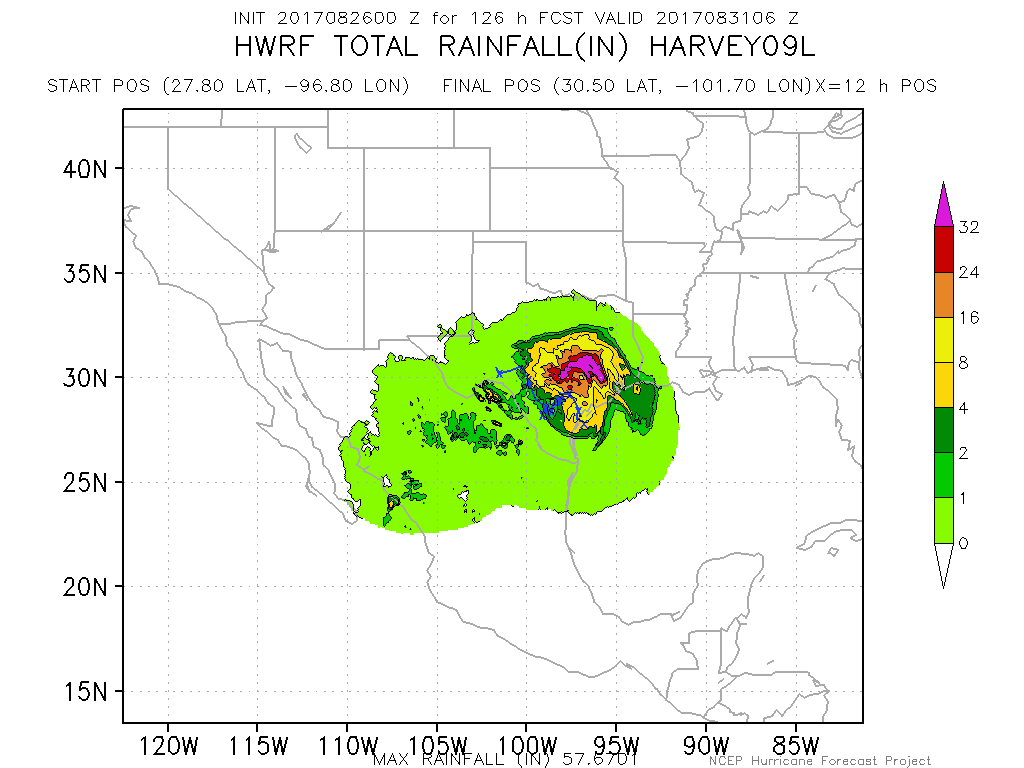
Through mid-week, Harvey is expected to move at an exceedingly slow 1 mph, pushing its rainfall forecast off the charts. For the first time in its history, the National Weather Service is forecasting seven-day rainfall totals as high as 40 inches in isolated pockets — equal to what’s normally a year’s worth or rain for coastal Texas.

Some high-resolution models predict even more. (For reference, the estimated 1-in-100-year seven-day rainfall total for the region is just 18 inches.) Meteorologist Ryan Maue estimated that 20 trillion gallons of water will fall on Texas over the next seven days, which is equal to about one-sixth of Lake Erie.

Virtually every river and stream between San Antonio and Houston is expected to experience record or near-record flooding over the next few days. Forecasters racked their brains to recall a scenario so dire anywhere in the world; a 2015 typhoon hitting the Philippines produced a similar amount of rain, but over a much smaller area.

Although the exact impact of global warming on the strength and frequency of hurricanes remains undetermined, there’s a clear climate connection when it comes to higher rainfall. All thunderstorms, including hurricanes, can produce more rain in a warmer atmosphere, which boosts the rate of evaporation and the water-holding capacity of clouds.

Heavy downpours have increased by 167 percent in Houston since the 1950s, and flooding there has been heightened by unfettered development and urban expansion. Some of the worst flooding in the region’s history has come from slow-moving storms like Harvey.

We don’t yet know if climate change will bring more slow-moving, rapidly intensifying tropical storms like Harvey. But flooding is what kills most people in hurricanes, and that will only get worse.

Taken from: 

Hurricane Harvey will bring some of the heaviest downpours anyone has ever seen

Posted in alo, Anchor, FF, G & F, GE, ONA, Pines, ProPublica, solar, Uncategorized | Tagged , , , , , , , , , | Comments Off on Hurricane Harvey will bring some of the heaviest downpours anyone has ever seen

Hurricane Harvey brings some of the heaviest downpours anyone has ever seen

This story has been updated. 

Hurricane Harvey made landfall late Friday night on the Texas coast as one of the most intense hurricanes in U.S. history, spawning as many as 50 tornado warnings in the Houston area alone.

But its worst feature is still unfolding: several days of what could be some of the most intense rainfall this nation has ever recorded, a clear signal of climate change.

After a destructive storm surge washed away homes, and winds as strong as 132 mph blew away roofs and left hundreds of thousands without power, Harvey is expected to stall, drastically worsening the risk of catastrophic inland flooding from relentless rains.

The dire National Weather Service forecast for catastrophic flooding appears to have come true. Overnight, parts of Houston received as much as two feet of rain, causing widespread devastation. Another two feet of rain is on the way, according to the latest forecasts.

Through mid-week, Harvey is expected to move at an exceedingly slow 1 mph, pushing its rainfall forecast off the charts. For the first time in its history, the National Weather Service is forecasting seven-day rainfall totals as high as 40 inches in isolated pockets — equal to what’s normally a year’s worth or rain for coastal Texas.

Some high-resolution models predict even more. (For reference, the estimated 1-in-100-year seven-day rainfall total for the region is just 18 inches.) Meteorologist Ryan Maue estimated that 20 trillion gallons of water will fall on Texas over the next seven days, which is equal to about one-sixth of Lake Erie.

Virtually every river and stream between San Antonio and Houston is expected to experience record or near-record flooding over the next few days. Forecasters racked their brains to recall a scenario so dire anywhere in the world; a 2015 typhoon hitting the Philippines produced a similar amount of rain, but over a much smaller area.

Although the exact impact of global warming on the strength and frequency of hurricanes remains undetermined, there’s a clear climate connection when it comes to higher rainfall. All thunderstorms, including hurricanes, can produce more rain in a warmer atmosphere, which boosts the rate of evaporation and the water-holding capacity of clouds.

Heavy downpours have increased by 167 percent in Houston since the 1950s, and flooding there has been heightened by unfettered development and urban expansion. Some of the worst flooding in the region’s history has come from slow-moving storms like Harvey.

We don’t yet know if climate change will bring more slow-moving, rapidly intensifying tropical storms like Harvey. But flooding is what kills most people in hurricanes, and that will only get worse.

From:  

Hurricane Harvey brings some of the heaviest downpours anyone has ever seen

Posted in alo, Anchor, FF, G & F, GE, ONA, Pines, ProPublica, solar, Uncategorized | Tagged , , , , , , , , | Comments Off on Hurricane Harvey brings some of the heaviest downpours anyone has ever seen