Tag Archives: Accent

Amazon fires: Satellite images show what’s happening in Brazil

High-resolution images from satellite company Planet are revealing glimpses of some of the fires currently devastating the Amazon rainforest.

While many of the images currently being shared on social media and by news outlets are from past fires — some from as long as 15 years ago — satellites can provide a near real-time view of what’s unfolding in the Amazon. With near-daily overflights and high-resolution imagery, Planet’s constellation of satellites is providing a clear look at some of the fires now burning in the Brazilian Amazon.

Beyond dramatic snapshots, those images also provide data that can be mined for critical insights into what’s happening in the Amazon on a basin-wide scale, according to Greg Asner, the director of the Center for Global Discovery and Conservation Science at Arizona State University, whose team is using Planet’s data to assess the impact of the fires on carbon emissions.

“Planet data provides unprecedented detail in mapping forest change down to individual trees which allows us to assess the damage from these kinds of large scale disturbances,” Asner said. “Our Planet Incubator Program is currently tracking forest carbon emissions all over the world — including the Amazon — using Planet Dove and SkySat imagery.”

“If you took all of the carbon stored in every tropical forest on Earth and burned it up, you would emit about five times the carbon dioxide into the atmosphere that is already there,” he said. “The Amazon rainforest represents about half of this forest carbon, to give you an idea of how serious this current situation is and the kind of impact it will have on climate change.”

Fires burning in the state of Pará, Brazil. Planet Labs Inc.

Planet wouldn’t comment what the images show specifically, but there are strong indications from other sources that many fires are burning near areas of recent deforestation. Analysis released this week by IPAM Amazônia, a Brazilian research group, shows that the 10 Amazonian municipalities that had the most fire outbreaks this year were also the ones that had the highest deforestation rates.

“These municipalities are responsible for 37 percent of the hotbeds in 2019 and 43 percent of recorded deforestation through July,” states the IPAM report. “This concentration of forest fires in newly deforested areas with mild drought represents a strong indication of the intentional character of the fires.”

In other words, fires are being set to clear lands for agriculture, most likely cattle pasture, which accounts for 70 to 80 percent of forest conversion in the Brazilian Amazon. Typically a landowner will cut and harvest valuable timber trees before slashing and burning the remaining trees. The resulting ash provides a temporary source of nutrients for pasture grass, but the soil degrades quickly without careful management.

While old-growth Amazon rainforest doesn’t typically burn naturally outside droughts and El Niño years, fires set intentionally in degraded forests and agricultural lands can burn hot enough to spread deep into otherwise untouched forests. That seems to be what’s happening this year, which, as IPAM noted, isn’t especially dry.

However that may soon change — for the worse.

With climate models forecasting a much hotter Amazon due to rising carbon dioxide concentrations in the atmosphere, a growing chorus of scientists are warning that the combination of continued deforestation and climate change could tip the wet Amazon rainforest toward a much drier, savanna-like ecosystem. Since the trees of the Amazon generate much of region’s precipitation, such a shift could be devastating for the region’s water supplies. The agricultural heartland of South America is predicted to be particularly hard hit by water scarcity, but diminished rainfall would also affect cities’ electricity supplies, which are disproportionately dependent on hydropower. Drier conditions would exacerbate fire and air pollution risk as well.

Planet images showing Nova Bandeirantes in Mato Grosso before and after a fire. Planet Labs Inc.

Fires and deforestation up in 2019

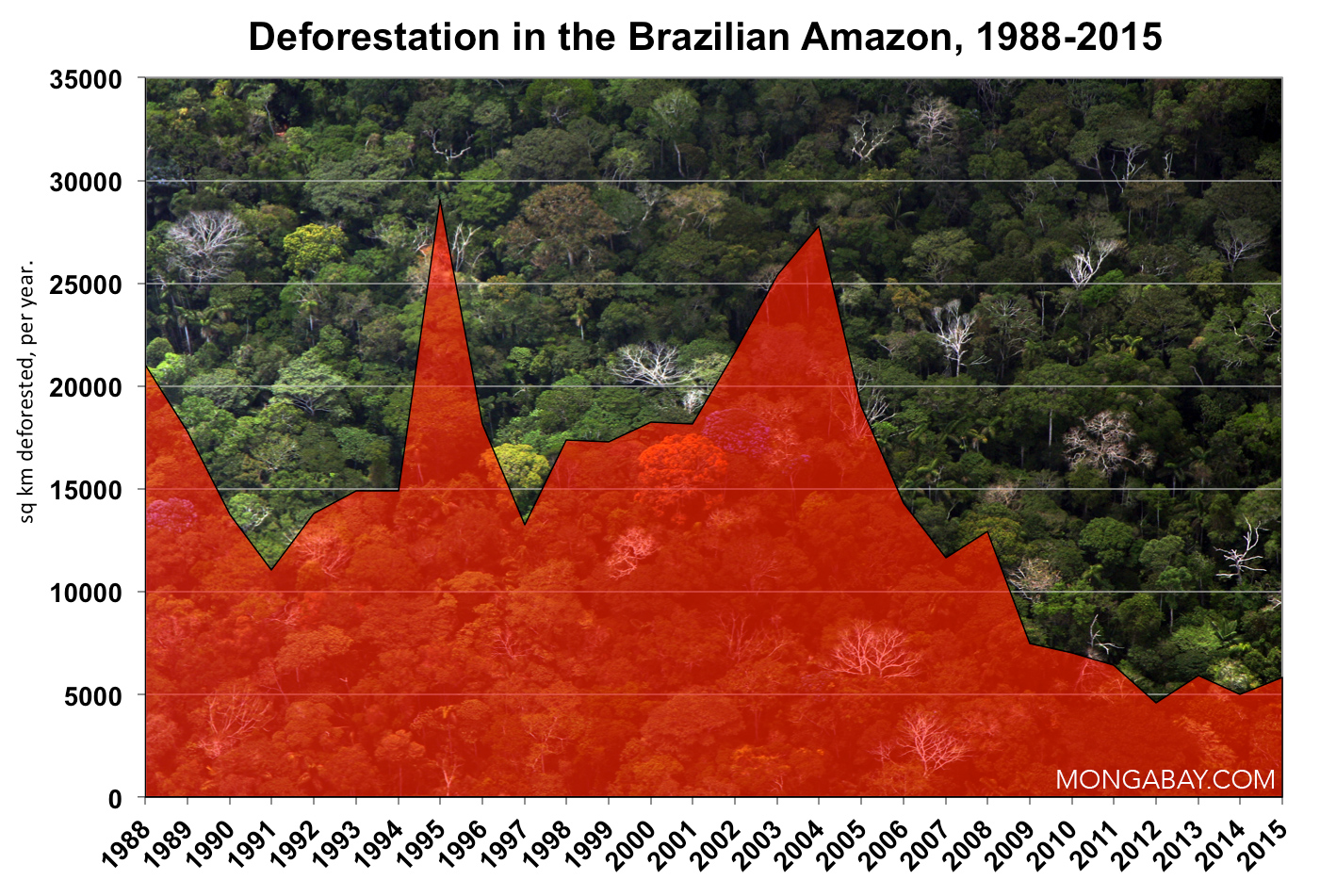
Deforestation in the Brazilian Amazon has been trending upward since bottoming out in 2012 at 4,571 square kilometers (1,765 square miles), but the issue didn’t get a lot of public attention until this week, when the skies of São Paulo, one the world’s largest cities, were blackened midday by smoke from the fires. The shocking descent into darkness prompted an outpouring of concern across social media, with the #PrayforAmazonas hashtag garnering more than 300,000 tweets in two days.

But while the fires in the Amazon have indeed increased significantly over last year, they aren’t off the charts relative to the past 20 years.

MODIS fire data presented by Global Forest Watch.

The difference this year is that weather conditions led the smoke from the fires to blanket densely populated urban areas. A similar phenomenon is seen in Southeast Asia: Indonesia’s peat fires get the most attention when winds blow the resulting haze over Singapore, the regional financial hub, as was the case in 2015.

However, to environmentalists worried about the anti-environment rhetoric from President Jair Bolsonaro, the Armageddon-like conditions in São Paulo and sharp rise in deforestation seem be playing out like a worst-case scenario for the Amazon.

According to the country’s national space research institute, INPE, forest loss in the world’s largest rainforest is already pacing 57 percent ahead of last year. And the region is only halfway through the peak deforestation season that runs from May to October. Data from Imazon, a Brazilian NGO that independently tracks deforestation in the Amazon, is expected to confirm the trend when it releases the latest numbers next week.

Stung by criticism over rising deforestation, Bolsonaro has asserted INPE is manipulating deforestation data and fired the agency’s director. INPE has not released any deforestation updates since the firing. Bolsonaro also claimed, without evidence, that NGOs are responsible for starting the fires as a fundraising strategy, although he backtracked on those remarks today.

Bolsonaro, however, hasn’t been able to effectively refute the satellite data coming from places like Planet and NASA. Scientists and civil society groups are now poring over that data to look for links between Bolsonaro’s policies — including weakened environmental laws, relaxed law enforcement, and amnesty for illegal deforesters — and what’s happening on the ground in the Amazon.

“While links between Brazilian government policy and these wildfires are unknown, the unprecedented data coming from Planet will allow us to help evaluate the extent to which their policies need to be reexamined,” Asner said.

Link: 

Amazon fires: Satellite images show what’s happening in Brazil

Posted in Accent, alo, FF, GE, LAI, LG, ONA, Uncategorized | Tagged , , , , , , , | Comments Off on Amazon fires: Satellite images show what’s happening in Brazil

Are farmers setting the Amazon ablaze in support of Bolsonaro?

Farmers are reportedly setting fire to the Amazon rainforest to show support for Brazilian President Jair Bolsonaro’s policy of opening up protected areas to private ownership. According to a widely disseminated article in a small newspaper, Folha do Progresso, the organizers of this “Day of Fire” are hoping that 2019 sets a record for burning.

Ranchers and farmers routinely use fire in tropical agriculture to clear land for planting and cattle pastures, but the practice had slowed before Bolsonaro took office in January. Brazil’s space research agency reported this week that fires have increased 84 percent this year compared to the dry season last year. On Monday, smoke from rampant fires plunged Sao Paulo into darkness in the afternoon.

Many news outlets have said the 74,000 fires Brazil has seen this year sets a record, but that’s based on statistics that only date back to 2013. And deforestation is actually down from its peak in the 1980s. The real, undisputable news here is that there’s been a spike in fires and deforestation under Bolsonaro. And given the Amazon rainforest’s important role in capturing carbon emissions, the stakes seem much higher.

Christian Poirier, a program director for the nonprofit Amazon Watch, said that farmers were clearly emboldened by Bolsonaro to burn forests. “The fires currently ravaging the Amazon are directly related to President Bolsonaro’s anti-environmental rhetoric, in which he errantly frames forests and forest protections as impediments to Brazil’s economic growth. Farmers and ranchers understand the president’s message as a license to commit arson with wanton impunity, in order to aggressively expand their operations into the rainforest.”

Bolsonaro isn’t exactly taking credit, saying he had a “feeling” that the fires were set by nonprofit environmental groups trying to make his government look bad.

There’s been a huge growth in Brazil’s farms, especially after President Donald Trump’s trade war sent China — the top buyer of U.S. soybeans — shopping in South America. But the farm boom won’t improve the lives of poor Brazilians if it depends on dismantling environmental protections, said Toby Gardner, the director of nonprofit Trase. He sees Brazil trending toward “apparent disregard for devastating effects of environmental degradation seen from the recent and unprecedented spate of wildfires, set by landowners to clear forest for agriculture,” he said in an email.

Brazil’s massive forests are a critical part of the Earth’s life support system. The Amazon holds some 17 percent of the world’s plant-based carbon, and fires release that greenhouse gas. It’s home to millions of unique species and people. Fires are also burning in Brazil’s Cerrado — the central savanna — and its other forests.

“We think this Day of Fire really captures the craziness of what is going on in Brazil — deforestation for the sake of it, as an act of political demonstration,” said Alex Armstrong of the environmental group Mighty Earth in an email. Mighty Earth and other organizations think big corporations can prevent deforestation by promising not to buy crops from Brazilian farmers who burn forests. Some corporations, such as the grain-trading giant Cargill, say they need a supportive government in Brazil before they can act.

It’s worth noting that Grist could not independently confirm that farmers have set fires as a demonstration: Every story and source interviewed about the Day of Fire pointed to the same article based on an interview with an anonymous source. But the space agency observed a spate of fires in the region where farmers reportedly planned their protest. And a government prosecutor has opened an investigation into the reported Day of Fire.

Source article – 

Are farmers setting the Amazon ablaze in support of Bolsonaro?

Posted in Accent, alo, FF, G & F, GE, LG, ONA, Uncategorized | Tagged , , , , , , , , | Comments Off on Are farmers setting the Amazon ablaze in support of Bolsonaro?

Why FEMA isn’t prepared for the next major U.S. disaster

According to every climate prediction model, our rapidly warming world is slated to experience more frequent and severe weather-related disasters. But according to a new investigation from E&E News, the Federal Emergency Management Agency is woefully unprepared for future catastrophes after misspending billions of dollars and countless hours of staff time on relatively minor disaster recovery efforts.

FEMA workers are an important resource for states in the wake of a disaster. They do everything from rescuing survivors to coordinating recovery efforts to providing emergency food and shelter. But they’re not for every occasion: The agency is only supposed to step in and supplement recovery efforts only when a disaster exceeds a state’s ability to cope. But according to the E&E article, FEMA tied up many of its key staffers’ time by responding to small-scale disasters such as undersized floods, storms and other events that states had the ability to bankroll themselves.

The total cost of that unnecessary aid? $3 billion.

For example, after July floods hit West Virginia — a state that was amassing over a billion dollars in budget surplus — FEMA not only staffed centers for residents to get emergency aid but provided 469 grants while the centers were open. And in 2017, FEMA responded to storms in Oklahoma that amounted to about $5 million in damage, while the state had over $450 million budget surplus.

FEMA helping out states hit by minor incidents may not sound like a terrible thing, but as a result of the misspending, E&E found that the agency failed to properly respond to the needs of communities hard-hit by major disasters, including Hurricane Maria. When Maria pummeled Puerto Rico two years ago FEMA was really not prepared. The U.S. territory’s disaster assistance progressed at a glacial pace, with the island not getting its first recovery center until Oct. 21, 2017 — a month after the hurricane, according to E&E News.

“FEMA is dying a death by 1,000 cuts,” Brock Long, former FEMA administrator, told E&E News. Long says that prior to Harvey, the agency already didn’t have enough emergency response staff to deploy. “We were out in the field staffing too many small to medium disasters.”

Making matters worse, when Governors (often) overestimate the costs of their states’ disaster recovery and get more FEMA funds than they need, there are no consequences.

The good news (and I use the word “good” loosely) is FEMA knows it has a problem. Last year, FEMA acknowledged that its disaster workforce “is historically over-committed to smaller disasters,” ultimately shrinking the agency’s capacity to prepare and respond to catastrophes.

In an effort to tackle this, FEMA administrators said they wanted to function as more of a block-grant agency, meaning it would be forced to prioritize disaster responses within a fixed budget. The agency also announced that rather than deploy its own staff for all disasters, it would reimburse states for minor disaster recovery — meaning states would need to buff up their own emergency response teams rather than relying on the federal agency to spearhead efforts.

But according to E&E, that policy has largely failed. FEMA is now facing a major staffing shortage at a time when the hurricane and wildfire seasons are about to hit their peaks. The agency currently has about 3,600 available emergency workers compared to about 6,000 at the same time two years ago — just before Hurricane Harvey hit. According to E&E, nearly three-quarters of the agency’s disaster workforce is currently tied up — meaning they are either assigned other disasters or on vacation.

“I cannot continue to send staff out to do every disaster for $2 million,” said former FEMA administrator Long during Senate Hearings last year. “The nation needs me to be ready to go for the Marias and the Harveys and Irmas.”

Originally posted here:  

Why FEMA isn’t prepared for the next major U.S. disaster

Posted in Accent, alo, Casio, FF, G & F, GE, LG, ONA, Ultima, Uncategorized | Tagged , , , , , , , , , , , | Comments Off on Why FEMA isn’t prepared for the next major U.S. disaster

States cut water use as Colorado River runs low. That’s actually good news.

For the first time in history, low water levels on the Colorado River have forced Arizona, Nevada, and Mexico to cut back the amount of water they use. It’s the latest example of climate change affecting daily life, but also an encouraging sign that people can handle a world with less: These orderly cutbacks are only happening because seven U.S. states and Mexico had agreed to abide by conservation rules when flows subside, rather than fight for the last drops.

“It is a new era of limits,” said Kevin Moran, who directs the Environmental Defense Fund’s Colorado River efforts.

The Colorado River is a vital source of water for the American West, sustaining some 40 million people and 5.5 million acres of farmland. And it’s been under enormous stress. Since 2000, the watershed has been, to put it mildly, dry. The region is suffering the worst 20-year drought in modern times.

A Bureau of Reclamation study of Colorado River levels, released Thursday, triggered the cutbacks. The Rocky Mountains finally turned white with heavy snow last winter, but despite a galloping spring runoff, drought persists and bathtub-ringed reservoirs in the Grand Canyon are low. In its study, the Bureau highlighted the unique circumstances: “This 20-year period is also one of the driest in the 1,200-year paleo record.”

Rising temperatures brought on by rising carbon emissions are partly to blame. “Approximately one‐third of the [Colorado River] flow loss is due to high temperatures now common in the basin, a result of human caused climate change,” wrote scientists Brad Udall and Jonathan Overpeck in a study published in 2017 that anticipated water will only become scarcer in the future.

But these water-use reductions are also an example of people binding themselves to rules to deal with scarce resources, rather than going to court, or war. The cutbacks come from an agreement hammered out by the Southwestern states and Mexico to impose limits on themselves.

“It’s not necessarily well known or talked about, but this collaboration between the states and Mexico is one of the most successful cross-border water management stories in the world,” Moran said.

Over the long course of history, the various parties have fought each other over water, but found that cooperation simply works better, Moran said. By working together, they’ve already managed to reduce the amount of water drawn for the last five years from the lower Colorado River Basin. In fact, they’ve cut back more in each of those years more than required by their agreement in 2020, said John Fleck, the director of the University of New Mexico Water Resources Program, who wrote the book Water is for Fighting Over, on the history of conflicts over the Colorado River.

“It puts the lie to the idea that water use is just going up and up and up: It’s been on a downward trend for a decade and a half at a time when population is increasing and agriculture is as productive as ever,” Fleck said. “We’re beyond the Malthusian math that suggests we’re going to run out of water and die.”

The region will need to go further to keep up with climate change and refill reservoirs, Fleck said. But the progress so far leaves him hopeful that people can resolve conflicts over scarce resources in this new era of limits.

“The key, I think, is for the water users to realize that you can have healthy, successful communities with declining water,” Fleck said. That opens up the space for collaboration, and allow them to get beyond the old myth that water is for fighting over.”

Taken from:  

States cut water use as Colorado River runs low. That’s actually good news.

Posted in Accent, alo, FF, GE, LG, ONA, Uncategorized, Wiley | Tagged , , , , , , , , , , | Comments Off on States cut water use as Colorado River runs low. That’s actually good news.

We’ve got another ozone problem, and it’s not what you think

Most of us know ozone as that benevolent stratospheric layer that absorbs the sun’s harmful UV light and keeps us safe. In the 1980s, scientists found a “hole” in the ozone layer — really just a large section that was getting precariously thin — caused by the use of potent chemicals called CFCs. The world took action and rapidly banned CFCs, effectively solving the problem.

But the beneficial ozone up in the stratosphere has an evil cousin, and it’s right here on the ground. A new study funded by the Environmental Protection Agency found that ground-level ozone — the main ingredient in smog — is on the rise, an issue that could have pretty severe public health consequences. Even a relatively small spike in ozone pollution where you live (just three parts per billion) has a similar effect on your lungs as smoking a pack of cigarettes a day for 29 years, according to the authors of the study.

This small increase in ozone ramps up your risk of emphysema, a form of chronic lung disease that can lead to hospitalization and death. Researchers from universities around the country kept tabs on more than 7,000 adults in six U.S. cities over a period of 18 years for the study, which was published in the journal JAMA.

Unlike the ozone layer, which is a naturally occurring part of the stratosphere, ground-level ozone is formed when pollutants from things like cars, chemical plants, and refineries react with sunlight. And beyond the obvious pollution sources, guess what’s making ground-level ozone even worse?

“What we will be seeing with climate change is an increase in the sunlight part of the equation,” said Joel Kaufman, one of the authors of the study. “Ozone increases with more sunshine, heat waves, and so forth.”

That’s not to say we can’t do something about smog. In fact, we already have. Since the Clean Air Act was implemented in 1970, pollution at the ground level has been reduced. Unfortunately, the Trump administration is in the process of rolling back environmental policies aimed at improving air quality. So it doesn’t look like we’ll be solving the ground-level ozone problem, or the climate crisis, anytime soon.

See original article: 

We’ve got another ozone problem, and it’s not what you think

Posted in Accent, alo, FF, GE, LG, ONA, Uncategorized | Tagged , , , , , , , , , | Comments Off on We’ve got another ozone problem, and it’s not what you think

A romance novel about Hurricane Maria exists. Here’s why.

Nothing puts a damper on one’s romantic life like a Category 5 hurricane. That’s just one of the obstacles faced by 20-year-old former sex worker Dolores “Dulce” Garcia, the sugar daddy-dealing protagonist of the new book Side Chick Nation. As she tries to outrun her past by going from Miami to the Caribbean, she ultimately lands in Puerto Rico just in time for Hurricane Maria.

Climate change and colonialism don’t typically make for a sexy beach read, but Side Chick Nation, the fourth installment in UC Berkeley lecturer Aya de León’s Justice Hustlers feminist heist series, attempts to do just that — weaving action and romance into the vivid backdrop of Puerto Rico’s stilting recovery from Hurricane Maria.

Dulce, the titular “side chick,” is a world-weary pragmatist; she answers the call from a past sugar daddy looking to, well, “reconnect,” all while lying to Zavier, the man with whom she has actually fallen for after just a few dates. After Hurricane Irma slows the flow of sugar daddies in Puerto Rico to a trickle, she finds herself sleeping in a storage unit in San Juan, waiting for the next storm — Maria — to hit.

In the aftermath of the hurricane, she serves as a witness to both the heartbreaking reality of climate change and the exploitation that can ensue. She notes the international businessmen who flock to the island to manipulate the destruction for their own financial gain, making shady use of relief funds and devastating the island even more. De León draws parallels between Dulce’s experience as a “side chick” and Puerto Rico’s relationship with the mainland, which cheerfully exploits the U.S. territory in good times but abandons it when it is in need.

For me, as a Puerto Rican transplant who has reported on Puerto Rico’s recovery after Maria, I was intrigued by the novel’s premise. I talked with de León, who teaches creative writing at UC Berkeley, about Side Chick Nation and why she chose popular fiction as a means to get folks riled up about the climate crisis.

The following interview has been edited for length and clarity.

Image courtesy of Aya de León

Q.Why did you write this book? What do you hope readers get out of it?

A. The biggest takeaway that I really want for everyone has to do with Hurricane Maria and the crisis of climate and colonialism in Puerto Rico. I’m hoping people feel that intersection at a level of empathy. Part of what I was thinking of when I was writing was, in the future when this book comes out, the hurricane will have receded from the headlines and yet the humanitarian crisis in Puerto Rico will be ongoing. I just wanted to make sure that folks could connect to these human stories, this unprecedented level of this devastation at this intersection.

Something that was also super important to me for this book is [to reach] an audience that includes young women of color. I really like the idea of young women of color thinking of themselves as activists around issues like the climate. Being a part of the Puerto Rican diaspora and watching the island get hit made it clear to me that climate change is the top political priority. Climate is something that affects everybody and affects people of color even more. The perception of environmentalism is that it’s a white movement — and that’s not actually true. So I wanted to push back on that.

Q.Where did you get the idea to set the fourth installment of your Justice Hustlers series in a post-Maria Puerto Rico?

A. I was writing another book at the time. I had outlined it and started to work on it. Then, the hurricane hit and I was like, “Oh my god, I have to write about the hurricane!” It occurred to me that the biggest platform that I have was this Justice Hustlers series. I wasn’t sure how to make it make sense with the rest of the series, but I remembered one character from a previous book — Dulce. One of the things I was reading at the time was Salvage the Bones, a novel about Hurricane Katrina. It made me think: what does it mean for the audience to know what’s gonna happen while the characters don’t know?

Q.You went to Puerto Rico to research this book. What was that like?

A. I had not been back to Puerto Rico for a decade. I visited in 2018 about a year after Hurricane Maria hit. It was really intense to be back. One of the things that was so profound is that the whole island has signs of Post Traumatic Stress Disorder. There was some sort of emotional chill because people had been deeply impacted in a lot of ways.

I mostly was in San Juan where things looked more or less back to normal. Still, stores were closed and traffic lights were knocked out — and that was almost a year later! I rented a car and drove around the interior of the island, where I saw lots of FEMA tarps blue roofs. I definitely got a sense of the devastation. That was key for me — to just go and just bear witness. It was less about information and more about being present with the community.

Q.The book deals with a lot of really intense issues like colonialism and disaster capitalists while also telling this gripping, feminist romance storyline. Do you think popular fiction in general, might be the way to get people to understand the complex relationship between disparity and climate crisis?

A. I think popular fiction and fiction, in general, has always played that role. It’s hard to empathize with a historical event, but it’s easy to empathize with an individual. And that’s what I wanted — for people to connect. What does it mean to have your homeland devastated, your people devastated? Ultimately, I’m writing romantic suspense but I’m thinking of suspenseful situations that relate to big political situations — like Hurricane María.

Q. Can you tell me about the challenges of writing about disaster?

A. I just had to cry a lot. I had to grieve a lot. And I had to hold off feelings like being unworthy or unable or not up to the task. Here we have this thing that changed the Puerto Rican people, and here I am, this sort of west coast, mixed-heritage diaspora Puerto Rican who is like the second generation born in the U.S. How could I possibly be the person to write this book? Ultimately it’s just the reality of the disaster. Maybe I’m not the right person, but I’m the person with a book contract and I can’t write about anything else.

The hurricane changed stuff for everyone in the diaspora. We have to show up, and what I have to bring to the table is a book that is a popular fiction approach. This may be the story for people that aren’t gonna read Naomi Klein’s Battle for Paradise — although I hope everybody will read that too! I wanted the message to get to the places where I already had a platform. I can’t imagine having written about anything else. This is the story of my people right now.

More:  

A romance novel about Hurricane Maria exists. Here’s why.

Posted in Accent, alo, Everyone, FF, GE, LG, ONA, Paradise, Ultima, Uncategorized | Tagged , , , , , , , | Comments Off on A romance novel about Hurricane Maria exists. Here’s why.

Disney World’s literal nuclear option, explained

Original article:  

Disney World’s literal nuclear option, explained

Posted in Accent, alo, ALPHA, Anchor, FF, GE, LAI, LG, ONA, solar, Uncategorized | Tagged , , , , , , , , | Comments Off on Disney World’s literal nuclear option, explained

5G networks could throw weather forecasting into chaos

This story was originally published by Wired and is reproduced here as part of the Climate Desk collaboration.

If you had a choice between a better, faster cell phone signal and an accurate weather forecast, which would you pick? That’s the question facing federal officials as they decide whether to auction off more of the wireless spectrum or heed meteorologists who say that such a move could throw U.S. weather forecasting into chaos.

On Capitol Hill Thursday, NOAA’s acting chief, Neil Jacobs, said that interference from 5G wireless phones could reduce the accuracy of forecasts by 30 percent. That’s equivalent, he said, to the quality of weather predictions four decades ago. “If you look back in time to see when our forecast scale was roughly 30 percent less than today, it was 1980,” Jacobs told the House Subcommittee on the Environment.

That reduction would give coastal residents two or three fewer days to prepare for a hurricane, and it could lead to incorrect predictions of the storms’ final path to land, Jacobs said. “This is really important,” he told ranking committee member Frank Lucas (R-Oklahoma).

In March, the FCC began auctioning off its 24-gigahertz frequency band to wireless carriers, despite the objections of scientists at NOAA, NASA, and the American Meteorological Society. This week, Senators Ron Wyden (D-Oregon) and Maria Cantwell (D-Washington) wrote to FCC chair Ajit Pai requesting the commission stop companies from using the 24-GHz band until a solution is found, and to delay any more of the auction.

Jordan Gerth, a research meteorologist at the University of Wisconsin, Madison, has been studying this issue as part of a group at the American Meteorological Society. He says that while the FCC can switch which regions of the spectrum it allocates to phone companies, forecasters are stuck. That’s because water vapor emits a faint signal in the atmosphere at a frequency (23.8 GHz) that is extremely close to the one sold for next-generation 5G wireless communications (24 GHz). Satellites like NOAA’s GOES-R and the European MetOp monitor this frequency to collect data that is fed into prediction models for upcoming storms and weather systems.

“We can’t move away from 23.8 or we would,” Gerth told WIRED. “As far as 5G is concerned, the administration has a priority to put 5G on the spectrum, and they thought this was an OK place to do it. It’s just close to where we are sensing the weather.” Gerth says that wireless carriers could turn down the power emitted by 5G cellphone transmitters so they don’t drown out the sensitive sensors on the satellite. NOAA and NASA want to limit the interference noise to a level closer to what is considered acceptable by the European Union and World Meteorological Organization.

NOAA’s Jacobs told the House committee that the number currently proposed by the FCC would result in a 77 percent data loss from the NOAA satellite’s passive microwave sounders. He also said that experts from the two agencies are trying to work out a compromise. “I’m optimistic we can come up with an elegant solution,” he told lawmakers Thursday.

In the meantime, Gerth says this issue probably won’t go away anytime soon. The FCC plans future 5G auctions for the radio frequency bands near ones used to detect rain and snow (36–37 GHz), atmospheric temperature (50.2–50.4 GHz), and clouds and ice (80–90 GHz). “This is not one and done,” Gerth added. “Today it’s 23.8, tomorrow it’s 36.”

The state department is negotiating with other nations over the interference level, which will be settled at a world radio conference in October. The FCC’s 5G auction has reaped nearly $2 billion from both small and large wireless providers and is still underway.

Continued: 

5G networks could throw weather forecasting into chaos

Posted in Accent, alo, ALPHA, Anchor, FF, GE, LG, ONA, Uncategorized | Tagged , , , , , , , | Comments Off on 5G networks could throw weather forecasting into chaos

Carbon dioxide levels just hit 415 ppm. Who saw this coming? Exxon Mobil.

Want to see something terrifying? Watch atmospheric carbon emissions climb to the new all-time high of 415 parts per million.

This emissions update comes from daily data collected via analyzer at Mauna Loa Observatory, Hawaii, since 1956. After breaking the 400 ppm threshold in 2013, data from 2019 puts emissions at 415 ppm. The “upward trajectory continues,” the video ends on an ominous note.

Who could have seen this coming? As Brian Kahn at Earther pointed out, leaked internal documents from Exxon Mobil reveal that the oil and gas giant has seen this emissions landmark coming since 1982. A graph shows their 2019 estimated carbon dioxide level was between about 385 ppm and 415 ppm, an impressively accurate guess for the time.

Exxon predicted 2019 would hit near 415 ppm.

Instead of using this knowledge to prevent it from becoming a reality, Exxon launched a series of climate denial efforts. It published anti-climate change ads in The New York Times, lobbied against government efforts to regulate emissions, and helped start the Global Climate Coalition to cast doubt on climate change.

After decades pushing climate denial, oil and gas companies are starting to face the consequences. Countless lawsuits are cropping up from states, cities, tribes, and fishermen that call for oil companies to finally own up to the self-serving role they’ve played in exacerbating the climate crisis.

Link:  

Carbon dioxide levels just hit 415 ppm. Who saw this coming? Exxon Mobil.

Posted in Accent, alo, Anchor, FF, GE, Landmark, LG, ONA, Uncategorized | Tagged , , , , , , , , | Comments Off on Carbon dioxide levels just hit 415 ppm. Who saw this coming? Exxon Mobil.

Watch John Oliver explain the Green New Deal like only he can

In typical John Oliver rapidly-switching-between-serious-and-satirical style, Last Week Tonight’s latest episode discussed the Green New Deal. And by ‘discussed,’ what we really mean is: He considered riding a sled pulled by 400 hamsters, made Trump jokes, and explained why carbon taxing may be an important tool in the climate fight.

In the nearly 20-minute piece, Oliver covered a lot of ground. He first described the Green New Deal and the frenzy of media coverage from both sides that has followed.

“However bumpy its rollout was, to its eternal credit, the Green New Deal has succeeded in getting people talking,” Oliver said. “But that won’t mean anything unless that talk turns to actions, and putting a price on carbon could be one of them.”

He then dove into carbon pricing. Using science icon Bill Nye the Science Guy to explain the concept, Oliver tried to make the idea of introducing a new tax a little more feasible and innocuous.

“[A carbon tax] will not be enough on its own by a long shot,” Oliver said in one of his moments of gravity. “We’re going to need a lot of different policies working in tandem, and we have to take action right now!”

And then, with an angry flourish, Bill Nye took a torch to a model of Earth.

Original source:  

Watch John Oliver explain the Green New Deal like only he can

Posted in Accent, alo, Anchor, FF, GE, LAI, LG, ONA, Uncategorized | Tagged , , , , , , , , , , | Comments Off on Watch John Oliver explain the Green New Deal like only he can