Tag Archives: alo

12 of the Best Cover Crops for Your Garden

Also known as green manure, cover crops are plants grown for the purpose of adding organic matter to your soil.

Organic matter from broken down plant material is vital for soil health. Not only does it contain essential nutrients for the growth of new plants, organic matter also stores carbon in the soil. This is important for maintaining the earth?s atmosphere and mitigating climate change.

Cover crops are typically planted in the fall or early spring when your garden beds are empty. You can also plant them in open areas during your growing season.

They can either be pulled up or tilled under when finished, or left in place to die over winter. It?s best to wait 3 to 5 weeks after tilling for the cover crop to decompose before planting any food or ornamental plants.

Almost any plant could be used as a cover crop, although the plants given below stand out because they?re fast, easy to grow and have proven benefits for your soil. You can get seeds at most garden centers or online retailers.

1. Alfalfa

Scientific name: Medicago sativa

Benefits: Alfalfa?s long tap roots are good for breaking up hard soils, which improves soil aeration and drainage. The long roots can also bring up trace minerals from deep in the soil. Alfalfa is a legume that fixes nitrogen in the soil.

Hardiness: Perennial in USDA zones 3 and higher.

Best time to sow seeds: Spring

Maintenance: Can be tilled under in summer or fall. Good to shear the plants periodically to prevent flowering and seeding.

2. Barley

Scientific name: Hordeum vulgare

Benefits: Barley has a short growing season, so it is ideal for northern gardens. It produces more biomass in a shorter time than other cereal grasses used for cover crops. Barley is also drought resistant.

Hardiness: Annual, but can live over winter in USDA zones 8 and higher. Barley will die over winter in lower zones.

Best time to sow seeds: Spring in lower zones, or fall for zones 8 or higher.

Maintenance: Barley does not reseed very well, so you can let it grow throughout your regular season, and let it die over winter in lower zones or till in spring for higher zones.

3. Berseem Clover

Scientific name: Trifolium alexandrinum

Benefits: Berseem clover builds the most nitrogen in your soil compared to all other legume crops. It also creates the most biomass of all the clovers.

Hardiness: Annual, but can live over winter in USDA zones 8 and higher.

Best time to sow seeds: Spring or early summer in lower zones, or fall for zones 8 or higher.

Maintenance: If you cut or mow the plants prior to seed set, they can grow back at least 2 to 3 times over your growing season to provide more organic matter.

4. Common Buckwheat

Scientific name: Fagopyrum esculentum

Benefits: Buckwheat can germinate within days of planting if planted in warmer weather. It can tolerate drought and poor soils. It will start to bloom after about 5 weeks and is excellent for supporting bees and other pollinators.

Hardiness: There are a few different varieties of buckwheat. Some are perennial, but common buckwheat is an annual. This is ideal because it dies over winter.

Best time to sow seeds: Spring or early summer

Maintenance: Mow or cut down buckwheat within two weeks of the first flowering if you want to avoid setting seed.

5. Crimson Clover

Scientific name: Trifolium incarnatum

Benefits: The fastest growing annual nitrogen fixer, which makes it great for fall seeding. Grows well in many conditions, including shade.

Hardiness: Annual, but can live over winter in USDA zones 8 and higher.

Best time to sow seeds: Due to its rapid growth, you can seed in spring, summer or fall.

Maintenance: Cutting or mowing when crimson clover starts to set flower buds will kill the plants. If you want it to flower and reseed, it will naturally die back after flowering.

6. Fall Mustards

Scientific names: Sinapsis alba (aka. Brassica hirta), Brassica juncea, or Brassica nigra

Benefits: All plants in the cabbage family have been shown to release biotoxic compounds that act against bacteria, fungi, insects, nematodes and weeds. These compounds are especially high in mustard crops.

Hardiness: Annuals, but may live over winter in USDA zones 8 and higher.

Best time to sow seeds: Spring or summer

Maintenance: The biotoxic compounds of mustards are only released when individual plant cells are ruptured. In order to maximize this, it?s best to till the plants under to break them up and incorporate them into the soil during your growing season.

7. Fall or Winter Rye

Scientific name: Secale cereale

Benefits: Rye is the hardiest cereal crop, so it makes an excellent winter cover crop in most climates. Rye quickly establishes a dense root system, which effectively suppresses weeds and breaks up hard soils.

Hardiness: Annual, but will live over winter in USDA zone 3 and higher.

Best time to sow seeds: Spring or fall

Maintenance: Beneficial to cut the plants periodically to prevent flowering and seeding.

8. Field Peas

Scientific name: Pisum sativum subsp. arvense

Benefits: Field peas grow rapidly in cool, moist weather. Their succulent stems break down easily for a quick source of available nitrogen.

Hardiness: Annual, but will live over winter in USDA zone 6 and higher.

Best time to sow seeds: Early spring

Maintenance: Field peas tend to stop growing in hot weather, so they?re best grown in spring and tilled under in early summer.


Photo credit: Wikimedia Commons

9. Hairy Vetch

Scientific name: Vicia villosa

Benefits: Hairy vetch is the hardiest legume cover crop, so it overwinters well and provides plenty of soil nitrogen for spring.

Hardiness: Annual, but will live over winter in USDA zone 4 and higher.

Best time to sow seeds: Fall

Maintenance: Hairy vetch grows slowly at first, but will continue establishing roots over winter. In spring, it grows long, vine-like branches up to 12 feet (3.7 meters) long. This provides great biomass as long as you have a tiller strong enough to break them up. Otherwise, cut hairy vetch early to prevent its extensive growth.

10. Marigolds

Scientific name: Tagetes species

Benefits: Marigolds can control a variety of pests, including nematodes, fungi, bacteria, weeds and insects. Research has shown marigolds are most effective when planted in large quantities as a cover crop.

Hardiness: Annual, will die as soon as temperatures reach freezing.

Best time to sow seeds: Spring

Maintenance: Can be tilled under in summer or fall.

Related: Do Marigolds Really Repel Garden Pests?

11. Oats

Scientific name: Avena sativa

Benefits: Oats grow well in cool weather, so they can be planted in the fall. They also can improve the productivity of legumes when planted in a mixture.

Hardiness: Annual, but can live over winter in USDA zones 7 and higher.

Best time to sow seeds: Summer or fall alone, or spring as part of a mixture with legumes.

Maintenance: When planted in spring, oats can be tilled under with your legume crop. If planting in summer or fall alone, try to seed them 40 to 60 days before your first frost. This will give them enough time to mature, but they will be winter killed before they set seed.

12. White Clover

Scientific name: Trifolium repens

Benefits: White clover can make a good living mulch in areas such as footpaths, between shrubs and trees, or on slopes. It only grows 6 to 12 inches (15 to 30 centimeters) high and does well with regular mowing or foot traffic.

Hardiness: Perennial in USDA zones 3 and higher.

Best time to sow seeds: Spring or summer

Maintenance: Can be tilled under in summer or fall, or left as a long-term, nitrogen-fixing groundcover.

Related
How to Share Extra Bounty from Your Garden with the Community
9 Mistakes to Avoid When Planting a New Vegetable Garden
Which Type of Mulch Is Best for Your Garden?

Disclaimer: The views expressed above are solely those of the author and may not reflect those of Care2, Inc., its employees or advertisers.

See the article here:

12 of the Best Cover Crops for Your Garden

Posted in alo, FF, G & F, GE, LAI, LG, ONA, organic, oven, PUR, Uncategorized | Tagged , , , , , , , , | Comments Off on 12 of the Best Cover Crops for Your Garden

This Hill, This Valley – Hal Borland

READ GREEN WITH E-BOOKS

This Hill, This Valley

Hal Borland

Genre: Nature

Price: $9.99

Publish Date: January 14, 2014

Publisher: Open Road Media

Seller: OpenRoad Integrated Media, LLC


A classic country memoir—Hal Borland’s masterful story of one year spent immersed in nature on his New England farm After a nearly fatal bout of appendicitis, Hal Borland decided to leave the city behind and move with his wife to a farmhouse in rural Connecticut. Their new home on one hundred acres inspired Borland to return to nature. In this masterpiece of American nature writing, he describes such wonders as the peace of a sky full of stars, the breathless beauty of blossoming plants, the way rain swishes as it hits a river, and the invigorating renewal brought by the changing seasons. The delights of nature as Borland observes them seem boundless, and his sense of awe is contagious. “[Hal Borland is the] beloved spokesman for all of us who love the earth and who find sustenance in nature.” —Loren Eiseley Hal Borland (1900–1978) was a nature writer and novelist who produced numerous bestselling books including memoirs and young adult classics, as well as decades of nature writing for the  New York Times . Borland considered himself a “natural philosopher,” and he was interested in exploring the way human life was bound to the greater world of plants, animals, and natural processes. 

Read this article – 

This Hill, This Valley – Hal Borland

Posted in alo, Anchor, FF, GE, ONA, PUR, Uncategorized | Tagged , , , , , , , , , | Comments Off on This Hill, This Valley – Hal Borland

AP Calculus Interactive Lectures Vol. 1, 2017-18 Edition – Rita Korsunsky

READ GREEN WITH E-BOOKS

AP Calculus Interactive Lectures Vol. 1, 2017-18 Edition

Calculus AB PowerPoints 2017

Rita Korsunsky

Genre: Mathematics

Price: $19.99

Publish Date: August 1, 2012

Publisher: EPub Bud

Seller: Rita Korsunsky


This Book reflects the recent changes in the College Board requirements for 2016 – 2017 school year. Imagine having interactive PowerPoint lectures that illustrate every problem, walking you through the procedure step-by-step. Imagine having every proof, illustration, or theorem explained concisely and accurately. This Book contains immersive and comprehensive PowerPoint presentations for every topic covered by AP Calculus AB classes or the AB part of Calculus BC classes. They can be used for both review and learning, a perfect fit for every student no matter their current knowledge of Calculus.  If you are a teacher who wants to learn about licensing options to use these lectures for classroom presentations please visit www.mathboat.com or contact captain@mathboat.com Every example and every lesson targets a specific skill or formula. With this book, you will have every concept you need to know at the tip of your fingers. At the end of this book, you will find the list of all the formulas and theorems needed for the AP test.  This Interactive eBook has all of the tools and teaches you the tips and tricks to master Calculus in no time. Our books are written by Mrs. Rita Korsunsky, a High School Mathematics Teacher with 18 years of experience teaching AP Calculus. Her lectures are rigorous, effective and engaging. Students frequently credit their success on the AP Exam to these thorough, detailed and concise lecture notes.   Her students’ AP Scores speak for themselves:  100% of her students pass the AP Exam 94% of her students get 5 on the AP Exam 

This article is from: 

AP Calculus Interactive Lectures Vol. 1, 2017-18 Edition – Rita Korsunsky

Posted in alo, Anchor, FF, GE, LAI, ONA, PUR, Uncategorized | Tagged , , , , , , , , | Comments Off on AP Calculus Interactive Lectures Vol. 1, 2017-18 Edition – Rita Korsunsky

The U.S. should go Dutch to avoid building another Houston

Want to design a city to maximize flood damage? Start on very flat land — any kind of slope will help water flow out of town. Next you’d want to create incentives for people to build the city wide and low; by covering a large area with concrete and asphalt, you collect more water whenever it rains. Then, be sure not to build much in the way of a drainage system. Ideally you’d be close to a humid body of water. And if you really wanted to put a cherry on top, you’d devote the city to industry that contributes to the warming of the seas, thereby increasing the likelihood of extreme downpours.

Voilà! You’ve just built Houston.

While America’s fourth-largest city is a poster child for flood vulnerability, much of the United States is built on similar principles. When the Dutch, the experts in flood prevention, look at us, they try to be polite, but really there’s no way around the truth.

“The United States is a little bit lagging behind in flood protection, to be honest,” says Jeroen Aerts, professor of water and climate risk at Vrije University in Amsterdam.

Aerts says that good flood control rests on three pillars: first, fortification to keep water out; second, buildings that can withstand flooding; and third, resources for evacuation and reconstruction.

The United States does fine on the third pillar, but fails on the first two. We build low-slung, widespread exurbs — partly because many American cities grew after the advent of the automobile. Thus, U.S. cities lack density, violating a key tenet advanced by the Dutch for making flood control possible and affordable. To avoid future Harvey-scale events, the U.S. could do well to take a page from Holland and get ahead of flooding, rather than scrambling to recover from it.


It’s hard to keep a city dry if it’s huge. The reverse is also true, says Jeff Carney, director of the Coastal Sustainability Studio at Louisiana State University. When cities stack their housing up, rather than sprawling out, they are easier to defend and are more resilient.

One example of a well-stacked American city is New York, New York — aka the island of Manhattan. It’s compact, with more than 1.5 million people in fewer than 34 square miles of land, so flood-prevention efforts are feasible.

A couple of years ago, the New York City government allocated $100 million to build a flood barrier around the lower part of the borough, and the U.S. Department of Housing and Urban Development kicked in nearly twice that last year to ensure it becomes a reality.

“Lower Manhattan has the ability — because of the amount of people and the amount of economic value on the island — to build a wall around itself,” Carney says. “They can do infrastructure that Houston isn’t going be able to do. You’re not going to be able to pump water out of Houston. It’s just too big.”

Houston took a laissez-faire approach to development, essentially allowing people to build whatever — and wherever — they wanted. Aerts thinks the United States would benefit from a baseline urban-planning rule requiring some level of fortification against floods.

If government required a measure of flood protection, a lot of the low-lying development just wouldn’t pencil out economically. If you have to build a levee around a sprawling subdivision, it drives up construction costs, as well as home prices — and not because the neighborhood is suddenly hip. (Strangely, the Trump administration is moving in the opposite direction: Earlier this month it revoked an Obama-era rule mandating that potential future flooding be taken into account when constructing federally funded buildings.)

From a European perspective, American flood protection is astonishingly fragmented and ad hoc. Some U.S. cities use levees, drains, or pumps; others do nothing. Usually, Aerts says, cities build their protections only after a disaster. That’s the case in lower Manhattan, where the proposed flood-protection system is a direct response to Superstorm Sandy in 2012.

Still, prevention isn’t enough. Even if Houston had state-of-the-art infrastructure, according to Aerts, it would have flooded. “If we had 30 inches of rain in 12 hours, the Netherlands would flood as well,” he says. “And we have the biggest flood-safety system in the world.”

Nature can always overwhelm humanity’s efforts, and so we need backup plans.


When authorities issue a flood warning, people tend to focus on escaping by moving out of the area — getting in cars and driving away. But it’s much easier, and often safer, to go up, rather than out.

“If you can flee to a higher floor and stay there for days, you will be safe,” says Frans van de Ven, an engineer at the Dutch institute Deltares who helped New Orleans design new flood-control plans after Hurricane Katrina.

This works a lot better if the lights stay on, plumbing continues to work, and food in refrigerators stays fresh. So cities need to invest more to keep critical services above the water line, says van de Ven. If power plants and hospitals stay dry, electricity could continue to flow, and patients could be moved upstairs instead of out of town.

Apartment-dwellers like Louise Walker are exceptions to Houston’s single-family-home norm. When the water rose into her first floor apartment, Walker was able to bunk upstairs with her neighbor. This kind of “vertical evacuation” is often a better option than jamming freeways or evacuating people to convention centers, arenas, and megachurches.

“If we really are moving into a time of greater dynamics in the weather — and I think the science is suggesting that we are — we’re going to have to build our cities differently,” says Louisiana State’s Carney. “We really need to rethink our obsession with the single-family house. We need to rethink our obsession with auto-dependent development.”

Deltare’s van de Ven is less prescriptive about designing cities. He says governments have every right to build in floodplains, but they should require those houses to be constructed to withstand and mitigate floods, rather than making them worse by converting landscape that could absorb water into a bigger bathtub.

American cities have started requiring builders to pay for the problems they cause. Even Houston’s in on it. In 2010, it voted to start taxing landowners $3 for every 1,000 square feet of shingles and pavement that sheds water from their properties into the sewers. The tax is providing some money for the city to start beefing up its drainage system.

That’s good, but not good enough, van de Ven says. Because Houston is so flat, there’s nowhere for draining stormwater to go, and even the best system will be overwhelmed unless people can also capture water on their own lots.

Here’s where even the Dutch look elsewhere for inspiration. Singapore requires builders to create water-retention basins when constructing new homes.

“You dig a hole for a retention basin,” van de Ven says. “And you can use the soil from that hole to build a hill so your house is on higher ground.”


Jeroen Aerts says America focuses mostly on flood insurance — futher proof we prioritize recovery over thinking about preventing floods or how best to cope with seeing more of them.

“In general, America depends more on insurance and the self-reliance of individual citizens, which basically reflects the whole American way of thinking,” Aerts says.

That doesn’t mean that the only way to prepare for a future of floods is to go Dutch. If we want to eschew European-style centralized control in favor of free-market systems for flood management, that’s entirely possible, says van de Ven. But we have to lay the groundwork for those systems to work.

Right now, Carney says, the markets are failing because people don’t have enough information to make smart choices. For example, people are buying houses all over America without fully understanding how likely they are to lose them to floods.

“When you build a community on the wrong side of a levee and no one knows it — then people are making decisions with bad information,” he says.

For much of U.S. history, we’ve opted to clean up after floods rather than protect against them. But experts say that as the climate warms, more cities are taking the first steps to enacting the three pillars of Dutch flood protection.

“Of course we from the Netherlands are happy to help,” van de Ven says, when it comes to fortifying American cities for the future. “But it is up to you.”

See the original article here:

The U.S. should go Dutch to avoid building another Houston

Posted in alo, Anchor, Citizen, FF, G & F, GE, LAI, ONA, Oster, Safer, Uncategorized | Tagged , , , , , , , | Comments Off on The U.S. should go Dutch to avoid building another Houston

Harvey pummels east Texas oil towns as Houston begins to dry out

At long last, skies are clearing over Houston. Yet the floodwaters have left an exacting mark, and human tragedy abounds. America’s fourth-largest city will never be the same.

After moving on from Houston, Harvey has wrought new devastation further east. The storm made a second landfall in Texas early Wednesday morning, bringing with it a fresh torrent of rain to the oil industry hubs of Port Arthur and Beaumont, 100 miles east of Houston.

Port Arthur and Beaumont are home to some 380,000 people — about the same population as the city of New Orleans — and Harvey dumped more rain on them than it did on Houston. Beaumont received more than 26 inches of rain on Tuesday alone, more than double what the city had ever seen on a single day — and about as much as Houston received during its rainiest 48 hours last weekend. Harvey has left the area’s residents stranded and its oil facilities battered.

In a Facebook post, the mayor of Port Arthur, Derrick Freeman, wrote, “Our whole city is underwater.” The county sheriff said most people couldn’t be reached to be rescued. The so-called “Cajun Navy” of fishing boats sprung into action, with a 60-mile convoy of boats departing Galveston, 100 miles southwest, toward the region. Even the designated evacuation center in Port Arthur flooded, complete with floating Red Cross cots, and residents forced to again flee. A local stretch of Interstate-10 looked like a lake, complete with waves and whitecaps. And north, in Beaumont, Harvey knocked out the municipal water system; local authorities say it will be out indefinitely.

Southeastern Texas is home to massive oil refineries and industry infrastructure — and Harvey has damaged much of it. In Crosby, east of Houston, a flooded chemical plant exploded early Thursday night, sending up plumes of black smoke. An ExxonMobil plant in Baytown, also an eastern suburb of Houston, reported a Harvey-related hazardous spill.

Now add facilities in the Beaumont and Port Arthur region to the list. There was a sulfur-dioxide release at an ExxonMobil refinery in Beaumont, which could cause respiratory issues for locals. And the nation’s largest refinery, run by Valero in Port Arthur, went offline on Wednesday.

About 20 percent of the nation’s refining capacity is now offline due to Harvey. Facilities have to file regulatory notices when floodwaters force them to shut down, a process that could result in releases of chemicals beyond what the law normally allows. ExxonMobil did that in association with its two damaged refineries. According to the Texas Tribune, “most of the other facilities belonging to major companies also filed notices with the Texas Commission on Environmental Quality,” meaning nearly every industry facility in the path of Harvey has the potential of a hazardous spill.

The scale of Harvey’s disaster across Texas remains nearly incomprehensible. More than 24 trillion gallons of water fell from the sky in five days, enough to cover Washington, D.C., in a 1,400-foot-high wall of water taller than the Empire State Building. Houston-area officials think it will take months to drain two key flood-protection reservoirs.

Meanwhile, it’s still peak hurricane season, and two new storms popped up on forecasters’ radars on Wednesday. (One meteorologist called them a “sick joke,” considering Harvey’s devastation.) Tropical Storm Irma, currently off the coast of West Africa, looks primed to grow into a large hurricane thanks in part to water temperatures in the tropical Atlantic that are currently near all-time highs. It may take nearly two weeks to cross the ocean, and its path is uncertain. It could make landfall anywhere from Texas to Bermuda.

The Gulf of Mexico has also spawned another area of interest to meteorologists. By early next week, it could become Tropical Storm Jose. One of its potential destinations: Texas.

View original: 

Harvey pummels east Texas oil towns as Houston begins to dry out

Posted in alo, Anchor, FF, G & F, GE, ONA, Uncategorized | Tagged , , , , , , , , | Comments Off on Harvey pummels east Texas oil towns as Houston begins to dry out

Harvey’s record rains just triggered Houston dams to overflow

In 1935, a storm swept through Houston, turning parts of the city into a lake. It was a wake-up call to city officials; they needed to get serious about flood control. About a decade later, the U.S. Army Corps of Engineers finished building two massive reservoirs west and upstream of the city. For the better part of a century, the Addicks and Barker dams have held back water that would have otherwise surged through Buffalo Bayou, the flood-prone waterway that snakes through downtown Houston before dumping into the Ship Channel.

This week, for the second time in as many years, a storm has pushed the Addicks and Barker dams to their limit. Early Monday morning, as Tropical Storm Harvey lingered over Houston and drowned whole swaths of the city, the Army Corps of Engineers began controlled releases from the dams, the first time they’ve done so during a major storm. By Monday afternoon, several neighborhoods near the reservoirs were under voluntary or mandatory evacuation as officials announced that releases from Addicks and Barker would continue for the foreseeable future. By early Tuesday morning, Addicks had topped the dam’s 108-foot spillway, leading to what officials call “uncontrolled releases” from the reservoir. Some homes could be inundated for a month.

Harris County Flood Control District meteorologist Jeff Linder called the releases the least-worst decision officials could make in light of floodwaters that continue to fill the reservoirs faster than they can safely drain. “If you are upstream of the reservoir, the worst is not over,” Linder said at a Monday afternoon press conference, warning that “water is going to be inundating areas that have currently not been inundated.” When someone asked him, via Twitter, whether the dams could break and trigger a Katrina-like disaster, Linder offered a one-word response: “No.”

That assurance comes despite the Corps of Engineers labeling the dams an “extremely high risk of catastrophic failure” after a 2009 storm that saw only a fraction of the rain Harvey poured on Houston this week. Officials insist that the hair-raising label has more to do with the breathtaking consequences of any major dam failure upstream of the country’s fourth-largest city than the actual likelihood of such a breach. In 2012, they detailed how a dam failure during a major storm would cause a multi-billion dollar disaster that turns the city into Waterworld.

Still, the Corps in recent years has implemented only piecemeal fixes to the earthen dams, including a $75 million upgrade that was underway before Harvey hit this weekend. Officials are barely even discussing how to fund a third reservoir that some experts say the region desperately needs.

This is the second year in a row that severe floodwaters have tested Addicks and Barker. Just last year, during 2016’s so-called Tax Day Flood, for the first time, the reservoirs hit and surpassed the level of a 100-year flood. That happened again this weekend, meaning the dams have seen two extremely rare flood events (at least one-in-a-100-year events) in just as many years. Last year was also the first time the National Weather Service ever issued a flood warning for the Addicks and Barker watersheds.

The dams are in some ways emblematic of how flood planning in the Bayou City hasn’t kept up with the region’s booming population and development, even as experts predict that climate change will dump increasingly severe storms on Houston’s doorstep with greater frequency. They were built in a region of water-absorbing prairie grasses that have in recent years been paved over by water-impermeable parking lots, driveways and suburban streets. The Sierra Club even sued the Corps in a failed attempt to stop construction on a nearby stretch of the Grand Parkway, a major toll road project that some opposed fearing it would coax development in an area that’s critical to the region’s flood control efforts.

Still, as the Texas Tribune and ProPublica pointed out in this 2016 investigation, Houston-area flood officials refuse to connect the region’s flooding problems to poorly planned development. As a result, every year people will keep building hundreds, if not thousands, of additional structures in Harris County’s 100-year floodplains, even as those “rare” storms start to hit year after year.

In a Monday press conference, Edmond Russo, an engineer with the Corps’ Galveston district, said officials wanted to keep high water from building up and going over the Addicks and Barker spillways, “because in that case, we do not have control over the water.” He’d hoped releases would stay low enough so that the already overtaxed Buffalo Bayou stays at the same level in the short term. In the long term, officials say it could take one to three months to totally drain the reservoirs.

Of course, that all depends on what happens in the coming days. Updating reporters on the reservoirs’ status Monday evening, Linder said more heavy rainfall or levee breaches upstream could change how fast the dams must release water downstream.

“Our infrastructure is certainly being tested to its limits,” Linder said.

Read article here: 

Harvey’s record rains just triggered Houston dams to overflow

Posted in alo, Anchor, FF, G & F, GE, LAI, ONA, ProPublica, Uncategorized | Tagged , , , , , , , , , , | Comments Off on Harvey’s record rains just triggered Houston dams to overflow

Harvey’s record rains triggered Houston dams to overflow

In 1935, a storm swept through Houston, turning parts of the city into a lake. It was a wake-up call to city officials; they needed to get serious about flood control. About a decade later, the U.S. Army Corps of Engineers finished building two massive reservoirs west and upstream of the city. For the better part of a century, the Addicks and Barker dams have held back water that would have otherwise surged through Buffalo Bayou, the flood-prone waterway that snakes through downtown Houston before dumping into the Ship Channel.

This week, for the second time in as many years, a storm has pushed the Addicks and Barker dams to their limit. Early Monday morning, as Tropical Storm Harvey lingered over Houston and drowned whole swaths of the city, the Army Corps of Engineers began controlled releases from the dams, the first time they’ve done so during a major storm. By Monday afternoon, several neighborhoods near the reservoirs were under voluntary or mandatory evacuation as officials announced that releases from Addicks and Barker would continue for the foreseeable future. By early Tuesday morning, Addicks had topped the dam’s 108-foot spillway, leading to what officials call “uncontrolled releases” from the reservoir. Some homes could be inundated for a month.

Harris County Flood Control District meteorologist Jeff Linder called the releases the least-worst decision officials could make in light of floodwaters that continue to fill the reservoirs faster than they can safely drain. “If you are upstream of the reservoir, the worst is not over,” Linder said at a Monday afternoon press conference, warning that “water is going to be inundating areas that have currently not been inundated.” When someone asked him, via Twitter, whether the dams could break and trigger a Katrina-like disaster, Linder offered a one-word response: “No.”

That assurance comes despite the Corps of Engineers labeling the dams an “extremely high risk of catastrophic failure” after a 2009 storm that saw only a fraction of the rain Harvey poured on Houston this week. Officials insist that the hair-raising label has more to do with the breathtaking consequences of any major dam failure upstream of the country’s fourth-largest city than the actual likelihood of such a breach. In 2012, they detailed how a dam failure during a major storm would cause a multi-billion dollar disaster that turns the city into Waterworld.

Still, the Corps in recent years has implemented only piecemeal fixes to the earthen dams, including a $75 million upgrade that was underway before Harvey hit this weekend. Officials are barely even discussing how to fund a third reservoir that some experts say the region desperately needs.

This is the second year in a row that severe floodwaters have tested Addicks and Barker. Just last year, during 2016’s so-called Tax Day Flood, for the first time, the reservoirs hit and surpassed the level of a 100-year flood. That happened again this weekend, meaning the dams have seen two extremely rare flood events (at least one-in-a-100-year events) in just as many years. Last year was also the first time the National Weather Service ever issued a flood warning for the Addicks and Barker watersheds.

The dams are in some ways emblematic of how flood planning in the Bayou City hasn’t kept up with the region’s booming population and development, even as experts predict that climate change will dump increasingly severe storms on Houston’s doorstep with greater frequency. They were built in a region of water-absorbing prairie grasses that have in recent years been paved over by water-impermeable parking lots, driveways and suburban streets. The Sierra Club even sued the Corps in a failed attempt to stop construction on a nearby stretch of the Grand Parkway, a major toll road project that some opposed fearing it would coax development in an area that’s critical to the region’s flood control efforts.

Still, as the Texas Tribune and ProPublica pointed out in this 2016 investigation, Houston-area flood officials refuse to connect the region’s flooding problems to poorly planned development. As a result, every year people will keep building hundreds, if not thousands, of additional structures in Harris County’s 100-year floodplains, even as those “rare” storms start to hit year after year.

In a Monday press conference, Edmond Russo, an engineer with the Corps’ Galveston district, said officials wanted to keep high water from building up and going over the Addicks and Barker spillways, “because in that case, we do not have control over the water.” He’d hoped releases would stay low enough so that the already overtaxed Buffalo Bayou stays at the same level in the short term. In the long term, officials say it could take one to three months to totally drain the reservoirs.

Of course, that all depends on what happens in the coming days. Updating reporters on the reservoirs’ status Monday evening, Linder said more heavy rainfall or levee breaches upstream could change how fast the dams must release water downstream.

“Our infrastructure is certainly being tested to its limits,” Linder said.

More: 

Harvey’s record rains triggered Houston dams to overflow

Posted in alo, Anchor, FF, G & F, GE, LAI, ONA, ProPublica, Uncategorized | Tagged , , , , , , , , , , | Comments Off on Harvey’s record rains triggered Houston dams to overflow

Quakeland – Kathryn Miles

READ GREEN WITH E-BOOKS

Quakeland

On the Road to America’s Next Devastating Earthquake

Kathryn Miles

Genre: Nature

Price: $14.99

Publish Date: August 29, 2017

Publisher: Penguin Publishing Group

Seller: Penguin Group (USA) Inc.


A journey around the United States in search of the truth about the threat of earthquakes leads to spine-tingling discoveries, unnerving experts, and ultimately the kind of preparations that will actually help guide us through disasters. It’s a road trip full of surprises.   Earthquakes. You need to worry about them only if you’re in San Francisco, right? Wrong. We have been making enormous changes to subterranean America, and Mother Earth, as always, has been making some of her own. . . . The consequences for our real estate, our civil engineering, and our communities will be huge because they will include earthquakes most of us do not expect and cannot imagine—at least not without reading Quakeland . Kathryn Miles descends into mines in the Northwest, dissects Mississippi levee engineering studies, uncovers the horrific risks of an earthquake in the Northeast, and interviews the seismologists, structual engineers, and emergency managers around the country who are addressing this ground shaking threat. As Miles relates, the era of human-induced earthquakes began in 1962 in Colorado after millions of gallons of chemical-weapon waste was pumped underground in the Rockies. More than 1,500 quakes over the following seven years resulted. The Department of Energy plans to dump spent nuclear rods in the same way. Evidence of fracking’s seismological impact continues to mount. . . . Humans as well as fault lines built our “quakeland”. What will happen when Memphis, home of FedEx's 1.5-million-packages-a-day hub, goes offline as a result of an earthquake along the unstable Reelfoot Fault? FEMA has estimated that a modest 7.0 magnitude quake (twenty of these happen per year around the world) along the Wasatch Fault under Salt Lake City would put a $33 billion dent in our economy. When the Fukushima  reactor melted down, tens of thousands were displaced. If New York’s Indian Point nuclear power plant blows, ten million people will be displaced. How would that evacuation even begin? Kathryn Miles’ tour of our land is as fascinating and frightening as it is irresistibly compelling.

Read the article:

Quakeland – Kathryn Miles

Posted in alo, Anchor, FF, GE, ONA, Prepara, PUR, Ultima, Uncategorized | Tagged , , , , , , , , , , | Comments Off on Quakeland – Kathryn Miles

Hurricane Harvey will bring some of the heaviest downpours anyone has ever seen

Hurricane Harvey made landfall late Friday night on the Texas coast as one of the most intense hurricanes in U.S. history, spawning as many as 50 tornado warnings in the Houston area alone.

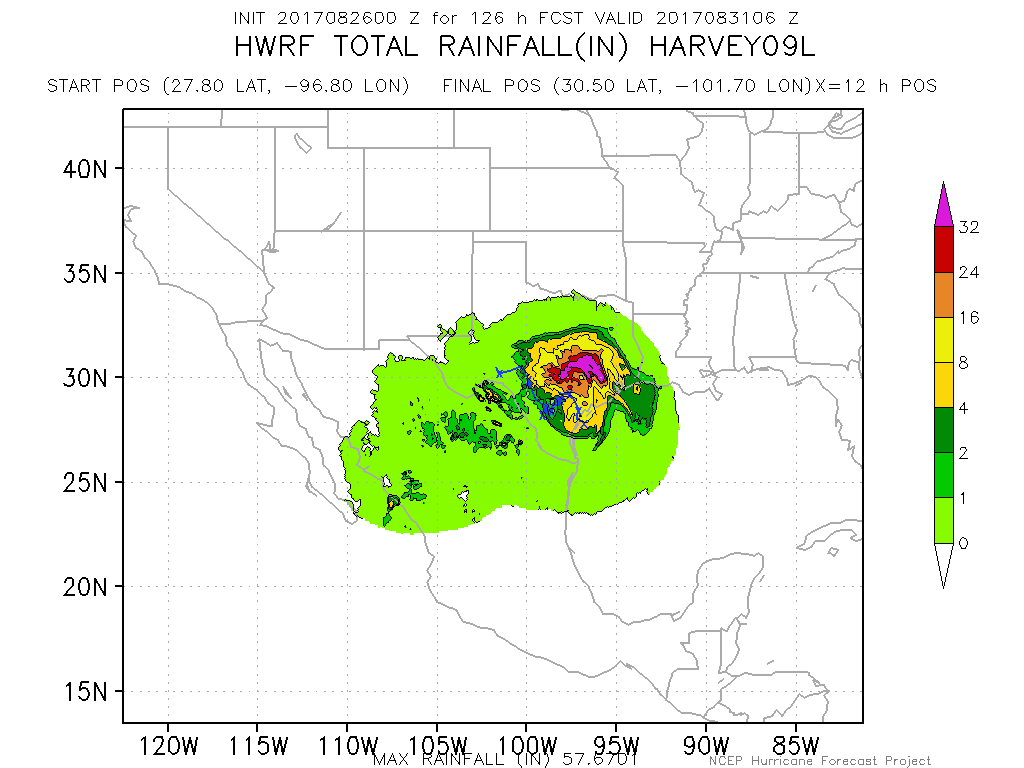
But its worst feature is still to come: several days of what could be some of the most intense rainfall this nation has ever recorded, a clear signal of climate change.

After a destructive storm surge washed away homes, and winds as strong as 132 mph blew away roofs and left hundreds of thousands without power, Harvey is expected to stall, drastically worsening the risk of catastrophic inland flooding from relentless rains.

As of Saturday morning, nearly 15 inches had already been recorded as bands of heavy thunderstorms streamed onshore from the warm Gulf of Mexico, with at least five more days of heavy rain on the way.

Through mid-week, Harvey is expected to move at an exceedingly slow 1 mph, pushing its rainfall forecast off the charts. For the first time in its history, the National Weather Service is forecasting seven-day rainfall totals as high as 40 inches in isolated pockets — equal to what’s normally a year’s worth or rain for coastal Texas.

Some high-resolution models predict even more. (For reference, the estimated 1-in-100-year seven-day rainfall total for the region is just 18 inches.) Meteorologist Ryan Maue estimated that 20 trillion gallons of water will fall on Texas over the next seven days, which is equal to about one-sixth of Lake Erie.

Virtually every river and stream between San Antonio and Houston is expected to experience record or near-record flooding over the next few days. Forecasters racked their brains to recall a scenario so dire anywhere in the world; a 2015 typhoon hitting the Philippines produced a similar amount of rain, but over a much smaller area.

Although the exact impact of global warming on the strength and frequency of hurricanes remains undetermined, there’s a clear climate connection when it comes to higher rainfall. All thunderstorms, including hurricanes, can produce more rain in a warmer atmosphere, which boosts the rate of evaporation and the water-holding capacity of clouds.

Heavy downpours have increased by 167 percent in Houston since the 1950s, and flooding there has been heightened by unfettered development and urban expansion. Some of the worst flooding in the region’s history has come from slow-moving storms like Harvey.

We don’t yet know if climate change will bring more slow-moving, rapidly intensifying tropical storms like Harvey. But flooding is what kills most people in hurricanes, and that will only get worse.

Taken from: 

Hurricane Harvey will bring some of the heaviest downpours anyone has ever seen

Posted in alo, Anchor, FF, G & F, GE, ONA, Pines, ProPublica, solar, Uncategorized | Tagged , , , , , , , , , | Comments Off on Hurricane Harvey will bring some of the heaviest downpours anyone has ever seen

Trump’s proposed cuts to weather research could make it much harder to prepare for storms

This story was originally published by Newsweek and is reproduced here as part of the Climate Desk collaboration.

Hurricane Harvey is strengthening as it approaches the Texas coast, and the massive storm is underscoring another big disturbance on the way: the battle over President Donald Trump’s proposed cuts to the National Weather Service.

Charged with providing weather forecasts and warnings, the National Weather Service also makes its data available to hundreds of companies that use it for everything from smartphone applications to agricultural equipment. Trump earlier this year proposed cutting its budget by 6 percent and that of its parent agency, the National Oceanographic and Atmospheric Administration (NOAA), by a mammoth 16 percent. It was an unprecedented proposal in the National Weather Service’s storied history, which extends back to 1890, when it was founded as the U.S. Weather Bureau.

Trump also proposed huge subcuts for programs that engage in computer modeling of storms, as well as observation of storms and dissemination of data. Tsunami research and prediction would be cut, along with supercomputing investments and a program to extend more accurate modeling to 30 days from 16, which could have huge benefits for everything from the insurance to the transportation industries.

The Trump proposal “is opposite to the ‘leave it better than you found it’ philosophy. This is take the money while you can, and let someone else in the future put Humpty Dumpty (aka NOAA) together again,” David Titley, director of the Center for Solutions to Weather and Climate Risk at Penn State and a retired Navy rear admiral, told Climate Central, a consortium.

Already, the U.S. is behind Europe in its forecast accuracy, and further cuts to research would likely leave the country farther behind in what’s been called “climate intelligence.” The National Weather Service’s main forecasting model, the Global Forecasting System, has seen a major drop-off in accuracy. The White House’s budget proposal would only make it worse. It seeks to cut 26 percent from NOAA’s Office of Oceanic and Atmospheric Research, which supports data collection, climate and science, as well as research into more accurate weather forecasting models. The budget blueprint also would cut $513 million from NOAA’s satellite division, the National Environmental Satellite, Data and Information Service, a 22 percent reduction.

Such cuts would cripple NOAA’s ability to keep afloat its satellites and data-gathering activities. That would not only affect the military but any business that relies on data and governments that have to plan how to handle snowstorms and hurricanes.

Scientists and meteorologists have worried that the cuts, and much more devastating reductions in climate change programs at NASA and other agencies, would harm the agency’s ability to forecast storms. In recent decades, the improvement in forecasting technologies has saved hundreds of lives, especially when it comes to tornadoes. The National Weather Service notes that hundreds used to die from pop up tornadoes like the ones that blew through Oklahoma in the mid-1970s, and that deaths are way down due to accurate predictions.

Harvey, which was just upgraded to a Category 3 hurricane, the first of that strength in more than 11 years, illustrates the point. The deadliest hurricane in U.S. history, which hit Galveston, Texas, in the year 1900, led to 6,000 to 12,000 deaths. By contrast, 72 deaths were associated with Superstorm Sandy in 2012 and fewer than 2,000 with Hurricane Katrina in 2005.

James Franklin, who headed the hurricane forecast team at the National Hurricane Center in Miami, a part of the National Weather Service, laments the budget cuts that are being proposed, including to the Hurricane Forecast Improvement Program that was launched in 2009. “It’s hanging on really by a thread in terms of funding,” said Franklin.

Trump has yet to nominate an administrator to lead NOAA. By contrast, President Barack Obama had named his pick before his 2009 swearing in. Speculation has centered on Barry Myers, the CEO of Accuweather — a weather business — but he is not a scientist.

A Senate panel passed smaller cuts to NOAA; the cuts by the House panel were significantly closer to President Trump’s proposed reductions. By the time a new budget is due in October, the country will be deep into hurricane season — as well as the fiscal budget storm.

View article: 

Trump’s proposed cuts to weather research could make it much harder to prepare for storms

Posted in alo, Anchor, FF, G & F, GE, ONA, solar, Uncategorized | Tagged , , , , , , , , , , | Comments Off on Trump’s proposed cuts to weather research could make it much harder to prepare for storms