Tag Archives: astronomy

A Space-Based Telescope for the People Wants Your Support

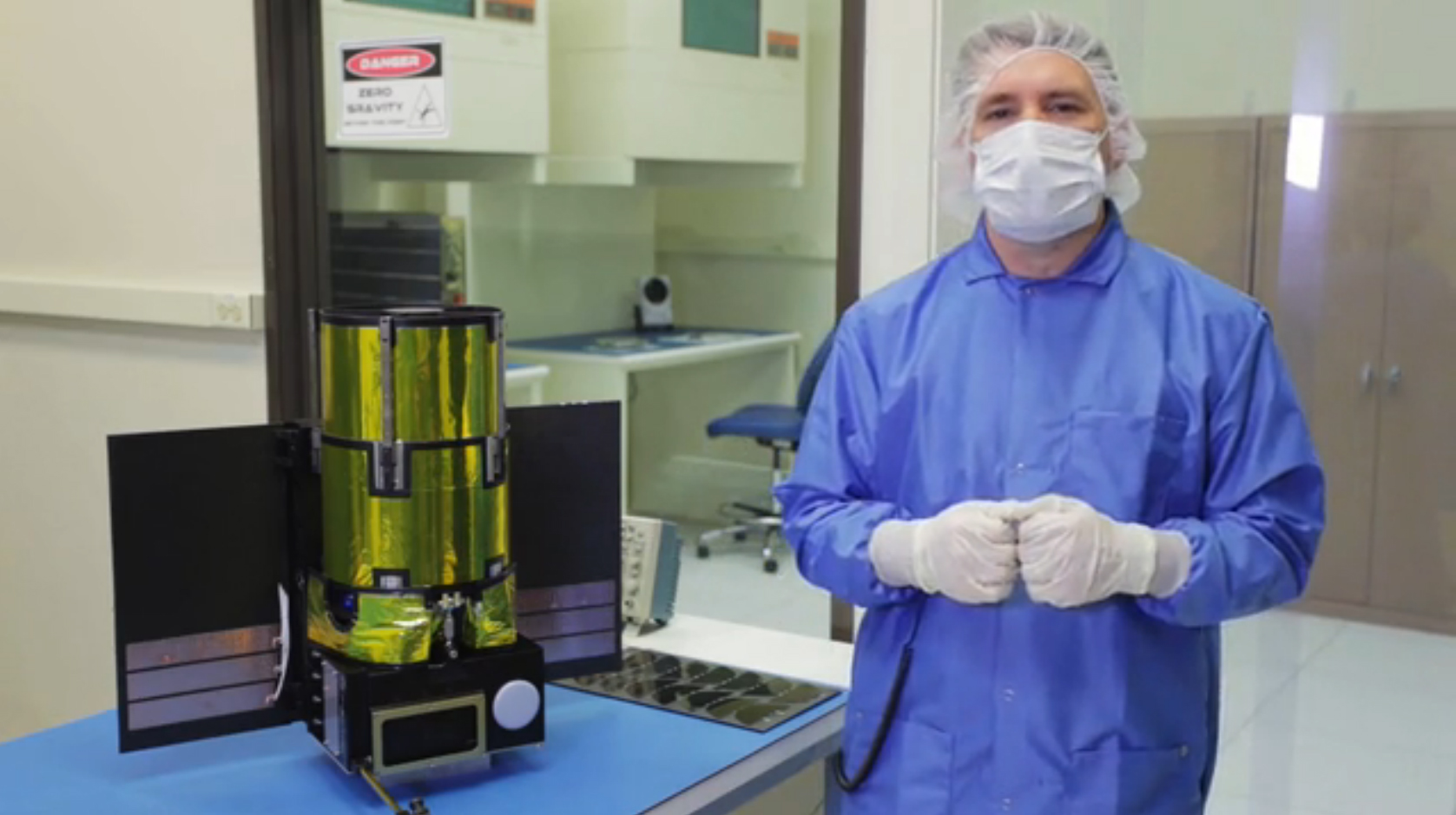
Planetary Resources president Chris Lewicki stands next to the Arkyd space telescope. Photo: Planetary Resources

In just a few short days, Planetary Resources, a fledgling space mining company, has raised more than $500,000 from the fine citizens of the world for their project to put a small space telescope into orbit around the Earth—one that would be controllable by regular folks down on the ground. With the telescope, a 200 millimeter orbiting telescope known as the Arkyd, you’d be able to take photos of the planet, of the stars, or of the other awesome things poking around in the solar system.

The team is looking to raise $1,000,000, and with 30 days left to go on their Kickstarter fundraiser it seems likely they’ll hit the mark.

The telescope’s big selling point for those not interested in doing planetary sciences is the option for you to take a “space selfie.” The Arkyd has a little camera pointing at a little screen aboard the telescope. With the selfie-cam, you’ll be able to take a photo of the screen with the cosmos as a backdrop. On the screen, you can display a photo, a graphic, whatever you want.

The project is being put together by Planetary Resources, a company whose main purpose is to mine asteroids for minerals. So, as cool as it is, the Arkyd kickstarter is sort of like paying De Beers to take you on a safari. Check out their slick promotional video:

According to the Economist, the relatively cheap $1 million price tag of the space telescope is enabled by a two trends:

The revolution has been made possible by two developments: the realisation of long dreamt-of nanosatellites that pack control systems, solar panels, scientific instruments, communications and computing gear into devices little larger than a mobile phone; and crowd-funding websites that turn the public’s enthusiasm for space into viable businesses.

Aside from taking space selfies, you can buy time on the telescope for schools and museums. Planetary Resources’ goal with the for-the-people telescope is to encourage enthusiasm for space research.

People care about stuff they can participate in,” says Peter Diamandis, co-founder of Planetary Resources. “Space for the last 50 years has been non-participatory. This is making space cooler and more fun.” The risk that fun might supplant function is something Mr Diamandis rejects. He is adamant that providing a “photo booth in space” will not detract from Planetary Resources’ primary aim of prospecting for minernal-rich near-Earth asteroids.

More from Smithsonian.com:

To the Asteroids and Beyond
What Can We Do About Big Rocks From Space?
International Space Station Cameras Will Bring Earth to You, Live, 24/7

More: 

A Space-Based Telescope for the People Wants Your Support

Posted in Citizen, FF, GE, ONA, PUR, solar, solar panels, Uncategorized | Tagged , , , , , , , , | Comments Off on A Space-Based Telescope for the People Wants Your Support

You’ll Want to Watch Today’s Solar Eclipse Create a Gorgeous ‘Ring of Fire’

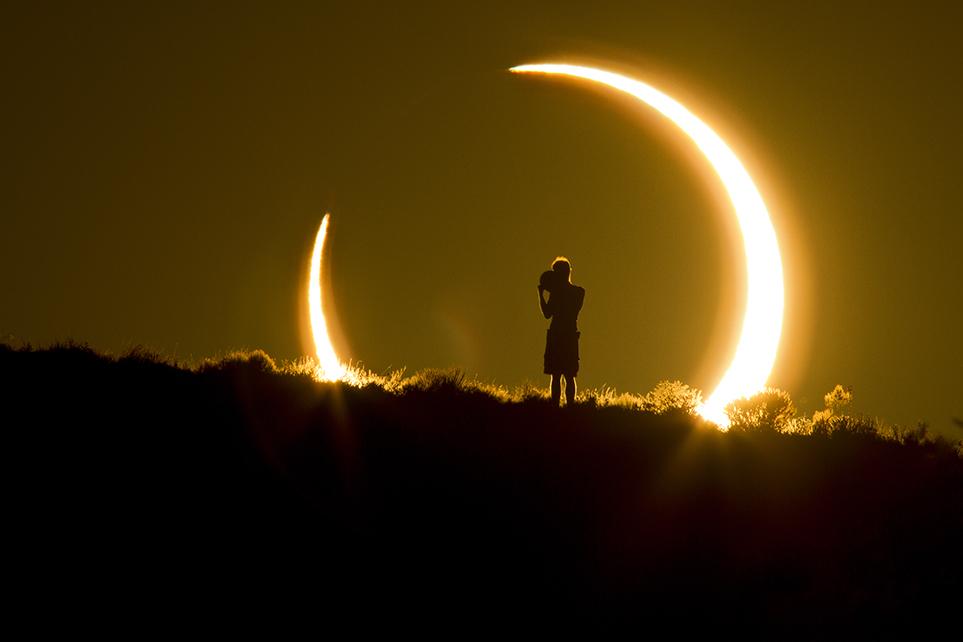
A partial solar eclipse in Albuquerque, New Mexico as photographed by Colleen Pinski. This photo was one of the finalists in Smithsonian’s annual photo contest. Photo: Colleen Pinski

Technically, this partial solar eclipse—which will produce this stunning “ring of fire”— will occur as the early morning Sun rises on Friday in Australia. But for those of us in North America, the spectacle will play out this evening starting around 6:30 pm on the East coast.

If you’re in Australia or the Philippines, enjoy the show. But if you’re not and still want to watch, you can tune in to the Slooh Space Camera to watch the whole thing live.

This is only a partial solar eclipse, so there will still be a bit of bright sun poking around the dusk of the Moon. This is what gives it the moniker “ring of fire.” For an idea of what you’re in for if you decide to turn into the Slooh feed, here is a video shot during last year’s similar eclipse.

More from Smithsonian.com:

The 10th Annual Photo Contest Finalists
A Solar Eclipse, As Seen From the Surface of Mars

View article:

You’ll Want to Watch Today’s Solar Eclipse Create a Gorgeous ‘Ring of Fire’

Posted in G & F, GE, Pines, solar, Uncategorized | Tagged , , , , , , , | Comments Off on You’ll Want to Watch Today’s Solar Eclipse Create a Gorgeous ‘Ring of Fire’

Scientists Just Recorded the Brightest Explosion We’ve Ever Seen

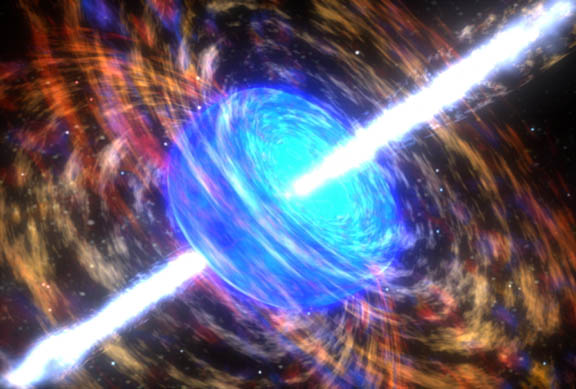
When a huge star collapses in a supernova, it can produce a gamma-ray burst, spires of tightly-concentrated energy shooting from the dying star. Photo: NASA

A star being ripped to shreds in a violent supernova is one of the most powerful explosions in the universe. The largest supernovae can produce gamma-ray bursts: a tightly concentrated lance of light that streams out into space. Gamma-ray bursts, says NASA, “are the most luminous and mysterious explosions in the universe.”

The blasts emit surges of gamma rays — the most powerful form of light — as well as X-rays, and they produce afterglows that can be observed at optical and radio energies.

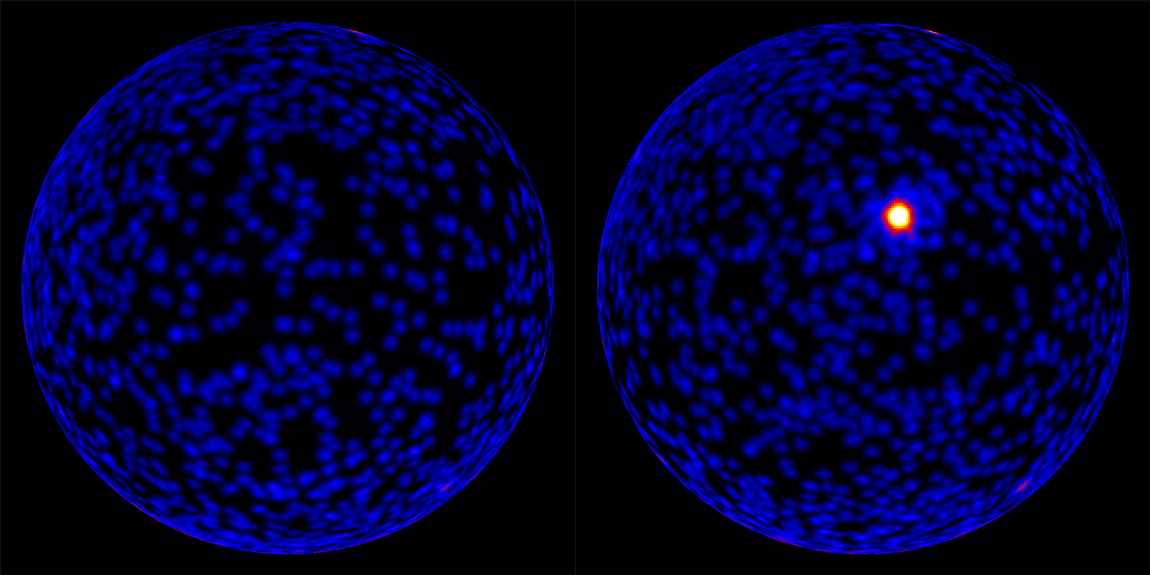
Two weeks ago, says NASA, astronomers saw the longest and brightest gamma-ray burst ever detected. It was the biggest shot of energy we’ve ever seen, streaming from the universe’s most powerful class of explosions. NASA:

“We have waited a long time for a gamma-ray burst this shockingly, eye-wateringly bright,” said Julie McEnery, project scientist for the Fermi Gamma-ray Space Telescope at NASA’s Goddard Space Flight Center in Greenbelt, Md.

“The event, labeled GRB 130427A, was the most energetic gamma-ray burst yet seen, and also had the longest duration,” says Matthew Francis for Ars Technica. “The output from GRB 130427A was visible in gamma ray light for nearly half a day, while typical GRBs fade within a matter of minutes or hours.”

The gamma-ray burst was a stunningly bright spot against the background gamma ray radiation. Photo: NASA

There are a few different of classes of gamma-ray bursts in the world. Astrophysicists think that some—short gamma-ray bursts—form when two neutron stars merge and emit a pulse of energy. Huge ones like the one just detected are known as long gamma-ray bursts, and they form when huge stars collapse, often leading to the formation of a black hole.

Gamma-ray bursts focus their energy in a tightly-concentrated spire of energy. A few years ago, says Wired, researchers calculated what would happen if a gamma-ray burst went off nearby, and was pointed at the Earth.

Steve Thorsett of Princeton University has calculated the consequences if such a merger were to take place within 3,500 light-years of Earth, with its energy aimed at the solar system. The blast would bathe Earth in the equivalent of 300,000 megatons of TNT, 30 times the world’s nuclear weaponry, with the gamma-ray and X-ray radiation stripping Earth of its ozone layer.

While scientists cannot yet predict with any precision which nearby stars will go supernova, the merger of neutron star binaries is as predictable as any solar eclipse. Three such binary systems have been discovered, and one, PSR B1534+12, presently sits about 3,500 light-years away and will coalesce in a billion years.

More from Smithsonian.com:

Hubble’s Ugliest Photographs
Astronomers Discover Baby Supernovae

This article:

Scientists Just Recorded the Brightest Explosion We’ve Ever Seen

Posted in FF, GE, solar, Uncategorized | Tagged , , , , , , , , , , | Comments Off on Scientists Just Recorded the Brightest Explosion We’ve Ever Seen

Eclipses Look Even More Gorgeous From Outer Space

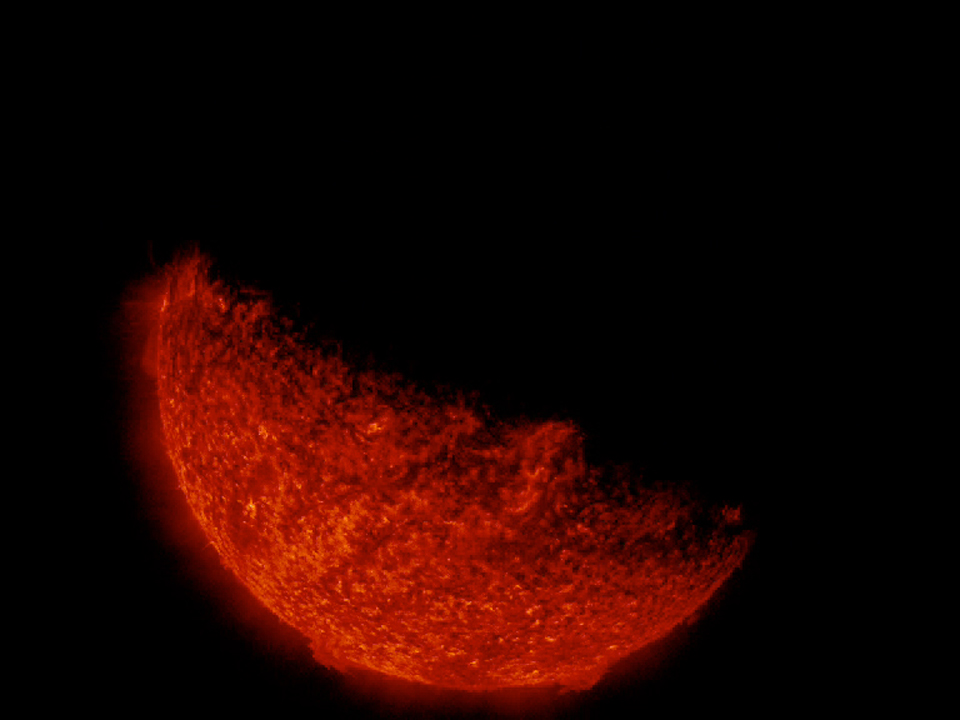
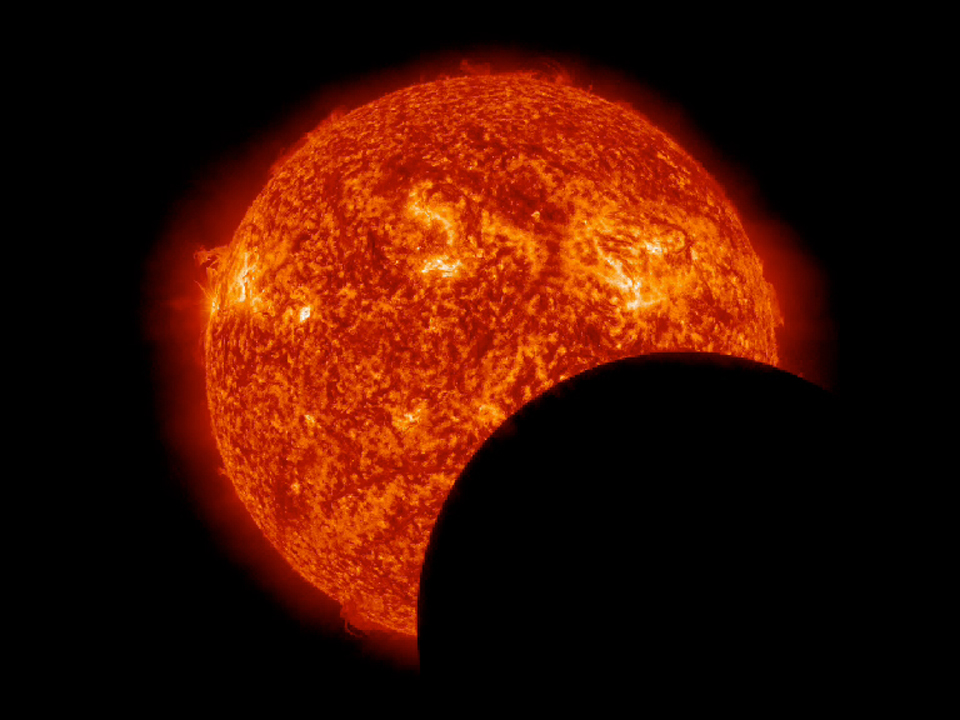
High in orbit above the Earth, the Solar Dynamics Observatory watches the Sun year-round, providing stunning stellar views that go unbroken except during a few special times each year. Because the SDO stays relatively fixed over one part of the planet in a geosynchronous orbit, the satellite goes through two annual “eclipse seasons.” For a few weeks twice each year, part of SDO’s view each day will be blocked by the Earth. And, three times a year, the Moon will get in the way.

Though a bit of a pain for the scientists trying to study the Sun, these orbital quirks provide some beautiful unintended consequences: gorgeous photos of an eclipse from space. Yesterday, NASA released photos and video of that day’s double whammy, a single day that saw both a terrestrial and lunar eclipse.

Earth passes in front of the Sun, from the perspective of the SDO satellite. Photo: NASA/SDO

One beautiful feature to notice is the apparent fuzziness of the Earthly eclipse. According to NASA, this is because of Earth’s atmosphere. The Moon, for the same reason, appears as a sharp disk.

When Earth blocks the sun, the boundaries of Earth’s shadow appear fuzzy, since SDO can see some light from the sun coming through Earth’s atmosphere. The line of Earth appears almost straight, since Earth — from SDO’s point of view — is so large compared to the sun.

The eclipse caused by the moon looks far different. Since the moon has no atmosphere, its curved shape can be seen clearly, and the line of its shadow is crisp and clean.

The Moon’s silhouette, by contrast, is much crisper. Photo: NASA/SDO

More from Smithsonian.com:

A Solar Eclipse, As Seen From the Surface of Mars

Read More: 

Eclipses Look Even More Gorgeous From Outer Space

Posted in GE, Uncategorized | Tagged , , , , , , , , , | Comments Off on Eclipses Look Even More Gorgeous From Outer Space

Life on Earth May Have Been Seeded by Comets

Image: Michael Karrer

One of the oldest questions on earth is how all this crazy life started. Where did you come from? How about your office plant, or your cat? For a long time, our only working idea was that gods from the heavens had provided the seed of life. We may, at least, have been looking into the correct direction: researchers at UC Berkeley recently added evidence to the idea that life on Earth came from a comet.

The idea goes like this: the so-called “building blocks of life” on this planet are called dipeptides. And the real mystery is where these dipeptides came from. The Berkeley scientists’ research suggests that dipeptides could have formed on interplanetary dust and been carried down to earth on a comet. Berkeley writes:

Chemists from the University of California, Berkeley, and the University of Hawaii, Manoa, showed that conditions in space are capable of creating complex dipeptides – linked pairs of amino acids – that are essential building blocks shared by all living things. The discovery opens the door to the possibility that these molecules were brought to Earth aboard a comet or possibly meteorites, catalyzing the formation of proteins (polypeptides), enzymes and even more complex molecules, such as sugars, that are necessary for life.

Or, in the paper itself, the authors put it this way:

Our results indicate that the radiation-induced, non-enzymatic formation of proteinogenic dipeptides in interstellar ice analogs is facile. Once synthesized and incorporated into the ”building material” of solar systems, biomolecules at least as complex as dipeptides could have been delivered to habitable planets such as early Earth by meteorites and comets, thus seeding the beginning of life as we know it.

They figured this out by making a mini-comet in the lab. Combining carbon dioxide, ammonia and other chemicals like methane at super cold temperatures (space is pretty cold), they created a tiny comet-like thing. Then they added the lab equivalent of cosmic rays, zapping the mini-comet with electrons. What they saw was that the combination of these high energy electrons and the comet they had built created organic molecules like amino acids and dipeptides.

The idea is that this reaction happened on its own in space, and those dipeptides were carried down to earth on that icy comet. In other words, the necessary blocks of life might really have descended to Earth from the sky.

More from Smithsonian.com:

The Origins of Life

Original article:

Life on Earth May Have Been Seeded by Comets

Posted in alo, Down To Earth, GE, Uncategorized | Tagged , , , , , , , , , | Comments Off on Life on Earth May Have Been Seeded by Comets

Assembling a Sandwich in Spaaaaaaace!

Food tray on the shuttle. Image: NASA

Canadian Astronaut Chris Hadfield has been described as “the International Space Station’s ambassador to the internet.” He’s made videos about nail clipping, hand washing, and adapting to weightlessness. Now, he’s showing you how to make a sandwich.

The Canadian Space Agency describes some of the solutions to the challenges presented by eating in space:

Astronauts consume mostly wet and sticky foods such as oatmeal, scrambled eggs, puddings and stews because they stick to an eating utensil long enough for the astronaut to put into their mouth. Foods like bread are rejected because they produce crumbs that can float around; tortillas, on the other hand, are perfect for eating in freefall. Salt and pepper are also consumed, but the salt must be dissolved into water and the pepper suspended in oil.

The CSA also had a contest for Canadian foods to go into space, bringing along things like Les Canardises Duck Rillettes, SeaChange Candied Wild Smoked Salmon, L.B. Maple Treat Maple Syrup Cream Cookies and Turkey Hill Sugarbush Maple Syrup.

In the United States, NASA has a food lab that researchers foods for space consumption. They test things like how many calories astronauts need, and how to actually package and store them. Last year, they tested some new foods for space missions.

But remember, in space, no one can hear you scream for ice cream.

More from Smithsonian.com:

Solar System Lollipops And Other Food That Looks Like Things
Inviting Writing: Lost Cereal, Kool-Aid and Astronaut Food

See the original article here – 

Assembling a Sandwich in Spaaaaaaace!

Posted in alo, GE, Uncategorized | Tagged , , , , , , | Comments Off on Assembling a Sandwich in Spaaaaaaace!