Tag Archives: china

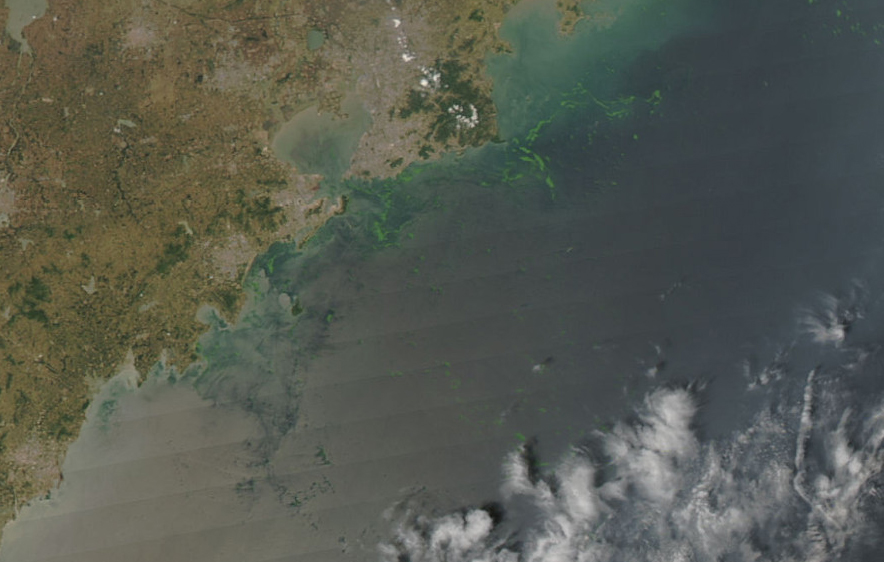
China’s Massive Algae Bloom Could Leave the Ocean’s Water Lifeless

Algae in the Yellow Sea near Qingdao in 2008. Photo: MODIS Rapid Response Team / Earth Observatory

It’s become an annual affair, the rafts of green algae washing up on the shores of Qingdao, China. Since 2007, massive algae blooms in the Yellow Sea have been fueled, scientists think, by “pollution and increased seaweed farming” south of Qingdao. The mats of photosynthetic phytoplankton aren’t dangerous to people (unless you count ruining a day at the beach as dangerous), but the return of these massive algae blooms year after year could be troubling for the marine creatures living in the Yellow Sea.

“The carpet on the surface can dramatically change the ecology of the environment beneath it,” says the Guardian. “It blocks sunlight from entering the ocean and sucks oxygen from the water suffocating marine life.”

Vast blooms of algae can cause the water to become “hypoxic,” to have the concentration of oxygen in the water drawn down so low that it makes it uninhabitable for many marine creatures. A strong case of hypoxia can further lead to something called a “dead zone.” And, by drawing down the oxygen levels and messing with the chemistry of the water, algae blooms can temporarily amplify ocean acidification. The National Oceanic and Atmospheric Administration explains how algae blooms lead to dead zones:

Such recurring, annual algae blooms like the one in Qingdao aren’t limited to China’s Yellow Sea, either. According to Scientific American, there are at least 405 dead zones around the world. One of the worst in the world is the one in the Gulf of Mexico, where this year researchers with NOAA expect around 8,000 square miles of the Gulf to be oxygen depleted—a patch of ocean about the size of New Jersey, says National Geographic. If the bloom lives up to expectations, this year’s would be the largest dead zone in the Gulf on record.

So while China’s algae problem may be making a mess for swimmers, it’s the life beneath the waves that may be hurting the most.

More from Smithsonian.com:
A Swim Through the Ocean’s Future
Arctic Algae Infiltration Demonstrates the Effects of Climate Change

From:  

China’s Massive Algae Bloom Could Leave the Ocean’s Water Lifeless

Posted in FF, GE, LG, ONA, Uncategorized | Tagged , , , , , , , | Comments Off on China’s Massive Algae Bloom Could Leave the Ocean’s Water Lifeless

Dot Earth Blog: 90 Degrees + A.C. + Open Doors = Hamptons Energy Policy?

In a rich Long Island summer resort, businesses blast the A/C with doors wide. See original article: Dot Earth Blog: 90 Degrees + A.C. + Open Doors = Hamptons Energy Policy? Related Articles 90 Degrees + A.C. + Open Doors = Hamptons Energy Policy? Dot Earth Blog: A Song for the Fallen on Independence Day A Song for the Fallen on Independence Day

Original article:

Dot Earth Blog: 90 Degrees + A.C. + Open Doors = Hamptons Energy Policy?

Posted in ALPHA, eco-friendly, FF, For Dummies, G & F, GE, growing marijuana, horticulture, LG, Monterey, ONA, Pines, solar, solar power, Uncategorized, wind energy | Tagged , , , , , , , , , | Comments Off on Dot Earth Blog: 90 Degrees + A.C. + Open Doors = Hamptons Energy Policy?

Full Planet, Empty Plates: Chapter 4. Food or Fuel?

green4us

Paracord Fusion Ties – Volume 1 – J.D. Lenzen

J.D. Lenzen is the creator of the highly acclaimed YouTube channel “Tying It All Together”, and the producer of over 200 instructional videos. He’s been formally recognized by the International Guild of Knot Tyers (IGKT) for his contributions to knotting, and is the originator of fusion knotting-innovative knots created through the merging of […]

iTunes Store
The Art of Raising a Puppy (Revised Edition) – Monks of New Skete

For more than thirty years the Monks of New Skete have been among America’s most trusted authorities on dog training, canine behavior, and the animal/human bond. In their two now-classic bestsellers, How to be Your Dog’s Best Friend and The Art of Raising a Puppy, the Monks draw on their experience as long-time breeders of German shepherds and as t […]

iTunes Store
Kids Puzzle Fun #1 – Lovatts Crosswords & Puzzles

Junior puzzlers will enjoy hours of quality entertainment with the first issue of Kids Puzzle Fun! This interactive book features ‘Magic Touch’ drawing tools, allowing kids to solve the puzzles by using their finger as a pen. Magic Touch unites the tactile feel of a printed book with a superior digital format, resulting in a more natural, intuitive experienc […]

iTunes Store
Codex: Tau Empire – Games Workshop

Codex: Tau Empire is your comprehensive guide to unleashing the might of the Tau upon the battlefields of the 41 st Millennium. This volume introduces the four Tau castes, the Ethereals, and their mercenary allies. This dynamic race has begun its Third Sphere Expansion, setting forth into the stars to grow the borders of their burgeoning empire and bring the […]

iTunes Store
How to Raise the Perfect Dog – Cesar Millan & Melissa Jo Peltier

From the bestselling author and star of National Geographic Channel’s Dog Whisperer , the only resource you’ll need for raising a happy, healthy dog. For the millions of people every year who consider bringing a puppy into their lives–as well as those who have already brought a dog home–Cesar Millan, the preeminent dog behavior expert, says, “Yes, […]

iTunes Store
The Cannabis Grow Bible – Greg Green

The definitive guide to growing marijuana just got better! Greg Green’s original Cannabis Grow Bible set a new standard for handbooks on cannabis horticulture and established Green as the leading authority in the field. Green’s comprehensive and professionally presented work on how to cultivate superior cannabis struck a chord with beginner, amateur and prof […]

iTunes Store
Inside of a Dog – Alexandra Horowitz

The bestselling book that asks what dogs know and how they think, now in paperback. The answers will surprise and delight you as Alexandra Horowitz, a cognitive scientist, explains how dogs perceive their daily worlds, each other, and that other quirky animal, the human. Horowitz introduces the reader to dogs’ perceptual and cognitive abilities and then draw […]

iTunes Store
A Big Little Life – Dean Koontz

NEW YORK TIMES BESTSELLER In a profound, funny, and beautifully rendered portrait of a beloved companion, bestselling novelist Dean Koontz remembers the golden retriever who changed his life. A retired service dog, Trixie was three when Dean and his wife, Gerda, welcomed her into their home. She was superbly trained, but her greatest gifts couldn’t be taught […]

iTunes Store
Trident K9 Warriors – Michael Ritland & Gary Brozek

As Seen on “60 Minutes”! As a Navy SEAL during a combat deployment in Iraq, Mike Ritland saw a military working dog in action and instantly knew he’d found his true calling. Ritland started his own company training and supplying dogs for the SEAL teams, U.S. Government, and Department of Defense. He knew that fewer than 1 percent of […]

iTunes Store
Gardening Basics For Dummies, Mini Edition – Steven A. Frowine & National Gardening Association

Your green-thumb guide to planning, planting, and cultivating a garden With some basic knowledge, the right tools, and a little work, anyone can transform a boring old yard into a beautiful garden. This friendly guide tells you how. From improving your soil to selecting plants and caring for them, you get just the information you need to start playing in the […]

iTunes Store

Link to article – 

Full Planet, Empty Plates: Chapter 4. Food or Fuel?

Posted in ALPHA, eco-friendly, FF, For Dummies, G & F, GE, growing marijuana, horticulture, LG, Monterey, ONA, Pines, solar, solar power, Uncategorized | Tagged , , , , , , , , | Comments Off on Full Planet, Empty Plates: Chapter 4. Food or Fuel?

U.S. and World Bank might stop financing dirty coal plants

U.S. and World Bank might stop financing dirty coal plants

Hunter Hogan

Coal processing in China.

The World Bank says it cares about climate change, so why is it providing loans to help developing countries build coal power plants? Same goes for America’s support for coal plants abroad.

In recognition of this glaring climate policy disconnect, both the World Bank and the Obama administration appear to be finally backing away from  financial support of such dirty energy enterprises.

From Bloomberg:

The World Bank plans to restrict its financing of coal-fired power plants to “rare circumstances,” according to a draft strategy that reflects the lender’s increased focus on mitigating the effects of climate change.

The Washington-based lender will help countries find alternatives to coal, according to the draft obtained by Bloomberg News which lays out the bank’s policy on lending to its member countries. The paper, which is subject to revision, describes universal access to energy as a priority for the World Bank’s mission to help end poverty.

The bank “will cease providing financial support for greenfield coal power generation projects, except in rare circumstances where there are no feasible alternatives available to meet basic energy needs and other sources of financing are absent,” according to the report. Greenfield is a term for a new facility. …

The World Bank, which lends to the developing and emerging economies among its 188 members countries, committed $8.2 billion to finance energy projects in the 12 months through June 2012, according to its website. Of that, $3.6 billion was for renewable energy.

But agreement on the proposal by the bank’s board is no sure thing, The Washington Post warned:

In the past, proposals to restrict coal finance have been blocked by countries like China. But the vision fits with World Bank President Jim Yong Kim’s push to address climate change. The lender hasn’t funded a coal project since offering South Africa a $3 billion loan in 2010 to build a large power plant near Johannesburg.

The Post points out that Obama’s recent climate change speech included a little-noted reference to a similar policy shift in the U.S. From the same article:

“Today, I’m calling for an end to public financing for new coal plants overseas unless they deploy carbon-capture technologies, or there’s no other viable way for the poorest countries to generate electricity,” Obama said in his speech at Georgetown University on Tuesday.

Those restrictions will most heavily affect the U.S. Export-Import Bank, a government-backed lender that acts to boost American sales overseas. Over the past five years, the bank has provided aid for a handful of large coal plants, including $805 million for a 4,800-megawatt plant in South Africa and $917 million for a 4,000-megawatt facility in India. The lender said each of those loans helped support hundreds of American jobs, from engineers to coal miners.

And there’s at least one coal project currently in the pipeline: The Ex-Im Bank has been reviewing a proposal for a 1,200-megawatt plant in Vietnam.

Environmentalists have long criticized the federal government for providing billions to finance fossil-fuel projects overseas, particularly at a time when the United States has pledged billions in foreign aid to help developing countries deal with climate change.

The U.S. is taking important steps to cut its use of coal, but those efforts could be overshadowed unless coal use is curbed in India, China, and the rest of the world.

John Upton is a science fan and green news boffin who tweets, posts articles to Facebook, and blogs about ecology. He welcomes reader questions, tips, and incoherent rants: johnupton@gmail.com.

Find this article interesting? Donate now to support our work.Read more: Business & Technology

,

Climate & Energy

,

Politics

Also in Grist

Please enable JavaScript to see recommended stories

Link: 

U.S. and World Bank might stop financing dirty coal plants

Posted in Anchor, FF, G & F, GE, LG, ONA, solar, solar panels, solar power, Uncategorized | Tagged , , , , , , , , , | Comments Off on U.S. and World Bank might stop financing dirty coal plants

Kerry implores India to tackle climate change, ticks off Indian enviros

Kerry implores India to tackle climate change, ticks off Indian enviros

U.S. Embassy New Delhi

IPCC Chairman Rajendra Pachauri, an Indian, welcomes John Kerry. That’s America’s ambassador to India, Nancy Powell, in the background.

U.S. Secretary of State John Kerry arrived in India over the weekend and gave a speech urging the fast-developing country to work closely with the U.S. and other countries on solutions to climate change.

Kerry is leading a delegation to Delhi for U.S.-India talks focused on trade and energy; Energy Secretary Ernest Moniz is part of the visiting group. The stop in Delhi is one leg of a trip Kerry is making throughout the region.

The Americans’ arrival in Delhi coincided with deadly floods in northern India that some Indian officials have linked to global warming. But though climate change poses urgent dangers in India, Kerry’s speech was not received warmly by all of the nation’s environmentalists. Some felt they were being lectured to by the secretary of state, a representative of a nation that is second only to China in total greenhouse gas emissions.

Kerry has long warned of the dangers of climate change, and it’s been one of his favorite topics to discuss abroad since he was sworn in as Obama’s top diplomat. “Everywhere I travel as secretary of state — in every meeting, here at home and across the more than 100,000 miles I’ve traveled since I raised my hand and took the oath to serve in this office — I raise the concern of climate change,” he wrote just last week in an opinion piece in Grist.

Kerry’s speech in India was part of a broader push by the Obama administration on climate change. The U.S. recently struck a deal with China to cooperate on reducing heat-trapping HFC emissions, and the president is preparing to make a big climate announcement on Tuesday.

The New York Times reports on Kerry’s speech:

“I do understand and fully sympathize with the notion that India’s paramount commitment to development and eradicating poverty [by increasing electricity supplies] is essential,” Mr. Kerry said in a speech at the start of a two-day visit. “But we have to recognize that a collective failure to meet our collective climate challenge would inhibit all countries’ dreams of growth and development.”

In an effort to prod the Indians to act, Mr. Kerry warned that climate change could cause India to endure excessive heat waves, prolonged droughts, intense flooding and shortages of food and water.

“The worst consequences of the climate crisis will confront people who are the least able to be able to cope with them,” he said. …

Mr. Kerry also pleaded with India to commit to working constructively on a global treaty to be negotiated under the United Nations Framework Convention on Climate Change.

From Reuters:

Emerging economies like India have resisted pressure in global climate talks to commit to targets to reduce greenhouse gas emissions, in a dispute with rich nations over whose industries should bear the brunt of the cuts.

The 1.2 billion people who live in India use far less electricity than do Americans, but the nation’s growing economy and its dependance upon coal pose major global warming threats.

Chandra Bhushan, a senior official at the Delhi-based Centre for Science and Environment, was unimpressed by Kerry’s speech, as he explained in an opinion piece in Down to Earth, a leading Indian environmental magazine published by his nonprofit:

I have no problems with [Kerry’s] pitch for countries coming together to develop renewable energy. But I have issues with the fact that nowhere in his speech did he mention what the US is doing on renewable energy or what is the renewable energy target that the US has set for itself for, say 2020. The fact is that today close to 20 per cent of India’s electricity supply is from renewable sources (including hydropower). India has set itself a target for renewable energy; the US has not.

The US today is going the fossil fuel route. It is moving to shale gas big time. Kerry should know that this shale gas mania would destroy the renewable future of the world that he so fervently preached yesterday.

I found his speech hypocritical. He talked about how India should reduce its emissions from residential sector but gave the massive energy consumption in residential and commercial sectors in the US a convenient miss. The US is the largest consumer of HFCs in the world, but Kerry did not throw light on what the US is doing to phase out the highly potent greenhouse gas, and how quickly. While I agree that India should also phase out HFCs, … it should not be through a deal that only benefits American multinational companies.

Though Kerry’s comments might not have pleased everybody, they were delivered in a country that is being hit especially hard by global warming — and that needs to do more to tackle and adapt to it.

Climate change is causing India’s once-predictable monsoon to become erratic. It is pushing up temperatures in a region already known for its scorching summers. And it is melting glaciers that are relied upon by hundreds of millions of people for year-round water supplies.

Last year, the subcontinent’s annual summer monsoon arrived months late, parching farms and causing widespread blackouts by reducing hydroelectric supplies.

This year, the monsoon appears to have arrived early, and when it reached the country’s north, it collided with low-pressure troughs that had pushed unusually far south. That collision of weather systems triggered remarkable deluges. Resultant floods have killed at least 5,000 people in the Himalayan state of Uttarakhand. They also inundated Delhi’s international airport and pushed levels in the Yamuna River in the capital to their highest points since 1978.

Some Indian officials are saying climate change could be to blame for the flooding. There’s a paucity of scientific research into the possible effects of climate change on the nation, but some studies are underway. “We’re trying to assess the impacts of climate change on the regional climate and on the monsoons,” Indian Institute of Tropical Meteorology monsoon researcher Raghavan Krishnan told Grist. “We’re trying to look at extreme precipitation.”

While the research continues, it may be a good idea for India to take stock of the global warming impacts that are already understood and at least follow America’s lead by starting to break its nasty coal addiction.

John Upton is a science fan and green news boffin who tweets, posts articles to Facebook, and blogs about ecology. He welcomes reader questions, tips, and incoherent rants: johnupton@gmail.com.

Find this article interesting? Donate now to support our work.Read more: Climate & Energy

,

Politics

Also in Grist

Please enable JavaScript to see recommended stories

View post:  

Kerry implores India to tackle climate change, ticks off Indian enviros

Posted in alo, Anchor, bamboo, Down To Earth, FF, G & F, GE, LG, ONA, Uncategorized | Tagged , , , , , , , , , , , | Comments Off on Kerry implores India to tackle climate change, ticks off Indian enviros

Dot Earth Blog: Cell Phone Population Spike Catching up With Humans

Our main source of connectedness, mobile phones, could soon outnumber us. Visit source –  Dot Earth Blog: Cell Phone Population Spike Catching up With Humans ; ;Related ArticlesDot Earth Blog: Wild Moment: A Fawn Saved By Someone Else’s MomDot Earth Blog: The End Comes for a Troubled California Nuclear PlantWild Moment: A Fawn Saved By Someone Else’s Mom ;

See the original post: 

Dot Earth Blog: Cell Phone Population Spike Catching up With Humans

Posted in eco-friendly, FF, G & F, GE, Monterey, ONA, organic, organic gardening, solar, solar power, Uncategorized | Tagged , , , , , , , | Comments Off on Dot Earth Blog: Cell Phone Population Spike Catching up With Humans

Dot Earth Blog: With CO2 Cuts Tough, U.S. and China Pledge a Push on a Rarer Greenhouse Gas

The United States and China pledge to act together to cut releases of a potent greenhouse gas. View article: Dot Earth Blog: With CO2 Cuts Tough, U.S. and China Pledge a Push on a Rarer Greenhouse Gas Related Articles Dot Earth Blog: The End Comes for a Troubled California Nuclear Plant Dot Earth Blog: Urban Trees as Triggers, From Istanbul to Oregon With CO2 Cuts Tough, U.S. and China Pledge a Push on Another Greenhouse Gas

See more here: 

Dot Earth Blog: With CO2 Cuts Tough, U.S. and China Pledge a Push on a Rarer Greenhouse Gas

Posted in eco-friendly, FF, G & F, GE, Monterey, ONA, solar, solar power, Uncategorized | Tagged , , , , , , , | Comments Off on Dot Earth Blog: With CO2 Cuts Tough, U.S. and China Pledge a Push on a Rarer Greenhouse Gas

U.S. and China Pledge New Model of Cooperation

President Obama and President Xi Jinping of China ended two days of informal meetings, moving closer on pressuring a nuclear North Korea, but remaining divided over cyberespionage. More here – U.S. and China Pledge New Model of Cooperation Related Articles Prototype: Tech Accessories, Courtesy of the Mountain Pine Beetle The Texas Tribune: Experts Urge Focus on Aquifers in Push for Water From Mexico The Texas Tribune: Abandoned Oil Wells Raise Fears of Pollution

Visit link: 

U.S. and China Pledge New Model of Cooperation

Posted in eco-friendly, FF, G & F, GE, Monterey, ONA, solar, solar power, Uncategorized | Tagged , , , , , , , , | Comments Off on U.S. and China Pledge New Model of Cooperation

Dot Earth Blog: Urban Trees as Triggers, From Istanbul to Oregon

When leaders crack down in fights over scarce urban trees, trouble follows. Original post: Dot Earth Blog: Urban Trees as Triggers, From Istanbul to Oregon Related Articles Dot Earth Blog: The End Comes for a Troubled California Nuclear Plant Dot Earth Blog: With CO2 Cuts Tough, U.S. and China Pledge a Push on a Rarer Greenhouse Gas With CO2 Cuts Tough, U.S. and China Pledge a Push on Another Greenhouse Gas

Excerpt from – 

Dot Earth Blog: Urban Trees as Triggers, From Istanbul to Oregon

Posted in eco-friendly, FF, G & F, GE, Monterey, ONA, solar, solar power, Uncategorized | Tagged , , , , , , , , , , , | Comments Off on Dot Earth Blog: Urban Trees as Triggers, From Istanbul to Oregon

Dot Earth Blog: The End Comes for a Troubled California Nuclear Plant

Is the closure of a troubled nuclear power plant in California an anomaly or a sign of more to come? Read article here: Dot Earth Blog: The End Comes for a Troubled California Nuclear Plant Related Articles Dot Earth Blog: Urban Trees as Triggers, From Istanbul to Oregon Dot Earth Blog: With CO2 Cuts Tough, U.S. and China Pledge a Push on a Rarer Greenhouse Gas With CO2 Cuts Tough, U.S. and China Pledge a Push on Another Greenhouse Gas

See the original post: 

Dot Earth Blog: The End Comes for a Troubled California Nuclear Plant

Posted in eco-friendly, FF, G & F, GE, Monterey, ONA, solar, solar power, Uncategorized | Tagged , , , , , , , , , , | Comments Off on Dot Earth Blog: The End Comes for a Troubled California Nuclear Plant