Tag Archives: earth

Shell wins prestigious award for ineptitude

Shell wins prestigious award for ineptitude

Quick word of congratulations to our friends at Shell. Yesterday, the company was awarded the Public Eye People’s Award for 2013 — making it (as far as I can tell) the first two-time winner of this estimable honor, having also won in 2005.

What’s the Public Eye Award? From the website for this esteemed prize:

The Public Eye Awards mark a critical counterpoint to the annual meeting of the World Economic Forum (WEF) in Davos. Organized since 2000 by Berne Declaration and Friends of the Earth (in 2009 replaced by Greenpeace), Public Eye reminds the corporate world that social and environmental misdeeds have consequences – for the affected people and territory, but also for the reputation of the offender.

Emphasis added.

infomatique

Guilty … of winning awards!

And why did Shell earn top honors? (Well, alongside Goldman Sachs.) (I accidentally typed “Goldamn Sachs” and thought briefly about keeping that.)

Shell is always involved in particularly controversial, risky and dirty oil production projects. Thus, this Dutch-British corporation, chosen by online users for the public naming and shaming award, is also out in front in the highly risky search for fossil fuels in the fragile Arctic. This has been made possible by climate change and the disappearance of the Arctic ice cap, to which Shell has contributed. Every Arctic offshore oil project means new CO2 emissions. The Arctic’s oil reserves are enough for just three years. For this, Shell is jeopardising one of the Earth’s last natural paradises and endangering the living space of four million people, as well as unique fauna.

The celebratory announcement then walks through the company’s litany of 2012 screw-ups, with which you may already be familiar.

It’s not only Greenpeace that’s celebrating the company. Shell is also a finalist for a very, very, very prestigious (and presumably non-ironic) “Oil and Gas Award” from the oil and gas industry — one of only 130 oil and gas companies to be so named. So that’s pretty impressive, too.

While we don’t sit on the jury for either award, we think Shell deserves both. We are often hard on Shell, sometimes letting our dislike of rampant fossil-fuel extraction, our frustration with runaway oil consumption, our skepticism of rapacious profit-seeking while accepting federal subsidization color our perspective. But no company more deserves accolades from the industry that celebrates those traits and mockery from those who oppose them.

Here’s hoping they don’t repeat in 2014.

Philip Bump writes about the news for Gristmill. He also uses Twitter a whole lot.

Read more:

Business & Technology

,

Climate & Energy

Also in Grist

Please enable JavaScript to see recommended stories

Read this article:  

Shell wins prestigious award for ineptitude

Posted in GE, Uncategorized | Tagged , , , , , , , , , , | Comments Off on Shell wins prestigious award for ineptitude

Soot is the second-most dangerous global warming pollutant

Soot is the second-most dangerous global warming pollutant

When the EPA announced stricter limits on soot emissions last year, the health benefits were immediately apparent. Less soot — that is, tiny particles that result from burning fossil fuels — means fewer heart attacks, less asthma, longer lifespans. On this basis alone, the new standard is a beneficial move.

Soot and smoke in Pittsburgh during the early 1900s

As it turns out, the move could also play a significant role in countering global warming. Researchers have determined that black carbon (soot) contributes twice as much to global warming as previously understood. From the University of Washington:

Black carbon’s role in climate is complex. Dark particles in the air work to shade the Earth’s surface while warming the atmosphere. Black carbon that settles on the surface of snow and ice darkens the surface to absorb more sunlight and increase melting. Finally, soot particles influence cloud formation in ways that can have either a cooling or warming impact.

Last year, another team of researchers proposed a novel way to curb Arctic ice melt: halting airplane trips over the region. The black carbon emitted by trans-Arctic flights lingers in the atmosphere in the area longer than it does elsewhere.

Bloomberg.com outlines other effects:

The four-year study by more than two dozen researchers also showed that black carbon causes “significantly higher warming” over the Arctic and can affect rainfall patterns in high- emitting regions such as Asia. The pollutant also has contributed to rising temperatures in mid- to high-latitude areas including the U.S. and Canada.

The article (by the aptly named “Justin Doom”) notes that soot “trails only carbon dioxide as the most dangerous climate pollutant.”

Soot pollution won’t be a trivial problem to fix. A recent report suggested that some 1,200 new coal plants are planned around the world, and coal consumption for power production is a big generator of soot. Earlier this week, we noted that soot pollution in Beijing was spiking as electricity production increased, though levels have since receded. Diesel engines, another major contributor to black carbon pollution, pose another set of challenges.

Nonetheless, you can’t cure a disease until you diagnose it. Here’s our diagnosis: Soot is dangerous — in more ways than we knew.

Philip Bump writes about the news for Gristmill. He also uses Twitter a whole lot.

Read more:

Climate & Energy

,

Living

Also in Grist

Please enable JavaScript to see recommended stories

This article is from:

Soot is the second-most dangerous global warming pollutant

Posted in GE, LG, Uncategorized | Tagged , , , , , , , , , , | Comments Off on Soot is the second-most dangerous global warming pollutant

Idle No More: A primer on the indigenous green movement

Idle No More: A primer on the indigenous green movement

fifth_business

A December 30, 2012 round dance in Toronto.

Over the last three months, Idle No More has taken North America by storm, blocking roads and trains, and flash-mobbing in community squares and shopping malls (and being summarily arrested for it in some places).

The movement is a response to hundreds of years of environmental rape and pillage by European settlers, who have generally shown themselves to be shitty stewards of this land (okay, “shitty” is generous). So why now?

Well, why not?

Idle No More has been particularly outspoken against tar sands pipelines in Canada and the U.S. But the movement actually began this past fall in reaction to Canada’s effort to weaken the Navigable Waters Protection Act so that it would protect only 97 bodies of water; it currently safeguards tens of thousands of them. It’s expanded beyond Canada, but its roots are still up north.

Gyasi Ross at Indian Country wrote a primer on the movement, its motivations and its goals:

It’s not a Native thing or a white thing, it’s an Indigenous worldview thing. It’s a “protect the Earth” thing. For those transfixed on race, you’re missing the point. The Idle No More Movement simply wants kids of all colors and ethnicities to have clean drinking water.

Idle No More, though at times militant, has taken an explicitly non-violent tack. “We are here to ensure the land, the waters, the air, and the creatures and indeed each of us, return to balance and discontinue harming each other and the earth,” movement founders wrote on Monday. “To keep us on this good path, we ask that you, as organizers create space for Elders or knowledge/ceremonial keepers to assist in guiding decisions as we move forward. It is up to each of us to see that this movement respects all people, the environment, and our communities and neighbours.”

lafemmeforster

Idle No More is gearing up for another global day of action on January 28. “This day of action will peacefully protest attacks on Democracy, Indigenous Sovereignty, Human Rights and Environmental Protections when Canadian MPs return to the House of Commons on January 28th.” Protests are planned in Arizona, California, Colorado, New York, South Dakota, and across Canada.

Council of Canadians

Idle No More is in it for the long haul, but they’re a little sensitive to comparisons to that other decentralized grassroots movement that came and went over the last year. Ross again:

We’re Native… Hello? You’re not going to scare us off with the cold weather.

Or the riot cops’ hot pepper spray, I hope.

Susie Cagle writes and draws news for Grist. She also writes and draws tweets for

Twitter

.

Read more:

Climate & Energy

Also in Grist

Please enable JavaScript to see recommended stories

Link to article:  

Idle No More: A primer on the indigenous green movement

Posted in Citizen, Create Space, GE, LG, Uncategorized | Tagged , , , , , , , , | Comments Off on Idle No More: A primer on the indigenous green movement

Crunching the numbers: Will you see a white Christmas?

Crunching the numbers: Will you see a white Christmas?

calliope

There are two questions that arise at the end of every year. The first is: Did I fulfill all of my resolutions this year? And the answer to that is always no, unless you are lying to yourself. The second is: Will we have a white Christmas? And, pretty soon, that one’s going to always be no, as well. Unless you move to, say, Canada.

This year is one of the bubble years, a year in which a white Christmas is still possible. Yes, it’s warmer than usual — in fact, it’s the warmest year in American history — but the worst long-term effects of warming haven’t yet made December snowfall an improbability. So let’s ask the question.

Spoiler: For most of the country, the answer is always no. If you live in Miami, it likely never occurs to you to even ask it, unless the query comes up as you’re singing a Christmas carol. Angelenos, the same; snowfall is something to be visited on mountaintops, not seen in drifts around a palm tree.

For those for whom it’s possible, a secondary question: What constitutes a white Christmas? There are three options.

  1. Snow falling on Christmas
  2. Any amount of snow visible on the ground on Christmas
  3. A blanket of snow on the ground on Christmas

These are three very different things, requiring different conditions, appearing in decreasing order of likelihood. As a purist, I’ll insist that the third choice is what really constitutes a white Christmas, an amount of snow that deters going outside for long — an amount of snow that encourages the coziness of a warm house and a fire. Well, not a fire, given the carbon dioxide and particulate emissions. But you get my point.

The National Oceanic and Atmospheric Administration agrees with my vision of Christmas whiteness (so to speak). Here’s its map of the historic probability of an inch of snow on the holiday.

Click to embiggen.

I grew up in a bit of that dark purple stretch in western New York, hence my purism. If you find even a dusting of snow acceptable for your (lacking) standard, note that the odds of such snowfall are higher than the odds presented above. But also note that this is from data collected between 1981 and 2010, what I like to call “the old days.”

NOAA’s map doesn’t tell us anything about this year. So we turn to Weather.com’s white Christmas forecast.

Click to embiggen.

Weather.com, headquartered in Atlanta, uses the lowest standard for a white Christmas — any snowfall at all. And even under those conditions, it doesn’t look good for much of the country.

Being only a week out, we can get city-specific forecasts now. Such as for New York:

And Chicago:

And Denver:

Of those three, only Denver has a even shot at some snow, however little.

Incidentally, for those of you who took our comments at the beginning of this article to heart and had begun plans to move to our neighbor to the north, there’s no rush. Canada doesn’t look like it’s going to have a very white Christmas, either. From Smithsonian:

“We have this reputation. We are known as the Cold White North. But I don’t think we’re as cold and white as we once were,” said Environment Canada senior climatologist David Phillips to the [Canadian Press]. “Our reputation is being undermined. Winter is not … what it used to be. It was more of a done deal. It was more of a guarantee.”

During the 1960s, 70s, and 80s, says the CP, there was an 80% chance that it would be snowy on Christmas.

“Fast-forward to the last 20 years, and those odds on average have slipped to 65 per cent, according to Environment Canada.”

In short, then, there’s only one place on Earth where you can be guaranteed a white Christmas. No, not the Arctic circle (at least over the long term). Antarctica. That’s it. That’s your only option.

And if Antarctica stops offering a white Christmas, the holiday itself will probably have been abandoned in the transition to an ocean-based subsistence economy of nation-states constantly doing battle by outrigger canoe.

Merry Christmas, everyone!

Philip Bump writes about the news for Gristmill. He also uses Twitter a whole lot.

Read more:

Climate & Energy

,

Living

Also in Grist

Please enable JavaScript to see recommended stories

Taken from:

Crunching the numbers: Will you see a white Christmas?

Posted in GE, Uncategorized | Tagged , , , , , , , , , , , | Comments Off on Crunching the numbers: Will you see a white Christmas?

For the 36th November in a row, global temperatures were above average

For the 36th November in a row, global temperatures were above average

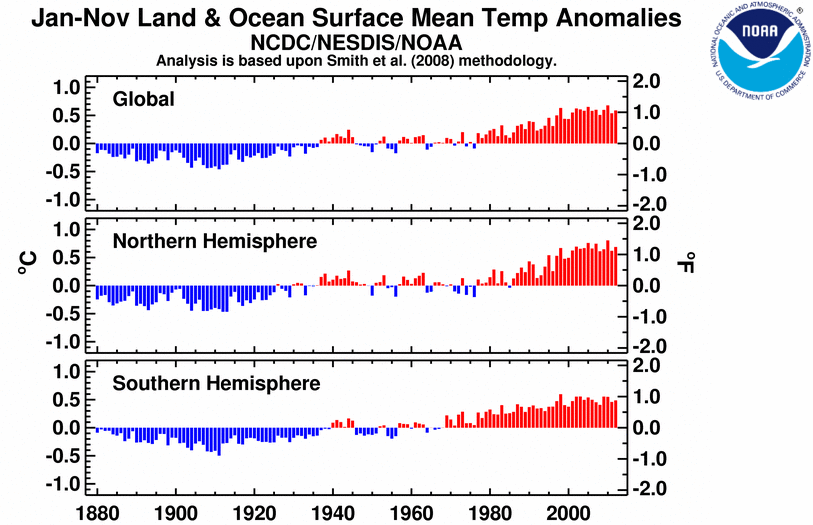
Last month, we had a popular post noting that people 27 years old or younger had never experienced a month of cooler-than-average global temperatures. A lot of people — presumably ones who lead such full, busy lives that they cannot click links and/or read past the first paragraph of an article — were quick to point out that where they lived (invariably somewhere in the northern expanses of Canada) it had in fact been very cold one winter, and that this personal, localized experience trumped 332 months of above-average global air and land temperatures because the world revolves around them.

Anyway, the point is: We’re up to 333 months.

The average November temperature across land and ocean surfaces around the world was 1.21°C (0.67°F) above the 20th century average, marking the fifth warmest November since records began in 1880. … Including this November, the 10 warmest Novembers have occurred in the past 12 years. The 10 coolest Novembers on record all occurred prior to 1920. November 2012 also marks the 36th consecutive November and 333rd consecutive month with global temperature higher than the long-term average. The last month with a below average temperature was February 1985, nearly 28 years ago.

333 months! Halfway to the apocalypse, one can only assume.

The map of variance from average temperatures is amazing. Not a single spot on Earth has seen record cold temperatures this year. Zero. But the U.S. and Europe and broad stretches of ocean have seen the warmest years ever recorded.

Click to embiggen.

And yet that’s still not enough to propel 2012 into position as the hottest year the world as a whole has ever seen. (But it will certainly end up as America’s hottest, as the map above suggests.) Through last month, this year is only the eighth-warmest in history.

Click to embiggen.

Each of the seven warmer years have occurred since 1998.

An important caveat: You will note that the map above is not uniformly red! That is because temperatures are different in different parts of the world. Maybe you can remember 10 Novembers warmer than this last one — that does not mean that the global average for November 2012 is the 11th-warmest! Your mileage may vary, as they say.

And another caveat: August 2040 will (possibly) be the 666th straight month with higher-than-average global temperatures (somewhat undermining the concept of average). The map for that month will likely be a pure splotch of red, as Earth will have been consumed by hellfire. Please prepare appropriately.

Source

State of the Climate, Global Analysis: November 2012, NOAA

Philip Bump writes about the news for Gristmill. He also uses Twitter a whole lot.

Read more:

Climate & Energy

Also in Grist

Please enable JavaScript to see recommended stories

More here: 

For the 36th November in a row, global temperatures were above average

Posted in GE, Uncategorized | Tagged , , , , , , , , , , , | Comments Off on For the 36th November in a row, global temperatures were above average

King tides give California coast a taste of warmer, wetter future

King tides give California coast a taste of warmer, wetter future

THE KING TIDES ARE COMING. Through the end of the week, California will be experiencing its highest tides of the year, the “king” kind, that come around each winter. It may be galactic gravity that’s pulling the water closer, but it looks a lot like climate change! The tides will be as high as +10.1 feet in some places.

SantaBarbaraOceanGirl

From The San Jose Mercury News:

“Flooding would be a concern if we had a storm system coming through,” said Matt Mehle, a meteorologist with the National Weather Service in Monterey. Instead, the rising water will offer a teachable moment, scientists say. Already, the ocean off California has risen 8 inches in the past 100 years. As the earth warms, polar ice melts, and the warmer ocean water expands, increasing sea level. That rate of sea level rise is accelerating. A National Academy of Sciences report in July found that, relative to sea levels in 2000, the California coast south of Cape Mendocino is projected to experience sea level rise of 1.5 inches to 11.8 inches by 2030, and 4.7 inches to 24 inches by 2050, and 16.5 inches to 65 inches by 2100.

Just because the Golden State won’t have a Sandy-sized catastrophe doesn’t mean there can’t still be a lesson in all this. The Mercury News calls this “a giant science project” but I call it “scaring people into better behavior.” The California King Tides Initiative is collecting citizens’ photos of the tides in an effort to educate the public about what higher sea levels might actually look like.

These photographs help us visualize the impact of rising waters on the California coast. Our shores are constantly being altered by human and natural processes and projections indicate that sea level rise will exacerbate these changes. The images offer a living record of the changes to our coasts and shorelines and a glimpse of what our daily tides may look like in the future as a result of sea level rise. Photos taken during king tide events document impacts to private property, public infrastructure, and wildlife habitat across the state.

For locals still set on taking a long walk on the beach, the king tides also bring extremely low tides in midday, but the California Coastal Commission has a friendly suggestion for the rest of us.

Just a thought … California’s next king tides will hit in 2013: Jan. 9-11 and Feb. 7-9.

Susie Cagle writes and draws news for Grist. She also writes and draws tweets for

Twitter

.

Read more:

Climate & Energy

Also in Grist

Please enable JavaScript to see recommended stories

View original article: 

King tides give California coast a taste of warmer, wetter future

Posted in Citizen, GE, Uncategorized | Tagged , , , , , , , , , , , | Comments Off on King tides give California coast a taste of warmer, wetter future

Gotta wear shades: Solar installations hit new annual record

Gotta wear shades: Solar installations hit new annual record

Year-over-year solar installations in the U.S. are up! Again! Up up up!

Greentech Media

Click to embiggen.

From Greentech Media:

[T]he U.S. solar photovoltaics (PV) market installed 684 megawatts in the third quarter (Q3) of 2012, representing 44-percent growth over the same period last year. This quarter marked the third largest on record for the U.S. PV industry and raised the total installed capacity through the first three quarters of the year to 1,992 megawatts — already surpassing 2011’s annual total of 1,885 megawatts.

Cumulatively, there are now 5.9 gigawatts of PV (which converts sunlight directly into electricity) operating in the U.S. from more than 271,000 installations. Combined with concentrating solar power facilities (CSP), which convert the sun’s heat to electricity, there are more than 6.4 gigawatts of solar electric capacity installed in the U.S., enough to power more than one million average American households.

But! Fox News is worried! “California doubles down on solar power, as critics question cost, job results.” Oh no!

Shutterstock

Your internet lesson for the day: This is what is known as “concern trolling.” Fox News is not legitimately worried that perhaps solar power — which it thinks is great, mind you! — is suffering setbacks. No, Fox News wants to see solar power vanish in a gigantic gasoline-fuelled fireball because renewable energy goes against Republican party orthodoxy.

The Fox story contains this paragraph:

Solar also promised to be a cheap source of power, fueled by the sun. What the industry didn’t say is the technology only converts a fraction of the sun’s energy, and the intermittent nature of sunshine does not produce the power promised.

“What the industry didn’t say is the technology only converts a fraction of the sun’s energy.” Saying that was maybe unneccessary? The sun, it turns out, is an incomprehensibly massive, fusion-reaction-powered star. Every second, it buffets the Earth with enough energy to fuel our current demands for thousands of years. So, yeah, solar panels don’t capture all of that energy.

And:

While solar has been painted an environmentally clean power, especially when compared with carbon-based fossil fuels, it is not without impact and growing opposition among preservationists.

I mean, what do you say to that?

Solar power generation and capacity continue to grow in the United States. If you’re unclear on why that’s a good thing, change the channel.

Philip Bump writes about the news for Gristmill. He also uses Twitter a whole lot.

Read more:

Business & Technology

,

Climate & Energy

Also in Grist

Please enable JavaScript to see recommended stories

Read original article: 

Gotta wear shades: Solar installations hit new annual record

Posted in GE, LG, Uncategorized | Tagged , , , , , , , , | Comments Off on Gotta wear shades: Solar installations hit new annual record

Prominent fundamentalist: God gets sad when we don’t use the oil He gave us

Prominent fundamentalist: God gets sad when we don’t use the oil He gave us

43rd State Blues

Bryan Fischer, ranting about something.

Bryan Fischer runs the American Family Association. He is … a piece of work. He spends most of his time bashing homosexuals, but is not afraid to dip a poison-soaked toe into the broader waters of far-right conservatism. Some tweets of his, to set context:

Charming. That last one, though, gets to the point of this story, why we’re bothering to write anything about him. Fischer is also a climate change denier. And on his radio show today (he has a radio show, apparently), he suggested that failing to use fossil fuels was an insult to God.

Fischer described being at a birthday party when he was about 6 years old. Then he went on, as transcribed by Raw Story:

“I opened up a birthday present that I didn’t like, and I said it right out, ‘Oh, I don’t like those,’” the radio host recalled. “And it just crushed — and the person that gave me gift was there. You know, I just kind of blurted it out, ‘I don’t like those.’ And it just crushed that person. It was enormously insensitive of me to do that.”

“And you think, that’s kind of how we’re treating God when he’s given us these gifts of abundant and inexpensive and effective fuel sources,” Fischer added. “And we don’t thank him for it and we don’t use it.”

He concluded with: “God’s buried those treasures there because he loves to see us find them and put them to use.”

Here’s video of the exchange. Suffice it to say that Fischer is as smart when it comes to energy and the environment as he is when predicting electoral outcomes.

According to the Bryan Fischer cosmology, God, while all-powerful, gets His feelings hurt easily. After all, He went to all of the trouble of setting up the planet Earth as a sort of multi-millennia Easter egg hunt. Even the thought that we’d stop searching for these delectable, oily treasures makes God super-sad. That’s probably why He is unleashing all of these storms and droughts and such, since we’re not playing with the toys He gave us. (For the record, the toys suck.)

Bryan Fischer, meanwhile, was sent down by God to test our faith in the First Amendment.

Source

Bryan Fischer: ‘Enormously insensitive’ to hurt God’s feelings by not using oil, Raw Story

Philip Bump writes about the news for Gristmill. He also uses Twitter a whole lot.

Read more:

Climate & Energy

,

Politics

Also in Grist

Please enable JavaScript to see recommended stories

Continue reading:  

Prominent fundamentalist: God gets sad when we don’t use the oil He gave us

Posted in GE, Uncategorized | Tagged , , , , , , , , , , , | Comments Off on Prominent fundamentalist: God gets sad when we don’t use the oil He gave us

Potential secretary of state candidate Susan Rice faces questions over TransCanada investments

Potential secretary of state candidate Susan Rice faces questions over TransCanada investments

Yesterday, the Natural Resources Defense Council’s OnEarth magazine dropped a bombshell. United States Ambassador to the United Nations Susan Rice, widely rumored to be the leading contender to replace Hillary Clinton as secretary of state, has large investments in both TransCanada, the company seeking to build the Keystone XL pipeline, and other businesses with a stake in seeing it built. The secretary of state, you may remember, is responsible for granting any permit to build the border-crossing pipeline.

In addition to TransCanada stock valued between $300,000 and $600,000, OnEarth outlines the breadth of her investments.

[A]ccording to financial disclosure reports, about a third of Rice’s personal net worth is tied up in oil producers, pipeline operators, and related energy industries north of the 49th parallel — including companies with poor environmental and safety records on both U.S. and Canadian soil. Rice and her husband own at least $1.25 million worth of stock in four of Canada’s eight leading oil producers, as ranked by Forbes magazine. That includes Enbridge, which spilled more than a million gallons of toxic bitumen into Michigan’s Kalamazoo River in 2010 — the largest inland oil spill in U.S. history.

Rice also has smaller stakes in several other big Canadian energy firms, as well as the country’s transportation companies and coal-fired utilities. Another 20 percent or so of her personal wealth is derived from investments in five Canadian banks. These are some of the institutions that provide loans and financial backing to TransCanada and its competitors for tar sands extraction and major infrastructure projects, such as Keystone XL and Enbridge’s proposed Northern Gateway pipeline, which would stretch 700 miles from Alberta to the Canadian coast.

USDA

Susan Rice and U.S. Secretary of Agriculture Tom Vilsack.

OnEarth then describes the possible conflict:

Were she to become Secretary of State, Rice would be in charge of the new environmental review process and would be in a position to decide whether to issue TransCanada a permit for sections of Keystone XL stretching from Oklahoma to the Canadian border.

The revelation prompts a lot of questions, to be sure. For one: Why does the U.S. ambassador to the U.N. hold so much stock in Canadian companies? Perhaps in part because her husband, Ian Cameron, is Canadian.

But more importantly: Should this be considered a disqualifying revelation?

It’s important to remember that we’ve already had a secretary of state who faced questions about improper relationships to TransCanada: Hillary Clinton.

In 2011, environmentalists began asking questions about TransCanada lobbyist Paul Elliott, who had served as Clinton’s deputy national campaign manager during her 2008 run for the presidency. Friends of the Earth, which uncovered emails between Elliott and staffers at the State Department after making a Freedom of Information Act request, suggested that the emails “indicate bias and complicity” and that State Department employees were “cozy with the oil industry.” Even Clinton’s husband spoke in favor of the project earlier this year, suggesting that America “embrace” the pipeline.

Ultimately, of course, the Keystone XL permit was denied in January of this year. The final authority at the State Department isn’t the secretary of state — it’s the president. And the president making the call was Barack Obama, same president who will be running State until 2016. With the Keystone permit due for reconsideration next year, the buck stops with him.

Rice’s investments are disconcerting and, for many, disappointing. But it’s hard to see how they would disqualify her from the post, a role that encompasses far more than this one decision. They are almost certainly, however, grounds for recusal from discussions about the Keystone XL permit — and they are certain to raise any number of questions during that process that may be uncomfortable to answer.

Source

Secretary of State Candidate Has a Major Financial Stake in Canadian Tar Sands, OnEarth

Philip Bump writes about the news for Gristmill. He also uses Twitter a whole lot.

Read more:

Business & Technology

,

Climate & Energy

,

Politics

Also in Grist

Please enable JavaScript to see recommended stories

Visit link – 

Potential secretary of state candidate Susan Rice faces questions over TransCanada investments

Posted in GE, Uncategorized | Tagged , , , , , , , , , , | Comments Off on Potential secretary of state candidate Susan Rice faces questions over TransCanada investments