Tag Archives: Hawaii

CO2 in atmosphere poised to blow past 400 ppm mark

CO2 in atmosphere poised to blow past 400 ppm mark

Shutterstock

Sometime soon, the concentration of carbon dioxide in the atmosphere is expected to hit a scary new milestone: 400 parts per million. That would be higher than at any time in human history — and it’s bad news for anyone who cares about a livable climate.

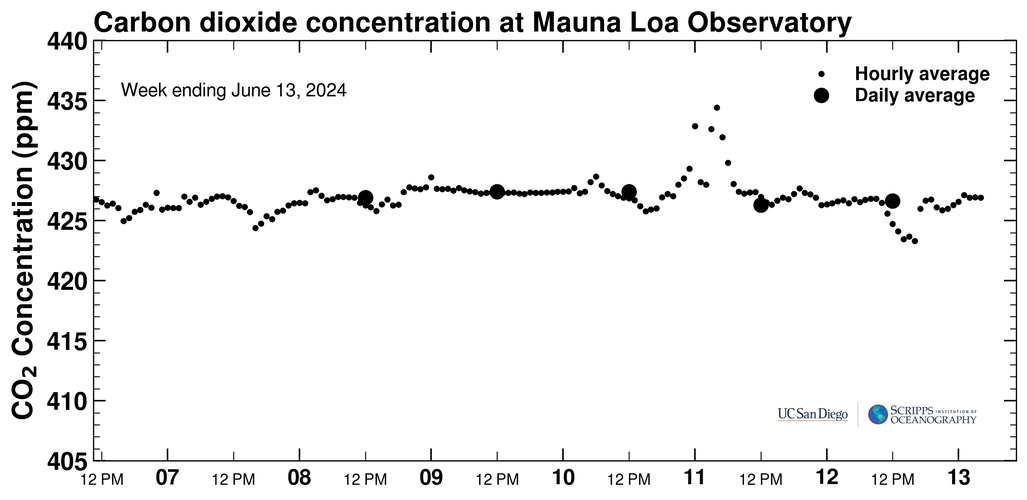
The latest daily average level recorded by Scripps Institution of Oceanography sensors at Mauna Loa, Hawaii, was 399.5 ppm, on Monday. The CO2 level fluctuates throughout the day, and hourly levels in excess of 400 ppm have already been recorded. The level also fluctuates throughout the year, with May being the month when CO2 reaches its highest concentrations.

The big thing to watch for is whether the average for the month of May will exceed 400 ppm.

Check out this graph showing data from the past week:

Scripps Institution of Oceanography

Click to embiggen.

You can follow @Keeling_curve on Twitter to keep up with the latest figures.

From The Guardian:

“I wish it weren’t true but it looks like the world is going to blow through the 400ppm level without losing a beat. At this pace we’ll hit 450ppm within a few decades,” said Ralph Keeling, a geologist with the Scripps Institution of Oceanography …

“Each year, the concentration of CO2 at Mauna Loa rises and falls in a sawtooth fashion, with the next year higher than the year before. The peak of the sawtooth typically comes in May. If CO2 levels don’t top 400ppm in May 2013, they almost certainly will next year,” Keeling said.

Here’s a graph showing that sawtoothed rise, also called the “Keeling Curve,” named for Ralph’s father, Charles Keeling, who began taking measurements at Mauna Loa in 1958:

Scripps Institution of Oceanography

Click to embiggen.

From a statement published by Scripps last week:

Scientists estimate that the last time CO2 was as high as 400 ppm was probably the Pliocene epoch, between 3.2 million and 5 million years ago, when Earth’s climate was much warmer than today. CO2 was around 280 ppm before the Industrial Revolution, when humans first began releasing large amounts of CO2 to the atmosphere by the burning of fossil fuels. By the time [Charles] Keeling began measurements in 1958, CO2 had already risen from 280 to 316 ppm. The rate of rise of CO2 over the past century is unprecedented; there is no known period in geologic history when such high rates have been found. The continuous rise is a direct consequence of society’s heavy reliance on fossil fuels for energy.

From another Guardian article:

Climate scientists have long maintained that concentrations need to be kept below 350ppm if the world is to stand a reasonable chance of meeting international targets to keep average temperature increases below 2C, while concentrations of above 400ppm put the planet on track for levels of warming deemed ‘dangerous’ by the international community.

Hence that whole 350.org thing.

Carbon dioxide levels of 400 ppm in the atmosphere aren’t much more threatening than levels of 399 ppm. But the zeros focus the mind (and the media) on an extremely dangerous trend: Failure to act on climate change has pushed the world into yet another new danger zone.

John Upton is a science aficionado and green news junkie who

tweets

, posts articles to

Facebook

, and

blogs about ecology

. He welcomes reader questions, tips, and incoherent rants:

johnupton@gmail.com

.

Find this article interesting? Donate now to support our work.Read more: Climate & Energy

Also in Grist

Please enable JavaScript to see recommended stories

Read this article: 

CO2 in atmosphere poised to blow past 400 ppm mark

Posted in Anchor, FF, G & F, GE, ONA, Pines, solar, solar panels, solar power, Uncategorized | Tagged , , , , , , , , , , | Comments Off on CO2 in atmosphere poised to blow past 400 ppm mark

Fukushima meltdown appears to have sickened American infants

Fukushima meltdown appears to have sickened American infants

Shutterstock

Fallout from that Fukushima meltdown thing a couple years back? It’s not just the Japanese who are suffering, though their plight is obviously the worst.

Radioactive isotopes blasted from the failed reactors may have given kids born in Hawaii and along the American West Coast health disorders which, if left untreated, can lead to permanent mental and physical handicaps.

Children born in Alaska, California, Hawaii, Oregon, and Washington between one week and 16 weeks after the meltdowns began in March 2011 were 28 percent more likely to suffer from congenital hypothyroidism than were kids born in those states during the same period one year earlier, a new study shows. In the rest of the U.S. during that period in 2011, where radioactive fallout was less severe, the risks actually decreased slightly compared with the year before.

Substantial quantities of the radioisotope iodine-131 were produced by the meltdowns, then wafted over the Pacific Ocean and fell over Hawaii, the American West Coast, and other Pacific countries in rain and snow, reaching levels hundreds of times greater than those considered safe.

After entering our bodies, radioactive iodine gathers in our thyroids. Thyroids are glands that release hormones that control how we grow. In babies, including those not yet born, such radiation can stunt the development of body and brain. The condition is known as congenital hypothyroidism. It is treatable when detected early.

“Fukushima fallout appeared to affect all areas of the U.S., and was especially large in some, mostly in the western part of the nation,” wrote researchers with the Radiation and Public Health Project in their peer-reviewed paper published in Open Journal of Pediatrics.

The links between iodine radioisotope exposure and juvenile hypothyroidism were established after the 1986 Chernobyl meltdown. The authors of this new paper suspect that the spike in Pacific Coast cases in 2011 was linked to the Fukushima accident, but they warn that further analysis is needed “to better understand any association between iodine exposure from Fukushima-Dai-ichi and congenital hypothyroidism risk.”

Their findings may be only a tip of an epidemiological iceberg.

“Congenital hypothyroidism can be used as one measure to assess any potential changes in U.S. fetal and infant health status after Fukushima because official data was available relatively promptly,” the researchers wrote. “However, health departments will soon have available for other 2010 and 2011 indicators of fetal/infant health, including fetal deaths, premature births, low weight births, neonatal deaths, infant deaths, and birth defects.”

So stay tuned. Two years and one month after the meltdown, we’re only just beginning to understand how the nuclear catastrophe affected the health of people living around the vast Pacific Ocean.

John Upton is a science aficionado and green news junkie who

tweets

, posts articles to

Facebook

, and

blogs about ecology

. He welcomes reader questions, tips, and incoherent rants:

johnupton@gmail.com

.

Read more:

Climate & Energy

Also in Grist

Please enable JavaScript to see recommended stories

Link – 

Fukushima meltdown appears to have sickened American infants

Posted in alo, ALPHA, Anchor, Citizen, FF, G & F, GE, ONA, Uncategorized | Tagged , , , , , , , , , , , | Comments Off on Fukushima meltdown appears to have sickened American infants