Tag Archives: weather

From wildfires to floods, climate change keeps coming for Montecito, California

This story was originally published by Wired and is reproduced here as part of the Climate Desk collaboration.

Montecito came back to life on Friday. The 9,000-person town to the east of Santa Barbara had been empty since Tuesday, when mandatory evacuations forced residents out of their homes for the fifth time in four months.

This week, it was a channel of tropical moisture called the Pineapple Express, dumping bands of intense rain and triggering flash floods throughout Southern California. In January, it was a once-in-a-200-year storm that dropped half an inch of water in five minutes, unleashing massive mudslides that ripped houses from their foundations and killed 27. In December, it was the deadly Thomas Fire that incinerated 280,000 acres — the largest wildfire in California history.

To some, Montecito might just seem like a town hit by a string of superlatively bad luck. But to people crunching the numbers it looks less like an outlier and more like an inevitability of climate change. If you want to see what California looks like in the future, you don’t need a crystal ball. You just need to hop on the 101 and drive until you hit Montecito.

Of course, you’ll have to wait until the weather clears up. For the last few days, a plume of tropical moisture carrying as much water as the Mississippi River has been wringing out between 4 and 9 inches of water along the coast and in the foothills. According to Daniel Swain, a climate scientist at the University of California Los Angeles, that’s nothing unusual. In fact, it’s what he would call a “textbook” atmospheric river. So why all the fuss? “It’s not the strongest atmospheric river we seen in a long time,” says Swain. “But it’s aimed directly at these burn scar regions which are incredibly vulnerable to flooding and debris flows.”

He’s not exaggerating. If you look at a satellite image of the plume, it’s pointing straight at the 280,000-acre bullseye left behind by the Thomas Fire. That’s bad because fires destabilize the landscape. Without vegetation to hold back the soil, even a little bit of rain on the hills can have huge consequences. A lot of rain can turn things deadly, like it did in January. Slabs of boulders, rocks, downed trees, even wrecked cars careened down the slopes, carried by waist-high mudflows. More than 100 homes were destroyed. Power was out for days.

When the new round of evacuation orders came, the town was still recovering. On Thursday, Montecito sent an excavator out to clear areas where debris was still piled up from the last flow, to prevent creeks and other outflows from sending it further downstream. With the National Weather Service predicting this storm to be even worse, local officials went door to door to make sure people got out and stayed out until the flash flood and mudslide risks subsided. But the question evacuees were asking each other Thursday night wasn’t “when can I go home?” But, “how many more times is this going to happen?”

Obviously no one can know for sure. But the science suggests that every aspect of California’s drought-to-deluge cycle is intensifying in the face of climate change. Even the Pineapple Express.

“In a future world you do see an expansion of this subtropical jet, which drives these southern atmospheric rivers, based on the models we’re using” says Christine Shields, a climate scientist at the National Center for Atmospheric Sciences. “What that has meant in the projections is that these events become longer lived, carry more precipitation, and have a stronger impact.”

That’s because as the atmosphere warms up, it’s able to hold more and more water, known in weather-nerd circles as the Clausius-Clapeyron relationship. This doesn’t affect the total amount of rainfall, necessarily. That’s more a function of how long the storm sticks around, which can be affected by surface wind and other pressure dynamics. But more water in the atmosphere does mean more intense precipitation — higher rainfall rates. And that’s the one that matters in California. “In these areas decimated by wildfires you may only get 2 inches of rain, but those 2 inches fall in half an hour,” says Shields. “That could be devastating.”

Understanding climate change’s impacts on precipitation intensity is an area of active research, including by Swain’s group at UCLA. He couldn’t speak to their latest findings because they’ve already been accepted for upcoming publication. But he did note that as climate change deals out more extreme weather events, scientists have a stronger financial case for running the kind of computationally expensive models groups like his use to translate global scale dynamics into regional predictions. “The present event is a really good example of why details matter,” he says. “We got the strength right but if the position is off by even 100 miles, that’s a huge difference for who gets impacted.”

This time it might have been the people of Montecito, and this time the storm might have passed without turning the hillsides into a deathtrap. But that’s the thing about California; there’s always another drought and another fire and another flood around the corner. Which means in the Golden State, it’s always evacuation season.

Source – 

From wildfires to floods, climate change keeps coming for Montecito, California

Posted in alo, Anchor, FF, G & F, GE, LG, Monterey, ONA, Uncategorized | Tagged , , , , , , , | Comments Off on From wildfires to floods, climate change keeps coming for Montecito, California

How to Read Water – Tristan Gooley

READ GREEN WITH E-BOOKS

How to Read Water

Clues and Patterns from Puddles to the Sea

Tristan Gooley

Genre: Nature

Price: $9.99

Publish Date: September 11, 2016

Publisher: The Experiment

Seller: Workman Publishing Co., Inc.


A New York Times Bestseller A Forbes Top 10 Conservation and Environment Book of 2016 Read the sea like a Viking and interpret ponds like a Polynesian—with a little help from the “natural navigator”!   In his eye-opening books The Lost Art of Reading Nature’s Signs and The Natural Navigator , Tristan Gooley helped readers reconnect with nature by finding direction from the trees, stars, clouds, and more. Now, he turns his attention to our most abundant—yet perhaps least understood—resource.   Distilled from his far-flung adventures—sailing solo across the Atlantic, navigating with Omani tribespeople, canoeing in Borneo, and walking in his own backyard—Gooley shares hundreds of techniques in How to Read Water . Readers will:  Find north using puddlesForecast the weather from wavesDecode the colors of pondsSpot dangerous water in the darkDecipher wave patterns on beaches, and more!

Read this article: 

How to Read Water – Tristan Gooley

Posted in alo, Anchor, Casio, FF, G & F, GE, LAI, ONA, PUR, The Atlantic, Uncategorized | Tagged , , , , , , , | Comments Off on How to Read Water – Tristan Gooley

Nor’easters are now just as dangerous as hurricanes

On Friday and Saturday, the winter storm now moving up the East Coast will unleash hurricane-force winds on Washington, blizzard conditions across parts of New York and New England, and inflict the worst coastal flood in Boston’s history.

By all accounts, this storm is a monster. It’s also the latest sign that New England’s long-feared coastal flooding problem is already here — and it’s time to admit climate change is its primary cause.

The storm’s strongest winds will point squarely toward the shore, smashing huge waves the size of three-story apartment buildings into coastal defenses, and roiling the sea as far away as South America. To make matters worse, it’s arriving in conjunction with a full moon, when tides are normally highest. The system is predicted to stall out for more than 24 hours just off the New England coastline — for an astonishing three straight tide cycles.

Although the storm is getting little attention in the national news, the National Weather Service and meteorologists across the Northeast are screaming at a fever pitch. Boston-area municipalities have taken heed, issuing evacuations, preparing dive-team equipment for water rescues, and deploying a temporary flood barrier designed as a climate change-resilience measure. Massachusetts Governor Charlie Baker has activated the National Guard to help with preparations.

Call it a nor’easter, a “bomb cyclone,” a superstorm — in an era of worsening extreme weather, fierce winter systems like this are arriving with startling frequency. And flooding is by far the most dangerous and destructive consequence. This week’s storm, like every weather event, is inseparable from the context of the warming climate. Nor’easters like this one are now a threat to public safety on par with hurricanes, and it’s time we start treating them that way.

This week’s storm is larger in size than Hurricane Sandy, with winds just as strong. National Weather Service in Boston called the storm’s gusts “about as extreme as it gets” and labeled the flooding it will spur a “life and death situation.” In a harrowing statement, the agency warns of massive power outages, the destruction of coastal homes, and some neighborhoods being “cut off for an extended time” from the rest of the metro area. It’s possible that sea walls and other semi-permanent coastal defenses could be breached, or beaches and dunes erased from the map — exposing vulnerable coastal communities and permanently altering the geography of New England.

Nor’easters draw their energy from clashing regions of warm and cold air, often producing massive circulations double the size of hurricanes. Hurricanes usually have much stronger winds at ground level, though, which is why they’re typically more destructive. But as seas have risen across the northeastern U.S. over the past century due to climate change, the flooding impact of what were once relatively routine winter storms has quickly grown.

While hurricanes are also expected to eventually grow stronger, there’s no convincing evidence they clearly have yet — although last year’s hurricane season is a worrying harbinger. Nor’easters are also expected to get worse due to climate change, as warmer air provides them with additional water vapor, fueling their ability to strengthen. Add to that, sea levels in Massachusetts have increased by about a foot over the past 100 years, and should rise by a further 3 to 9 feet by the end of this century.

Winter superstorms that bring high-level coastal flooding to northern locales like Boston are already occurring with alarming regularity. Only 34 hurricanes have passed within 200 miles of the city since 1851 — an average of one every five years. And only nine of these created a significant rise in the tides. Meanwhile more than 90 of the top 100 floods in Boston were spawned by nor’easters, and 13 of the top 20 have happened since 2000.

Though it’s one of the most severe examples in history, today’s storm is not the first one to hit the most densely populated part of the country with the power of a hurricane. It’s not even the first one this year — in January, another “bomb cyclone” floated rafts of ice into flooded Boston streets.

There are around three strong nor’easters every winter, 15 times as frequent as hurricanes — plenty of opportunity for repeat flooding disasters. A study earlier this year showed that record flooding could happen in New York City every five years starting just a few decades from now, largely because sea level rise has transformed nor’easters into coastline-devouring monsters.

Storms like these — technically called “extratropical cyclones,” because they form outside the tropics — don’t come with scary cone-shaped tracking maps like hurricanes or official names that can be blasted across social media. Still, they have quickly become the single biggest threat to coastal development across most of the northeast.

Coastal floods are one of the leading indicators that the world is warming. Given the path we’re on, the worst is yet to come.

View original article: 

Nor’easters are now just as dangerous as hurricanes

Posted in alo, Anchor, FF, G & F, GE, Northeastern, ONA, Prepara, PUR, Ringer, Uncategorized | Tagged , , , , , , , , | Comments Off on Nor’easters are now just as dangerous as hurricanes

The Weather of the Future – Heidi Cullen

READ GREEN WITH E-BOOKS

The Weather of the Future
Heat Waves, Extreme Storms, and Other Scenes from a Climate-Changed Planet
Heidi Cullen

Genre: Science & Nature

Price: $1.99

Publish Date: August 24, 2010

Publisher: HarperCollins e-books

Seller: HarperCollins


From Heidi Cullen, one of America’s foremost experts on weather and climate change and a senior research scientist with Climate Central, comes The Weather of the Future , a fascinating and provocative book that predicts what different parts of the world will look like in the year 2050 if current levels of carbon emissions are maintained.

Taken from – 

The Weather of the Future – Heidi Cullen

Posted in alo, Anchor, FF, GE, HarperCollins e-books, ONA, PUR, Uncategorized | Tagged , , , , , , , | Comments Off on The Weather of the Future – Heidi Cullen

Trump wants to to keep the largest coal plant in the West, built on Navajo land, open.

You’d think that, in an era of increasingly extreme weather and disasters that render whole regions of the country nearly uninhabitable for months, maintaining a weather service in tip-top shape would be a priority.

Turns out, under President Donald Trump, that hasn’t been the case. Shifting priorities and uncertainty over funding at the National Weather Service have led to as many as 700 current staff vacancies, according to a report in the Washington Post. That’s about 15 percent of its mandated positions.

“Given our staffing, our ability to fill our mission of protecting life and property would be nearly impossible if we had a big storm,” Brooke Taber, a weather service forecaster in Vermont, told her local paper.

Some offices, like the one in Washington, D.C., are missing a third of their workforce as hurricane season winds down ahead of winter, traditionally one of the busiest times of the year for storms. Although a weather service spokesperson denied the problem was hurting the quality of its forecasts, the service’s employees union said in a statement that the organization is “for the first time in its history teetering on the brink of failure.”

The report follows a Grist cover story this week that looked at how Trump’s proposed cuts to the National Weather Service are already making the country less safe.

Link – 

Trump wants to to keep the largest coal plant in the West, built on Navajo land, open.

Posted in alo, Anchor, Everyone, FF, GE, LAI, ONA, oven, PUR, solar, Uncategorized | Tagged , , , , , , , , | Comments Off on Trump wants to to keep the largest coal plant in the West, built on Navajo land, open.

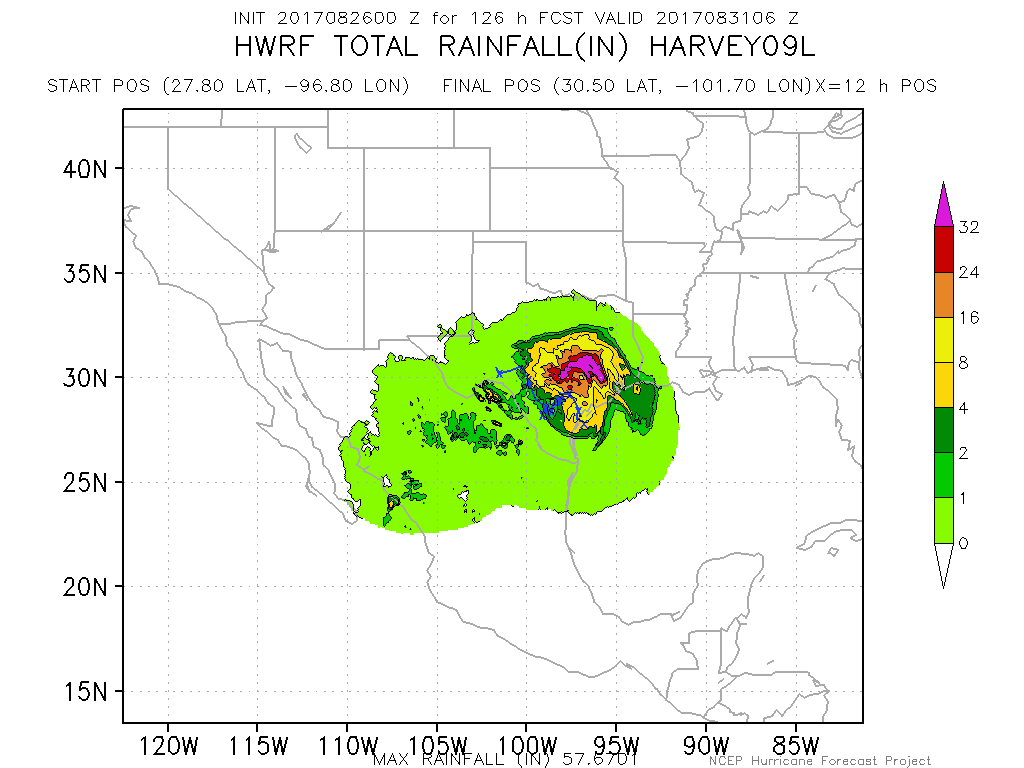
Hurricane Harvey will bring some of the heaviest downpours anyone has ever seen

Hurricane Harvey made landfall late Friday night on the Texas coast as one of the most intense hurricanes in U.S. history, spawning as many as 50 tornado warnings in the Houston area alone.

But its worst feature is still to come: several days of what could be some of the most intense rainfall this nation has ever recorded, a clear signal of climate change.

After a destructive storm surge washed away homes, and winds as strong as 132 mph blew away roofs and left hundreds of thousands without power, Harvey is expected to stall, drastically worsening the risk of catastrophic inland flooding from relentless rains.

As of Saturday morning, nearly 15 inches had already been recorded as bands of heavy thunderstorms streamed onshore from the warm Gulf of Mexico, with at least five more days of heavy rain on the way.

Through mid-week, Harvey is expected to move at an exceedingly slow 1 mph, pushing its rainfall forecast off the charts. For the first time in its history, the National Weather Service is forecasting seven-day rainfall totals as high as 40 inches in isolated pockets — equal to what’s normally a year’s worth or rain for coastal Texas.

Some high-resolution models predict even more. (For reference, the estimated 1-in-100-year seven-day rainfall total for the region is just 18 inches.) Meteorologist Ryan Maue estimated that 20 trillion gallons of water will fall on Texas over the next seven days, which is equal to about one-sixth of Lake Erie.

Virtually every river and stream between San Antonio and Houston is expected to experience record or near-record flooding over the next few days. Forecasters racked their brains to recall a scenario so dire anywhere in the world; a 2015 typhoon hitting the Philippines produced a similar amount of rain, but over a much smaller area.

Although the exact impact of global warming on the strength and frequency of hurricanes remains undetermined, there’s a clear climate connection when it comes to higher rainfall. All thunderstorms, including hurricanes, can produce more rain in a warmer atmosphere, which boosts the rate of evaporation and the water-holding capacity of clouds.

Heavy downpours have increased by 167 percent in Houston since the 1950s, and flooding there has been heightened by unfettered development and urban expansion. Some of the worst flooding in the region’s history has come from slow-moving storms like Harvey.

We don’t yet know if climate change will bring more slow-moving, rapidly intensifying tropical storms like Harvey. But flooding is what kills most people in hurricanes, and that will only get worse.

Taken from: 

Hurricane Harvey will bring some of the heaviest downpours anyone has ever seen

Posted in alo, Anchor, FF, G & F, GE, ONA, Pines, ProPublica, solar, Uncategorized | Tagged , , , , , , , , , | Comments Off on Hurricane Harvey will bring some of the heaviest downpours anyone has ever seen

Hurricane Harvey brings some of the heaviest downpours anyone has ever seen

This story has been updated. 

Hurricane Harvey made landfall late Friday night on the Texas coast as one of the most intense hurricanes in U.S. history, spawning as many as 50 tornado warnings in the Houston area alone.

But its worst feature is still unfolding: several days of what could be some of the most intense rainfall this nation has ever recorded, a clear signal of climate change.

After a destructive storm surge washed away homes, and winds as strong as 132 mph blew away roofs and left hundreds of thousands without power, Harvey is expected to stall, drastically worsening the risk of catastrophic inland flooding from relentless rains.

The dire National Weather Service forecast for catastrophic flooding appears to have come true. Overnight, parts of Houston received as much as two feet of rain, causing widespread devastation. Another two feet of rain is on the way, according to the latest forecasts.

Through mid-week, Harvey is expected to move at an exceedingly slow 1 mph, pushing its rainfall forecast off the charts. For the first time in its history, the National Weather Service is forecasting seven-day rainfall totals as high as 40 inches in isolated pockets — equal to what’s normally a year’s worth or rain for coastal Texas.

Some high-resolution models predict even more. (For reference, the estimated 1-in-100-year seven-day rainfall total for the region is just 18 inches.) Meteorologist Ryan Maue estimated that 20 trillion gallons of water will fall on Texas over the next seven days, which is equal to about one-sixth of Lake Erie.

Virtually every river and stream between San Antonio and Houston is expected to experience record or near-record flooding over the next few days. Forecasters racked their brains to recall a scenario so dire anywhere in the world; a 2015 typhoon hitting the Philippines produced a similar amount of rain, but over a much smaller area.

Although the exact impact of global warming on the strength and frequency of hurricanes remains undetermined, there’s a clear climate connection when it comes to higher rainfall. All thunderstorms, including hurricanes, can produce more rain in a warmer atmosphere, which boosts the rate of evaporation and the water-holding capacity of clouds.

Heavy downpours have increased by 167 percent in Houston since the 1950s, and flooding there has been heightened by unfettered development and urban expansion. Some of the worst flooding in the region’s history has come from slow-moving storms like Harvey.

We don’t yet know if climate change will bring more slow-moving, rapidly intensifying tropical storms like Harvey. But flooding is what kills most people in hurricanes, and that will only get worse.

From:  

Hurricane Harvey brings some of the heaviest downpours anyone has ever seen

Posted in alo, Anchor, FF, G & F, GE, ONA, Pines, ProPublica, solar, Uncategorized | Tagged , , , , , , , , | Comments Off on Hurricane Harvey brings some of the heaviest downpours anyone has ever seen

America’s nearing a record number of weather disasters, and it’s not even hurricane season yet.

Jump to original – 

America’s nearing a record number of weather disasters, and it’s not even hurricane season yet.

Posted in G & F, GE, ONA, Uncategorized | Tagged , , , , , , , , , , | Comments Off on America’s nearing a record number of weather disasters, and it’s not even hurricane season yet.

We’re about to name a sad swirling sack of clouds Tropical Storm Don, which is apt.

See the original article here:  

We’re about to name a sad swirling sack of clouds Tropical Storm Don, which is apt.

Posted in GE, ONA, The Atlantic, Uncategorized | Tagged , , , , , , , , , | Comments Off on We’re about to name a sad swirling sack of clouds Tropical Storm Don, which is apt.

3 Essential Zero Waste Items to Keep in Your Car

No matter where you go, taking a zero waste trip can be pretty challenging.Disposables are king on the road!

If you want to make it tothe end of your trip without gathering up a collection of paper coffee cups and throwaway plastics, youhave to be prepared. Luckily, (now that the weather is getting warmer) I’ve had the chance to test out my very own Zero Waste Car Kit. And let me tell you, it has saved me a number of times.

You never know where the open road will take you; these amazing, portable, lightweight zero waste items will ensure you’re always prepared for whatcomes your way.

Here’s what I keep in my car.

3Essential Zero Waste Items to Keep in Your Car

1. Mason Jar

Why I Love Them

I honestly believe that amason jar is one of the most versatile items on the planet. Theyseal water-tight, making them perfect for solid foods, soups and cold drinks. Perfect for restaurant leftovers! Need to use it for coffee in a snap? Pack a mason jar cozy to protect your fingers while you sip your coffee.

Where to Find Them

Mason jars are very easy to find. I highly recommend checking out your local thrift stores to see if you can find a range of sizes for your pantry and your to-go kit. Not interested in buying secondhand? Save and wash jars from sauces and nut butters or visit any of your local big boxstores.

What You’ll Spend

Mason jars are definitely your most affordable jar option out there, especially if you choose to buy secondhand. Expect to spend between $0.50 and a couple of dollars. Nice!

2. Cloth Napkin

Why I Love Them

If you eat out a lot, definitely stasha cloth napkin or dish towel in your car or purse. This item will come in handy if you needto pick up a sandwich or a pastry, or need to wrap something for transport. Most places will gladly hand you your food item on your clean cloth napkin. They’re also great for wrapping bulk goodieslike crackers or nuts.

Where to Find Them

Odds are you already have plenty of cloths to choose from in your kitchen. Pick one that isn’t too thick (you want to be able to tie it closed) and that is made froma natural fiber that washes up well. If you don’t have any kitchen cloths to spare, pick one up locally.

What You’ll Spend

If you’re buying new, expect to spend between $5 and $15 for a pack of 3-5. However, you can definitely find secondhand linens as well! Just be sure to sanitize and wash them before use.

3. Cutlery Kit

Why I Love Them

Few fast fooditems sneak up on me more than plastic straws and disposable cutlery. This is why I keep a cutlery kit that includes bamboo fork, knife, spoon and chopsticks, and a stainless steel straw in my purse. Pick one up and start refusing those disposables at restaurants!

Where to Find Them

Amazon.com has a number of lightweight, nicely wrapped cutlery kits to choose from. You can also opt to make your own, or assemble some silverware from home. Just make sure it includes all the items you need. Feeling even more minimalist? Look for a convertible multipurpose tool that is a fork, spoon and knife all in one!

What You’ll Spend

Most of the cutlery kits I’ve seen range between $12 and $20 online. I purchased my To-Go Ware kit for about $15. If you want to save money, just stash a few pieces of silverware from your kitchen.

What do you think? Will you create a Zero Waste To-Go Kit like this one?

Disclaimer: The views expressed above are solely those of the author and may not reflect those of Care2, Inc., its employees or advertisers.

Read the article:  

3 Essential Zero Waste Items to Keep in Your Car

Posted in bamboo, FF, GE, LAI, LG, ONA, PUR, Uncategorized | Tagged , , , , , , , , | Comments Off on 3 Essential Zero Waste Items to Keep in Your Car