Tag Archives: wiley

Oceans are absorbing excess heat, for now

Oceans are absorbing excess heat, for now

Shutterstock

/ Willyam BradberryMissing heat has shown up in the oceans, particularly in shallow tropical depths.

Pity the oceans. Not only do we dump oil and plastics and all kinds of nasty chemicals and garbage into them. Turns out we’re dumping heat into them too.

Studies of ocean temperatures are revealing that a lot of the excess heat we’re creating by pumping greenhouse gases into the atmosphere is ending up in the oceans.

That’s helping to keep the atmosphere cooler than scientists had previously projected; the rise in surface temperatures slowed during the first decade of this century. (The effects of aerosols spat out by volcanoes and other phenomena are also thought to have helped keep temperatures on the surface of Earth lower than expected.) That may seem a good thing from the perspective of terrestrial creatures like us. But the oceans won’t suck up all that heat forever.

A new paper published in Nature Climate Change by scientists from Spain and France identified where much of the missing heat had ended up:

Most of this excess energy was absorbed in the top 700 [meters] of the ocean at the onset of the warming pause, 65% of it in the tropical Pacific and Atlantic oceans. Our results hence point at the key role of the ocean heat uptake in the recent warming slowdown.

From Reuters:

Lead author Virginie Guemas of the Catalan Institute of Climate Sciences in Barcelona said the hidden heat may return to the atmosphere in the next decade, stoking warming again. …

Caroline Katsman of the Royal Netherlands Meteorological Institute, an expert who was not involved in the latest study, said heat absorbed by the ocean will come back into the atmosphere if it is part of an ocean cycle such as the “El Nino” warming and “La Nina” cooling events in the Pacific.

She said the study broadly confirmed earlier research by her institute but that it was unlikely to be the full explanation of the warming pause at the surface, since it only applied to the onset of the slowdown around 2000.

The study builds upon a paper published last month in the journal Geophysical Research Letters. That research, as summarized by the blog Skeptical Science, found that “about 90% of overall global warming goes into heating the oceans, and the oceans have been warming dramatically” during the past 15 years. “The slowed surface air warming over the past decade has lulled many people into a false and unwarranted sense of security.”

So it seems that before we bake our own homes, we’re going to boil the oceans. And then our homes will be baked anyway.

Chilling.

John Upton is a science aficionado and green news junkie who

tweets

, posts articles to

Facebook

, and

blogs about ecology

. He welcomes reader questions, tips, and incoherent rants:

johnupton@gmail.com

.

Find this article interesting? Donate now to support our work.Read more: Climate & Energy

Also in Grist

Please enable JavaScript to see recommended stories

Excerpt from – 

Oceans are absorbing excess heat, for now

Posted in alo, Anchor, FF, G & F, GE, LG, ONA, solar, solar panels, Uncategorized, Wiley | Tagged , , , , , , , , , , , | Comments Off on Oceans are absorbing excess heat, for now

Don’t Blame the Awful U.S. Drought on Climate Change

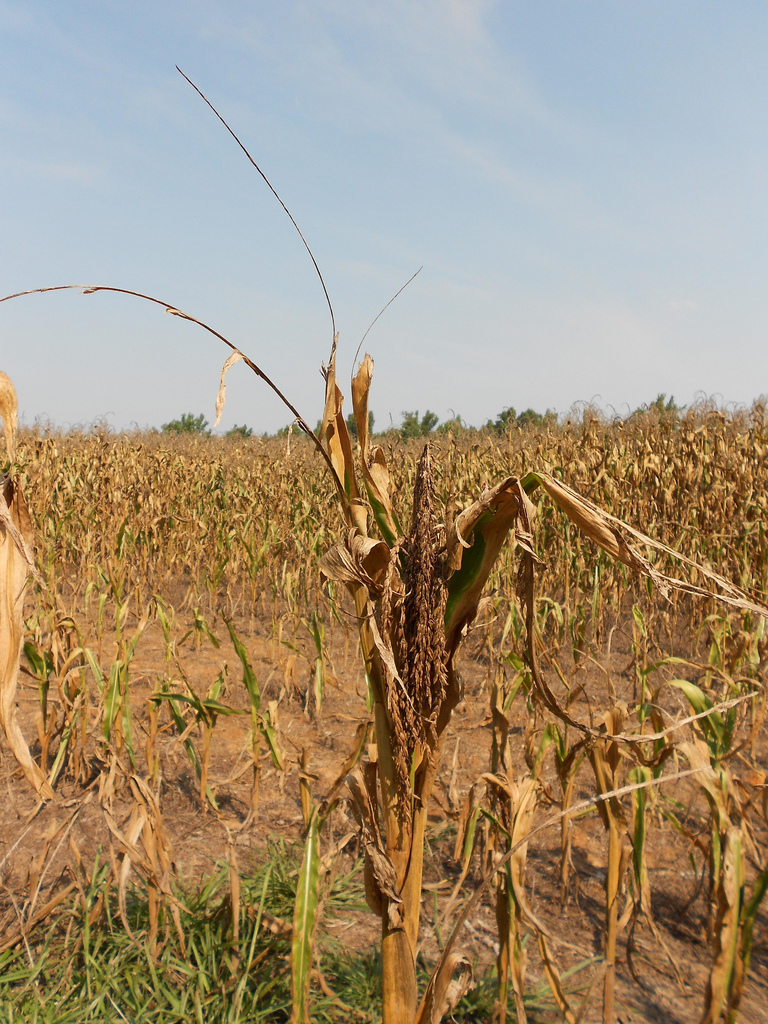
Drought in western Kentucky. Photo: CraneStation

For more than two years, a devastating drought has gripped a huge swath of the U.S.—drying up groundwater, killing crops and choking shipping lanes. One part of that drought, dubbed the “2012 Great Plains Drought” for its effect on middle America, says Climate Central, was worse than the Dust Bowl droughts of the 1930s. For many places, the drought is far from over.

With high temperatures and low rain taking a staggering economic toll—with billions of dollars in lossesa federal task force set out to figure out what caused the drought and to sort out if we should have seen it coming.

It seems that every time horrible weather hits, people turn and ask, “Is this climate change?” Typically, the answer you’ll get goes something like this: climate change is defined as a long-term statistical change in the weather, and so you can’t say that is any one disaster is “because of climate change.” That response is about as common as it is outdated.

In the past few years, a new concept has entered the discussion among climate scientists. Spear-headed in large part by the work of English scientist Peter Stott, the field of “event attribution” uses climate models to try to say how much we can attribute a natural disaster to global climate change. The famine-inducing drought that struck East Africa two years ago, a plight that lead to the deaths of hundreds of thousands of people, for instance, has been attributed to climate change: higher sea temperatures made the spring rains fail, driving the drought.

There’s never an all-or-nothing relationship between climate change and a particular extreme event. But what event attribution allows us to say is how much more likely a particular weather event was or how much stronger it ended up being because of shifts caused by climate change.

According to the Associated Press, the federal task force’s investigation says that the U.S. drought couldn’t be predicted by climate models and that the drought wasn’t due to climate change.

“This is one of those events that comes along once every couple hundreds of years,” said lead author Martin Hoerling, a research meteorologist at the National Oceanic and Atmospheric Administration. “Climate change was not a significant part, if any, of the event.”

“There was a change in the large-scale, slowly evolving climate that made drought severity more likely” in the past decade or so, Hoerling said” to Climate Central, “but nothing that pointed to a severe drought in 2012 specifically.”

The report may leave more open questions than answers, given that it found that no known source of natural climate variability can shoulder most of the blame for the drought, nor can man-made global warming, which over the long run is projected to make droughts more likely in some parts of the U.S., particularly the Southwest.

More from Smithsonian.com:

Brace Yourselves, the Drought’s Not Close to Over Yet

This article:  

Don’t Blame the Awful U.S. Drought on Climate Change

Posted in alo, FF, GE, global climate change, ONA, Uncategorized, Wiley | Tagged , , , , , , , , , , | Comments Off on Don’t Blame the Awful U.S. Drought on Climate Change

Yes, Antibiotic-Resistant Bugs Can Jump from Animals to Humans

Mother Jones

<!DOCTYPE html PUBLIC “-//W3C//DTD HTML 4.0 Transitional//EN” “http://www.w3.org/TR/REC-html40/loose.dtd”>

For decades, the meat industry has denied any problem with its reliance on routine, everyday antibiotic use for the nation’s chickens, cows, and pigs. But it’s a bit like a drunk denying an alcohol problem while leaning on a barstool for support. Antibiotic use on livestock farms has surged in recent years—from 20 million pounds annually in 2003 to nearly 30 million pounds in 2011.

Over the same period, the entire US human population has consumed less than 8 million pounds per year, meaning that livestock farms now suck in around 80 percent of the antibiotics consumed in the United States. Meanwhile, the industry routinely churns out meat containing an array of antibiotic-resistant pathogens.

As former FDA commissioner David A. Kessler recently put it in a New York Times op-ed, “rather than healing sick animals, these drugs are often fed to animals at low levels to make them grow faster and to suppress diseases that arise because they live in dangerously close quarters on top of one another’s waste.” And feeding antibiotics to livestock at low levels may “do the most harm,” Kessler continued, because it provides a perfect incubation ground for the generation of antibiotic-resistant microbes.

The meat industry’s retort to all of this is, essentially: And the problem is? The websites of the major industry trade groups—the American Meat Institute, the National Chicken Council, the National Pork Producers Council—all insist current antibiotic practices are “safe.” The main reason they can claim this with a straight face is that while scientists have long suspected that drug-resistant pathogens can jump from antibiotic-treated animals to humans, it’s been notoriously difficult to prove. The obstacle is ethics: You wouldn’t want to extract, say, antibiotic-resistant salmonella from a turkey and inject it into a person just to see what happens. The risk of what the Centers for Disease Control and Prevention politely calls “treatment failure,” i.e., death, would be too great.

But this decades-old industry fig leaf is fraying fast. The latest: a gene-sequencing study from Denmark that documents two cases of the movement of MRSA, an often-deadly, antibiotic-resistant staph infection, from farm animals to people. The excellent “scary disease” reporter Maryn McKenna recently broke down the science in lucid detail:

Continue Reading »

Original post – 

Yes, Antibiotic-Resistant Bugs Can Jump from Animals to Humans

Posted in FF, GE, ONA, Uncategorized, Wiley | Tagged , , , , , | Comments Off on Yes, Antibiotic-Resistant Bugs Can Jump from Animals to Humans

Japan Just Opened Up a Whole New Source for Fossil Fuels

An artist’s rendering of methane hydrate’s small-scale structure, with a methane molecule in green and gold trapped within a blue and silver cage of water. Photo: Masakazu Matsumoto

Found deep underwater in coastal oceans worldwide, a slushy mix of natural gas and water ice is on path to becoming an energy source of future, reports the BBC. Japanese researchers announced that, for the first time, they have managed to successfully extract useful natural gas from the mix, known as a methane clathrate.

Previous work on methane clathrates found on land have been used to produce natural gas, but this is the first time that ocean floor deposits have been tapped. The stores of offshore methane clathrates around Japan, says the BBC, are estimated at around 1.1 trillion cubic metres of the mix, enough to supply “more than a decade of Japan’s gas consumption.” The United States Geological Survey, says The Washington Post, estimates that gas hydrates worldwide “could contain between 10,000 trillion cubic feet to more than 100,000 trillion cubic feet of natural gas.”

Some of that gas will never be accessible at reasonable prices. But if even a fraction of that total can be commercially extracted, that’s an enormous amount. To put this in context, U.S. shale reserves are estimated to contain 827 trillion cubic feet of natural gas.

Japan says that the technology to usefully produce natural gas from methane clathrates is still around five years off.

Burning natural gas emits less carbon dioxide than burning coal, and replacing coal or other fossil fuels with natural gas is often looked at as a a way to limit global warming. However, fossil fuels are still fossil fuels, and burning this new source of energy could do a wondrous amount of damage. The Washington Post:

The U.S. Geological Survey estimates that there’s more carbon trapped inside gas hydrates than is contained in all known reserves of fossil fuels.

…Bottom line: It could prove impossible to keep global warming below the goal of 2°C if a significant fraction of this natural gas gets burned.

The New York Times:

“Gas hydrates have always been seen as a potentially vast energy source, but the question was, how do we extract gas from under the ocean?” said Ryo Matsumoto, a professor in geology at Meiji University in Tokyo who has led research into Japan’s hydrate deposits. “Now we’ve cleared one big hurdle.”

The other big hurdle is deciding whether this is a path worth following.

More from Smithsonian.com:

A Massive Field Of Frozen Greenhouse Gas Is Thawing Out

Source: 

Japan Just Opened Up a Whole New Source for Fossil Fuels

Posted in GE, Uncategorized, Wiley | Tagged , , , , , , , | Comments Off on Japan Just Opened Up a Whole New Source for Fossil Fuels