Tag Archives: year

Will 2013 be the year of ag-gag bills?

Will 2013 be the year of ag-gag bills?

The U.N. has declared 2013 to be the Year of Quinoa. But it’s also shaping up to be the Year of Ag Gag, those bills that make it illegal to covertly investigate factory farms for animal and ecological abuse. From Bruce Friedrich of Farm Sanctuary:

In 2011, the meat industry backed laws in four states to make taking photos or videos on farms and slaughterhouses illegal. In 2012, the industry pushed similar laws in 10 states. This year, we expect even more.

Shutterstock

In 2011 and 2012, Iowa, Utah, and Missouri all enacted some version of an anti-whistleblower ag-gag law, while similar proposals were struck down in Florida, Illinois, Indiana, Minnesota, Nebraska, New York, and Tennessee.

This year, more such laws are proposed in Nebraska, New Hampshire, and Wyoming.

Ag-gag laws are hardly the first attempt to keep the prying eyes of the public — activists, journalists, eaters all — away from the truths about animals raised en masse for food. Kansas, Montana, and North Dakota passed less restrictive versions of these laws back in the early ’90s, when the Animal Liberation Front was running around in balaclavas, being surprisingly organized and effective at freeing moneys and minks and smashing up butcher shops. In 1992, Congress passed the Animal Enterprise Protection Act, boosting penalties for these crimes.

The Animal Enterprise Terrorism Act, passed in 2006, went even further — like, way way further — making it illegal to “intentionally damage” a company’s physical property or its potential profits, even by nonviolent civil disobedience. Under the AETA, activists have been arrested and held for running websites and peacefully protesting animal testing.

But the corporate- and Koch-backed American Legislative Exchange Council wanted to crack down even further. In 2003 it proposed model legislation that would make it illegal to “enter an animal or research facility to take pictures by photograph, video camera, or other means with the intent to commit criminal activities or defame the facility or its owner.” Today’s ag-gag bills are a direct descendant of that far-reaching legislation. From Alternet:

Ag-Gag laws passed 20 years ago were focused more on deterring people from destroying property, or from either stealing animals or setting them free. Today’s ALEC-inspired bills take direct aim at anyone who tries to expose horrific acts of animal cruelty, dangerous animal-handling practices that might lead to food safety issues, or blatant disregard for environmental laws designed to protect waterways from animal waste runoff. In the past, most of those exposes have resulted from undercover investigations of exactly the type Big Ag wants to make illegal.

The three state bills proposed so far this year would require people with knowledge of animal abuse to promptly report it to officials. But if you just upload those photos and video and don’t report them to the government within a day or two, you’ll be breaking the law. Friedrich again:

It’s certainly possible that animal-friendly legislators are supporting [these kinds of bills] out of concern for animals, but of course undercover investigations, whether of a drug ring or organized crime syndicate or factory farm, require that the investigator document the full extent of the illegal activity. If the FBI or CIA stopped an investigation at the first sign of criminal activity, wrong-doers would be inadequately punished, if they were punished at all, because the full extent of the criminal behavior would not be known. Similarly, if an investigator witnesses illegal abuse of animals and immediately turns in that evidence without thorough documentation, the plant may receive a slap on the wrist (at best), the investigator leaves the plant, and business-as-usual continues.

The more of these laws that pass, the more free speech is chilled, and the less likely we are to see the uncovering of abuses. (Activists, you are fucking badass, but I know you also don’t want to go to jail.)

So is 2013 the Year of Ag Gag? Or is that actually every year now?

Susie Cagle writes and draws news for Grist. She also writes and draws tweets for

Twitter

.

Read more:

Food

,

Politics

Also in Grist

Please enable JavaScript to see recommended stories

Credit: 

Will 2013 be the year of ag-gag bills?

Posted in GE, Uncategorized | Tagged , , , , , , , | Comments Off on Will 2013 be the year of ag-gag bills?

Nearly half of new U.S. power capacity in 2012 was renewable — mostly wind

Nearly half of new U.S. power capacity in 2012 was renewable — mostly wind

As predicted, almost half of the new power-generating capacity installed in the United States last year was renewable.

The Federal Energy Regulatory Commission recently released its December update on the nation’s energy infrastructure [PDF]. When we last checked on the data, it suggested that some 46 percent of new capacity — January through October — was renewable. Well, that ratio improved over the last two months of the year. Ultimately, 49.1 percent of new capacity was renewable.

Compare that to 2011, when less than 40 percent was renewable.

GreenBiz.com explains that end-of-year boost.

The latest Energy Infrastructure Update report from the Office of Energy Projects, part of the Federal Energy Regulatory Commission (FERC), lists just shy of 13GW of green energy projects coming online last year, a more than 50 percent rise on the 8.5GW of capacity added in 2011.

Around a quarter of this capacity became operational in December alone, as wind energy developers rushed to complete projects before the feared expiration of federal tax credits.

We noted last September the furious rush to bring those projects to completion. Seems like it worked.

The FERC report breaks out the new capacity by type.

Wind ended up being the biggest new source of capacity, beating even natural gas (which itself had a pretty good year).

The question is: Can this pace be sustained into 2013? The tax credit was extended as part of the fiscal cliff deal, but only temporarily. Our David Roberts thinks 2013 will be another big year for the industry. It will certainly be better than it would have been without the extension — but we’ll have to wait 12 months to see if Roberts is right.

Philip Bump writes about the news for Gristmill. He also uses Twitter a whole lot.

Read more:

Business & Technology

,

Climate & Energy

,

Politics

Also in Grist

Please enable JavaScript to see recommended stories

Continue reading: 

Nearly half of new U.S. power capacity in 2012 was renewable — mostly wind

Posted in GE, LG, Uncategorized | Tagged , , , , , , , , , , | Comments Off on Nearly half of new U.S. power capacity in 2012 was renewable — mostly wind

California cold snaps farmers’ crops

California cold snaps farmers’ crops

Time for more predictably weird weather news! Sunny California, while still sunny, has been freezing this week. Temperatures statewide plunged to as much as 20 degrees F below normal, the lowest lows the state has seen in years.

The freezing overnight temps are seriously bad news for California farmers’ crops, especially the state’s $2 billion citrus industry, which accounts for most of the commercially available oranges and lemons in the U.S.

mr. ephotopoet

Strawberry and avocado farmers, too, “are having a lot of sleepless nights,” protecting crops with in-field heaters, coverings, fans, and water.

From the Los Angeles Times:

The cold snap has been a particular concern for citrus farmers across the state, who have been up all night since Thursday. There are $1 billion in oranges, lemons, tangerines and grapefruit still on trees in California, the nation’s largest producer of fresh citrus.

The year had been off to a good start, with a particularly flavorful crop of mandarins and good sugar content across the state …

“We were looking at a very profitable year,” said John Nelsen, president of California Citrus Mutual, an association of the state’s 3,900 citrus growers, the majority of which are family farmers.

But a cold snap can change that in hours. In January 2007, citrus growers lost 60% of the state’s crop to freezes. In 1998 it was 85%. The worst season in memory was the Christmas freeze of December 1990, when a week of temperatures in the teens defoliated the orchards, leading to a total loss for that season and the one after, Nelsen said.

Nothing like some weird weather to remind us how tenuous our centralized food system truly is! The delicious irony here is that a modest touch of cold weather actually regulates citrus sugars well, making better and more stable fruit. So enjoy the California clementines while you can — they may be freezing today, but soon they’ll be rotting on the vine.

Susie Cagle writes and draws news for Grist. She also writes and draws tweets for

Twitter

.

Read more:

Food

Also in Grist

Please enable JavaScript to see recommended stories

Excerpt from:

California cold snaps farmers’ crops

Posted in GE, LG, Uncategorized | Tagged , , , , , , , , , , , | Comments Off on California cold snaps farmers’ crops

Peer-to-peer sharing went big in 2012 — and so did opposition

Peer-to-peer sharing went big in 2012 — and so did opposition

This year, ride-sharing services Lyft and Sidecar amassed millions in new funding. Uber, which lets passengers hail idle town cars with their smartphones, expanded to new cities from San Francisco to New York. And Airbnb, which makes it easy for people to rent out their homes or rooms for short periods, expects to be filling more rooms per night than Hilton by the end of the year.

And yet, in a number of cities across the country, these businesses are illegal. New things are scary. And new things that grow really fast are the scariest.

2012 saw increased acceptance and growth in sharing and peer-to-peer businesses, presenting new options for consumers and new problems for established businesses and government regulators. As these new businesses grew, so did their collective disruptive force.

As Tim Wu wrote at The New York Times, “Change isn’t always pretty, but a healthy city is one where old systems — even the hallowed taxi medallion — stand to be challenged by the winds of creative destruction.”

New tech makes these businesses possible, but their sustained success doesn’t hinge on advances in smartphone design or social networking. We’re choosing peer-to-peer because we want to do business differently. We actually kind of want to pretend like we’re not doing business at all.

Lyft and Sidecar enable individuals with their own cars to find and drive customers, keeping the majority of the fare with a small chunk going to the company.

LyftThe detachable pink mustache lets ride-seekers know this is a Lyft.

“The big difference between the Lyft experience and the cab experience is supposedly friendliness. That’s why they bill themselves as ‘your friend with a car,’” Lyft driver Kate Dollarhyde told me. “A lot of my customers tell me they prefer Lyft because they feel more safe than they do in cabs, and also because they feel they can talk to and make friends with drivers.”

In an increasingly inhospitable, unfriendly world, peer-to-peer business sells you on, well, your peers. Lyft, which launched in San Francisco this summer with plans to expand into Seattle and Los Angeles in 2013, is selling community. But it’s also selling savings. Dollarhyde says Lyft trains drivers to inform customers that the rides cost about $4 less than a cab.

Even with those lower fares, Lyft can be a real source of income for drivers: “I make more money driving for Lyft per hour than I have doing anything else,” said Dollarhyde.

Airbnb can also be a significant moneymaker for participants. ”Ultimately, we want to empower people and we have thousands of people around the world that are making an incredible, meaningful amount of revenue,” Airbnb cofounder and CEO Brian Chesky told CBS. “We’ve helped thousands of people stay in their homes.”

Peer-to-peer business also empowers service providers to not provide services to clients with bad reputations; the companies let participants rate customers as well as car drivers and homeowners. ”At the end of every ride, passengers rate drivers and drivers rate passengers,” Dollarhyde tells me. “Five stars is the baseline; everyone starts out at the top. You deduct stars for rude behavior, like barfing in someone’s car, being a jerk, or generally making a ride uncomfortable.” If a barfy customer ends up with a bad rating, they’ll be peer-pressured out of the system by drivers who just won’t choose to pick them up.

But with great power comes great responsibility. (Sorry, had to.) While Airbnb helped a lot of houseless folks in the wake of Hurricane Sandy, with many people using the service to offer their homes and rooms for free, Uber was slammed for price-gouging during a difficult time.

A number of U.S. cities have banned different peer-to-peer businesses or tried to regulate them out of existence. Officials claim they’re protecting consumers, but Wu says complaints about the companies often “have the odor of industry protectionism.”

“Banning Airbnb helps hotels more than homeowners; banning Uber helps taxi companies more than passengers,” Wu writes. Owners of established businesses often have ties to local politicians, unlike the random guy who wants to rent out his studio while he’s out of town.

Wu suggests more flexible approaches to regulation that hinge on openness and real-time data. “Regulators could simply require Uber to disclose the prices it charged and where its cars were going. If cities wanted to ban rate hikes during emergencies, they could watch to see that the law was obeyed,” he writes. “This kind of precise, data-driven regulation could protect consumers while also protecting their right to pay for a valuable service.”

It could, but governments would have to put their fears aside first. So far, it’s baby steps. Earlier this month, California regulators began an inquiry into how to regulate ride-sharing services.

“We’re cautiously optimistic that the investigation will result in rules that will support innovation and support the benefits that Sidecar represents, which are reductions in emissions and congestion and more affordable transportation options,” Sidecar cofounder Sunil Paul told the San Francisco Examiner.

California’s regulatory commission will deliver its findings in six months — by which time a whole new corner of the peer-to-peer industry will likely be delighting new consumers and frustrating established business owners.

Susie Cagle writes and draws news for Grist. She also writes and draws tweets for

Twitter

.

Read more:

Business & Technology

,

Cities

Also in Grist

Please enable JavaScript to see recommended stories

Source: 

Peer-to-peer sharing went big in 2012 — and so did opposition

Posted in GE, Uncategorized | Tagged , , , , , , , , | Comments Off on Peer-to-peer sharing went big in 2012 — and so did opposition

New Hawaii senator says climate change is urgent

New Hawaii senator says climate change is urgent

Governor Neil Abercrombie

Brian Schatz, the newest member of the U.S. Senate.

The new senator from Hawaii may come from a laid-back state, but he’s not very chill when it comes to climate change. Brian Schatz (D), the former lieutenant governor, said this week that climate change will top his legislative agenda as he joins the Senate as a replacement for the late Sen. Daniel Inouye (D).

“For me, personally, I believe global climate change is real and it is the most urgent challenge of our generation,” Schatz said.

And then this beautiful rainbow burst forth across the islands.

dbdigital

I don’t have to tell you how unusual it is to hear this kind of straight talk from a U.S. senator. But Schatz is young, and he also comes from a series of small islands that for obvious reasons may have more immediate concerns about rising sea levels than, say, Nebraska. From The Hill:

Schatz will serve with incoming [senator] Rep. Mazie Hirono (D-Hawaii), who is replacing retiring Sen. Daniel Akaka (D-Hawaii).

Hirono and Schatz likely will both champion climate change.

Hirono was named to the Senate Committee on Energy and Natural Resources earlier this month, and touted clean energy on the campaign trail. Green groups have praised Hirono’s positions on energy and climate change.

Climate change is particularly urgent for America’s 50th state. Pacific islands, including Hawaii, have been experiencing droughts, eroded beaches, and increased storm surges, and they’re not afraid of connecting the dots to climate collapse. More warm temps across the state could help grow the year-round mosquito population and further expose and damage Hawaii’s prized coral reefs.

Mahalo, Sen. Schatz, for saying what most pols won’t. Now, for the doing!

Susie Cagle writes and draws news for Grist. She also writes and draws tweets for

Twitter

.

Read more:

Climate & Energy

,

Politics

Also in Grist

Please enable JavaScript to see recommended stories

This article is from:

New Hawaii senator says climate change is urgent

Posted in GE, Holiday shopping, LG, Uncategorized | Tagged , , , , , , , , , , | Comments Off on New Hawaii senator says climate change is urgent

America’s fastest-growing state: North Frackota

America’s fastest-growing state: North Frackota

According to the weirdly huge text on the Census Bureau’s website, the fastest-growing state in the country in 2011 was North Dakota, which grew at a rate of 2.17 percent. The second fastest-growing state was the District of Columbia, which is not a state.

Your top ten in growth by percent and population:

You’ll notice that the growth in North Dakota was substantially higher than any other state. That’s for three reasons. First, because it had a smaller population to begin with. The state’s population in 2011 was about 684,000; if it were a city, it would be the 19th largest (and by far the least dense). Second, that great tourism ad from January.

The third reason is one we’ve talked about before: the fracking boom.

It’s impossible to argue that fracking doesn’t create jobs. A recent study in Michigan suggested that hydraulic fracturing of natural gas and oil created 38,000 direct or indirect jobs in Michigan this year. People have been pouring into North Dakota, relatively speaking — some 15,000 new residents over 12 months. What is also impossible to dispute is that this has shifted North Dakota culturally, but that’s a debate for a different day. We do, however, encourage everyone to keep arguing about what the fracking boom means environmentally.

ethankan

There was a movie made about this city.

I would take this population data with a grain of salt, however. It was released a day before winter starts, a time of year for which North Dakota is not known as an ideal destination. Though if we frack enough oil, winters will be perfectly pleasant in a few decades. Maybe that’s another reason for the population spike: real estate speculators.

Philip Bump writes about the news for Gristmill. He also uses Twitter a whole lot.

Read more:

Business & Technology

,

Cities

,

Climate & Energy

Also in Grist

Please enable JavaScript to see recommended stories

Continue reading: 

America’s fastest-growing state: North Frackota

Posted in GE, LG, Uncategorized | Tagged , , , , , , , , , | Comments Off on America’s fastest-growing state: North Frackota

Time’s Person of the Year talks climate a tiny, tiny bit

Time’s Person of the Year talks climate a tiny, tiny bit

mistydawnphoto

/ Shutterstockclap clap clap

Well, everyone, it’s official: President Barack Obama was the most important person in the world in 2012, as determined by the person researchers at Time magazine. (For context, Time has previously named Hitler, Stalin, and “you” the person of the year. Two of those were deeply undeserved.)

Why did the most powerful man in the world deserve to be named the most important man in the world, again? (“Again” as in “for the second time,” since he was also the most important man of 2008.) Because he won reelection, basically, prompting speculation about who would have been named the Person of the Year had Mitt Romney won. Would it have been Mitt Romney? Our world will never know.

Time did mention other reasons for the honor besides the president’s successful campaign. In its long article (about 5,000 words), even climate change is mentioned! Once. But that’s appropriate; during his first term, Obama mentioned climate change .04 percent of the time.

After the election, Obama began writing goals for his second term on a legal pad.

They soon discovered that the yellow pad included some things spoken of only rarely during the campaign: dealing with the problem of climate change, for instance, emerged as a major thread, despite all the money the campaign had spent in southeastern Ohio praising Obama’s commitment to coal.

Obama grabs a pen. Chews on the end of it, thoughtfully. Slowly but with assurance writes “CLIMATE CHANGE” on a yellow sheet titled, “My Legacy.” Looks at it. Nods approvingly. Sets the pen down.

The magazine also secured an interview with the president, given that it had bestowed this big award on him again and everything. And there, too, Obama couldn’t resist talking about climate change (despite all the money his campaign had spent touting a commitment to coal). In response to a question about alternative crime sentencing:

I think this is one of those things where I don’t think you should anticipate that I’m leading with an issue like this. My primary focus is going to continue to be on the economy, on immigration, on climate change and energy.

The article-writers at The Hill touted this as suggesting that climate would be one of Obama’s top three priorities – neglecting the key phrase “and energy.” By which he means that action on climate will be reliant on it not affecting economic growth. We’ve heard this before.

Obama was a bit less modified — and even less specific – later in the interview. He was asked about how consideration of his daughters’ future affects his priorities.

[O]n an issue like climate change, for example, I think for this country and the world to ask some very tough questions about what are we leaving behind, that weighs on you. And not to mention the fact I think that generation is much more environmentally aware than previous generations. …

And so when we think about getting our fiscal house in order, when we think about climate change, when we think about the kind of economy that they’ll be inheriting and what opportunities they have, again, taking the long view is something that I’m constantly pushing for.

Maybe not “constantly,” but, you get the point.

The interview was 27,000 words. Climate change came up four times: .002 percent. Because Obama didn’t get to be Person of the Year (again) by taking bold action on the climate. He got to be Person of the Year (again) by winning a campaign.

And he didn’t win that campaign by taking bold action on the climate, either.

Philip Bump writes about the news for Gristmill. He also uses Twitter a whole lot.

Read more:

Climate & Energy

,

Politics

Also in Grist

Please enable JavaScript to see recommended stories

View original article: 

Time’s Person of the Year talks climate a tiny, tiny bit

Posted in GE, Uncategorized | Tagged , , , , , , , , , , | Comments Off on Time’s Person of the Year talks climate a tiny, tiny bit

Crunching the numbers: Will you see a white Christmas?

Crunching the numbers: Will you see a white Christmas?

calliope

There are two questions that arise at the end of every year. The first is: Did I fulfill all of my resolutions this year? And the answer to that is always no, unless you are lying to yourself. The second is: Will we have a white Christmas? And, pretty soon, that one’s going to always be no, as well. Unless you move to, say, Canada.

This year is one of the bubble years, a year in which a white Christmas is still possible. Yes, it’s warmer than usual — in fact, it’s the warmest year in American history — but the worst long-term effects of warming haven’t yet made December snowfall an improbability. So let’s ask the question.

Spoiler: For most of the country, the answer is always no. If you live in Miami, it likely never occurs to you to even ask it, unless the query comes up as you’re singing a Christmas carol. Angelenos, the same; snowfall is something to be visited on mountaintops, not seen in drifts around a palm tree.

For those for whom it’s possible, a secondary question: What constitutes a white Christmas? There are three options.

  1. Snow falling on Christmas
  2. Any amount of snow visible on the ground on Christmas
  3. A blanket of snow on the ground on Christmas

These are three very different things, requiring different conditions, appearing in decreasing order of likelihood. As a purist, I’ll insist that the third choice is what really constitutes a white Christmas, an amount of snow that deters going outside for long — an amount of snow that encourages the coziness of a warm house and a fire. Well, not a fire, given the carbon dioxide and particulate emissions. But you get my point.

The National Oceanic and Atmospheric Administration agrees with my vision of Christmas whiteness (so to speak). Here’s its map of the historic probability of an inch of snow on the holiday.

Click to embiggen.

I grew up in a bit of that dark purple stretch in western New York, hence my purism. If you find even a dusting of snow acceptable for your (lacking) standard, note that the odds of such snowfall are higher than the odds presented above. But also note that this is from data collected between 1981 and 2010, what I like to call “the old days.”

NOAA’s map doesn’t tell us anything about this year. So we turn to Weather.com’s white Christmas forecast.

Click to embiggen.

Weather.com, headquartered in Atlanta, uses the lowest standard for a white Christmas — any snowfall at all. And even under those conditions, it doesn’t look good for much of the country.

Being only a week out, we can get city-specific forecasts now. Such as for New York:

And Chicago:

And Denver:

Of those three, only Denver has a even shot at some snow, however little.

Incidentally, for those of you who took our comments at the beginning of this article to heart and had begun plans to move to our neighbor to the north, there’s no rush. Canada doesn’t look like it’s going to have a very white Christmas, either. From Smithsonian:

“We have this reputation. We are known as the Cold White North. But I don’t think we’re as cold and white as we once were,” said Environment Canada senior climatologist David Phillips to the [Canadian Press]. “Our reputation is being undermined. Winter is not … what it used to be. It was more of a done deal. It was more of a guarantee.”

During the 1960s, 70s, and 80s, says the CP, there was an 80% chance that it would be snowy on Christmas.

“Fast-forward to the last 20 years, and those odds on average have slipped to 65 per cent, according to Environment Canada.”

In short, then, there’s only one place on Earth where you can be guaranteed a white Christmas. No, not the Arctic circle (at least over the long term). Antarctica. That’s it. That’s your only option.

And if Antarctica stops offering a white Christmas, the holiday itself will probably have been abandoned in the transition to an ocean-based subsistence economy of nation-states constantly doing battle by outrigger canoe.

Merry Christmas, everyone!

Philip Bump writes about the news for Gristmill. He also uses Twitter a whole lot.

Read more:

Climate & Energy

,

Living

Also in Grist

Please enable JavaScript to see recommended stories

Taken from:

Crunching the numbers: Will you see a white Christmas?

Posted in GE, Uncategorized | Tagged , , , , , , , , , , , | Comments Off on Crunching the numbers: Will you see a white Christmas?

For the 36th November in a row, global temperatures were above average

For the 36th November in a row, global temperatures were above average

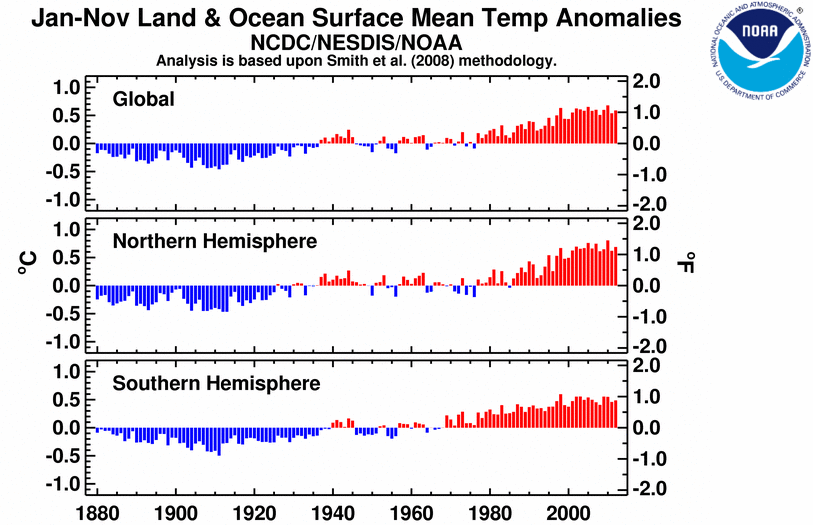
Last month, we had a popular post noting that people 27 years old or younger had never experienced a month of cooler-than-average global temperatures. A lot of people — presumably ones who lead such full, busy lives that they cannot click links and/or read past the first paragraph of an article — were quick to point out that where they lived (invariably somewhere in the northern expanses of Canada) it had in fact been very cold one winter, and that this personal, localized experience trumped 332 months of above-average global air and land temperatures because the world revolves around them.

Anyway, the point is: We’re up to 333 months.

The average November temperature across land and ocean surfaces around the world was 1.21°C (0.67°F) above the 20th century average, marking the fifth warmest November since records began in 1880. … Including this November, the 10 warmest Novembers have occurred in the past 12 years. The 10 coolest Novembers on record all occurred prior to 1920. November 2012 also marks the 36th consecutive November and 333rd consecutive month with global temperature higher than the long-term average. The last month with a below average temperature was February 1985, nearly 28 years ago.

333 months! Halfway to the apocalypse, one can only assume.

The map of variance from average temperatures is amazing. Not a single spot on Earth has seen record cold temperatures this year. Zero. But the U.S. and Europe and broad stretches of ocean have seen the warmest years ever recorded.

Click to embiggen.

And yet that’s still not enough to propel 2012 into position as the hottest year the world as a whole has ever seen. (But it will certainly end up as America’s hottest, as the map above suggests.) Through last month, this year is only the eighth-warmest in history.

Click to embiggen.

Each of the seven warmer years have occurred since 1998.

An important caveat: You will note that the map above is not uniformly red! That is because temperatures are different in different parts of the world. Maybe you can remember 10 Novembers warmer than this last one — that does not mean that the global average for November 2012 is the 11th-warmest! Your mileage may vary, as they say.

And another caveat: August 2040 will (possibly) be the 666th straight month with higher-than-average global temperatures (somewhat undermining the concept of average). The map for that month will likely be a pure splotch of red, as Earth will have been consumed by hellfire. Please prepare appropriately.

Source

State of the Climate, Global Analysis: November 2012, NOAA

Philip Bump writes about the news for Gristmill. He also uses Twitter a whole lot.

Read more:

Climate & Energy

Also in Grist

Please enable JavaScript to see recommended stories

More here: 

For the 36th November in a row, global temperatures were above average

Posted in GE, Uncategorized | Tagged , , , , , , , , , , , | Comments Off on For the 36th November in a row, global temperatures were above average

People aren’t connecting extreme weather to climate change — at least, not on Google

People aren’t connecting extreme weather to climate change — at least, not on Google

This morning, Google unveiled its “Zeitgeist 2012″ report, a look at what the world searched for over the past 12 months. (Well, over the past 11-and-a-third months, anyway.) The No. 1 trending thing people searched for was Whitney Houston, which: OK. But when it came to news events, the most captivating thing was Hurricane Sandy.

Which got us thinking: Did those searches for Sandy prompt more searches on climate change? And the answer is: yes, but not many.

Here’s what search traffic for “Hurricane Sandy” looked like over the course of the year, across the globe. (In all graphs, 100 represents the peak search volume.)
And, here, searches for “climate change” and “global warming.”

See that tiny little tick up at the end of October? Yeah, that’s correlated to Sandy.

The searches for “Hurricane Sandy” were, predictably, centered on the East Coast.

Interestingly, searches for “climate change” were centered in Australia …
… and those for “global warming” in Southeast Asia.
Australia, of course, was battered by floods, as was the Philippines. The only places in the United States that saw much traffic for either term were in the Northeast.

We also wondered if the drought caused any splash on Google. And it did, exactly when you’d have expected.
No doubt thanks to the size of the state’s cities, the searches were centered in Texas.
Google is as close as we can get to gauging the public’s thinking. What we learn, then, is that extreme weather events don’t prompt an immediate, online connection to climate change; or, at least, no connection to the desire to learn more about the issue.

And, if you’re wondering who’s searching for Grist?
Not nearly enough people.

Philip Bump writes about the news for Gristmill. He also uses Twitter a whole lot.

Read more:

Climate & Energy

Also in Grist

Please enable JavaScript to see recommended stories

Originally from:

People aren’t connecting extreme weather to climate change — at least, not on Google

Posted in GE, Uncategorized | Tagged , , , , , , , , , , , | Comments Off on People aren’t connecting extreme weather to climate change — at least, not on Google