Category Archives: ALPHA

A building El Niño in 2018 signals more extreme weather for 2019

In case you couldn’t get enough extreme weather, the next 12 months or so could bring even more scorching temps, punishing droughts, and unstoppable wildfires.

It’s still early, but odds are quickly rising that another El Niño — the periodic warming of the tropical Pacific Ocean — could be forming. The latest official outlook from NOAA and Columbia University gives better-than-even odds of El Niño materializing by the end of this year, which could lead to a cascade of dangerous weather around the globe in 2019.

That’s a troubling development, especially when people worldwide are still suffering from the last El Niño, which ended two years ago.

Dear reader, like what you see here?

Keep Grist’s green journalism humming along by supporting us with a donation today. Your gift will help us fight for a planet that doesn’t burn and a future that doesn’t suck.

Support Grist   

These early warnings come with a caveat: Predictions of El Niño at this time of year are notoriously fickle. If one comes, it’s impossible to know how strong it would be.

When it’s active, El Niño is often a catch-all that’s blamed for all sorts of wild weather, so it’s worth a quick science-based refresher of what we’re talking about here:

El Niño has amazingly far-reaching effects, spurring droughts in Africa and typhoons swirling toward China and Japan. It’s a normal, natural ocean phenomenon, but there’s emerging evidence that climate change is spurring more extreme El Niño-related events.

On average though, El Niño boosts global temperatures and redistributes weather patterns worldwide in a pretty predictable way. In fact, the Red Cross is starting to use its predictability to prevent humanitarian weather catastrophes before they happen.

All told, the the U.N. estimates the 2016 El Niño directly affected nearly 100 million people worldwide, not to mention causing permanent damage to the world’s coral reefs, a surge in carbon dioxide emissions from a global outbreak of forest fires, and the warmest year in recorded history.

In Ethiopia, it spawned one of the worst droughts in decades. More than 8.5 million Ethiopians continue to rely on emergency assistance, according to the UN. That includes some 1.3 million people — a majority of whom are children — who have been forced to migrate from their homes.

Initial estimates show that, if the building El Niño actually arrives, 2019 would stand a good chance at knocking off 2016 as the warmest year on record. With a strong El Niño, next year might even tiptoe across the 1.5 degree-Celsius mark — the first major milestone that locks in at least some of global warming’s worst impacts.

Recently, the United Kingdom’s Met Office — the U.K’s version of the National Weather Service — placed a 10-percent chance of the world passing the 1.5 degree Celsius target before 2022. That target was a key goal of the 2015 Paris climate agreement because a sharp upward spike in temperature that severe, if sustained, would be potentially catastrophic — causing, among other impacts, “fundamental changes in ocean chemistry” that could linger for millennia, according to a draft UN report due out later this year.

Another El Niño is bad news, but it has been inevitable that another one will happen eventually. Knowing exactly when the next one is coming will give those in harm’s way more time to prepare.

Continue reading here:  

A building El Niño in 2018 signals more extreme weather for 2019

Posted in alo, ALPHA, Anchor, Cascade, FF, G & F, GE, LG, ONA, PUR, Uncategorized | Tagged , , , , , , , , , , | Comments Off on A building El Niño in 2018 signals more extreme weather for 2019

Officials tried to censor a report on national parks. Here’s what was in it.

Roughly 25 percent of U.S. national parks are vulnerable to rising sea levels because they’re situated in coastal areas. For years, the National Parks Service has had a report in the works to quantify how higher ocean tides and storm surges could impact its sites. But in April, Reveal found that in drafts of the publication, park officials had censored all mentions of human-caused climate change as an explanation for the encroaching waters.

The story prompted Democrats on the House Committee on Natural Resources to write a letter to the Department of the Interior requesting an investigation into the scientific integrity of the Parks Service. Interior Secretary Ryan Zinke has said that he never changes reports before they go out.

In a follow-up, Reveal reported that when Maria Caffrey, a University of Colorado research assistant and the study’s lead author, fought the changes, officials said they could take her name off the paper or potentially not release it at all. “The fight probably destroyed my career with the (National Park Service) but it will be worth it if we can uphold the truth and ensure that scientific integrity of other scientists won’t be challenged so easily in the future,” she said.

Finally released Friday, the analysis illustrates how different levels of emissions would increase sea levels and storm surges near 118 national parks over roughly the next century. In the end, science prevailed: The report identifies human-caused climate change as the main culprit behind the rising sea levels that endanger the sites.

Here’s what the collaboration between the National Parks Service and the University of Colorado found:

Rising seas will flood parks. By the end of the century, some sites in North Carolina’s Outer Banks, for example, could experience an ocean rise of nearly two-and-a-half feet. The researchers caution that this would submerge large parts of those parks.
Wright Brothers National Memorial is predicted to face the largest sea-level rise. By 2100, the shoreline near the park is predicted to see up to a 2.7 foot increase under the most severe global warming situation they studied.
Unsurprisingly, islands are at an increased risk. The authors note that for more remote national parks, like those in the Caribbean or the National Park of American Samoa, a storm surge could be particularly ruinous, as it’s difficult to deliver aid to those sites quickly.
Overall, parks in the U.S. southeast are at highest risk for storm surges. For example, a category two hurricane would inundate Everglades National Park.

Now is the time to plan. The authors say that their findings can help inform parks as they adapt to a warming world that endangers their infrastructure and historical structures.

Read original article: 

Officials tried to censor a report on national parks. Here’s what was in it.

Posted in alo, ALPHA, Anchor, FF, G & F, GE, ONA, OXO, Uncategorized | Tagged , , , , , , , , , , | Comments Off on Officials tried to censor a report on national parks. Here’s what was in it.

Satirical ad reveals how to live luxuriously like Scott Pruitt

EPA Administrator Scott Pruitt got ridiculed in front of the nation at a hearing this week, when Senate Democrats took him to task over his excessive spending and alleged ethical missteps.

But that wasn’t enough for the Sierra Club. The environmental group launched a satirical video making fun of Pruitt’s lush life on Friday. The premise of the parody advertisement? That you, too, could live in such a luxurious fashion — as long as you’re cool with doing a little dirty business.

“Looking to plan a luxury vacation to far off places like Australia, Morocco, or Italy? Try Do-it-Pruitt, your one-stop shop for outrageous pay-to-play deals at the Environmental Protection Agency,” the narrator says. “We have a lobbyist ready to make your plane, dinner, and hotel reservations for you — all you have to do is meet with their corporate polluter clients.”

The ad is part of the growing #BootPruitt campaign, the first coordinated effort to kick Pruitt out of office.

See the article here:

Satirical ad reveals how to live luxuriously like Scott Pruitt

Posted in alo, ALPHA, Anchor, FF, G & F, GE, LG, ONA, Uncategorized | Tagged , , , , , , , , , , | Comments Off on Satirical ad reveals how to live luxuriously like Scott Pruitt

Utah sobers up from climate denial

The flamboyantly conservative state of Utah — home to the Mormon Tabernacle Choir, an all-Republican government, and the Utah Jazz — now officially recognizes climate change, thanks to a bunch of kids.

Seven high-school students stood behind the desk of Gov. Gary Herbert this week as he signed the climate change resolution they’d championed. The resolution acknowledges the existence of climate change, calls for cutting carbon emissions, and states that ratcheting down carbon need not “constrain the economy nor its global competitiveness.”

The students started their push for this legislation back in 2010, after Utah lawmakers passed a resolution calling on the federal government to stop efforts to reduce greenhouse-gas emissions until there was more evidence that climate change was a thing.

The students then found an ally, Rebecca Edwards, a Republican representative in the state House, who introduced their resolution. After two years of lobbying, it passed by a wide margin.

Grist has been writing about Republicans who want to act on climate change for years now. The problem has been that members of the eco-right often get voted out of office if they take too strong a stand. Conservative media outlets have long argued that climate action is a liberal plot to expand big government, and now that idea is baked into the orthodoxy of the Republican base. But the Republican party is changing. It’s not enough for lawmakers to listen to aging Rush Limbaugh “dittoheads.” They also have to consider their younger constituents, who are twice as likely to accept that humans are causing climate change as Republican boomers.

Millennial Republicans aren’t exactly hardcore climate hawks, though: just 36 percent think that climate change is mostly our fault, while 59 percent say it’s having an effect on the United States, according to a Pew poll.

The Utah resolution matches that sentiment. It doesn’t single out humans as culprits and emphasizes the potential for competitive markets and innovation to curb emissions. That’s not perfect, but it’s pretty damn (excuse me, Utah) pretty darn good for a start.

Originally posted here – 

Utah sobers up from climate denial

Posted in alo, ALPHA, Anchor, FF, G & F, GE, LG, ONA, Uncategorized | Tagged , , , , , , , | Comments Off on Utah sobers up from climate denial

How to Grow Your Own Spirulina

Spirulina is likely the most nutrient-dense food on the planet. It?s also been shown to have many health benefits. In fact, the United Nations declared spirulina ?the best food for the future? at their World Food Conference in 1974. This is one food that may truly deserve the title of ?superfood.?

You can buy spirulina supplements and powders commercially, although these are often extremely expensive and there may be potential health concerns related to them.

An excellent way to skip the high cost and questionable quality is to grow your own. The process is no harder than keeping a fish aquarium. And you?ll be able to harvest fresh, affordable, ready-to-use spirulina right from your home.

WHAT IS SPIRULINA AND WHY SHOULD YOU GROW IT?

Spirulina is a type of blue-green microalgae that naturally grows in warm, alkaline lakes. It was traditionally eaten by ancient Aztecs and other Mesoamericans as well as many cultures in Africa.

Spirulina is a nearly perfect source of nutrition. Some of its nutritional highlights include:

Contains all essential amino acids, making it a complete protein.
High amounts of polyunsaturated fatty acids, such as alpha-linoleic acid (ALA) and docosahexaenoic acid (DHA).
One of the few known food sources of gamma linoleic acid (GLA), which is needed to regulate your hormone system.
Rich in many B vitamins and vitamins A, C, D and E, as well as iron, magnesium, selenium, potassium and many other minerals.

Due to its outstanding nutritional value, various international organizations currently help to establish small-scale production of spirulina in impoverished communities throughout the world to combat malnutrition and promote local food security. Another benefit of spirulina is that it requires minimal resources to produce. As it grows in water, it doesn?t need fertile land. It doesn?t even need much water because you can reuse the water it grows in.

SUPPLIES YOU?LL NEED

The equipment you?ll need to grow spirulina is fairly straight-forward. If you want to simplify the process, you can buy spirulina growing kits that come with everything you?ll need. Otherwise, you can gather the following items on your own.

1. Tank

You can grow spirulina in any container, depending on how much spirulina you can use. Good options include a large jar, an aquarium tank or even a pool in your back yard. Spirulina needs light to grow, so it?s best if your container is transparent.

2. Culture Medium

Spirulina only needs water and nutrients to grow. It requires water that is very alkaline with a high pH. You?ll be adjusting the pH yourself (we?ll discuss the process below), so you do not have to use especially high-quality water. You can use water from a creek, brackish water, de-chlorinated tap water or rain water. As long as your water isn?t polluted with heavy metals or other toxins, it should work fine.

3. Spirulina Starter Culture

If you happen to know someone who grows spirulina, you can take a portion of their culture to start your own. You can also check your local health food store or find a company online that sells spirulina culture. It typically comes in a bottle with live spirulina in water.

4. Stirring Device

Spirulina needs to be stirred to maximize light reaching the entire growing culture. You can do this periodically with a stick or long spoon, or install a pump with a bubbler.

5. Harvesting Equipment

You?ll need some kind of screen with a very fine mesh of 50 microns in diameter or less. This is used to strain the spirulina out of the water. Natural silk cloth works well, or some aquarium nets have a fine enough mesh. A large cup is also handy to scoop the water into the mesh.

THE GROWING PROCESS

1. Set Up Your Tank and Starter Medium

Whatever container you?re using for your spirulina, make sure it has good light. Indoors, it can live in front of a window or you can use grow lights above it. Outside, try to position it in a bright area that?s out of direct sun.

Check out the Ice Age Farmer?s great video on setting up your tank and starting your culture below. His recipe for the starter medium nutrient mix is here on his website. You can also buy pre-made starter nutrient mixes online.

2. Check Your pH

The pH of your starter medium should be between 8 and 8.5. Litmus paper is the best way to measure your pH. It can be found at most pharmacies or natural food stores. Dip the litmus paper into your solution for 2 to 3 seconds. Once the color on the litmus paper has changed, compare it to the guide on the box to determine the pH. If the pH is still too low, add more baking soda. If it?s too high, add a bit of vinegar.

3. Add Your Spirulina Culture

Pour your spirulina culture into the starter medium and stir gently. Make sure your starter medium and spirulina culture are both at the same temperature. This helps prevent the spirulina from going into shock at too much of a temperature difference.

4. Water Your Spirulina

Water will naturally evaporate over time, so you?ll need to keep it topped up to the same amount you started with. Otherwise, your pH or nutrients can come out of balance. It?s helpful to make a mark on the side of your container once your starting culture is all done so you can see your initial amount. Then simply keep adding water if you ever see it drop.

5. Keep Your Spirulina Warm

Spirulina is naturally from tropical lakes, so it prefers warm water. It will grow in temperatures between 55 and 100 degrees Fahrenheit (13 to 38 degrees Celsius), but the ideal temperature is between 89 to 98 degrees Fahrenheit (32 to 37 degrees Celsius). Your spirulina will grow at colder temperatures, it will just be slower. If you want to maximize the growth, consider installing a heater in your water. Just make sure it does not get over 104 degrees Fahrenheit (40 degrees Celsius), as this will start to kill the spirulina.

6. Enlarge Your Culture if Needed

You can repeat the previous steps to make your culture larger if you?d like. After making your initial culture, wait at least 3 days for the spirulina to grow and establish a good population. You should see the culture becoming greener as the spirulina replicates. Then mix up a new batch of starter medium and add it to your main spirulina culture. You can do this a few times if needed until your container is full.

7. Harvest Your Spirulina

As spirulina grows, the pH of the entire culture will rise. This is the primary reason why it?s typically very safe to eat spirulina, because almost no other organisms can actually live in such alkaline conditions. To ensure your spirulina is safe, wait until the pH of your culture has reached 10 or higher before harvesting it.

After about 3 to 6 weeks of growth, your spirulina should be ready to harvest. And harvesting is as simple as scooping some of the culture?s water out and running it through your mesh cloth or net. The spirulina will collect on the cloth. Gently squeeze out any excess liquid to avoid consuming the alkaline water. You?ll be left with a deep green paste.

8. Feed Your Spirulina

Each time you harvest some spirulina, you?ll need to replenish the nutrients in the main culture. For example, if you take out 1 tablespoon of spirulina, you?ll need to add 1 tablespoon of a nutrient mixture back into to the culture. The Ice Age Farmer has a good nutrient mix on his website, or you can buy a pre-made nutrient mix from spirulina suppliers.

WHAT TO DO WITH YOUR SPIRULINA

1. Eat It Fresh

Fresh spirulina is much tastier than most store-bought powders. Spirulina growers claim there is no comparison between the two. You can add fresh spirulina to your favorite dishes, spread it on top of fruit or bread, use it as a condiment, mix it into dips and spreads, or simply have a spoonful plain or in juice as often as you like.

2. Preserve It

Fresh spirulina is very delicate and perishable. It should be eaten or preserved within one hour of harvest. It will last about three days in the fridge, and indefinitely when frozen. It can last up to a year when dried.

To dry spirulina, spread it out in a thin layer on a flat surface. It?s best if you can spread it on some kind of net for better air flow, but a baking sheet or something similar will also work. Alternatively, use a nylon bag with a small hole or a large syringe to create thin spirulina ?noodles? to dry.

You can dry your spirulina outside in the sun for about 2 days. You can also use a dehydrator or an oven set on a low heat.

Check out the following recipes for using either fresh or dried spirulina.

Spirulina Tapenade
Spirulina Risotto
Mermaid Toast
Spirulina Cake

Related at Care2

How to Grow Your Own Ginger
How to Grow Your Own Turmeric
How to Grow Your Own Mushrooms

Biologigaragen Spirulina, via Flickr

Disclaimer: The views expressed above are solely those of the author and may not reflect those of Care2, Inc., its employees or advertisers.

Continue at source: 

How to Grow Your Own Spirulina

Posted in ALPHA, bigo, FF, GE, LAI, LG, ONA, oven, PUR, Uncategorized | Tagged , , , , , , , | Comments Off on How to Grow Your Own Spirulina

While hurricanes struck, Scott Pruitt was up to some interesting activities

This story was originally published by Mother Jones and is reproduced here as part of the Climate Desk collaboration.

The devastation from hurricanes Irma and Harvey, the two weeks of catastrophic flooding, and the toxic aftermath should have been opportunities for the head of the EPA to snap into action. Had Scott Pruitt done so, it would have been in stark contrast with his tenure so far, which has mostly consisted of making the case that the regulatory power of the EPA should be undermined and advocating that his agency be made smaller in size and scope, be deprived of a robust budget and enforcement power, and shift focus to what he likes to call “regulatory certainty” for polluting industries.

In the past, the EPA’s job in the aftermath of storms has been to help ensure that victims do not return to homes and neighborhoods that are toxic cesspools. The environmental aftermath of Harvey and Irma has been particularly devastating, with Superfund sites that have flooded, pipelines that have have leaked, forced evacuations because of explosions at the Arkema chemical plant, and a hazardous mix of floodwaters and sewage.

A week ago, George W. Bush’s EPA administrator, Christine Todd Whitman, wrote a scathing assessment in the New York Times of how Pruitt has been performing on the job. “The agency created by a Republican president 47 years ago to protect the environment and public health may end up doing neither under Mr. Pruitt’s direction,” she noted. When reflecting on Pruitt’s performance during Hurricane Harvey, she added that the EPA’s recent actions, including the EPA’s attack on an AP reporter, “are only the latest manifestations of my fears.”

Whitman may have missed some of Pruitt’s other activities. During the two hurricanes, the EPA administrator has appeared in far-right media, blasted the Obama administration and the mainstream media, disparaged discussions about climate change, and rolled back more regulations. Here are some noteworthy Pruitt sightings that took place during the recent weeks when severe weather battered the United States:

Aug. 28: Harvey’s deluge was in its fourth day, the death toll had risen to nine, and parts of Texas had already seen nearly 40 inches of rain when Pruitt had an interview with the right-wing media site Breitbart. At the end, host Alex Marlow pressed Pruitt on his response to coverage that connected the hurricane to climate change. What he didn’t mention was the growing consensus among scientists that climate change will worsen the severity of these storms. A discussion about “a cause and effect isn’t helping the people of Texas right now,” Pruitt replied. “I think for opportunistic media to use events like this to, without basis or support, just to simply engage in a cause-and-effect type of discussion, and not focus upon the needs of people, I think is misplaced.”

Over the course of the two storms, Pruitt would have several opportunities to repeat this observation.

On the same day, Pruitt was also interviewed by another sympathetic conservative radio host, Newsmax’s Joe Pagliarulo.

Pruitt explained what the EPA was doing to respond to Harvey: First, he praised his fast response to Texas’ request to waive gasoline mix requirements to avert shortages. He then mentioned a refinery monitoring center that is working “with industry, private-sector folks to ensure that things are secure.” Finally he added that the EPA is observing drinking-water quality and any potential contamination from landfills.

He even came up with an unusual new definition for what environmentalism means: “Is true environmentalism ‘Do not touch’? Or is it, ‘Hey, we’ve been blessed with natural resources across our country and we should use and cultivate those natural resources with what: environmental sensitivity? Environmental stewardship?””

Aug. 31: The Arkema chemical plant exploded near Houston. The same day, six Senate Democrats sent a letter to Pruitt asking him to respond to a series of accusations about how he’s limited transparency and public information access at the EPA. “At your direction, the political leadership of the U.S. Environmental Protection Agency is taking deliberate steps to thwart transparency,” the senators wrote. “It is essential to the functioning of our democracy that our government does its business in the open. Yet according to recent press reports, you are taking measures to conceal your official actions.”

Sept. 3: The Associated Press reported that the EPA was not on the scene to survey the Houston area’s Superfund sites that were underwater and found seven sites flooded. (The EPA later estimated from aerial imagery that there were actually 13.) In response, the EPA put out a statement accusing one of the bylined reporters of inaccurate reporting because he was in Washington, D.C., and not in Houston, despite the fact that the AP had a reporting team on the scene. The EPA went on to link to conservative press to prove its point, and Pruitt’s Twitter account shared the press release.

Sept. 8: Harvey had quieted, but now, eyes were turned to Irma’s growing strength and its unclear path toward Florida. The Arkema explosion occurred just one week before Pruitt appeared on an ABC News podcast to discuss Harvey’s aftermath. In it, he defended delaying a regulation that lays out the specific information chemical companies like Arkema are required to provide first responders in the event of chemical explosions similar to the one in Houston. When asked about the “hype about climate change,” Pruitt answered, “Will there be a time and place to perhaps discuss that and debate that? Sure,” he said. “But not in the midst of the storm, not in the midst of the responses, because there’s enough to say grace over right now.”

Sept. 6: On the day that Hurricane Irma — which was at certain points a Category 5 storm — reached Puerto Rico after leveling some islands in the Caribbean, Pruitt, along with Rick Perry and other Cabinet members, were scheduled to accompany Donald Trump on a visit to an oil refinery in North Dakota, where the president delivered a speech on taxes. Pruitt didn’t attend, an EPA spokesperson confirmed, but Trump still gave the agency a shoutout in the aftermath of Harvey: “We’ve ended the EPA intrusion into your jobs and into your lives. And we’re refocusing the EPA on its core mission: clean air and clean water.”

Sept. 7: Pruitt gave a phone interview to CNN in which he repeated the same line he used with Breitbart when asked about climate change. “To use time and effort to address it at this point is very, very insensitive to this people in Florida,” he said.

The most vulnerable areas of Florida, Georgia, and South Carolina were busy engaging in the evacuation of nearly 7 million people, but that didn’t stop Miami’s Republican mayor from discussing climate change in relation to the storm.

“If this isn’t climate change, I don’t know what is,” Mayor Tomás Regalado said two days later, after he declared a Sept. 8 State of Local Emergency in his city.

Sept. 11: On Monday, Pruitt gave a wide-ranging interview to the Washington Examiner from his EPA office in Washington. The stories reported that Pruitt went after Barack Obama’s environmental record and his other adversaries:

“I’ve got to say this to you: what is it about the past administration?” Pruitt said. “Everyone looks at the Obama administration as being the environmental savior. Really? He was the environmental savior? He’s the gold standard, right? Well, he left us with more Superfund sites than when he came in. He had Gold King [the 2015 mine wastewater spill] and Flint, Michigan [drinking water crisis]. He tried to regulate CO2 twice and flunked twice. Struck out. So what’s so great about that record? I don’t know.”

He also took the opportunity to criticize Christine Todd Whitman, Bush’s EPA administrator. Pruitt said he hadn’t read her New York Times op-ed but added:

“Maybe Christine Todd Whitman likes the Obama administration,” Pruitt said. “Go ask her, I don’t know. [Obama] is the gold standard, right?”

Finally, he attacked German Chancellor Angela Merkel in anticipation of a United Nations General Assembly meeting in New York next week:

“If Chancellor Merkel … really cares about reducing CO2 in this world, why is she going away from nuclear?” Pruitt asked. “It’s so hypocritical for countries to look at the United States and say, ‘You need to do more.’ Really? So, we’ve reduced our pollutants under the Clean Air Act [criteria pollutants and CO2].”

Sept. 12: Irma had already flattened Barbuda, leaving 95 percent of the buildings destroyed and 1 million people in Puerto Rico without power for what could be months. Seventy-five percent of Florida was without power in the aftermath of the weekend’s storm, and the U.S. death toll had risen to 22. That’s when the EPA announced a two-year delay for a 2015 rule that set the first limit on toxic metals that can be discharged into wastewater from power plants. “Today’s final rule resets the clock for certain portions of the agency’s effluent guidelines for power plants, providing relief from the existing regulatory deadlines while the agency revisits some of the rule’s requirements,” Pruitt said in a statement.

This delay only adds to Irma victims’ challenges: Not only do they have to rebuild, but the Trump administration’s EPA isn’t doing much these days to make their water and air safer.

Link:  

While hurricanes struck, Scott Pruitt was up to some interesting activities

Posted in alo, ALPHA, Anchor, Everyone, FF, G & F, GE, LAI, LG, ONA, Safer, Uncategorized | Tagged , , , , , , , , , | Comments Off on While hurricanes struck, Scott Pruitt was up to some interesting activities

Hurricane Maria poses a catastrophic threat to the Caribbean

This post has been updated to reflect Maria’s upgrade to Category 5.

The already miserable hurricane season is about to get worse, as Hurricane Maria barrels toward a storm-weary Caribbean.

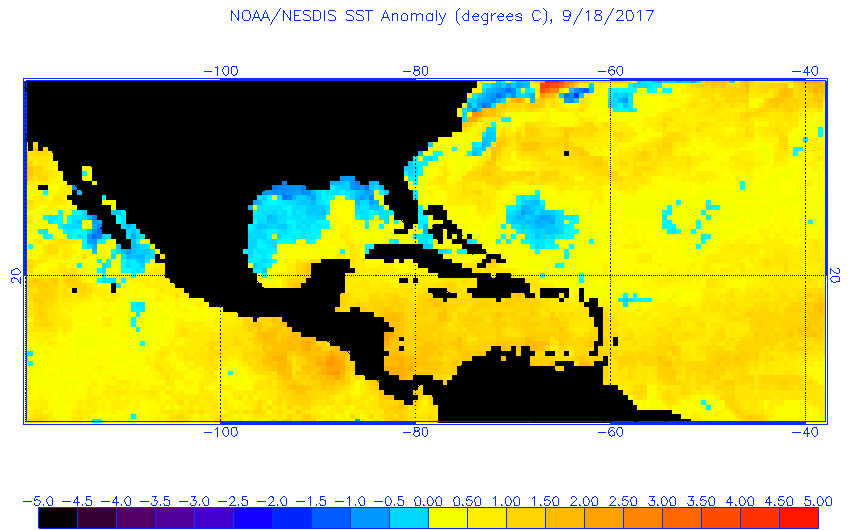
Maria rapidly strengthened to a Category 5 hurricane on Monday, packing winds of at least 160 mph as it neared the eastern Caribbean island country of Dominica — one of the fastest intensifying hurricanes in history. Meteorologists with the National Hurricane Center warned that the storm would likely keep growing stronger as it moves closer to Puerto Rico and the U.S. Virgin Islands, home to more than 3.5 million people. Ocean waters on its path are much warmer than normal, and atmospheric conditions are nearly ideal for a storm to intensify.

The latest forecast takes Maria ashore in Puerto Rico early Wednesday as a Category 5 — a worst-case scenario. Puerto Rico Governor Ricardo Rosselló declared a state of emergency to help the island prepare and speed the flow of disaster aid.

All this comes less than two weeks after Irma struck the Caribbean as one of the strongest hurricanes in history. The damage from Irma in the U.S. Virgin Islands was so severe that local officials, whose economy depends on tourism, have told visitors to stay away. Cruise ships have been put into service as rescue vessels. In some of the hardest hit islands, like Barbuda, Anguilla, and St. Martin, recovery could take years.

Even though the wounds of Irma are still fresh, it’s important to remember that a hurricane as strong as Maria is exceedingly rare in the Caribbean. According to weather records dating back to 1851, no Category 5 hurricane has ever struck Dominica. Hurricane David, in 1979, was the only Category 4 to do so. That storm ruined the local economy and left roughly three-quarters of the population homeless.

Irma was a powerful Category 5, but its center moved past Puerto Rico without a direct landfall, so although the island experienced massive power outages, Irma could have been much worse.

Maria will likely be much worse.

Weather models show Maria crossing the center of Puerto Rico at peak strength, becoming the first Category 5 to do so since 1928, and only the second in recorded history. The result could be catastrophic, with heavy rainfall leading to inland flooding and landslides, winds in excess of 170 mph battering coastal cities, and storm surge of six to nine feet inundating homes and businesses along the shoreline.

It’s impossible to overstate how serious a storm like Maria is. The U.S. Virgin Islands’ Governor Kenneth Mapp warned of high winds and torrential rain and called on islanders to prepare, even as relief supplies for Irma continued to pour in. “If your home is damaged,” he said, “do not ride out this storm in your home.”

See original article: 

Hurricane Maria poses a catastrophic threat to the Caribbean

Posted in alo, ALPHA, Anchor, FF, G & F, GE, ONA, Uncategorized | Tagged , , , , , , , , | Comments Off on Hurricane Maria poses a catastrophic threat to the Caribbean

World hunger rises after decades of decline.

“Clearly, our environment changes all the time,” the Republican leader said after touring Irma’s devastation. “And whether that’s cycles we’re going through or whether that’s man-made, I wouldn’t be able to tell you which one it is.”

It’s good to see Scott pondering those wacky ideas we’ve all heard floating around: Human-caused climate changemore intense hurricanesrising sea levels, etc. Coming to terms with climate change is a journey we all must pursue at our own pace! It’s not urgent or anything.

So what is Scott feeling sure about? Let’s hear it:

This is a catastrophic storm our state has never seen,” he warned on Saturday before Irma hit Florida.

“We ought to go solve problems. I know we have beach renourishment issues. I know we have flood-mitigation issues,” he said in the wake of Irma.

“I’m worried about another hurricane,” he shared with reporters while touring the Florida Keys this week. We feel ya, Scott.

Big ideas! Perhaps a fellow Florida Republican could illuminate their common thread.

“[I]t’s certainly not irresponsible to highlight how this storm was probably fueled — in part — by conditions that were caused by human-induced climate change,” Florida congressman and Grist 50er Carlos Curbelo said this week.

In fact, it just might be necessary.

Read this article – 

World hunger rises after decades of decline.

Posted in alo, ALPHA, Anchor, FF, G & F, GE, LAI, ONA, PUR, The Atlantic, Uncategorized | Tagged , , , , , , , , | Comments Off on World hunger rises after decades of decline.

Donald Glover’s ‘Atlanta’ is a double-Emmy winner.

“Clearly, our environment changes all the time,” the Republican leader said after touring Irma’s devastation. “And whether that’s cycles we’re going through or whether that’s man-made, I wouldn’t be able to tell you which one it is.”

It’s good to see Scott pondering those wacky ideas we’ve all heard floating around: Human-caused climate changemore intense hurricanesrising sea levels, etc. Coming to terms with climate change is a journey we all must pursue at our own pace! It’s not urgent or anything.

So what is Scott feeling sure about? Let’s hear it:

This is a catastrophic storm our state has never seen,” he warned on Saturday before Irma hit Florida.

“We ought to go solve problems. I know we have beach renourishment issues. I know we have flood-mitigation issues,” he said in the wake of Irma.

“I’m worried about another hurricane,” he shared with reporters while touring the Florida Keys this week. We feel ya, Scott.

Big ideas! Perhaps a fellow Florida Republican could illuminate their common thread.

“[I]t’s certainly not irresponsible to highlight how this storm was probably fueled — in part — by conditions that were caused by human-induced climate change,” Florida congressman and Grist 50er Carlos Curbelo said this week.

In fact, it just might be necessary.

Read original article:

Donald Glover’s ‘Atlanta’ is a double-Emmy winner.

Posted in alo, ALPHA, Anchor, FF, G & F, GE, LAI, ONA, PUR, The Atlantic, Uncategorized | Tagged , , , , , , , , | Comments Off on Donald Glover’s ‘Atlanta’ is a double-Emmy winner.

The Dog Listener – Jan Fennell

READ GREEN WITH E-BOOKS

The Dog Listener
Learn How to Communicate with Your Dog for Willing Cooperation
Jan Fennell

Genre: Nature

Price: $1.99

Publish Date: October 13, 2009

Publisher: HarperCollins e-books

Seller: HarperCollins


In The Dog Listener Jan Fennell shares her revolutionary insight into the canine world and its instinctive language that has enabled her to bring even the most delinquent of dogs to heel. This easy-to-follow guide draws on Jan’s countless case histories of problem dogs—from biters and barkers to bicycle chasers—to show how you can bridge the language barrier that separates you from your dog. This edition includes a new 30-Day Training Guide to further incorporate Jan’s powerful method into every element of pet ownership, including: Understanding what it means to care for a dogChoosing the right dog for youIntroducing your dog to its new homeOvercoming separation anxietyWalking on a leashDealing with behavioral problemsGrooming And much more

Visit site: 

The Dog Listener – Jan Fennell

Posted in alo, ALPHA, Anchor, ATTRA, FF, GE, HarperCollins e-books, LG, ONA, PUR, Uncategorized | Tagged , , , , , , , | Comments Off on The Dog Listener – Jan Fennell