Category Archives: FF

Rising temperatures pose ‘extreme danger’ to Muslims on Hajj pilgrimage

It’s not always easy to have faith — especially when your faith might involve trekking through temperatures upwards of 120 degrees Fahrenheit.

For the world’s estimated 1.8 billion Muslims — roughly a quarter of the world’s population — making a once-in-a-lifetime pilgrimage to Mecca is considered a religious duty. Hajj, as the ritual is called, brings millions of people to the Saudi Arabian holy city each year. But according to a new study, climate change could lead to an increase in temperatures and humidity along the heart of the route, putting many devotees in “extreme danger” of developing heat-related illnesses.

“When it comes in the summer in Saudi Arabia, conditions become harsh, and a significant fraction of these activities are outdoors,” Elfatih Eltahir, MIT engineering professor and lead author of the study, said in a press release.

When the Hajj falls in the summer — the timing of the annual migration changes every year due as it depends on the lunar calendar — it may not be safe for participants to remain outdoors during the trip. This year, the Hajj fell in August, and temperatures in Mecca averaged about 109 degrees F (43 degrees C). Saudi officials cautioned visitors that temperatures could reach as high as 122 degrees F (50 degrees C) on some days.

While rising temperatures along the traditional holy route are worrying, Saudi Arabia has some time to prepare for the increased danger. Each year the Hajj occurs about 11 days earlier, so there will only be the occasional stretch of five to seven years where the pilgrimage falls during the hottest summer months. According to the study, the Hajj won’t fall during the summer again until 2047. In the meantime, researchers are arguing for Saudi Arabia to introduce countermeasures or restrictions on participation in the pilgrimage, warning of an even more severe toll on human health. But even with mitigation measures in place, Eltahir says, “it will still be severe.”

“It is time for the Muslim community to become the leaders in the fight, with not just countries such as Bangladesh and Pakistan under threat now, but increasingly the holy site of Mecca.” Tufail Hussain, director of Islamic Relief U.K. told Sky News in response to the study.

“If we don’t act now, not only will people suffer the impact of more frequent and intense disasters, but our children born from today will no longer be able to perform the sacred duty of Hajj.”

View original – 

Rising temperatures pose ‘extreme danger’ to Muslims on Hajj pilgrimage

Posted in Accent, alo, Casio, Eureka, FF, GE, LG, ONA, Uncategorized | Tagged , , , , , , , , | Comments Off on Rising temperatures pose ‘extreme danger’ to Muslims on Hajj pilgrimage

Wetware – Dennis Bray

READ GREEN WITH E-BOOKS

Wetware

A Computer in Every Living Cell

Dennis Bray

Genre: Biology

Price: $12.99

Publish Date: May 26, 2009

Publisher: Yale University Press (Ignition)

Seller: OpenRoad Integrated Media, LLC


“A beautifully written journey into the mechanics of the world of the cell, and even beyond, exploring the analogy with computers in a surprising way” (Denis Noble, author of Dance to the Tune of Life ).   How does a single-cell creature, such as an amoeba, lead such a sophisticated life? How does it hunt living prey, respond to lights, sounds, and smells, and display complex sequences of movements without the benefit of a nervous system? This book offers a startling and original answer.   In clear, jargon-free language, Dennis Bray taps the findings from the discipline of systems biology to show that the internal chemistry of living cells is a form of computation. Cells are built out of molecular circuits that perform logical operations, as electronic devices do, but with unique properties. Bray argues that the computational juice of cells provides the basis for all distinctive properties of living systems: it allows organisms to embody in their internal structure an image of the world, and this accounts for their adaptability, responsiveness, and intelligence.   In Wetware , Bray offers imaginative, wide-ranging, and perceptive critiques of robotics and complexity theory, as well as many entertaining and telling anecdotes. For the general reader, the practicing scientist, and all others with an interest in the nature of life, this book is an exciting portal to some of biology’s latest discoveries and ideas.   “Drawing on the similarities between Pac-Man and an amoeba and efforts to model the human brain, this absorbing read shows that biologists and engineers have a lot to learn from working together.” — Discover magazine   “ Wetware will get the reader thinking.” — Science magazine

Original source: 

Wetware – Dennis Bray

Posted in alo, Anchor, FF, GE, LAI, LG, ONA, oven, PUR, Uncategorized, Yale University Press | Tagged , , , , , , , , | Comments Off on Wetware – Dennis Bray

Amazon fires: Satellite images show what’s happening in Brazil

High-resolution images from satellite company Planet are revealing glimpses of some of the fires currently devastating the Amazon rainforest.

While many of the images currently being shared on social media and by news outlets are from past fires — some from as long as 15 years ago — satellites can provide a near real-time view of what’s unfolding in the Amazon. With near-daily overflights and high-resolution imagery, Planet’s constellation of satellites is providing a clear look at some of the fires now burning in the Brazilian Amazon.

Beyond dramatic snapshots, those images also provide data that can be mined for critical insights into what’s happening in the Amazon on a basin-wide scale, according to Greg Asner, the director of the Center for Global Discovery and Conservation Science at Arizona State University, whose team is using Planet’s data to assess the impact of the fires on carbon emissions.

“Planet data provides unprecedented detail in mapping forest change down to individual trees which allows us to assess the damage from these kinds of large scale disturbances,” Asner said. “Our Planet Incubator Program is currently tracking forest carbon emissions all over the world — including the Amazon — using Planet Dove and SkySat imagery.”

“If you took all of the carbon stored in every tropical forest on Earth and burned it up, you would emit about five times the carbon dioxide into the atmosphere that is already there,” he said. “The Amazon rainforest represents about half of this forest carbon, to give you an idea of how serious this current situation is and the kind of impact it will have on climate change.”

Fires burning in the state of Pará, Brazil. Planet Labs Inc.

Planet wouldn’t comment what the images show specifically, but there are strong indications from other sources that many fires are burning near areas of recent deforestation. Analysis released this week by IPAM Amazônia, a Brazilian research group, shows that the 10 Amazonian municipalities that had the most fire outbreaks this year were also the ones that had the highest deforestation rates.

“These municipalities are responsible for 37 percent of the hotbeds in 2019 and 43 percent of recorded deforestation through July,” states the IPAM report. “This concentration of forest fires in newly deforested areas with mild drought represents a strong indication of the intentional character of the fires.”

In other words, fires are being set to clear lands for agriculture, most likely cattle pasture, which accounts for 70 to 80 percent of forest conversion in the Brazilian Amazon. Typically a landowner will cut and harvest valuable timber trees before slashing and burning the remaining trees. The resulting ash provides a temporary source of nutrients for pasture grass, but the soil degrades quickly without careful management.

While old-growth Amazon rainforest doesn’t typically burn naturally outside droughts and El Niño years, fires set intentionally in degraded forests and agricultural lands can burn hot enough to spread deep into otherwise untouched forests. That seems to be what’s happening this year, which, as IPAM noted, isn’t especially dry.

However that may soon change — for the worse.

With climate models forecasting a much hotter Amazon due to rising carbon dioxide concentrations in the atmosphere, a growing chorus of scientists are warning that the combination of continued deforestation and climate change could tip the wet Amazon rainforest toward a much drier, savanna-like ecosystem. Since the trees of the Amazon generate much of region’s precipitation, such a shift could be devastating for the region’s water supplies. The agricultural heartland of South America is predicted to be particularly hard hit by water scarcity, but diminished rainfall would also affect cities’ electricity supplies, which are disproportionately dependent on hydropower. Drier conditions would exacerbate fire and air pollution risk as well.

Planet images showing Nova Bandeirantes in Mato Grosso before and after a fire. Planet Labs Inc.

Fires and deforestation up in 2019

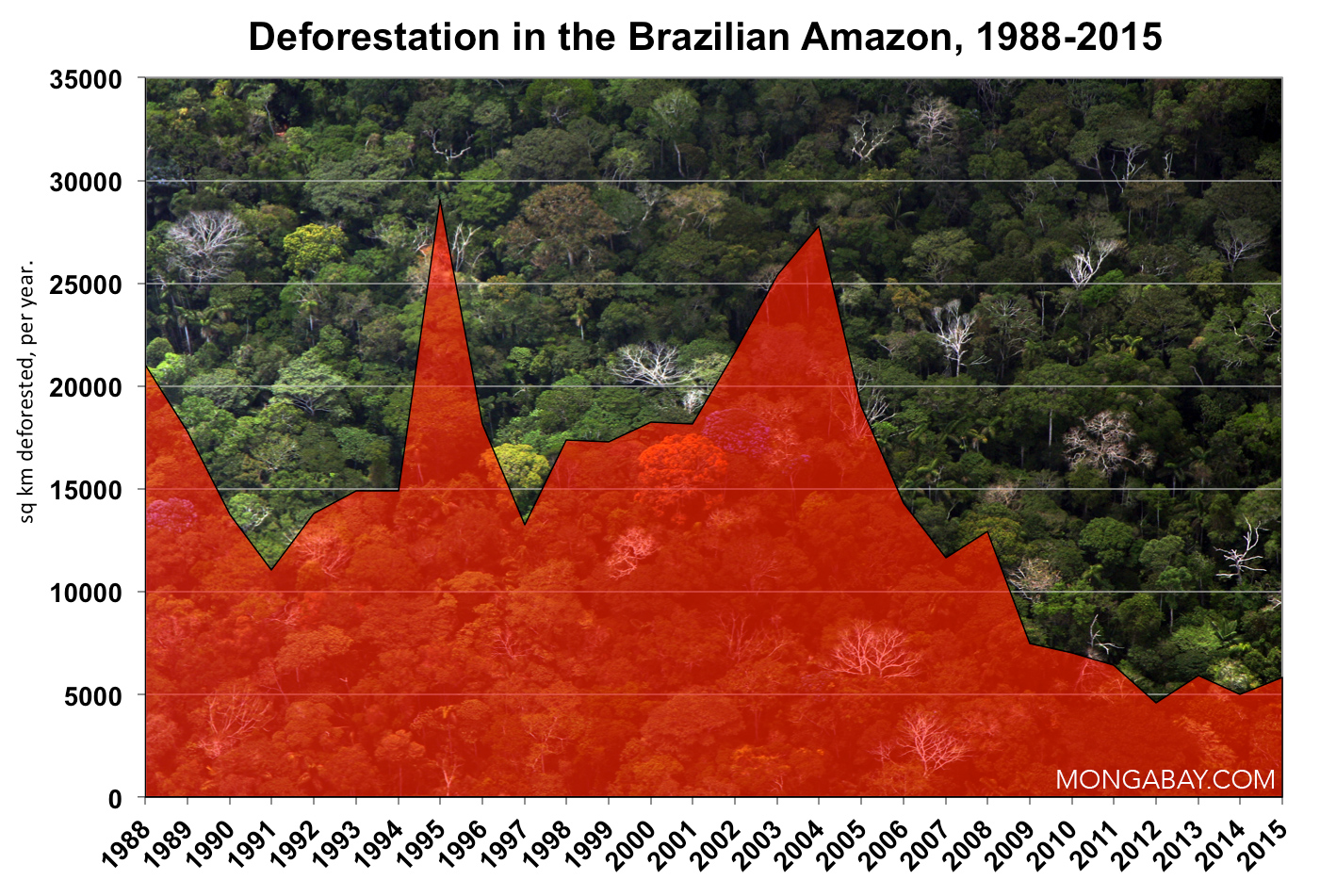
Deforestation in the Brazilian Amazon has been trending upward since bottoming out in 2012 at 4,571 square kilometers (1,765 square miles), but the issue didn’t get a lot of public attention until this week, when the skies of São Paulo, one the world’s largest cities, were blackened midday by smoke from the fires. The shocking descent into darkness prompted an outpouring of concern across social media, with the #PrayforAmazonas hashtag garnering more than 300,000 tweets in two days.

But while the fires in the Amazon have indeed increased significantly over last year, they aren’t off the charts relative to the past 20 years.

MODIS fire data presented by Global Forest Watch.

The difference this year is that weather conditions led the smoke from the fires to blanket densely populated urban areas. A similar phenomenon is seen in Southeast Asia: Indonesia’s peat fires get the most attention when winds blow the resulting haze over Singapore, the regional financial hub, as was the case in 2015.

However, to environmentalists worried about the anti-environment rhetoric from President Jair Bolsonaro, the Armageddon-like conditions in São Paulo and sharp rise in deforestation seem be playing out like a worst-case scenario for the Amazon.

According to the country’s national space research institute, INPE, forest loss in the world’s largest rainforest is already pacing 57 percent ahead of last year. And the region is only halfway through the peak deforestation season that runs from May to October. Data from Imazon, a Brazilian NGO that independently tracks deforestation in the Amazon, is expected to confirm the trend when it releases the latest numbers next week.

Stung by criticism over rising deforestation, Bolsonaro has asserted INPE is manipulating deforestation data and fired the agency’s director. INPE has not released any deforestation updates since the firing. Bolsonaro also claimed, without evidence, that NGOs are responsible for starting the fires as a fundraising strategy, although he backtracked on those remarks today.

Bolsonaro, however, hasn’t been able to effectively refute the satellite data coming from places like Planet and NASA. Scientists and civil society groups are now poring over that data to look for links between Bolsonaro’s policies — including weakened environmental laws, relaxed law enforcement, and amnesty for illegal deforesters — and what’s happening on the ground in the Amazon.

“While links between Brazilian government policy and these wildfires are unknown, the unprecedented data coming from Planet will allow us to help evaluate the extent to which their policies need to be reexamined,” Asner said.

Link: 

Amazon fires: Satellite images show what’s happening in Brazil

Posted in Accent, alo, FF, GE, LAI, LG, ONA, Uncategorized | Tagged , , , , , , , | Comments Off on Amazon fires: Satellite images show what’s happening in Brazil

Electric Scooters: Dirty or Green Transportation?

Share this idea!

Pin0
Facebook0

0shares

If you visit a city these days, you are sure to see Lime, Bird, Spin, or Skip electric scooters zipping between traffic and pedestrians or parked in rows near busy restaurants and malls. But these electric scooters might not be as green as you think. Shared electric scooter companies like to boast about their carbon-free credentials but that is not the whole truth. 

The Influx of Electric Scooters Across the U.S.

Love them or hate them, electric scooters seem to be here to stay. Shared or “dockless” — meaning riders don’t have to return them to a charging station after a ride — electric scooters rolled onto U.S. city streets in 2018 and ever since, have been rented millions of times over. 

The National Association of City Transportation Officials revealed that 38.5 million trips were taken on shared electric scooters in 2018, overtaking station-based bicycles as the most popular form of shared micro-mobility transportation in the U.S. in just the first year they were widely available.

The eclipse of the docked bicycles was mainly due to the introduction of a staggering 85,000 electric scooters available for public use in U.S. cities compared with 57,000 station-based bikes.

How Micro-Mobility Is Changing Urban Transport

As electric scooters have become more widely available to the public, a micro-mobility revolution has surfaced: U.S. citizens increasingly opt to travel the “last mile” by alternative over traditional transport methods. 

The changing landscape of urban transportation can be boiled down to two factors. The first is the ubiquity of electric scooters and smartphones. People can easily locate and rent shared electric scooters by using an app. After a small financial transaction conducted through a smartphone app, the renter can ride a scooter for a set period of time. The ability to pay from a smartphone app using a credit card makes the process of using an electric scooter extremely convenient.

The second factor is the dockless appeal of the shared micro-mobility devices. It is easy to see why electric scooters eclipsed the number of docked, station-based bikes in 2018. If a rider rents a docked bike, they need to return it to a docking station. But the dockless electric scooters can be found, ridden, and left almost anywhere. The convenience of hopping on an electric scooter, riding it from A to B, and leaving it wherever you want contributes significantly to the popularity of these shared micro-mobility devices.

Part of the appeal of shared electric scooters? Riders don’t need to return them to a docking station at the end of their ride. Photo: Paulo Almeida on Unsplash

The Recharge Process

Scooters don’t charge themselves. Throughout the day, the scooter service deploys people driving cars or trucks to collect scooters that have run through their electric charge. Batteries must be plugged in, and the maintenance person who picks them up must haul them to a workspace to recharge tired scooters.

Besides the source of power used, moving scooters from where the last rider left them to a recharging center — which may be someone’s home — produces the same CO2 output as the car or truck used. It’s a two-way trip and scooters must be redistributed where riders are likely to find and use them. We can’t calculate the total emissions, but if you are looking for a green ride, seek scooters from companies that document how much mileage and the types of vehicles used to collect and distribute their two-wheeled transportation.

The Invisible Carbon Contributor 

At face value, electric scooters appear to be carbon-free modes of transportation. But what you can’t see may come as a surprise.

Just like all other modes of transportation, electric scooters need fuel. With traditional modes of transportation such as cars, it is easy to see the pollutants being emitted from their tailpipes. But that is not the case with electric scooters. Although electric scooters may not directly emit emissions through tailpipes, they do contribute greenhouse gases once you factor in the energy used to charge the scooters.

The widespread use of electric scooters and the energy needed to keep the wheels rolling has had a direct effect on the environment. Research from Electric Scooter Insider revealed that, once you factor in the CO² that is released as a result of producing and delivering the electricity needed to charge the scooters, 146.21 grams, or about a third of a pound, of CO² is emitted for every mile ridden.

Bloomberg reported that the scooter riders average 1.5 miles per trip. Combining this with the 38.5 million trips, approximately 57.8 million miles were traveled on electric scooters in 2018. In fact, electric scooters contributed 9,308 tons of CO² in 2018, equivalent to the energy use of an average house for 650 years.

However, it’s not all bad. The amount CO² emissions would have been far greater if those 57.8 million miles were traveled using gas-powered cars. Traveling that distance by car instead of electric scooters, the amount of CO² emitted could have been more than double (22,720 tons).

Electric scooters may not be carbon-free but they still contribute 59 percent less CO² compared to the average car in America (356.91 grams of CO² per mile).

Current State of Electricity Generation in the U.S.

In 2018, fossil fuels made up the majority (63.5 percent) of U.S. electricity generation. This played a significant role in the CO² per mile emission factor for electric scooters.

Charging an electric scooter using clean energy sources would substantially reduce its carbon footprint. The current status of renewable energy sources for the U.S. accounts for only 17.1 percent of all electricity generated. The growing popularity of electric scooters is just one more reason the U.S. needs to expand its investment clean, renewable energy.

The electric scooter, if powered by renewable energy, is a win for the environment. It’s up to you to learn about the power sources a scooter service uses.

Conscious Consumerism

How clean electric scooters are is totally dependent on the energy source used to generate the electricity needed to charge them. As such, conscious consumerism will play a significant role in the future of these micro-mobility devices and their impact on the environment. 

As environmentally conscious consumers, we should know the source of our energy. If you don’t know how your electricity is generated, ask your electricity service provider. If your electricity comes from a clean, renewable energy source like wind, solar, or hydropower, you can feel good about riding and charging your electric scooter — or electric car.

About the Author

Josh Frisby is the founder of Electric Scooter Insider, a site that reviews and recommends the best electric scooters. He also conducts extensive research studies into the micro-mobility industry to uncover interesting insights that spark debate and increase the exposure of electric scooters to the general public.

Feature image courtesy of Marek Rucinski from Unsplash


You Might Also Like…

Are Bike Lanes Worth the Cost?

Seattle residents were shocked when they discovered how much two …Gemma AlexanderAugust 10, 2018

Reduce Your Carbon Footprint: Transportation
After three flat years, carbon dioxide emissions rose again in 2017, …Sarah LozanovaApril 18, 2018

Bike Benefits: 6 Reasons To Pedal Power Your Commute
What’s the one mode of transport that won’t fail you …Earth911July 22, 2015

earth911

Visit link: 

Electric Scooters: Dirty or Green Transportation?

Posted in alo, ALPHA, Citizen, eco-friendly, FF, G & F, GE, LAI, LG, Mop, ONA, PUR, Radius, solar, Uncategorized | Tagged , , , , , , , , , | Comments Off on Electric Scooters: Dirty or Green Transportation?

Lights In the Sky & Little Green Men – Hugh Ross, Kenneth Samples & Mark Clark

READ GREEN WITH E-BOOKS

Lights In the Sky & Little Green Men

A Rational Christian Look at UFOs and Extraterrestrials

Hugh Ross, Kenneth Samples & Mark Clark

Genre: Astronomy

Price: $9.99

Publish Date: October 24, 2002

Publisher: Reasons To Believe

Seller: DIY Media Group DBA BookBaby


Lights in the Sky and Little Green Men presents a fresh look at UFOs and extraterrestrials.

See original article here: 

Lights In the Sky & Little Green Men – Hugh Ross, Kenneth Samples & Mark Clark

Posted in alo, Anchor, Anker, FF, GE, LAI, LG, ONA, oven, PUR, Uncategorized | Tagged , , , , , , , | Comments Off on Lights In the Sky & Little Green Men – Hugh Ross, Kenneth Samples & Mark Clark

Are farmers setting the Amazon ablaze in support of Bolsonaro?

Farmers are reportedly setting fire to the Amazon rainforest to show support for Brazilian President Jair Bolsonaro’s policy of opening up protected areas to private ownership. According to a widely disseminated article in a small newspaper, Folha do Progresso, the organizers of this “Day of Fire” are hoping that 2019 sets a record for burning.

Ranchers and farmers routinely use fire in tropical agriculture to clear land for planting and cattle pastures, but the practice had slowed before Bolsonaro took office in January. Brazil’s space research agency reported this week that fires have increased 84 percent this year compared to the dry season last year. On Monday, smoke from rampant fires plunged Sao Paulo into darkness in the afternoon.

Many news outlets have said the 74,000 fires Brazil has seen this year sets a record, but that’s based on statistics that only date back to 2013. And deforestation is actually down from its peak in the 1980s. The real, undisputable news here is that there’s been a spike in fires and deforestation under Bolsonaro. And given the Amazon rainforest’s important role in capturing carbon emissions, the stakes seem much higher.

Christian Poirier, a program director for the nonprofit Amazon Watch, said that farmers were clearly emboldened by Bolsonaro to burn forests. “The fires currently ravaging the Amazon are directly related to President Bolsonaro’s anti-environmental rhetoric, in which he errantly frames forests and forest protections as impediments to Brazil’s economic growth. Farmers and ranchers understand the president’s message as a license to commit arson with wanton impunity, in order to aggressively expand their operations into the rainforest.”

Bolsonaro isn’t exactly taking credit, saying he had a “feeling” that the fires were set by nonprofit environmental groups trying to make his government look bad.

There’s been a huge growth in Brazil’s farms, especially after President Donald Trump’s trade war sent China — the top buyer of U.S. soybeans — shopping in South America. But the farm boom won’t improve the lives of poor Brazilians if it depends on dismantling environmental protections, said Toby Gardner, the director of nonprofit Trase. He sees Brazil trending toward “apparent disregard for devastating effects of environmental degradation seen from the recent and unprecedented spate of wildfires, set by landowners to clear forest for agriculture,” he said in an email.

Brazil’s massive forests are a critical part of the Earth’s life support system. The Amazon holds some 17 percent of the world’s plant-based carbon, and fires release that greenhouse gas. It’s home to millions of unique species and people. Fires are also burning in Brazil’s Cerrado — the central savanna — and its other forests.

“We think this Day of Fire really captures the craziness of what is going on in Brazil — deforestation for the sake of it, as an act of political demonstration,” said Alex Armstrong of the environmental group Mighty Earth in an email. Mighty Earth and other organizations think big corporations can prevent deforestation by promising not to buy crops from Brazilian farmers who burn forests. Some corporations, such as the grain-trading giant Cargill, say they need a supportive government in Brazil before they can act.

It’s worth noting that Grist could not independently confirm that farmers have set fires as a demonstration: Every story and source interviewed about the Day of Fire pointed to the same article based on an interview with an anonymous source. But the space agency observed a spate of fires in the region where farmers reportedly planned their protest. And a government prosecutor has opened an investigation into the reported Day of Fire.

Source article – 

Are farmers setting the Amazon ablaze in support of Bolsonaro?

Posted in Accent, alo, FF, G & F, GE, LG, ONA, Uncategorized | Tagged , , , , , , , , | Comments Off on Are farmers setting the Amazon ablaze in support of Bolsonaro?

Bernie Sanders’ ‘Green New Deal’ looks like a trillion bucks (OK, 16 trillion)

Washington Governor Jay Inslee vacated the role of “climate candidate” in the 2020 Democratic presidential primary when he dropped out of the race Wednesday night. By Thursday morning, it appeared Bernie Sanders was poised to fill it.

The Vermont senator unveiled a plan to spend more than $16 trillion in federal dollars on “a ten-year, nationwide mobilization centered around justice and equity” to forestall the climate crisis. He’s calling it — stop us if you’ve heard this one before — the “Green New Deal.”

Yep, Sanders told the New York Times that he’s putting “meat on the bones” of the resolution, introduced in February by New York Congresswoman Alexandria Ocasio-Cortez and Massachusetts Senator Ed Markey, which called for a “10-year national mobilization” to essentially remake the U.S. into a clean-energy economy. The Ocasio-Cortez and Markey version of the Green New Deal (a.k.a. GND original flavor) is currently being constructed by the think tank New Consensus.

Sanders’ version calls for creating 20 million union jobs he says are necessary for averting climate disaster, phasing out fossil fuels by midcentury, providing $200 billion to the United Nations to aid developing countries in slashing emissions, and spearheading new projects in solar, wind, and geothermal energy. According to the senator’s campaign, the plan will pay for itself in 15 years, in part by levying massive taxes on the income of corporate polluters and increasing penalties for fossil-fuel company pollution. And Sanders said he would declare climate change a national emergency, a step that even Inslee was not ready to commit to. Last month, Sanders proposed a congressional resolution to do just that.

The language in Sanders’s plan indicates he’s ready to tussle with Big Oil: He says he would direct his Department of Justice to go after fossil fuel companies for both civil and criminal penalties. So far, cases winding through the state court systems have not been successful at holding the fossil fuel industry accountable.

“They have evaded taxes, desecrated tribal lands, exploited workers, and poisoned communities,” the proposal reads. “President Bernie Sanders will ensure that his Department of Justice and Securities and Exchange Commission investigate these companies and bring suits — both criminal and civil — for any wrongdoing, just as the federal government did with the tobacco industry in the 1980s.”

The 77-year-old presidential-hopeful also plans to ensure a “fair” and “just transition” for fossil fuel workers. Under Sanders’ Green New Deal, the federal government would provide five years of unemployment insurance, a wage guarantee, housing assistance, and job training to “any displaced worker” who loses their job during the transition to a clean-energy economy.

Moreover, Sanders’ plan pitches a ban on hydraulic fracturing — a.k.a. fracking — and mountaintop coal mining. He also plans on establishing a $40 billion Climate Justice Resiliency Fund specifically to help communities of color prepare for climate impacts.

While the Green New Deal of Ocasio-Cortez and Markey calls for transitioning to 100-percent zero-emission energy generation and slashing emissions from transportation “as much as is technologically feasible” within 10 years, Sanders’ plan ups the ante a bit. He calls for eliminating all emissions from the transportation sector by 2030. And while the original resolution doesn’t exclude the use of nuclear power or developing technologies like carbon capture, Sanders’ proposal prohibits so-called “false solutions,” specifically naming nuclear, carbon sequestration, and geoengineering among them.

But while the Green New Deal (original) and its effect in shifting the conversation on climate in politics has been up to this point most closely identified with Ocasio-Cortez, today’s announcement could essentially transfer the concept to Sanders. So if at the next round of debates, fellow candidate and Senator Kamala Harris utters her support for a “Green New Deal”, as she has in the previous two, she’ll essentially be saying she supports Sanders’ plan. It’s his now — both its transformative allure, as well as its heavy price tag.

But at least, according to Sanders’ estimates, he can get the job done for less than 20 percent of what the Republicans say a Green New Deal will cost.

Continue reading: 

Bernie Sanders’ ‘Green New Deal’ looks like a trillion bucks (OK, 16 trillion)

Posted in Accent, alo, Casio, FF, GE, LG, ONA, solar, Uncategorized | Tagged , , , , , , , | Comments Off on Bernie Sanders’ ‘Green New Deal’ looks like a trillion bucks (OK, 16 trillion)

Plants That Can Kill – Stacy Tornio

READ GREEN WITH E-BOOKS

Plants That Can Kill

101 Toxic Species to Make You Think Twice

Stacy Tornio

Genre: Nature

Price: $11.99

Publish Date: September 19, 2017

Publisher: Skyhorse Publishing

Seller: OpenRoad Integrated Media, LLC


A National Outdoor Book Award–winning author looks at the dangerously poisonous plants that may be in your garden—“a must-read for every gardener!” (Diane Blazek, executive director, All-America Selections and National Garden Bureau)   In this follow up to her fascinating book, Plants You Can’t Kill , journalist and gardening writer Stacy Tornio now takes a look at plants that can actually kill you if you’re not careful.   Here, gardening enthusiasts of all levels will learn about common plants that are toxic, dangerous, and even deadly. And some of them will surprise you, such as daffodils, irises, tulips, mistletoe, and even fruits and vegetables like cherries, rhubarb, and some tomatoes.   And while the level of toxicity may vary, all are considered deadly in one way or another to wild animals, family pets, and even humans. But with its colorful, easy-to-read format, Plants That Can’t Kill will introduce readers to what these plants look like, smell like, feel like, and sometimes even taste like.   Full of fun facts and fascinating history, this is “an essential guide to common garden plants that can cause harm―and even kill―so we can keep children, pets, and ourselves safe” (Stephanie Rose, creator of GardenTherapy.ca and award-winning author of Garden Made ).

Visit site – 

Plants That Can Kill – Stacy Tornio

Posted in alo, Anchor, FF, GE, LAI, LG, ONA, oven, PUR, Skyhorse Publishing, Ultima, Uncategorized | Tagged , , , , , , , , , | Comments Off on Plants That Can Kill – Stacy Tornio

How to Negotiate With a Contractor for Green Building Projects

Share this idea!

Pin0
Facebook0

0shares

If you’re planning a green renovation or remodeling project, you now have more green-friendly products and contractors available than ever before.

Although there are many important details to consider, finding the right contractor for completing the project is essential. Contractors with experience in making energy efficiency upgrades, using natural and local materials, and conserving resources will bring a lot to the table. Ideally, they will add synergy to your green home project and to make it a reality. Here are some tips for negotiating with contractors for green home projects.

Dream Green From the Start

To achieve the best results, we recommend you keep green features in mind from the project’s beginning, not merely as an afterthought. Look for contractors with an established track record of building using sustainable and recyclable materials, deep awareness of the insulation and natural lighting opportunities when remodeling, and the customer roster to prove they deliver. When you need to hire an architect or other design professionals for your project, make sure they are aware of your green project goals and that they are experienced.

If you are building an addition to your home, for example, strategically placing windows and doors can help save energy. If this isn’t planned early on, it can drive up project costs and create delays. During your walk-through with the contractor, listen to whether they make these suggestions or have to be asked. Make clear from the start you want a healthy and environmentally friendly outcome.

Do Your Homework

Although many experienced contractors will have ideas and suggestions, it is also helpful to conceptualize your project before meeting with them. Conduct research about the type of project and the materials, such as doors, window frames, or appliances involved before even the first planning session. This will help you bring specific goals to the table for the first meeting, making it more productive.

Take the time to meet several contractors, no matter how good the first one appears. Asking three contractors about the same project will produce three different approaches that may bring important issues to the surface. With those meetings behind you, pick the contractor with the best reputation who provides the most complete estimate and covers all, or at least most, of the concerns raised by the other contractors.

Consider the Long-Term Costs

Keep in mind that the upfront cost may be greater for green projects but will often save you money over time. For example, if you add insulation to the attic when finishing it out, it can reduce your heating and cooling costs for decades. Metal roofs cost more than their asphalt counterparts but are far more durable.

Consider both the project cost and potential cost savings to understand the big picture financially.

Find a Contractor With Green Renovation Experience

There are now many builders, electricians, carpenters, and even plumbers with vast knowledge and experience in completing green projects. Find a building professional with experience in the given type of project.

For example, if you want to add a graywater system to your home, find a plumber who has done this work before. Look at examples or at least photos of their work; speak with past clients and read online reviews to learn about their experience. Make sure they are licensed and insured to complete the work and that they will take care of any needed permits. There are several national certification programs that can be helpful in your search:

National Association of Home Builders (NAHB): — Certified Green Professional (CGP)
Leadership in Energy and Environmental Design (LEED) — LEED Accredited Professional
Green Advantage (GA) — Green Advantage Certified Practitioner (GACP)

Always Get Multiple Bids

It is typically recommended to get at least three bids for your project. It is hard to know if you are getting a fair price without shopping around. Some contractors will take different approaches to the same project, resulting in a different finished product.

The initial meeting is a great opportunity to pick their brains and get ideas. If your preferred contractor has a higher bid than others, you can ask him or her to match the price of a lower bid. Your goal is to get the best result for you, the planet, and your wallet.

Flesh Out the Details

The details can be extremely important, especially for green products.

Ask the contractor to specify what materials they will use. Whenever possible, use formaldehyde-free and recycled materials, locally and sustainably harvested wood products, nontoxic insulation, and low or no VOC finishes and adhesives. Buying these products yourself is a possible way to cut costs and ensure they have the green features you want.

Also, find out if the contractor will subcontract out some of the work. If so, research the reputation of the subcontractors as well. It’s the person doing the work who has to live up the the environmental expectations you set.

Have a Clear Contract

Make sure that the contract specifies all the important details, starting with a clear project description. Hold your contractor to their estimate, requiring they ask you before over-spending on materials or labor. The final cost of your project is your responsibility to manage and the contractor’s business to increase as much as you will allow.

Here are a few of the common questions to answer in the contract:

Who will purchase the materials and apply for needed permits?
What products will be used?
How long will it take the complete the project and is there a penalty if the project goes past the deadline?
What is the payment schedule and terms?
Is there a warranty on the work and for how long?

Make sure you get any promises the contractor makes in writing and don’t just rely on just a firm handshake. Keep your estimates, contract, and any receipts provided together both for your security and to share with a future home buyer.


You Might Also Like…

Infographic: Anatomy of a Green Home

Have you ever found yourself spending way more on a …Earth911July 29, 2019

6 Things to Consider Before Replacing Windows
Windows provide light, warmth, ventilation, and views of the outdoors. …Sarah LozanovaApril 2, 2019

7 Things to Consider for an Eco-Friendly Bathroom Remodel
When you’re remodeling any part of your home, most of …Shruti AgrawalDecember 20, 2016

earth911

Source – 

How to Negotiate With a Contractor for Green Building Projects

Posted in alo, ALPHA, eco-friendly, FF, G & F, GE, LG, Mop, Natural Light, ONA, organic, Oster, PUR, Radius, Uncategorized | Tagged , , , , , , , , , , , | Comments Off on How to Negotiate With a Contractor for Green Building Projects

Julián Castro’s Trump-defying plan to save endangered species

Hold your horses, because presidential candidate Julián Castro just came out with an animal welfare plan on Tuesday. The former housing secretary’s proposal may be the first policy proposed by a presidential candidate to highlight the connection between animals, climate change, and extinction (if only because we just learned how bad the extinction situation is about to get). And it arrived on the heels of the Trump administration’s attempt to weaken the Endangered Species Act.

As the effects of the climate crisis — more severe wildfires, floods, and hurricanes — have become clearer, politicians on the left have generally stopped talking about animals under threat and started talking about people at risk. Research indicates that that’s a good thing: Earlier this year, the author of a Yale University study on effective climate change imagery told Grist that the picture of a starving polar bear is pretty much tapped out. After all, most Americans have never even seen a polar bear up close.

But it’s not just charismatic megafauna under threat. A United Nations assessment this spring found that climate change could wipe out 1 million species if left unchecked. Evolution, you see, is hardly a fair match for our fast-warming planet. A new study out on Tuesday from Cornell University shows the climate is changing more speedily than animals can adapt to it. By studying 10,000 climate change papers, a team of international scientists found that normal functions like hibernation, reproduction, and migration are under threat due to shifting seasons and warming temperatures.

Article continues below

“The climate crisis is accelerating an unprecedented decline in biodiversity, threatening not only the future of animals but human life,” Castro writes in a Medium post detailing his new proposal. “Public policy must also confront the consequences of the climate crisis, including the threat of animal extinctions.”

He notes that much progress has been made on the animal welfare front in recent years: California recently established new standards for farming chickens, pigs, and cows. Delaware became the first “no-kill” state this month, meaning that its shelters save at least 90 percent of the cats and dogs that enter their doors (San Antonio, Castro’s hometown, achieved no-kill status a few years ago). But climate change, he posits, threatens to undermine that progress.

In order to make public policy match the scale of the crisis, Castro suggests establishing a $2 billion National Wildlife Recovery Fund aimed at protecting animals from imminent extinction. He also wants to preserve 30 percent of America’s lands and oceans, a first step toward an ambitious 50 percent goal by 2050. How does he aim to accomplish this? The proposal doesn’t say. But Castro does write that he’d appoint a conservation scientist to head up the Department of the Interior to clean up “Trump’s environmental disaster.” He would also double the Multinational Species Conservation Fund — an act approved by Congress that gives grants to projects that benefit elephants, great apes, rhinos, and sea turtles around the world.

One of the Cornell study’s coauthors, André Dhondt at the Cornell Lab of Ornithology, said Castro’s plan seemed like a good idea. Creating a fund to address the crisis, as Castro proposed, “would help everybody,” he said — people and animals included.

Castro’s plan could be interpreted as a return to old school conservation — using wildlife to hook mainstream audiences, or in this case, voters. But it could also be understood as a foray into new territory. By marrying the climate crisis to the extinction crisis, Castro is paving the way for a more enlightened conversation about conservation among the 2020 Democratic hopefuls, two of whom happen to already be vegan (Senator Cory Booker and Representative Tulsi Gabbard). And not a moment too soon.

“Animals have been going extinct forever,” Dhondt said. “The problem is now its happening faster, or will happen faster, than ever before.”

Original article – 

Julián Castro’s Trump-defying plan to save endangered species

Posted in Accent, alo, Eureka, FF, GE, LG, ONA, Uncategorized | Tagged , , , , , , , , , , | Comments Off on Julián Castro’s Trump-defying plan to save endangered species