Category Archives: ONA

The Green New Deal is already at work in one Portland neighborhood

Subscribe to The Beacon

This story was originally published by High Country News and is reproduced here as part of the Climate Desk collaboration.

It’s a cloudy gray day in Cully, a neighborhood in northeastern Portland, and the air is thick with the smell of burnt tires. The culprit? An asphalt manufacturing plant, where black rubble is piled into one long heaping mound, waiting to be hauled off to areas across the city to fill in old potholes and pave new streets.

Cully is located in one of the city’s most culturally diverse pockets, but the predominantly low-income neighborhood is regularly subject to industrial pollution. Automobile salvage lots, including one that caught fire and spewed toxic chemicals into the air last year, litter entire city blocks with old car parts and used tires.

Across the street from the asphalt plant, a barren parking lot is cordoned off by a chain-link fence. This was formerly the site of the Sugar Shack, a notorious strip club and adult video store that was torn down less than two months ago. After the owners’ arrest in 2015 for tax fraud and running a prostitution ring, the lot became a meeting spot for neighborhood groups and community members. Now, thanks to a coalition of four local organizations that goes by the name Living Cully, the site will soon be home to a new affordable housing complex: Las Adelitas, named in honor of the women soldiers who fought during the Mexican Revolution.

With a large crowd of community members as an audience, the Sugar Shack in Cully neighborhood is destroyed to make room for a new affordable housing development, Las Adelitas.Living Cully

On the surface, this housing complex in one of the most rapidly gentrifying corners of the country will be much like any other development designed to help respond to the national housing crisis. But dig a little deeper, and Las Adelitas has the potential to become a model for much more — a solution not only to the displacement of longtime residents but to the lack of green investment in the low-income communities of color that are already on the front lines of the looming climate change crisis.

Dig deeper still, and Las Adelitas — together with the whole Living Cully framework — begins to look a lot like the much-touted Green New Deal: a preliminary plan touted by Democratic congressional members to create a “green workforce” that will build out green infrastructure and clean energy projects while bringing economic opportunities to vulnerable communities. The long-term success or failure of Living Cully could provide a window into an ambitious national program that’s still in the visionary stage today.

Now a landscape crew supervisor, Mateo Fletes, center, has specialized in habitat restoration at Verde Landscaping.Naim Hasan

When the Great Recession hit in 2008, Mateo Fletes Cortes, who lives in the town next to Cully, lost his job. Originally from Nayarit, Mexico, Fletes Cortes moved to Oregon with his uncle in 2002, picking up work in construction, building out wooden window frames, installing baseboards, and adding finishing touches to buildings and houses. But when the construction industry collapsed, so did Fletes Cortes’ job stability. He’d heard about opportunities in landscaping work but been reluctant to apply, associating landscaping with unskilled low-wage labor. Then he heard about Verde.

The area nonprofit, which is also the lead organizer of Living Cully, operates a landscaping company called Verde Landscaping. The business was started in 2005 in order to train and employ residents to do sustainable landscaping for affordable housing developments built by Hacienda CDC, a Latino Community Development Corporation. Hacienda is also a member organization of Living Cully, and the owner of Las Adelitas. At Verde, wages start at $13.50 an hour and increase to $18.50 by the third year of employment, with paid training sessions and certification provided, as well as medical and dental benefits. So far, the program has trained over 200 area residents in jobs like stormwater management and habitat restoration, according to Verde’s executive director, Tony DeFalco. Ironically, as the economy has picked up in recent years, it’s become harder to recruit labor for the training program, DeFalco said. “You’ve got historically low unemployment, and so it can be really challenging to be competitive.”

Through Verde’s workforce training program, Fletes Cortes took English classes, received industry certifications, and learned that landscaping was indeed for him. “As fate would have it, I started to work in habitat restoration,” something he’d previously known nothing about, Fletes Cortes said. “I saw that [landscaping] wasn’t just about working a lawnmower.” Rather, it could be about restoring wildlife habitats or redirecting stormwater to hydrate vegetation and native plants and shrubs.

These days, Fletes Cortes spends a lot more time in the office, having been promoted to landscape crew supervisor. Bidding for landscaping contracts and checking on equipment and crewmembers keep him busy. He’s been with Verde for a decade, and today, he manages other employees in the workforce program. When the Las Adelitas project gets fully underway, it will be highly skilled workers like Fletes Cortes who carry out the necessary landscaping and subsequent maintenance work for the planned 140 affordable housing units and ground-level commercial spaces.

Brenna Bailey and Linda Dentler volunteer to inventory Living Cully’s mobile home weatherization program supplies.

Living Cully’s motto can seem counterintuitive at first: “Sustainability as an anti-poverty strategy.” After all, it’s now widely believed that the more green investments like parks and vegetation appear in a neighborhood, the more desirable (and expensive) that place becomes, often pushing longtime residents out of their homes and neighborhoods. The phenomenon even has its own trendy name: “green gentrification.” This is certainly a challenge in Cully, where, despite anti-displacement efforts, housing prices are in fact rising. But DeFalco believes that pairing housing projects with environmental investments will be key to the project’s success. “[That] is a really simple recipe for proofing the community against green gentrification,” he said.

That experiment is coming together in Las Adelitas: Verde Builds will construct the building’s green features; green roofs and walls, solar panels, water reuse systems are all being considered in the design. Verde Landscaping will provide local skilled workers to build out green stormwater infrastructure as well as sustainable landscaping. The housing project is expected to be completed by 2020.

In addition to Las Adelitas, Living Cully partners are not only creating energy-efficient affordable housing but also preserving existing low-income housing, through initiatives like a mobile home weatherization program that aims to lower bills of low-income residents who pay a disproportionate amount of their paychecks to utilities. And there are other benefits: That weatherization allows low-income residents to lower their energy use and therefore, their carbon footprint. In August, Portland City Council passed a new zoning designation to protect mobile home parks in Portland from redevelopment, thanks to organizing efforts by Living Cully partners and other area organizations.

As Congress continues to figure out what a Green New Deal might look like on a national scale, Cully could become a valuable and tangible model community to turn to for inspiration. “We are at a place now, where — as a nation — we can no longer make an environmental investment without social and environmental justice outcomes,” DeFalco said. “What we’ve been able to do here at a smaller scale is basically to demonstrate how you do that.”

Read this article: 

The Green New Deal is already at work in one Portland neighborhood

Posted in Accent, alo, Anchor, FF, G & F, GE, LG, Northeastern, ONA, Radius, solar, solar panels, Uncategorized | Tagged , , , , , , , , , , , | Comments Off on The Green New Deal is already at work in one Portland neighborhood

Design in Nature – Adrian Bejan & J. Peder Zane

READ GREEN WITH E-BOOKS

Design in Nature

How the Constructal Law Governs Evolution in Biology, Physics, Technology, and Social Organization

Adrian Bejan & J. Peder Zane

Genre: Life Sciences

Price: $6.99

Publish Date: January 24, 2012

Publisher: Knopf Doubleday Publishing Group

Seller: Penguin Random House LLC


In this groundbreaking book, Adrian Bejan takes the recurring patterns in nature—trees, tributaries, air passages, neural networks, and lightning bolts—and reveals how a single principle of physics, the Constructal Law, accounts for the evolution of these and all other designs in our world.   Everything—from biological life to inanimate systems—generates shape and structure and evolves in a sequence of ever-improving designs in order to facilitate flow. River basins, cardiovascular systems, and bolts of lightning are very efficient flow systems to move a current—of water, blood, or electricity. Likewise, the more complex architecture of animals evolve to cover greater distance per unit of useful energy, or increase their flow across the land. Such designs also appear in human organizations, like the hierarchical "flowcharts" or reporting structures in corporations and political bodies. All are governed by the same principle, known as the Constructal Law, and configure and reconfigure themselves over time to flow more efficiently. Written in an easy style that achieves clarity without sacrificing complexity, Design in Nature is a paradigm-shifting book that will fundamentally transform our understanding of the world around us.

Original post: 

Design in Nature – Adrian Bejan & J. Peder Zane

Posted in alo, Anchor, FF, GE, Knopf, LAI, ONA, PUR, Uncategorized | Tagged , , , , , , , | Comments Off on Design in Nature – Adrian Bejan & J. Peder Zane

The Physics of Life – Adrian Bejan

READ GREEN WITH E-BOOKS

The Physics of Life

The Evolution of Everything

Adrian Bejan

Genre: Physics

Price: $14.99

Publish Date: May 24, 2016

Publisher: St. Martin’s Press

Seller: Macmillan


The Physics of Life explores the roots of the big question by examining the deepest urges and properties of living things, both animate and inanimate: how to live longer, with food, warmth, power, movement and free access to other people and surroundings. Bejan explores controversial and relevant issues such as sustainability, water and food supply, fuel, and economy, to critique the state in which the world understands positions of power and freedom. Breaking down concepts such as desire and power, sports health and culture, the state of economy, water and energy, politics and distribution, Bejan uses the language of physics to explain how each system works in order to clarify the meaning of evolution in its broadest scientific sense, moving the reader towards a better understanding of the world's systems and the natural evolution of cultural and political development. The Physics of Life argues that the evolution phenomenon is much broader and older than the evolutionary designs that constitute the biosphere, empowering readers with a new view of the globe and the future, revealing that the urge to have better ideas has the same physical effect as the urge to have better laws and better government. This is evolution explained loudly but also elegantly, forging a path that flows sustainability.

Read article here – 

The Physics of Life – Adrian Bejan

Posted in alo, Anchor, Casio, FF, GE, LAI, ONA, PUR, Uncategorized | Tagged , , , , , , , , , , | Comments Off on The Physics of Life – Adrian Bejan

A Green New Deal must not sabotage climate goals

Subscribe to The Beacon

This story was originally published by the Bulletin and is reproduced here as part of the Climate Desk collaboration.

Recently, 626 organizations — mostly environmental groups, including 350.org and Greenpeace USA — sent a letter to Congress urging lawmakers to consider a number of principles when crafting climate legislation like a Green New Deal “to keep global warming below 1.5 degrees C (2.7 degrees F).” Broadly, there were six major principles in the letter: Halt all fossil fuel leasing, phase out all fossil fuel extraction, end fossil fuel and other dirty energy subsidies; transition power generation to 100 percent renewable energy; expand public transportation and phase out fossil-fuel vehicles; harness the full power of the Clean Air Act; ensure a just transition led by impacted communities and workers; and uphold indigenous rights.

These are generally wise goals, but some concerns about the details caused eight major environmental groups — including the Sierra Club, the Natural Resources Defense Council, and the Environmental Defense Fund — to decline to sign the letter. As one national environmental group spokesperson put it, “the details matter … There is some language that gave us some concern.”

To meet climate targets, we need every tool in the chest. Meeting the Paris climate agreement targets of limiting global warming to less than 1.5 degrees C (2.7 degrees F) of global warming above pre-industrial temperatures — or even a more dangerous but more feasible 2 degrees C (3.6 degrees F) — would require massive and immediate global action to reduce fossil fuel consumption and carbon pollution. Simply put, we’ve already burned through so much of our carbon budget that meeting those targets would take everything we’ve got. (We’ve already locked ourselves in to close to 1.5 degrees C of warming, just based on greenhouse gas emissions to date.)

But the letter includes language that rules out some zero-carbon technologies. For example, it states, “in addition to excluding fossil fuels, any definition of renewable energy must also exclude all combustion-based power generation, nuclear, biomass energy, large scale hydro and waste-to-energy technologies. To achieve this, the United States must shift to 100 percent renewable power generation by 2035 or earlier.”

The listed energy sources all have pros and cons, and groups concerned about their non-climate environmental impacts could certainly make the case for eventually phasing out each one. But the United States currently gets about 32 percent of its electricity generation from natural gas, 30 percent from coal, 20 percent from nuclear, 7 percent from hydroelectricity, 6 percent from wind, and 1 percent from solar, in round numbers. (The remaining few percent come from miscellaneous energy sources such as geothermal, landfill gas, wood, and others.) Were nuclear and hydroelectric power to be eliminated as energy sources at the same time as all fossil fuels, that means that the United States would have to replace its top four electricity sources (nearly 90 percent of its supply) within about 15 years.

Simply replacing all forms of fossil fuels alone (63 percent of the supply) with zero-carbon technologies within this short timeframe would already be an immense task. And the figures here are strictly referring to what it is required for electricity generation in the United States; they don’t even account for other voracious energy-consuming sectors like transportation — which bring the fossil-fuel share of the U.S. economy up to 80 percent, plus another 9 percent from nuclear and 7 percent from hydroelectric power and biomass. Why make the already gargantuan task so much more difficult?

Germany provides a cautionary tale for environmental groups. The country implemented what it called an “Energiewende” (energy transition) strategy that prioritized the phase-out of nuclear power over replacing fossil fuels, despite its goal of achieving a low-carbon energy supply. For example, in the year 2000, 50 percent of Germany’s electricity was supplied by coal compared to 29 percent from nuclear power and 7 percent from renewables. In 2015, the share was 46 percent coal, 15 percent nuclear, and 33 percent renewables. In other words, the country’s coal consumption has remained nearly unchanged since the turn of the century — from 50 percent coal to 46 percent coal. Instead, Germany’s rapid deployment of renewable energy has primarily replaced its nuclear power plants.

There are certainly legitimate objections to nuclear power, but it is nevertheless a zero-carbon energy source. If we consider climate change an urgent, existential threat and if we want to meet the Paris climate targets, then eliminating fossil fuels must be our first priority. Only after fossil fuels have been replaced can we consider doing the same to other zero-carbon energy sources.

Market-based solutions can be effective. Along similar lines, the letter states: “We will vigorously oppose any legislation that … promotes corporate schemes that place profits over community burdens and benefits, including market-based mechanisms and technology options such as carbon and emissions trading and offsets, carbon capture and storage, nuclear power, waste-to-energy and biomass energy.”

The letter seems to envision that the needed carbon pollution cuts will be achieved purely through government regulations rather than market-based mechanisms such as a carbon tax or a cap-and-trade system. But it’s unclear why that must necessarily be our approach. Putting a price on carbon pollution is a logical way to incorporate its costs into fuel and energy prices, and 45 top economists across the political spectrum recently endorsed a carbon tax. And rebating the taxed revenue via regular dividend checks is a progressive measure that would benefit lower income communities.

One concern may be that a market-based system pricing carbon pollution would benefit zero-carbon energy technologies that some letter signatories oppose — such as nuclear, hydroelectric, biomass, and fossil fuels using carbon capture and storage. There are environmental reasons to oppose some of these technologies; for example, other harmful pollution from fossil fuels and the disposal of hazardous nuclear waste present very real problems.

But the letter’s stated primary goal is to meet the Paris climate targets, and we’ll fail if we tie our hands behind our backs by ruling out zero-carbon technologies and market-based policy tools. Phasing out nuclear, hydroelectric, and biomass energy should only be considered after fossil fuels have been eliminated. Pricing carbon pollution certainly shouldn’t be ruled out (and in fact should be pursued vigorously), and even carbon capture and sequestration should remain on the table.

If we consider climate change an urgent existential threat that justifies the Paris climate targets, then at the very least phasing out fossil fuels and carbon pollution must be our top priority when crafting climate policy. Other concerns that undermine zero-carbon energy sources must be secondary, lest we sabotage our own climate-preserving efforts.

Dana Nuccitelli is an environmental scientist, and author of Climatology versus Pseudoscience. He has published 10 papers related to climate change in peer-reviewed journals, including three studies on the expert climate consensus.

Continue reading:  

A Green New Deal must not sabotage climate goals

Posted in Accent, alo, Anchor, FF, G & F, GE, LAI, LG, ONA, PUR, Radius, solar, Uncategorized | Tagged , , , , , , , , , | Comments Off on A Green New Deal must not sabotage climate goals

Solar-power benefits aren’t reaching communities of color

Visit link: 

Solar-power benefits aren’t reaching communities of color

Posted in Accent, alo, Anchor, FF, G & F, GE, LAI, LG, ONA, Radius, solar, solar power, Uncategorized | Tagged , , , , , , , , | Comments Off on Solar-power benefits aren’t reaching communities of color

Don’t mean to alarm you, but there’s a big hole in the world’s most important glacier

From: 

Don’t mean to alarm you, but there’s a big hole in the world’s most important glacier

Posted in Accent, alo, Anchor, FF, G & F, GE, LG, ONA, Radius, solar, solar power, Uncategorized | Tagged , , , , , , , , , , | Comments Off on Don’t mean to alarm you, but there’s a big hole in the world’s most important glacier

Despite the U.S. cold snap, January was hot hot hot

Subscribe to The Beacon

This January should be remembered for its unusual warmth, not its cold.

Yes, it’s so cold right now that even hardy Minneapolis is shutting down schools, but even with these few days of extreme cold, Minnesota should end up with a near “normal” month thanks to weeks of unusual warmth. It was in the 70s and 80s as far north as Maryland on New Year’s Day. Alaska has been so warm that they’re canceling sled dog races. So far this month, there have been 651 record daily highs across the United States, compared to 321 record daily lows — a roughly 2-to-1 ratio. And that’s just in the U.S.

Globally, the ratio of record highs to lows was about 20-to-1, with new all-time records in Namibia, Chile, and Reunion Island.

It’s summer in the southern hemisphere, and a brutal heat wave in Australia is melting roads and killing wildlife on a mass scale. On January 18, one town never dropped below 96.6 degrees F — marking the hottest night in Australian history. Thursday was the hottest day so far in relatively mild Sydney, with temperatures reaching 104 degrees F and knocking out power for tens of thousands of people.

Ongoing bushfires in Tasmania are threatening a World Heritage site with thousand-year-old pine trees — parts of the same area burned in 2016. Fires in this protected alpine wilderness were once unheard of; now they’re becoming routine.

To put it bluntly, events like this can’t happen in a normal climate. The harsh truth is we are not only losing the weather of the past, but there’s no hope of it stabilizing any time soon.

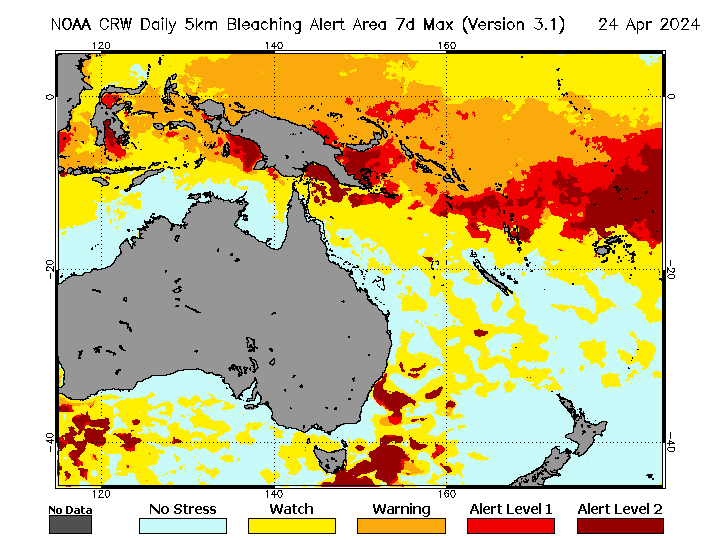
Underlying this warmth and extreme weather is the irreversible heat buildup of the oceans. The waters in the South Pacific are off the charts right now, triggering the highest alert for coral bleaching and boosting the likelihood of significant mortality in marine ecosystems. Sea ice on both poles is near record lows, with profound effects for the world’s weather. Current temperatures in the Arctic are likely the warmest they’ve been in at least 115,000 years, with melting ice beginning to reveal plants and landscapes buried for at least 40,000 years, according to new research.

Climate change is the sum effect of changes to daily weather, and our weather these days is bordering on indescribable. We are pushing the atmosphere into uncharted territory. That means what happens next is inherently unpredictable.

According to the Trump administration’s just-completed National Climate Assessment, “positive feedbacks (self-reinforcing cycles) within the climate system have the potential to accelerate human-induced climate change and even shift the Earth’s climate system, in part or in whole, into new states that are very different from those experienced in the recent past.”

The real danger of climate change is not that we are proving ourselves unable to heed scientists’ warnings, but that those warnings are inherently too cautious and we’ve already gone past the point of no return. Even the bombshell IPCC report, which recently kicked off an unprecedented youth movement advocating for a Green New Deal, may have underestimated how dire things truly are.

This is the core truth of our time: We have left the stable climate era that gave rise to civilization. Our society is brittle, and our new context — for generations to come — will be constant change. Even if we manage to rapidly stabilize greenhouse gas emissions in the next 10 years or so, as the IPCC report says we must, weather will continue to worsen for decades and the seas will continue to rise for hundreds of years.

With this extreme month as yet another warning sign, we need to wrap our heads around what it will take to match our solutions with the scale of the problem.

Link: 

Despite the U.S. cold snap, January was hot hot hot

Posted in Accent, alo, Anchor, Casio, FF, G & F, GE, LAI, LG, ONA, Radius, Uncategorized | Tagged , , , , , , , , , | Comments Off on Despite the U.S. cold snap, January was hot hot hot

Empire Antarctica – Gavin Francis

READ GREEN WITH E-BOOKS

Empire Antarctica

Ice, Silence & Emperor Penguins

Gavin Francis

Genre: Nature

Price: $1.99

Publish Date: September 16, 2013

Publisher: Counterpoint Press

Seller: OpenRoad Integrated Media, LLC


“It is difficult to read this engaging memoir without a smile on one’s face . . . moments of sheer joy . . . [a] mesmerizing and memorable book.” — The Economist   Chosen as a Book of the Year by the Scotsman , the Financial Times , and the Sunday Herald Gavin Francis fulfilled a lifetime’s ambition when he spent fourteen months as the basecamp doctor at Halley, a profoundly isolated British research station on the Caird Coast of Antarctica—so remote that it is said to be easier to evacuate a casualty from the International Space Station than it is to bring someone out of Halley in winter.   Antarctica offered a year of unparalleled silence and solitude, with few distractions and a rare opportunity to live among emperor penguins, the only species truly at home in the Antarctic. Following penguins throughout the year—from a summer of perpetual sunshine to months of winter darkness—Francis explores the world of great beauty conjured from the simplest of elements, the hardship of below-zero temperatures and the unexpected comfort that the penguin community brings. Empire Antarctica is the story of one man’s fascination with the world’s loneliest continent, and the emperor penguins who weather the winter with him.   Includes maps and illustrations   “Part travelogue, part memoir, part natural history book, a fascinating, lyrical account of one of the strangest places on earth and its majestic inhabitants.” — Esquire   “Highly readable, enjoyable . . . the author writes vividly of auroras, clouds, stars, sunlight, darkness, ice and snow . . . A literate, stylish memoir of personal adventure rich in history, geography and science.” — Kirkus Reviews

Originally posted here: 

Empire Antarctica – Gavin Francis

Posted in alo, Anchor, FF, GE, ONA, PUR, Uncategorized | Tagged , , , , , , , , , , , | Comments Off on Empire Antarctica – Gavin Francis

The Ghost Map – Steven Johnson

READ GREEN WITH E-BOOKS

The Ghost Map

The Story of London’s Most Terrifying Epidemic–and How It Changed Science, Cities, and the Modern World

Steven Johnson

Genre: History

Price: $1.99

Publish Date: October 19, 2006

Publisher: Penguin Publishing Group

Seller: PENGUIN GROUP USA, INC.


A National Bestseller, a New York Times Notable Book, and an Entertainment Weekly Best Book of the Year From Steven Johnson, the dynamic thinker routinely compared to James Gleick, Dava Sobel, and Malcolm Gladwell, The Ghost Map is a riveting page-turner about a real-life historical hero, Dr. John Snow. It's the summer of 1854, and London is just emerging as one of the first modern cities in the world. But lacking the infrastructure — garbage removal, clean water, sewers — necessary to support its rapidly expanding population, the city has become the perfect breeding ground for a terrifying disease no one knows how to cure. As the cholera outbreak takes hold, a physician and a local curate are spurred to action-and ultimately solve the most pressing medical riddle of their time. In a triumph of multidisciplinary thinking, Johnson illuminates the intertwined histories and interconnectedness of the spread of disease, contagion theory, the rise of cities, and the nature of scientific inquiry, offering both a riveting history and a powerful explanation of how it has shaped the world we live in.

Read this article – 

The Ghost Map – Steven Johnson

Posted in alo, Anchor, FF, GE, ONA, PUR, Ultima, Uncategorized | Tagged , , , , , , , , , , , | Comments Off on The Ghost Map – Steven Johnson

House Democrats just told the Pentagon to redo its climate change report

Subscribe to The Beacon

This story was originally published by Mother Jones and is reproduced here as part of the Climate Desk collaboration.

Earlier this month, the Pentagon released a landmark report that identified the 79 American military installations most vulnerable to the “effects of a changing climate.” The 22-page filing frankly acknowledged the security implications of climate change — in dramatic contrast with President Trump’s very public global warming skepticism — but Democrats roundly criticized its failure to include several details requested by Congress, including specific cost estimates to protect or replace the ten most vulnerable bases from each of the military services.

Now those lawmakers want a complete do-over.

In a letter released Wednesday afternoon, three Democratic members of the House Armed Services panel, including Chair Adam Smith from Washington state, urged Acting Defense Secretary Patrick Shanahan to compile another report by April that “thoroughly and clearly addresses” the criteria requested by Congress.

“They clearly ignored the requirement in the law,” says Representative Jim Langevin of Rhode Island, one of the signatories, who had described himself as “deeply disappointed” with the original report. “The report they issued was completely unsatisfactory.” Senator Jack Reed of Rhode Island, the ranking member on the Senate Armed Services panel, said the report carried “about as much value as a phonebook.” Smith immediately demanded another report that “rigorously confronts the realities of our warming planet.”

Heather Babb, a Defense Department spokesperson, attempted to explain the priorities, saying earlier this month that Pentagon officials “focused on mission assurance” when compiling the report. “By using this alternative approach, we are able to highlight where there are operational risks,” she said. When asked about the new request on Wednesday, Babb said, “As with all congressional correspondence, we will respond directly to [the] authors of the letter.”

What was omitted in the first report that the Pentagon had a year to compile was striking. No Marine Corps installations were mentioned, for example, despite the fact that just four months before the report was released, Hurricane Florence slammed into Camp Lejeune, the Marines’ biggest base on the East Coast, costing more than $3 billion in damages. Omissions from other branches of the military were just as concerning. Tyndall Air Force Base in Florida, where Hurricane Michael devastated 95 percent of the buildings in October, was not included among the Air Force’s most vulnerable bases.

In the summer of 2017, as part of the debate over last year’s annual defense spending bill, Langevin introduced an amendment requesting that the Pentagon assess how best to mitigate climate-related threats across the armed services, down to the level of an estimated cost and combatant command requirements. Earlier that year, the Washington Post had reported that defense officials removed nearly two-dozen references to climate change from a draft survey of installations vulnerable to the threat, creating an embarrassing news cycle for the Pentagon.

The amendment was added by voice vote in committee and reaffirmed with bipartisan support on the floor of the House. In July, more than 40 members of Congress, including several Republicans, even wrote to former defense secretary Jim Mattis to remind him of the requirements included in the report. Notably, lawmakers said they had been “disturbed” by the Post story, as if to warn Mattis against inciting a similar firestorm.“We expect that when this report is delivered to Congress later this year, it will contain candid assessments in line with the clear instructions passed by Congress and signed into law by the President,” the letter stated.

The report clearly fell short of its goal in the first version and now, with Democrats in control of the House, Langevin said the Armed Services committee is considering several options in case the Pentagon ignores this new request, from subpoenaing documents to hauling relevant DOD staffers before the panel for testimony. “I hope this doesn’t become a long, dragged-out battle,” he said. At least one major ex-Pentagon official has already voiced his support for a new report. John Conger, the former assistant secretary of defense for energy, installations, and environment, noted in a blog post earlier this month that “DoD should make the transition from anecdote to analysis and provide a fuller assessment, as Congress directed.”

For Shanahan, now in his fifth week leading the Pentagon as Mattis’s acting successor, the challenge from House Democrats poses an important early test of how compliant he will be with Congress. Mattis, who fell out of favor with Trump and ultimately resigned once the president announced that he would withdraw U.S. troops from Syria, had long been viewed as a climate change realist in a Cabinet of deniers and skeptics. Shanahan, whose background had been in weapons acquisition and management as a career executive at Boeing, arrived at the Pentagon as deputy secretary without a history of making his public policy views explicit.

But in the months since he entered government as the No. 2 to Mattis, climate change has risen on the military’s agenda. The recently released annual worldwide threat assessment from the intelligence community even listed global warming as a menace to “low-lying military bases.” The Democrats’ request for a new report can potentially put Shanahan at loggerheads with Congress, which confirmed him as deputy secretary with wide bipartisan support, and Trump, who has indicated that Shanahan could remain acting secretary indefinitely. (A spokesperson for Shanahan was not immediately available for comment.)

Since the early days of the Trump administration, the Pentagon has quietly but firmly adopted a more proactive approach toward climate change in some areas. After years of degradation to shipyards in Virginia, Hawaii, Maine, and other states, the Navy submitted a $21 billion infrastructure plan last year to clear a backlog of maintenance work. Military leaders have also grown more assertive in confronting the possibility of security threats from Russia and China in a warmer Arctic. In the past, reports from the Pentagon and the independent Government Accountability Office have even catalogued the threat to hundreds of installations in the United States and abroad. But the reluctance some officials have shown toward openly contradicting their commander in chief has compromised lawmakers’ confidence in DOD’s willingness to seriously confront the security implications of a warming planet.

Read the complete letter here.

Link to original: 

House Democrats just told the Pentagon to redo its climate change report

Posted in Accent, alo, Anchor, FF, G & F, GE, LAI, Landmark, LG, ONA, Radius, Ultima, Uncategorized | Tagged , , , , , , , , | Comments Off on House Democrats just told the Pentagon to redo its climate change report