Tag Archives: australia

Lots of people, animals, and plants will be homeless thanks to climate change

Lots of people, animals, and plants will be homeless thanks to climate change

The Digital Story

The historic rise of carbon dioxide levels above 400 parts per million in the atmosphere has many people thinking about climate change’s Brobdingnagian impacts. And right on cue, new research indicates that huge numbers of people, animals, and plants can expect to find themselves ejected from their homes because of global warming over the coming years and decades.

An estimated 32.4 million people were forced to flee their homes last year because of disasters such as floods and storms, according to a new report released by the Internal Displacement Monitoring Centre — and 98 percent of that displacement can be blamed on climate- and weather-related events. That includes not just people in poor countries but also many Americans displaced by Hurricane Sandy and other disasters.

Also picking up the homeless theme is Lord Nicholas Stern, a British economist famous for a groundbreaking 2006 report on the costs of climate change. He warns that hundreds of millions of people will likely be displaced in the near future. From The Guardian:

Massive movements of people are likely to occur over the rest of the century because global temperatures are likely to rise by up to 5C because carbon dioxide levels have risen unabated for 50 years, said Stern, who is head of the Grantham Research Institute on Climate Change.

“When temperatures rise to that level, we will have disrupted weather patterns and spreading deserts,” he said. “Hundreds of millions of people will be forced to leave their homelands because their crops and animals will have died. The trouble will come when they try to migrate into new lands, however. That will bring them into armed conflict with people already living there. Nor will it be an occasional occurrence. It could become a permanent feature of life on Earth.”

Meanwhile, a study published Sunday warned of far-reaching impacts of the changing climate on the world’s plants and animals. From Reuters:

About 57 percent of plants and 34 percent of animal species were likely to lose more than half the area with a climate suited to them by the 2080s if nothing was done to limit emissions from power plants, factories and vehicles, [scientists] wrote in the journal Nature Climate Change.

Hardest hit would be species in sub-Saharan Africa, Australia, the Amazon and Central America.

“Climate change will greatly reduce biodiversity, even for many common animals and plants,” lead author Rachel Warren of the University of East Anglia in England said. The decline would damage natural services for humans such as water purification and pollination, she said.

But the scientists said governments could reduce the projected habitat loss by 60 percent if global greenhouse gas emissions peaked by 2016 and then fell. A peak by 2030 would cut losses by 40 percent.

Only 4 percent of animals, and no plants, were likely to benefit from rising temperatures and gain at least 50 percent extra territory, the study said.

Brobdingnagian ugh.

John Upton is a science aficionado and green news junkie who

tweets

, posts articles to

Facebook

, and

blogs about ecology

. He welcomes reader questions, tips, and incoherent rants:

johnupton@gmail.com

.

Find this article interesting? Donate now to support our work.Read more: Climate & Energy

Also in Grist

Please enable JavaScript to see recommended stories

Continue at source – 

Lots of people, animals, and plants will be homeless thanks to climate change

Posted in Anchor, FF, G & F, GE, LG, ONA, Pines, PUR, Uncategorized | Tagged , , , , , , , , , , , | Comments Off on Lots of people, animals, and plants will be homeless thanks to climate change

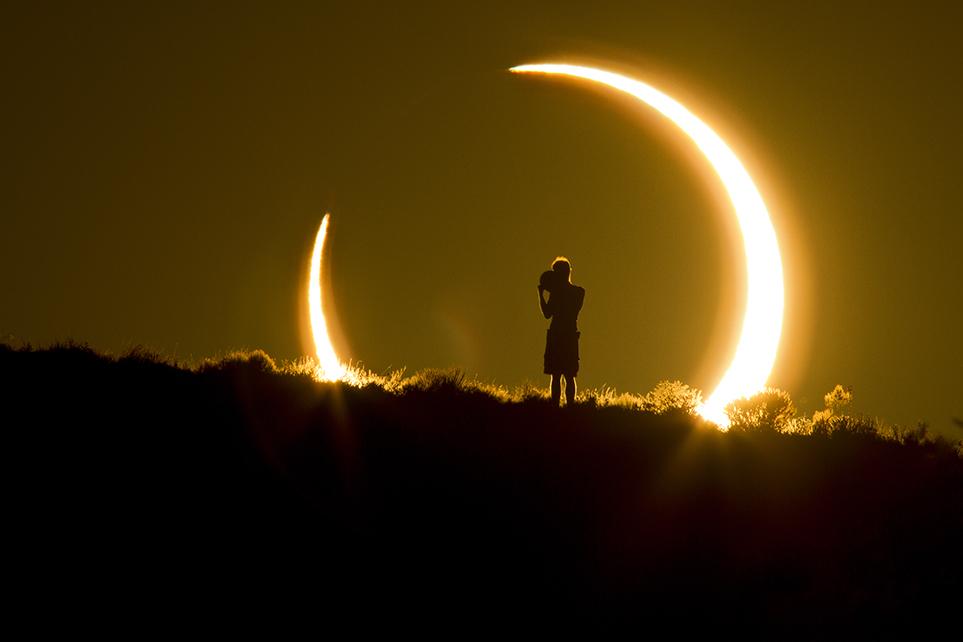
You’ll Want to Watch Today’s Solar Eclipse Create a Gorgeous ‘Ring of Fire’

A partial solar eclipse in Albuquerque, New Mexico as photographed by Colleen Pinski. This photo was one of the finalists in Smithsonian’s annual photo contest. Photo: Colleen Pinski

Technically, this partial solar eclipse—which will produce this stunning “ring of fire”— will occur as the early morning Sun rises on Friday in Australia. But for those of us in North America, the spectacle will play out this evening starting around 6:30 pm on the East coast.

If you’re in Australia or the Philippines, enjoy the show. But if you’re not and still want to watch, you can tune in to the Slooh Space Camera to watch the whole thing live.

This is only a partial solar eclipse, so there will still be a bit of bright sun poking around the dusk of the Moon. This is what gives it the moniker “ring of fire.” For an idea of what you’re in for if you decide to turn into the Slooh feed, here is a video shot during last year’s similar eclipse.

More from Smithsonian.com:

The 10th Annual Photo Contest Finalists
A Solar Eclipse, As Seen From the Surface of Mars

View article:

You’ll Want to Watch Today’s Solar Eclipse Create a Gorgeous ‘Ring of Fire’

Posted in G & F, GE, Pines, solar, Uncategorized | Tagged , , , , , , , | Comments Off on You’ll Want to Watch Today’s Solar Eclipse Create a Gorgeous ‘Ring of Fire’

Climate skeptic could run Down Under

Climate skeptic could run Down Under

Shutterstock /

Phillip Minnis

Tony Abbott.

Australians endured devastating bushfires, floods, and record-breaking heat waves during this year’s Southern Hemisphere summer. Per capita, Australia is one of the world’s biggest contributors to global warming — and it has also been among those hardest hit by its effects. But in recent years, the country has been doing more than most to rein in emissions and brace for climate change disaster.

Australians head to the polls this year, and unfortunately for them (and everyone), the main opposition candidate vying to defeat Julia Gillard in the race for prime minister happens to be a mug who reckons all this climate change talk is just a bunch of bull dust and whingeing. (The candidates are tied in early polls.)

Tony Abbott leads the Liberal Party, the opposition party which — because Australia is politically as well as geographically upside down — is actually the country’s conservative party. If elected, Abbott has pledged to kill a carbon tax that Gillard introduced despite angry handwringing by the resource-extraction-dominated business sector. Abbott now says that he would also sack the officials charged with preparing the nation for changes in the weather. And he recently went even further, saying he may kill a renewable energy target introduced back when über-conservative Liberal Party leader John Howard was prime minister.

From The Australian:

The Opposition Leader, who vows to remove the carbon tax if elected in September, said there would be no further need for the bureaucracy that supports it.

“When the carbon tax goes all of those bureaucracies will go and I think you’ll find that [Climate Commissioner Tim Flannery] will go with them,” Mr Abbott said.

Mr Abbott will consider dumping the Howard government’s renewable energy target, which he says is “significantly increasing the cost of power”.

Speaking to Sky News last night, he equivocated on his previous support for the scheme, which aims to ensure 20 per cent of electricity comes from renewable sources by 2020.

Not the sharpest tool in the shed, Abbott went on that recent tirade at the same time as the publication of a new report that predicts worse days ahead for extreme-weather-weary Australians. From the Daily Telegraph:

The report from the Climate Commission says climate change is already increasing the intensity and frequency of extreme weather like heatwaves, fires, cyclones, heavy rainfall and drought.

The report entitled Critical Decade: Extreme Weather, released on Wednesday, says the global climate system is warmer and moister than 50 years ago, with the extra heat making extreme weather events more frequent and severe.

In response to the report, the Australasian Fire and Emergency Service Authorities Council warned that while they had experience combating extreme weather events, people cannot expect emergency crews to protect their communities from increasingly intense fires and floods.

Lucky for him, Abbott is a notorious vacillator. If smarter minds within his party prevail, maybe they can convince him to flip-flop on his imbecilic (and increasingly unfashionable) climate skepticism. Do Oz and everybody else a favor.

John Upton is a science aficionado and green news junkie who

tweets

, posts articles to

Facebook

, and

blogs about ecology

. He welcomes reader questions, tips, and incoherent rants:

johnupton@gmail.com

.

Find this article interesting? Donate now to support our work.Read more: Climate & Energy

,

Politics

Also in Grist

Please enable JavaScript to see recommended stories

See original article here:  

Climate skeptic could run Down Under

Posted in ALPHA, Anchor, FF, G & F, GE, ONA, Uncategorized | Tagged , , , , , , , , | Comments Off on Climate skeptic could run Down Under

Climate Change Strategies from a Country on Fire

Rama H.

on

Butter vs. Margarine – Which is Better?

8 minutes ago

customize your newsletter

causes & news
animal welfare
global warming
environment & wildlife
human rights
women’s rights
news
submit news story
healthy living
food & recipes
health & wellness
healthy home
family life
true beauty
pets
shopping
take action
browse petitions
create a petition
daily action
volunteer
jobfinder
click to donate
community & sharing
people
groups
singles
photos
blogs
polls
ecards
my care2
my account
my groups
my page
my friends
my petitionsite
my messages
join care2
about us
advertise
partnerships
careers
press
contact us
terms of service
privacy
subscription center
help
rss feeds

Copyright © 2013 Care2.com, inc. and its licensors. All rights reserved

healthy living
food
health
love + sex
nature
pets
spirit
home
life
family
green
do good
all recipes
appetizers & snacks
basics
desserts
drinks
eating for health
entrees
green kitchen tips
raw
side dishes
soups & salads
vegan
vegetarian
videos
ALTERNATIVE THERAPIES
AYURVEDA
CONDITIONS
DIET & NUTRITION
FITNESS
GENERAL HEALTH
HEALTHY AGING
Mental Wellness
MEN’S HEALTH
NATURAL REMEDIES
WOMEN’S HEALTH
VIDEOS
dating
friendship
relationships
sex
videos
environment
lawns & gardens
natural pest control
outdoor activities
wildlife
videos
Adoptable Pets
Animal Rights
Behavior & Communication
Cats
Dogs
Everyday Pet Care
Humor & Inspiration
Less Common Pets
Pet Health
Cute Pet Photos
Safety
Wildlife
Remedies and Treatments
Videos
Biorhythms
Deepak Chopra’s Tips
Exercises
Global Healing
Guidance
Inspiration
Peace
Self-Help
Spirituality & Technology
Videos
home
life
family
beauty
green
do good
crafts & designs
news
videos
conscious consumer
blogs
astrology
my favorites
my Care2 main
my account
my butterfly rewards
my click to donate
my eCards
my friends
my groups
my kudos
my messages
my news
my page
my petitionsite
my photos
my sharebook
my subscriptions

Continued here: 

Climate Change Strategies from a Country on Fire

Posted in GE, Uncategorized | Tagged , , , , , , , , | Comments Off on Climate Change Strategies from a Country on Fire

One step forward, one step back for tar-sands protesters

One step forward, one step back for tar-sands protesters

It’s a bittersweet moment for direct environmental action against nasty tar-sands pollution. (So many moments are bittersweet in the fight against nasty tar-sands pollution …)

On the sweet side, Canada’s Idle No More movement has gone global today, mobilizing protests around the world to highlight mistreatment of indigenous peoples and the environment. The movement has been galvanized by plans to pipe tar-sands oil across First Nations land in British Columbia and by the Canadian government’s attempts to roll back environmental protections for most of the country’s waterways. Actions are already rolling across Canada, at U.N. headquarters in New York, and as far away as Australia and Greenland.

“This day of action will peacefully protest attacks on Democracy, Indigenous Sovereignty, Human Rights and Environmental Protections when Canadian MPs return to the House of Commons on January 28th,” organizers said in a statement.

But for the bitter: The Tar Sands Blockade, which is fighting ongoing construction of the southern leg of the Keystone XL pipeline in Texas, faced a significant setback in court on Friday.

In a lawsuit against 19 individual activists as well as the groups Tar Sands Blockade, Rising Tide North Texas, and Rising Tide North America, pipeline builder TransCanada sought $5 million in damages, stating that the activists had disrupted pipeline construction and caused financial losses for the company (despite at other times claiming they had no impact at all). Activists settled the lawsuit without paying damages, but agreed not to trespass on Keystone XL property in Texas or Oklahoma.

“TransCanada is dead wrong if they think a civil lawsuit against a handful of Texans is going to stop a grassroots civil disobedience movement,” said Ramsey Sprague, a spokesperson for the Tar Sands Blockade.

Sprague is right. This court loss might be bitter, but I wouldn’t count out the blockaders in this fight. And when even the Sierra Club is preparing to tape up and jump in the ring, you know the real shit is still yet to go down.

Susie Cagle writes and draws news for Grist. She also writes and draws tweets for

Twitter

.

Read more:

Climate & Energy

Also in Grist

Please enable JavaScript to see recommended stories

Link:

One step forward, one step back for tar-sands protesters

Posted in GE, Uncategorized | Tagged , , , , , , , , , , , | Comments Off on One step forward, one step back for tar-sands protesters

Guess which North American country produces the most garbage. Wrong!

Guess which North American country produces the most garbage. Wrong!

Despite how demure its citizens are, Canada sometimes feels a little insecure about always being promoted as second-fiddle to the United States. There is a famous T-shirt which suggests that Canada is America’s hat; while this is largely true, Canada yearns to occasionally suggest that the U.S. is Canada’s boxer shorts. (Your Florida is hanging out.)

In one thing, though, Canada emerges victorious: garbage production. From the CBC:

The Conference Board of Canada gave Canada a C grade on Thursday and ranked it in 15th place among 17 developed nations studied across a host of environmental-efficiency metrics. …

While Canada earned a few A grades in categories such as water quality, endangered species and the use of forest resources, overall the country scored a D average. …

Canada fared dismally in terms of the amount of waste we produce. In 2009 (the data year on which the study was based), Canada produced 777 kilgrams of garbage per citizen. Across all 17 countries studied, the average was only 578 kg produced.

pedalfreak

This is actually a dump in Canada. Really. With bears.

This is what happens when you have a ton of extra space — it fills up with junk you don’t need to keep. Been there, Canada! We feel you!

[This spot could have been used for a hacky joke about the things Canadians throw away — Tim Horton’s cups, moose antlers, empty syrup bottles, retired NHL players — but we’re too mature for that.]

So congratulations to our head-warming neighbors to the north. You’ve done it. You’ve bested America in a field that most people would assume the U.S. would win in a walk. On garbage production, we are truly Canada’s underpants.

On nearly every other factor studied, though:

The 15th-place [overall] ranking put Canada only ahead of the U.S. and Australia …

The report found Canadians use 1,131 cubic metres per capita of water per year. The only country that uses more water is the United States, which consumes 1,632 cubic metres per capita.

U-S-A, motherf*ckers. U. S. A.

Source

Canadians produce more garbage than anyone else, CBC

Philip Bump writes about the news for Gristmill. He also uses Twitter a whole lot.

Read more:

Cities

,

Climate & Energy

,

Living

Also in Grist

Please enable JavaScript to see recommended stories

From:

Guess which North American country produces the most garbage. Wrong!

Posted in Citizen, GE, LG, Uncategorized | Tagged , , , , , , , , , | Comments Off on Guess which North American country produces the most garbage. Wrong!

By 2017, the world will be burning enough coal for another U.S. and Russia

By 2017, the world will be burning enough coal for another U.S. and Russia

Shutterstock

Extremely good news for the world: Over the next five years, oil will fall from the top spot as a source of energy.

Extremely bad news for the world: Coal will replace it.

From The Guardian:

Coal consumption is increasing all over the world — even in countries and regions with carbon-cutting targets — except the US, where shale gas has displaced coal, shows new research from the International Energy Agency (IEA). The decline of the fuel in the US has helped to cut prices for coal globally, which has made it more attractive, even in Europe where coal use was supposed to be discouraged by the emissions trading scheme. …

According to the IEA, demand from China and India will drive world coal use in the coming five years, with India on course to overtake the US as the world’s second biggest consumer. China is the biggest coal importer, and Indonesia the biggest exporter, having temporarily overtaken Australia.

According to the IEA’s Medium Term Coal Market Report, published on Tuesday morning, the world will burn 1.2bn more tonnes of coal per year by 2017 compared with today — the equivalent of the current coal consumption of Russia and the US combined. Global coal consumption is forecast to reach 4.3bn tonnes of oil equivalent by 2017, while oil consumption is forecast to reach 4.4bn tonnes by the same date.

The calculus, in brief: The U.S.’s natural gas boom has dropped demand for coal, making U.S. coal cheaper. That cheaper U.S. coal helps drive down costs for the fuel internationally, where it’s already cheap and accessible. So in five years’ time, we’ll be burning as much coal as we do now, plus the amount of coal currently consumed by another Russia and another United States.

Last year, global demand for coal rose 4.3 percent. It’s expected to keep growing until it hits the figures above. A short ton of coal produces 2.86 short tons of carbon dioxide. So the additional 1.2 billion tons of coal we’ll be burning each year means 3.4 billion tons of carbon dioxide produced on top of what we’re producing right now — getting us ever closer to the magic too-late number on carbon pollution.

The IEA report does have some good news. In the U.S., coal production is expected to plummet. And Europe, temporarily crazy for coal, will recover from that psychosis as natural gas prices and coal prices even out and the continent relies more heavily on renewables. But that’s about it. Australia and Indonesia will export more. India will become a dominant force in coal markets.

But the grimmest note is the one the IEA leaves us with:

In the pipeline are almost 300 million tonnes per annum (mtpa) of terminal capacity and the 150 mtpa (probable) to 600 mtpa (potential) of mine expansion capacity, more than enough to meet coal demand in a secure way over the outlook period.

For all of the coal that the world’s going to want to burn, there’s more than enough to supply it. Dig it up, light it on fire, watch the smoke rise into the sky.

Philip Bump writes about the news for Gristmill. He also uses Twitter a whole lot.

Read more:

Business & Technology

,

Climate & Energy

Also in Grist

Please enable JavaScript to see recommended stories

View post: 

By 2017, the world will be burning enough coal for another U.S. and Russia

Posted in GE, LG, Uncategorized | Tagged , , , , , , , , , , | Comments Off on By 2017, the world will be burning enough coal for another U.S. and Russia

Traffic signals for cyclists pop up nationwide

Traffic signals for cyclists pop up nationwide

It’s not all about the painted lanes, folks. In an effort to make streets more bike-friendly, more than 16 U.S. cities have embraced traffic signals just for bike-riders.

sgray21

The lights are standard in Australia, Germany, the Netherlands, and Sweden, and over the last couple years have started gaining traction in America, according to a study commissioned by the Oregon Department of Transportation and the Federal Highway Administration.

USA Today reports:

Bicyclists can be at risk when entering an intersection on a yellow light that allows enough time for cars to clear the intersection, but not for bikes, the study found. Even traditional green lights may not allow enough time for a bicyclist starting from a stopped position to make it across. Bicycle signals can also help prevent collisions when a motorist is turning right and a cyclist is going straight, by allowing the cyclist a few seconds head start.

Some bicycle signals stand alone, while others are incorporated into regular traffic signals. Some are timed, while others are activated when a bicyclist approaches the intersection, the study found.

Over the last few months, adoption has picked up as Chicago, Atlanta, and Salem, Ore., have all installed the new signals, to cyclists’ delight.

Salem resident Joel Cleland, 39, rides his bike two miles to and from work each day. His route takes him past the new signal.

“It’s a lot quicker and easier to make my way through that intersection now,” Cleland said. “I’ve never waited more than 20 seconds for the new light to turn green.”

As for the other kind of green, the lights in Salem cost just $1,000 each, compared to $80,000-$100,000 for a whole new traffic light.

Susie Cagle writes and draws news for Grist. She also writes and draws tweets for

Twitter

.

Read more:

Cities

,

Living

Also in Grist

Please enable JavaScript to see recommended stories

Original source:  

Traffic signals for cyclists pop up nationwide

Posted in GE, Uncategorized | Tagged , , , , , , , , | Comments Off on Traffic signals for cyclists pop up nationwide

Your local beach may be getting slightly cleaner, or maybe not

Your local beach may be getting slightly cleaner, or maybe not

Dehk

Just in time for summer (in Australia), the EPA released new water quality standards for beaches yesterday.

The new guidelines lower the allowable levels of Enterococci and E. coli bacteria — if states choose to participate. From the Los Angeles Times:

The new guidelines, which update standards issued in 1986, may not immediately mean safer beaches and coastal waters. States have the authority to set their own water quality standards.

But federal environmental officials said they hoped the suggested guidance would prompt state leaders to toughen their own oversight of recreational waters where people swim, surf and go boating. California is among the states that may tighten standards. …

The tougher guidelines are expected to keep illnesses down to 32 per 1,000 people, compared with 36 illnesses for the lower standard, the agency said.

So, in short: If states apply the new guidelines, it will potentially reduce illness by about 11 percent. That’s … a little underwhelming? Come on, EPA, Obama won reelection. This is the moment to be bold!

According to the Times, the Natural Resources Defense Council is similarly unimpressed.

“It’s an odd approach,” said Steve Fleischli, the council’s director of water programs.

Fleischli said the two standards could perpetuate inconsistencies between states that adopt the tougher guidelines and those that opt for the more lenient ones.

The NRDC produces an annual report listing the dirtiest beaches in America, which is always a disconcerting read. In its report released this past June, outlining water quality in 2011, the organization found that Delaware and New Hampshire — those oceanside favorites — had the lowest levels of pollution. The most polluted water in 2011 was found in Louisiana — but we’re sure the state will jump at the optional chance to crack down on water pollution.

There is one group that will be pleased about the update: those four people out of 1,000 who don’t become sick because their state chose to allow only a lower level of E. coli at their favorite swimming hole. Yaayyy.

Philip Bump writes about the news for Gristmill. He also uses Twitter a whole lot.

Read more:

Living

,

Politics

Also in Grist

Please enable JavaScript to see recommended stories

View this article: 

Your local beach may be getting slightly cleaner, or maybe not

Posted in GE, Uncategorized | Tagged , , , , , , , , | Comments Off on Your local beach may be getting slightly cleaner, or maybe not