Tag Archives: climate & energy

The election cleared the way for bold climate policy in these 6 states

Subscribe to The Beacon

Most of the climate-related coverage of this week’s midterm elections was pretty pessimistic. But if you dig down to the state level — the true hotbed of climate policy in the Trump era — the results were much brighter, even hopeful.

Climate-friendly Democrats won governorships and state legislatures across the country. In several key states, they managed to do both at once, achieving a “trifecta”: Unified control of the governor’s mansion and both branches of the statehouse. In most cases, that means there’s a wide-open lane for an expansion of renewable energy mandates and other climate-friendly policy from coast to coast — at a critical moment in planetary history.

Before the election, Democrats had trifectas in Washington, Oregon, California, Hawaii, New Jersey, Delaware, Connecticut, and Rhode Island. This week, they added Nevada, Colorado, New Mexico, Illinois, New York, and Maine. Combined, those 14 states are home to more than a third of the U.S. population.

Story continues below

Here’s a quick look at some of states that are gearing up to finally put climate change on the front burner:

New Mexico

Newly elected Governor Michelle Lujan Grisham is aiming to transform New Mexico — the third largest oil-producing state in the country, behind Texas and North Dakota — into an environmental leader. She wants the state to be able to produce so much renewable energy that they can export it to California.

Colorado

Incoming Governor Jared Polis campaigned on a promise of 100 percent renewable energy by 2040, which would be the boldest state-level policy in the country. That goal is so ambitious that even Polis admits it will be a heavy lift, but he’s got the backing of the legislature to help make it a reality.

Nevada

Voters in Nevada managed to pass a 50 percent renewables mandate by 2030 on Tuesday, one of the most aggressive in the country — and one of the few big direct democracy victories this week. Incoming Governor Steve Sisolak campaigned in support of the ballot measure, and will have the full support of his state legislature to roll out policies to make it happen.

Illinois

Newly elected Governor JB Pritzker has vowed to turn the most populous state in the Midwest into a renewables powerhouse, boosting its relatively weak 15 percent by 2025 mandate to 25 percent, and ally his state with others vowing to uphold commitments under Paris agreement.

New York

It was the state senate that flipped, not the governorship, in New York. That will free up Andrew Cuomo to answer his critics and pass legislation to put the state on a path to 50 percent renewables by 2030, something he’s been trying to do for a while now. This comes a year after New York City Mayor Bill de Blasio’s plan for the city to purchase 100 percent renewable energy “as soon as sufficient supply can be brought online.”

Maine

Janet Mills, the first woman elected governor in Maine, is aiming to reduce the state’s emissions 80 percent by 2030 and supports the development of offshore wind farms — widely seen as more efficient and reliable than onshore wind. Maine’s potential offshore wind resources are 75 times greater than its current statewide electricity use, meaning it could soon sell energy to other parts of New England and the East Coast.


In these state plans, it’s easy to get a glimpse of a future United States that’s actually on a path to holding global warming to less-than-catastrophic levels. Today’s bold state policies could quickly grow into regional hubs entirely reliant on renewable energy, leapfrogging the broken incrementalist approach of the past few decades at the national level and stealthily achieving the kind of world we need.

See the original post: 

The election cleared the way for bold climate policy in these 6 states

Posted in alo, Anchor, FF, GE, green energy, LAI, LeapFrog, ONA, PUR, Radius, Uncategorized, wind energy | Tagged , , , , , , , , | Comments Off on The election cleared the way for bold climate policy in these 6 states

3 climate winners (and losers) from the California midterms

Subscribe to The Beacon

Ever since President Donald Trump began rolling back climate efforts, environmentalists have pinned their hopes on California — and on Election Day, they weren’t disappointed. Well, mostly.

There was a ton on the ballot in California: Voters had to decipher confusing initiatives concerning farm animal space requirements, rent control, and even a proposal to perpetually stay on daylight saving time. And many of the voters’ choices have implications for the climate.

Overall, the recent election suggests that voters and politicians in the state continue to embrace their role as the keepers of the (green) flame. But there were a few surprising exceptions. To cut through that tangle, here are three environmental-policy winners and three losers from the California midterms.


Winners

The solar industry

Leadership — both in the governor’s mansion, and the statehouse where Democrats maintained a strong majority — matters when it comes to the robustness of a state’s renewables industry, and it’s looking mighty sunny for solar in California. California has picked renewable energy, especially solar, as its primary tool in forging a carbon-free future, and that’s not going to change. There probably won’t be much difference between the environmental policies of outgoing Governor Jerry Brown and Governor-elect Gavin Newsom (Grist wrote more on Newsom when he was all-but-elected in the primary). Also winning: Tesla, General Motors and other electric automakers. Brown started policies to boost electric cars and Newsom is likely to double down on those efforts.

Bikers and bus riders

California voters defeated an effort to repeal an existing gas tax while at the same time approving $6 billion in bonds to build affordable housing. Both decisions will likely nudge people to drive less. The gas tax makes driving more expensive and provides money for transit and infrastructure; and opening up new affordable housing options could allow more people to live in areas where walking, biking, and public transit are an option.

Climate skeptics

Even though the state has a deeply liberal reputation, big sections of California are Trumpy, conservative, or some other shade of red. The state will be sending at least a half-dozen (we’ll update as the numbers come in) representatives  to the U.S. House who routinely thwart climate policy. They include Representative Duncan Hunter (California’s 50th District), who was recently indicted on charges of fraudulently spending $250,000 in campaign contributions on vacations and shopping sprees. “Is there human-caused climate change?” Hunter asked, rhetorically. “I don’t buy that.” (What he allegedly does buy are video games, golfing clothes, Steelers tickets, and lots of alcohol, according to his indictment.)

Losers

The Central Valley

California voters rejected Proposition 3, a bond measure that would have paid to improve dams, provide water to families with dry wells, and preserve wildlife areas — mostly in the state’s rural Central Valley. Californians rarely see a bond that they don’t love, but this one — put on the ballot by a coalition of farmers, anti-poverty advocates, and environmentalists — shriveled up and died like an unwatered almond tree in a drought. Some environmental groups opposed it because it would have given a lot of money to the dams and canals that keep agribusiness alive.

Oil companies

Governor Brown made it a point to include petroleum interests when bargaining over environmental policy, and even got the powerful Western States Petroleum Association to support his cap-and-trade bill. Governor-elect Gavin Newsom has signaled that he’ll be more antagonistic to oil companies.

Climate skeptics

No, this is not a typo: Climate skeptics were losers as well as winners. Those who won were the usual suspects — lots of incumbents in politically “safe” districts. But in toss-up races, climate became an important issue for candidates. The votes are still being counted (and we will update this, too), but it looks like Democrats will pick up at least one seat in the U.S. House formerly held by climate deniers. Representative Darrell Issa, who got a “Climate Change Denier Award” from the League of Conservation Voters, decided he wouldn’t even bother running in his coastal district north of San Diego. He’ll be replaced by an environmental lawyer, Mike Levin, to represent California’s 49th District.

Link:  

3 climate winners (and losers) from the California midterms

Posted in alo, Anchor, FF, GE, LG, ONA, Radius, solar, Uncategorized | Tagged , , , , , , , , , , | Comments Off on 3 climate winners (and losers) from the California midterms

How did the environment do on the 2018 ballot?

See original article here: 

How did the environment do on the 2018 ballot?

Posted in alo, Anchor, FF, GE, LG, ONA, Radius, Uncategorized | Tagged , , , , , , , | Comments Off on How did the environment do on the 2018 ballot?

Typhoon Yutu spurs disaster in a remote U.S. territory

Get your

daily dose of good news

from Grist

Subscribe to The Beacon

Far away from the mainland, American citizens are reeling from a direct hit by Super Typhoon Yutu.

During its landfall on Thursday, Yutu lashed the Mariana Islands with more than a foot of rain, coastal flooding in excess of 15 feet, waves the size of five-story apartment buildings, and winds of 180 mph.

Saipan and Tinian are the two most-populated islands of the Commonwealth of the Northern Mariana Islands, a U.S. territory in the central Pacific Ocean about 8,000 miles from Washington, D.C. — nearly twice as far away as Honolulu. Both islands took a direct hit. About 50,000 people live in the Commonwealth, and after Yutu, they’re fighting for survival.

Most structures have lost their roofs, and even the leaves have been stripped from trees and bushes, local lawmaker Edwin Propst told the Associated Press. Closed circuit video from near the point of landfall showed an entire hotel lobby destroyed in seconds.

Just hours after landfall, local news reports said that food, drinking water, and fuel were already in short supply. “This damage is just horrendous, it’s going to take months and months for us to recover,” Propst said.

If recent history holds, he’ll be right. Yutu is the third tropical cyclone (the scientific term for typhoons and hurricanes) in just over a year to plunge a remote U.S. territory into humanitarian crisis. Last year, Hurricane Irma’s devastation in the U.S. Virgin Islands was eclipsed just days later when Hurricane Maria made a direct hit in Puerto Rico.

In historical context, Yutu is an exceedingly rare disaster, though storms like Yutu are coming with a worrying frequency these days. According to preliminary weather data, Yutu is tied for the fifth-strongest tropical cyclone ever to hit land. Six of the 10 strongest landfalls in world history have occurred this decade.

The United States has borne a particularly damaging share of horrific storms lately. Yutu is the fifth Category 4 or 5 tropical cyclone to make landfall in the past 15 months on U.S. soil. No previous decade has had more than four such strikes on American shorelines, making this an outbreak unseen in nearly 170 years of recorded weather history.

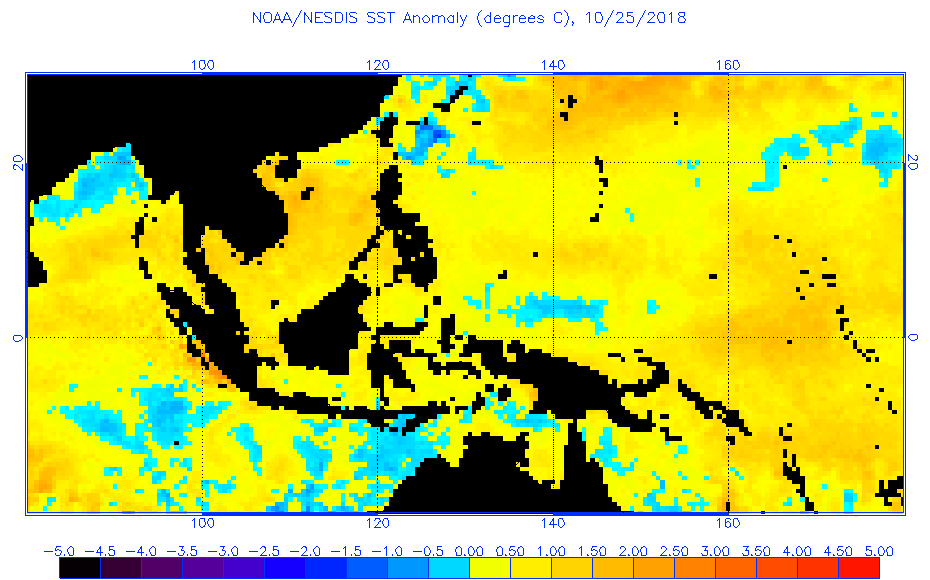
Like so many recent hurricanes, Yutu rapidly strengthened just before landfall, going from a Category 1 to a Category 5 in just 36 hours. Waters near Yutu were 2 to 3 degrees Fahrenheit warmer than normal, consistent with the effects of climate change and a key factor in rapidly strengthening storms.

Despite signing an emergency declaration to help speed the flow of federal aid to the islands, a routine task for a storm of this magnitude, President Trump has yet to publicly comment on the disaster. Mainstream media coverage has also been sparse; The New York Times’ initial story ran on page 16.

“It’s been tough seeing the lack of mainstream coverage for this,” said Steven Johnson, a native of Saipan and marine biologist now studying climate change at Oregon State University, wrote in an email interview with Grist.

Johnson pointed to the round-the-clock coverage of the mail bombs sent to Trump critics in comparison. It “hurts to know that +50K people living on U.S. soil deserve a fraction of the attention of Robert de Niro,” he said.

A lack of media and federal attention could prove deadly in the Marianas, as it did in the aftermath of Maria in Puerto Rico. Despite convincing evidence of a humanitarian catastrophe in Puerto Rico, the federal response was slow. That official neglect, plus logistical bottlenecks, lead to a nearly total breakdown in medical services and contributed to the storm’s outsized death toll, according to an independent study.

Johnson has been trying to bring attention to the storm by tweeting to celebrities like Leonardo DiCaprio. He said that communicating with friends and family over social media had turned into a full-time job.

“Growing up on Saipan and Tinian, you go through storms all the time,” Johnson said. “This was the first time I’ve heard family and friends say they feared for their lives.”

Read More:

Typhoon Yutu spurs disaster in a remote U.S. territory

Posted in alo, Anchor, Citizen, FF, GE, ONA, PUR, Radius, solar, solar power, Uncategorized | Tagged , , , , , , , , , , | Comments Off on Typhoon Yutu spurs disaster in a remote U.S. territory

Carbon tax debate: Nobels and IPCC vs. Trump and Doug Ford

Apologies, future generations: The world has been totally slacking on carbon taxes. And the Nobel prize committee may be trying to give us a hint.

The panel awarded its latest economic prize this week to William Nordhaus, a professor at Yale and the father of climate change economics. He’s best known for creating a model that simulates how the climate and the economy coevolve. It’s now widely used to project the outcomes of climate policies like carbon taxes.

The Nobel committee lauded him for showing that “the most efficient remedy for the problems caused by greenhouse gas emissions would be a global scheme of carbon taxes that are uniformly imposed on all countries.” Nordhaus received the prize on Monday along with New York University economist Paul Romer.

“I wouldn’t say that it’s a coincidence that Nordhaus and Romer won this year,” says Christopher Knittel, a professor of applied economics at MIT. “They both work on sustainable growth. I think the committee probably understands we’re on a path toward unsustainable growth. Their choice underscores the need for policymakers to act.”

A day earlier, the world’s top scientists sent a similar message in a gigantic, comprehensive report outlining the various way we can try to keep the planet habitable. A carbon price “is central to prompt mitigation,” the report says, though “a complementary mix of stringent policies is required.”

It’s a timely reminder. Although there are some regional cap-and-trade programs up and running in California and the Northeast, there’s nothing resembling a carbon tax in the U.S. So here’s another coincidence: The closest thing yet, a “carbon fee,” has a chance of passing next month in Washington state — assuming the multi-million-dollar campaign by oil companies doesn’t convince voters it’s a bad idea.

Washington state’s Initiative 1631 would charge $15 per ton of carbon dioxide, ramping up by $2 per year until the state hits its climate goals. Researchers say an effective carbon price would need to be quite a bit steeper — something in the $40 to $50 range, according to Knittel.

And any effective carbon price would need to rise really fast. Limiting warming to 1.5 degrees C above pre-industrial levels would take a carbon price of at least $135 per ton by 2030 — and possibly as high as $5,500 per ton, according to the U.N. report. If that sounds astronomical, it’s just a fraction of the kind of carbon price we’d need by the end of this century: somewhere between $690 to $27,000 a ton (yes, that’s 27 with three whole zeroes!).

So … better late than never? Knittel says the real power of a state-level carbon tax policy is that it could serve as a demonstration for a nationwide policy. That could come in handy if, say, an administration that actually wanted to act on climate change ever came into office.

Carbon taxes may sound like the most boring, straightforward thing in the world, but they remain controversial (and not just in Trump Nation). Just look to Canada, where Ontario’s premier, Doug Ford, has launched a crusade against carbon taxes. “The carbon tax is the absolute worst tax for Canadian families, Canadian businesses, and the Canadian economy,” he tweeted last week. Ford launched a legal challenge against Canada’s federal carbon tax plan in September. People on the other side of the political spectrum have it out for carbon taxes, too.

“If I had the time and heart to comment on Nordhaus’ Nobel, it would be to simply say that Nordhaus was wrong, in ways that may have done as much damage as it’s possible for an economist to do,” wrote climate advocate Alex Steffen in a Twitter thread. “[P]utting the weight of economic authority behind carbon pricing as the only effective strategy for action, helped exclude bolder, and — it turns out — more realistic strategies for regulation, public planning and technological disruption.”

The U.N. scientists acknowledge the many barriers to getting effective carbon taxes passed. The report says carbon prices are a “necessary ‘lubricant’” (their words, not mine!) for climate action, though not enough on their own. That’s because of “a persistent ‘implementation gap’ between the aspirational carbon prices and those that can practically be enforced.”

“The policies are lagging very, very far — miles, miles, miles behind the science and what needs to be done,” Nordhaus said shortly after winning the Nobel. “It’s hard to be optimistic. And we’re actually going backward in the United States with the disastrous policies of the Trump administration.”

Knittel says carbon taxes still make sense, despite the high cost. “By delaying it, it means the right carbon tax was harder than it would have been,” he says. “It’s more costly to act now, but that doesn’t reduce the necessity to act.”

View the original here: 

Carbon tax debate: Nobels and IPCC vs. Trump and Doug Ford

Posted in alo, Anchor, FF, G & F, GE, LAI, ONA, Radius, Thermos, Uncategorized | Tagged , , , , , , , , , , | Comments Off on Carbon tax debate: Nobels and IPCC vs. Trump and Doug Ford

The U.N.’s climate report has something to piss everyone off

If bikes are your thing, great. If you’re a vegan crusader, bully for you. If you’re a solar-power enthusiast, way to go.

The greenest among are often evangelists for our favorite causes. But according to the blockbuster report out this week from the Intergovernmental Panel on Climate Change, it’s not enough to stick to your thing, or even to take up all of the causes environmentalists love. If we want to prevent the likely consequences of climate change — food shortages, forest fires, and mass extinctions — we’ll need to deploy the popular solutions as well as the some of the unpopular ones, the report concludes.

That means turning off coal plants and building lots of renewables, but also devoting more acres to growing biofuels. It means reducing consumption (fly less, drive less, and eat less meat) but also increasing our use of nuclear power.

The danger is so great, in other words, that the IPCC’s team of 91 scientists and policy experts suggest we consider all of the above. Whatever works. They came up with 90 different mixes of solutions that would keep warming limited to 1.5 degrees Celsius, but none of them work without biofuels, atomic energy, and reigning in consumerism.

Here are three unpopular ideas that the report says we’ll need to embrace, and two that are still up for debate.

The must-do list:

Less stuff: Every scenario for keeping global warming under 1.5 degrees Celsius requires reducing per capita consumption. The scenarios range from shrinking world energy demand 15 percent by 2030 to constraining it to a 17 percent increase. Either way would mean less power for anyone rich enough to read this on a computer (if poorer people get more stuff under constrained growth, it means the richer people are going to have to make some lifestyle changes).

Some of this would come from efficiency, but it would also require “behavioural changes.”

The report does offer some “high overshoot” scenarios that don’t require giving up creature comforts. But in those scenarios the world zips past the 1.5 degree mark, then reels it back in with “negative emissions.” That would rely on growing huge tracts of forest that suck up carbon before the trees are logged; then burning the wood for energy and capturing the carbon. But it might not work.

Biofuel: Every scenario laid out by the IPCC relies on ethanol, biodiesel and other biofuels to some extent, and projects an increase in farmland devoted to growing fuel. We could really use biofuels to replace jet fuel and gasoline, but it’s controversial. There are good scientists who say corn ethanol has a bigger carbon footprint than gasoline. Others say burning ethanol is already carbon negative and getting better all the time. It seems impossible to tell who is right. If you are cutting down rainforests for palm oil, that’s definitely a climate catastrophe. If you can get algae in a tank to turn sunlight to fuel, well, that’s awesome.

Nuclear power: All scenarios have nuclear providing a greater share of our electricity through 2050. Right now, nuclear power provides 11 percent of the world’s electricity. In one 1.5 degree scenario, the IPCC report has the world doubling the percentage of electricity it gets from nuclear by 2030, and quintupling it by 2050. The most “degrowthy” scenario, with dramatically decreasing energy demand, doesn’t require building new atomic plants but does require keeping the ones we have open.

Up for debate:

Carbon capture: Most scenarios to limit warming rely on fossil-fuel power plants capturing their carbon as long as they’re still running, rather than releasing it into the atmosphere. There’s a bunch of plants already doing this around the world, but it’s pretty expensive. The businesses that capture carbon affordably are usually injecting the carbon into the ground in a way that squeezes out more oil for them to sell. Many environmentalists dislike carbon capture because it opens up a way for the fossil fuel industry to survive and thrive.

There’s no carbon capture required if global energy demand declines 15 percent between 2010 and 2030, but that’s looking more and more unlikely: Since 2010, energy demand has gone up, up, up.

Geoengineering: Imagine high-altitude airplanes constantly spraying reflective dust into the air to bounce sunlight back into space. Or fertilizing the ocean to allow a million carbon-sucking algal blooms. Technology to the rescue!

Except it’s all in your imagination. None of this whizbangery has been modelled enough to tell how it would affect the scenarios in this report. There’s just not enough science on geoengineering to say something substantive about it, according to the IPCC.

More – 

The U.N.’s climate report has something to piss everyone off

Posted in alo, Anchor, Everyone, FF, GE, LAI, LG, ONA, Radius, solar, solar power, Thermos, Uncategorized | Tagged , , , , , , , , | Comments Off on The U.N.’s climate report has something to piss everyone off

Trump’s latest rule rollback makes natural gas as dirty as coal

This story was originally published by High Country News and is reproduced here as part of the Climate Desk collaboration.

This summer’s statistics on electricity use and generation included a significant gem: Over the last 12 months, power generation from coal has dropped to a three-decade low. That was party-worthy news for the climate, for air quality, for folks who live near power plants, and for the natural gas industry, which is partly responsible for coal’s decline. Just days later, however, the Trump administration crashed the shindig, causing a major buzzkill.

No, the president’s attempts to revive coal have not succeeded. But on September 18, the Interior Department snuffed out new rules aimed at lowering the oil and gas industry’s methane emissions, just days after the EPA started the process of euthanizing its own methane regulations. This is a bummer not only for the planet, but also for the natural gas industry’s efforts to portray its product as the clean fossil fuel.

Dear reader, like what you see here?

Keep Grist’s green journalism humming along by supporting us with a donation today. All donations made between now and September 29 will be matched dollar-for-dollar.


Coal began its climb to dominate the electricity mix in the 1960s, peaking in the mid-2000s, when power plants burned about 1 billion tons per year, generating about half of the nation’s electricity — and an ongoing disaster. Donald Trump likes to talk about “clean, beautiful coal.” It’s anything but. The smokestacks that loom over coal power plants kick out millions of tons of planet-warming carbon dioxide annually, along with mercury, sulfur dioxide, arsenic, and particulates, all of which wreak havoc on human health. What’s left over ends up as toxic (sometimes radioactive) piles of ash, clinkers, and scrubber sludge.

When natural gas is burned to produce power, however, it emits only about half the carbon dioxide of coal, and virtually none of the other pollutants associated with burning coal. So during the 2008 election season — when climate politics were less polarized than now — both parties pushed natural gas in different ways, with Republicans chanting, “Drill, baby, drill,” and Democrats calling natural gas a “bridge” to greater reliance on renewable energy sources. At the same time, advances in drilling were unlocking vast stores of oil and gas from shale formations, driving down the price of the commodity, and making it more desirable to utilities.

(Video via Andrew Thorpe and Joshua Krohn / NASA Jet Propulsion Laboratory)

As a result, natural gas gobbled up a growing share of the nation’s electricity mix, while coal’s portion withered. In 2008, natural gas generated 21 percent of the electricity in the United States; now, its share is 33 percent. Coal use, meanwhile, plummeted from 48 percent to 29 percent over the same period. In consequence, the electric power sector’s total carbon dioxide emissions have dropped by 700 million metric tons over the last decade, with an attendant decrease in other harmful pollutants. Every megawatt-hour of coal-fired electricity that is replaced by gas-fired electricity is a net win for the planet — and the humans who live on it.

Except when it’s not. Natural gas has an Achilles’ heel: When it is sucked from the earth and processed and moved around, leaks occur. The main ingredient in natural gas is methane, a greenhouse gas with 86 times the short-term warming potential of carbon dioxide. Every punctured pipeline, leaky valve, and sloppy gas-well completion eats away at any climate benefits. And if methane’s leaking, so too are other harmful pollutants, including benzene, ethane, and hydrogen sulfide. And so the fuel’s green credentials, and one of the industry’s main marketing tools, end up wafting into thin air.

An aerial view taken by the airborne imaging spectrometer AVIRIS-NG of a methane plume from a gas storage tank in Kern Front oil field. The leak persisted for multiple years.Riley Duren, Andrew Thorpe and Stanley Sander / NASA Jet Propulsion Laboratory

When the Obama administration proposed rules that would make the oil and gas industry clamp down on methane emissions, it was a gift, not a punishment. Not only would people and the climate benefit; the natural gas industry would be able to sell itself as a clean fuel and a bridge to the future.

The Obama-era rules are similar to those passed in Colorado in 2014, with the industry’s support. Far from being onerous, they simply require companies to regularly look for and repair leaks and to replace faulty equipment. Some companies already do this on their own; the Obama rules would simply mandate this responsible behavior across the board. That’s why the Republican-controlled Congress ultimately decided not to kill the rules. That, however, did not discourage Trump.

Trump is not being “business-friendly” by ending the rules. Rather, he is once again indulging his own obsession with Obama and with destroying his predecessor’s legacy, regardless of the cost to human health and the environment. Trump’s own EPA estimates that its rule rollback will result in the emission of an additional 484,000 tons of methane, volatile organic compounds, and other hazardous pollutants over the next five years. Meanwhile, the death of Interior’s methane rule on Tuesday will add another half-million tons of pollutants to the air. In the process, it will erode the pillars of the once-vaunted natural gas bridge.

Then again, maybe the time has come to let that bridge burn. We get 70 times more electricity from solar sources now than we did in 2008, and renewables hold 11 percent of the total share of power generation. Perhaps just as significant is a less-noticed fact: Electricity consumption in the U.S. has held steady for the last decade, even dropping during some years, despite a growing population, a burgeoning economy, harder-working air conditioners, and more electric devices. That means we’re becoming more efficient and smarter about how we use energy. If we keep this up, we’ll be able to cross that fossil fuel chasm, no matter how many bridges Trump burns down.

Jump to original:  

Trump’s latest rule rollback makes natural gas as dirty as coal

Posted in alo, Anchor, FF, G & F, GE, LG, ONA, organic, Radius, solar, Ultima, Uncategorized | Tagged , , , , , , , , | Comments Off on Trump’s latest rule rollback makes natural gas as dirty as coal

Jerry Brown has positioned himself as a climate change hero. Not everyone agrees.

This story was originally published by Mother Jones and is reproduced here as part of the Climate Desk collaboration.

Before they could enter the sleek and sterile conference space where California Governor Jerry Brown’s Global Climate Action Summit is taking place this week, attendees were greeted Thursday morning by a scene of nonviolent chaos: Hundreds of protesters blocked entrances as they confronted police who guarded the star-studded event. Protesters sang and chanted, “Tell Jerry Brown, keep it in the ground,” and held replica oil pumps and rigs and “water for life” signs.

On a day that was otherwise dominated by business leaders and politicians congratulating themselves for their leadership in addressing the crisis of a rapidly warming planet, environmental and indigenous activists marched to the Moscone Center. One of the central messages to the rest of the world: Jerry Brown’s climate legacy isn’t worth all the hype.

Mother Jones

But why not? After all, Brown started his week by signing both SB 100, which promises carbon-free electricity by 2045, into a law and an even more ambitious executive order, pledging California to go entirely carbon-neutral by 2045. These were just a few of the many announcements California has rolled out this week to showcase its global leadership in the absence of federal action. But Kassie Siegel, director of the Center for Biological Diversity’s Climate Change Law Institute, is unimpressed, noting that Brown has fallen short of doing all he can to curb emissions.

“It’s pushing the problem far into the future,” she says, “when we need to take action today.”

Story continues below

What Brown could do now that would have far more impact, Siegel and others argue, is stopping new oil permits for fossil fuel projects, creating a buffer around oil and gas development in areas where people work and live, and pledging to phase out California’s existing permits for fossil fuel extraction.

“The things we’re asking for are necessary and inevitable,” Siegel says. “They can’t be denied from a scientific perspective; they can’t be denied form a moral perspective. And we’re not going away until these things are done.”

A report by the advocacy group Oil Change International released in May shows that California’s Division of Oil, Gas, and Geothermal Resources has approved more than 20,000 permits for new oil and gas wells since Brown began his final two terms as governor in 2011. Those numbers are incompatible with climate leaders’ stated goals to keep global warming to well below 2 degrees C, the report claims. Oil Change notes that 5.4 million Californians live within a mile of oil and gas development, often in communities of color with high poverty rates.

Mother Jones

Brown was not alone as a target of protests. Conference co-chair and former New York City Mayor Michael Bloomberg was interrupted by anti-capitalist protesters holding signs when he took the stage to address the summit. Earlier Thursday, he compared the morning protesters — many of them Native Americans with the It Takes Roots coalition — to people advocating for a U.S.-Mexico border wall.

“We’ve got environmentalists protesting an environmental conference,” he said. “It reminds me of people who want to build a wall along the Mexican border to keep people out from a country we go to for vacations. Something’s crazy here.”

Outside the summit, the message appears to have an audience: An estimated 30,000 people marched in San Francisco this weekend calling for more world leaders to stop patting themselves on the back and make the commitments that are actually needed to contain warming — and those leaders include Jerry Brown and Michael Bloomberg.

Link: 

Jerry Brown has positioned himself as a climate change hero. Not everyone agrees.

Posted in alo, Anchor, Everyone, FF, GE, LAI, ONA, Radius, Uncategorized | Tagged , , , , , , , , | Comments Off on Jerry Brown has positioned himself as a climate change hero. Not everyone agrees.

California wants all of its electricity carbon-free. How’s that possible?

If you want to get electricity generated by fossil fuels in California you’re soon going to be out of luck. A bill that just made it through the legislature requires the state’s electricity to come entirely from zero-carbon sources by 2045.

Environmentalists campaigned hard for the bill. Michael Brune, executive director of the Sierra Club, called its passage, “a pivotal moment for California, for the country and the world.”

That’s assuming Governor Jerry Brown signs it into law. Brown reportedly said he won’t sign unless the legislature also passes a bill to expand the energy grid to cover several states.

There’s a key term of art in this clean-energy bill that’s easy to miss if you aren’t clued in. Activists and like-minded politicians often campaign for “100 percent renewable,” but this bill mandates 100 percent carbon-free sources of electricity. Catch that? It means California is likely to replace fossil fuels with more electricity from large hydroelectric dams (not considered renewable under California rules), nuclear reactors, and any new technologies, like fusion, that become viable in the next 30 years.

There’s a big debate among greens over how much wind and solar an electric grid can handle.

Right now, California gets about a third of its electricity from renewables. Another third comes from natural gas. The rest comes from large hydroelectric dams, nuclear, and a little coal.

Most experts say that California — and the United States as a whole — could eventually get 80 percent of its electricity from renewables, but it’s really hard to fill that last 20 percent (see explanations here and here). A few academics, most famously Stanford’s Mark Jacobson (a 2016 Grist 50 member), think 100 percent renewable energy is within our grasp.

The new bill says that California will have to get half its electricity from renewables by 2027 and 60 percent by 2030. That seems within reach because the state expects to produce 50 percent renewable electricity by 2020.

Where will the other half come from? California’s network of dams provides as much as a fifth of its electricity in some years, but that depends on the weather. In the middle of the drought in 2015, California hydropower was less than half of what it is in an average year.

California Energy Commission

In-state nuclear looks like a long shot. It provides 10 percent of the state’s electricity, but the state’s only nuclear plant, near San Luis Obispo, is slated to shut down in 2025.

And then there’s conservation: If people turn off their lights and air conditioners, the state won’t need to generate as much electricity.

Finally, there’s generation from outside the state, which is the most likely way that California will compensate for any shortfall. Californians already buy hydropower from Washington and Oregon, along with some nuclear electricity from Arizona. If Brown signs the mandate into law, they’re likely to get more.

Of course, climate action is a planetary problem, not a local problem, so there’s only so much one state can do. It doesn’t help the climate if California buys Arizona’s low-carbon electricity while Arizona buys the fossil-fuel power that California shunned. But California could prove to other states that switching to clean electricity isn’t so hard. Massachusetts, New Jersey, New York and Washington, D.C are considering bills to make the switch. Hawaii already has a carbon-free law — not just for electricity, but for all forms of energy.

Brown is holding out for another bill that would allow California’s electric grid to bring in renewable resources from say, windy Wyoming, to big coastal cities like Los Angeles. The larger the grid, the greater the likelihood that it contains a spot where the wind is blowing and the sun is shining. But many labor and environmental justice groups are fighting against that bill on the grounds that it would give away local control. The Sierra Club and Earthjustice oppose it; the Natural Resources Defense Council and the Union of Concerned Scientists back it.

In the meantime, it seems like every environmental group is cheering the passage of the zero carbon bill.

By shooting for 100 percent carbon free, instead of 100-percent renewable, California is shifting from the true north of activists’ demands. Yet activists appear exultant. It’s like what New York’s Governor Mario Cuomo said back in 1985, “You campaign in poetry. You govern in prose.”

Original link: 

California wants all of its electricity carbon-free. How’s that possible?

Posted in alo, Anchor, FF, GE, LG, ONA, Poetry, Radius, solar, Uncategorized | Tagged , , , , , , , , | Comments Off on California wants all of its electricity carbon-free. How’s that possible?

Hawaii’s Hurricane Lane is already a flooding catastrophe

A rare hurricane is dousing Hawaii, producing flooding, power outages, and washing away roads — damage the National Weather Service is calling “catastrophic.” It’s increasingly clear that the Aloha state is already feeling the effects of a changing climate.

As of Friday morning, Hurricane Lane is at Category 2 strength and continues to move towards Oahu, home to Honolulu and Hawaii’s most densely populated island. Though the latest projections showed Lane’s center remaining offshore, the most powerful side of the storm will still wash over nearly all of Hawaii’s main islands, bringing torrential rainfall for more than 24 hours to a million people.

As Lane approached Thursday evening, civil defense sirens pierced the cloudy Honolulu skies and federal officials pre-staged plane-loads of supplies in the country’s most isolated state, hoping to prevent a repeat of the government’s bungled response to Hurricane Maria’s in Puerto Rico. The Big Island has been hardest hit so far with rainfall exceeding 30 inches, transforming normally tranquil waterfalls into violent torrents.

As a result of Lane’s slow motion, the National Weather Service in Honolulu has boosted its maximum rainfall prediction to 40 inches in some parts of the islands — months worth of rain, even for Hawaii’s lushest locations. In an update late Thursday Hawaii time, the NWS said Lane is “expected to lead to major, life-threatening flash flooding and landslides over all Hawaiian Islands.”

There has never been a hurricane landfall in Maui or Oahu in recorded history. Even if Lane doesn’t achieve that feat, it’s already the closest a storm has ever approached central Hawaii. Water temperatures near Hawaii are as much as 4.5 degrees F warmer than normal this week, supporting Lane’s high winds and heavy rains.

As the waters of the Pacific warm, heavy rainfall has become an increasingly dangerous problem for Hawaii. Lane is Hawaii’s second major flooding disaster this year, after torrential rainfall on Kauai in April produced nearly 50 inches in 24 hours, a new U.S. record. Our warmer atmosphere can now hold more water vapor, resulting in heavier rainfall during both regular thunderstorms and hurricanes. Since the 1950s, the amount of rain falling in the worst storms in Hawaii has increased by about 12 percent, according to a University of Hawaii study.

As the the country’s only ocean state, Hawaii is on the front lines of climate change. Hurricane Lane is the latest example that Hawaii’s warmer, wetter reality is already here.

Follow this link: 

Hawaii’s Hurricane Lane is already a flooding catastrophe

Posted in alo, Anchor, FF, G & F, GE, LAI, ONA, Radius, Uncategorized | Tagged , , , , , , , , , , , | Comments Off on Hawaii’s Hurricane Lane is already a flooding catastrophe