Tag Archives: fire

Arctic Forests Are On Fire Now More Than at Any Point in the Past 10,000 Years

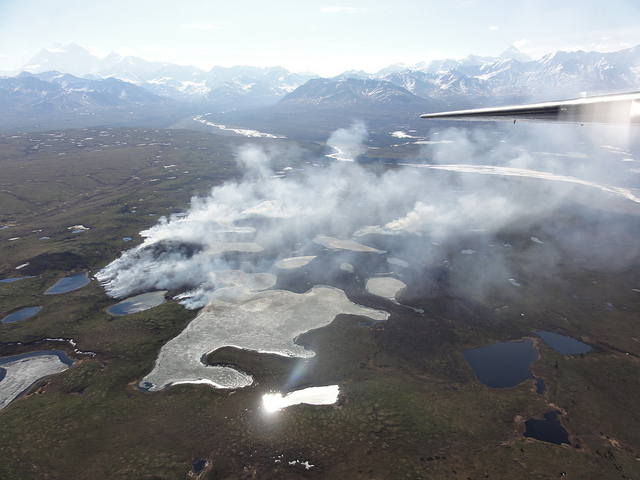
Wildfires burning in Alaska. Photo: Alaska Fire Service

The temperature in the Arctic is rising, the snow is melting, and the landscape is getting greener—that is, when it’s not on fire. In the 10,000 years since the end of the last ice age, says a new study lead by Ryan Kelly, the severity of Arctic fires—the damage they do to the areas, particularly the soil, that they burn—is the highest it’s ever been. The closest match, the researchers say, was a 500-year stretch known as the Medieval Climate Anomaly, a period that ended around 750 years ago and was defined by warm, dry conditions in the Northern Hemisphere.

The modern boreal forest of Alaska, where the scientists did their study, took shape around 3,000 years ago. Along with the sharp increase in fire severity, the frequency of Arctic wild fires has been increasingly recently, too. Kelly and the others write that the frequency of fires is the highest it has been in this 3,000 year stretch.

Predictions of future Arctic wildfires, say the scientists, “almost ubiquitously suggest increased frequency, size, and/or severity of burns in coming decades as a result of future warming.” But Kelly and colleagues point out that making these sorts of predictions might not be quite so simple. They say that some trees are more flammable than others, and just like during the Medieval Climate Anomaly, an increase in strong fires may be increasing the prevalence of less flammable species. During the Medieval Climate Anomaly, this type of shift capped the extent of the fires, and, the scientists write, a similar change that seems to be going on now “may stabilize the fire regime, despite additional warming.”

So, Arctic greening and changes in the types of plants might put a damper on the recent increases in Arctic fire frequency. Or, it might not. “The present fire regime seems to have surpassed the vegetation-induced limit that constrained burning during the [Medieval Climate Anomaly],” Kelly and his colleagues say. Modern climate change seems to be more dramatic than even that five-hundred-year warm period centuries ago, so we’re really not entirely sure what’s going to happen to the Arctic. Maybe something will dampen the blaze, like it has in the past, or maybe it won’t. We might, as the scientists say, be headed for a “novel regime of unprecedented fire activity” in the Alaskan Arctic.

More from Smithsonian.com:

A Warming Climate Is Turning the Arctic Green

Link to article: 

Arctic Forests Are On Fire Now More Than at Any Point in the Past 10,000 Years

Posted in alo, GE, ONA, Uncategorized | Tagged , , , , , , , , | Comments Off on Arctic Forests Are On Fire Now More Than at Any Point in the Past 10,000 Years

Green Gear for Your Camping Trip

Taking a camping trip with the family this summer is a great way to spend some quality time outdoors. A little pre-planning can help you tread lightly on the planet while you’re exploring your surroundings, so before heading out, think about making eco-friendly choices for your trip.

We’ve selected a handful of green gear and gadgets for your camping trip that will make your adventure easier for both you and the planet.

Photo: BioLite

BioLite CampStove

The BioLite camp stove is a unique alternative to gasoline-burning stoves. BioLite’s stove uses twigs as fuel, so you won’t need to carry any extra fuel with you. By burning a renewable resource instead of petroleum, the stove also reduces your carbon footprint.

In addition to burning cleanly, BioLite’s stove can charge your gadgets while you’re cooking. The stove can convert heat from the fire into usable electricity, allowing you to charge your phone and other electronics.

Price: $129.95

BUY IT HERE

earth911

Taken from – 

Green Gear for Your Camping Trip

Posted in alo, eco-friendly, FF, GE, ONA, PUR, solar, solar power, Uncategorized | Tagged , , , , , , , | Comments Off on Green Gear for Your Camping Trip

Colorado Wildfires Are So Big They Can Be Seen From Space

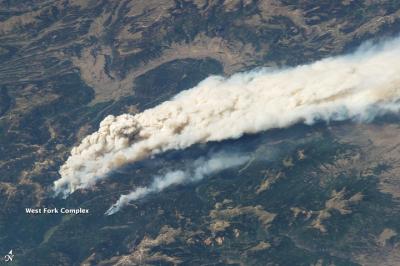
Image Credit:ISS Crew Earth Observations experiment and Image Science & Analysis Laboratory, Johnson Space Center. The image was taken by the Expedition 36 crew

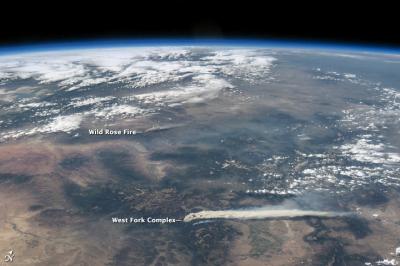
The fires in Colorado continue to rage through dry forest timber, damaging both forests and towns. Coloradans have already endured the most destructive fire in state history, and while that one has abated, others have sprung up in different corners of the state. Hundreds of firefighters are currently battling the West Fork Complex and the East Peak Fire. The blazes are so large that they can be seen from space. Astronauts on the ISS took these dramatic images of the smoke plumes from the West Fork Complex and the Wild Rose Fire.

Image Credit: ISS Crew Earth Observations experiment and Image Science & Analysis Laboratory, Johnson Space Center. The image was taken by the Expedition 36 crew.

The smoke from these fires reached European airspace on Monday.

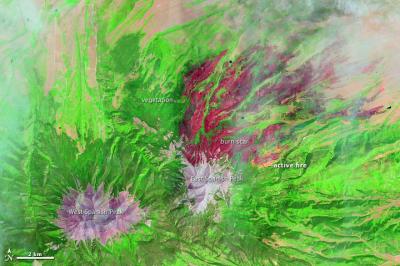
Firefighters trying to contain the East Peak fire got some help from the weather last night, in the form of less than an inch of rain. It wasn’t much moisture, but it was enough. The fire is now 75 percent contained, but its scars remain on the landscape. Satellite images form NASA’s Earth observatory show what kind of impact the fire has already made in the forested area.

On June 22, 2013, the Operational Land Imager (OLI) on Landsat 8 captured this false-color image of the East Peak fire burning in southern Colorado near Trinidad. Burned areas appear dark red, while actively burning areas look orange. Dark green areas are forests; light green areas are grasslands. Image Credit: NASA Earth Observatory image by Jesse Allen and Robert Simmon, using Landsat data from the U.S. Geological Survey. Caption by Adam Voiland.

More from Smithsonian.com:

Here’s What $110 Million in Fire Damage Looks Like
Colorado Wildfire Forces Evacuations, Threatens World’s Highest Suspension Bridge
Fires Are Escaping Our Ability to Predict Their Behavior

Continued: 

Colorado Wildfires Are So Big They Can Be Seen From Space

Posted in FF, GE, ONA, Uncategorized | Tagged , , , , , , | Comments Off on Colorado Wildfires Are So Big They Can Be Seen From Space

The Big Burn: Teddy Roosevelt and the Fire that Saved America

[amzn_product_post]

Posted in Mariner Books | Tagged , , , , , , , , , , , , , | Comments Off on The Big Burn: Teddy Roosevelt and the Fire that Saved America

Colorado wildfires get an early start this dry year

Colorado wildfires get an early start this dry year

USAFColorado on fire in 2012.

An early start to wildfire season took northern Colorado residents by surprise late last week. Two fires broke out on Friday, fanned by unusually high temperatures, low humidity, and strong winds, which forced hundreds of people to evacuate their homes. And the state has been suffering from epic, epic drought, so that’s really helping with the burning.

Reuters reports:

The early-season wildfires could be a bad omen for drought-stricken Colorado, which had one of its worst ever wildfire seasons in 2012.

All of Colorado is experiencing moderate to exceptional drought conditions, according to the U.S. Drought Monitor.

Snowpack levels in the Colorado mountains are below the annual average. The state’s high-population urban corridor and farmers on the eastern plains rely on melting mountain snow for drinking water and irrigation.

As local fire captain Patrick Love told the Los Angeles Times, “the drought that we have been in, in this portion of the state, has somewhat played a role in the dryness of all the fuels.”

The two wildfires were contained over the weekend, but the unseasonable blaze really freaked out Colorado residents who were hit with hundreds of wildfires last year, which ultimately burned out tens of thousands of acres.

Two Colorado state senators are now pushing for the state to bankroll its own aerial fleet of fire-fighting planes, as the federal fleet is aging, depleted, and often slow in responding. ”We are pushing our luck when we think that the federal government will come flying in to save Colorado when it’s burning,” Sen. Steve King (R) told 7NEWS.

Not that King is wrong per se, but we’re missing the big picture if we think that more fire-fighting airplanes and helicopters are the answer to a scorched Western landscape.

Susie Cagle writes and draws news for Grist. She also writes and draws tweets for

Twitter

.

Read more:

Climate & Energy

,

Politics

Also in Grist

Please enable JavaScript to see recommended stories

Continue reading here:

Colorado wildfires get an early start this dry year

Posted in ALPHA, Anchor, FF, G & F, GE, ONA, Uncategorized | Tagged , , , , , , , , | Comments Off on Colorado wildfires get an early start this dry year

Pipeline struck by tug still burning, yards away from oil-laden barge

Pipeline struck by tug still burning, yards away from oil-laden barge

Coast GuardThis photo, taken Wednesday, shows how close the oil barge, on the left, is to the burning tug and pipeline. The barge contains 2,200 barrels of crude oil.

A tugboat and a gas pipeline continued to burn in Louisiana on Thursday — and connected to the burning tug is a barge laden with 2,200 barrels of crude oil, potentially ready to catch fire or spill.

The tug crashed into the liquid petroleum pipeline in Bayou Perot, 30 miles south of New Orleans, on Tuesday evening in shallow water after its crew steered into an area that vessels are not supposed to enter.

Not only was the no-go area clearly marked with white stakes, but the crew apparently plowed right over the warning stakes. ”The tug and barge was in the middle [of a marked pipeline area],” Coast Guard spokesman Tanner Stiehl told WWMT. “It had taken down some of the white stakes and was in the middle of that area.”

Miraculously, all of the barge’s crude has remained safely aboard so far, as emergency crews sprayed water over the barge to keep it cool and over the nearby flames. More than a dozen emergency response boats were floating near the fire on Thursday, with 40 emergency workers on hand ready to respond to a spill. A ring of floating absorbent boom was laid around the barge to help contain the oil if it leaks.

But nothing can be done to extinguish the blaze — officials are waiting for the contents of the severed liquid petroleum gas pipeline to burn themselves out. (Previous reports inaccurately stated that it was a natural gas pipeline.) The Associated Press reported on Wednesday:

The Coast Guard said pipeline owner Chevron shut off the flow of gas to the area, but what’s left in the 19-mile section of pipeline could fuel the fire until Thursday or later.

Petty Officer William Colclaugh said Chevron began a process Wednesday to inject nitrogen gas into the pipeline in hopes of extinguishing the blaze, but it was unclear how soon that might affect the fire.

An oil spill would wreak further havoc on fisheries and coastal ecosystems in an area still affected by the 2010 Deepwater Horizon spill. The Coast Guard had previously said that Tuesday’s accident had triggered an oil spill. It now appears that the sheen the Coast Guard had spotted on the water surrounding the accident was not oil — it was a thick layer of ash from the blazing gas.

As emergency workers labored to protect the oil-laden barge from the flames on Thursday, questions were being asked about how the crew of the 47-foot tug Shanon E. Settoon could have drifted so far off course.

Unusually, the Coast Guard refused to say whether the tug boat crew had been tested for drugs and alcohol after the accident, as is standard practice. “We’re not releasing that information,” Stiehl told Grist. As many as four members of the tug boat’s crew were reportedly injured. The captain reportedly suffered burns to more than three-quarters of his body, which could have complicated normal toxicology testing procedures.

John Upton is a science aficionado and green news junkie who

tweets

, posts articles to

Facebook

, and

blogs about ecology

. He welcomes reader questions, tips, and incoherent rants:

johnupton@gmail.com

.

Read more:

Climate & Energy

Also in Grist

Please enable JavaScript to see recommended stories

Jump to original:

Pipeline struck by tug still burning, yards away from oil-laden barge

Posted in ALPHA, Anchor, FF, G & F, GE, LG, Uncategorized | Tagged , , , , , , , , , , | Comments Off on Pipeline struck by tug still burning, yards away from oil-laden barge

California levies record $1 million fine against Chevron for refinery fire

California levies record $1 million fine against Chevron for refinery fire

Nearly six months after a Chevron refinery erupted in flames in Richmond, Cailf., there’s a tiny bit of charred justice for residents of the San Francisco East Bay area.

In an announcement Wednesday, California’s Division of Occupational Safety and Health (Cal/OSHA) said it would be fining Chevron $963,200 for the fire — the biggest fine ever levied by the agency, and the biggest fine Cal/OSHA was even legally able to levy.

Cal/OSHA enforces workplace-safety law, and this judgment stemmed directly from 25 violations the agency said Chevron had committed. From the San Francisco Chronicle:

The state said 11 of the violations were willful and that Chevron had disregarded known and obvious hazards, a category that carries a fine of $70,000 per instance. Twelve other violations were deemed serious, with fines ranging from $6,000 to $25,000 apiece. The other two violations were minor.

Cal/OSHA found that Chevron officials ignored their own reliability department’s urging in 2002 that they replace the pipe that ultimately failed. Company inspectors told managers that the line was vulnerable to corrosion.

The line had lost more than 80 percent of its thickness to corrosion when it finally ruptured, a separate federal investigation has found. …

The state also found several violations at the refinery that weren’t related to the fire, but which suggest that Chevron’s safety regimen was lax.

Among those were nine makeshift repairs of pipe leaks in which Chevron had tried to fix the problems with clamps, Cal/OSHA said. Such repairs should have been temporary, but “in some cases the clamps remained in place for years, rather than (Chevron) replacing the pipes themselves,” the agency said.

The judgment did not say whether Chevron’s own workers had actually made the situation worse by puncturing another pipe.

In a move that surprised no one, Chevron vowed to appeal the decision, specifically the “willful” characterization.

Chevron wasn’t the only passive-aggressive problem at this party. Cal/OSHA itself was criticized after the fire when it was discovered the agency had not fined a major oil company in 10 years, and had been inspecting refineries in about 50 hours each, compared to 1,000 hours spent on average by federal officials.

As for members of the general public who also suffered from Chevron’s black plumes — about 15,000 of whom sought medical attention at local hospitals — Chevron says it’s paid $10 million to area medical centers in compensation.

It’s a little bit of justice for poor, dirty Richmond, but it’s not likely to quell the unrest there. Two weeks ago, even Richmond Mayor Gayle McLaughlin joined in a demonstration at the refinery protesting Chevron’s comically large money sacks of influence over local politics. The oil giant can build all the community gardens it wants — this town will still remember the time Chevron sent their kids to the hospital with acute respiratory distress, and then tried to buy the city council.

Susie Cagle writes and draws news for Grist. She also writes and draws tweets for

Twitter

.

Read more:

Business & Technology

,

Climate & Energy

Also in Grist

Please enable JavaScript to see recommended stories

Link:  

California levies record $1 million fine against Chevron for refinery fire

Posted in GE, Uncategorized | Tagged , , , , , , , , , , , | Comments Off on California levies record $1 million fine against Chevron for refinery fire