Tag Archives: houston

Hurricane Harvey will bring some of the heaviest downpours anyone has ever seen

Hurricane Harvey made landfall late Friday night on the Texas coast as one of the most intense hurricanes in U.S. history, spawning as many as 50 tornado warnings in the Houston area alone.

But its worst feature is still to come: several days of what could be some of the most intense rainfall this nation has ever recorded, a clear signal of climate change.

After a destructive storm surge washed away homes, and winds as strong as 132 mph blew away roofs and left hundreds of thousands without power, Harvey is expected to stall, drastically worsening the risk of catastrophic inland flooding from relentless rains.

As of Saturday morning, nearly 15 inches had already been recorded as bands of heavy thunderstorms streamed onshore from the warm Gulf of Mexico, with at least five more days of heavy rain on the way.

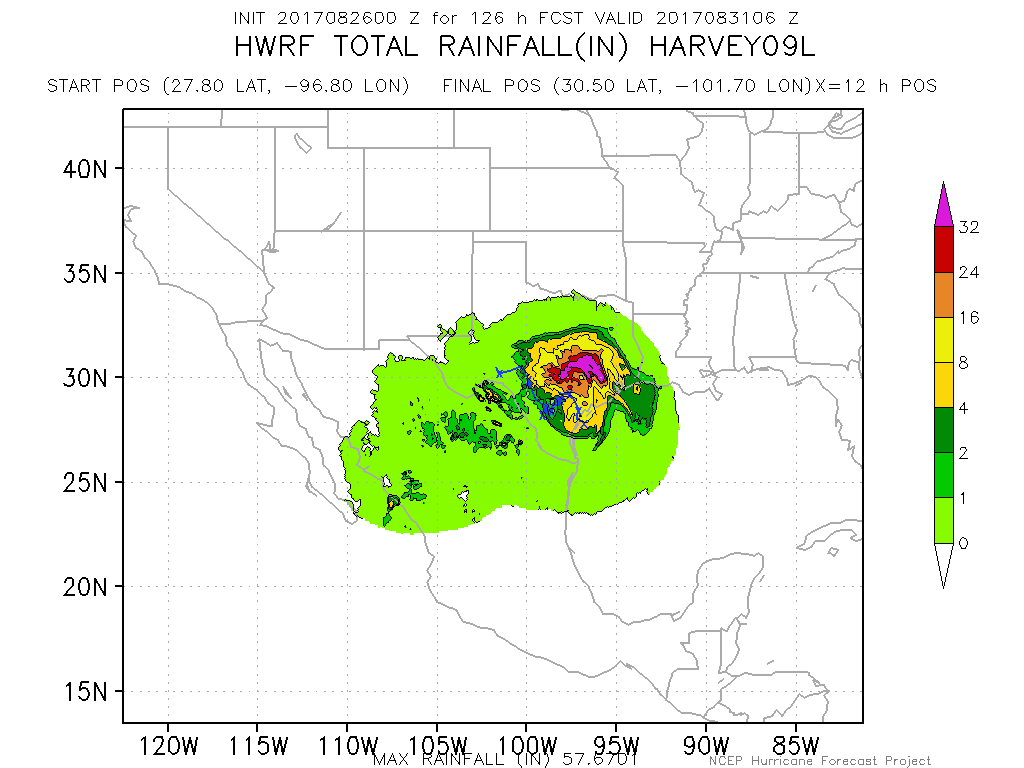
Through mid-week, Harvey is expected to move at an exceedingly slow 1 mph, pushing its rainfall forecast off the charts. For the first time in its history, the National Weather Service is forecasting seven-day rainfall totals as high as 40 inches in isolated pockets — equal to what’s normally a year’s worth or rain for coastal Texas.

Some high-resolution models predict even more. (For reference, the estimated 1-in-100-year seven-day rainfall total for the region is just 18 inches.) Meteorologist Ryan Maue estimated that 20 trillion gallons of water will fall on Texas over the next seven days, which is equal to about one-sixth of Lake Erie.

Virtually every river and stream between San Antonio and Houston is expected to experience record or near-record flooding over the next few days. Forecasters racked their brains to recall a scenario so dire anywhere in the world; a 2015 typhoon hitting the Philippines produced a similar amount of rain, but over a much smaller area.

Although the exact impact of global warming on the strength and frequency of hurricanes remains undetermined, there’s a clear climate connection when it comes to higher rainfall. All thunderstorms, including hurricanes, can produce more rain in a warmer atmosphere, which boosts the rate of evaporation and the water-holding capacity of clouds.

Heavy downpours have increased by 167 percent in Houston since the 1950s, and flooding there has been heightened by unfettered development and urban expansion. Some of the worst flooding in the region’s history has come from slow-moving storms like Harvey.

We don’t yet know if climate change will bring more slow-moving, rapidly intensifying tropical storms like Harvey. But flooding is what kills most people in hurricanes, and that will only get worse.

Taken from: 

Hurricane Harvey will bring some of the heaviest downpours anyone has ever seen

Posted in alo, Anchor, FF, G & F, GE, ONA, Pines, ProPublica, solar, Uncategorized | Tagged , , , , , , , , , | Comments Off on Hurricane Harvey will bring some of the heaviest downpours anyone has ever seen

Hurricane Harvey could be the strongest storm to hit the country in over a decade.

The Regional Greenhouse Gas Initiative announced yesterday that it plans to curb power plant emissions by 30 percent between 2020 and 2030.

The participating states — Connecticut, Delaware, Maine, Maryland, Massachusetts, New Hampshire, New York, Rhode Island, and Vermont — will finalize the agreement on Sept. 25. According to the Washington Post, Massachusetts wanted to set the bar higher by “reducing carbon emissions 5 percent a year. But Maryland balked and threatened to pull out of the pact, saying it would lead to higher energy costs for consumers.”

The agreement caps the emissions from the power generation only (unlike California’s system, it does not include other industry, transportation, or agriculture), and allows those electricity generators to buy and sell emissions rights. This latest move simply lowers the cap.

Even though Washington, D.C., tends to suck up all the oxygen in the conversation, local and regional leaders are trying different approaches to suck all the carbon out of the economy. In these statehouses, it’s a lot less hot air, and a lot more action.

Jump to original:  

Hurricane Harvey could be the strongest storm to hit the country in over a decade.

Posted in alo, Anchor, aquaculture, FF, G & F, GE, ONA, Ringer, solar, Uncategorized | Tagged , , , , , , , , , | Comments Off on Hurricane Harvey could be the strongest storm to hit the country in over a decade.

Women Are Now Living With the Fear of Deportation If They Report Domestic Violence

Mother Jones

<!DOCTYPE html PUBLIC “-//W3C//DTD HTML 4.0 Transitional//EN” “http://www.w3.org/TR/REC-html40/loose.dtd”>

President Donald Trump’s January executive orders on immigration worried advocates working with survivors of domestic violence and sexual assault, who argued that their clients and other victims of crime would no longer be willing to seek help or cooperate with law enforcement. Their concerns were further justified when police departments in Los Angeles and Houston announced that Latinos in those cities were reporting sexual assaults at lower rates in the wake of hostile rhetoric and enforcement activity targeting undocumented immigrants. Now, a new survey provides the data that demonstrates a noticeable shift in immigrant survivors’ contacts with victim services providers in recent months.

“The results of this survey are troubling,” Cecilia Friedman Levin, senior policy counsel for ASISTA Immigration Assistance, said in a recent press call discussing the survey results. “It represents that there is uncertainty and distrust around the institutions that are supposed to provide survivors with protection and safety.”

The “2017 Advocate and Legal Service Survey Regarding Immigrant Survivors” was conducted last month by a coalition of national organizations focused on domestic violence and sexual assault. The sponsors included the Tahirih Justice Center, ASISTA, the National Network to End Domestic Violence, and the Asian Pacific Institute on Gender-Based Violence. The groups collected responses from roughly 700 advocates and attorneys from 46 states and Washington, DC, asking them about the issues confronting immigrant survivors seeking services and information about specific incidents. They found that a majority of respondents are seeing an increase in fear among their immigrant clients, some of whom are fearful of even calling 911 or seeking medical assistance. Here are some of the highlights:

62% of respondents—a group that includes both social and legal services providers—said they have seen an increase in immigration-related questions from survivors;
78% of respondents said that survivors had expressed concerns about contacting police due to fears that it would open them up to deportation;
75% said that survivors had expressed concerns about going to court for a matter related to their abuser, a concern that was likely exacerbated by the highly reported courthouse arrest of a domestic violence victim seeking a protective order against her abuser earlier this year;
43% of respondents also said that the survivors they have worked with have dropped criminal or civil cases related to their abuse because they were fearful of potentially opening themselves up to enforcement.

Anecdotes from respondents also shed light on the increased level of fear among immigrant survivors. “Survivors have a lot of questions about how they can safety plan under the new administration,” the report says, adding that some victims now question if they should submit petitions for relief to the federal government. In another response, the survey report notes that a 16-year old survivor attempted suicide because she feared that her offender would report her family to federal enforcement officials.

In the months since the immigration executive orders were announced, there has been confusion about what protections were still in place for the vulnerable subset of survivors of domestic abuse. US Immigration and Customs Enforcement has maintained that agency protections covering immigrant survivors and other victims of crime are still in place. But, in practice, the picture is quite different. The administration has largely overlooked these crime victims both in its statements on immigration and in the resources it has provided. Last month, the Department of Homeland Security launched a new office focused on crimes committed by immigrants and the president’s proposed 2018 budget promises to dedicate significant resources to immigration enforcement and crack down on sanctuary jurisdictions that refuse to participate in aggressive targeting of undocumented immigrants. The shift in tone has already had an effect: Earlier this week, a Baltimore defense attorney was arrested after allegedly offering an immigrant rape victim $3,000 to not testify against her alleged assailant, telling the woman that she risked deportation should she appear in court.

Immigrant survivors can still qualify for protections under the Violence Against Women Act, a 1994 law protecting victims of domestic violence, sexual assault, and stalking. But the administration’s activity could further exacerbate survivors’ reluctance to seek assistance. “We’ve seen a lot of people reach out and ask specifically for what people can do outside of the legal system because they’re afraid of deportation, or they’re afraid of law enforcement and they’ve been hearing a lot about raids,” Qudsia Raja, policy director at the National Domestic Violence Hotline, told reporters. “We’re having to work with advocates on safety planning outside of legal recourse.”

Advocates are also concerned that legislation working its way through Congress would negatively impact survivors’ willingness to report. Of particular concern is the Davis-Oliver Act, a bill that would give state and local law enforcement the power to enforce federal immigration laws, impose harsher penalties on undocumented immigrants, and punish sanctuary cities. The bill’s sponsor, Rep. Raul Labrador (R-Idaho) has argued that the bill is necessary to ensure public safety.

Those who actually work with immigrants disagree. They say public safety will suffer if harsh immigration policies are allowed to push immigrant survivors into the shadows. “The fear among immigrant survivors is still rampant,” Archi Pyati, chief of policy and programs at the Tahirih Justice Center, a group working with women and girls fleeing gender-based violence, told Mother Jones. “So long as the federal government continues down this road there are going to be immigrant women who are going to be hurt.”

Link: 

Women Are Now Living With the Fear of Deportation If They Report Domestic Violence

Posted in FF, GE, LG, ONA, Radius, Uncategorized, Venta | Tagged , , , , , , , , , , , | Comments Off on Women Are Now Living With the Fear of Deportation If They Report Domestic Violence

Bill O’Reilly Can’t Listen to Congresswoman Because He’s Too Distracted by Her "James Brown Wig"

Mother Jones

<!DOCTYPE html PUBLIC “-//W3C//DTD HTML 4.0 Transitional//EN” “http://www.w3.org/TR/REC-html40/loose.dtd”>

Fox News host Bill O’Reilly is under fire after dismissing a speech by Rep. Maxine Waters (D-Calif.) with a racially charged jab at the 78-year-old congresswoman’s hairstyle.

“I couldn’t hear a word she was saying,” O’Reilly said during a Wednesday segment of Fox & Friends, after Waters spoke on the House floor about the dangers of President Donald Trump’s policies. “I was looking at the James Brown wig.”

As the male hosts laughed off the remarks, female host Ainsley Earhardt called O’Reilly out for “going after a woman’s looks.” Earhardt said she found Waters “very attractive.”

“I didn’t say she wasn’t attractive,” O’Reilly responded. “I love James Brown, but it’s the same hair.”

This isn’t the first time Fox has been accused of racially insensitive attacks on Waters. In 2012, host Eric Bolling used Whitney Houston’s death as a cautionary tale to suggest that Waters “step away from the crack pipe.” He later claimed he was “just kidding.”

See original article here:

Bill O’Reilly Can’t Listen to Congresswoman Because He’s Too Distracted by Her "James Brown Wig"

Posted in ATTRA, FF, GE, LAI, LG, ONA, Radius, Uncategorized, Venta | Tagged , , , , , , , , , , | Comments Off on Bill O’Reilly Can’t Listen to Congresswoman Because He’s Too Distracted by Her "James Brown Wig"

Buying a Home Is Nearly Impossible for Teachers in These Cities

Mother Jones

<!DOCTYPE html PUBLIC “-//W3C//DTD HTML 4.0 Transitional//EN” “http://www.w3.org/TR/REC-html40/loose.dtd”>

Lauren Paquette dreams of owning a home with a pool. But the 34-year-old fifth-grade science teacher knows it’s a pipe dream: She recently had to find a roommate to help with the monthly rent of $1,425 on her three-bedroom house in Houston. Although that’s relatively cheap compared with rents across the country, it’s tough on a teacher’s salary. Saving up for a down payment is out of the question, said Paquette, a single mother.

“It’s not like I went into this job thinking I’d make a bunch of money, but I expected to be able to make ends meet,” Paquette said. Finances have been easier since she left North Carolina for Texas (North Carolina ranks in the lower tenth of states for teacher pay), but Paquette’s struggles aren’t unique.

As housing prices have soared in all the usual major metropolitan areas—as well as in cites like Las Vegas, Sacramento, Atlanta, and Minneapolis—teachers’ wages haven’t kept pace. And with school districts already struggling to recruit and retain educators, this rising gap is just another barrier to keeping teachers in the profession.

Redfin, a real estate brokerage firm, compared listed home prices in more than 30 cities with average teachers’ salaries to gauge what percentage of available homes teachers could afford. (Administrators, principals, and special-education teachers were not included in the data, and New York City was not studied.) The number of homes within reach for a single teacher has declined in some places by more than 25 percent since 2012.

That’s no surprise in San Francisco, where just 14 out of the 2,244 listed houses were within reach on the average teacher salary of $71,000. But the dearth of affordable options has worsened in Las Vegas, Sacramento, Chicago, and Dallas, where in each city less than 25 percent of listed houses are affordable for teachers.

Of course, home ownership—traditionally an economic engine of the middle class—isn’t out of reach for just teachers. High housing prices are pushing middle-class workers out of many cities. Redfin chief economist Nela Richardson said the notion that civil servants live in the communities they serve is becoming a thing of the past: “These are middle-class salaries, but middle-class people can’t afford to buy homes.”

Rental prices mirror the housing market, so teachers who rent are also getting pushed out of the cities in which they teach. Meanwhile, attempts to fix the crisis in Los Angeles have backfired, and other novel solutions—like Sen. Corey Booker’s eight-building Teacher Village in Newark, New Jersey, or plans for teacher-only residential units in the San Francisco Bay Area—either just opened or are still years away. Despite creative housing solutions for our cities’ educators, many critics of these plans argue that the real solution is simply paying teachers higher salaries.

David Fisher, the vice president of the Sacramento City Teachers Association, lived in a studio apartment with his wife and son for 15 years before he could afford a house in Sacramento. “These aren’t McMansions in the suburbs,” Fisher said. “These are modest houses is modest neighborhoods.” Besides, he said, most teachers are concerned with paying off student loan debt before even considering buying a home.

There are a few cities where it’s not so bad. In Philadelphia, where teachers’ salaries saw a 15 percent increase since 2012, more than 35 percent of houses for sale are affordable for teachers. Like most civil servants, teachers have more options anywhere the housing supply is larger.

Paquette, the science teacher, figures that she may be able to buy a house in 10 years—and says she’ll stay in Houston as long as she can afford it. Whether she’ll stay in education is another question. “I get that itch quite often,” she said, “to leave the classroom.”

Original link – 

Buying a Home Is Nearly Impossible for Teachers in These Cities

Posted in Everyone, FF, GE, LG, ONA, Radius, Uncategorized, Venta | Tagged , , , , , , , , | Comments Off on Buying a Home Is Nearly Impossible for Teachers in These Cities

What If We Never Passed the Clean Air Act?

Fortyyears ago, the United States government passed theClean Air Acta federal law that regulates atmospheric emissions in order to protect the air we breathe from pollution. Without it, our world would look a whole lot different.

But what exactly does that mean?

Let me take you into an alternate reality, with the help of a report from our friends at Save on Energy: a reality in which air pollution levels have reached a new height, where impurities rule and air visibility is just about non-existent. You can find that full report here!

What would our cities look like? How would our lives be different?

The following graphics demonstrate how American citieswould look in a world without the Clean Air Act. The pollution levels were determined by calculatingconcentration of particles in the air (similar to China’s post polluted city, Xingtai), to visibility in miles.

Here’s the actual formula, for all your science aficionadosout there:

Adj. Max. Daily PM2.5 for Population = (US Pop. / Xingtai Pop.) * Max Daily PM2.5 for Xingtai

VL= (A * 10^3)/G

VL= Equivalent visual range.

A = 0.75 Adjusted for miles

G = Micrograms per cubic meter.

Here’s how Chicagowould look without the Clean Air Act:

What about Dallas? Houston?San Jose? Take a look!

What isAir Pollution?

According to the Save on Energy report, which gives a great definition, “Air pollution occurs when particulate matter, biological agents, or other harmful pollutants are introduced into the atmosphere, posing both an environmental and human health risk.” The World Health Organization (WHO) considers this to be just about any contaminant that “modifies the natural characteristics of the atmosphere.”

Pollutants like this can come through anything like industrial facilities, the burning of fossil fuels, vehicle exhaust, household fires and more. These pollutants can cause allergies and seriously detrimental diseases like lung cancer, chronic and acute respiratory disease, asthma, reduced fertility, neurological disorders and stroke.They also make their way into our foods, contaminating the fish and plants we eatthrough bioaccumulation,and cause acid rain. The Guardian suggests that air pollution kills approximately 3.3 million people every single yeara number that will double by 2050 if we don’t make some more serious changes to our pollution policies. That’s more than malaria and HIV/AIDScombined.

Did the Clean Air Act really make a difference?

Absolutely! Since 1973, when the Act was passed, the Clean Air Act has helped decrease surface ozone levels by 25 percent since 1980, reduced mercury emissions by 45 percent since 1990 and taken out more than half of the nitrogen oxide and sulfur dioxide responsible for acid rain since 1980. We can also thank the Clean Air Act for preventing the premature deaths of some 40,000 people, and millions more from contracting diseases like those listed above.

Thank goodness for proactivity!

Disclaimer: The views expressed above are solely those of the author and may not reflect those of Care2, Inc., its employees or advertisers.

View the original here:  

What If We Never Passed the Clean Air Act?

Posted in FF, GE, LAI, LG, ONA, PUR, Radius, Uncategorized | Tagged , , , , , , , | Comments Off on What If We Never Passed the Clean Air Act?

Texas is still gunning for your reproductive rights

y’all things considered

Texas is still gunning for your reproductive rights

By on Aug 18, 2016Share

One might think that when the U.S. Supreme Court sends a clear message — like, “no, it’s still not at all chill to mess around with a woman’s right to a safe and legal abortion” — state legislatures would take that and run with it. But this is America! And never one to be bossed around, Texas continues to try to flout the June Supreme Court ruling that reaffirmed Roe v. Wade.

As we’ve established before, reproductive rights are a key sustainability issue. Around the world, women are disproportionately threatened by climate change. Ensuring that women are able to decide when, how, and even whether to have children is pretty much the best means of empowering them to face the coming challenges.

And that means keeping a close eye on what’s going on with those rights in Texas, both our third-most populous state and one severely threatened by climate change (being both southern and coastal), where an antiquated-at-best, misogynistic-at-worst mentality still holds sway with way too many legislators.

The Supreme Court ruled in June that Texas’ highly restrictive abortion clinic regulations (known as HB2) were unconstitutional. The rules, which required facilities that provide abortions to meet the same standards as ambulatory surgical centers, would have closed all but eight abortion clinics in the entire state.

The court ruling was a wonderful moment for the pro-choice movement — and, indeed, for women in general. But as we wrote at the time, it only addressed part of the problem. Since 2011, Texas women have had to endure a slew of restrictive legislation surrounding their reproductive rights. June’s ruling, while a promising step in the right direction, may have intensified that flood.

In July, Gov. Greg Abbott published new rules regarding the disposal of fetal remains, dictating that they would have to be cremated or buried to “affirm the value and dignity of all life,” as Texas Monthly reported. The Texas Health and Human Services Commission (HHSC) then awarded a massive contract to an anti-abortion organization as a provider in the state’s already much-weakened Healthy Texas Women program, which is the state’s publicly funded healthcare program for low-income women.

As the Houston Chronicle reported, $1.6 million of the meager $18 million chunk of state cash for the Texas Healthy Women program this year will go to the Heidi Group — an organization behind “crisis pregnancy centers” that work to steer pregnant women in need away from abortions. As Nancy Cardenas with the National Latina Institute for Reproductive Health puts it: “The Heidi Group does not provide health services.”

And yet its share of program funding is now the second-largest (after the Harris County Public Health Department). That’s more or less the equivalent of asking your weed dealer to take over the legal team handling your divorce.

We asked the HHSC why, exactly, it provided this contract to the Heidi Group, and got the following response:

“The Heidi Group has partnered with healthcare providers across the state to offer quality women’s healthcare services including family planning and birth control. The group’s proposal was one of the most comprehensive of any of the applicants that applied for the grants. The group’s services will cover more than 60 counties in seven regions through approximately 20 clinic sites. The Heidi Group is a Medicaid provider.”

That doesn’t assuage the concern of activists like Cardenas, who told me: “If we just look at basic facts, they are not licensed medical providers. [The Heidi Group’s founder] Carol Everett has a history of being very disingenuous when it comes to reproductive health access.”

Everett has publicly made the following claims: 1) That she can’t condone “killing babies” after “coming to Christ”; 2) that disposal of fetal tissue could disseminate HIV and other STDs into the water supply; and 3) that abortion  in the United States is a profit-based industry that attempts to trick young girls into getting knocked up. She actively and destructively spreads misinformation about reproductive health.

The Heidi Group’s inexplicable role in Texas’ public health program is a slap in the face to both women’s rights and sustainability. The women who will be most disadvantaged by the decimation of reproductive health services are exactly those most affected by climate change (which, let’s remember, is already hitting Texas hard): low-income women, women of color, and women in rural areas.

“We have to keep in mind that when cuts are made to reproductive healthcare services, they don’t affect groups the same way,” Cardenas told me. “And this rings especially true when we’re talking about the Latinx community in Texas.”

Latina women in Texas suffer from some of the highest rates of cervical cancer in the nation. And regular gynecological exams and cervical cancer screenings are some of the invaluable reproductive health services that end up falling by the wayside when money allotted for public health is given to an organization that traffics in ideology instead.

Says Cardenas: “I think the state is angry. I think our governor is angry … [and] I think they are trying to overcompensate at this point.”

The Supreme Court decision was a boon for women in Texas by saving them from having just a handful of abortion providers sprinkled across the largest state in the lower 48. But as events of this summer have shown, it’s hardly been a solution to all their problems.

The obstacles that Texas has hurled in the way of reproductive healthcare access are not dissimilar to a herd of raccoons: Even if you (say, Ruth Bader Ginsburg) can pick one off with a shotgun, there are plenty more to hurl garbage around your yard.

ShareElection Guide ★ 2016Making America Green AgainOur experts weigh in on the real issues at stake in this electionGet Grist in your inbox

Visit link – 

Texas is still gunning for your reproductive rights

Posted in alo, Anchor, FF, G & F, GE, LAI, ONA, Uncategorized | Tagged , , , , , , , | Comments Off on Texas is still gunning for your reproductive rights

How Science Could Help Prevent Police Shootings

Mother Jones

<!DOCTYPE html PUBLIC “-//W3C//DTD HTML 4.0 Transitional//EN” “http://www.w3.org/TR/REC-html40/loose.dtd”>
Illustration by Richie Pope

One morning in April 2015, Rayid Ghani was sitting among more than a dozen big-city police chiefs and officials in a fourth-floor conference room across the street from the White House. It was the latest in a series of meetings about curbing police abuses that the Obama administration had urgently called. The day before, a cellphone video had emerged showing a white South Carolina cop shooting an unarmed black man in the back, sparking another wave of Black Lives Matter protests and eventually prompting an FBI investigation. Ghani didn’t know much about law enforcement, having spent most of his career studying human behavior—things like grocery shopping, learning, and voting. But the Pakistani-born data scientist and University of Chicago professor had an idea for how to stop the next police shooting.

Back when he worked for the consulting company Accenture, Ghani had figured out how to guess the final price of an eBay auction with 96 percent accuracy. In 2012, he served on Obama’s reelection campaign, pinpointing supporters who were most likely to shell out donations. Ghani now believed he could teach machines to predict the likelihood that cops would abuse their power or break the law. It was, he thought, “low-hanging fruit.”

Experts have long understood that only a small fraction of cops are responsible for the bulk of police misconduct. In 1981, when research showed that 41 percent of Houston’s citizen complaints could be traced to 12 percent of the city’s cops, the US Civil Rights Commission encouraged every police department to find their “violence-prone officers.” Ever since, most major departments have set up a system to identify so-called bad apples. These systems typically use software to flag officers who have received a lot of citizen complaints or have frequently used force. But each department’s model is different and no one really knows how well any of them work. Some may overlook officers with many red flags, while others may target cops who haven’t broken any rules. What’s more, the police chiefs at the White House meeting had a hunch that the bad apples were gaming their systems.

Ghani saw a different problem: The departments simply weren’t using enough data. So he made the top cops gathered in Room 430 an offer. If they handed over all the data they’d collected on their officers, he’d find a better way to identify the bad cops.

The Charlotte-Mecklenburg Police Department in North Carolina signed up, agreeing to give Ghani and his team 15 years’ worth of personnel records and other data, provided that its officers’ identities remained anonymous. Charlotte was a good test lab for Ghani’s project. It had also had two recent police shootings; the case against one officer ended in a mistrial, and the other officer was never charged.

Since 2001, Charlotte had flagged officers for review based on certain criteria, like if the cop had used physical force against a suspect three or more times over the past 90 days. Once an officer was flagged, an internal affairs team would decide whether to issue a warning or to notify his supervisor. But the criteria were built on “a gut feeling,” explains Chief Kerr Putney. “It was an educated guess, but it was a guess nonetheless. We didn’t have any science behind it.” When Ghani’s team interviewed cops and supervisors, almost everyone said the system failed to account for factors like what neighborhoods the officers patrolled or which shifts they worked.

The system also created a lot of false positives, dinging more than 1,100 cops out of a 2,000-person force. “The officers felt like we were accusing them when they didn’t do anything wrong,” Putney says. Out on the street, cops were concerned accidents or even justified uses of force might be seen as foul play. When Ghani’s team dove into the data, they discovered that nearly 90 percent of the officers who had been flagged were false positives. “It was a huge eureka moment,” Putney says.

Identifying who was truly a problem cop was an obvious priority, but Ghani also wanted to predict who was most likely to misbehave in the future. So his team started to mine more data—any available information on the stops, searches, and arrests made by every Charlotte officer since 2000. In the end they analyzed 300 data points, trying to find which ones could best predict an officer’s chances of acting badly.

Ghani’s first set of predictions was shaky; it still incorrectly flagged about 875 officers, though it did correctly identify 157 officers who wound up facing a complaint or internal investigation within the following year—making it 30 percent more accurate than Charlotte’s previous model.

It came as no surprise that Ghani’s team eventually found that one of the best predictors of future problems was a history of past problems—like using unjustified force or getting into car accidents, for example. But the team also confirmed something many experts and officers had long suspected but could never demonstrate: Officers subjected to concentrated bouts of on-the-job stress—handling multiple domestic-violence or suicide calls, or cases involving young children in danger, for example—were much more likely to have complaints lodged against them by community members. “That’s something we’ve known anecdotally, but we’ve never seen empirical evidence before,” explains Geoffrey Alpert, a criminologist at the University of South Carolina.

Ghani’s research is already spurring changes in Charlotte. His team found that when three or more officers responded to a domestic-violence call, they were much less likely to use force than when only two officers were called to the scene. Putney says that realization has led his department to rethink how it handles emotionally charged incidents. He is eager to see what Ghani’s research says about shift rotations as well. Often, the youngest and least experienced cops get stuck on night shifts, which tend to be the most stressful and violent, and “where they can become desensitized and calloused,” he says. Putney also hopes to use Ghani’s research as a guide for traits to look for when hiring new officers. He is circumspect, though, about the ability to accurately foresee a police officer’s behavior. Some variables will always be unpredictable, he says, like when things go wrong at 3 a.m. But with 300 data points, he adds, “maybe there’s some science behind this after all.”

Ghani agrees there are limitations to his big-data approach. Even the most accurate predictions won’t eliminate bad cops. Preventing abuses may require a wider look at how officers are recruited, trained, counseled, and disciplined—as well as addressing personal and systemic biases. Without that layer of human intervention and analysis, personnel decisions based on predictive data alone could ricochet through a police department, harming morale and possibly making things worse.

“This is the first step,” Alpert says. “It may not be a panacea, but we’ve got to start thinking differently.” Eventually, Ghani says, data from dashboard and body cameras will factor into his calculations, and his system will help dispatchers quickly decide which officer is best suited to respond to a certain type of call at any given moment. He hopes most large police departments will adopt prediction models in the next five years. Most of the police officials at that White House meeting have said they’d like to work with him, and his team is negotiating with the Los Angeles County sheriff and the police chief of Knoxville, Tennessee. “I don’t know if this will work at every department,” he says. “But it’s going to be better than what it is now.”

More – 

How Science Could Help Prevent Police Shootings

Posted in Accent, alo, Citizen, Eureka, Everyone, FF, GE, LAI, LG, ONA, PUR, Radius, Uncategorized, Venta | Tagged , , , , , , , , | Comments Off on How Science Could Help Prevent Police Shootings

New Study Suggests Police Shoot Whites More Frequently Than Blacks

Mother Jones

<!DOCTYPE html PUBLIC “-//W3C//DTD HTML 4.0 Transitional//EN” “http://www.w3.org/TR/REC-html40/loose.dtd”>

In a new paper using an interesting approach, Roland Fryer finds that police officers treat blacks and Hispanics more roughly than whites, but they don’t shoot them any more frequently:

The results obtained using these data are informative and, in some cases, startling. Using data on NYC’s Stop and Frisk program, we demonstrate that on non-lethal uses of force — putting hands on civilians (which includes slapping or grabbing) or pushing individuals into a wall or onto the ground, there are large racial differences. In the raw data, blacks and Hispanics are more than fifty percent more likely to have an interaction with police which involves any use of force.

In stark contrast to non-lethal uses of force, we find no racial differences in officer-involved shootings on either the extensive or intensive margins. Using data from Houston, Texas — where we have both officer-involved shootings and a randomly chosen set of potential interactions with police where lethal force may have been justified — we find, in the raw data, that blacks are 23.8 percent less likely to be shot at by police relative to whites. Hispanics are 8.5 percent less likely.

Analyzing data from cities in California, Texas, and Florida, Fryer found that lethal force was used more often against whites than blacks.1This is from the New York Times:

In officer-involved shootings in these cities, officers were more likely to fire their weapons without having first been attacked when the suspects were white. Black and white civilians involved in police shootings were equally likely to have been carrying a weapon. Both of these results undercut the idea that the police wield lethal force with racial bias.

….A more fundamental question still remained: In the tense moments when a shooting may occur, are police officers more likely to fire if the suspect is black?

To answer this question, Mr. Fryer focused on one city, Houston. The Police Department there allowed the researchers to look at reports not only for shootings but also for arrests when lethal force might have been justified. Mr. Fryer defined this group to include suspects the police charged with serious offenses like attempting to murder an officer, or evading or resisting arrest. He also considered suspects shocked with Tasers.

And in the arena of “shoot” or “don’t shoot,” Mr. Fryer found that, in tense situations, officers in Houston were about 20 percent less likely to shoot a suspect if the suspect was black. This estimate was not very precise, and firmer conclusions would require more data. But, in a variety of models that controlled for different factors and used different definitions of tense situations, Mr. Fryer found that blacks were either less likely to be shot or there was no difference between blacks and whites.

Fryer calls this “the most surprising result of my career.” Needless to say, it’s based on limited data and a new way of looking at police shootings, so Fryer’s results should be considered tentative. And it’s worth keeping in mind that lesser uses of force are far more common in encounters with blacks than whites:

“Who the hell wants to have a police officer put their hand on them or yell and scream at them? It’s an awful experience,” he said. “I’ve had it multiple, multiple times. Every black man I know has had this experience. Every one of them. It is hard to believe that the world is your oyster if the police can rough you up without punishment. And when I talked to minority youth, almost every single one of them mentions lower level uses of force as the reason why they believe the world is corrupt.”

Food for thought. Fryer is a careful and high respected researcher, and he was motivated to conduct this study by the events in Ferguson a couple of years ago. Both of his conclusions are worth taking seriously.

1The results weren’t statistically significant, so technically Fryer’s conclusion is that there’s no difference between the shooting rate of whites and blacks.

See more here: 

New Study Suggests Police Shoot Whites More Frequently Than Blacks

Posted in FF, GE, LG, ONA, Uncategorized, Venta | Tagged , , , , , , , , , | Comments Off on New Study Suggests Police Shoot Whites More Frequently Than Blacks

Powerful Photos From One of Texas’ Most Historic Black Communities

Mother Jones

<!DOCTYPE html PUBLIC “-//W3C//DTD HTML 4.0 Transitional//EN” “http://www.w3.org/TR/REC-html40/loose.dtd”>
Johnny Jones
Whether singing in a choir or playing keyboards on stage Saturday nights, music is been Jones’ passion. He spent his career working on the railroad tracks that run through Tamina. Now retired, Jones devotes his time to singing and recording Gospel music.

When photographer Marti Corn moved to The Woodlands, Texas, in 1996, she found herself living next to the subject of what would become her first book: the town of Tamina.

“Literally across the tracks” from The Woodlands, as Corn says, Tamina is a small community just north of Houston. Founded in 1871 by freed slaves, Tamina (originally known as Tammany) flourished for decades, benefiting from the logging industry and a railroad that ran from Houston to Conroe. It’s the oldest freedman town in Texas and one of the last emancipation communities of its kind left in the country; descendants of the original freed-slave founders still live in town.

But in the 1960s and ’70s, affluent suburbs like Shenandoah, Chateau Woods, Oak Ridge, and The Woodlands grew, pushing up against poorer, rural Tamina . This juxtaposition is what drew Corn to Tamina. As she met its residents, she thought she could help create awareness of the town and its history through her photography. “At the very least,” Corn says, “I could gift those who live in Tamina with a book of portraits and their stories so their descendants would know where they came from.”

Consider Corn’s mission accomplished. Her book, The Ground on Which I Stand (published by Texas A&M University as part of its Sam Rayburn Series on Rural Life), is a nuanced portrait of the town, filled out by archival family photos and a history of the town

The book compiles oral histories of 15 families, from those whose trace their lineage in Tamina for seven generations to relative newcomers. Resilience and pride in Tamina are common threads throughout the book, tying together family stories into a wonderful tribute.

As Annette Hardin, one of the descendants of the founding families, told Corn, “The value developers place on our land is vastly different than ours. What they don’t understand is that it’s not just our property—it’s our legacy. The land represents the blood, heart, and soul of our African American heritage.”

Live Oak
This emancipation town’s landscape has a unique pastoral charm. Eighty-year-old live oaks shade houses built years ago. Horses can be found along most streets behind the wooden fences or tethered to a tree.

Molly
“The prejudice we have felt might be one of the reasons we are such a close community.”

Lonnie

Horse and Trailer
This is a community that is at risk of gentrification as real estate values escalate and surrounding cities eye Tamina land for development.

Bubba

Joe
“Five-fifty a week, that’s what we made cuttin’ wood. We’d cut four cords a day to make that dollar. Times sure could be real hard, and we had many hungry days.”

Ruth
Faith plays an important role in Tamina. There are five churches, many of which line the railroad tracks.

Sweet Rest Cemetery
Many headstones at Tamina’s Sweet Rest Cemetery are hand-made with names either painted onto crosses or etched into concrete markers. The cemetery floods every time there is a heavy rain, causing headstones to sink into the ground.

Jada
Tamina has the opportunity to send its children to some of the best schools in the country, thanks to the growth of surrounding cities. But that growth also puts the town at risk of gentrification.

The Ground on Which I Stand: Tamina, a Freedman’s Town
Sam Rayburn Series on Rural Life, sponsored by Texas A&M University-Commerce

Link: 

Powerful Photos From One of Texas’ Most Historic Black Communities

Posted in alo, FF, GE, LG, ONA, Uncategorized, Venta | Tagged , , , , , , , | Comments Off on Powerful Photos From One of Texas’ Most Historic Black Communities