Tag Archives: mining

A Space-Based Telescope for the People Wants Your Support

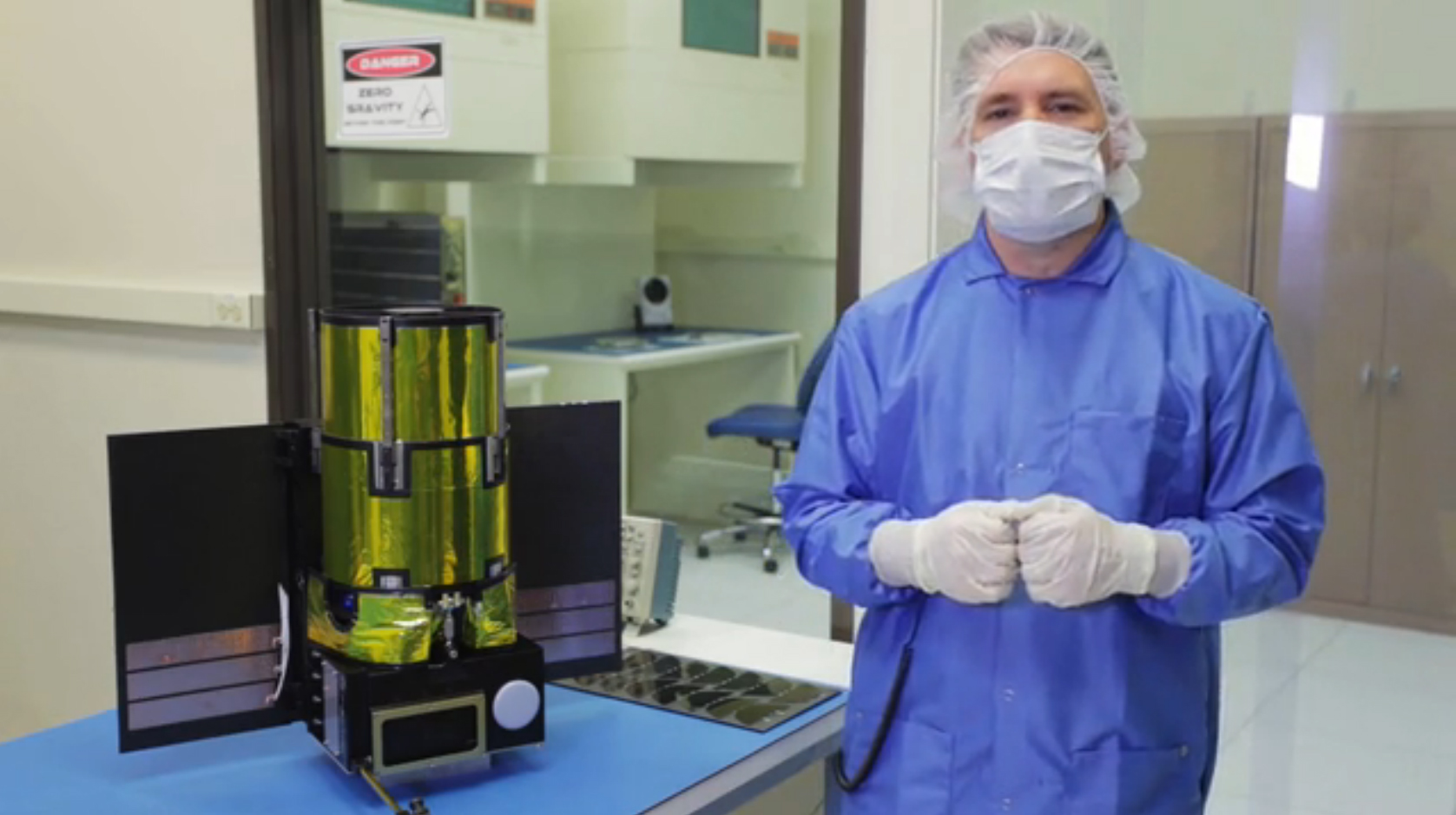
Planetary Resources president Chris Lewicki stands next to the Arkyd space telescope. Photo: Planetary Resources

In just a few short days, Planetary Resources, a fledgling space mining company, has raised more than $500,000 from the fine citizens of the world for their project to put a small space telescope into orbit around the Earth—one that would be controllable by regular folks down on the ground. With the telescope, a 200 millimeter orbiting telescope known as the Arkyd, you’d be able to take photos of the planet, of the stars, or of the other awesome things poking around in the solar system.

The team is looking to raise $1,000,000, and with 30 days left to go on their Kickstarter fundraiser it seems likely they’ll hit the mark.

The telescope’s big selling point for those not interested in doing planetary sciences is the option for you to take a “space selfie.” The Arkyd has a little camera pointing at a little screen aboard the telescope. With the selfie-cam, you’ll be able to take a photo of the screen with the cosmos as a backdrop. On the screen, you can display a photo, a graphic, whatever you want.

The project is being put together by Planetary Resources, a company whose main purpose is to mine asteroids for minerals. So, as cool as it is, the Arkyd kickstarter is sort of like paying De Beers to take you on a safari. Check out their slick promotional video:

According to the Economist, the relatively cheap $1 million price tag of the space telescope is enabled by a two trends:

The revolution has been made possible by two developments: the realisation of long dreamt-of nanosatellites that pack control systems, solar panels, scientific instruments, communications and computing gear into devices little larger than a mobile phone; and crowd-funding websites that turn the public’s enthusiasm for space into viable businesses.

Aside from taking space selfies, you can buy time on the telescope for schools and museums. Planetary Resources’ goal with the for-the-people telescope is to encourage enthusiasm for space research.

People care about stuff they can participate in,” says Peter Diamandis, co-founder of Planetary Resources. “Space for the last 50 years has been non-participatory. This is making space cooler and more fun.” The risk that fun might supplant function is something Mr Diamandis rejects. He is adamant that providing a “photo booth in space” will not detract from Planetary Resources’ primary aim of prospecting for minernal-rich near-Earth asteroids.

More from Smithsonian.com:

To the Asteroids and Beyond
What Can We Do About Big Rocks From Space?
International Space Station Cameras Will Bring Earth to You, Live, 24/7

More: 

A Space-Based Telescope for the People Wants Your Support

Posted in Citizen, FF, GE, ONA, PUR, solar, solar panels, Uncategorized | Tagged , , , , , , , , | Comments Off on A Space-Based Telescope for the People Wants Your Support

Breakthrough clean gold mining technique replaces cyanide with… cornstarch!

Mining gold’s a dirty business. To extract gold from raw ore, a lot of cyanide is required, and wherever a lot of cyanide is found, there are also big environmental risks. Original article:  Breakthrough clean gold mining technique replaces cyanide with… cornstarch! ; ;Related ArticlesExplosive poop foam is killing hogs, destroying barns and stumping scientistsAmerica’s first hemp crop in 60 years was planted this week in ColoradoKids (and Teachers) in Peril, From Oklahoma to Oregon ;

See more here:

Breakthrough clean gold mining technique replaces cyanide with… cornstarch!

Posted in eco-friendly, FF, G & F, GE, Monterey, ONA, solar, solar power, Uncategorized | Tagged , , , , , , , , | Comments Off on Breakthrough clean gold mining technique replaces cyanide with… cornstarch!

How coal is keeping its firm grip on miners and elected officials

How coal is keeping its firm grip on miners and elected officials

Shutterstock

The coal industry is far more effective at preserving its political and economic power than it is at innovating cheap ways of getting coal out of the ground. In its push for continued relevance, the industry takes no prisoners in the mines or on Capitol Hill.

Consider the case of Reuben Shemwell, as told by Huffington Post:

Shemwell’s troubles started in September 2011. After his year and a half as a welder at mining properties in Western Kentucky, [Armstrong Coal] management fired the 32-year-old for what supervisors deemed “excessive cell phone use” on the job — an allegation Shemwell denied. Furthermore, Shemwell argued that the cell phone charge was merely a pretext for his firing. In subsequent court filings, he claimed the real reason he was canned was that he’d complained about safety problems at his worksite.

According to Shemwell’s filings with the Mine Safety and Health Administration (MSHA), the federal agency responsible for protecting miners, Shemwell had refused to work in confined spaces where he’d been overcome by fumes, and he’d complained to a superior that the respirators provided to welders were inadequate. Shortly before Shemwell was fired, he and a colleague also refused to work on an excavator while it was in operation, according to filings.

Not long after Shemwell filed his discrimination complaint, MSHA officials tried to inspect the site where he’d been working. According to court documents, Armstrong chose to shut the site down rather than subject it to MSHA oversight, which management said would be too costly. Ten workers were laid off.

The government decided not to hear a discrimination complaint Shemwell filed, which should have ended things — albeit unhappily for Shemwell. It didn’t.

Armstrong filed suit against Shemwell in Kentucky state court, claiming that the miner had filed a “false discrimination claim” against them, and that his claim amounted to “wrongful use of civil proceedings” — akin to a frivolous lawsuit.

Shemwell and his attorneys think that Armstrong Coal’s motive isn’t to repair its good name (assuming it once had a good name). Rather, the goal is to curtail complaints from employees and stifle whistleblowers. Efforts to silence employees drawing attention to safety concerns is hardly a new phenomenon; in 2011, whistleblowing miner Charles Scott Howard was fired by Cumberland River Coal, and then, after a court found the firing to be unjust, reinstated. What’s new in the Shemwell case is that Armstrong Coal took a further retaliatory step.

Despite wails during last year’s election that Obama was killing the coal industry, Big Coal appears to be feeling pretty confident. Politico reports on an emboldened industry:

The mining industry is optimistic about wielding Congress and the courts this year to push an agenda focused on expanding mining on federal lands and coal export capacity, as well as fighting EPA’s greenhouse gas regulations.

“There’s not one corner of the Congress where we don’t have strong friends,” said Rich Nolan, the National Mining Association’s senior vice president for government affairs. …

“We have a strong base both in committee and in the House floor,” Nolan said.

This is true. And as it happens, contributions from the coal mining industry to congressional candidates neared $5.5 million in the 2011-2012 cycle. The average contribution to House candidates spiked.

Open Secrets

There’s not one corner of the Congress where the mining industry doesn’t have strong friends. Some of those friends even stop by for parties.

Yesterday, the National Mining Association gave a briefing to the media on its outlook for the year. In summary: It’s bright. The Charleston Gazette was there and quoted NMA President Hal Quinn: “The outlook for U.S. coal and minerals mining in 2013 is positive due to clear improvements in key sectors of the U.S. economy and the global demand for mined products, particularly in developing economies.” Quinn later reverted to 2012′s talking points, critiquing government measures that could slow production — things like EPA regulations on air pollution and increased government response to repeated mine violations. The future is bright — but it could be brighter.

It is certainly the case that the industry would like to expand. And it’s true that coal use continues nearly unabated internationally. But that doesn’t mean that the coal industry, particularly in Appalachia, is doing well. So the same scramble continues — punishing dissension among employees and currying favor in Washington.

If only the industry actually spent as much time and money and energy cleaning up its product. But, then, that wouldn’t make so much money.

Philip Bump writes about the news for Gristmill. He also uses Twitter a whole lot.

Read more:

Business & Technology

,

Climate & Energy

,

Politics

Also in Grist

Please enable JavaScript to see recommended stories

Continued here:  

How coal is keeping its firm grip on miners and elected officials

Posted in GE, Uncategorized | Tagged , , , , , , , , | Comments Off on How coal is keeping its firm grip on miners and elected officials

W.Va. congressmember compares EPA head to Gadhafi

W.Va. congressmember compares EPA head to Gadhafi

Here’s some political rhetoric for you, via The Hill.

Rep. David McKinley (R-W.Va.) said the change of leadership at the EPA might not be for the better.

“I don’t want a repeat of what happened in Libya when we helped topple [Moammar] Gadhafi and then we wound up having al-Qaeda,” McKinley told Environment & Energy Daily. 

McKinley, a member of the Energy and Commerce Committee, is among the many Republicans who say President Obama’s EPA is harmful to the coal industry.

So let’s analyze this. Let’s break down this statement by the esteemed congressmember from the great state of West Virginia.

Moammar Gadhafi ruled Libya as dictator for 40 years after assuming power in a coup. During that time, he started a war with Iran that took the lives of 500,000 to a million soldiers and some 100,000 civilians. Hundreds more died in uprisings against his brutal regime. Gadhafi actively supported terrorism against Western targets, including providing material support for the bombing of Pan Am 103 over Lockerbie, Scotland. During the 2011 uprising that eventually claimed his position and life, thousands more died.

Moammar Gadhafi, left. Lisa Jackson, right.

Lisa Jackson was appointed by President Obama to serve as the head of the EPA. In that position, she has pushed hard for new standards limiting mercury pollution, smog, particulate matter, and greenhouse gases. She oversaw new mileage requirements for automobiles that will dramatically decrease fuel use in the future. It is safe to say that the new standards implemented during her tenure will prevent hundreds of thousands of premature deaths and save the government billions in healthcare costs.

But then, the Libyan resistance didn’t give McKinley nearly $400,000 in contributions over the course of his career. Mining interests committed to continuing cheap pollution did. Which may help explain the good congressmember’s odd moral position.

Philip Bump writes about the news for Gristmill. He also uses Twitter a whole lot.

Read more:

Climate & Energy

,

Politics

Also in Grist

Please enable JavaScript to see recommended stories

Read this article: 

W.Va. congressmember compares EPA head to Gadhafi

Posted in GE, Uncategorized | Tagged , , , , , , , , , , , | Comments Off on W.Va. congressmember compares EPA head to Gadhafi

GOP Congressman’s first priority: Party with the coal lobby

GOP Congressman’s first priority: Party with the coal lobby

Meet Andy Barr.

Gage Skidmore

No, not the guy with the winning smile and the lapel pin in the foreground. The guy doing the deer-in-headlights impression in the background. That’s Andy. Or, rather, that’s Rep. Andy Barr (R-Ky.), as of a few hours ago.

Barr was elected to the House last November, running on the Republican/Coal ticket. We noted his contribution to the GOP convention, which consisted of hugging a piece of coal as he walked around Tampa. Probably not literally, but who knows.

Anyway, it’s only fitting that Barr has chosen as the location of his swearing-in party, that celebration of his officially becoming a member of Congress, the headquarters of the National Mining Association. From BoldProgressives.org:

During his campaign, he even had a coal company executive pose as a miner for a commercial he cut. We’ve just been passed on a list of Congressional swearing-in and inaugural parties today, and it turns out Barr is having his party today from 5:30-7:30 PM ET at the National Mining Association (NMA), one of the chief lobbying organizations for Big Coal.

BoldProgressives notes that NMA gave Barr $5,000 for his campaign; he raised a solid $178,000 from mining interests in total. Celebrate good times, come on!

This will not be the first time Barr has been at NMA headquarters. Last September, during his campaign, Senate Minority Leader Mitch McConnell (R-Ky.) hosted a reception for Barr in the organization’s offices.

Nor, I suspect, will tonight be the last time Barr shows up at NMA headquarters. Maybe they should just give him a little office and a desk. If someone needs to cast a vote, I’m sure the NMA would happily send a staffer over to the Capitol to do that hard work.

Hat-tip: Paul Rauber

Source

Kentucky Republican holding congressional swearing-in party at headquarters of coal lobby, BoldProgressives

Philip Bump writes about the news for Gristmill. He also uses Twitter a whole lot.

Read more:

Business & Technology

,

Climate & Energy

,

Politics

Also in Grist

Please enable JavaScript to see recommended stories

Link to original: 

GOP Congressman’s first priority: Party with the coal lobby

Posted in GE, LG, Uncategorized | Tagged , , , , , , , , | Comments Off on GOP Congressman’s first priority: Party with the coal lobby

Coal museum installs solar panels to save money (obviously)

Coal museum installs solar panels to save money (obviously)

Today in irony:

Wales’ National Coal Mining Museum located at Big Pit, Blaenavon, Nr Abergavenny in south Wales, now has 200 photovoltaic solar panels erected on the Big Pit museum’s roof with another 200 solar panels installed on the National Collection Centre in Nantgarw.

locosteve

Wales’ National Coal Museum.

Why? Because solar panels save money, obviously. I mean, why use other fuel sources, whatever those might be, when you can generate your own electricity and make some money off of it?

It is estimated that the solar panels will offset about £400,000 [$648,000] during the next 25 years. [It] cost about £70,000 to install the panels, which was funded by the museum. The electricity generated will be used on site with any surplus being sold to the National Grid, which can produce additional income for the museum.

“Coal is such an important part of Wales’ heritage and yet green energy will play a major part in its future. A solar powered coal-mining museum is a fantastic way to celebrate this national journey,” said Peter Walker, Museum Manager of Big Pit. “But it’s far from just symbolic — the museum will benefit from huge reductions in energy bills and a solid return from the feed-in tariff.”

Meanwhile, in America, the coal industry reminds us that solar panels are what Satan uses to turn Americans into communists.

Another way in which Wales is a step ahead of the United States: The coal industry has been made into a museum exhibition. See how life used to be, kids, in the terrible times of yesteryear.

Good to know that something coal-related is making money, anyway.

Source

National Coal Mining Museum Fits Solar Panels, Renewable Energy World

Philip Bump writes about the news for Gristmill. He also uses Twitter a whole lot.

Read more:

Business & Technology

,

Climate & Energy

Also in Grist

Please enable JavaScript to see recommended stories

View original – 

Coal museum installs solar panels to save money (obviously)

Posted in GE, LG, Uncategorized | Tagged , , , , , , , , , , | Comments Off on Coal museum installs solar panels to save money (obviously)

Americans are quite literally giving their gold and silver away

Americans are quite literally giving their gold and silver away

A quick civics quiz to start your day. The answers are in italics at the end of each question. (If you read the headline, you’re cheating.)

  1. When was the General Mining Act, which is still in place, signed into law? 1872.
  2. Under the General Mining Act, how much do companies pay to stake a claim to extract precious metals on public land? How much in annual maintenance costs thereafter? $189; $140.
  3. How much do they pay to the government in royalties for each ounce of gold extracted? Silver? Copper? Zero dollars; nada; zilch.
  4. How much did the government earn in royalties from precious metal extraction last year? Not one fucking penny.

In other words, if your company staked a claim in 1873, and had been mining gold from it continuously, the total cost to your company would have been $19,509. At today’s spot price of $1,715 an ounce, you’d have needed to extract only 12 ounces over the past 139 years to recoup the entire amount you’d paid the U.S. government.

jvleis

This mining operation paid the same amount to the government that a mining company would today, because the system works.

Today, the General Accounting Office will release a report documenting the extent to which the government has been ripped off for more than a century. From The Washington Post:

The GAO report — which estimates that extraction of oil, gas, natural gas liquids and coal on federal and Indian lands produced $11.4 billion in federal revenue last year — said it could not make a similar assessment for hard-rock minerals. Federal agencies generally don’t collect data on the value of hard-rock minerals taken from public land because the only reason to do so would be to calculate royalties, the report states.

Back in 1993, when metal prices were much lower, however, the Interior Department estimated that sales of hard-rock minerals from federal lands totaled $6.41 billion. “This should be front and center of the natural resource agenda for this next administration,” [Sen. Tom Udall (D-N.M.)] said in a phone interview. “These hard-rock minerals belong to the American people, and today we’re quite literally giving our gold and silver away.”

If the 1993 extraction were valued at $6.41 billion, and that’s representative of every year between, say, 1980 and 2012 (which it very much may not be), and the government exacted a 1 percent royalty fee — that’s $2 billion in revenue. Two. Billion. Dollars.

Counterpoint from extractors:

Industry officials say they contribute to the economy even without paying royalties.

Responding to an inquiry last year from [Rep. Raul Grijalva (D-Ariz.)] about the value of uranium that Denison Mines Corp. had extracted from public land, company chief executive Ron F. Hochstein did not divulge any specific figures. But he said the metal ore industry overall accounted for nearly 290,000 jobs and contributed $37.2 billion to the nation’s gross domestic product, according to an industry-commissioned PricewaterhouseCoopers study.

The Federal Reserve puts the number of people employed in non-oil-and-gas mining at about 215,000. But apparently we’re not in the business of holding mining companies accountable for numbers, so who am I to complain?

There have been a lot of rackets in the history of American politics. But this — this massive gift to raw material extractors — is one of the biggest.

Source

Mining firm profits from public lands remain a mystery, new GAO study shows, The Washington Post

Philip Bump writes about the news for Gristmill. He also uses Twitter a whole lot.

Read more:

Business & Technology

,

Climate & Energy

,

Politics

Also in Grist

Please enable JavaScript to see recommended stories

See original article here:

Americans are quite literally giving their gold and silver away

Posted in GE, LG, Uncategorized | Tagged , , , , , , , , , , , | Comments Off on Americans are quite literally giving their gold and silver away

Oil companies polluting aquifers with EPA’s blessing

Oil companies polluting aquifers with EPA’s blessing

Shutterstock

Kind of like this, but underground.

Oil companies: They’re kind of like pet cats, it turns out. They don’t care what you want, they’re only out for themselves, and they love to bury their waste wherever they feel like it. And thanks to the Environmental Protection Agency, they’re able to bury it via aquifer injection at hundreds of sites across the country where the EPA says the water is not “reasonably expected” to be used for drinking.

In some of America’s most drought-stricken communities, this practice is polluting what little drinkable water there is left. A new report from ProPublica digs into the EPA’s spotty record on issuing exemption permits for dumping in the nation’s precious aquifers — starting with the fact that the EPA itself hasn’t kept great records on which permits it has issued at all.

Federal officials have given energy and mining companies permission to pollute aquifers in more than 1,500 places across the country, releasing toxic material into underground reservoirs that help supply more than half of the nation’s drinking water. …

Though hundreds of exemptions are for lower-quality water of questionable use, many allow grantees to contaminate water so pure it would barely need filtration, or that is treatable using modern technology.

The EPA is only supposed to issue exemptions if aquifers are too remote, too dirty, or too deep to supply affordable drinking water. Applicants must persuade the government that the water is not being used as drinking water and that it never will be.

Sometimes, however, the agency has issued permits for portions of reservoirs that are in use, assuming contaminants will stay within the finite area exempted.

In Wyoming, people are drawing on the same water source for drinking, irrigation and livestock that, about a mile away, is being fouled with federal permission. In Texas, EPA officials are evaluating an exemption for a uranium mine — already approved by the state — even though numerous homes draw water from just outside the underground boundaries outlined in the mining company’s application.

Wyoming, Montana, Utah, and Colorado have been hit with the most pollution exemptions. Those same states are digging deeper to get at cleaner water, looking into pipelines to pump it in from elsewhere, and/or just still drinking the possibly contaminated stuff. Thirsty Texas communities are considering pricey desalination efforts while the EPA has granted upwards of 50 aquifer exemptions throughout that state.

Most of the exemptions have gone to small, independent companies, but you will not be even a tiny bit surprised to learn that multinational energy giants Chevron, Exxon, and EnCana hold 80 of the permits between them.

To the resource industries, aquifer exemptions are essential. Oil and gas drilling waste has to go somewhere and in certain parts of the country, there are few alternatives to injecting it into porous rock that also contains water, drilling companies say. In many places, the same layers of rock that contain oil or gas also contain water, and that water is likely to already contain pollutants such as benzene from the natural hydrocarbons within it.

Similarly, the uranium mining industry works by prompting chemical reactions that separate out minerals within the aquifers themselves; the mining can’t happen without the pollution …

“The energy policy in the U.S. is keeping this from happening because right now nobody — nobody — wants to interfere with the development of oil and gas or uranium,” said a senior EPA employee who declined to be identified because of the sensitivity of the subject. “The political pressure is huge not to slow that down.”

But ProPublica also reports the EPA has “quietly” assembled a task force to reconsider the agency’s policies on aquifer exemptions given the rising value of water.

And at least judging by the EPA’s records as provided to ProPublica, there’s no clear trend of aquifer exemptions being handed out with increasing frequency. Permits took a huge dip in the late ’90s and early ’00s, then rose to about 75 annually, then dipped again last year.

Susie Cagle writes and draws news for Grist. She also writes and draws tweets for

Twitter

.

Read more:

Business & Technology

,

Climate & Energy

Also in Grist

Please enable JavaScript to see recommended stories

Original post:  

Oil companies polluting aquifers with EPA’s blessing

Posted in GE, LG, Uncategorized | Tagged , , , , , , , , , , , | Comments Off on Oil companies polluting aquifers with EPA’s blessing