Tag Archives: Pines

Hurricane Harvey brings some of the heaviest downpours anyone has ever seen

This story has been updated. 

Hurricane Harvey made landfall late Friday night on the Texas coast as one of the most intense hurricanes in U.S. history, spawning as many as 50 tornado warnings in the Houston area alone.

But its worst feature is still unfolding: several days of what could be some of the most intense rainfall this nation has ever recorded, a clear signal of climate change.

After a destructive storm surge washed away homes, and winds as strong as 132 mph blew away roofs and left hundreds of thousands without power, Harvey is expected to stall, drastically worsening the risk of catastrophic inland flooding from relentless rains.

The dire National Weather Service forecast for catastrophic flooding appears to have come true. Overnight, parts of Houston received as much as two feet of rain, causing widespread devastation. Another two feet of rain is on the way, according to the latest forecasts.

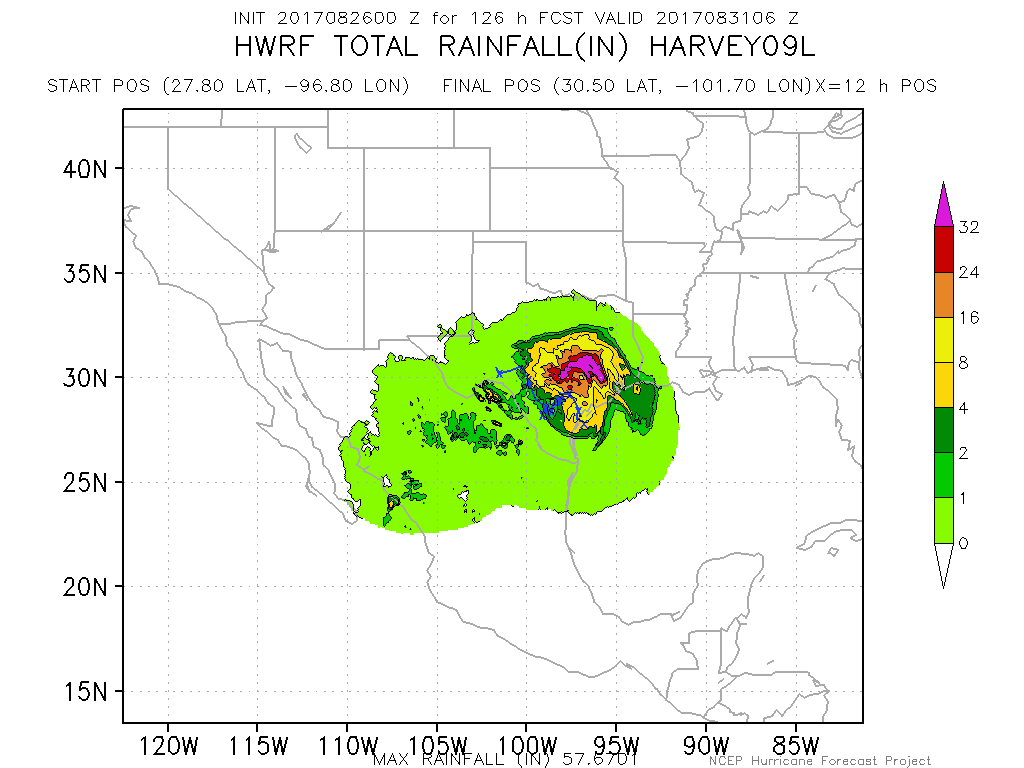
Through mid-week, Harvey is expected to move at an exceedingly slow 1 mph, pushing its rainfall forecast off the charts. For the first time in its history, the National Weather Service is forecasting seven-day rainfall totals as high as 40 inches in isolated pockets — equal to what’s normally a year’s worth or rain for coastal Texas.

Some high-resolution models predict even more. (For reference, the estimated 1-in-100-year seven-day rainfall total for the region is just 18 inches.) Meteorologist Ryan Maue estimated that 20 trillion gallons of water will fall on Texas over the next seven days, which is equal to about one-sixth of Lake Erie.

Virtually every river and stream between San Antonio and Houston is expected to experience record or near-record flooding over the next few days. Forecasters racked their brains to recall a scenario so dire anywhere in the world; a 2015 typhoon hitting the Philippines produced a similar amount of rain, but over a much smaller area.

Although the exact impact of global warming on the strength and frequency of hurricanes remains undetermined, there’s a clear climate connection when it comes to higher rainfall. All thunderstorms, including hurricanes, can produce more rain in a warmer atmosphere, which boosts the rate of evaporation and the water-holding capacity of clouds.

Heavy downpours have increased by 167 percent in Houston since the 1950s, and flooding there has been heightened by unfettered development and urban expansion. Some of the worst flooding in the region’s history has come from slow-moving storms like Harvey.

We don’t yet know if climate change will bring more slow-moving, rapidly intensifying tropical storms like Harvey. But flooding is what kills most people in hurricanes, and that will only get worse.

From:  

Hurricane Harvey brings some of the heaviest downpours anyone has ever seen

Posted in alo, Anchor, FF, G & F, GE, ONA, Pines, ProPublica, solar, Uncategorized | Tagged , , , , , , , , | Comments Off on Hurricane Harvey brings some of the heaviest downpours anyone has ever seen

Why Would a President Schmooze With Vicious Autocrats and Repressive Monarchs?

Mother Jones

A version of this story first appeared on the TomDispatch website.

Much outrage has been expressed in recent weeks over President Donald Trump’s White House invitation to Rodrigo Duterte, president of the Philippines, whose “war on drugs” has led to thousands of extrajudicial killings. Criticism of Trump was especially intense given his warm public support for other authoritarian rulers, including Egypt’s Abdel Fatah al-Sisi (who visited the Oval Office amid presidential praise weeks earlier), Turkey’s Recep Tayyip Erdogan (who got a congratulatory phone call from Trump on the recent referendum victory that cemented his powers), and Thailand’s Prayuth Chan-ocha (who also received a White House invitation).

But here’s the strange thing: The critics generally ignored the far more substantial and long-standing support US presidents, Democrat and Republican, have offered to dozens of repressive regimes over the decades. These regimes have one striking thing in common: They are all on an autocratic honor role of at least 45 nations and territories hosting scores of US military bases—from tiny outposts to installations the size of a small city. All told, these bases are home to tens of thousands of US troops.

To ensure basing access, American officials regularly collaborate with regimes and militaries that have been implicated in torture, murder, suppression of democratic rights, systematic oppression of women and minorities, and countless other human rights abuses. Never mind Trump. These collaborations have been the status quo for nearly three-quarters of a century. In fact, since World War II, US administrations have often shown a preference for maintaining bases in undemocratic and/or despotic states—Spain under Generalissimo Francisco Franco, South Korea under Park Chung-hee, Bahrain under King Hamad bin Isa al-Khalifa, and Djibouti under four-term President Ismail Omar Guelleh, to name just a few.

Many of our 45 undemocratic base hosts qualify as fully “authoritarian regimes,” according to a democracy index compiled by the Economist. Which means American installations and the troops stationed there are effectively helping block the spread of democracy in countries like Cameroon, Chad, Ethiopia, Jordan, Kuwait, Niger, Oman, Qatar, Saudi Arabia, and the United Arab Emirates.

This support for dictatorship and repression should trouble any American who believes in the principles of our Constitution and Declaration of Independence. After all, one of the long-articulated justifications for maintaining US military bases abroad has been that our military presence protects and spreads democracy. Far from it, such bases tend to help legitimize and prop up repressive regimes, while often interfering with genuine efforts toward political and democratic reform. The silencing of the critics of human rights abuses in base nations such as Bahrain, which has violently cracked down on pro-democracy demonstrators since 2011, has left the United States complicit.

During the Cold War, such bases were often justified as the unfortunate but necessary consequence of confronting the “communist menace.” Yet in the quarter-century since the Cold War ended, few of those bases have closed. So today, while White House visits from autocrats generates indignation, the presence of American military installations in the same countries receives little notice.

The 45 nations and territories with little or no democratic rule represent more than half the roughly 80 countries now hosting US bases—countries that often lack the power to ask their “guests” to leave. They are part of a historically unprecedented global network of military installations the United States has built or occupied since World War II.

While there are no foreign bases in the United States, we have around 800 bases in foreign countries—almost certainly a record for any nation or empire in history. More than 70 years after World War II and 64 years after the Korean War, there remain, according to the Pentagon, 181 US “base sites” in Germany, 122 in Japan, and 83 in South Korea. Hundreds more dot the planet from Aruba to Australia, Belgium to Bulgaria, Colombia to Qatar. Hundreds of thousands of troops, civilians, and family members occupy these installations. By my conservative estimate, manning and maintaining these installations costs US taxpayers at least $150 billion annually—which is more than the budget of any government agency other than the Pentagon.

For decades, our leaders in Washington have insisted these foreign bases spread American values and democracy—and that may have been true to some extent in occupied Germany, Japan, and Italy after World War II. But as base expert Catherine Lutz suggests, the subsequent historical record shows that “gaining and maintaining access” for our outposts “has often involved close collaboration with despotic governments.”

Consider the Philippines: The United States has maintained military facilities in the archipelago almost continuously since seizing it from Spain in 1898. America only granted the colony independence in 1946, conditioned on the local government’s agreement that the United States would retain access to more than a dozen military installations there.

After independence, a succession of US administrations supported two decades of Ferdinand Marcos’ autocratic rule in the Philippines, ensuring the continued use of Clark Air Base and Subic Bay Naval Base, two of our largest overseas bases. The Filipinos finally ousted Marcos in 1986 and ordered the US military to leave in 1991, but five years later, the Pentagon quietly returned. With the help of a “visiting forces agreement” and a growing stream of military exercises and training programs, it began to set up surreptitious, small-scale bases once more. A desire to solidify this renewed base presence, while also checking Chinese influence in the region, may have driven Trump’s White House invitation to Duterte. It came despite the Filipino president’s record of joking about rape, swearing he would be “happy to slaughter” millions of drug addicts just as “Hitler massacred six million Jews,” and bragging, “I don’t care about human rights.”

In Turkey, President Erdogan’s increasingly autocratic rule is only the latest episode in a pattern of military coups and undemocratic regimes interrupting periods of democracy in Turkey. Since 1943, however, US bases have been a constant presence in the country, where they have repeatedly sparked protest—throughout the 1960s and 1970s, prior to the Bush administration’s 2003 invasion of Iraq, and more recently, when US forces began using them to launch attacks in Syria.

Although Egypt has a relatively small US base presence, its military has enjoyed deep and lucrative Pentagon ties since the signing of the Camp David Accords with Israel in 1979. After a 2013 military coup ousted a democratically elected Muslim Brotherhood government, the Obama administration waited months to withhold some forms of military and economic aid, despite more than 1,300 killings by security forces and the arrest of more than 3,500 members of the Brotherhood. According to Human Rights Watch, “Little was said about ongoing abuses,” which have continued to this day.

The United States also has maintained deep connections with the Thai military, which has carried out 12 coups since 1932. Both countries have been able to deny they have a basing relationship of any sort, thanks to a rental agreement between a private contractor and US forces at Thailand’s Utapao Naval Air Base. “Because of contractor Delta Golf Global,” writes journalist Robert Kaplan, “the US military was here, but it was not here. After all, the Thais did no business with the US Air Force. They dealt only with a private contractor.”

In monarchical Bahrain, which has had a US military presence since 1949 and now hosts the Navy’s 5th Fleet, the Obama administration offered only the most tepid criticism of the Bahraini government despite an ongoing, often violent crackdown on pro-democracy protesters. According to Human Rights Watch and others (including an independent commission of inquiry appointed by the Bahraini king, Hamad bin Isa al-Khalifa), the government has been responsible for widespread abuses, including the arbitrary arrest of protesters, ill treatment during detention, torture-related deaths, and growing restrictions on freedoms of speech, association, and assembly. The Trump administration has already signaled its desire to protect the military ties of the two countries by approving a sale of F-16 fighters to Bahrain without demanding any improvements in its human rights record.

This is typical of what the late base expert Chalmers Johnson once called the American “baseworld.” Research by political scientist Kent Calder confirms what’s come to be known as the “dictatorship hypothesis”: that “the United States tends to support dictators in nations where it enjoys basing facilities.” Another large study concluded that autocratic states have been “consistently attractive” as base sites. “Due to the unpredictability of elections,” it added bluntly, democratic states prove “less attractive in terms of sustainability and duration.”

Even within what are technically US borders, democratic rule has regularly proved “less attractive” than preserving colonialism into the 21st century. The presence of scores of bases in Puerto Rico and the Pacific island of Guam has been a major motivation for keeping these and other territories—American Samoa, the Northern Mariana Islands, and the US Virgin Islands—in varying degrees of colonial subordination. Conveniently for military leaders, they have neither full independence nor the full democratic rights—voting, representation in Congress—that come with US statehood. Installations in at least five of Europe’s remaining colonies have proved equally attractive, as has the base US troops have forcibly occupied in Guantánamo Bay, Cuba, since shortly after the Spanish-American War of 1898.

Authoritarian rulers are well aware of the desire of US officials to maintain the status quo when it comes to bases. As a result, they often capitalize on a base presence to extract benefits or help ensure their own political survival.

The Philippines’ Marcos, former South Korean dictator Syngman Rhee, and more recently Djibouti’s Ismail Omar Guelleh have been typical in the way they used bases to extract economic assistance from Washington, which they then lavished on political allies to shore up their power. Other autocrats have relied on US bases to bolster their international prestige and legitimacy, or to justify violence against political opponents.

After the 1980 Kwangju massacre—in which the South Korean government killed hundreds, if not thousands, of pro-democracy demonstrators, strongman General Chun Doo-hwan explicitly cited the presence of US bases and troops to suggest that he enjoyed Washington’s support. Whether that was true remains a matter of historical debate. What’s clear, though, is that American leaders have regularly muted their criticism of repressive regimes lest they imperil US basing rights. And the US presence tends to strengthen military, rather than civilian, institutions because of military-to-military ties, arms sales, and training missions that generally accompany the basing agreements.

Opponents of repressive regimes often use the bases to rally nationalist sentiment, anger, and protest against their ruling elites and the United States. In some such cases, fears in Washington that a transition to democracy might lead to base eviction leads to a doubling down on support for the undemocratic ruler. The result can be an escalating cycle of opposition and US-backed repression.

While some analysts defend the presence of US bases in undemocratic countries as necessary to deter bad actors and support American interests (primarily corporate ones), backing dictators and autocrats frequently leads to harm—not just for the citizens of the host nations, but for US citizens as well. The base buildup in the Middle East is the most prominent example. In the wake of the 1979 Soviet invasion of Afghanistan and the Iranian Revolution the same year, the Pentagon has built up scores of bases across the Middle East at a cost of tens of billions of dollars. These bases and the troops stationed in them have been a “major catalyst for anti-Americanism and radicalization,” according to former West Point professor Bradley Bowman, who cites research noting a correlation between the bases and Al Qaeda recruitment.

Outposts in Saudi Arabia, Iraq, and Afghanistan have helped generate and fuel the radical militancy that has spread throughout the Greater Middle East and led to terrorist attacks in Europe and the United States. The presence of US bases and troops in Muslim holy lands was a major recruiting tool for Al Qaeda, and part of Osama bin Laden’s professed motivation for the 9/11 attacks.

With the Trump administration seeking to entrench the renewed base presence in the Philippines, and the president commending Duterte and similarly authoritarian leaders in Bahrain and Egypt, Turkey and Thailand, human rights violations worldwide are likely to escalate, fueling unknown brutality and baseworld blowback for years to come.

Continued here:

Why Would a President Schmooze With Vicious Autocrats and Repressive Monarchs?

Posted in ATTRA, Bragg, Citizen, FF, GE, Hipe, LAI, LG, ONA, Pines, Radius, Uncategorized, Venta | Tagged , , , , , , , , , , , | Comments Off on Why Would a President Schmooze With Vicious Autocrats and Repressive Monarchs?

Go to Jail. Die From Drug Withdrawal. Welcome to the Criminal Justice System.

Mother Jones

<!DOCTYPE html PUBLIC “-//W3C//DTD HTML 4.0 Transitional//EN” “http://www.w3.org/TR/REC-html40/loose.dtd”>

When Tyler Tabor was booked in a jail outside Denver on a spring afternoon in 2015, he told a screening nurse that he was a daily heroin user and had a prescription for Xanax. A friendly, outdoorsy 25-year-old with a son in kindergarten, Tabor had started using opioids after he injured his back on the job as a welder. When he was arrested on two misdemeanor warrants, his parents decided not to pay his $300 bail, thinking he would be safer in jail and away from heroin for a few days.

Three days later, Tabor died of dehydration at the Adams County jail, according to a coroner’s report. The alleged cause: drug withdrawal.

A lawsuit filed by the Tabors against the county and Corizon Health, the jail’s private health care provider, describes in chilling detail the three days of missed opportunities and seemingly callous medical care. It draws on video footage, some of which is shown below, from a surveillance camera in Tabor’s cell. By the end of the first day in jail, Tabor was in the throes of severe withdrawal: vomiting, diarrhea, low blood pressure. He was too dehydrated to provide a urine sample. A day later, he could no longer walk or unclench his fingers. When a nurse came by to give him the usual withdrawal medications—a cocktail of things like Gatorade and Pepto Bismol—he fell to the ground, trembling. Later that night, he begged for an IV—he knew from a previous detox that withdrawing from the combination of heroin, an opioid, and Xanax, a benzodiazepine, was particularly risky. But, according to the complaint, he was told IVs were only used when “absolutely necessary.” He died six hours later, leaving behind a wife and a five-year-old son.

“A simple IV would have almost certainly saved his life,” reads the complaint.

Adams County officials declined to comment on the case. Martha Harbin, a spokesperson for Corizon Health, said the allegations in the complaint were “inconsistent with the known facts.” She added, “It certainly is not our policy to deny a patient appropriate and indicated treatment.”

Yet as the nationwide opioid epidemic continues to spiral, more and more inmates who use heroin, painkillers, or methadone are showing up in jails across the country, where withdrawal treatment can be rudimentary. “So many more people are coming in hooked on opioids,” says David Lane, the attorney representing the Tabors. “If the jails are not trained and they’re not ready for it, you get a Tyler Tabor.”

No organization tracks how many people have died from drug withdrawal in jail, but Mother Jones found 20 lawsuits filed between 2014 and 2016 alleging that an inmate died from opiate withdrawal complications. That number likely represents just a fraction of all jail withdrawal deaths, Lane says. In addition to the counties, many families also sue the companies that public jails often contract with to provide health care—like Corizon Health, in the Tabors’ case.

By the time of Tabor’s death, in May, at least four other inmates in jails around the country had died that year from complications of opiate withdrawal, according to lawsuits filed by their families. In March, 37-year-old Jennifer Lobato was booked into Colorado’s Jefferson County jail, just a half hour from where Tabor would die, for shoplifting $57 of merchandise from Old Navy with her son. A guard scoffed at Lobato, a regular heroin user, as she vomited before collapsing, according to a subsequent investigation by the sheriff’s office. A month later, an 18-year-old aspiring artist named Tori Herr collapsed in Pennsylvania’s Lebanon County jail. “I just want something to drink,” she said to her mom on the phone days before she died. “I want lemonade.”

Left: Tori Herr as a high schooler. Right: Herr in the hospital after withdrawal in jail. Courtesy of the Herr family

Jefferson County settled the Lobato case for $2.5 million last fall. County spokesman Mark Techmeyer said the jail’s withdrawal treatment and evaluation protocols changed in response to Lobato’s death; Lebanon County officials declined to comment on the Herr case.

Outside of jails, dying from opiate withdrawal is exceedingly rare because, with few exceptions, it is so preventable. Dehydration, the withdrawal symptom that usually kills people, can be treated with intravenous fluids. It’s nearly unheard of to withdraw from opioids without slowly tapering or having emergency medical care, says Kevin Fiscella, an addiction specialist who sits on the board of the National Commission on Correctional Health Care (NCCHC), which accredits correctional health services. “What’s happening in jails, it’s kind of a natural experiment to see what happens,” he says. “And in fact some people do die.”

When a user quits opioids cold turkey, the body quickly starts to experience the opposite effects of the original drug, resulting in a rarely fatal but often tortuous withdrawal process that can persist for days or weeks. Where opioids reduce pain, withdrawal makes the body hypersensitive to it. Opioids induce euphoria; withdrawal feels like the world is going to end. Opioids cause constipation; withdrawal causes diarrhea and vomiting. If a person going through withdrawal can’t keep fluids down and is not given an IV, he or she can succumb to dehydration.

Fiscella notes that a number of factors can make withdrawal behind bars risky. Inmates don’t always tell nurses during the screening process that they’re drug users; sometimes, withdrawal kicks off a domino effect that makes other health conditions, like heart problems, act up. Lots of opioid users are also on benzodiazepines like Xanax or Valium, known for enhancing and extending the effects of heroin, painkillers, or methadone. Benzodiazepines can make withdrawal much more dangerous.

What’s more, many cash-strapped jails lack basic medications or medical equipment like IVs. And often, Fiscella says, there simply aren’t enough health care staff to check in regularly on each and every withdrawal patient. “In a lot of these deaths, people were simply ignored,” he says.

Of the 20 alleged opiate withdrawal deaths in jails that Mother Jones found, five occurred in jails served by a privately held company called Correct Care Solutions. Based in Tennessee, CCS is one of the country’s largest correctional health care services, providing medical services to 250,000 patients in jails, prisons, state hospitals, and forensic treatment centers throughout the country.

In 2015, the company brought in nearly $1 billion in revenue, according to the Nashville Business Journal. CCS President Patrick Cummiskey told the Journal that the company had “grown 20 percent-plus annually since inception, so growth is our norm.”

Related: Seven Charts That Speak Volumes About the Opioid Epidemic

Despite the company’s robust finances, treating withdrawal can fall through the cracks, according to four jail nurses who currently or recently worked for Correct Care Solutions. Their names have been changed to protect their privacy.

During the evening shift at the Brown County jail in Green Bay, Wisconsin, there is one nurse—and no other medical staff—for roughly 700 inmates, according to nurses who worked at the facility. “I had people detoxing, I had people with chest pain, I had people getting into fights, I had emergencies where people aren’t breathing,” said Abby, who worked at the facility for nine months before leaving last fall. “I can’t assess somebody three times a shift when there’s one nurse for 700 inmates, and do a meaningful assessment, and also provide interventions when I have 20 people on opiate withdrawal.”

Abby says she bought her own medical supplies because the blood pressure cuffs, thermometers, and stethoscopes provided by CCS didn’t always work. She often found herself stuck between a rock and a hard place: There was no IV therapy in the jail, but sending inmates to the hospital was frowned upon. In order to send a withdrawal patient to the hospital, she said, the inmate would “need to be at the point where their vital signs were dropping, their internal organs were starting to become compromised.”

Abby left CCS last fall because she was worried that the quality of care at the jail was so low that she was violating her nursing license. “If I was called into court, I couldn’t say truthfully that I am providing good nursing care,” she said.

Brown County declined to comment for this article.

Greta, a nurse at a different jail served by CCS, described a similar scene. During a typical medical check, Greta had about 30 seconds to take an inmate’s vital signs, hand out medications, and gauge withdrawal symptoms—often in dim lighting and always standing next to a deputy jail guard. On top of it, she said, “You’re using your eyes and your ears because you don’t really have technology. You’re lucky to have a blood pressure cuff.”

Asked about the allegations, CCS spokesman Jim Cheney wrote in an email to Mother Jones, “While it is very difficult to respond to an anonymous source when determining the credibility of their assertion, CCS employs regional executives across the country to ensure that the service standards we have established are upheld. It is difficult to imagine a scenario in which a facility was not provided the instruments necessary for routine healthcare, and should there be a need, our nurses have immediate and direct access to administrative teams who can facilitate those resources in short-order.” He added that the staffing ratio is determined by “facility capabilities,” and the company does not frown upon the use of outside providers. In the event that the medical needs of an inmate fall beyond what the facility can provide, he said, “we rely on our medical partners in the community for support.”

Watch: WDIV investigates the death of David Stojcevski

But in some cases no one calls for support before it’s too late. A video strikingly similar to that of Tabor shows David Stojcevski, a 32-year-old from outside Detroit, losing 50 pounds over 16 days of vomiting, diarrhea, and trembling on the ground before his death in the summer of 2014. Stojcevski had been booked at the Macomb County Jail, also served by CCS, for being unable to pay a $772 fine for driving carelessly. Though he notified nurses of his prescriptions to methadone and Xanax, an opioid and a benzodiazepine, respectively, he never received either medication in jail, according to a lawsuit later filed by his parents.

A Department of Justice investigation of the case found no criminal wrongdoing on the part of Macomb County or CCS, saying there wasn’t enough evidence that jail staff acted with criminal intent to prosecute the case. The lawsuit filed by the family is ongoing; county officials declined to comment on the case. Cheney described CCS’s withdrawal protocol as “one of most advanced and respected in the industry,” adding that CCS follows standards from the NCCHC and the American Correctional Association. He added that “while tragic situations do occur, there are exponentially more circumstances in which our professionals save lives and improve the health of the individuals that they treat.”

Corizon Health, the health care provider in Tabor’s case and the nation’s largest privately held correctional health company, is currently facing at least one other lawsuit alleging an opiate withdrawal death. A year before Tabor died, Madaline Pitkin, a 26-year-old from Portland, Oregon, died of heroin withdrawal after repeatedly requesting help on medical forms, according to a lawsuit filed by her family. In her final request, she wrote, “This is a 3rd or 4th call for help. I haven’t been able to keep food, liquids, meds down in 6 days…I feel like I am very close to death. Can’t hear, seeing lights, hearing voices. Please help me.”

Harbin, the Corizon spokesperson, declined to comment on the specifics of Tabor’s or Pitkin’s cases because of active litigation and patient privacy rules. “One of the most common misconceptions about our company is that we somehow benefit from providing lower quality care,” she wrote in an email. “To the contrary, what makes good medical sense and good business sense is proactive preventive care—intervening early to treat conditions before they become serious and more costly to treat.”

Tabor’s family, meanwhile, is still reeling from their loss. Tyler’s son, D.T., an energetic six-year-old who loves fishing and biking, still regularly asks when his dad will come home. Tyler’s father, Ray, a manager at the local Safeway, tells D.T. that he went to heaven. “It’s one thing to lose a child,” says Ray. “But it’s another thing knowing that he died in a jail cell alone on the floor, asking for help.”

Originally posted here: 

Go to Jail. Die From Drug Withdrawal. Welcome to the Criminal Justice System.

Posted in alo, FF, GE, LAI, LG, ONA, Pines, Radius, Safer, Uncategorized, Venta | Tagged , , , , , , , , , , , | Comments Off on Go to Jail. Die From Drug Withdrawal. Welcome to the Criminal Justice System.

So About That Deal to Accept Some Refugees From Australia…

Mother Jones

Here’s the latest on President Trump’s unhappiness upon learning that the Obama administration had previously agreed to accept 1,250 Muslim asylum seekers from Australia. Note the timestamps. The statement from the US Embassy in Canberra comes at 6:15 pm (Pacific Time):

President Trump’s tweet about the deal comes an hour later:

First the US will honor the deal. Then the US president tweets that he’s going to study it.

Aside from the sheer ineptitude on public display here, this shows that, once again, Trump refuses to be briefed before calls with foreign leaders. Even a cursory memo from an area expert in the State Department would have mentioned that the refugee deal was likely to come up in his call with Prime Minister Turnbull on Saturday. But Trump was taken completely by surprise. He had no idea.

Source: 

So About That Deal to Accept Some Refugees From Australia…

Posted in FF, GE, LG, ONA, Pines, Uncategorized, Venta | Tagged , , , , , , , , , , | Comments Off on So About That Deal to Accept Some Refugees From Australia…

Beyoncé Will Bless Our Cruel World with Two Beautiful Babies

Mother Jones

<!DOCTYPE html PUBLIC “-//W3C//DTD HTML 4.0 Transitional//EN” “http://www.w3.org/TR/REC-html40/loose.dtd”>

Beyoncé is having twins, y’all.

We would like to share our love and happiness. We have been blessed two times over. We are incredibly grateful that our family will be growing by two, and we thank you for your well wishes. – The Carters

A photo posted by Beyoncé (@beyonce) on Feb 1, 2017 at 10:39am PST

The musical superstar posted this photo to Instagram on Wednesday morning to announce her pregnancy.

And Twitter promptly lost its shit.

Continued here – 

Beyoncé Will Bless Our Cruel World with Two Beautiful Babies

Posted in FF, GE, LG, ONA, Pines, Radius, Uncategorized, Venta | Tagged , , , , , , , , , , , | Comments Off on Beyoncé Will Bless Our Cruel World with Two Beautiful Babies

Trump is bringing a Kennedy into his administration. Too bad it’s the nutty one.

The Center for American Progress, a liberal think tank, released a report Tuesday morning that adds up the many ways in which the incoming Trump administration could enrich the world’s largest oil company.

The report comes a day before Rex Tillerson, Exxon’s former CEO, starts his nomination hearing to be President-elect Trump’s secretary of state.

In that role, Tillerson could do a lot for his former employer. The oil giant has massive holdings in foreign oil reserves and remains one of the biggest investors in the Canadian tar sands, with rights worth around $277 billion at current prices.

As it happens, the State Department is responsible for approving the fossil fuel infrastructure that could bring Canadian tar sands oil to the U.Smarket. Remember the Keystone XL pipeline? It could come back from the dead and get approved by Tillerson.

Tillerson could also undo sanctions on Russia that have blocked Exxon’s projects there, including a deal with Rosneft, the Russian state oil company, worth roughly $500 billion.

And then there are the Trump administration’s domestic plans to lift every restriction on extracting oil from public lands and offshore. The CAP report also figures that Trump’s Department of Justice is unlikely to investigate Exxon’s effort to mislead the public about climate change. Tally all the benefits and you get nearly $1 trillion.

So who was the biggest winner of the November election? According to the CAP report, ExxonMobil.

See the article here:  

Trump is bringing a Kennedy into his administration. Too bad it’s the nutty one.

Posted in alo, Anchor, Anker, Citizen, FF, G & F, GE, LG, Mop, ONA, Pines, Ultima, Uncategorized | Tagged , , , , , , , , , | Comments Off on Trump is bringing a Kennedy into his administration. Too bad it’s the nutty one.

America’s Real Migrant Crisis Is the One You’ve Never Heard Of

Mother Jones

<!DOCTYPE html PUBLIC “-//W3C//DTD HTML 4.0 Transitional//EN” “http://www.w3.org/TR/REC-html40/loose.dtd”>

The migration began shortly after sundown. For most of the encampment’s residents, it had become routine. State officials had swept the park and rousted its inhabitants four times the previous week, and four times the week before that. The residents started by taking down their roofs—tarps, mostly, sometimes patched together with umbrellas. Next came the walls: tents for those who had them, cardboard and sheets for those who didn’t. Finally, they packed up their possessions. No one had many of these. A few sleeping pads and blankets, and maybe some mementos.

Some of the residents loaded their belongings into shopping carts and pushed them down Ilalo Street, away from the park they’d called home since the last sweep. One man pulled his things in a child’s red wagon. A few people attached carts to their bicycles and pedaled northwest, as night fell on the palm trees and grassy squares of Kakaako Waterfront Park, the beachside public recreation area just south of Honolulu’s downtown.

Jaymiola and Jerana had no carts or wagons or bicycles. The sisters gathered up their bedding in their arms, while a companion hoisted their tent over his head for the half-mile trek to Ala Moana Boulevard. Their family used to have two tents, one for the women and girls and another for the men and boys. But the other one, the bigger one, had been thrown out during an earlier sweep, they said. Now the five female family members crowded into the neon green tent—which could maybe, generously, be termed a three-person tent—while the males stayed with friends and relatives in the park.

Jerana, 21, is petite and reticent around strangers. Jaymiola, 18, is taller and more outgoing. But the sisters have the same shy smile, wear their hair in the same bun, and have a habit of completing each other’s sentences. They’re also two of the approximately 8,000 homeless residents of Hawaii. (These are the names they gave me, spelling them patiently but making no pretense of authenticity—hardly any homeless residents I spoke to for this story wanted to use their real names.) The state has the highest rate of homelessness of any in the country, and Honolulu has more homeless than any comparably sized city.

But Hawaii’s homeless epidemic has masked another crisis, one that implicates the highest levels of the US government and has left thousands of legal US residents mired in poverty and homelessness. Jaymiola and Jerana’s family came to Hawaii, via Guam, from the island state of Chuuk in the Federated States of Micronesia (FSM). The FSM and two other countries in the Micronesian region have a special relationship with the United States, one that cedes huge swaths of the Pacific Ocean to US military control and gives Micronesians the ability to come freely to America to work and live.

But the federal government has revoked some of the benefits previously available to Micronesians, leaving them unable to afford the health care many of them came for and the high cost of living in Hawaii, their main destination. With climate change inundating the Pacific islands and rendering them increasingly uninhabitable, the flow of migrants is likely to grow in the coming years, along with the struggles of the Micronesians who come to America in search of something better.

“I anticipate that within the next 20 years, it would be so explosive that that’s going to be another significant challenge for US policymakers,” said Esther Kia’aina, the US Assistant Secretary of the Interior for Insular Affairs.

Homeless residents per 10,000 inhabitants

if(“undefined”==typeof window.datawrapper)window.datawrapper={};window.datawrapper”RWbBi”={},window.datawrapper”RWbBi”.embedDeltas=”100″:240.16666,”200″:225.16666,”300″:225.16666,”400″:225.16666,”500″:225.16666,”600″:225.16666,”700″:225.16666,”800″:225.16666,”900″:225.16666,”1000″:225.16666,window.datawrapper”RWbBi”.iframe=document.getElementById(“datawrapper-chart-RWbBi”),window.datawrapper”RWbBi”.iframe.style.height=window.datawrapper”RWbBi”.embedDeltas[Math.min(1e3,Math.max(100*Math.floor(window.datawrapper”RWbBi”.iframe.offsetWidth/100),100))]+”px”,window.addEventListener(“message”,function(a)if(“undefined”!=typeof a.data”datawrapper-height”)for(var b in a.data”datawrapper-height”)if(“RWbBi”==b)window.datawrapper”RWbBi”.iframe.style.height=a.data”datawrapper-height”b+”px”);

Jaymiola wore a tank top with a faded American flag on the front as she gathered her possessions from Kakaako Waterfront Park, also known as Point Panic Beach Park, named for a surf break off the shore. It became the focus of public alarm last year, when Jaymiola and Jerana and hundreds of other homeless residents set up camp there, many of them forced off city sidewalks in response to pressure from neighbors and businesses. The park is controlled by the state government, which began conducting patrols to enforce the park’s nighttime curfew, pushing residents back out onto city sidewalks along busy Ala Moana Boulevard and nearby streets.

“They try to kick us out of the park, but we have nowhere to go,” said Jaymiola. “So we just come back.”

Migration has defined Jaymiola and Jerana’s lives since they arrived in Honolulu four years ago. In the first public housing complex they called home, 13 family members shared a one-bedroom apartment. In the next, they had more space, but still feared eviction if the housing authority discovered how many of them were living there off-lease. So when Jaymiola turned 18 last year, she came to Kakaako with Jerana and several other family members.

But the story of their migration begins long before the Kakaako sweeps; before the move from one overcrowded apartment to another; before their family’s journey from Chuuk, a collection of tiny islands 3,500 miles southwest of Honolulu, to Guam and then Hawaii. It was set in motion 70 years ago, when the US military governor of the Marshall Islands told the residents of Bikini Atoll they would need to relocate temporarily so the United States could test nuclear weapons there.

Later that year, in 1946, the military dropped two nuclear bombs on Bikini, kicking off a 12-year detonation of the equivalent of 7,000 Hiroshima-sized bombs in the Marshall Islands, an archipelago of more than 1,000 Micronesian islands clustered around 29 coral atolls (ring-shaped reefs encircling lagoons). The residents of Bikini would never be able to return permanently to their former home, now hopelessly contaminated by radiation. US political leaders were not always sympathetic to the displacement of Micronesians that they’d engineered. “There are only 90,000 of them out there,” Henry Kissinger would later say about the relocation of Marshall Islands residents for missile testing. “Who gives a damn?”

Able, the first test of the Operation Crossroads series of nuclear explosions, seen above Bikini. National Security Archive/GWU

Micronesia, which spans 3 million square miles roughly halfway between Hawaii and the Philippines, was controlled by Spain in the 19th century, taken over by Germany and then Japan, and finally captured by the United States during World War II. The American government helped resettle the population affected by the nuclear tests and provided financial assistance while continuing to expand its military presence in the region. When the islands gained sovereignty in 1986, their arrangement with the United States was codified in the Compact of Free Association (COFA), signed by two of the newly independent Micronesian states, the FSM and the Republic of the Marshall Islands. The Micronesian island of Palau joined the compact and became a sovereign state in 1994.

Under the terms of COFA, the United States retained military control of a wide area of the Pacific and the use of sites for missile tests and other defense functions. In exchange, the Micronesian states received protection by America’s armed forces and economic aid, and their residents gained the right to live and work in the United States without a visa.

At first, the impact of that last provision was minor. In 2003, 17 years after COFA was signed, there were 7,297 residents of the COFA nations living in Hawaii, according to the US Census Bureau. A decade later, that number had more than doubled. The latest Census Bureau figures suggest there could now be as many as 20,000 COFA migrants in Hawaii.

The only way to get to the United States from Micronesia without detouring through Asia is to fly to Hawaii, sometimes by way of Guam. Some Micronesians head onward to the mainland, and substantial populations have settled in Arkansas and Oregon. But the flights are long and expensive, and Hawaii has a familiar climate and geography, as well as the country’s largest Micronesian community.

In the theater of national politics, the presidential election featured breathless proclamations of a migrant invasion of America. Yet the hordes of Mexican rapists and drug traffickers haven’t materialized, and the Syrian refugees whom President-elect Donald Trump has called a “Trojan horse” and said “probably are ISIS” have entered the country largely without incident. By contrast, there’s a real migrant crisis taking place on America’s far western frontier that hardly anyone on the mainland has noticed.

Micronesians living in the United States pay federal taxes. Under COFA, Micronesians are also eligible to serve in the US military, and they do so in large numbers: Citizens of the FSM volunteer for the US armed forces at double the rate of US citizens, although they cannot serve as commissioned officers.

A homeless encampment in Kakaako Waterfront Park. Aaron Wiener

Yet many Micronesians living in Hawaii feel their contributions are not being reciprocated. As non-citizens, they can’t vote. (Although they can live and work freely in the United States, in order to become citizens they must first apply for green cards, which they can’t receive unless they have certain job skills or relatives who are legal permanent residents.) Worse, they’ve lost access to federal safety-net programs to which they were once entitled.

“We gave up a lot for the Compact of Free Association,” said Jojo Peter, a native of Chuuk and co-founder of the COFA Community & Advocacy Network, based in Honolulu. “Almost all of the northern hemisphere between Japan and Hawaii has been given to the United States exclusively for its military purpose.”

Peter continued, “And then we come here and pay taxes just like everybody else, but we don’t have access to the same thing that we pay for. So for us, it’s like we’re paying over and over again for this treatment that we expect to be fair.”

The Marshall Islands and the FSM have the highest rates of diabetes in the world, according to a 2014 survey from the International Diabetes Federation, due largely to the introduction of a Western diet. But there are no dialysis centers in the Marshall Islands or Chuuk, and treatment for other ailments, including cancer, is limited. (Some studies have linked elevated cancer levels in parts of Micronesia to radiation from the nuclear tests, although the science is not settled.) As a result, health care, along with education, is now the most cited reason Micronesians migrate to Hawaii.

But in 1996, 10 years after COFA was signed, a provision of the landmark welfare reform bill, introduced by then-Rep. John Kasich of Ohio and signed by President Bill Clinton, revoked the right of some immigrants to Medicaid and other federal programs, such as food stamps and Temporary Assistance for Needy Families (TANF) stipends. Certain immigrant groups were granted an exception to this change, but the COFA population was not.

“I don’t think anyone thought about the implications for Micronesians,” said a US government official who has worked on Micronesian affairs for many years but was not authorized to speak on the record. “Once it had happened, it was like, ‘Oh, shit.’ And there were almost immediately efforts to put it back.”

But revoking funding for a niche constituency is a lot easier than restoring it, particularly when that population can’t vote. The Hawaiian delegation to Congress has unsuccessfully introduced measures to restore federal benefits to COFA migrants. In the current political climate, the chances of a Republican-controlled Congress appropriating funds for a virtually unknown migrant group with no political voice is effectively zero. The result is a peculiar imbalance: Legal immigrants from most foreign countries gain access to federal benefits such as Medicaid after five years in the United States, but migrants from the COFA countries, who enjoy the unique privilege of unfettered residency in America, do not.

Micronesians who come to Hawaii in search of medical care or economic opportunity find instead that they can’t afford the treatments they’re seeking or the cost of living, the highest of any state. Isolated from the mainland and limited in the supply of increasingly valuable land, Hawaii ranks first in the cost of housing, utilities, groceries, and transportation. Honolulu is the most expensive metropolitan area in America. The growing number of Micronesian arrivals in recent years has coincided with annual increases in Hawaiian homelessness for each of the past five years and a rising share of the homeless who are unsheltered, which reached 50 percent last year.

Like Jaymiola and Jerana, most arrivals from Micronesia don’t take directly to the streets. Many land first in public housing. But they often don’t last long. Micronesian cultures are built around family ties, and extended families are accustomed to living together. So Micronesian families of a dozen or more people, unfamiliar with the rules and customs, pack into small public-housing apartments. The result is often eviction, or departure before an eviction can take place.

The most common complaint among Micronesians living in Hawaii is discrimination. For a state where one-fifth of the population was born in another country, Hawaii has a heritage of entrenched stereotypes against the latest immigrant group. Samoans bore the brunt of it until Micronesians began arriving.

Hawaii state spending on COFA population (in millions):

if(“undefined”==typeof window.datawrapper)window.datawrapper={};window.datawrapper”Y70ZN”={},window.datawrapper”Y70ZN”.embedDeltas=”100″:168.16666,”200″:153.16666,”300″:153.16666,”400″:153.16666,”500″:153.16666,”600″:153.16666,”700″:153.16666,”800″:153.16666,”900″:153.16666,”1000″:153.16666,window.datawrapper”Y70ZN”.iframe=document.getElementById(“datawrapper-chart-Y70ZN”),window.datawrapper”Y70ZN”.iframe.style.height=window.datawrapper”Y70ZN”.embedDeltas[Math.min(1e3,Math.max(100*Math.floor(window.datawrapper”Y70ZN”.iframe.offsetWidth/100),100))]+”px”,window.addEventListener(“message”,function(a)if(“undefined”!=typeof a.data”datawrapper-height”)for(var b in a.data”datawrapper-height”)if(“Y70ZN”==b)window.datawrapper”Y70ZN”.iframe.style.height=a.data”datawrapper-height”b+”px”);

In Kakaako Waterfront Park, perhaps 100 yards from Jaymiola and Jerana, three women shared a tattered, makeshift tent. They were all native Hawaiians, and they scoffed when I said I was writing a story about the challenges facing Micronesians in the state.

“This is Hawaii,” said one, who declined to give her name. “It’s hard for everyone. It’s expensive.” She complained, “If you try to get welfare, you won’t get it. But the Micronesians will get it.”

Micronesians have become the present-day Hawaiian version of the welfare queens of Reagan-era America. Many locals, a rung or two up the economic ladder from the new Micronesian arrivals, view them as lazy, unmotivated, and entitled—common stereotypes for any new migrant group—and think they’ve come to the United States to live regally on public largesse. The problem, of course, is that they’re no longer eligible for most federal benefits. They’re welfare queens who don’t qualify for welfare.

Inflated reports of the Micronesian presence at Honolulu’s homeless encampments, fueled by these stereotypes, have skewed perceptions of the share of the homeless who are Micronesian and the share of Micronesians who are homeless. It’s hard to come by exact figures, but two things are clear: Contrary to widespread beliefs, COFA migrants do not make up a majority of Hawaii’s homeless residents, but they do represent a share of the homeless that’s vastly disproportionate to their overall population. Josie Howard, who runs We Are Oceania, a Honolulu nonprofit that assists Micronesians with housing, health care, and employment (and where Jojo Peter serves as community advocacy manager), estimates that about 40 percent of her clients are homeless. But that’s just the people who sleep on the streets or in shelters. An additional 30 percent or more are what she calls “hidden homeless,” often living off-lease with friends or relatives and at risk of falling into homelessness at any moment.

On the day I visited the emergency family shelter operated by the Institute for Human Services (IHS), Honolulu’s oldest and largest homeless services provider, 76 percent of the families staying there were Micronesian, according to Kimo Carvalho, IHS’s community relations director. Many of them had arrived in the summer and fall of 2015, when officials undertook the first big sweeps of Kakaako and another growing homeless encampment, along the banks of the Kapalama Canal.

“The one day they evicted everyone from Kakaako, it was a race to IHS,” said Carvalho. “We filled up in 10 minutes.”

Janet Lorenzo was part of the wave who sought shelter at IHS following last year’s sweeps. She grew up in Chuuk and moved to Honolulu four years ago, spending three of them living in Kakaako Waterfront Park.

“Not fun” is how she described her time there. “There’s no life. I cook under the rain. When the typhoon came, it’s all flooded. It’s hard.”

Still, she was reluctant to seek shelter, wary of the tight rules and curfews she’d heard about. But when the sweeps began last year, Lorenzo gave in and visited IHS, where she still lives with her husband and daughter. She teaches English to the growing population of Chuukese students at a local elementary school, and her husband washes dishes.

Sweeps by city and state officials have made life on the streets a constant hassle. But that’s also part of the strategy.

“People say sweeps don’t work,” said Carvalho. “But Janet Lorenzo’s here.”

Joey Manahan, a member of the Honolulu City Council, was one of the reluctant authors of the laws that have led to the crackdown across the city. His district includes the bulk of the city’s public housing and of its Micronesian residents. On a scorching spring afternoon, we went for a drive along Honolulu’s homeless migration route in his Honda Element. We started in Waikiki, the heart of Honolulu tourism and the first epicenter of the city’s homelessness crisis. Homeless residents had lined the sidewalks of the upscale hotel district, until business owners and tourism officials persuaded the city to implement its first sit-lie ban in late 2014. The rules imposed by sit-lie are simple: On the sidewalks of the demarcated area, you can’t sit, and you can’t lie. Put another way, you can’t be homeless.

Jerana and Jaymiola in front of their tent in Kakaako Waterfront Park. Aaron Wiener

So the homeless moved to Ala Moana Park, a green expanse along the shore, facing shimmering high-rises under construction. As the homeless population pushed west, so did the sit-lie ordinances. Chinatown and downtown joined the list. In the Kalihi neighborhood, in Manahan’s district, homeless residents began to sleep along the Kapalama Canal.

“I had over 100 campers at one point,” Manahan said, showing me a photo on his phone. “There were a lot of singles and couples on one side of the canal. And on the other side were all the families. And there were a lot of COFA families.”

Under pressure from nearby businesses, Manahan and the City Council imposed a sit-lie ban for the canal area, overriding the mayor’s veto, and erected a fence along the canal. The homeless residents moved on once again. Manahan doesn’t like resorting to sit-lie bans, saying, “Our policy for homelessness is: Out of sight, out of mind.” But business owners have raised hell at meetings with him. The Micronesians in his district can’t vote. It’s hardly a fair fight.

The staunchest political advocate for Micronesians living in the United States operates far from the streets of Kakaako and Kalihi. Esther Kia’aina, the Assistant Secretary of the Interior, established the $250,000 annual grant that funds We Are Oceania’s one-stop center in Kalihi that’s now the service hub of the Micronesian community. A Guam native, Kia’aina is unapologetically blunt, and when I asked if the federal government was meeting its obligations to Micronesians in Hawaii under COFA, she replied, “Clearly not.”

Kia’aina believes the simplest and most important fix would be to restore Micronesians’ access to federal benefits such as Medicaid. But that would require Congress to mobilize behind an issue it’s shown little inclination to tackle. That’s left Kia’aina as one bureaucrat fighting a lonely battle. “We’re just on our own,” she said. “We’re a tiny office. We have less than 40 staff.” Next month, Kia’aina will depart, handing control to Trump administration officials who may not consider aid to an obscure community of islanders a priority.

The most pressing concern for her office, Kia’aina said, is assisting the population that was at the heart of the migration story’s origins: the Bikinians displaced from their home by nuclear testing. Now, some of these Bikinians are living on an island, designated for them after relocation, “that is being inundated with king tides as a result of climate change.” Their struggle is a window into the future of Micronesia. Climate change is beginning to render some of the islands uninhabitable. Most of the Marshall Islands are less than six feet above sea level, and the battle against rising tides is already underway. The out-migration from Micronesia is likely to accelerate, and the United States is the obvious destination.

Compounding the Micronesian exodus is the island nations’ fiscal situation. The COFA countries rely heavily on US aid: It accounts for half of the total revenue in the FSM and 60 percent in the Marshall Islands. But that aid is set to expire in 2023, and the trust funds that are supposed to replace it are unlikely to be adequate. Again, the Trump administration might not feel much imperative to hand taxpayer dollars to a population with no political voice. By appointing vocal opponents of efforts to combat climate change to top positions, Trump has already signaled that slowing the rising seas is not high on his agenda.

These foreboding omens were far from the minds of Jaymiola and Jerana as they sat in Kakaako Waterfront Park and contemplated their more immediate future, wondering where they would sleep that night.

Jaymiola, Jerana, and a friend carry their possessions away from the park ahead of a city sweep. Aaron Weiner

“Out here on the streets, it’s dangerous,” said Jaymiola. “People steal from you.” Their tent was singed on one side, after someone tried to burn it down.

Social workers have tried to recruit them to the Next Step shelter down the road. But they fear it would be even more destabilizing than life in the park.

“Cause we’re gonna get kicked out in the morning,” said Jerana.

“And then it’s just back to the park,” her sister added. For once, she allowed her mind to wander beyond the tedium of their regular migration up and down the same street, beyond their sleeping configurations and the status of their meager possessions. She reflected for a moment on the family decision that took them to Hawaii in the first place, then said, “I regret coming here.”

Reporting for this story was supported by the Fund for Investigative Journalism.

Taken from: 

America’s Real Migrant Crisis Is the One You’ve Never Heard Of

Posted in alo, Citizen, Everyone, FF, GE, Hipe, LAI, Landmark, LG, ONA, Oster, Pines, PUR, Uncategorized, Venta | Tagged , , , , , , , | Comments Off on America’s Real Migrant Crisis Is the One You’ve Never Heard Of

Dr. Orange: The Scientist Who Insists Agent Orange Isn’t Hurting America’s Veterans

Mother Jones

<!DOCTYPE html PUBLIC “-//W3C//DTD HTML 4.0 Transitional//EN” “http://www.w3.org/TR/REC-html40/loose.dtd”>

This story originally appeared on ProPublica and the Virginian-Pilot.

A few years ago, retired Maj. Wes Carter was picking his way through a stack of internal Air Force memos, searching for clues that might help explain his recent heart attack and prostate cancer diagnosis. His eyes caught on several recommendations spelled out in all capital letters:

“NO ADDITIONAL SAMPLING…”

“DESTROY ALL…”

“IMMEDIATE DESTRUCTION…”

A Pentagon consultant was recommending that Air Force officials quickly and discreetly chop up and melt down a fleet of C-123 aircraft that had once sprayed the toxic herbicide Agent Orange across Vietnam. The consultant also suggested how to downplay the risk if journalists started asking questions: “The longer this issue remains unresolved, the greater the likelihood of outside press reporting on yet another ‘Agent Orange Controversy.'”

The Air Force, Carter saw in the records, had followed those suggestions.

Carter, now 70, had received the 2009 memos in response to public records requests he filed after recalling the chemical stench in a C-123 he crewed on as an Air Force reservist in the years after the Vietnam War. He’d soon discovered that others he’d served with had gotten sick, too. Now it seemed he’d uncovered a government-sanctioned plan to destroy evidence of any connection between the aircraft, Agent Orange and their illnesses. And the cover-up looked like it had been set in motion by one man: Alvin L. Young.

Carter had gotten his first glimpse of “Dr. Orange.”

Young had drawn the nickname decades earlier as an Air Force expert on herbicides used to destroy enemy-shielding jungle in Vietnam. Since then—largely behind the scenes—the scientist, more than anyone else, has guided the stance of the military and U.S. Department of Veterans Affairs on Agent Orange and whether it has harmed service members.

Young tested the weed killer for the Air Force during the war, helped develop a plan to destroy it at sea a decade later—a waste of good herbicides, he’d said—then played a leading role in crafting the government’s response to veterans who believed the chemicals have made them sick. For a while, he even kept a vial of Agent Orange by his desk.

Throughout, as an officer and later as the government’s go-to consultant, Young’s fervent defense hasn’t wavered: Few veterans were exposed to Agent Orange, which contained the toxic chemical dioxin. And even if they were, it was in doses too small to harm them. Some vets, he wrote in a 2011 email, were simply “freeloaders,” making up ailments to “cash in” on the VA’s compensation system.

Over the years, the VA has repeatedly cited Young’s work to deny disability compensation to vets, saving the government millions of dollars.

Along the way, his influence has spawned a chorus of frustrated critics, including vets, respected scientists and top government officials. They argue that Young’s self-labeled “investigations” are compromised by inaccuracies, inconsistencies or omissions of key facts, and rely heavily on his previous work, some of which was funded by Monsanto Co. and Dow Chemical Co., the makers of Agent Orange. Young also served as an expert for the chemical companies in 2004 when Vietnam vets sued them.

Alvin Young, the government’s oft-used Agent Orange consultant, speaks to the Armed Forces Pest Management Board in 2014. Armed Forces Pest Management Board/Flickr

“Most of the stuff he talks about is in no way accurate,” said Linda S. Birnbaum, director of the National Institute of Environmental Health Sciences, part of the National Institutes of Health, and a prominent expert on dioxin. “He’s been paid a hell of a lot of money by the VA over the years, and I think they don’t want to admit that maybe he isn’t the end all and be all.”

Birnbaum, whose agency studies how environmental factors affect health, questions how Young’s training in herbicide science qualifies him to draw some conclusions. “He is not an expert when it comes to the human health effects,” she said.

Others complain that Young spent years using his government authority to discount or resist new research, then later pointed to a lack of research to undercut vets’ health claims.

“For really almost 40 years, there has been a studious, concerted, planned effort to keep any study from being done and to discredit any study that has been done,” said Jeanne M. Stellman, an emeritus professor at Columbia University. Stellman, a widely published Agent Orange researcher, has repeatedly clashed with Young and the VA.

There’s a reason. In an era in which the military and the VA are facing a barrage of claims from vets alleging damaging chemical exposures, from burn pits in Afghanistan to hidden munitions in Iraq, Stellman said Young provides a reliable response when it comes to Agent Orange: No.

Anyone who set foot in Vietnam during the war is eligible for compensation if they become ill with one of 14 cancers or other ailments linked to Agent Orange. But vets with an array of other illnesses where the connection is less well established continue to push for benefits. And those vets who believe they were exposed while serving elsewhere must prove it—often finding themselves stymied.

It’s not just the vets. Some of their children now contend their parents’ exposure has led to their own health problems, and they, too, are filing claims.

In recent years, Young, 74, has been a consultant for the Department of Defense and the VA, as well as an expert witness for the U.S. Department of Justice on matters related to dioxin exposure. By his own estimate, he’s been paid “a few million” dollars over that time.

“He’s an outstanding scientist,” said Brad Flohr, a VA senior advisor for compensation, defending the agency’s decision to hire Young in spite of the controversy surrounding his work. “He’s done almost everything there is. He’s an excellent researcher into all things, not necessarily just Agent Orange.”

In an interview and emails, Young defended his role. To date, he said, there’s no conclusive evidence showing Agent Orange directly caused any health problems, only studies showing a statistical association. It’s an important distinction, he says.

“I’ve been blamed for a lot of things,” Young said. He likened the criticism he faces to Republican presidential nominee Donald Trump’s smearing of “Crooked Hillary” Clinton after 30 years of public service: “They say, ‘Crooked Young.'”

Young said he believes most sick vets are simply suffering from the effects of old age, or perhaps war itself, rather than Agent Orange. It’s a point even critics say has some validity as vets have grown older during the benefits battle. His critics, he said, are as biased against the herbicide as he is accused of being for it. “Who’s an impartial expert? Name one for me, by all means.”

When Carter came across Young’s name, he knew nothing of the controversy that surrounded him. He also had no need for benefits related to Agent Orange: He was already receiving full disability compensation from the VA for a back injury suffered during the first Gulf War.

Reading the memos after his 2011 cancer diagnosis, it seemed clear there was a link between Agent Orange and illnesses plaguing those who’d flown aboard C-123s.

But to get answers—and to help others get benefits—he’d have to take on Dr. Orange.

In the summer of 1977, a VA claims worker in Chicago took a call from the sobbing wife of a veteran claiming “chemicals in Vietnam” had caused his cancer. The woman mentioned a mist sprayed from above to kill plants on the ground. The claims specialist, Maude DeVictor, called the Pentagon and was transferred to Capt. Alvin Young, who knew more about the chemicals used in Vietnam than perhaps anyone.

By then, Young, who’d gained an appreciation for herbicides on his family’s farm, had a doctorate in herbicide physiology and environmental toxicology and had spent nearly a decade studying defoliants for the Air Force. In 1961, the U.S. began spraying millions of gallons of herbicides across Vietnam’s thick jungles. Then, in 1971, it halted the effort after the South Vietnamese media reported a surge in birth defects in areas where the chemicals had been used—a political decision, according to Young, who didn’t believe the claims.

DeVictor peppered Young with questions on the phone that day. Within weeks, she’d identified more than two dozen other vets who believed their contact with Agent Orange had made them sick. DeVictor prepared a memo on what she had learned and shared her findings with a reporter, spurring national media attention on Agent Orange for the first time.

“Dr. Young was very helpful. Without him, I wouldn’t have known anything,” said DeVictor. She was later fired by the VA; she claimed for speaking out about the herbicide.

Young publicly refuted many of the comments attributed to him—especially those suggesting Agent Orange might have harmed vets—and criticized media reports that he felt sensationalized the risks. But the episode was a turning point, moving Young from the Air Force’s internal herbicide expert to public defender of Agent Orange.

Over the next decade, as concern grew about the effects of Agent Orange, Young was repeatedly promoted to positions of increasing influence, despite public clashes with prominent politicians and some federal health experts. In 1980, an exasperated Rep. Tom Daschle, D-South Dakota, who later became the Senate’s Majority Leader, challenged Young’s testimony before a House subcommittee by rattling off recent studies and media reports that suggested vets had suffered because of Agent Orange. “I really find it somewhat interesting,” Daschle said, “that they are all wrong and he is correct.”

Moments earlier, Young had said he didn’t doubt the competency of other authors, they just couldn’t match his 12 years of analyzing records. “It is a very complex issue,” he said.

Young’s genial, almost folksy style belied a resolute confidence that while his listeners’ opinions might differ, no one knew Agent Orange as well as he did.

In a 1981 Air Force research paper titled “Agent Orange at the Crossroads of Science and Social Concern,” Young questioned whether some vets were using Agent Orange “to seek public recognition for their sacrifices in Vietnam” and “to acquire financial compensation during economically depressed times.” The paper earned him an Outstanding Research Award from the Air Force’s staff college.

The same year, the Air Force assigned Young to serve as director of the VA’s new Agent Orange Projects Office, in charge of planning and overseeing initial research into emerging health claims. Here, too, he attracted congressional ire. Sen. Alan Cranston, R-California, warned the VA’s chief medical director in 1983 that Young’s dismissive comments about possible health risks might cause the public to doubt the “sincerity of the VA’s effort.”

Soon after that, the White House tapped Young to serve as a senior policy analyst for its Office of Science and Technology Policy, giving him broad influence over the nation’s policy on dioxin. Over the next several years, the Reagan administration was accused of obstructing, stalling and minimizing research into Agent Orange.

In 1986, another House committee faulted Young for undermining a planned study of chemical company workers exposed to dioxin. Young maintained that previous studies conducted by Monsanto and Dow of their workers “might have been enough,” the panel’s report said.

Young recently denied interfering with that research but took credit for helping to shut down a major Centers for Disease Control and Prevention study of Vietnam vets in 1987 that sought definitive evidence of a link between health issues and Agent Orange. Young said data on who had been exposed wasn’t reliable enough, though others argued that military records on spray missions and troop movements would have sufficed.

In the end, answering the question of who was exposed was taken out of the hands of the scientists. Under pressure from vets and their families, Congress passed the Agent Orange Act. Signed into law by President George H. W. Bush in 1991, it presumed that all vets were exposed if they set foot in Vietnam during the war or traveled in boats on its rivers. And it provided compensation for them if they had certain conditions linked to exposure.

In Young’s view, the vets won; the science lost. By his final years at the White House, he was tiring of the battle. Young said emotions had risen so high he began “receiving threats to my family, threats to me.”

Carter didn’t serve in Vietnam and thus wasn’t covered by the Agent Orange Act. His connection to the herbicide began in 1974, when for six years he served as a crew member on a C-123 as part of his reserve duty at Westover Air Reserve Base in Massachusetts.

During the war, C-123s criss-crossed southeast Asia, mostly ferrying troops and supplies. A few dozen were modified for spraying herbicides and insecticide. Back home, most were stripped of the spray gear, cleaned and put into service with the Air Force reserves.

For Carter, the planes were an exhilarating break from his civilian marketing gig—even though when they flew through rain clouds, water seeped into the cabins and they were always too hot or too cold. He often flew on a C-123 that had been nicknamed “Patches” because it was hit almost 600 times by enemy bullets in Vietnam—then patched up with metal. Over the years, he served as an aeromedical evacuation technician, flight instructor and flight examiner.

Even then, Patches’ former duties in Vietnam worried Carter and other reservists, who complained about the overpowering odor coming from it. But after an inspection, he said, “the wing commander assured us that the aircraft was as safe as humanly possible.”

Patches was sent in 1980 to the National Museum of the Air Force near Dayton, Ohio, where it was displayed outside because of its chemical odor. Then, in 1994, during a restoration attempt, Air Force staff toxicologists said samples from the plane showed it was “heavily contaminated” with the dioxin TCDD, an unfortunate byproduct of manufacturing Agent Orange. Later, other planes were also found to be contaminated.

But no one alerted Carter or any of the 1,500 to 2,100 reservists who’d flown them at least two weekends a month plus two weeks a year, often for years. Instead, most of the contaminated planes were quarantined in Arizona at Davis-Monthan Air Force Base, a sprawling airplane graveyard nicknamed “the Boneyard.” In 2010, at Young’s recommendation, they were destroyed.

One year later, when Carter learned he had prostate cancer, his best friend from the reserves found out he did, too. With a few phone calls, Carter quickly tallied five from his old squadron with prostate cancer. The sixth he called had died. His squadron commanders and others tied to the planes also had Agent Orange-related illnesses.

“Nearly two months into this project,” Carter wrote on a blog he kept, “it seems I have trouble finding crewmembers who don’t have AO-illnesses!”

Decades after the last of the military’s Agent Orange was supposedly incinerated aboard a ship in the Pacific Ocean, Army vet Steve House went public in 2011 with a surprising claim: He and five others had been ordered in 1978 to dig a large ditch at a U.S. base in South Korea and dump leaky 55-gallon drums, some labeled “Compound Orange,” in it. One broke open, splashing him with its contents. More than three decades later, House was suffering from diabetes and nerve damage in his hands and feet—ailments that researchers have associated with dioxin exposure.

Around the same time House came forward, other ailing vets recounted that they, too, had been exposed to Agent Orange on military bases in Okinawa, Japan.

The Pentagon turned to a familiar ally.

“I just heard back from Korea and the situation has ‘re-heated’ and they do want to get Dr. Young on contract,” one defense department official wrote to others in June 2011, according to internal correspondence obtained by ProPublica and The Virginian-Pilot through the Freedom of Information Act.

By then, Young had established a second career. From his home in Cheyenne, Wyoming, he and his son ran a sort of Agent Orange crisis management firm. His clients: the federal government and the herbicide’s makers—both worried about a new wave of claims.

In 2006, under contract for the Defense Department, Young had produced an 81-page historical report listing everywhere Agent Orange had been used and stored outside of Vietnam, and emphasizing that even in those places, “individuals who entered a sprayed area one day after application … received essentially no ‘meaningful exposure.'” Among the scholarly references cited were several of his own papers, including a 2004 journal article he co-authored with funding from Monsanto and Dow. That conflict of interest was not acknowledged in the Defense Department report.

In an interview, Young said the companies’ financial support essentially paid the cost of publishing, but did not influence his findings. He and his co-authors, he said, “made it very clear” in the journal that Dow and Monsanto had funded the article. “That doesn’t mean that we took the position of the companies.”

The Pentagon also hired Young to write a book documenting its history with herbicides. Published in 2009, the book made Young Agent Orange’s official biographer.

In 2011, facing the new claims involving South Korea and Okinawa, the Defense Department asked Young and his son to search historical records and assess the evidence. In both cases, they concluded that whatever the vets thought they’d seen or handled, it wasn’t Agent Orange. Young’s son did not respond to a request for comment.

Alvin Young dismissed the claims of House and other vets from Korea, saying he found no paperwork that showed the herbicide had been moved to their base. “Groundless,” Young told the Korea Times newspaper in 2011.

In Okinawa, Young was similarly dismissive, even after dozens of barrels, some labelled Dow Chemical Co., were found buried under a soccer field. The barrels were later found to contain high levels of dioxin. But Young told the Stars and Stripes newspaper, they were likely filled with discarded solvents and waste.

Young never spoke to the vets in either case.

“Why would I want to interview the veterans, I know what they’re going to say,” Young told ProPublica, saying he focused on what the records showed. “They were going to give the allegation. What we had to do is go and find out what really happened.”

In 2012, Young’s firm was hired again, this time by the VA, in part to assess the claims of other groups who believed they’d been sickened by their exposure to Agent Orange. One was led by Carter, a man whose determination appeared to match Young’s.

“Mr. Carter,” Young recalled recently, “was a man on a mission.”

From almost the moment Carter came upon Young’s name in the Air Force documents, he’d been consumed by the scientist’s pivotal role. He began documenting Young’s influence on a blog he’d set up to keep fellow C-123 reservists informed. “Memo after memo from him showed exquisite sensitivity to unnecessary public awareness … what he calls ‘misinformation’ about Agent Orange. Best to keep things mum, from his perspective,” Carter wrote in a July 2011 post.

An Agent Orange activist who heard about Carter’s efforts sent him an email exchange between Young and a veteran named Lou Krieger. Krieger had been corresponding with Young about herbicide test sites in the United States and had mentioned that he believed the controversy over the C-123 aircraft represented “another piece of the puzzle.”

In a flash of anger, Young had written back, “The only reason these men prepared such a story is that they are hoping they can cash in on ‘tax free money’ for health issues that originate from lifestyles and aging. There was no exposure to Agent Orange or the dioxin, but that does not stop them from concocting exposure stories about Agent Orange hoping that some Congressional member will feel sorry for them and encourage the VA to pay them off.

“I can respect the men who flew those aircraft in combat and who made the sacrifices, many losing their lives, and almost all of them receiving Purple Hearts,” Young wrote, “but these men who subsequently flew them as ‘trash haulers,’ I have no respect for such freeloaders. If not freeloading, what is their motive?”

Young’s response offended Carter. He pressed his Freedom of Information Act campaign with renewed vigor, requesting a slew of new records from the Air Force and the VA. He later filed lawsuits, with the help of pro-bono lawyers, against the agencies for withholding documents. The government eventually gave him the records and paid his lawyers’ fees.

Carter worked the non-military world as well, soliciting letters from doctors, researchers and government officials who had expertise with toxic chemicals, some of whom had clashed with Young in the past. Several responded with letters supporting his cause, even a few who worked for federal agencies.

The head of the Agency for Toxic Substances and Disease Registry, a part of the CDC, wrote in March 2013 that based on the available information, “aircrew operating in this, and similar, environments were exposed to TCDD dioxin.”

And a senior medical officer at the National Institute for Environmental Health Sciences wrote, “it is my opinion that the scientific evidence is clear” that exposure to dioxin is not only possible through the skin but has been associated with a number of health conditions, including cancer, heart disease and diabetes.

Carter also found support in Congress from Sen. Richard Burr, R-North Carolina, and Sen. Jeff Merkley, D-Oregon, who began writing the VA regularly to advance Carter’s cause.

He sent missive after missive filled with his findings and the letters of support he’d received to the prestigious Institute of Medicine, a congressionally chartered research organization hired by the VA to assess the science behind the claims of Carter and other C-123 vets. If the VA was going to grant them benefits, Carter realized, he had to first convince this group of researchers that he was right.

“It didn’t take long to realize that the VA had a lot of resources working against us and we found none working for us,” he said.

One of those resources was Young, whom the agency had given a $600,000 no-bid contract to write research reports on Agent Orange.

Young had approached the VA in 2012, offering to assess vets’ claims that they’d been exposed to herbicides outside of Vietnam and weren’t covered by the Agent Orange Act.

Over the next two years, Young and his son wrote about two-dozen reports examining issues such as whether vets who served in Thailand, Guam or aboard Navy ships off the coast of Vietnam could have been exposed. In most cases, they concluded exposure was unlikely. The reports buttressed the VA’s rejection of claims by members of those groups, just as Young’s Pentagon reports were cited to deny those of individual vets.

In November 2012, Young turned in the first of several reports discounting the claims of Carter and his group. “All the analytical and scientific studies suggested that if they were exposed, that exposure was negligible,” he wrote. Although some samples taken from the C-123s showed minimal traces of dioxin, it was nothing to be concerned about, Young wrote, since dioxin sticks to surfaces and was unlikely to affect anyone who came in contact with the planes.

Though Young dismissed the vets’ claims, Carter’s campaign clearly bothered him. In a June 2013 email to a VA staffer, Young criticized the Air Force for releasing all of his correspondence to Carter.

A couple months later he wrote: “You and I knew that the preparations of these investigative reports were going to show that in most cases the allegations are without any evidence. We can expect much more media interest as more and more veteran claims are rejected on the basis of the historical records and science.”

Young’s contract with the VA and emails were later disclosed to Carter as a result of his FOIA requests and a lawsuit against the VA. The emails showed that Young had also discounted the opinions of other experts, including the VA’s own researchers when they linked Agent Orange to prostate cancer.

“It is clear the VA researchers do not understand what really occurred in Vietnam,” he wrote in May 2013 to several VA leaders, “and that the likelihood of exposure to Agent Orange was essentially negligible.”

For three years, Carter and Young had circled each other. Carter in his blog and in at least one intemperate email; Young in dismissive reports and notes to the VA. Finally in June 2014, they were face to face in Washington D.C. where an Institute of Medicine panel would weigh the evidence to determine which man was right.

They lived just 45 minutes apart—Young in Wyoming and Carter in Colorado—but had never met. Now they sat next to each other to deliver testimony.

Carter, who was now in a wheelchair, told panel members that their task should be straight-forward: Did the evidence show—more likely than not—that he and his crewmates had been exposed? “I’m probably the only bachelor’s degree person in this room, but I know the airplane,” he said.

Young, who followed him, gave a rundown on the planes’ uses during the Vietnam War and their return to this country. He then defended the destruction of the planes, leaving out his role as the consultant who told the military to do it.

“Those aircraft had been out there for almost 25 years. How long do you maintain an aircraft?” he said, adding later, “Those aircraft had a stigma.”

Young had been at odds with the IOM before. An earlier panel had embraced a method to estimate troop exposure to Agent Orange, angering Young and his allies who didn’t believe it was possible.

But the hours-long hearing on C-123s, in which an array of experts spoke, ended with no hint of which way the panel was leaning. As the months wore on without a decision, Carter began to wonder if he had wasted the past few years of his life. “I wasn’t a grandpa or a retiree or a hobbyist or a churchman, the things that usually follow in retirement,” he said. “I was ill and I was tired. It’s a lot of money. Every time I went back to Washington, there goes another fifteen hundred bucks.”

Finally, on a crisp January morning in 2015, the IOM was ready to announce its decision. Carter and his wife Joan had flown in and now they sat holding hands in a conference room. Joining them were VA and Air Force officials, members of the IOM staff and journalists. Four lawyers who had helped him showed up too, as well as supportive congressional aides. Young, the man who’d fueled his quest, wasn’t there.

At the front of the room, Emory University’s nursing school dean began to deliver the results of the institute’s report. Carter heard the words “could have been exposed,” and knew he’d won. “That was the moment that I really understood.” Carter and his wife squeezed hands, then hugged with happiness and relief when the meeting ended.

The committee had rejected Young’s position that the dioxin residue found on interior surfaces of the C-123s would only have come off with a chemical wipe, dismissing that claim as “conjecture and not evidence-based.” His argument that dioxin wouldn’t be absorbed through a crew member’s skin was also wrong, the committee determined, and appeared to be based on an irrelevant Dow-funded study of contaminated soil. Further, Young’s overall description of the chemical properties and behavior of TCDD, a dioxin contaminant, were “inaccurate.”

Joan Carter said it was her husband’s most meaningful mission, “a kind of a legacy of some good work, some definitive good work that he could leave behind.” It allowed him to help “a far greater circle of fellow veterans, most of whom he never met.”

Within weeks, Young protested to the IOM that it had “ignored important historical and scientific information … some material was misinterpreted, and there was a failure to focus on the science instead of who or what agency provided the information.”

The IOM stood by its findings, and several months later, the VA approved disability benefits for the ailing C-123 veterans. In a statement, VA Secretary Robert McDonald called it “the right thing to do.”

In an interview, Young said the IOM panelists got it wrong—a retort he’s used for decades whenever his findings have been challenged.

“Unfortunately,” he said, they “did not have a good handle on the science.”

The IOM’s dismissal of Young’s findings has not dampened the military’s reliance on him.

The Pentagon once again has signed Young on as a consultant, this time to track where herbicides were used at bases in the United States.

Pentagon officials declined to answer detailed questions about Young’s work, including how much he’s been paid. Spokesman Lt. Col. James B. Brindle would only say that Young is the “most knowledgeable subject matter expert” on Agent Orange and that his personal views “are not relevant to the historical research he was contracted to perform.”

While the VA didn’t renew Young’s contract when it expired in 2014, a VA official said the department wouldn’t hesitate to hire him again if he was the most qualified person. Flohr, the VA senior advisor, said Young was chosen for his expertise—not his position on the vets’ exposure. “It was purely scientific, the research he did,” he said, “no bias either way on his part or our part.”

In a subsequent statement, the VA said it makes decisions on Agent Orange “only after careful and exhaustive reviews of all the medical/scientific evidence. … Our obligation remains to the veterans we serve.”

Young’s continued work for the government comes as a surprise to those who squared off against him a generation ago. “As a physician, as a dioxin scientist, as an Agent Orange researcher, as a Vietnam-era veteran, I’m just appalled by that personally,” said Dr. Arnold Schecter, who has written a major textbook on dioxin and who has feuded with Young.

Today, despite his loss to Carter, Young is unwavering in his belief that his research is “great.” Among his few regrets: Putting controversial opinions—such as calling C-123 reservists freeloaders—in emails that could be obtained through public records requests.

Young said he, too, was exposed to Agent Orange while testing the chemicals over the years, and in that way has a deeply personal interest in the research.

“Give me some credit,” Young said. “Hell, I’ve got 40 years working out there on these issues. I have a great deal of experience. … Am I wrong? I could be wrong. I’ve always said I don’t understand it all.”

Source:  

Dr. Orange: The Scientist Who Insists Agent Orange Isn’t Hurting America’s Veterans

Posted in alo, ATTRA, FF, GE, LAI, LG, ONA, Pines, Prepara, ProPublica, PUR, Radius, Ringer, Springer, Uncategorized, Venta | Tagged , , , , , , , | Comments Off on Dr. Orange: The Scientist Who Insists Agent Orange Isn’t Hurting America’s Veterans

Watch This Guy Try to Flatter His Way to Becoming Trump’s Ag Secretary

Mother Jones

<!DOCTYPE html PUBLIC “-//W3C//DTD HTML 4.0 Transitional//EN” “http://www.w3.org/TR/REC-html40/loose.dtd”>

President-elect Donald Trump has made some mind-bending Cabinet picks, tapping a Big Oil CEO to lead foreign policy, a former pro wrestling magnate as head of the Small Business Administration, and a raunchy burger tycoon from a company with a history of worker wage disputes as head of the Labor Department. But one Cabinet slot remains open: secretary of the US Department of Agriculture, a sprawling agency with more than a $150 billion budget that directs farm and hunger policy.

Last last week, I posted an update about the chaos surrounding Trump’s USDA transition. Since I filed that piece, some fascinating new information has emerged. Here’s a rundown of why another wild-card pick might be on the way:

• During his campaign, Trump assembled a 60-plus-person band of right-wing farm state pols, agribiz flacks, and donors to serve on what he called his Agricultural Advisory Committee. Texas Agriculture Commissioner Sid Miller is one its highest-profile members. On the national scene, he’s most famous for (1) unapologetically sharing fake news stories on his office’s Facebook page; (2) calling Hillary Clinton a “cunt” on on Twitter; and (3) trying to bill his state’s taxpayers for a trip to take a medical procedure called a “Jesus shot.”

In what Politico described as a “Hail Mary attempt” to assert himself as a candidate to take the USDA helm, Miller released a fulsome love letter to Trump Friday in the form of an op-ed piece. “The focus is now the golden lobby of Trump Tower, the new symbolic representation of power in America: an edifice built by sharp-edged business acumen and cold American cash rather than taxpayer dollars and political pork,” Miller opines.

At the start of the piece, Miller predicts that “not only will Donald Trump defy his critics, befuddle his opponents and become one of our greatest presidents, but he will fulfill his promise to Make America Great Again.” By the end, Miller is ready to go further: “In just over one month Donald Trump has already kept the pledge written on thousands of red caps across the America: He has already Made America Great Again.”

• Just a little over a week ago, Trump seemed close to choosing a centrist Democrat from a farm state as USDA chief—a surprisingly tame pick for this crew. It would also have been diabolically smart, because if Sen. Heidi Heitkamp (D-N.D.) could have been persuaded to take the post, it would quite likely have meant increasing the GOP majority in the Senate by one seat, since a Republican would likely have won a special election to replace her. But then Politico reported last Monday that “Trump’s closest rural advisers are trying to torpedo efforts” to appoint Heitkamp, and the post has been in limbo ever since.

Since then, the San Antonio Express News‘ Lynn Brezosky has added some excellent perspective on what happened. She got a hold of an email from one of Trump’s ag advisers, high-powered DC attorney Gary Baise. (Baise confirmed the authenticity of the email, Brezosky reports.) Baise is a significant figure in Trump World—he’s the man who takes credit for putting together the Agricultural Advisory Committee on which the above-mentioned Miller sits. Baise represents Big Ag interests for the law firm and lobbying house Olsson Frank Weeda Terman Matz, and serves as policy expert for the Heartland Institute, an oil industry-funded think tank that denies man-made climate change.

In his email, which went out to the transition team as well as members of the ag advisory group, Baise declares:

Politico just put this story out regarding the delay in selecting a USDA Secretary. All of you need to know that I have been advised that a person on the Trump transition team believes “I” have been causing problems regarding the USDA Secretary selection. I have been told indirectly to “back off”!!!! Rest assured I will not. I am speaking and reflecting you, Mr. Trump and agriculture’s best interests not some politically correct solution. President–Elect Trump did not win by being politically correct!

The “politically correct solution” he’s referring to appears to be choosing Heitkamp. Baise goes on to call for a USDA chief who “supported Mr. Trump and did not oppose him or offer lukewarm support,” and who is “not a Tom Vilsack type” (a reference to the current USDA secretary).

San Antonio Express News‘ Brezosky goes on to report that members of Trump’s advisory committee “say they had been promised a seat at the table on agricultural policy,” and Baise’s email represents their effort to promote themselves. Meanwhile, Politico reports that Charles Herbster, chairman of that committee, remains a contender to become Trump’s USDA pick. Citing a a “source close to the transition,” Politico reports that Herbster “managed to stay under the radar as he made his way to New York last week to meet with Trump transition officials,” though “he doesn’t appear to have spoken directly to the president-elect.” The news site adds:

Still, the fact Herbster was summoned to NYC suggests he remains very much in the mix. In many ways, Herbster would make sense: He’s a businessman from one of the country’s biggest farm states who was a key rural backer for the loyalty-loving Trump during the campaign. His dearth of government experience, which would likely be a detriment in any other administration, could fit into Trump’s swamp-draining pledge.

Herbster would be a fascinating drain-the-swamp pick. As I reported in August, he is a major funder of a super-PAC called Ag America, and he even sits on its steering committee. According to the money-in-politics tracker Open Secrets, he donated $60,000 to it in 2015. Other recent contributors include Monsanto, DuPont, Archer Daniels Midland, and several other agribusiness giants. He also runs a multilevel marketing operation—one of those companies like Avon, Amway, or Herbalife that sell their products to the public through a network of individual “distributors” who make money not just based on their own sales, but also from the sales of others they’ve managed to recruit. More here.

Meanwhile, as Christmas approaches, we all anxiously await word of whom our Great Leader will choose to oversee ag and hunger policy.

Originally posted here:

Watch This Guy Try to Flatter His Way to Becoming Trump’s Ag Secretary

Posted in FF, G & F, GE, LG, ONA, Pines, PUR, Radius, Uncategorized, Venta | Tagged , , , , , , , , , , | Comments Off on Watch This Guy Try to Flatter His Way to Becoming Trump’s Ag Secretary

Tig Notaro Is Not Afraid of the Dark

Mother Jones

<!DOCTYPE html PUBLIC “-//W3C//DTD HTML 4.0 Transitional//EN” “http://www.w3.org/TR/REC-html40/loose.dtd”>
Bob Chamberlin

For democracy in America, 2016 was a particularly rotten year. But comedian Tig Notaro’s Terrible, Horrible, Very Bad Year is already four years in the rearview. If you’re familiar with Notaro, whose deadpan routines invariably leave audiences in stitches, you probably know the basic outline: In 2012, she was stricken with a stubborn intestinal illness (aptly named Clostridum difficile), split up with her girlfriend, buried her mother—and got a cancer diagnosis that resulted in a double mastectomy. But Tig being Tig, on the night after her diagnosis, opted not to cancel a show scheduled at Los Angeles’ Largo club. Instead, she went onstage and transformed her personal shit-show into a bold tragicomedy routine (“Hello, I Have Cancer!”) that would propel her to far greater fame. You can read more about all of that in our 2013 interview with Notaro here.

The gods have since been kind to the 45 year old. The cancer—knock wood—has stayed away. Her career is kicking butt. And more importantly, she met and fell for actress Stephanie Allynne—they were married last year; in July Allynne gave birth to twin boys, Max and Finn.

Beyond touring and cuddling babies, Notaro’s big project has been her semi-autobiographical Amazon Prime series, One Mississippi, recently renewed for a second season. In this decidedly dark comedy, a lightly fictionalized “Tig,” still shellshocked from losing her breasts to cancer, travels from Los Angeles to her Mississippi hometown to say goodbye to her mother, attend the funeral, and sort through her mom’s affairs. She stays at the home of Bill, her super-uptight stepfather, where elder brother Remy—a sweet, hapless guy who never ventured too far, emotionally or otherwise, after high school—lives in the attic. It’s basically the story of a dysfunctional family coming together around tragedy to work through their issues, which include a mother’s dark secret and resentment at parents who failed to see that Granddad was molesting their little girl.

Yeah, like I said, dark. But if anyone can find levity amid darkness, it’s Mathilde O’Callaghan Notaro (please, call her Tig), who famously noted in that 2012 Largo set that “tragedy plus time equals comedy”—not that she bothered to wait.

Mother Jones: Happy Thanksgiving! First things first: How’s your health?

Tig Notaro: Good as far as I know. I go in every three months and get checked out and I’ve gotten good news for four years now. Waiting on the big five-year marker, which is a huge…marker.

Mother Jones: So now you’re not only married to this lovely actress, but you have twin boys. Had you previously imagined yourself as a mom—before or especially after your cancer diagnosis?

TN: Oh, yeah! That was like my main focus in my life, trying to have a child. When I got sick, it threw everything off course.

MJ: Wait, you’re not joking.

TN: No! There’s actually a whole movie about it on Netflix.

MJ: Alas, I haven’t seen it. But you famously had a big breakup not long before you were diagnosed with cancer. I mean, I can’t imagine. I’m curious whether going through that made you despair about whether you’d ever meet somebody new?

TN: It was definitely a concern. I didn’t know what my fate was as far as being alive. I didn’t know whether I’d be attractive to anybody. Even when I was healthy I was always concerned if I would ever meet somebody I would fall for the way I ultimately did for Stephanie.

MJ: Would you say there was any positive side of going through this hell, insofar as the relationships that emerged from it?

TN: Well, I’ve had a really positive response after my story went viral and I’ve shared vulnerable aspects of my life. I would say the positive aspect of all of that is knowing people had comfort in knowing they weren’t alone in the world, or could see somebody that made it through that kind of horrific time period. I still get letters daily from people sharing their stories or thanking me for sharing mine. That’s been positive. Also, I think it’s really shortened the amount of time I can deal with hogwash in the world. Laughs.

MJ: I can totally see that. So, you’ve taken to showing off your mastectomy scars. You’ve performed topless a few times. And in One Mississippi, you take it a step further and expose your chest during this awkward sex scene. I’m sure this is the first time, other than that Ken Burns cancer documentary, that I’ve seen mastectomy scars in a TV series. What was your thought process leading up to doing these things.

TN: It all was born out of fear of my own body and discomfort and insecurities. And wondering how I would get used to myself and my body just being out in the world—whether it was just me alone, or dating, or anything really. I think my brain just has a natural way of going to what would be the most insane thing, the least likely option. When I announced I had cancer on stage, it was my brain leaping to that insane moment of, “There’s no way I could start a show saying, ‘Hi, I have cancer!'” And also for me to have these scars, and then think, “Oh my gosh, what if I did stand-up and not even acknowledge that my shirt was off, or that I have scars.

MJ: So this is your basic approach to life?

TN: I think so. I think it’s jumping immediately to reality and truth without giving much time in between.

MJ: Would you have considered doing any of this pre-cancer?

TN: I mean, my chest wasn’t much bigger than it is now before the surgery. But I probably wouldn’t have gone on stage topless. I didn’t have a point to it or a political statement that really resonated with me that would make me think I needed to do that. And I felt my surgery was a nice collision of politics and comedy in the silliest way possible, because I talk about airplanes and things like that while my scars are on clear view.

MJ: One Mississippi is billed as semi-autobiographical. Let’s talk about the “semi” part. How far from reality are these portrayals?

TN: The actress who plays my mother, I feel like she is my mother. When she walks on set and when I interact with her, I can’t see her as anyone other than my mother. She’s so perfectly cast that even my stepfather, my brother, family friends are blown away. My real-life stepfather is warmer than Bill on the show, and he has more of a sense of humor, but he definitely has very rigid ways that pop up even still. He’s come a long way since my mother died and I got sick, but John Rothman, the actor, really plays that part of him phenomenally. He’s so fun to be in scenes with and to watch. He’s so good. The guy that plays my brother, it’s that same thing. There are elements there that are similar, but it’s certainly not his twin. I wanted a total guy’s guy, but that had a heart—believably flawed. I feel like actor Noah Harpster walks those lines perfectly.

MJ: Bill, the stepdad, is this this super-uptight, controlling guy who is terrible at expressing emotions, and yet he’s likeable because he’s really trying.

TN: That’s what I said in the writers’ room. I want people to see Bill as, oddly enough, a hero in some ways. That he’s really trying and really got everyone’s best interests in mind. I wanted to show these flaws, but have people say, “Love that guy.”

MJ: What do the real-life Bill and Remy think of these portrayals?

TN: They love the show! My stepfather watched the whole series the day it came out and sat down and wrote me a letter, and just raved about it.

MJ: Your fictional biological father shows up at your mom’s wake, and he’s a bit of a yahoo. What can you tell me about your real father?

TN: He passed away, actually, while I was making the pilot. He was very charismatic and kindhearted, but also had a gun or a knife in his cowboy boots at any given moment, and he was always kind of struggling in life to find happiness and make ends meet. He really did mean well, but was just a little misguided in ways. What is nice is at the end of his life, he was married to his wife for 20 years and he had a nice relationship with three other children—my brother and I weren’t as involved in his life as his other kids, but it was nice to know he had that in the end.

MJ: What about your own character? Is TV Tig much different from real Tig?

TN: Well, I think it was important for me to show that I’m flawed like everyone else. I didn’t just want to be the one who was always looking around at the weird family members. I wanted to make my mistakes. But when people ask me about my acting, I’m like laughs, “I really just tried to remember my lines and do my best.” I didn’t really have any huge plan.

MJ: But you’re on stage performing monologues all the time.

TN: Sure, but it’s so different when there’s a camera inches away from your face and you’re crying or doing something very emotional. In standup, you don’t have anything near you except a microphone. There’s something a lot more self-conscious feeling when there’s cameras coming in for close-ups. It makes you very aware. But yeah, the character isn’t too far off from me.

MJ: The tricky thing with “semi-autobiographical” is that we get confused about what’s real and what’s not.

TN: I think that’s the fun part.

MJ: Sure. But in particular when there’s heavy stuff, like your character has memories of being molested. And you say to yourself, “Wow, I’ve never heard Tig talk about this. Did that really happen, or is it fiction?”

TN: Mmm.…I don’t know. Laughs.

MJ: Well, what I wanted to ask was, if it is fiction, given all your character is going through, why lay even more baggage on her?

TN: But who’s to say that’s the end of the baggage? Who’s to say that’s not how life goes? I had a conversation with Ira Glass about the idea of randomness and that time period in 2012. He was saying people think randomness is kind of a spread-out, odd pattern of events. But randomness can be all in the same place. I was foolish to think, “Wow, everything’s happened to me. Nothing can happen to me now.” That’s just not how it works.

MJ: Density may vary.

TN: Yeah. Life can very genuinely and realistically pile things on. It doesn’t dole out the heartache and pain, or joy, perfectly.

MJ: Well, it sounds like you’ve had your share of joy lately!

TN: I truly turn to Stephanie every day and express appreciation for our relationship and my life. I can’t believe I’m breathing and happy and thriving. I hope life doles things out excessively on this end, because it’s euphoric.

MJ: What was the hardest part about going back to re-create this awful period of your life?

TN: The fun part is people thinking they know my story because there’s a book out, and the Netflix movie, but with this show, I can say with confidence, “No, you can actually tune in and there’s a different story.” There’s the skeleton of what happened or what you think you know, and then to be able to fictionalize and move things around with the timeline and facts and people. There are moments and interactions that never happened—moments with my mother that never happened. It was still very therapeutic. True or not, it gave me a feeling for what other people in my family may have been going through. Playing with the moment brought out thoughts and emotions I had never considered. Of course I knew people were struggling around me, but I really was able to get in touch with that very quickly.

MJ: In the pilot, you’re alone in the hospital with your mother when she dies.

TN: In real life, I was at my mother’s side for 14 hours. And I was alone. It was brutal, and I wanted to show the emotional and drawn-out and not-glamorous part. In movies, you just see somebody close their eyes, and you go on to the next scene.

MJ: So let’s talk about your real name, Mathilde. I had to look it up. I didn’t know you and your mom shared the same first and middle names.

TN: Yeah, my grandmother had the same first name as well. It’s pronounced “mat-teel.”

MJ: Do you think you would have been successful in comedy using that name?

TN: Laughs. Who knows? I always wonder, aside from even my name, what if my parents never split up? What if my mother never died? It swirls in my head all the time.

MJ: I read that your brother nicknamed you Tig when you were two.

TN: Yeah. His name is Renaud in real life.

MJ: So you were named by a three-year-old?

TN: Yes.

MJ: What’s the family lore about why Tig?

TN: I think he couldn’t say Mathilde. I don’t know why Tig. There’s some theory that my grandmother, even though she was named Mathilde, she went by “Thilde” and maybe he was trying to say that. I don’t know. But it’s been with me for 43 years.

MJ: It’s great the show was renewed. It seems like you left plenty of doors open to take it in new directions.

TN: I think so. I just hope people keep watching. I’m so proud of One Mississippi. We’re going into the writers’ room in January, and I think we’ve got plenty to talk about.

You can catch Tig Notaro live in her post-Thanksgiving tour of the western United States, with bonus stops in Vancouver, Chicago, and Minneapolis.

HBO/Scott McDermott

Read article here: 

Tig Notaro Is Not Afraid of the Dark

Posted in alo, ATTRA, Everyone, FF, GE, LG, Mop, ONA, Pines, Radius, Ultima, Uncategorized, Venta | Tagged , , , , , , , , , | Comments Off on Tig Notaro Is Not Afraid of the Dark