CO2 in atmosphere poised to blow past 400 ppm mark
CO2 in atmosphere poised to blow past 400 ppm mark
Sometime soon, the concentration of carbon dioxide in the atmosphere is expected to hit a scary new milestone: 400 parts per million. That would be higher than at any time in human history — and it’s bad news for anyone who cares about a livable climate.
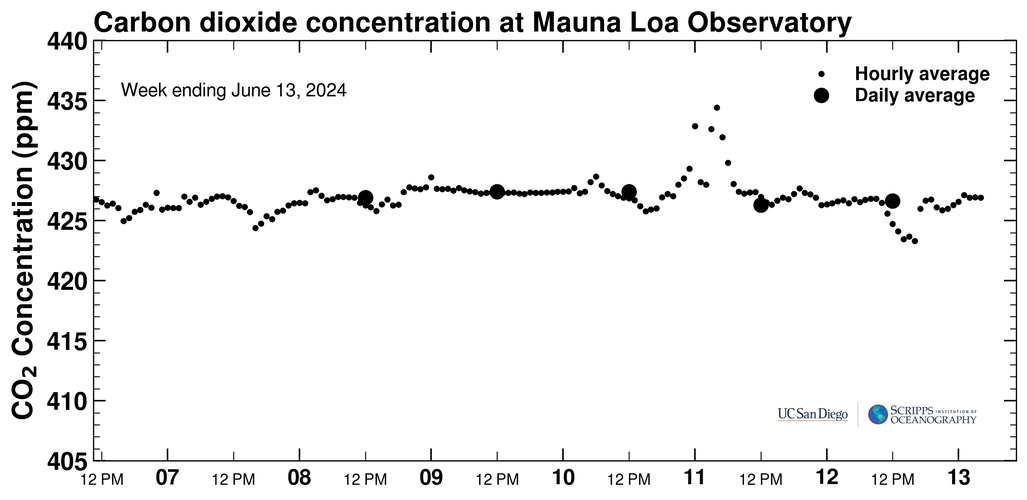
The latest daily average level recorded by Scripps Institution of Oceanography sensors at Mauna Loa, Hawaii, was 399.5 ppm, on Monday. The CO2 level fluctuates throughout the day, and hourly levels in excess of 400 ppm have already been recorded. The level also fluctuates throughout the year, with May being the month when CO2 reaches its highest concentrations.
The big thing to watch for is whether the average for the month of May will exceed 400 ppm.
Check out this graph showing data from the past week:
Scripps Institution of Oceanography
Click to embiggen.
You can follow @Keeling_curve on Twitter to keep up with the latest figures.
“I wish it weren’t true but it looks like the world is going to blow through the 400ppm level without losing a beat. At this pace we’ll hit 450ppm within a few decades,” said Ralph Keeling, a geologist with the Scripps Institution of Oceanography …
“Each year, the concentration of CO2 at Mauna Loa rises and falls in a sawtooth fashion, with the next year higher than the year before. The peak of the sawtooth typically comes in May. If CO2 levels don’t top 400ppm in May 2013, they almost certainly will next year,” Keeling said.
Here’s a graph showing that sawtoothed rise, also called the “Keeling Curve,” named for Ralph’s father, Charles Keeling, who began taking measurements at Mauna Loa in 1958:
Scripps Institution of Oceanography
Click to embiggen.
From a statement published by Scripps last week:
Scientists estimate that the last time CO2 was as high as 400 ppm was probably the Pliocene epoch, between 3.2 million and 5 million years ago, when Earth’s climate was much warmer than today. CO2 was around 280 ppm before the Industrial Revolution, when humans first began releasing large amounts of CO2 to the atmosphere by the burning of fossil fuels. By the time [Charles] Keeling began measurements in 1958, CO2 had already risen from 280 to 316 ppm. The rate of rise of CO2 over the past century is unprecedented; there is no known period in geologic history when such high rates have been found. The continuous rise is a direct consequence of society’s heavy reliance on fossil fuels for energy.
From another Guardian article:
Climate scientists have long maintained that concentrations need to be kept below 350ppm if the world is to stand a reasonable chance of meeting international targets to keep average temperature increases below 2C, while concentrations of above 400ppm put the planet on track for levels of warming deemed ‘dangerous’ by the international community.
Hence that whole 350.org thing.
Carbon dioxide levels of 400 ppm in the atmosphere aren’t much more threatening than levels of 399 ppm. But the zeros focus the mind (and the media) on an extremely dangerous trend: Failure to act on climate change has pushed the world into yet another new danger zone.
John Upton is a science aficionado and green news junkie who
, posts articles to
, and
. He welcomes reader questions, tips, and incoherent rants:
.
Find this article interesting? Donate now to support our work.Read more: Climate & Energy
Also in Grist
Please enable JavaScript to see recommended stories
Read this article: