Tag Archives: Scientists

We can harvest methane from cow guts. Should we?

We can harvest methane from cow guts. Should we?

Shutterstock

Cows’ weird digestive systems, including four stomach compartments and the eternal chewing of cud, help them get the most out of their grassy diets — but it also produces a lot of methane. Controlling the methane is not easy once it gets burped or farted out of a cow’s digestive system. (Just ask the German farmers whose barn was recently blown up by a buildup of the gas.)

But now scientists have come up with a way of harvesting the climate-changing methane that they produce: by piping it directly out of their guts.

Cattle are responsible for two-thirds of the greenhouse gas emissions produced by livestock. And livestock are responsible for nearly 15 percent of the world’s greenhouse gas emissions. Cutting down on their methane emissions could help slow global warming.

So Argentinian scientists are punching holes in the sides of cattle and passing pipes through to their stomachs. The other end of the pipe goes into a bag fitted on the cow’s back. The captured gas, which is basically the same natural gas that frackers and other drillers mine out of the ground, can be burned to produce energy. That releases carbon dioxide into the atmosphere instead of the methane, which is a far more potent greenhouse gas.

The scientists have been developing the idea for more than five years, but they have received a burst of publicity following a Reuters article and a BBC report. “We believe that today it could be used in areas where conventional energies are not available,” Guillermo Berra of the National Institute of Agricultural Technology told the British broadcaster, speaking in Spanish. “We could have these animals produce, for example, the gas that you need for a refrigerator. A 100-liter capacity fridge can run … by the gas produced by one cow.”

Worried about how this makes the cows feel? The scientists say it’s harmless; they basically use body piercing technology. For cows that are increasingly being subjected to gruesome factory farming conditions, it would seem to be just one more inconvenience in an already brutal existence.


Source
Scientists harness cows’ ‘burp-power’ as alternative energy, BBC

John Upton is a science fan and green news boffin who tweets, posts articles to Facebook, and blogs about ecology. He welcomes reader questions, tips, and incoherent rants: johnupton@gmail.com.

Find this article interesting? Donate now to support our work.Read more: Climate & Energy

,

Food

View this article: 

We can harvest methane from cow guts. Should we?

Posted in alternative energy, Anchor, FF, GE, LAI, LG, ONA, organic, Uncategorized | Tagged , , , , , , , , , , | Comments Off on We can harvest methane from cow guts. Should we?

Stick it to ‘em: Scientists call for labeling tar-sands oil

Stick it to ‘em: Scientists call for labeling tar-sands oil

Shutterstock

Let’s slap some labels on these puppies.

For the past four years, European Union officials have been mulling a labeling system that would require fuel companies to tell their customers how much carbon pollution is produced by each of the products they sell.

The idea is deeply unpopular with oil companies, which don’t want their customers thinking about such things every time they fill up their tanks. It’s also deeply unpopular with Canada. That’s because the country’s tar-sands oil is particularly dreadful for the climate, something the government would rather not have advertised. The oil companies and Canadian government have called the labeling idea unscientific.

But the idea is popular with an independent group of experts — experts who are better qualified to determine whether or not something is “scientific.” Those would be scientists.

Reuters reports that 53 scientists from such universities as Harvard, Stanford, and Columbia, as well as from European institutions, sent a letter urging the president of the European Commission “to press ahead with a plan to label tar sands as more polluting than other forms of oil, in defiance of intensive lobbying” from the Canadian government:

They say the EU draft law, which would label fuels according to how much carbon they emit over their entire wells-to-wheels lifecycle, is scientifically sound, after criticism from the oil industry that it is not.

In the letter dated December 16, they say the policy would ensure investment in cleaner fuels and for the first time hold the oil industry accountable for carbon emitted during production of the fuels they sell in Europe.

“We live in an era during which it has become clear that we cannot burn all of the fossil fuels without causing dangerous climate change,” the letter, seen by Reuters, said.

U.S. lawmakers — listen up!


Source
Scientists urge EU action on tar sands – letter, Reuters

John Upton is a science fan and green news boffin who tweets, posts articles to Facebook, and blogs about ecology. He welcomes reader questions, tips, and incoherent rants: johnupton@gmail.com.

Find this article interesting? Donate now to support our work.Read more: Business & Technology

,

Climate & Energy

,

Politics

Source article: 

Stick it to ‘em: Scientists call for labeling tar-sands oil

Posted in ALPHA, Anchor, FF, G & F, GE, LG, ONA, Uncategorized | Tagged , , , , , , , , , , , | Comments Off on Stick it to ‘em: Scientists call for labeling tar-sands oil

The Big Sur Fire is Just The Latest Sign of Longer Fire Seasons

Mother Jones

<!DOCTYPE html PUBLIC “-//W3C//DTD HTML 4.0 Transitional//EN” “http://www.w3.org/TR/REC-html40/loose.dtd”>

The fire currently burning in Pfeiffer Big Sur State Park, Calif., isn’t particularly large: As of the latest Forest Service report, it has burned 769 acres and is 20 percent contained.

Nor is it particularly damaging: So far, 22 buildings or structures have been destroyed by the fire. (One was the fire chief’s home.) Compare that with the 2003 Cedar Fire in San Diego county, which destroyed 2,820 structures.

However, it is markedly unseasonal: The California wildfire season was pronounced over on October 31, 2013. But of course, it isn’t over.

In general, western wildfire seasons are getting longer. Thomas Tidwell, chief of the US Forest Service, said so directly in recent congressional testimony, noting that “the length of the fire season has increased by over two months since the 1970s.”

And of course, it doesn’t help that the Big Sur area is currently experiencing drought conditions.

It is also worth pointing out that for the state of California, seven of its 10 largest fires have occurred since the year 2000, including this year’s Rim Fire, the third largest in state history.

Here’s a helpful infographic from the Union of Concerned Scientists, showing just how much fire seasons are lengthening:

Union of Concerned Scientists

And here’s a Climate Desk video on how global warming is making wildfires worse:

Source:

The Big Sur Fire is Just The Latest Sign of Longer Fire Seasons

Posted in FF, GE, LG, ONA, Uncategorized, Venta | Tagged , , , , , , , , , | Comments Off on The Big Sur Fire is Just The Latest Sign of Longer Fire Seasons

Antarctica’s permafrost is melting

Antarctica’s permafrost is melting

NASA’s Marshall Space Flight Center

Antarctica.

Things are getting ugly on Earth’s underside.

Antarctic permafrost, which had been weathering global warming far better than areas around the North Pole, is starting to give way. Scientists have recorded some of it melting at rates that are nearly comparable to those in the Arctic.

Scientists used time-lapse photography and LiDAR to track the retreat of an Antarctic ice cliff over a little more than a decade. They reported Wednesday in the journal Scientific Reports that the cliff was “backwasting rapidly.” The permafrost that made up the cliff was found to be disappearing nearly 10 times more quickly than was the case during recent geological history. And the rate of melting is picking up pace. From the Los Angeles Times:

Cliff-face measurements of the buried ice in the four-mile-long Garwood Valley revealed melt rates that shifted from a creeping annual rate of about 40,000 cubic feet per year over six milleniums, to more than 402,000 cubic feet last year alone. … (That’s a leap from the capacity of about eight standard railroad boxcars to 77.)

The scientists also monitored the weather at the cliff and found that rising air temperatures were not to blame for the melt. Rather, they think it was caused by growing amounts of dark debris on the surface of the ice and snow that absorbed the sun’s rays.

How did the debris get there? During sudden bursts of warmth brought to the area by strong winds from other regions, ice expanded and cracked and sometimes broke up, throwing the dark debris up to the surface.

Scientific Reports

Monitoring equipment placed in front of the cliff.

If temperatures in the valley eventually start to rise, as expected with global warming, then things could get really watery. From the L.A. Times again:

[The scientists] found that changing patterns of soil erosion altered the amount of solar radiation absorbed in the area, known as the albedo effect, adding about two watts of energy per square meter. (That’s about the power of a candle style lightbulb radiating on less than a third of a sheet of plywood.)

“It doesn’t sound like much to crank up two watts at a time but when you add this up over the last several decades, it’s enough to tip the balance in Garwood from having buried ice in equilibrium to having accelerated melting,” [said geologist Joseph Levy, lead author of the study]. “It’s serious because when you think about permafrost thaw in the Arctic and Antarctic peninsula, usually people think about air temperature. But the dry valley has been in a cooling trend that started about 20 years ago.”

Adding a small rise in temperature, as predicted by climate models, would cause a wide swath of the valley to melt, Levy warned. …

That type of accelerated melt could become typical at the fringes of much larger areas, such as Antarctica’s ice sheets and the land ice in Greenland. Unlike the dry valley thaw, those melts would contribute significantly to rising sea levels.

The scientists reported on the results of studies of just one Antarctic ice cliff, but their findings suggest that similar frozen features across swaths of the southern continent are also vulnerable. “Garwood Valley ice cliff recession may be a leading indicator of more widespread landscape change,” they wrote in the paper. Such changes could “transform low elevation and coastal Antarctic landscapes by the close of the century.”

John Upton is a science fan and green news boffin who tweets, posts articles to Facebook, and blogs about ecology. He welcomes reader questions, tips, and incoherent rants: johnupton@gmail.com.

Find this article interesting? Donate now to support our work.Read more: Climate & Energy

Also in Grist

Please enable JavaScript to see recommended stories

View original article – 

Antarctica’s permafrost is melting

Posted in alo, Anchor, Dolphin, FF, G & F, GE, LG, ONA, solar, solar power, Uncategorized | Tagged , , , , , , , , | Comments Off on Antarctica’s permafrost is melting

Climate Change Slowdown is Due to Warming of Deep Oceans, Say Scientists

Climate sceptics have seized on a pause in warming over the past five years, but the long-term trend is still upwards. Redeo/Flickr A recent slowdown in the upward march of global temperatures is likely to be the result of the slow warming of the deep oceans, British scientists said on Monday. Oceans are some of the Earth’s biggest absorbers of heat, which can be seen in effects such as sea level rises, caused by the expansion of large bodies of water as they warm. The absorption goes on over long periods, as heat from the surface is gradually circulated to the lower reaches of the seas. Temperatures around the world have been broadly static over the past five years, though they were still significantly above historic norms, and the years from 2000 to 2012 comprise most of the 14 hottest years ever recorded. The scientists said the evidence still clearly pointed to a continuation of global warming in the coming decades as greenhouse gases in the atmosphere contribute to climate change. To keep reading, click here. This article – Climate Change Slowdown is Due to Warming of Deep Oceans, Say Scientists Related Articles The Alberta Oil Sands Have Been Leaking for 9 Weeks CIA Backs $630,000 Scientific Study on Controlling Global Climate Reach for the Sun

Follow this link: 

Climate Change Slowdown is Due to Warming of Deep Oceans, Say Scientists

Posted in ATTRA, eco-friendly, FF, G & F, GE, Monterey, ONA, PUR, solar, solar power, Uncategorized | Tagged , , , , , , , , | Comments Off on Climate Change Slowdown is Due to Warming of Deep Oceans, Say Scientists

Climate change could be leading to more El Ninos

Climate change could be leading to more El Ninos

Shutterstock

Peruvian fishermen came up with the name El Niño, Spanish for “Christ child,” because it normally arrived around Christmas.

El Niño is one of Earth’s most influential climatic phenomena. Its occasional arrival, heralded by warming in parts of the eastern Pacific Ocean, can be a harbinger of floods in Peru, droughts in Australia, harsh winters in Europe, and hurricanes in the Caribbean. Yet we know precious little about it.

But this week, two separate scientific studies chipped away at the mystery.

One study reveals that the El Niño phenomenon has been occurring more frequently as the globe has warmed. The other paper promises to dramatically improve our ability to foretell the weather pattern’s arrival.

A team of scientists reported Tuesday in the journal Nature Climate Change on the increased frequency of El Niños over the past half century. From The Christian Science Monitor:

Scientists compiled some 2,222 tree-ring chronologies of the past seven centuries from both the mid-latitudes in both hemispheres and the tropics. Tree rings can provide an accurate record of historical climate pattern, packing in their width and color information about the precipitation, wind, and temperature conditions at the time at which the tree was growing.

Scientists found that the tree ring patterns in the 20th century suggested that El Niño had been more active then than during the last seven centuries, meaning that long-term El Niño patterns have dovetailed with the global warming that characterized that century.

“This suggests that many models underestimate the sensitivity to radiative perturbations in greenhouse gases,” said Shang-Ping Xie, co-author and meteorology professor at the International Pacific Research Center. “Our results now provide a guide to improve the accuracy of climate models and their projections of future [El Niño–Southern Oscillation] activity.”

“If this trend of increasing ENSO activity continues, we expect to see more weather extremes such as floods and droughts,” she said.

A study by a separate team published Monday in Proceedings of the National Academy of Sciences proposes a new method for predicting El Niño’s arrival. That could be especially useful for farmers who want to know which varieties of crops they should plant each year. From the Australian Broadcasting Corporation:

The forecasting algorithm is based on the interactions between sea surface temperatures in the equatorial Pacific and the rest of the ocean, and appears to warn of an El Nino event one year in advance instead of the current six months.

The German scientists analysed more than 200 measurement points in the Pacific dating back to the 1950s. The interactions between distant points helped predict whether the El Niño warming would come about in the eastern equatorial Pacific.

They used the model in 2011 to correctly predict the absence of an El Niño event last year, while conventional forecasts wrongly said there would be significant warming well into 2012.

Too good to be true? Time will tell. From the same news report:

“At the moment they’ve found a pattern, but they’re not really explaining where that pattern comes from,” [Alex Sen Gupta, senior lecturer at the Climate Change Research Centre at the University of New South Wales,] says.

He says the model needs to be tested further against standard models to assess if the findings are physically based, not just a correlation.

“I think give it another two or three El Niños and if it predicts those correctly more than a year in advance you’d start to think we’re on to something.”

Aw, c’mon Mr. Science Man — do we really have to wait that long? Oh well, at least those two or three more El Niños can be expected to come more quickly than they used to.

John Upton is a science fan and green news boffin who tweets, posts articles to Facebook, and blogs about ecology. He welcomes reader questions, tips, and incoherent rants: johnupton@gmail.com.

Find this article interesting? Donate now to support our work.Read more: Climate & Energy

Also in Grist

Please enable JavaScript to see recommended stories

Taken from:

Climate change could be leading to more El Ninos

Posted in Anchor, FF, G & F, GE, LG, ONA, Uncategorized, wind energy | Tagged , , , , , , , , , , , | Comments Off on Climate change could be leading to more El Ninos

A Friendly Reminder From Pretty Much Every Climate Scientist in the World: Climate Change Is Real

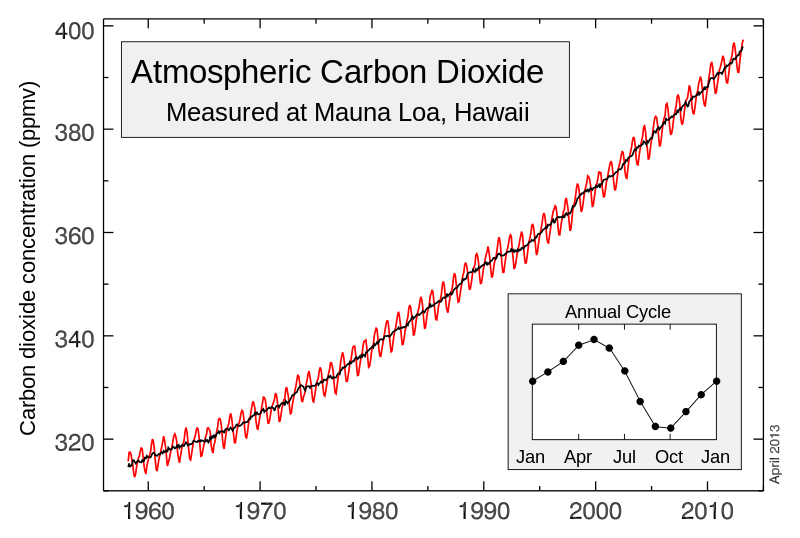
For the first time in human history the atmospheric concentration of carbon dioxide has reached 400 parts per million. Photo: Mauna Loa Observatory

There’s an interesting relationship, borne out in polling numbers, between the “general public’s” belief in global climate change and the weather. When it’s hot out, people believe in climate change. When it’s cold, they don’t.  When summer heat and drought and wildfires tore through the U.S. last summer, 74 percent of Americans believed that climate change was affecting the weather. Only 46 percent of Americans think that this climate change is caused by human activities – most directly the burning of fossil fuels.

The numbers are a little different when it is climate scientists, and the scientific research conducted on climate change, that are polled.

Writing in the GuardianDana Nuccitelli and John Abraham describe a new study that polled the recent research to see what scientists thought of climate change. (Nuccitelli is one of the voices behind the website Skeptical Science and one of the authors of the new scientific study.) They found that the vast, overwhelming majority of climate scientists agree that humans are causing climate change.

The team searched a database of scientific studies for the words “global climate change” or “global warming.” They found 11,944 relevant studies published between 1991 and 2012. Then, they read through the study’s summaries to figure out whether the study supported, rejected, was uncertain about or said nothing at all about our role in causing climate change. They also asked the scientists behind the papers whether their research supported or refuted the idea of man-made global warming.

Of the studies that expressed some sort of position on global warming, of which there were 4,000, the team write in their paper, “97.1% endorsed the consensus position that humans are causing global warming.” When the climate scientists themselves said whether or not their work supported the idea of anthropogenic climate change, “97.2% endorsed the consensus.”

For the papers that didn’t seem to have an opinion on whether humans were causing climate change, the reason, they write, is not that the scientists don’t know. Rather, it’s that the debate is so fully and completely settled within the scientific community that they aren’t going to use space re-hashing old fights.

Some people may mention that the scientific community is conflicted over the cause of climate change. This new survey would like to remind that that is not true.

More from Smithsonian.com:

Three Quarters of Americans Now Believe Climate Change Is Affecting the Weather
We’re About to Pass a Disheartening New Climate Change Milestone

Visit source:

A Friendly Reminder From Pretty Much Every Climate Scientist in the World: Climate Change Is Real

Posted in FF, GE, global climate change, Uncategorized | Tagged , , , , , , , | Comments Off on A Friendly Reminder From Pretty Much Every Climate Scientist in the World: Climate Change Is Real