Tag Archives: texas

Ted Cruz Says the GOP Lost in 2012 Because of Two Words: "47 Percent"

Mother Jones

<!DOCTYPE html PUBLIC “-//W3C//DTD HTML 4.0 Transitional//EN” “http://www.w3.org/TR/REC-html40/loose.dtd”>

On Sunday night, Senator Ted Cruz (R-Texas) appeared with Rand Paul and Marco Rubio, his Senate colleagues and fellow presidential hopefuls, at the Koch brothers’ winter donor retreat, and he offered a two-word post-mortem for the GOP’s drubbing in the 2012 elections: 47 percent.

Cruz was referring, of course, to Mitt Romney’s infamous remarks, secretly caught on tape during a private campaign fundraiser, in which he dismissed 47 percent of Americans (“who will vote for this president no matter what”) as freeloaders “who are dependent on government” and who refuse to take responsibility for their lives.

According to Cruz, who was one of four presidential aspirants to appear before some 300 well-heeled donors at this weekend’s Koch retreat (Wisconsin Gov. Scott Walker was the fourth, though he did not join Sunday’s panel), the GOP’s 47-percent problem is bigger than Romney’s comments. It’s a party-wide problem. But Cruz noted that he had a fix in time for the 2016 election.

Here’s what Cruz told panel moderator Jonathan Karl of ABC News:

Of course we have a problem with income inequality. And I have to say I chuckle every time I hear Barack Obama or Hillary Clinton talk about income inequality. Because it’s increased dramatically under their policies.

Now, if you look at the last election, I think in 2012 the reason Republicans lost can be summed up in two words: 47 percent. And I don’t just mean Mitt Romney’s comment that was caught on tape—that the 47 percent of Americans who are not currently paying taxes, who are in some ways dependent on government, we don’t have to worry about them. I don’t just mean that comment. I think Mitt is a good and decent and honorable man; I think he ran a very hard campaign.

But the central narrative of the last election, what the voters heard, was we don’t have to worry about the 47 percent. And I think Republicans are and should be the party of the 47 percent.

That is, the GOP should be the party of the bottom half.

Cruz did not go into great detail about how the Republicans could assist and appeal to the 47 percent. But he did accuse Obama administration officials of using their clout to get “fat and happy,” slamming Washington as rife with crony capitalism and claiming its denizens are fixated on self-enrichment at the expense of everyone else. “I think we need to move back to a dynamic where you have Schumpeter’s creative destruction, where you have small businesses that are creating opportunities,” he said. Cruz’s reference to Joseph Schumpeter, the Austrian economist beloved by libertarians and conservatives, was sure to delight at least one audience member: Charles Koch, a longtime fan of Schumpeter’s. Cruz added, “We should be fighting for the little guy who has dreams and hopes and desires.”

Link: 

Ted Cruz Says the GOP Lost in 2012 Because of Two Words: "47 Percent"

Posted in alo, Anchor, Everyone, FF, GE, LAI, LG, ONA, Radius, Uncategorized, Venta | Tagged , , , , , , , , , , | Comments Off on Ted Cruz Says the GOP Lost in 2012 Because of Two Words: "47 Percent"

Mitt Romney Has a Koch Problem

Mother Jones

<!DOCTYPE html PUBLIC “-//W3C//DTD HTML 4.0 Transitional//EN” “http://www.w3.org/TR/REC-html40/loose.dtd”>

This weekend, a select group of Republican presidential hopefuls will arrive in southern California to attend one of Charles and David Koch’s biannual donor retreats, a coveted invite for GOP politicians seeking the backing of the billionaire brothers and their elite club of conservative and libertarian mega-donors. Featured guests at the conclave will include Sens. Marco Rubio (R-Fla.), Rand Paul (R-Ky.), and Ted Cruz (R-Texas) and Wisconsin Gov. Scott Walker. Former Florida Gov. Jeb Bush was also invited to the confab but is unlikely to attend.

Notably absent from the guest list for the Koch winter seminar: Mitt Romney.

Romney recently barged his way back into the political fray, suggesting he might launch a third presidential bid. He told a group of donors earlier this month, “Everybody in here can go tell your friends that I’m considering a run.” In a presentation over the weekend at a resort near Palm Springs, California—as it happens, the same venue that has played host to previous Koch seminars—Romney delivered what sounded an awful lot like a presidential stump speech, talking about poverty (“I believe that the principles of conservatism are the best to help people get out of poverty”), education (“We have great teachers. I’d pay them more”), and even climate change.

Continue Reading »

Original source:  

Mitt Romney Has a Koch Problem

Posted in alo, Anchor, FF, GE, LG, ONA, Radius, Uncategorized, Venta | Tagged , , , , , , , , | Comments Off on Mitt Romney Has a Koch Problem

Governor-Elect Laments the Californication of Texas

Mother Jones

<!DOCTYPE html PUBLIC “-//W3C//DTD HTML 4.0 Transitional//EN” “http://www.w3.org/TR/REC-html40/loose.dtd”>

Local fracking bans. Laws outlawing plastic bags. Strict tree-cutting ordinances. Another day in California? Nope. Welcome to life in urban Texas, where Democratic-controlled city councils are enacting powerful consumer and environmental protections—much to the chagrin of the state’s leading conservatives. “Texas is being California-ized, and you might not even be noticing it,” Gov.-elect Greg Abbott complained last week at a meeting of the conservative Texas Public Policy Foundation. “We’re forming a patchwork quilt of bans and rules and regulations that is eroding the Texas model.”

This, he added, is a nasty “form of collectivism” that could “turn the Texas miracle into the California nightmare.”

Though California has long been a conservative bête noire, Abbott’s comments highlight a rising fear among Texas Republicans. More than half of all Texans now live in 10 large urban counties that are growing much faster than the state as a whole. Their voters tend to be more liberal than other Texans, a trend that’s accelerating as minorities, young people, and out-of-staters settle there, lured by cosmopolitan neighborhoods and good jobs. According to a 2012 analysis by the Houston Chronicle and San Antonio Express-News, 70 percent of Democratic gains in Texas since 2000 have come from the four counties that encompass Dallas, Houston, San Antonio, and Austin. All of them voted for Barack Obama in 2012.

In a state known for caring more about hot-button social issues than consumer or environmental protections, it should come as no surprise that urbanites would turn to their city councils to tackle quality-of-life issues the state prefers to ignore. The fracking ban enacted this November in Denton, a college town near Dallas in the gas-rich Barnett Shale formation, is a case in point: It might have never passed had residents felt the state was doing enough to protect them. “It says the industry can’t come in and do whatever they want to do to people,” Cathy McMullen, the head of the Denton Drilling Awareness Group, told the Washington Post. “They can’t drill a well 300 feet from a park anymore. They can’t flare 200 feet from a child’s bedroom anymore.”

Last week, the governor-elect went on to suggest that the Legislature should crush such liberal local regulations. “My vision,” Abbot said, “is one where individual liberties are not bound by city limit signs.”

But critics quickly accused him of hypocrisy. “It’s disappointing to hear the governor-elect wants to overrule the will of city voters on a range of issues,” Bennett Sandlin, the executive director of the Texas Municipal League, which represents city governments, said in a press release. “It amounts to the same kind of governmental overreach at the state level that he opposes when it comes from Washington.”

That the new governor has so quickly backed himself into a rhetorical corner may reflect his party’s increasingly cramped political circumstances. Demographic trends strongly suggest that Texas will turn blue. The state GOP, sandwiched in between the big federal government and a lot of pesky little local ones, almost seems to be defending the political equivalent of the Alamo.

Almost, but not quite: The Alamo is in San Antonio, now a stronghold of Democrats.

Read the article:

Governor-Elect Laments the Californication of Texas

Posted in Anchor, FF, GE, LAI, LG, Mop, ONA, PUR, Radius, Uncategorized, Venta | Tagged , , , , , , , , , | Comments Off on Governor-Elect Laments the Californication of Texas

How much fracking is happening in the Gulf of Mexico?

How much fracking is happening in the Gulf of Mexico?

By on 10 Jan 2015commentsShare

We don’t know nearly enough about the fracking that’s already going on in the U.S. — that’s the point of two lawsuits filed this past week by environmental advocates against the federal government.

In the first suit, an environmental group is suing the feds to get more information about hydraulic fracturing happening off U.S. coastlines, an increasingly common practice that hasn’t yet sparked the same public debate that fracking on land has. In the second, a coalition of nine groups is suing the EPA to force companies to release information about toxic chemicals used in the fracking process.

Fracking allows drillers to get at hard-to-reach oilfields that weren’t readily accessible before, especially offshore. Many underwater areas that were considered tapped out are now looking potentially profitable once again. The Gulf of Mexico appears especially lucrative — Heather Smith wrote recently for Grist that drillers are viewing it as a “giant, underwater piggybank.”

But, as this gold rush begins, environmentalists are pointing out that we know very little about the risks involved with projects like these. And, in the past, when we’ve lacked knowledge about the dangers of risky offshore drilling operations, bad things have happened. (See: Deepwater Horizon.)

Thus the lawsuit, filed by the Center for Biological Diversity. By compelling the Bureau of Ocean Energy Management and the Bureau of Safety and Environmental Enforcement to disclose permits, documents, and emails related to the approval of drilling operations, the Center hopes to learn the extent of the practice. “We’re trying to untangle the web of secrecy that surrounds offshore fracking in the Gulf of Mexico,” said Kristen Monsell, an attorney with the Center. “We know it’s happening and know the government is approving it — the public ought to know how much and how often.” There are at least 115 fracking wells already operating in the Gulf at depths ranging from 18 to 8,843 feet, but government agencies haven’t yet complied with advocates’ open-records requests seeking more information.

In a separate suit, nine environmental groups are demanding that oil and gas companies be required to report the toxic chemicals they use to the Toxics Release Inventory, just as other industries, including coal mines and electric utilities, have to do. “The Toxics Release Inventory requires just one thing: annual reporting to the public,” said Adam Kron, an attorney for the Environmental Integrity Project, one of the groups that brought the suit. “This reporting is critical to health, community planning, and informed decision making.”

“What we are asking for is actually very simple: treat fracking just like every other industrial operation that releases air and water pollution,” said Zac Trahan, program director with Texas Campaign for the Environment, another of the groups behind the suit. “[F]racking is currently given special exceptions to get around our nation’s most important environmental laws. If oil and gas drilling and extraction is as safe as industry lobbyists say it is, they should be able to follow the same rules every other industry already does.”

Share

Please

enable JavaScript

to view the comments.

Find this article interesting?

Donate now to support our work.

sponsored post

In 2015, make a New Year’s resolution that will actually change the world

How the power of positive energy turns you into a climate superhero.

Get stories like this in your inbox

AdvertisementAdvertisement

Jump to original: 

How much fracking is happening in the Gulf of Mexico?

Posted in Anchor, FF, GE, LAI, LG, ONA, Uncategorized | Tagged , , , , , , , | Comments Off on How much fracking is happening in the Gulf of Mexico?

Nebraska Supreme Court clears the way for a Keystone decision

Nebraska Supreme Court clears the way for a Keystone decision

By on 9 Jan 2015 11:06 amcommentsShare

President Obama recently cited a pending court case in Nebraska as a reason for delaying his final decision on whether to approve the Keystone XL pipeline. The court has now ruled in the case, so that excuse for inaction is gone.

From The New York Times:

The Nebraska Supreme Court on Friday cleared the way for the Keystone XL pipeline to be built through the state, removing President Obama’s chief reason for delaying a decision on the project.

Gov. Dave Heineman had approved the Keystone project after the pipeline company, TransCanada, proposed a route that avoided Nebraska’s ecologically delicate Sandhills region. In making their decision, the Nebraska justices effectively overturned a lower court’s ruling that had blocked a state law giving the governor the right to approve the pipeline project.

Both opponents and supporters of the proposed pipeline are now calling on Obama to make a damn decision already.

Oil-loving Alaska Sen. Lisa Murkowski (R), new head of the Senate Energy and Natural Resources Committee: “Today’s court decision wipes out President Obama’s last excuse. He’s had six years to approve a project that will increase U.S. energy supplies and create closer ties with our nearest ally and neighbor, and he’s refused to act.”

350.org Executive Director May Boeve: “President Obama is now free to act and reject Keystone XL outright. No matter the route, as long as the pipeline is carrying tar sands oil it is a global warming disaster and fails the President’s climate test.”

More immediately, though, the Nebraska decision puts Secretary of State John Kerry in the hot seat. From Politico:

Friday’s ruling will let the State Department resume its almost-completed review of the Canada-to-Texas oil pipeline, which the department halted in April amid uncertainty about the Nebraska case.

State Department officials have indicated it could still take months for Secretary John Kerry to offer his own judgment on whether building Keystone would be in the interests of the United States.

Meanwhile, the House is gearing up to approve a bill today that would push through Keystone, and the Senate is expected to do the same next week — even though Obama has already threatened to veto the measure.

Share

Please

enable JavaScript

to view the comments.

Find this article interesting?

Donate now to support our work.

sponsored post

In 2015, make a New Year’s resolution that will actually change the world

How the power of positive energy turns you into a climate superhero.

Get stories like this in your inbox

AdvertisementAdvertisement

Read this article – 

Nebraska Supreme Court clears the way for a Keystone decision

Posted in Anchor, FF, GE, LG, ONA, Uncategorized | Tagged , , , , , , , , , , | Comments Off on Nebraska Supreme Court clears the way for a Keystone decision

Leave it to West Virginia to confuse its students about science

Leave it to West Virginia to confuse its students about science

By on 5 Jan 2015commentsShare

The campaign by special interests and right-wing politicians to inject climate skepticism into public school classrooms has gone on for years. In 2014, it hit Texas, Kansas, and Wyoming. Now West Virginia has become the latest science-education battleground.

Members of the state school board were unhappy with the national Next Generation Science Standards, a blueprint for teaching science in schools, even though it had already been watered down on the topic of climate change to the satisfaction of the climate change–denying Heartland Institute.

One board member was concerned about the effect that teaching climate science would have on the coal industry, reports The Charleston Gazette. Another took issue with the science itself: “There was a question in there that said: ‘Ask questions to clarify evidence of the factors that have caused the rise in global temperatures over the past century,’” school board member Wade Linger told the newspaper. “If you have that as a standard, then that presupposes that global temperatures have risen over the past century, and, of course, there’s debate about that.”

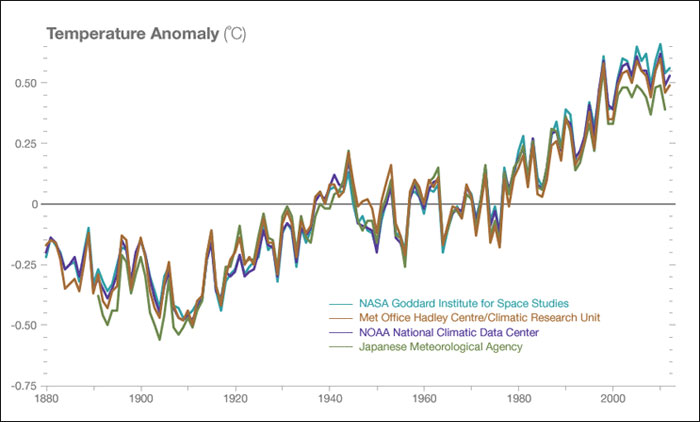
No, there’s not. There’s no question that temperatures have risen over the past century. Any “debate” is over why temperatures have risen — and it’s hardly much of a debate, as 97 percent of climate scientists agree that human activity is the primary cause.

Well so anyway, because the opinions of the world’s scientists are, cumulatively, worth slightly less than those of Mr. Wade Linger, the board made some changes, detailed here by Ryan Quinn of The Charleston Gazette:

The changes, for example, added “and fall” after “rise” to a proposed standard requiring that sixth-graders “ask questions to clarify evidence of the factors that have caused the rise in global temperatures over the past century.”

The other changes West Virginia Department of Education staff members made in response to Linger’s concerns were:

Original ninthgrade science requirement: “Analyze geoscience data and the results from global climate models to make an evidence-based forecast of the current rate of global or regional climate change and associated future impacts to Earth systems.”
Adopted version: “Analyze geoscience data and the predictions made by computer climate models to assess their creditability [sic] for predicting future impacts on the Earth System.”
Original high school elective Environmental Science requirement: “Debate climate changes as it [sic] relates to greenhouse gases, human changes in atmospheric concentrations of greenhouse gases, and relevant laws and treaties.”
Adopted version: “Debate climate changes as it relates to natural forces such as Milankovitch cycles, greenhouse gases, human changes in atmospheric concentrations of greenhouse gases, and relevant laws and treaties.”

Milankovitch cycles are long-term changes in Earth’s orbit around the sun, and some who do not believe in man-made global warming use that theory as the basis of their assertion that the Earth is simply in a natural warming period.

Never a good sign when a newspaper has to insert “sic” more than once into a state’s teaching requirements.

The school board’s break with mainstream science is concerning to education advocates and many parents. One nonprofit, Climate Parents, will petition the school board to throw out its inaccurate changes before they’re implemented in 2016.

Source:
Climate change learning standards for W.Va. students altered

, The Charleston Gazette.

Climate groups oppose changes to W.Va. science standards

, The Charleston Gazette.

Share

Please

enable JavaScript

to view the comments.

Find this article interesting?

Donate now to support our work.

Get stories like this in your inbox

AdvertisementAdvertisement

Source: 

Leave it to West Virginia to confuse its students about science

Posted in Anchor, FF, GE, LG, ONA, Uncategorized | Tagged , , , , , , , , | Comments Off on Leave it to West Virginia to confuse its students about science

There Is No Higher Ed Bubble. Yet.

Mother Jones

Is there a higher-education bubble? Will technology produce cheaper, better alternatives in the near future? Are kids and parents finally figuring out that if Bill Gates can drop out of Harvard and become the richest man in the world, maybe an Ivy League degree isn’t actually worth 50 grand a year? Dan Drezner thinks the whole idea is ridiculous, and he’s willing to put his money where his mouth is:

If, in fact, there really is a higher ed bubble, it should pop before 2020. And if it does pop, then tuition prices for college should plummet as demand slackens. After all, that’s how a bubble works — when it deflates, the price of the asset should plummet in value, like housing in 2008. So who wants to bet me that an average of the 2020 tuition rates at Stanford University, Williams College, Texas A&M and the University of Massachusetts-Lowell will be lower than today?

I’m open to changing the particular schools, but those four are a nice distribution of private and public schools, elite and not-quite-as-elite colleges, with some geographic spread. Surely, true believers in a higher ed bubble would expect tuition rates at those schools to fall.

I really don’t think that will be the case. So anyone who believes in a higher ed bubble should be happy to take the other side of that bet.

Not me. I’d be willing to bet that eventually artificial intelligence will basically wipe out the demand for higher education completely. But “eventually” means something like 30 years minimum, probably more like 40 or 50. Maybe even more if AI continues to be as intractable as some people think it will be.

In the meantime, Drezner is right: the vast, vast majority of college students don’t want to strike out on their own and try to become millionaire entrepreneurs. They just want ordinary jobs. And that’s a good thing, since if everyone wanted to run their own companies, entrepreneurs wouldn’t be able to find anyone to do all the non-CEO scutwork for their brilliant new social media startups.

So if something like 98 percent of college grads are aiming for traditional jobs in which they work for somebody else, guess what? All those somebody elses—which probably includes most of the people who think there’s a higher-ed bubble—are going to want to hire college grads. They sure don’t want to hire a bunch of losers who were too dim to drop out and become millionaires and couldn’t even manage the gumption to accrue 120 units at State U, do they?

Look: the rising cost of higher education has multiple causes, but it’s mostly driven by two simple things. At public schools, it’s driven by declining state funding, which transfers an increasing share of the cost of higher ed onto students. Unfortunately, I see no reason to think this trend won’t continue. At private schools, it’s driven by the perception of how much a private degree is worth—and right now, all the evidence suggests that even with fairly astronomical tuitions at elite and semi-elite universities, the lifetime value of a degree is still worth more than students pay for it. Universities understand this, and since these days they mostly think of themselves not as public trusts, but as businesses who simply charge whatever the traffic will bear, they know they still have plenty of headroom to increase tuition. So this trend is likely to continue as well.

If I had to guess, I’d say that there’s a class of 2nd or 3rd tier liberal arts colleges that might be in trouble. They have high tuitions, but the value of their degree isn’t really superior to that of a state university. They might be in trouble, and if Drezner added one of these places to his list it might make his bet more interesting.

But he’d still win. He might lose by 2040, but he’s safe as long as he sticks to 2020.

Jump to original:

There Is No Higher Ed Bubble. Yet.

Posted in Everyone, FF, GE, LG, ONA, Uncategorized, Venta | Tagged , , , , , , , , , , , | Comments Off on There Is No Higher Ed Bubble. Yet.

Rick Perry Is One Lucky Dude

Mother Jones

<!DOCTYPE html PUBLIC “-//W3C//DTD HTML 4.0 Transitional//EN” “http://www.w3.org/TR/REC-html40/loose.dtd”>

From James Pethokoukis:

The energy sector gives, and the energy sector takes. The stunning drop in oil prices looks like bad news for the “Texas Miracle.” (Texas is responsible for 40% of all US oil production — vs. 25% five years ago — and all of the net US job growth since 2007.) This from JPMorgan economist Michael Feroli: “As we weigh the evidence, we think Texas will, at the least, have a rough 2015 ahead, and is at risk of slipping into a regional recession.”

Man, Rick Perry is one lucky guy, isn’t he? It’s true that the “Texas Miracle” may not be quite the miracle Perry would like us to believe. As the chart below shows in a nutshell, the Texas unemployment rate has fared only slightly better than the average of all its surrounding states.

Still, Texas has certainly had strong absolute job growth. However, this is mostly due to (a) population growth; (b) the shale oil boom; and (c) surprisingly strict mortgage loan regulations combined with loose land use rules, which allowed Texas to escape the worst of the housing bubble. Perry had nothing to do with any of this. And now that oil is collapsing and might bring the miracle to a sudden end, Perry is leaving office and can avoid all blame for what happens next.

One lucky guy indeed.

Original article: 

Rick Perry Is One Lucky Dude

Posted in FF, GE, LG, ONA, Uncategorized, Venta | Tagged , , , , , , , | Comments Off on Rick Perry Is One Lucky Dude

Executions Just Hit a 20-Year Low

Mother Jones

<!DOCTYPE html PUBLIC “-//W3C//DTD HTML 4.0 Transitional//EN” “http://www.w3.org/TR/REC-html40/loose.dtd”>

There’s some encouraging news this week in the usually gloomy realm of criminal justice. According to a new report from the Death Penalty Information Center (DPIC), there were fewer executions this year than in any year since 1994—and fewer new death sentences imposed than any year since 1974. That may be of little comfort to the family of Robert Wayne Holsey, a low-functioning man whose severely alcoholic court-appointed lawyer sealed his ultimate fate—Georgia executed him earlier this month—but the numbers are certainly dwindling. In 2012, states put 43 people to death. In 2013, the number was 39. This year, it’s down to 35.

Perhaps more encouraging for foes of capital punishment: Only 72 new death sentences were imposed this year (a measure the DPIC considers a more accurate indicator of the trend). That’s a 77 percent decline since 1996, as more and more states have offered juries the option of imposing a sentence of life without the possibility of parole.

Death Penalty Information Center

In addition, an increasingly smaller group of states accounts for the majority of executions. Seven states put prisoners to death this year (down from 20 just 15 years ago)‚ but just three of them—Florida, Missouri, and Texas—accounted for 80 percent of all the executions. The number of states that sanction the death penalty may be waning, too. In 2014, the governors of Colorado, Oregon, and Washington all imposed moratoria. And for what it’s worth, 2014 was the first year since 1997 that Texas didn’t lead the country in executions. (It tied with Missouri, at 10 apiece.)

Death Penalty Information Center

Aside from the continued decline in public support for capital punishment—just over half of Americans were for it in 2014, as opposed to nearly two-thirds in 2011—some new factors may have contributed to this year’s numbers. Botched executions in Ohio, Arizona, and Oklahoma shed light on the untested drug cocktails states are now using for lethal injections, after European drugmakers cut off their supplies. Following widespread press coverage of these gruesome execution attempts—some of which appeared to violate the Eighth Amendment’s protection from cruel and unusual punishment—Oklahoma and Ohio halted executions for the rest of the year. (In response to the mishaps, the Justice Department is expected to release a major report next year.)

We’ve also seen increased scrutiny this year of states’ willingness to execute the mentally ill or intellectually disabled. Earlier in the year, the Supreme Court ruled in Hall v. Florida that Florida’s fit-for-execution standard—merely having an IQ exceeding 70 was enough—violated standards of decency. And the case of Scott Panetti, a schizophrenic man that Texas is determined to execute, put that state’s low standards on international display. (A federal court has temporarily stayed Panetti’s execution, a move even prominent conservatives have supported.)

Major battles lie ahead for death penalty opponents. More than 3,000 people are still on death row and 30 executions have been scheduled for 2015. Fourteen states, including some the ones that botched their executions, have pursued legislation that would shroud many aspects of the execution process in secrecy—particularly the details about what’s in their lethal cocktails.

But momentum against the death penalty is strong. “Overall, the decline in the use of the death penalty has been going on for 15 years, and is likely to continue,” explains Richard Dieter, the executive director of the DPIC and an author of the new report. “For the public, the death penalty has already receded as a significant part of the criminal justice process.”

See the article here:

Executions Just Hit a 20-Year Low

Posted in Anchor, FF, GE, LAI, LG, ONA, PUR, Radius, Ultima, Uncategorized, Venta | Tagged , , , , , , , , , | Comments Off on Executions Just Hit a 20-Year Low

Methane is leaking out all over the damn place, thanks to the oil and gas industry

Methane is leaking out all over the damn place, thanks to the oil and gas industry

By on 10 Dec 2014commentsShare

Methane, the second most common greenhouse gas emitted by the U.S., is a scary, scary thing. Thanks to two new studies, we just found out a bit more about how, through drilling for oil and gas, it leaks into the air.

Compared with CO2, methane is frighteningly potent — it’s 86 times more effective at trapping heat than CO2 over a 20-year time period. Even though the EPA estimates that methane is only 9 percent of the greenhouse gas cocktail the U.S. is tossing into the sky, the Environmental Defense Fund estimates that methane is responsible for around 25 percent of the human-made global warming we’re experiencing. The biggest source of methane emissions? The oil and gas industry, of course.

The first new study, put out by Princeton University and published in Proceedings of the National Academy of Sciences, found that millions of unused oil and gas wells across America could be leaking significant amounts of unreported methane. Researchers measured methane leaks from 19 abandoned wells in northwestern Pennsylvania. From a Princeton announcement:

Only one of the wells was on the state’s list of abandoned wells. Some of the wells, which can look like a pipe emerging from the ground, are located in forests and others in people’s yards. [Researcher Mary] Kang said the lack of documentation made it hard to tell when the wells were originally drilled or whether any attempt had been made to plug them.

All of the 19 wells that the researchers looked at were leaking methane. All of them! But three of them were spitting out methane at thousands of times the levels that the others were. From an earlier study conducted by Stanford University, we know that there are around 3 million abandoned wells like the ones Princeton studied scattered across the U.S. That means abandoned wells like these that are just sitting out in the woods, not doing anything for anybody, could be making a notable contribution to climate change. Pennsylvania makes an attempt to plug those wells, but the Department of Environmental Protection, which is tasked with that work, is, predictably, understaffed.

The second study, by the University of Texas at Austin with funding from both the EDF and natural gas companies, found that among those wells that are operating, only a few are responsible for the vast majority of emissions. Around 20 percent of sites researchers looked at were emitting far more than the rest. “To put this in perspective, over the past several decades, 10 percent of the cars on the road have been responsible for the majority of automotive exhaust pollution,” said David Allen, chemical engineering professor at the Cockrell School and principal investigator for the study, which was published in Environmental Science & Technology. With natural gas wells, he said, it appears to be the same situation.

To sum up: Emissions from oil and gas wells — both those that are currently operating and those that have been abandoned — are a major issue that has been going largely unnoticed.

Unfortunately, America doesn’t have a system set up to monitor the wells and determine which are the major emitters. And, even if we did, there’s no standard policy on what to do with methane-leaking wells when we find them. The White House announced back in March that it intended to fill this policy gap with some regulations by the fall of 2014. But the regulations aren’t out yet, and environmental groups are becoming frustrated.

“The last we heard was the same. EPA is expected to decide on whether to issue methane standards this fall,” said Kate Kiely, a spokesperson for the Natural Resources Defense Council, which, along with Clean Air Task Force and the Sierra Club, issued a report showing how the EPA could cut methane leaks from oil and gas drilling in half. But winter’s drawing closer by the day. “The clock for that timeline is ticking, and we’re hopeful they’ll stick to it and release strong standards for reducing this waste.”

Source:
Abandoned Wells Leak Powerful Greenhouse Gas

, ClimateWire via Scientific American.

Methane still belches from USA’s old oil and gas wells

, USA Today.

Share

Please

enable JavaScript

to view the comments.

×

Get stories like this in your inbox

AdvertisementAdvertisement

Original source:

Methane is leaking out all over the damn place, thanks to the oil and gas industry

Posted in alo, Anchor, Everyone, FF, G & F, GE, LG, ONA, Uncategorized | Tagged , , , , , , , , | Comments Off on Methane is leaking out all over the damn place, thanks to the oil and gas industry