Tag Archives: cool finds

Sail-Powered Ships Are Making a Comeback

A c 1835 lithograph of the clipper ship Challenger. Photo: Library of Congress

“Clipper ships were not a specific design, they were a state of mind,” says John Lienhard, an engineer from the University of Houston. “And that state of mind lasted only a decade.”

Bristling with a staggering array of sails and built for speed, clipper ships were the “greyhounds of the sea.” And now, because of rising fuel costs and limits on gas emissions, says Businessweek, clippers—sails and all—may be on their way back.

Rolls-Royce Holdings is best known for producing engines that powered planes from the late Concorde to the current Airbus superjumbo. Now the British propulsion giant is working with partners to develop a modern-day clipper ship, as it bets that regulations curbing air pollution emissions will increase fuel costs for conventional ocean freighters and herald a New Age of Sail.

In the mid-19th century, says Lienhard, soaring prices for cargo shipping made it more profitable for vessels to be swift instead of bulky—a change that drove the temporary reign of clippers.

So masts rose into the sky. Hulls developed a knife-edged bow. And the widest beam was moved over half-way back. Economy and long life were literally thrown to the winds. Ships began to look like they’d sailed out of a child’s dream. They were tall and beautiful. Acres of canvas drove them at 14 knots.

The ships, says the Australian National Maritime Museum, “won the admiration and envy of the world. Hundreds of Yankee clippers, long and lean, with a beautiful shape, and acres of canvas sails roamed the globe carrying passengers and freight.” The end of the high shipping fees in 1855, though, sunset the era of the clippers, says Lienhard.

The origin of the clipper ship can be found in the mindset of the 19th century entrepeneur that was driven by market competition and profit. Profits depended on how quickly a cargo reached the market. This created a demand for fast vessels and a willingness to push the boundaries of design and technology.

Now, those same market forces are pushing shipping technology once more—tying the old to the new in a bid to face new challenges with old ideas.

More from Smithsonian.com:

The Great Tea Race of 1866

Original article:

Sail-Powered Ships Are Making a Comeback

Posted in GE, ONA, Smith's, Uncategorized | Tagged , , , , , , , , , , , | Comments Off on Sail-Powered Ships Are Making a Comeback

The International Cronut Wars Are On

Photo: WynLok

The cronut combines everything that is delicious and unhealthy about both a donut and a croissant. Created a few months back by a New York pastry chef at the Dominique Ansel Bakery, it consists of flaky, buttery croissant dough, folded into a classic donut shape and deep fried, then—as if that weren’t enough—injected with some sort of luscious cream and topped off with icing. Lines of people desperate to try one have formed two hours before the bakery opened.

Obviously, this pastry bonanza could not remain a secret for long. Asia, the Wall Street Journal reports, is already all over it. Bakeries from Hong Kong to Singapore to Japan to the Philippines have already churned out their own versions of the sugar bomb snack—inspiring their own block-long lines of hungry patrons. Some of these shops added a distinctly Asian flare to the scrumptious dessert:

Different bakeries have infused local flavors into their versions. Wildflour Cafe has a dulce de leche option. Banderole, which is already selling hundreds of its croissant doughnuts each day, has green-tea flavored ones and even one with a kawaii, or cute, smiley face on it. The Sweet Spot’s rendition has crushed peanuts, caramel and custard. The end product resembles a mini-doughnut burger with a custard patty.

Even Dunkin Donuts—at least those in Asia—are jumping on the cronut bandwagon. Here’s Quartz:

In South Korea, an adaptation of Ansel’s recipe is now being offered by a global donut and coffee chain, rather than a local baker or domestic pastry chain. A Dunkin Donuts spokesman told Quartz that the chain introduced the “New York Pie Donut” this past weekend. Dunkin Donuts also launched a “Donut Croissant” in Manila a few weeks ago but has no plans to introduce them in the US right now. In South Korea, the pastries are being sold in the high-end Seoul neighborhood of Gangnam, as well as Jamsil and Myungdong.

The original New York creators aren’t feeling too threatened, the Journal reports, given that most of the competition abroad hasn’t sampled the real deal, meaning their version of the cronut is just visual interpretations injected with some imagination. Technically, imitators aren’t allowed to use the name “cronut” since it’s been trademarked by Dominique Ansel, Quartz points out, though China in particular has never given much heed to copyrights. 

More from Smithsonian.com:

Kolaches: The Next Big Thing in Pastries and The Tex-Czech Community Behind Them
Can Starbucks Do for the Croissant What it Did for Coffee? 

View post:

The International Cronut Wars Are On

Posted in FF, GE, ONA, Pines, Smith's, Uncategorized | Tagged , , , , , , , , , | Comments Off on The International Cronut Wars Are On

These Kindergarten Kids Aren’t Just Playing With Colored Blocks—They’re Coding

Photo: Gamaliel Espinoza Macedo

Today’s kids already live in a world where tablets are replacing books, computers are built into  glasses and the internet is set to connect all things. While the specifics of most programming languages may be beyond reach for most children, the fundamental ideas that underlie coding are easily within their grasp, and like learning any other language, picking up coding early means kids are more likely to stick with it and develop advanced skills, says New Scientist.

The unintuitive structure of many programming language isn’t exactly kid-friendly, though. For instance, to teach your computer to say “Hello World!” —a common first lesson in coding— in C++ , you need this confusing packet of squiggly brackets and semi-colons:

#include <iostream.h>

main()

cout << “Hello World!”;
return 0;

If you’re working in JavaScript, a favorite language of the web, it would look more like this:

<script type=”text/javascript”>
<!– to hide script contents from old browsers
document.write(“Hello World!”)
// end hiding contents from old browsers –>
</script>

So researchers have designed colorful, blocky, kid-friendly programming languages, like ScratchJr, that are meant to be easily manipulable by children as young as 4 or 5, says New Scientist:

Unlike typical programming languages, which require users to type in complicated text commands, Scratch uses coloured blocks that are strung together to create lines of code. ScratchJr is similar, only the commands are even simpler. After assembling a rudimentary program, the child clicks a green flag at the beginning of the list of commands to run it.

It may sound very simple, says Marina Bers at Tufts, who co-created ScratchJr, “but it teaches sequencing – the idea that order matters”.

ScratchJr is still in experimental stages, but New Scientist points to other non-coder friendly languages, such as Scratch or Blockly.

Lifehacker and ReadWrite point to a number of programs designed for kids to get into coding, from games to simplified, highly-visual languages.

And, for the non-coders among us who feel like they sort of missed the boat, MIT has the App Inventor, a system for novices to design and build their own Android phone applications. Bsides, whether you want to be a programmer or not, says Quora user Ben Werdmuller von Elgg, doesn’t really matter to whether you should learn some basic coding:

It’s important to understand the difference between “learning to code” and “being a coder”.

I know how to do some math. I am not a mathematician.
I know how to drive. I am not a professional driver.
I know how an engine works. I am not a professional mechanic.
I can cook. I am not a professional chef.
I can unclog a toilet and hook up a sink. I am not a plumber.

In this context, yes, I think everyone should learn to code.

Sure, you can get away without math, but you’re more likely to be ripped off. You can get away without knowing how to drive yourself, but it limits your transport options. You can get away without understanding your car, but you’ll spend a fortune on mechanics (and get ripped off). You can avoid learning how to cook, but you’ll spend more on food, eat worse and probably get fat. If you can’t do basic plumbing, you’re at the mercy of the people who can.

I’ll repeat that again, in the context of computing: if you can’t do basic coding, you’re at the mercy of the people who can.

More from Smithsonian.com:

First Grader Codes Her Own Computer Game

Continue reading here:

These Kindergarten Kids Aren’t Just Playing With Colored Blocks—They’re Coding

Posted in FF, GE, LG, ONA, Smith's, Uncategorized | Tagged , , , , , , , , , , , | Comments Off on These Kindergarten Kids Aren’t Just Playing With Colored Blocks—They’re Coding

NASA Goes All the Way to Saturn, Takes a Stunning Selfie

That little blue dot floating in the black is every single one of us. Photo: NASA/JPL-Caltech/Space Science Institute

Last week we told you to smile wide, because a camera far, far, far away was about to take your portrait. From orbit around the gas giant Saturn, some 898 million miles from Earth, the Cassini space probe turned and took this photo. We’re that tiny blue dot, drifting in the black between Saturn’s rings and the blue smear at the bottom. (This smear, says Carolyn Porco, the head of the imaging team for Cassini, is Saturn’s E ring, a band produced by the geysers of Saturn’s moon Enceladus.)

This photo is just a sneak preview of what’s to come, says NASA. The full Saturn-Earth photo was taken as 33 individual frames, and this is just one of them. But, it’s the one that has Earth.

The snap is only humanity’s third such photo from the outer solar system. Unlike most tourists, NASA doesn’t travel to distant places just to spend the whole time taking photos of itself. One of the earlier snaps was also taken by Cassini, back in 2006. The one before that was by Voyager 1 way back in 1990—the famous Pale Blue Dot.

More from Smithsonian.com:

Smile! A Satellite Around Saturn Is About To Take Your Picture

This article – 

NASA Goes All the Way to Saturn, Takes a Stunning Selfie

Posted in GE, solar, Uncategorized | Tagged , , , , , , , , | Comments Off on NASA Goes All the Way to Saturn, Takes a Stunning Selfie

Honeybee Theft Is on the Rise

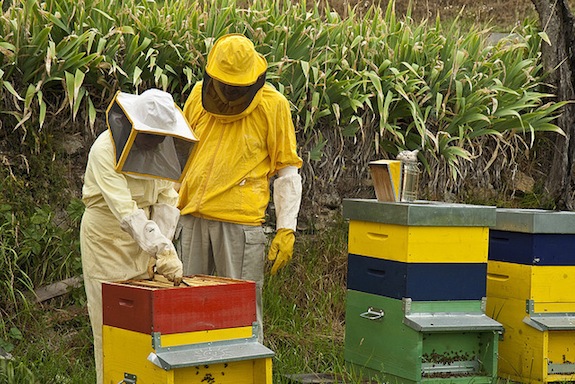
Image: bwohack

Somebody in Ontario is rustling bees. The thieves go into bee hives and steal queens, bee boxes and supplies. So far, in Ontario, there have been a handful of similar robberies, according to the Toronto Star:

In May, in another incident reported to police, a thief in the Goderich area decided to take the honey and run, pilfering seven active beehives worth about $2,100. That same month, Kawartha Lakes police were investigating the theft of eight hives worth about $1,600 from a producer near Lindsay.

The buzz in beekeeping circles is that this spring there was also a robbery near Waterloo, another north of Peterborough and yet another in the Ottawa area, none of which made it into the media.

There are a few problems with tracking stolen beekeeping stuff. First, there’s no way to tag queens as your own. Unlike cattle, bees aren’t branded. So whoever swipes them gets away with a clean bee, untraceable to its original owner. The same goes for honey. People who uproot hive frames have it harder: those are easier to track. But as the Star points out, nobody steals a 180-pound box full of 80,000 bees if they don’t know what they’re doing. One apiarist says it would be like stealing an airplane—it requires a pilot to do it successfully.

On beekeeping forums, apiarists generally agree that whoever is stealing is probably a professional beekeeper, not a hobbyist. Times have been tough on the beekeeping industry—and when times are tough some turn to the dark side. The commercial beekeeping world saw a 43 percent mortality rate in its bees last year. One apiarist in Ontario lost 37 million bees.

Ontario isn’t the only place to see bee theft, either. Last year, a 500-pound beehive was stolen from outside a Houston restaurant. In 2010, as colony collapse disorder was starting to seriously make its presence known, there was an 85 percent increase in beehive thefts in Germany. The California State Beekeepers Association has a $10,000 be Theft Reward Program in place.

Some beekeepers are working towards making tiny trackers for bees to locate them when they are stolen, but there’s no “find my queen” app just yet.

More from Smithsonian.com:

French Bees Are Making M&M-Contaminated Blue And Green Honey
Honey Bees Still Struggling

More: 

Honeybee Theft Is on the Rise

Posted in FF, GE, ONA, Uncategorized | Tagged , , , , , , , | Comments Off on Honeybee Theft Is on the Rise

This Pink Snow Is Not What You Think it Is

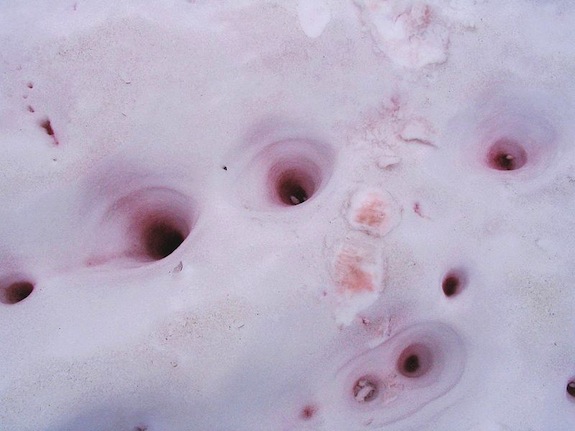
You know you’re not supposed to eat the yellow snow, but what about this pink stuff?

Image: Will Beback

At Scientific American, Jennifer Frazer tells of stumbling upon pink snow in Colorado a few years ago. But she’s far from the first person to find this curious pink stuff in the powder. Captain John Ross’s 1818 expedition through the Northwest Passage also found pink snow and thought it was iron-nickel meteorite detritus. His weird discovery even made the London Times:

Sir John Ross did not see any red snow fall; but he saw large tracts overspread with it. The colour of the fields of snow was not uniform; but, on the contrary, there were patches or streaks more or less red, and of various depths of tint. The liquor, or dissolved snow, is of so dark a red as to resemble red port wine.

But it wasn’t iron-nickel meteorite. It was actually an algae. Frazer explains:

If there’s one thing Earth has taught us, it’s that if a surface or substrate is ever wet, something will grow. And, despite near-zero temperatures, acidity, solar irradiation, and what must be frankly admitted to be minimal nutritional value, snow is no exception. Over 60 species of algae alone dwell there, and no doubt more await discovery. Scientists just announced this May the discovery of a new species from Colorado snow that they suggest could be a source of biofuel feedstock for northern climates where other algae cannot thrive.

This algae in particular, named Chlamydormonas nivalis, is actually the most common of the snow alga, Frazer writes. Frazer explains in her post how it moves about in the snow and why it’s red. 

The phenomenon is commonly known as watermelon snow, red snow or blood snow. The nickname “watermelon snow” comes not only from the pink color, but it is said to smell slightly sweet, a bit like watermelon. Walking on this pink snow can stain your boots. Wayne’s World, an online textbook of natural history, writes that to really understand and appreciate the algae, you have to see it up close:

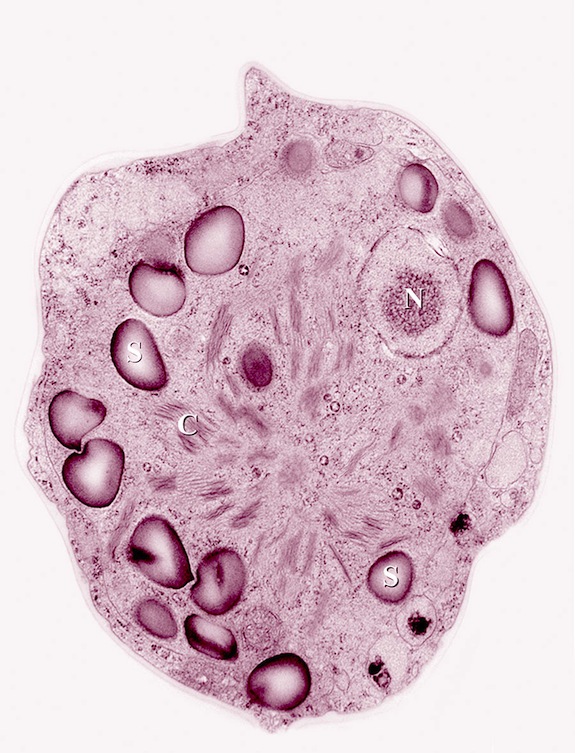
Through a microscope a drop of melted snow contains literally thousands of brilliant red cells of Chlamydomonas nivalis that resemble globular hard candies. Critical focusing reveals a thickened wall with a warty or minutely bumpy ornamentation.

Here’s what the little cells look like up close:

Image: USDA

But can you eat it? SummitPost.org says that you probably can, but might not want to:

In general, most algae is considered edible. Even the faint watermelon-like scent of snow algae might give that impression. The author of this SummitPost article has even tasted very small doses of snow algae, for testing purposes, without feeling sick. However, it is possible that snow algae might be contaminated by bacteria and toxic algae that are harmful to humans. Eating large quantities of watermelon snow has been known to cause digestive ailments, although the tolerance level of each person’s digestive system might be different.

More from Smithsonian.com:

Eating Snow
Sugar on Snow

Link to original: 

This Pink Snow Is Not What You Think it Is

Posted in alo, FF, GE, LG, ONA, PUR, solar, Uncategorized | Tagged , , , , , , , , | Comments Off on This Pink Snow Is Not What You Think it Is

Dogs Have Terrible Eyesight: See for Yourself

“Waterloo” by C. M. Coolidge. Photo: Wikimedia Commons

Sorry, C. M. Coolidge, but man’s best friend would probably really suck at poker. For one, dogs can’t see red. Two, their vision is so awful that they’d probably have trouble even making out the numbers.

See for yourself: WolframAlpha, every nerd’s favorite search engine, has a web app that lets you look at life through a dogs’ eyes.

See what we mean? Photo: WolframAlpha

Where people have three specialized receptors in our eyes to distinguish colors, dogs only have two: this leaves them red-green color blind (we think). Life’s Little Mysteries:

To see blue and yellow, dogs and humans alike rely on neurons inside the eye’s retina. These neurons are excited in response to yellow light detected in the cone cells (which are also inside the retina), but the neurons’ activity gets suppressed when blue light hits the cones. A dog’s brain interprets the excitation or suppression of these neurons as the sensation of yellow or blue, respectively. However, in dogs and color-blind individuals, red light and green light both have a neutral effect on the neurons. With no signal to interpret these colors, the dogs’ brains don’t perceive any color. Where you see red or green, they see shades of gray.

“A human would be missing the sensations of red and green,” Neitz told Life’s Little Mysteries . “But whether or not the dog’s sensations are missing red and green, or if their brains assign colors differently, is unclear.”

Aside from the color issue, dogs’ sight is pretty bad. Using a custom eye test for dogs, researchers have found that dogs basically have 20/75 vision compared to a person’s 20/20 vision, says Psychology Today.

To give you a feeling about how poor this vision is, you should know that if your visual acuity is worse than 20/40 you would fail the standard vision test given when you apply for a driver’s license in the United States and would be required to wear glasses. A dog’s vision is considerably worse than this.

More from Smithsonian.com:

Colorful Kindergarten Lessons Throw Color-Blind Kids Off Their Game
Was Vincent van Gogh Color Blind? It Sure Looks Like It

More: 

Dogs Have Terrible Eyesight: See for Yourself

Posted in ALPHA, FF, GE, Green Light, Uncategorized | Tagged , , , , , , , , | Comments Off on Dogs Have Terrible Eyesight: See for Yourself

Crayola Has At Least 16 Different Names For What Most of Us Would Call ‘Orange’

Image: The-Tim

You probably grew up envying the kid who had the big box of crayons. He had colors you had never even heard of. Tamborine Green? Razzle Dazzle Rose? You weren’t sure what to color with those colors, but you wanted them anyway.

Crayola is the master of colors. Sort of. In fact, what they’re actually the master of is color naming, and renaming. This list of Crayola colors has 745 entries. But it doesn’t actually have 745 different colors. Instead, it’s a great lesson in marketing.

Take black, for example. How many different names for black are there? If you’re Crayola, a lot. There’s Kitty Cat Black, Leather Jacket, Licorice, Black Hole, Muscle Shell Black (Black), New Sneakers, Starry Night, Storm Cloud Black, Cosmic Black, Shades of Black, Allen Iverson’s favorite – black, Illinois Abe Lincoln’s Hat, Cleaner Coal Black, Eerie Black, Carbon Black.

But they’re all the same color—what an average person would call…well, Black.

And it’s not just black either. Here are the names for basic blue:

Birdie Blue, Blueberry, New Car, Blustery Blue, Deep Sea, Galaxy Blue, Hetty the Duck Blue, Mole Blue, Overalls Blue, Bell-Bottom Blue, Derrick Coleman’s favorite – blue, Matt Harpring’s favorite – blue, Speedy Claxton’s favorite – blue, iron man blue, liberty blue, Blue Cheese, Bushkill Blue, America the Blue-tiful, Clearwater Blue

And for orange:

Jack “O” Lantern Orange, Tulip, Cyberspace Orange, Grandma’s Perfume, Huggable Bear Orange, Jupiter Orange, Shrimp (Orange), Solar Flare (Orange),Damone Brown’s favorite – orange, Jack-O-Lantern Orange, go O’s, Dreamy Creamy Orange, Orange you glad you’re in America?, Evolution Orange, Orange Soda, Smashed Pumpkin

And for brown:

Van Dyke Brown, Bunny Brown, Chocolate, Mouse Brown, Asteroid Brown, Ocean Floor (Brown), Pet Shop, Whoo Brown, Woodstock Mud, Chock-A-Lot Shake, Portobello, Mississippi Mud Pie, Brown Sugar, Mother Earth Brown, Sweet Brown

A lot of what Crayola does is take classic colors, give them fun names and remarket them in different combinations. Even Burnt Sienna has pseudonyms like Baseball Mitt and Massachusetts Boston Tea Party.

Some colors tell us a little bit about culture and social change, too. The light pink crayon, for example, is no longer called “Flesh.” In 1962 they changed the name to “Peach,” to acknowledge that there are in fact more flesh tones than pink, and now it’s possible to buy a special set of “multicultural crayons.” In 1999, Crayola renamed “India Red” to ensure that kids didn’t think it referred to the skin color of Native Americans. (In fact, the color was named after a pigment that originated in India.)

And clearly their marketing of a million colors has worked. In 2011, Smarty Pants ranked Crayola as the top brand among mothers, and in the top 20 among kids. According to a Yale study, a box of crayons is the 18th most recognizable smell to American adults.

But at least you can now feel a little bit better about being the kid that didn’t have the 64-color crayon set, since while those crayons had fancier names, they were really just the same colors you had.

More from Smithsonian.com:

The Colors of Childhood
Colorful Kindergarten Lessons Throw Color-Blind Kids Off Their Game

See original article – 

Crayola Has At Least 16 Different Names For What Most of Us Would Call ‘Orange’

Posted in Bunn, FF, GE, solar, Uncategorized | Tagged , , , , , , , | Comments Off on Crayola Has At Least 16 Different Names For What Most of Us Would Call ‘Orange’

How Do You Shield Astronauts and Satellites From Deadly Micrometeorites?

Astronaut Tracy Caldwell Dyson in the ISS’ Cupola, where a micrometeorite hit the window last year. Photo: NASA

Late last month GOES-13, a weather satellite that helps the U.S. government forecast hurricanes, got smacked by a piece of supersonic space dust. A little micrometeorite, a small-but-incredibly-fast piece of space debris, says USA Today, “struck the arm of the satellite’s power-producing solar array, engineers say. The jolt knocked the satellite off balance, and spacecraft instruments automatically turned themselves off.” The orbital collision brought the satellite down for a few weeks as engineers figured out what was wrong.

Astronauts on the International Space Station have had their own run-ins with micrometeorites, too. Last year, one slammed into one of the station’s giant windows. “Micrometeroid and orbital debris (MMOD) impacts are part of life in low Earth orbit,” says Space Safety Magazine. “MMOD impacts occur all the time on ISS and other spacecraft, although most are not easily visible through a window. Returning Space Shuttles have shown pock marks from high velocity MMODs.” As humans enter low-Earth orbit with increasing regularity, the threat posed by small bits of space debris—an errant bolt, say—goes up.

To protect satellites and astronauts (and soon, space tourists), engineers have to give the ships some sort of armor. Right now, NASA uses something called “Whipple Shielding”:

In the 1940s, Fred Whipple proposed a meteoroid shield for spacecraft, called the Whipple shield in recognition of his contribution. The Whipple shield consists of a thin, aluminum “sacrificial” wall mounted at a distance from a rear wall. The function of the first sheet or “BUMPER” is to break up the projectile into a cloud of material containing both projectile and BUMPER debris. This cloud expands while moving across the standoff, resulting in the impactor momentum being distributed over a wide area of the rear wall (Figure 2). The back sheet must be thick enough to withstand the blast loading from the debris cloud and any solid fragments that remain.

In updated versions of this design, says NASA, “bulletproof” Kevlar or other materials are placed between the outer sacrificial wall and the inside plate.

The designs amount to, essentially, putting something thick in the way that will hopefully stop the micrometeorite before it can ram its way all the way through your spacecraft. But once that hole is punctured, the strength of the shield is reduced until it can be repaired—not the greatest if you want to leave your satellite up there for years at a time, or you want your commerical space ship to do back-to-back flights.

The future of spacecraft shielding could stem from ongoing research into “self-healing” shields, materials that automatically repair themselves after they’re hit. The CBC recently toured the Planetary and Space Science Centre at the University of New Brunswick, where researchers use a gigantic gun to simulate micrometeorite strikes and test the space shields of the future:

More from Smithsonian.com:

One Tiny Piece of Space Debris Can Destroy a Satellite

View original post here:  

How Do You Shield Astronauts and Satellites From Deadly Micrometeorites?

Posted in FF, GE, ONA, solar, Uncategorized | Tagged , , , , , , , | Comments Off on How Do You Shield Astronauts and Satellites From Deadly Micrometeorites?

Unless You Like Toxic Chemicals, Skip This Chinese Delicacy

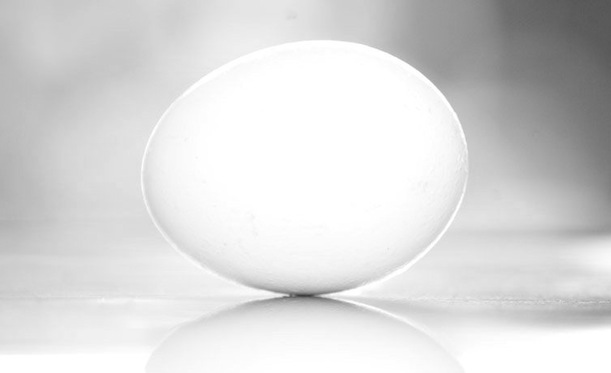
Photo: Alexi Kostibas

China’s pidan, or preserved eggs, go by many names: preserved egg, hundred-year egg, century egg, thousand-year egg, thousand-year-old egg, and millennium egg. You get the idea—these eggs look like they’ve been sitting around for years and years.

While their putrid-looking greenish-grey yolk and transparent, brown egg white may appear to be the furthest thing from appetizing to Western palettes, for the Chinese, these things are a common delicacy. But now, even Chinese consumers have a reason to avoid 1,000-year-old eggs. Thirty preserved egg companies are being shut down for using industrial copper sulphate, a toxic chemical, to expedite the egg-festering process. South China Morning Post reports:

Industrial copper sulphate usually contains high levels of toxic heavy metals, including arsenic, lead and cadmium, so is banned for use as a food additive.

The eggs are usually preserved with baking soda, salt, and quicklime for about two months. The process turns yolks dark green and the egg white into a stiff, dark jelly. Using copper sulphate could significantly reduce the processing time while achieving the same effect.

For now, the companies—one of which produces 300,000 tons of preserved eggs per year—are on hiatus as investigations continue. One official remarked that nearly all the preserved egg companies used this chemical, and he doesn’t consider it such a big deal. ”There won’t be a problem if you don’t eat too many of them,” he told South China Morning Post.

In other Chinese cuisine news, Quartz reports, watch out for chewing on suspect pork knuckles and chicken legs in the country. Some of those chewy treats were sold more than a year past their expiration date after being washed with detergent to cover up their foulness.

More from Smithsonian.com:

Why Did Jewish Communities Take to Chinese Food?
China Acknowledges It Has a Problem With Pollution-Laden ‘Cancer Villages’

See original article – 

Unless You Like Toxic Chemicals, Skip This Chinese Delicacy

Posted in FF, G & F, GE, Uncategorized | Tagged , , , , , , , , , | Comments Off on Unless You Like Toxic Chemicals, Skip This Chinese Delicacy