Tag Archives: cool finds

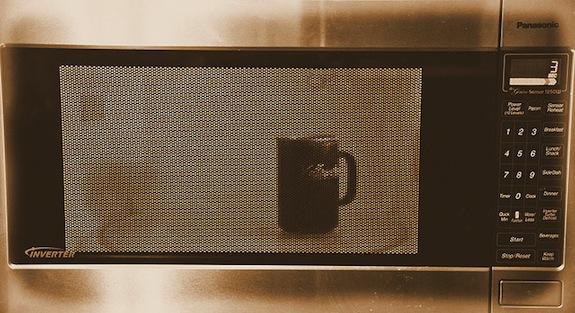
Why Microwaving Water for Tea Is a Bad Idea

Image: CR Artist

Making tea might seem pretty easy; you just heat up some water and add some tea leaves. But apparently there are a lot of things us novice tea makers are doing wrong. A big one is using the microwave to heat up our water.

It seems like no big deal. Tea requires hot water. Microwaves make things hot. What’s the problem?

It turns out that tea requires certain types of hot water. That is, water at a certain temperature. Green tea, for example, should be steeped at 176º F; herbal tea requires 210º F. When you stick your mug in the microwave, you have no idea how hot your water is. Tea kettles, on the other hand, are designed to heat tea to 212º F, according to Slate.

There are a lot of other theories about why nuking your mug isn’t the best. Slate says that the microwave will result in unevenly hot water:

Microwave ovens shoot tiny waves into the liquid at random locations, causing the water molecules at those points to vibrate rapidly. If the water isn’t heated for long enough, the result is isolated pockets of very hot or boiling water amid a larger body of water that’s cooler. Such water may misleadingly exhibit signs of boiling despite not being a uniform 212 degrees. For instance, what appears to be steam rising from a mug of microwaved water is only moist vapor evaporating off the water’s surface and condensing into mist on contact with cooler air—it’s the same principle that makes our breath visible on frigid days.

But Lifehacker says that this isn’t quite right:

That’s not true—after all, microwave wavelengths are about 4-inches, so unless you have a really huge teacup, you’re getting pretty even heating, especially if you remember to put it on the edge of the carousel, so we don’t think that’s much of a problem, especially if you stir after heating.

The two do agree though, that the right temperature of water is really important. Overheating your water can make your tea taste bitter and weird, says Slate. But those without a kettle shouldn’t despair just yet: as long as you’re willing to drink only green tea, the microwave is the way to go.

More from Smithsonian.com:

Two for Tea
Can You Make Tea Out of Coffee?

Source:  

Why Microwaving Water for Tea Is a Bad Idea

Posted in FF, GE, oven, Uncategorized | Tagged , , , , , , | Comments Off on Why Microwaving Water for Tea Is a Bad Idea

A Galactic GPS System That’s Now in the Works Could Help Our Descendants Navigate Through the Universe

Photo: Avarycce

The International Space Station aims to be testing out an interplanetary GPS system by 2017, IEEE Spectrum reports. Rather than navigate with the stars or planets themselves, the system would rely upon the lingering X-ray pulses of dead stars to create a map of the galaxy.

At present, space navigation relies primarily on a network of earthbound tracking stations. When a craft ventures into deep space, ground crews beam radio waves out to the craft, which are then retransmitted back. By measuring the round trip time and the Doppler shift of the signal, the crews can calculate the craft’s position. But the further away the craft wanders from our planet, the poorer this method’s resolution becomes. So it follows that if a space vehicle could calculate its own position independently and accurately, its navigational capabilities would improve by leaps and bounds.

The new system aims to do just that. It relies upon the electromagnetic radiation emitted by pulsars, or technically dead stars that still give off bursts of oscillating energy. These pulses come at regular intervals, so they can be used for navigation in the same way GPS systems on earth use atomic clocks for standardization and accuracy.

A craft heading into space would carry a detector that, similarly to a GPS receiver, would accept X-rays from multiple pulsars and use them to resolve its location.

In order to test the system, the NASA team built the Goddard X-ray Navigation Laboratory Testbed (GXNLT). Nicknamed the “pulsar-on-a-table,” it’s composed of pulsar-processing software and hardware, a modulated X-ray source, and a built-in detector. The test bed tries to mimic the combination of an interplanetary GPS and pulsars.

If all goes well, a NASA engineer told IEEE Spectrum, these initial systems will lay the foundation for our descendants to navigate throughout our solar system and beyond.

More from Smithsonian.com:

Quirkiest Space Shuttle Science 
Have GPS Devices Taken Fun Out of Navigation? 

View original post here: 

A Galactic GPS System That’s Now in the Works Could Help Our Descendants Navigate Through the Universe

Posted in FF, GE, ONA, solar, Uncategorized | Tagged , , , , , , , , | Comments Off on A Galactic GPS System That’s Now in the Works Could Help Our Descendants Navigate Through the Universe

A Space-Based Telescope for the People Wants Your Support

Planetary Resources president Chris Lewicki stands next to the Arkyd space telescope. Photo: Planetary Resources

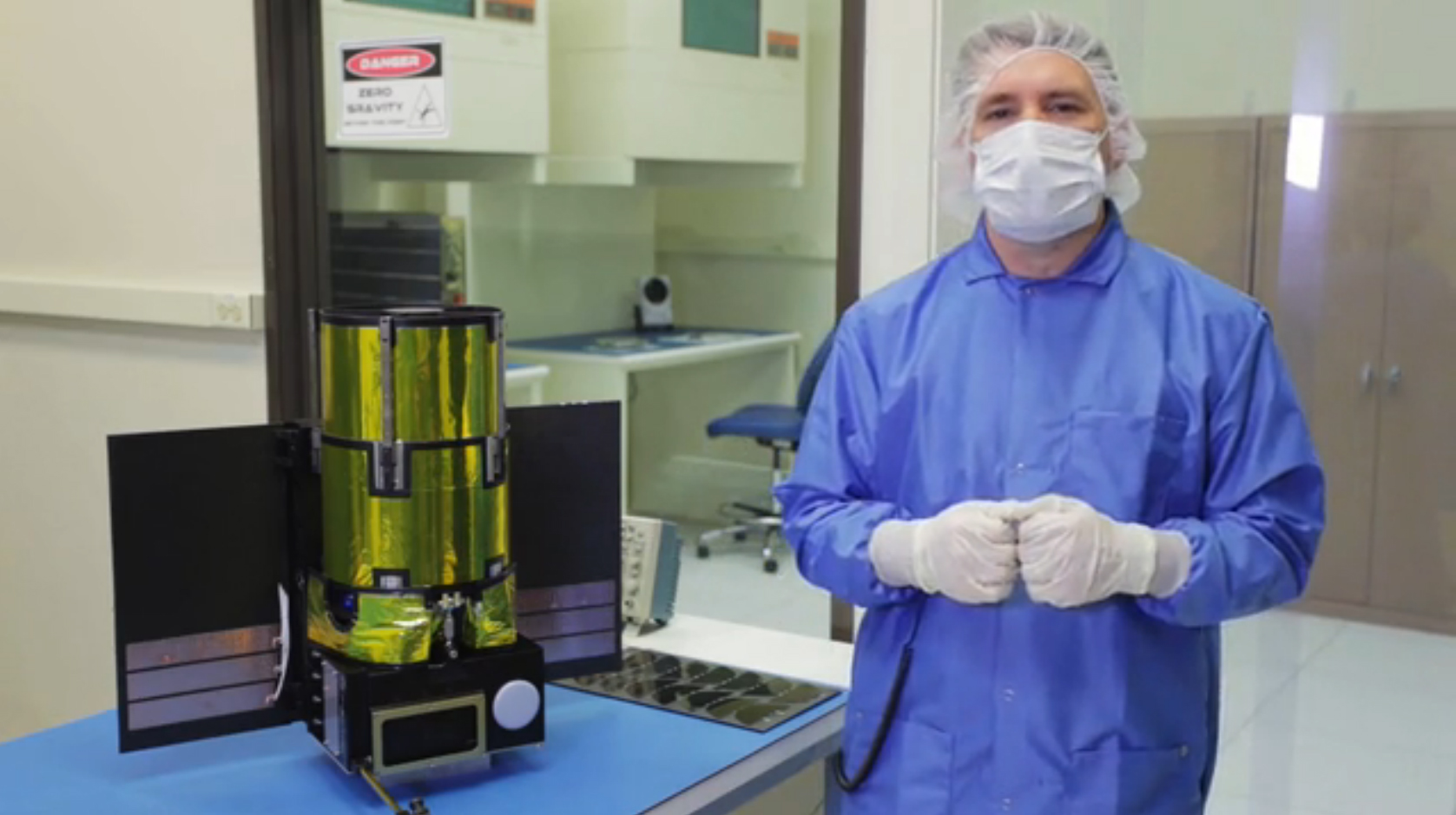
In just a few short days, Planetary Resources, a fledgling space mining company, has raised more than $500,000 from the fine citizens of the world for their project to put a small space telescope into orbit around the Earth—one that would be controllable by regular folks down on the ground. With the telescope, a 200 millimeter orbiting telescope known as the Arkyd, you’d be able to take photos of the planet, of the stars, or of the other awesome things poking around in the solar system.

The team is looking to raise $1,000,000, and with 30 days left to go on their Kickstarter fundraiser it seems likely they’ll hit the mark.

The telescope’s big selling point for those not interested in doing planetary sciences is the option for you to take a “space selfie.” The Arkyd has a little camera pointing at a little screen aboard the telescope. With the selfie-cam, you’ll be able to take a photo of the screen with the cosmos as a backdrop. On the screen, you can display a photo, a graphic, whatever you want.

The project is being put together by Planetary Resources, a company whose main purpose is to mine asteroids for minerals. So, as cool as it is, the Arkyd kickstarter is sort of like paying De Beers to take you on a safari. Check out their slick promotional video:

According to the Economist, the relatively cheap $1 million price tag of the space telescope is enabled by a two trends:

The revolution has been made possible by two developments: the realisation of long dreamt-of nanosatellites that pack control systems, solar panels, scientific instruments, communications and computing gear into devices little larger than a mobile phone; and crowd-funding websites that turn the public’s enthusiasm for space into viable businesses.

Aside from taking space selfies, you can buy time on the telescope for schools and museums. Planetary Resources’ goal with the for-the-people telescope is to encourage enthusiasm for space research.

People care about stuff they can participate in,” says Peter Diamandis, co-founder of Planetary Resources. “Space for the last 50 years has been non-participatory. This is making space cooler and more fun.” The risk that fun might supplant function is something Mr Diamandis rejects. He is adamant that providing a “photo booth in space” will not detract from Planetary Resources’ primary aim of prospecting for minernal-rich near-Earth asteroids.

More from Smithsonian.com:

To the Asteroids and Beyond
What Can We Do About Big Rocks From Space?
International Space Station Cameras Will Bring Earth to You, Live, 24/7

More: 

A Space-Based Telescope for the People Wants Your Support

Posted in Citizen, FF, GE, ONA, PUR, solar, solar panels, Uncategorized | Tagged , , , , , , , , | Comments Off on A Space-Based Telescope for the People Wants Your Support

China Plans to Regulate Some of Its Carbon Emissions for the First Time Ever

Smog in a Beijing neighborhood. Photo: Chris Aston

Next month, China will begin its first carbon-trading pilot program in Shenzhen, a major Chinese city just north of Hong Kong, the Guardian reports. The program will begin modestly, targeting only certain Shenzhen companies, but will soon expand to other sectors and cities. Environmentalists hope these initial trials will help the country determine how to best go about setting caps on emissions, the Guardian writes.

China ranks as the world’s number one carbon dioxide emitter, thanks in part to the massive amounts of coal the country burns. China currently builds a new coal-fired power plant at a rate of about one every week to ten days. The country’s coal burning levels are nearly on par with the rest of the world combined.  

Politicians around the world have focused on carbon trading as the market-based strategy of choice for regulating greenhouse gas emissions. HowStuffWorks explains the basic concept:

Cap-and-trade schemes are the most popular way to regulate carbon dioxide (CO2) and other emissions. The scheme’s governing body begins by setting a cap on allowable emissions. It then distributes or auctions off emissions allowances that total the cap. Member firms that do not have enough allowances to cover their emissions must either make reductions or buy another firm’s spare credits. Members with extra allowances can sell them or bank them for future use. Cap-and-trade schemes can be either mandatory or voluntary.

But in the European Union, this system has not worked so well. The Royal Society of Chemistry explains the problem:

In theory, the cost of buying the allowances, either directly from other companies or on the open market, is supposed to provide financial incentives for companies to invest in carbon reducing technology or shift to less carbon intensive energy sources. But after reaching a peak of nearly €30 (£25) per tonne in the summer of 2008, prices have steadily fallen. By January they had crashed to under €5, providing little, if any, financial incentive for companies to reduce emissions.

This initial effort in China will extent to just 638 companies, the Guardian reports, though those businesses are responsible for 68 percent of Shenzhen’s total greenhouse gas emissions. While any efforts China undertakes to reduce its emissions will help ward off global climate change and reduce greenhouse gas build up in the planet’s atmosphere, China’s leaders say the decision primarily stems from it’s escalating in-country problems with air pollution, the Guardian reports.

If things go well, the scheme will further incorporate transportation, manufacturing and construction companies as well. China plans to enroll seven cities in the experiment by 2014. By 2020, China hopes to have implemented a nation-wide carbon control program—just in time for the country’s estimated emissions peak in 2025.

More from Smithsonian.com:

The Political History of Cap and Trade 
China Acknowledges It Has a Problem with Pollution-Laden ‘Cancer Villages’ 

See more here – 

China Plans to Regulate Some of Its Carbon Emissions for the First Time Ever

Posted in FF, GE, global climate change, Uncategorized | Tagged , , , , , , , , , , , | Comments Off on China Plans to Regulate Some of Its Carbon Emissions for the First Time Ever

3D-Printed Pizza Brings Us One Step Closer to Meal-in-a-Pill

Nom. Photo: British Mum

NASA, those great engineers of tomorrow, just put $125,000 behind work intended to build a 3D food printer—a device that will be able to crank out “nutritionally-appropriate meals” from a mix of oils and powders, says Christopher Mims for Quartz. The money is going to a mechanical engineer, Anjan Contractor, who will build a prototype of the machine. “Contractor’s vision,” says Mims, “would mean the end of food waste, because the powder his system will use is shelf-stable for up to 30 years, so that each cartridge, whether it contains sugars, complex carbohydrates, protein or some other basic building block, would be fully exhausted before being returned to the store.”

Laid down layer by layer using a waterless mix of carbohydrates, protein and nutrient, according to Contractor, the device should be able to make meals out of pretty much any source of these essential foodstuffs—plants, bugs, seeds, whatever.

NASA wants the printer for long-distance space flights. Waterless powders don’t go bad, and living in space you’d probably get sick of slurping soup out of a baggie. Pizza sounds much better:

Pizza is an obvious candidate for 3D printing because it can be printed in distinct layers, so it only requires the print head to extrude one substance at a time. Contractor’s “pizza printer” is still at the conceptual stage, and he will begin building it within two weeks. It works by first “printing” a layer of dough, which is baked at the same time it’s printed, by a heated plate at the bottom of the printer. Then it lays down a tomato base, “which is also stored in a powdered form, and then mixed with water and oil,” says Contractor.

Finally, the pizza is topped with the delicious-sounding “protein layer,” which could come from any source, including animals, milk or plants.

While a 3D food printer would be able to make food-looking food, the idea isn’t so far off from the mainstay futuristic projections of the early 20th century that said we were all supposed to be eating our food in pill form by now. Against that, we’ll take the “protein” pizza.

More from Smithsonian.com:

Solar System Lollipops And Other Food That Looks Like Things

Excerpt from:  

3D-Printed Pizza Brings Us One Step Closer to Meal-in-a-Pill

Posted in FF, GE, ONA, solar, Uncategorized, Waterless | Tagged , , , , , , , | Comments Off on 3D-Printed Pizza Brings Us One Step Closer to Meal-in-a-Pill

Mount Everest Climbers’ Waste Could Power Local Villages

The village of Gorak Shep. Photo: Frank Kehren

There is no plumbing on Mount Everest. When nature calls, climbers must use makeshift holes dug by sherpas, or use buckets as substitute toilets. With the ever-increasing number of climbers attempting to scale the mountain, containing all of that human waste is no small problem.

Currently, National Geographic reports, much of the excrement is carried in sealed containers on the backs of porters to the nearby village of Gorak Shep (which also lacks plumbing or sanitation facilities), where it is emptied into open pits. Up to 12 metric tons of the stuff can be hauled to Gorak Shep in a single year. But the village is running out of space for containing the mess, and last year researchers discovered that the refuse had contaminated one of the village’s two major water sources.  

Seattle climber and engineer Garry Porter witnessed the problem first hand when he attempted to scale Everest ten years ago. Since then, the image of all of that waste has stuck with him. ”I couldn’t shake the feeling that my final tribute to Nepal and the people of Everest was having my waste dumped in these open pits. It just didn’t seem right,” he told National Geographic.

Porter decided to found the Mount Everest Biogas Project as a potential fix, along with Everest guide Dan Mazur.

In biogas production, bacteria feed on organic waste (like feces) and produce several gases as a byproduct. One of these is methane, which is the primary component of natural gas and can be burned for heat and light, or converted to electricity. One cubic meter of biogas provides about two kilowatt-hours of useable energy. This is enough to power a 60-watt light bulb for more than a day, or an efficient 15-watt CFL bulb for nearly six days. A biogas reactor at Gorak Shep could address the fecal contamination problem while providing the perennially low-income community with a sustainable source of methane gas for energy, especially for cooking, Porter says.

The team plans to keep the biogas digester tanks warm (they stop working if temperatures drop below freezing) with solar panels.

In addition to getting rid of all the feces, the team hopes that the biogas project will relieve some of the pressure on Everest’s natural resources. All of those poop-producing climbers also need to eat, and cooking fuel often takes the form of native plants harvested around Everest, including an endangered species, the alpine juniper. If successful, the project will be the world’s highest elevation biogas reactor and could be introduced to other high altitude areas around the world.  

More from Smithsonian.com:

Mount Everest Is Not Immune to Climate Change 
Conquering Everest 

Follow this link – 

Mount Everest Climbers’ Waste Could Power Local Villages

Posted in alo, FF, GE, LG, ONA, organic, solar, solar panels, Uncategorized | Tagged , , , , , , , | Comments Off on Mount Everest Climbers’ Waste Could Power Local Villages

Barns Are Painted Red Because of the Physics of Dying Stars

Image: Loring Loding

Have you ever noticed that almost every barn you have ever seen is red? There’s a reason for that, and it has to do with the chemistry of dying stars. Seriously.

Yonatan Sunger is a Google employee who decided to explain this phenomenon on Google+ recently. The simple answer to why barns are painted red is because red paint is cheap. The cheapest paint there is, in fact. But the reason it’s so cheap? Well, that’s the interesting part.

Red ochre—Fe2O3—is a simple compound of iron and oxygen that absorbs yellow, green and blue light and appears red. It’s what makes red paint red. It’s really cheap because it’s really plentiful. And it’s really plentiful because of nuclear fusion in dying stars. Sunger explains:

The only thing holding the star up was the energy of the fusion reactions, so as power levels go down, the star starts to shrink. And as it shrinks, the pressure goes up, and the temperature goes up, until suddenly it hits a temperature where a new reaction can get started. These new reactions give it a big burst of energy, but start to form heavier elements still, and so the cycle gradually repeats, with the star reacting further and further up the periodic table, producing more and more heavy elements as it goes. Until it hits 56. At that point, the reactions simply stop producing energy at all; the star shuts down and collapses without stopping.

As soon as the star hits the 56 nucleon (total number of protons and neutrons in the nucleus) cutoff, it falls apart. It doesn’t make anything heavier than 56. What does this have to do with red paint? Because the star stops at 56, it winds up making a ton of things with 56 neucleons. It makes more 56 nucleon containing things than anything else (aside from the super light stuff in the star that is too light to fuse).

The element that has 56 protons and neutrons in its nucleus in its stable state? Iron. The stuff that makes red paint.

And that, Sunger explains, is how the death of a star determines what color barns are painted.

More from Smithsonian.com:

“Stormy Sunset at Moulton Barn”
Weathered barn doors

Visit site:  

Barns Are Painted Red Because of the Physics of Dying Stars

Posted in FF, GE, ONA, Uncategorized | Tagged , , , , , | Comments Off on Barns Are Painted Red Because of the Physics of Dying Stars

Physicists to Shoot Extremely Fast-Moving Electrons at Dinosaur Skin Fossil

Parasaurolophus cyrtocristatus skeleton, Field Museum. Image: Field Museum Dinosaurs

We generally think of dinosaurs as green, lizard-like creatures. But the actual color of dinosaur skin is still very much up for debate. During fossilization the dinosaur’s skin rarely survives, and there are just a few tiny pieces of fossilized skin in existence. Physicists are about to shoot a bunch of extremely bright lights at one of them, in order to try and identify the color of the duck-billed dinosaur to which this small piece of skin belonged.

Those extremely bright lights will come from a synchrotron, which will let physicists at the Canadian Light Source research facility examine the fossils more closely. The synchrotron will shoot a beam of infrared light at the fossil. Some of that light will be reflected. By analyzing that reflection, scientists can try to figure out what the skin was made of. That’s because the chemical bonds in some compounds create different light frequencies than others. So if there’s protein, that will look different than sugar or fat.

Physicist Mauricio Barbi told the press, “If we are able to observe the melanosomes and their shape, it will be the first time pigments have been identified in the skin of a dinosaur. We have no real idea what the skin looks like. Is it green, blue, orange…There has been research that proved the colour of some dinosaur feathers, but never skin.”

The scientists are also curious about why this particular fossil has skin. What happened to this dinosaur, unlike nearly all the others, that allowed for its skin to be preserved?

Answering these questions will not only provide more accurate pictures of dinosaurs, but also might hint at where they can find more samples of preserved skin.

More from Smithsonian.com:

Dinosaur Sighting: Colorful Stegosaurus
Dinosaurs, Now in Living Color

Taken from: 

Physicists to Shoot Extremely Fast-Moving Electrons at Dinosaur Skin Fossil

Posted in FF, GE, Uncategorized | Tagged , , , , , , | Comments Off on Physicists to Shoot Extremely Fast-Moving Electrons at Dinosaur Skin Fossil

The New $100 Bill Will Have Thousands of Tiny Lenses Built In

Photo: The US Treasury

As of October 8, a new $100 bill will be in circulation in the U.S. In an attempt to cut down on counterfeits, the Federal Reserve will add features such as a blue 3D security ribbon composed of thousands of tiny lenses and a disappearing Liberty Bell in an inkwell, USA Today reports.

The new bill is a bit late to arrive in Americans wallets. Originally, it was scheduled to be released in February 2011. But the Feds discovered an issue with unwanted wrinkles appearing in many of the notes, so they postponed its release indefinitely.

As for that blue security ribbon and its tiny lenses, the technology works by magnifying the objects underneath. When the bill is moved one way, whatever is underneath seems to move the opposite way. Though the $100 is the note most frequently targeted by counterfeiters, USA Today points out, it’s the last bill to undergo an upgrade to try and deter those fakes.

But as the Wall Street Journal points out, even with fancy new technology, the counterfeiters will likely find a way around the security measures. They always do. Ben Franklin himself lost sleep over this issue. He designed the country’s first bills, which immediately triggered a wealth of counterfeits despite his adding a “mysterious anticounterfeiting device.”

This was the so-called nature print, which consisted of an image of a leaf or leaves. It was extraordinarily lifelike, and with good reason. Franklin had devised a way of taking a plaster cast of the surface of a leaf. That in turn could be used to cast a lead plate that would be used to print the notes. Because every leaf was unique—with a complex web of veins of varying thickness—the notes were very difficult to counterfeit.

No surprise, though, the strategy didn’t work for very long. The British actually used counterfeits of Franklin’s bills as a means of undermining the impending war. While we’ve moved beyond Red Coat plots to crash the U.S. economy, as the Wall Street Journal writes, however many fancy security tactics are crammed onto a small slip of green paper, counterfeiters will eventually and inevitably crack that code.

More from Smithsonian.com:

The Art of Money 
To Save Money, Ask for Pretty New Dollar Bills

Visit link: 

The New $100 Bill Will Have Thousands of Tiny Lenses Built In

Posted in FF, GE, Uncategorized | Tagged , , , , , , , , , , , | Comments Off on The New $100 Bill Will Have Thousands of Tiny Lenses Built In

No, You Can’t Officially Rename a Planet. But No One Can Stop You From Trying

An artist’s rendition of Gliese 581 g, a potentially habitable exoplanet with a decidedly boring name. Photo: NASA / Lynette Cook

The Kepler spacecraft is hunting down planets outside our solar system at a rapid clip. The total number of confirmed exoplanets is now at a whopping 861 and there are 2,903 more potential exoplanet candidates waiting in the wings. Space, it seems, is less of an empty void with each passing day.

The pace of discovery and the uncertainty in each finding—with exoplanets first being considered “candidates” before moving to full-fledged “discovered” status with subsequent observations—means that exoplanets are often given unwieldy placeholder names. Gliese 667Cc, for example, is the second planet around the third star in the Gliese 667 system. Gliese 581 g is the 6th planet around the star Gliese 581. But as useful as these names are for astronomers—more road map than moniker—they don’t exactly roll off the tongue.

A new organization—Uwingu–wants to fix this little dilemma. They’re offering a platform for you to suggest and vote on new planetary names. Their general goal is not to assign a specific name to a specific planet, but rather to tabulate a ready-made list from which astronomers can draw. They did, however, recently launch a contest to rename the planet Alpha Centauri Bb, the closest exoplanet to Earth. Drawing a wary eye from some, Uwingu wants you to back your votes with cash: one dollar, one vote.

Uwingu’s project to give exoplanets new names has drawn the ire of another group – the people who actually name exoplanets. The International Astronomical Union, says the CBC, wants to remind everyone that only they have the power to officially name extraplanetary bodies. Even if your exoplanet name of choice wins Uwingu’s contest, they say, it will have “no bearing on the official naming process.” Uwingu points out, however, that while the International Astronomical Union controls planets’ official names, they have no control over their common names. And, just because a name isn’t official doesn’t mean people won’t use it.

Back in October, The Weather Channel tried a similar trick when they unilaterally decided to start giving names to winter storms without first talking to the World Meteorological Organization or other large meteorological bodies. If you remember Winter Storm Nemo, thank The Weather Channel.

So while it may be true that you can’t vote your way to an official new planet name, the CBC adds that for many celestial objects their unofficial common name (say, the North Star) is used by many in place of the official name (Alpha Ursa minori).

Besides, says Phil Plait for his blog Bad Astronomy, the money being raised is going toward real science. Uwingu “will use the profits to fund scientific research. People will be able to submit proposals for the funding, which will be peer reviewed to ensure high-quality work. And it’s not just research: they hope to fund space-based projects, education, and other science-supporting ventures.”

Indeed, says Plait, even though only the IAU can make planet names official, the names on Uwingu’s list “will be seen by planetary astronomers, and eventually those planets are going to need names. Why not yours?”

More from Smithsonian.com:

Dennis Hope Thinks He Owns the Moon
What the Discovery of Hundreds of New Planets Means for Astronomy—and Philosophy
What if All 2,299 Exoplanets Orbited One Star?

Link to original: 

No, You Can’t Officially Rename a Planet. But No One Can Stop You From Trying

Posted in alo, ALPHA, FF, GE, ONA, solar, Uncategorized | Tagged , , , , , , , , , | Comments Off on No, You Can’t Officially Rename a Planet. But No One Can Stop You From Trying