Tag Archives: education

Charts: How Big Debt on Campus Is Threatening Higher Ed

Mother Jones

<!DOCTYPE html PUBLIC “-//W3C//DTD HTML 4.0 Transitional//EN” “http://www.w3.org/TR/REC-html40/loose.dtd”>

The explosion of college tuition and student debt is leaving more grads with big bills and doubts about their futures. Some back-to-school stats:

1. College costs a lot more than it used to.

The good news: College grads earn 84% more than high school grads.

The bad: Getting that sheepskin is getting a lot more expensive.

Between 2000 and 2012:

• Consumer Price Index increased 33%.

• Median household income (adjusted for inflation) dropped 9%.

• Average four-year college tuition increased 44%.

• Private for-profit tuition increased 19%.

• Private nonprofit college tuition increased 36%.

• Public college tuition increased 71%.

Between 2000 and 2012:

• Public spending on public education has dropped 30% even as enrollment at public colleges has jumped 34%.

2. So we’re borrowing more to go to school.

As college costs have shot up, so has student debt. Americans owe almost $1 trillion on their student loans, 310% more than a decade ago.

In 1989, 9% of households had student debt. Today nearly 20% do.

The average amount of student loan debt has increased 177% since 1989.

3. But we can’t pay it off.

Debt is increasing fastest for those who have the least money to pay it back.

56% of all student loan debt is owed by households headed by people 35 or older.

47% of total student loan debt is held by households with incomes below $60,000.

4. And we’re putting our dreams on hold.

Nearly half of college graduates with student debt say it has made it more difficult for them to make ends meet. 24% say it has affected their career choices.

25% of recent grads say student loan debt has made them take unexciting jobs just for the money.

Student debt’s impact on borrowers’ long-term plans:

• For every $10,000 in student debt: Borrowers’ likelihood of taking a nonprofit, government, or education job drops more than 5 percentage points. Their long-term probability of getting married drops at least 7 percentage points.

• Student loans affect the housing market: Larger student debt burdens are making it harder for recent college graduates to get home loans, according to the National Association of Home Builders.

• Student loans affect the entire economy: The Financial Stability Oversight Council reports that high student debt levels could “lead to dampened consumption,” and the Consumer Financial Protection Bureau warns that unpaid student loans “could be a drag on the recovery.”

Read article here:

Charts: How Big Debt on Campus Is Threatening Higher Ed

Posted in FF, GE, LG, ONA, Uncategorized, Venta | Tagged , , , , , , | Comments Off on Charts: How Big Debt on Campus Is Threatening Higher Ed

Here’s Obama’s Plan to Make College More Affordable

Mother Jones

<!DOCTYPE html PUBLIC “-//W3C//DTD HTML 4.0 Transitional//EN” “http://www.w3.org/TR/REC-html40/loose.dtd”>

President Obama laid out a new plan today to make college more affordable:

A draft of the proposal, obtained by The New York Times and likely to cause some consternation among colleges, shows a plan to rate colleges before the 2015 school year based on measures like tuition, graduation rates, debt and earnings of graduates, and the percentage of lower-income students who attend…“All the things we’re measuring are important for students choosing a college,” a senior administration official said. “It’s important to us that colleges offer good value for their tuition dollars, and that higher education offer families a degree of security so students aren’t left with debt they can’t pay back.”

Mr. Obama hopes that starting in 2018, the ratings would be tied to financial aid, so that students at highly rated colleges might get larger federal grants and more affordable loans. But that would require new legislation. “I think there is bipartisan support for some of these ideas, as we’ve seen in states where the governors have been working on them,” said the administration official, who spoke on condition of anonymity in order to disclose information not yet made public.

The basic idea here is that endlessly increasing the amount of federal student aid just isn’t working anymore. At this point, all it does is encourage universities to raise their prices, which means that students are no better off than they were before. In fact, maybe worse, since they end up graduating with ever more gargantuan loans to pay off. Instead we need to reward universities that actually provide a good bang for the buck: a solid education and high graduation rates at a reasonable cost.

Interestingly, this is very similar to the Washington Monthly’s “bang for the buck” ranking of colleges, which they started last year. Now, I have to confess that I’ve been sort of skeptical from the start of the Monthly’s attempt to rank colleges not on the basis of pure academic excellence but on the basis of how useful they are to society. I figured it was just spitting into the wind and would never catch on. Luckily, no one asked me and they kept plugging away at it. This year, in addition to pulling in lots of useful advertising dollars, I think they can legitimately feel like they’ve done something to advance the national conversation on higher education. The formula that the feds come up with will undoubtedly be different from the Monthly’s, but the idea will be the same. The Obama administration is basically proposing to do what they’ve been recommending for the past few years.

If you’re curious to see how various universities rank, click here. The top 20 are on the right, and I’m happy to see my alma mater coming in at #6. Nice work, 49ers!

Now about Obama’s belief that there’s “bipartisan support” for some of these ideas…

Link to original:

Here’s Obama’s Plan to Make College More Affordable

Posted in FF, GE, LAI, LG, ONA, PUR, Uncategorized, Venta | Tagged , , , , , , , | Comments Off on Here’s Obama’s Plan to Make College More Affordable

As Expected, Student Test Scores Have Plummeted in New York City

Mother Jones

<!DOCTYPE html PUBLIC “-//W3C//DTD HTML 4.0 Transitional//EN” “http://www.w3.org/TR/REC-html40/loose.dtd”>

Just to follow up on a post from a couple of days ago, the scores on New York’s new, more difficult school tests are in. Here’s how New York City did:

Across the city, 26 percent of students in third through eighth grade passed the state exams in English, and 30 percent passed in math, according to the New York State Education Department….Under the old exams last year, the city fared better: 47 percent of students passed in English, and 60 percent passed in math.

….The results galvanized critics of Mayor Michael R. Bloomberg, who has often pointed to improvements in test scores as evidence that his stewardship of city schools has been a success.

….Anticipating the outcry, the city and state arranged for the United States secretary of education, Arne Duncan, to participate in a conference call with reporters on Tuesday. In his remarks, Mr. Duncan said the shift to Common Core was a necessary recalibration that would better prepare students for college and the work force.

“Too many school systems lied to children, families and communities,” Mr. Duncan said. “Finally, we are holding ourselves accountable as educators.”

This is all pretty silly. The only thing it proves is that you can pass or fail as many kids as you want by fiddling with a test. Make it hard enough, and even a national merit scholar will fail. Make it easy enough, and even a moron will pass. You can set the bar anywhere you like.

Is the new test a “better” measure of how much students know? Maybe. Maybe not. But it’s different, which means it tells you exactly nothing about how good Bloomberg’s stewardship of New York City schools has been over time. If you think test scores are a good way of measuring student performance, we already know the answer to that question: he’s done OK, but not great.

Taken from: 

As Expected, Student Test Scores Have Plummeted in New York City

Posted in FF, GE, LG, ONA, Uncategorized, Venta | Tagged , , , | Comments Off on As Expected, Student Test Scores Have Plummeted in New York City

Test Scores in New York City Are Nothing to Write Home About

Mother Jones

<!DOCTYPE html PUBLIC “-//W3C//DTD HTML 4.0 Transitional//EN” “http://www.w3.org/TR/REC-html40/loose.dtd”>

New York City is about to introduce new, more difficult school testing based on the Common Core curriculum, and that means average scores are likely to go down. Mayor Michael Bloomberg is getting ready to take some heat:

The mayor’s telling of history is poised to receive one of its most vigorous challenges yet on Wednesday, when New York State is expected to report drastic drops in student performance across the state because of a new set of tougher exams.

In New York City, the proportion of students deemed proficient in math and reading could decrease by as many as 30 percentage points, city officials said, threatening to hand Mr. Bloomberg a public relations problem five months before he is set to leave office.

….As his mayoralty winds down, Mr. Bloomberg has sought to burnish an image as a savior of a school system rife with racial and socioeconomic disparities. But several of the Democratic candidates for mayor have rejected that portrayal, seizing on anger among some parents rankled by what they say is his unilateral approach to governing.

Politics is politics, but the rest of us don’t really need to pay any attention to this. Nor do we have to pay attention to New York’s own testing, which may or may not be afflicted by dumbed-down tests that are about to get dumbed back up. Nor do we have to guess. Instead, we can just look at TUDA, the subset of the national NAEP test aimed at urban districts. New York City has participated in TUDA for Bloomberg’s entire mayoralty, and the basic results are below:

New York City’s test scores have increased over the past decade, but they’ve increased less than in most other big cities (2 points vs. 6 in reading, 6 points vs. 12 in math). On the 4th grade test, New York City has done about the same as other big cities. This isn’t a massive failure, but it doesn’t look like any kind of outsized success either.

View original article: 

Test Scores in New York City Are Nothing to Write Home About

Posted in FF, GE, LG, ONA, Uncategorized, Venta | Tagged , , , | Comments Off on Test Scores in New York City Are Nothing to Write Home About

Charts: Racial Polarization Increasing in Higher Education

Mother Jones

College attendance rates for African-American and Latino students have been increasing steadily in recent years. But here’s the bad news that comes along with that: those students are mostly attending non-selective four-year colleges and community colleges, while whites are increasingly attending prestigious colleges and universities, the Washington Post reports.

A study released Wednesday by the Georgetown University Center on Education and the Workforce found that between 1995 and 2009, college enrollment more than doubled for Latinos and jumped 73 percent for African Americans, while only increasing 15 percent for whites. During that period, 80 percent of white college freshman enrolled in the nation’s top 468 colleges, while only 13 percent of Latinos and nine percent of African-Americans went to those selective four-year schools. More than two-thirds of African Americans and almost three-quarters of Hispanics went to non-selective schools. Look:

It’s not because minority students are less qualified. Thirty percent of African-American and Hispanic students who had an A average in high school attend community colleges, compared with 22 percent of whites, according to the report, which says that unequal educational outcomes for minorities can be attributed to things like family income, and peer expectations, but also to simply not being white.

“The higher-education system is colorblind in theory but in fact operates, at least in part, as a systematic barrier to opportunity for many blacks and Hispanics, many of whom are college-qualified but tracked into overcrowded and under-funded colleges, where they are less likely to develop fully or to graduate,” Anthony Carnevale, one of the report’s authors, told the Post.

Here’s how unequal college paths for whites and non-whites contributes to growing inequality in America, via the Post:

Students at the nation’s top 468 colleges are the beneficiaries of much more spending—anywhere from two to five times as much as what is spent on instruction at community colleges or other schools without admissions requirements. And students at top schools are far more likely to graduate than students at other institutions, even when they are equally prepared, according to the report. In addition, graduates of top schools are far more likely than others to go on to graduate school.

The financial implications of those differences are huge: A worker with an advanced degree is expected to earn as much as $2.1 million more in his or her lifetime than a college dropout, the report said. Also, the report said graduates of selective colleges earn an average of $67,000 a year 10 years after graduation, about $18,000 a year more than their counterparts who graduate from non-selective schools.

The report’s authors say that in order to combat growing racial polarization in higher education, more resources need to be directed to improve students’ academic experiences at non-selective schools, which often struggle with over-crowded classrooms and outdated materials. The authors say that colleges and lawmakers should also do more to bring black and Hispanic students into top schools.

The report comes just as the Supreme Court recently dealt a blow to affirmative action. In June, the high court allowed affirmative action to survive, but made it harder to institute as part of the admissions process, ruling that schools must first prove there are “no workable race-neutral alternatives” to achieve diversity on campus.

Continued here: 

Charts: Racial Polarization Increasing in Higher Education

Posted in alo, FF, GE, LG, ONA, Uncategorized, Venta | Tagged , , , , , , | Comments Off on Charts: Racial Polarization Increasing in Higher Education

No, You’re Probably Not Smarter Than a 1912-Era 8th Grader

Exam time. Photo: University of Saskatchewan

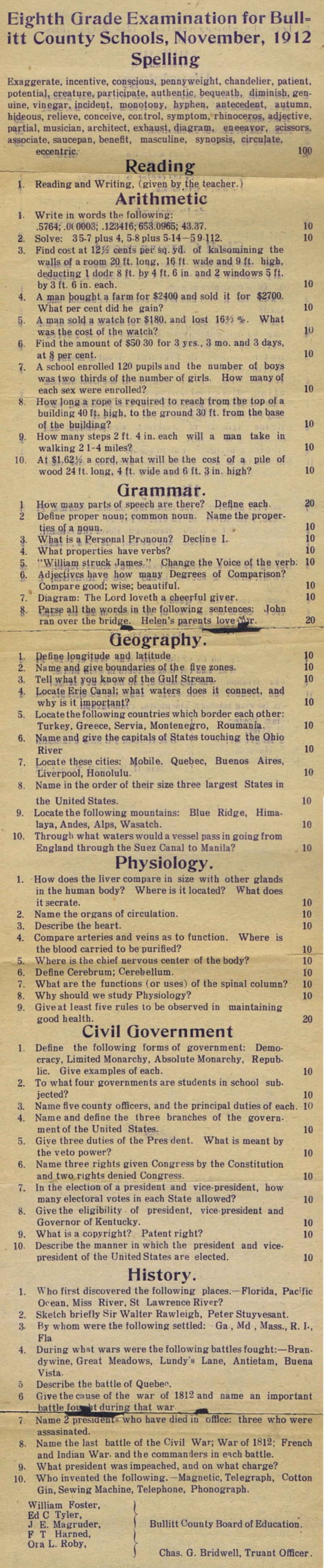
In the early years of the 20th century, the students in Bullitt County, Kentucky, were asked to clear a test that many full-fledged adults would likely be hard-pressed to pass today. The Bullitt County Geneaological Society has a copy of this exam, reproduced below—a mix of math and science and reading and writing and questions on oddly specific factoids–preserved in their museum in the county courthouse.

But just think for a moment: Did you know where Montenegro was when you were 12? Do you know now? (Hint: it’s just across the Adriatic Sea from Italy. You know where the Adriatic Sea is, right?)

Or what about this question, which the examiners of Bullitt County deemed necessary knowledge: “Through what waters would a vessel pass in going from England through the Suez Canal to Manila?” The Bullitt geneaological society has an answer sheet if you want to try the test, but really, this question is just a doozie:

A ship going from England to Manilla by way of the Suez Canal would pass through (perhaps) the English Channel, the North Atlantic Ocean, Bay of Biscay (possibly), Strait of Gibraltar, Mediterranean Sea, Suez Canal, Red Sea, Gulf of Aden/Arabian Sea, Indian Ocean, Gulf of Thailand (may have been called Gulf of Siam at that time), South China Sea.

Eighth graders needed to know about patent rights, the relative size of the liver and mountain range geography. They had to be able to put together an argument for studying physiology. Though some of it is useful, much of the test amounts of little more than an assessment of random factoids.

So, if you’re anything like us, no, you’re probably not much smarter than an 1912 Bullitt County eighth grader. But that’s okay.

Tests like this are still done today, of course, often in the form of “scientific literacy” tests. The tests are meant to give an idea of how well people understand the world around them. But, in reality, what the these tests share in common with the Bullitt County test is that they quiz facts in place of knowledge or understanding. Designing a standardized test to quiz true understanding is of course very difficult, which is one of the reasons why these sorts of tests persist.

Writing for The Conversation, Will Grant and Merryn McKinnon argue that using these types of tests to say that “people are getting dumber” or “people are getting smarter” is kind of dumb itself. “Surveys of this type are, to put it bluntly, blatant concern trolling,” they say.

We pretend that factoids are a useful proxy for scientific literacy, and in turn that scientific literacy is a useful proxy for good citizenship. But there’s simply no evidence this is true.

Like asking a 12-year old Kentuckian about international shipping routes, “[t]he questions these [science literacy] tests ask have absolutely no bearing on the kinds of scientific literacy needed today. The kind of understanding needed about alternative energy sources, food security or water management; things that actually relate to global challenges.”

So, really, don’t feel too bad if you can’t finish your grandparent’s school exam—the fault lies more in outdated ideas of education than in your own knowledge base.

But, with all that aside, taking the Bullitt County quiz is still kind of fun:

The Bullitt County quiz for 8th graders. Photo: Bullitt County Geneaological Society

More from Smithsonian.com:

Do Teachers Need Their Own “Bar Exam”?
Document Deep Dive: What Was on the First SAT?

Read original article:  

No, You’re Probably Not Smarter Than a 1912-Era 8th Grader

Posted in alternative energy, Citizen, FF, GE, ONA, Smith's, Uncategorized | Tagged , , , , , , , , , , | Comments Off on No, You’re Probably Not Smarter Than a 1912-Era 8th Grader

Former Indiana Schools Superintendent Raised Grade of Charter School Run by Big GOP Donor

Mother Jones

<!DOCTYPE html PUBLIC “-//W3C//DTD HTML 4.0 Transitional//EN” “http://www.w3.org/TR/REC-html40/loose.dtd”>

I love this story. Apparently Christel DeHaan is a big Republican donor who runs a charter school in Indianapolis, and last year she became a big problem for Indiana schools superintendent Tony Bennett. Why? Because lousy 10th grade algebra scores meant that her school would receive an embarrassingly low official state grade. What to do?

Trouble loomed when Indiana’s then-grading director, Jon Gubera, first alerted Bennett on Sept. 12 that the Christel House Academy had scored less than an A.

….A weeklong behind-the-scenes scramble ensued among Bennett, assistant superintendent Dale Chu, Gubera, Neal and other top staff at the Indiana Department of Education. They examined ways to lift Christel House from a “C” to an “A,” including adjusting the presentation of color charts to make a high “B” look like an “A” and changing the grade just for Christel House.

Hmmm. That sounds about like the kind of lame plan that a desperate 10th grader who had failed algebra might come up with. In the end, though, Indiana’s public education brain trust came up with a more sophisticated plan from the John Lott school of statistical analysis: Just change the state ranking formula so that Christel House would get a better grade.

Sadly, AP’s Tom LoBianco, who rounded up the incriminating emails about this, couldn’t tell us just how the formula was changed:

It’s not clear from the emails exactly how Gubera changed the grading formula, but they do show DeHaan’s grade jumping twice….Indiana education experts consulted for this article said they weren’t aware the formula had been changed.

I sure hope we learn more about this. Did they decide to reduce the importance of all math tests? Just algebra tests? Or maybe raise the importance of some subject that Christel House did especially well in? Or perhaps just toss out 10th grade scores entirely since, really, who cares about 10th grade anyway? Inquiring minds want to know.

Via Atrios.

See the original article here – 

Former Indiana Schools Superintendent Raised Grade of Charter School Run by Big GOP Donor

Posted in FF, GE, LG, ONA, Uncategorized, Venta | Tagged , , , | Comments Off on Former Indiana Schools Superintendent Raised Grade of Charter School Run by Big GOP Donor

Congress Close to Deal on Student Loan Interest Rates

Mother Jones

After a more than year-long political impasse, Congress appears close to a compromise plan to lower student loan interest rates, the New York Times reported Wednesday night.

At the beginning of July, interest rates on federal undergraduate student loans—called Stafford loans—jumped from 3.4 percent to 6.8 percent after Congress couldn’t agree on legislation to avert the spike. On Wednesday evening, a bipartisan group of Senators—including Sens. Tom Harkin (D-Iowa), the chair of the education committee, Joe Manchin (D-W.Va.), Lamar Alexander (R-Tenn.), and Tom Coburn (R-Okla.)—reached a deal that would set rates at 3.86 percent for the coming year. Thereafter, the rate for undergrad Stafford loans would be calculated by adding two percentage points to the rate at which the government borrows money over the long term (currently at about 2 percent), but the plan wouldn’t allow that rate to rise above 8.25 percent. (For graduate student loans, the Senate plan would add 3.6 percent to the government’s borrowing rate, and set a 9.5 percent interest rate cap.)

The Senate compromise brings Congress close to a solution on the student loan interest rate log jam because the plan the upper chamber has cobbled together is very similar to a plan the House passed in May.

Many Senate Democrats had long resisted the idea of tying interest rates to market fluctuations. And they argued that the House Republican plan, and a similar plan in the Senate, would reduce the deficit on the backs of students and eventually lead to higher rates.

But after senators met Tuesday with President Barack Obama, who was worried about ending the impasse, Democrats caved.

Progressive Dems are sure to be disappointed by the accord. When the House passed its student loan interest rate bill a couple of months ago, Sen. Elizabeth Warren (D-Mass.) said the plan “takes a bad situation and makes it worse… Our students should not be a profit center for the government.” The Congressional Budget Office has estimated that the Senate plan would save the government $715 million over 10 years.

“I am just trying to get the best deal for students,” Harkin said Wednesday, according to Bloomberg.

Congress got itself into this mess in 2007, when it passed a law that gradually lowered interest rates from a fixed 6.8 percent to 3.4 percent over five years, then allowed the rate to shoot back to 6.8 percent in 2012. Last year, no one could agree on a compromise to prevent the rate increase, so lawmakers passed a stopgap measure to extend the 3.4 percent interest rate for a year. This year, when Congress again couldn’t reach a compromise, interest rates spiked up to 6.8 percent on July 1. Since then, lawmakers and the White House have been scrambling for a solution.

Alexander said Wednesday he was optimistic the Senate deal would pass the House. “The House can hopefully accept it, send it to the president, and it can all be done by the end of the month,” he told National Journal. A vote could come by next week.

Jump to original:  

Congress Close to Deal on Student Loan Interest Rates

Posted in FF, GE, ONA, Uncategorized, Venta | Tagged , , , , , , | Comments Off on Congress Close to Deal on Student Loan Interest Rates

More Signs of ‘Peak Us’ in New Study of ‘Peak Oil Demand’

A new study foresees declining demand for oil both through thriftier use and new fuel options. See the article here –  More Signs of ‘Peak Us’ in New Study of ‘Peak Oil Demand’ ; ;Related ArticlesDot Earth Blog: More Signs of ‘Peak Us’ in New Study of ‘Peak Oil Demand’Fiddling While the World WarmsDot Earth Blog: The Long Chain of Responsibility Behind an Oily and Deadly Train Wreck ;

Read More: 

More Signs of ‘Peak Us’ in New Study of ‘Peak Oil Demand’

Posted in alo, alternative energy, eco-friendly, FF, G & F, GE, Monterey, ONA, solar, solar power, Uncategorized | Tagged , , , , , , , , , , , | Comments Off on More Signs of ‘Peak Us’ in New Study of ‘Peak Oil Demand’

Dot Earth Blog: The Long Chain of Responsibility Behind an Oily and Deadly Train Wreck

The deadly derailment of an oil train in a small Quebec town says much about the unaccounted costs of humanity’s appetite for crude. Visit link: Dot Earth Blog: The Long Chain of Responsibility Behind an Oily and Deadly Train Wreck Related Articles The Long Chain of Responsibility Behind an Oily and Deadly Train Wreck 90 Degrees + A.C. + Open Doors = Hamptons Energy Policy? In Europe, Greener Transit on Existing Infrastructure

View original article – 

Dot Earth Blog: The Long Chain of Responsibility Behind an Oily and Deadly Train Wreck

Posted in eco-friendly, FF, G & F, GE, Monterey, ONA, solar, solar power, Uncategorized, wind energy | Tagged , , , , , , , , , , , | Comments Off on Dot Earth Blog: The Long Chain of Responsibility Behind an Oily and Deadly Train Wreck