Tag Archives: florida

Hurricanes keep bringing blackouts. Clean energy could keep the lights on.

When Hurricane Irma scraped its way up the Florida peninsula, it left the state’s electrical grid in pieces. Between 7 million and 10 million people lost power during the storm — as much as half of the state — and some vulnerable residents lost their lives in the sweltering days that followed. Meanwhile, tens of thousands of electrical workers from around the country rushed to the Sunshine State to repair damaged substations, utility poles, and transmission lines.

But in Palm Coast, on Florida’s eastern seaboard, midway between Daytona and St. Augustine, Jim Walden never lost power. As he and his wife listened to debris clattering off their roof, 24 solar panels and 10 kilowatt hours of battery storage kept their lights on and their refrigerator cool. Over the ensuing days, as electric utilities struggled to return power to Florida’s storm-wracked communities, the only thing Walden and his wife missed was their air conditioner (which would have drained their batteries too quickly).

“It worked flawlessly,” Walden says of his solar-plus-storage system. “We had plenty of power for the fans to keep us cool and the lights when you walk into the bathroom at night. The wife would even run her hairdryer off of it.”

Support Grist, win an electric bike!
ENTER

Walden’s setup — which draws power from the sun during the day and dispenses it at night, with or without the help of the grid — is an illustration of how we might reimagine our electrical system to be more modular, resilient, and renewable-powered. We’ve already been struggling with the question of how to build (or rebuild) our grids to better accommodate solar- and wind-generated energy. But this month’s run of record-making Atlantic hurricanes has made finding an answer — one that will help us better weather the storms of the coming century — even more urgent.

Questions about reliability have dogged renewable energy from the beginning. Simply put, when the sun isn’t shining and the wind isn’t blowing, you’re not getting any energy from those sources. Our grid, by contrast, is set up to provide constant, unwavering power around the clock. We’re only just starting to address the challenge of reconciling these two basic facts in one functional system. (Hint: The solution involves batteries). But according to a Department of Energy report, wind and solar power have not made the U.S. power grid less reliable, even as the amount of renewable energy loaded onto it has shot up.

But the grid is getting less reliable overall. Thanks to perpetual delays in updating old infrastructure, the United States sees more power outages per year than any other developed country — costing an annual $150 billion in lost productivity.

And it’s likely to get worse before it gets better. Even as Florida’s lights turn back on, the Atlantic keeps serving up hurricanes like Maria, which left all of Puerto Rico in darkness that could last as long as six months. Overall, the average number of annual weather-related power outages doubled from 2003 to 2012, a Climate Central report found.

One basic improvement the United States could make to its power grid is moving power lines from above-ground utility poles to protected underground conduits. This is how Germany rebuilt its grid after World War II, and now it suffers very few outages, says Blake Richetta, the U.S. VP for German clean-energy company sonnenBatterie. The country has fewer than 12 minutes of blackout per customer per year, compared to the 244 minutes that plague Americans.

But moving America’s 300,000 miles of transmission lines underground would be an epic investment of time and labor — just the sort of massive infrastructure project we’ve been putting off.

Florida utilities did invest in some storm-hardening of their power infrastructure in the past decade, replacing wooden poles with concrete ones and placing them closer together as a response to hurricane damage in 2004 and 2005. The state’s largest investor-owned utility, Florida Power & Light, spent $3 billion on improvements over the last decade, including an $800-million smart-grid project completed in 2013 with backing from the Department of Energy. The initiative involved deploying more than 4.5 million smart meters, sensors, and flood monitors, all networked together to give the utility real-time information on how power is moving around the grid.

Those moves helped lessen the damage Irma caused, according to Florida Power & Light CEO Eric Silagy. During the hurricane, several power substations were able to shut down when flooding monitors indicated equipment was at risk, saving the utility several days of work and possibly millions in equipment repair.

Still, Silagy’s company had to deploy around 20,000 workers in camps across the state to patch power plants and transmission lines in the days after the storm. And a utility spokesperson told ABC News that parts of the electrical grid on Florida’s west coast will require a “wholesale rebuild.”

“This is going to be a very, very lengthy restoration, arguably the longest and most complex in U.S. history,” VP of Communication Rob Gould said.

Clearly, Florida — and the rest of the country — still needs to do much more. And according to Jim Walden, it’s going to require a change in attitude for many Americans.

“It’s amazing to me that we live in the Sunshine State, and it’s hard to get people interested in solar power whatsoever,” he explains.

Walden himself got interested because he wanted to save money on his electric bill. Later, with the help of a $7,500 federal tax incentive, he installed his own battery storage to become more self-sufficient, especially during power outages.

The solutions to our collective energy troubles, however, will also need to be collective. One way that could look is scaling up from individual battery-powered homes to networked storage hubs that could act as regional power sources, flexibly responding to the changing demands of the grid.

As one urban resilience expert, Thaddeus Miller, told ProPublica, increasing the defenses of our cities and systems will require deeper changes than any we’ve embraced so far. “Fundamentally, we must abandon the idea that there is a specific standard to which we can control nature,” he said.

That means, for instance, changing the way we think about resilient infrastructure. Rather than working to prevent flooding at all times with high-investment levees and reservoirs, we could work to build facilities that are better at weathering flooding without being totally compromised. These “safe-to-fail” approaches would leave less of a mess after a storm blows through.

Because storms are going to blow through places like Florida, and they’re likely going to get stronger.

“We lose electricity quite often here, believe it or not — there are thunderstorms that can come up and knock power out,” Walden says. “Just to have electricity during those times is a great comfort.”

Excerpt from: 

Hurricanes keep bringing blackouts. Clean energy could keep the lights on.

Posted in alo, Anchor, FF, G & F, GE, LAI, ONA, Paradise, ProPublica, solar, solar panels, solar power, The Atlantic, Uncategorized | Tagged , , , , , , , , , , | Comments Off on Hurricanes keep bringing blackouts. Clean energy could keep the lights on.

Houston was built for cars. What happens when Harvey destroys 250,000 vehicles?

“Clearly, our environment changes all the time,” the Republican leader said after touring Irma’s devastation. “And whether that’s cycles we’re going through or whether that’s man-made, I wouldn’t be able to tell you which one it is.”

It’s good to see Scott pondering those wacky ideas we’ve all heard floating around: Human-caused climate changemore intense hurricanesrising sea levels, etc. Coming to terms with climate change is a journey we all must pursue at our own pace! It’s not urgent or anything.

So what is Scott feeling sure about? Let’s hear it:

This is a catastrophic storm our state has never seen,” he warned on Saturday before Irma hit Florida.

“We ought to go solve problems. I know we have beach renourishment issues. I know we have flood-mitigation issues,” he said in the wake of Irma.

“I’m worried about another hurricane,” he shared with reporters while touring the Florida Keys this week. We feel ya, Scott.

Big ideas! Perhaps a fellow Florida Republican could illuminate their common thread.

“[I]t’s certainly not irresponsible to highlight how this storm was probably fueled — in part — by conditions that were caused by human-induced climate change,” Florida congressman and Grist 50er Carlos Curbelo said this week.

In fact, it just might be necessary.

See the original post – 

Houston was built for cars. What happens when Harvey destroys 250,000 vehicles?

Posted in alo, Anchor, FF, G & F, GE, LAI, ONA, PUR, Uncategorized | Tagged , , , , , , , , , , , | Comments Off on Houston was built for cars. What happens when Harvey destroys 250,000 vehicles?

Donald Glover’s ‘Atlanta’ is a double-Emmy winner.

“Clearly, our environment changes all the time,” the Republican leader said after touring Irma’s devastation. “And whether that’s cycles we’re going through or whether that’s man-made, I wouldn’t be able to tell you which one it is.”

It’s good to see Scott pondering those wacky ideas we’ve all heard floating around: Human-caused climate changemore intense hurricanesrising sea levels, etc. Coming to terms with climate change is a journey we all must pursue at our own pace! It’s not urgent or anything.

So what is Scott feeling sure about? Let’s hear it:

This is a catastrophic storm our state has never seen,” he warned on Saturday before Irma hit Florida.

“We ought to go solve problems. I know we have beach renourishment issues. I know we have flood-mitigation issues,” he said in the wake of Irma.

“I’m worried about another hurricane,” he shared with reporters while touring the Florida Keys this week. We feel ya, Scott.

Big ideas! Perhaps a fellow Florida Republican could illuminate their common thread.

“[I]t’s certainly not irresponsible to highlight how this storm was probably fueled — in part — by conditions that were caused by human-induced climate change,” Florida congressman and Grist 50er Carlos Curbelo said this week.

In fact, it just might be necessary.

Read original article:

Donald Glover’s ‘Atlanta’ is a double-Emmy winner.

Posted in alo, ALPHA, Anchor, FF, G & F, GE, LAI, ONA, PUR, The Atlantic, Uncategorized | Tagged , , , , , , , , | Comments Off on Donald Glover’s ‘Atlanta’ is a double-Emmy winner.

Hurricane Jose may be headed toward New England.

“Clearly, our environment changes all the time,” the Republican leader said after touring Irma’s devastation. “And whether that’s cycles we’re going through or whether that’s man-made, I wouldn’t be able to tell you which one it is.”

It’s good to see Scott pondering those wacky ideas we’ve all heard floating around: Human-caused climate changemore intense hurricanesrising sea levels, etc. Coming to terms with climate change is a journey we all must pursue at our own pace! It’s not urgent or anything.

So what is Scott feeling sure about? Let’s hear it:

This is a catastrophic storm our state has never seen,” he warned on Saturday before Irma hit Florida.

“We ought to go solve problems. I know we have beach renourishment issues. I know we have flood-mitigation issues,” he said in the wake of Irma.

“I’m worried about another hurricane,” he shared with reporters while touring the Florida Keys this week. We feel ya, Scott.

Big ideas! Perhaps a fellow Florida Republican could illuminate their common thread.

“[I]t’s certainly not irresponsible to highlight how this storm was probably fueled — in part — by conditions that were caused by human-induced climate change,” Florida congressman and Grist 50er Carlos Curbelo said this week.

In fact, it just might be necessary.

This article:  

Hurricane Jose may be headed toward New England.

Posted in alo, Anchor, Everyone, FF, G & F, GE, ONA, PUR, The Atlantic, Uncategorized | Tagged , , , , , , , , , | Comments Off on Hurricane Jose may be headed toward New England.

Hurricane Irma wiped out half of Florida’s citrus crop.

There’s been a long decline in the nutrition of our crops, often attributed to people breeding plants for higher yields rather than health benefits. But, as is often the case, climate change is making it worse.

An altered atmosphere means altered food, because plants suck up CO2 from the air and turn it into sugars, Helena Bottemiller Evich points out in a new piece for Politico. That means we’re getting more sugar per bite, and less protein, iron, and zinc. The global phenomenon puts hundreds of millions of people at risk for nutrient deficiencies.

It’s not just a problem for humans. Analysis of pollen samples going back to 1842 shows that protein concentration declined dramatically as atmospheric CO2 rose. That makes yet another suspect in the great bee-murder mystery.

“To say that it’s little known that key crops are getting less nutritious due to rising CO2 is an understatement,” Evich writes for Politico. “It is simply not discussed in the agriculture, public health, or nutrition communities. At all.”

The world is changing in so many ways that it’s nearly impossible to track them all — even when those changes happen right at the ends of our forks.

Link – 

Hurricane Irma wiped out half of Florida’s citrus crop.

Posted in alo, Anchor, Everyone, FF, G & F, GE, LAI, ONA, PUR, Uncategorized | Tagged , , , , , , , , , , | Comments Off on Hurricane Irma wiped out half of Florida’s citrus crop.

Hurricane Irma has made landfall in the Florida Keys

One of the strongest storms ever to touch U.S. soil  arrived on Sunday morning, crossing near Key West as a Category 4 hurricane. With sustained winds of 130 mph, a storm surge as high as 15 feet, and waves an additional 30 feet on top of that, Irma is expected to lash nearly the entire state for at least 24 hours.

The storm is so huge that tropical storm watches extend as far inland as Atlanta. As of midday Sunday, it yielded around 80 terajoules of energy, more than the atomic bomb dropped on Hiroshima.

The biggest worry for meteorologists is Irma’s immense coastal flooding potential, which could perfectly align to create a worst-case scenario for Gulf Coast cities like Naples, Ft. Myers, and Tampa. Nearly 7 million people have fled the path of the storm, the largest mass evacuation in U.S. history.

Meanwhile, photos of complete devastation continue to pour in from the Caribbean. On the island of St. Thomas, in the U.S. Virgin Islands, forests were flattened and twisted into mangled messes. In the Bahamas, Irma’s offshore winds were so strong on one beach that they pushed the ocean completely out of sight. Barbuda was so ravaged that the normally lush island appeared brown from space.

And if you’re wondering, climate change is a huge part of the story here. Since 2010, seas have risen in Florida at one of the fastest rates anywhere in the world.

Read more: 

Hurricane Irma has made landfall in the Florida Keys

Posted in alo, Anchor, FF, G & F, GE, ONA, Prepara, Uncategorized | Tagged , , , , , , , , , , , | Comments Off on Hurricane Irma has made landfall in the Florida Keys

Climate Change – Joseph Romm

READ GREEN WITH E-BOOKS

Climate Change

What Everyone Needs to Know®

Joseph Romm

Genre: Earth Sciences

Price: $10.99

Publish Date: November 5, 2015

Publisher: Oxford University Press

Seller: Oxford University Press


Climate change will have a bigger impact on humanity than the Internet has had. The last decade's spate of superstorms, wildfires, heat waves, and droughts has accelerated the public discourse on this topic and lent credence to climatologist Lonnie Thomson's 2010 statement that climate change "represents a clear and present danger to civilization." In June 2015, the Pope declared that action on climate change is a moral issue. This book offers the most up-to-date examination of climate change's foundational science, its implications for our future, and the core clean energy solutions. Alongside detailed but highly accessible descriptions of what is causing climate change, this entry in the What Everyone Needs to Know series answers questions about the practical implications of this growing force on our world: · How will climate change impact you and your family in the coming decades? · What are the future implications for owners of coastal property? · Should you plan on retiring in South Florida or the U.S. Southwest or Southern Europe? · What occupations and fields of study will be most in demand in a globally warmed world? · What impact will climate change have on investments and the global economy? As the world struggles to stem climate change and its effects, everyone will become a part of this story of the century. Here is what you need to know.

View original – 

Climate Change – Joseph Romm

Posted in alo, Anchor, Cyber, Everyone, FF, GE, ONA, PUR, Uncategorized | Tagged , , , , , , , , , | Comments Off on Climate Change – Joseph Romm

Irma, the strongest Atlantic hurricane in history, tears through the Caribbean

This story has been updated.

Just days after Hurricane Harvey brought historic rainfall to parts of Texas and Louisiana, another potentially catastrophic hurricane looms in the Atlantic.

Hurricane Irma rapidly strengthened over warmer than normal ocean waters on Tuesday into a Category 5 storm with estimated wind speeds of 185 mph — the strongest ever measured in the Atlantic Ocean.

On Wednesday, Irma made landfall in a number of northern Caribbean islands at peak strength, including Barbuda, Anguilla, St. Martin, St. Barthelemy, and several of the British Virgin Islands. Its landfall tied a 1935 Florida hurricane for the strongest on record anywhere in the Atlantic basin, and the second strongest ever measured anywhere on Earth. In some of the first reports out of St. Martin, officials say the island suffered “major damage” with even some of the strongest buildings destroyed.

From the National Hurricane Center’s description of Category 5 damage: “A high percentage of framed homes will be destroyed, with total roof failure and wall collapse. Fallen trees and power poles will isolate residential areas. Power outages will last for weeks to possibly months. Most of the area will be uninhabitable for weeks or months.”

Quite simply, meteorologists never expected a storm like Irma. The storm appears to have exceeded the maximum theoretical strength for a hurricane in its environment — an estimate based on current water temperature and other conditions.

Irma has grown in size amid nearly ideal circumstances for intensification over the past several days. On social media, hurricane experts pondered whether or not it should be considered a Category 6 — which it would qualify for if the traditional five-tiered Saffir-Simpson scale were extrapolated for wind speeds as strong as Irma’s.

People in Irma’s path have never been through a storm this strong, and the hurricane may rewrite history for the islands that experience a direct hit. Irma packs a punch that’s stronger than Andrew or Katrina, two of the most notorious recent hurricanes. In Antigua, one of the islands that Irma hit, the national meteorological service lapsed into prayer.

As meteorologists marveled at the storm from afar, hurricane hunter aircraft sent back jaw-dropping photos from inside the eye. Earthquake scientists in the Caribbean noticed the hurricane’s winds and waves registering on seismographs as it neared the Leeward Islands, an incredible example of Irma’s strength.

Long-range forecast models have repeatedly projected Irma making landfall in South Florida this weekend, though the hurricane could still veer off on a range of possible paths as it approaches the U.S. mainland.

Preparations are already underway in Florida, a historical hurricane hotspot. Somehow, the state has avoided a Category 3 or higher landfall for more than a decade. The last storm to hit Florida at Irma’s current intensity was the “Labor Day” hurricane of 1935 — the strongest hurricane to ever strike the U.S. coast.

The state has transformed since the most recent Category 5 hurricane, Andrew, hit in 1992. Miami alone has added 600,000 new residents in that time, and the state’s storm-buffering wetlands have degraded amid a push for urbanization. In the past 25 years, 1 in 10 new homes in America were built in Florida, during a slow spell for hurricane landfalls. That lucky streak now appears to be coming to an end.

What’s more, Irma’s projected path up the spine of the peninsular state poses a unique challenge: If hurricane-force winds are wide enough to affect both coastlines simultaneously — which they’re expected to be — where will people evacuate to? It’s nearly inconceivable to think of millions of people traveling northward out of Irma’s path.

So far, the state is preparing in an orderly fashion. The Florida Keys expect to begin a total evacuation on Wednesday. Miami has shifted to an “all hands on deck” preparedness level, and is considering evacuating its most vulnerable residents. Florida Governor Rick Scott announced he will activate the entire Florida National Guard later this week. President Trump approved emergency declarations for Florida, Puerto Rico, and the U.S. Virgin Islands, which will help speed preparations and aid.

But before Irma reaches Florida, it’ll continue to pass over — or dangerously close to — much of the northern Caribbean, including Puerto Rico, the Turks and Caicos Islands, and the Bahamas. The northern coasts of the Dominican Republic, Haiti, and Cuba could also feel significant impacts as Irma passes by.

Wherever it strikes, the hurricane’s impact will be worsened by the rising seas and heavier downpours associated with climate change. There’s still a chance the storm could curve safely out to sea after its trip through the Caribbean, but those odds are quickly slipping.

Should the hurricane make landfall in Florida or elsewhere in the Southeast, it will set a regrettable record — the first-ever back-to-back U.S. landfalls of Category 4 or higher storms.

Hurricane Harvey’s catastrophic impact in Texas and Louisiana now ranks as the worst natural disaster in U.S. history. (Hurricane Katrina cost an estimated $150 billion in 2017 dollars, and the Texas governor’s office estimates Harvey could cost $180 billion.) A recent study examined the possibility of a Category 5 hurricane strike in downtown Miami. It calculated that damages from that nightmare scenario could cost upward of $300 billion.

As improbable as it may seem, two of the worst hurricanes in U.S. history might hit in the span of just two weeks.

Source:

Irma, the strongest Atlantic hurricane in history, tears through the Caribbean

Posted in alo, Anchor, FF, G & F, GE, ONA, Prepara, The Atlantic, Uncategorized | Tagged , , , , , , , | Comments Off on Irma, the strongest Atlantic hurricane in history, tears through the Caribbean

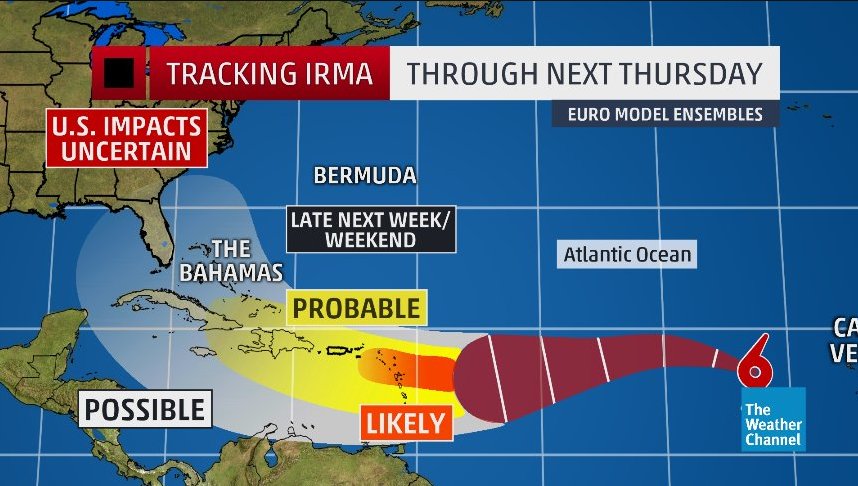
Hurricane Irma is a monster storm. Here’s where it might be headed.

As the remnants of what was once Hurricane Harvey move mercifully away from Texas, forecasters are already eyeing another monster storm.

Hurricane Irma formed early Wednesday in the warm waters off the coast of West Africa — and took just 30 hours to strengthen to a Category 3. That’s the fastest intensification rate in almost two decades. By Friday afternoon, the storm had also grown noticeably larger in size with a well-defined eye, a classic sign of a strong hurricane.

Though Irma poses no immediate threat to land, the outlook is ominous: In the Atlantic, Irma is expected to pass through some abnormally warm waters — the primary fuel source for storm systems. The official National Hurricane Center forecast says it will remain at major hurricane status for at least the next five days, and, in a worst-case scenario, Irma could eventually grow into one of the strongest hurricanes ever seen in the Atlantic.

That assessment is leaving forecasters and coastal residents understandably jittery. A hurricane this far out at sea normally wouldn’t draw this much attention, but Harvey’s floodwaters are still receding, leaving behind historic damage in Texas and Louisiana. This is not a normal situation.

Irma is “starting to give me that uncomfortable feeling in my gut,” wrote meteorologist Brendan Moses on Twitter. Another meteorologist, Michael Ventrice, said some of the initial modeling of Irma output “the highest windspeed forecasts I’ve ever seen in my 10 yrs of Atlantic hurricane forecasting.” Even the National Hurricane Center forecaster tasked with constructing the storm’s official forecast was surprised by how “uncommonly strong” Irma already is.

Hurricane Irma is what meteorologists call a “Cape Verde hurricane,” named after the African island nation just west of Senegal — an infamous late-summer breeding ground for powerful long-track storms. Some of the most notorious hurricanes ever to make U.S. landfall were born near where Irma generated.

Only about 15 percent of Cape Verde hurricanes directly strike the United States, so there’s no guarantee that Irma will. Since any potential landfall is still almost two weeks away and could take place anywhere from Texas to Maine, there’s not much for people to do right now except monitor the storm’s progress — and speculate.

On Friday, the National Weather Service warned of “fake forecasts” that are circulating widely on social media. But even established forecasting outlets have begun to share (rather cautiously) long-range graphics that show Irma threatening the U.S.

Meteorologists won’t have even a ballpark estimate of where Irma might make landfall or how strong it will be until early next week at the soonest. It will probably take a few more days to refine those forecasts enough to confidently call for preparedness actions.

But as of Friday, the most likely scenarios for Irma aren’t looking good.

Florida and the Caribbean: Historically, Florida is the state most likely to be hit by a hurricane in September. Recent runs of the European model, the weather model with the greatest historical accuracy, showed a swath of the southeast coast from the Florida Keys to southern Virginia as the most likely area where Irma would make landfall. On the way, it could pass close to the islands of the northeast Caribbean.
Northeast: A few recent model runs show Irma curving northward off the East Coast, potentially affecting the mid-Atlantic or New England. The large-scale North American weather pattern over the next 10 days may become especially chaotic due to a dwindling typhoon in the Pacific (the atmosphere is one giant connected system, after all), so it’s possible an unpredictable dip in the jet stream could steer Irma inland.
Gulf of Mexico: Should a high-pressure area over the western Atlantic remain in place, Irma could scoot underneath it, passing through the northern edge of the Caribbean and into the Gulf of Mexico. With the Gulf coast already devastated by Harvey, it’s a potentially tragic scenario that can’t yet be ruled out.
Out to sea: Most hurricanes that form where Irma did don’t make landfall in the United States at all. They safely curve out to sea. If we’re lucky, Irma might do the same.

It’s peak hurricane season, so it’s no surprise to see another strong storm spinning across the Atlantic. But with Irma’s path still to be determined, the best place to focus our attention now is on helping soothe the disaster that’s already happened in Texas and Louisiana.

See original article: 

Hurricane Irma is a monster storm. Here’s where it might be headed.

Posted in alo, Anchor, FF, G & F, GE, ONA, The Atlantic, Uncategorized | Tagged , , , , , , , , , , | Comments Off on Hurricane Irma is a monster storm. Here’s where it might be headed.

Need a break from political news? Hey, look, the ocean!

We’ve seen big declines in wild bee populations. That’s not just bad for the fuzzy little bees; it could drive up prices for almonds, blueberries, and other pollinator-dependent treats.

The challenge is knowing what would help them. Do we focus on preserving habitat and flowers? Or should we focus on certain pesticides? Is climate change behind this, too? It’s hard to say because bees are hard to study. It’s relatively easy to count long-legged pronghorns or wide-winged condors compared to counting the gnat-sized Perdita minima, the world’s tiniest bee.

That’s why a research team at the University of Missouri has been putting little microphones in alpine meadows. When those mics record buzzing, the team’s software analyzes the noise to tell scientists the number and species of bees visiting. They just published a paper, showing that their methods work.

This breakthrough could allow regular folks to collect solid scientific data from the safety of their porch. Farmers could “monitor pollination of their orchards and vegetable crops and head off pollination deficits,” said Candace Galen, a biological science professor who led the university’s research team, in a news release.

Interested? The group is working on an app that would let you collect bee data with your smartphone.

Original article: 

Need a break from political news? Hey, look, the ocean!

Posted in alo, Anchor, Everyone, FF, G & F, GE, LG, ONA, Ringer, Uncategorized | Tagged , , , , , , , , , | Comments Off on Need a break from political news? Hey, look, the ocean!