Tag Archives: news

The lessons FEMA says it learned from Hurricane Maria

It’s been nine months since Maria devastated Puerto Rico. After more than $90 billion in damage and an astronomical death toll, there are strong criticisms of the Federal Emergency Management Agency’s response to the storm.

A planning document revealed that before Maria, FEMA underestimated the role that federal authorities would need to play if a catastrophic hurricane hit the island. As a result, the agency relied heavily on strapped local resources in a territory beset for years by an economic crisis.

“We must hold the federal government accountable for their response to the communities they are responsible to serve,” Hispanic Federation Senior Vice President Frankie Miranda said on a recent call hosted by the Power 4 Puerto Rico Coalition. “What we know from the groups working on the ground is that the federal response was uncoordinated, ineffective and, in many cases, even criminal.”

Now, as hurricane season kicks off again, there are deep fears about what will happen if another big one hits. And in an audio recording of a private meeting between President Trump and FEMA obtained by the Washington Post, the president’s conversation on everything from aircraft carriers to “clean coal” seemed to indicate that his priorities are far from Puerto Rico and how to protect Americans from this year’s hurricanes.

In an email to Grist, FEMA acknowledged that the agency can do better. The storms of 2017, a spokesperson wrote, illustrate that there’s much to be done “across the country at all levels of government” to prepare the U.S. for future hurricanes.

FEMA sent Grist some of its “lessons learned” from Hurricane Maria. We asked experts in emergency management and on Puerto Rico to weigh in on the priorities the agency outlined.

Engaging the community in public health

According to a death toll released by Harvard researchers last week, Hurricane Maria may have been one of the deadliest disasters in U.S. history — with up to 5,740 people perishing in the storm and its aftermath. The study found that one of the culprits behind such an astronomically high number of fatalities was lack of access to medical care — like breathing machines, which failed when electricity was lost.

So it’s no surprise that FEMA is reportedly focused on making sure people get the healthcare they need come the next storm. The agency says it’s reinforcing Puerto Rico’s healthcare systems, beefing up behavioral and mental health services, and working on plans for emergency oxygen backups.

The priorities FEMA outlined for Grist are broad, and the experts we spoke with emphasized that the devil will be in the details. “There’s a gap in terms of the stated goals and the specific measures within the public health system in Puerto Rico,” says Edwin Meléndez, director for the Center for Puerto Rican Studies at Hunter College. “How are the local authorities, the private hospitals, involved in this particular approach? How are they sharing goals and what is their implementation plan?”

Restoring power

Today, more than 60,000 people — nearly 5 percent of the island — are still without power. And in May, FEMA announced that the U.S. Army Corps of Engineers would be turning the job of restoring downed power lines back over to the embattled and bankrupt Puerto Rico Electric Power Authority.

Experts agree that one of the biggest challenges is building back Puerto Rico’s ailing power grid to be more reliable than it was before. “Puerto Rico had experienced brownouts prior to the storm,” says Mike Sprayberry, president of the National Emergency Management Association. “The distribution lines were not well maintained, and then they get hit by this storm.”

So fixing Puerto Rico’s aging energy infrastructure will take more than just FEMA. But in the meantime, the agency is shoring up the number of backup generators it has available in the event of another catastrophic storm. The island was in seriously short supply of generators prior to Hurricane Maria.

“This has been the largest disaster generator mission in U.S. history with 1,667 generators installed to support the weakened power grids,” FEMA writes to Grist.

And relying too much on generators creates new challenges. “Having the generators in place is great, but what is the access to reliable and consistent fuel going to be? That’s going to be fundamental for the hospitals,” says Martha Thompson, Oxfam America’s program coordinator for disaster response in Puerto Rico.

Ivis Garcia Zambrana, a professor at the University of Utah, argues for more solar power instead of the expensive, and polluting, generators. “Generators are not good for people that are lower-income,” she says. “There must be ways of working towards more sustainability.”

Working on smarter aid distribution

With only one warehouse in the Caribbean prior to Hurricane Maria, FEMA struggled to distribute supplies across the territory in the wake of Hurricane Irma (which hit just weeks earlier).

FEMA now says that its warehouse capacity in Puerto Rico has increased from 84,295 to 315,000 square feet. It plans to stock six times as much water and generators this year compared to 2017, seven times as many meals, and eight times as many tarps.

So next time, the agency will just have to get those supplies to people in rural areas. “Whether they have taken measures to have preparedness across the regions — specifically in more isolated areas on the inside of the island — is something we haven’t seen data for yet,” says Meléndez with the Center for Puerto Rican Studies.

Beefing up communications and trainings

The storm crippled communications on the island, making it nearly impossible for residents to communicate with loved ones or authorities. It hampered recovery efforts, too, as emergency responders struggled to coordinate with one another due to downed cellphone towers.

Now, FEMA tells Grist it’s working with Puerto Rican agencies to create and test better emergency alert systems. And it’s developing a public outreach plan to ensure communication lines stay open.

“If you don’t have communications, you don’t know what people need,” says Sprayberry with the National Emergency Management Association. “You can really mismanage commodities.”

What FEMA’s not talking about

Puerto Rico’s struggling economy and global warming’s contributions to extreme weather phenomena, like Maria, are two elements FEMA doesn’t appear to be factoring in to future emergencies. When it released its strategic plan this spring, FEMA managed to omit any mention of climate change — which the agency openly addressed during the Obama administration.

But former FEMA administrator, Craig Fugate, assures us that career officials in the agency are still taking this into mind, albeit surreptitiously. “Apparently, it got cut out,” he says. “But if you look at what they’re doing, they’re in effect addressing climate change without saying it.”

Fugate, along with all the experts Grist spoke with, stresses the importance of building back a more resilient Puerto Rico.

“The problem is, if you’re just responding to disasters, they’re getting bigger and bigger,” Fugate explains. “And if you’re really going to change the outcome, it isn’t focusing on improving the response — that’s important, but it kind of misses the point.

“Why are we not doing more to reduce the impacts of disaster?”

Continue reading – 

The lessons FEMA says it learned from Hurricane Maria

Posted in alo, ALPHA, Anchor, FF, G & F, GE, LAI, LG, ONA, solar, solar power, Uncategorized | Tagged , , , , , , , , , , , | Comments Off on The lessons FEMA says it learned from Hurricane Maria

Here’s the one dude defending Trump’s latest bid to save coal

President Trump keeps trying to make coal happen. Last week, he told Energy Secretary Rick Perry to extend a lifeline to unprofitable coal and nuclear plants that are struggling to survive while competing against natural gas plants and renewables.

The rationale for propping up these plants? We might need their power soon. The United States keeps shutting down old power plants and some worry we’re losing too much too fast. In an op-ed  supporting Trump’s move, Terry Jarrett, a former regulator of Missouri’s utilities, argues we’re going to be sorry we don’t have that extra capacity.

Jarrett points out a Department of Energy finding that without coal plants, the Eastern U.S. would have suffered serve electricity shortages and blackouts during last winter’s “bomb cyclone.”

Blackouts aren’t just inconvenient and expensive — as we saw in Puerto Rico, they can be deadly. Without electricity, pumps stop pushing water into houses, sewage systems back up, and ventilators flatline in hospitals.

That study Jarrett cites notes that during the harsh weather, congestion in pipelines kept natural gas plants from ramping up, while wind and solar generation faltered. But does that mean blackouts are more likely if we don’t bail out coal and nuclear plants? Not according to another DOE study, which concluded that retiring old plants and building a diverse set of new plants actually would make the energy system more resilient.

Federal Energy Regulatory Commissioner Richard Glick cited this second study while rejecting the Trump administration’s last bid to save unprofitable plants in January. “There is no evidence in the record to suggest that temporarily delaying the retirement of uncompetitive coal and nuclear generators would meaningfully improve the resilience of the grid,” Glick wrote. Trump appointed Glick, and all but one of the other FERC commissioners (they may thwart this new proposal as well).

This proposal is unpopular not just among Trump appointees, but also fossil fuel companies, and utilities, along with the renewables industry and environmental groups (obviously).

Although there are some environmentalists, like those at Third Way, who favor subsidizing nuclear plants, they aren’t buying the assertion that we’ll have blackouts if we don’t we keep old nuclear and coal plants running.

So there’s a ridiculously broad coalition of interests saying this is a dumb idea. It’s harder to find people supporting this idea, whether they care about climate change or not. It’s probably safe to say that Jarrett, who likes to tweet articles from climate denier websites, belongs to the latter category.

View original post here: 

Here’s the one dude defending Trump’s latest bid to save coal

Posted in alo, ALPHA, Anchor, FF, GE, ONA, solar, Uncategorized | Tagged , , , , , , , , , , | Comments Off on Here’s the one dude defending Trump’s latest bid to save coal

This natural gas plant could be a big breakthrough

Yesterday, the startup Net Power switched on its 50-megawatt power plant, proving it could burn natural gas without releasing greenhouse gases. If this technology works at scale, it could be the flexible, emissions-free lynchpin the world needs to reverse climate change.

That’s a big “if” of course. After the engineering challenge comes the market challenge: We could make a laundry list of promising energy sources that launch to great excitement, then struggle for years to compete against the incumbent technologies (see cellulosic ethanol).

Net Power captures the carbon dioxide given off as gas burns. That’s the same thing done by carbon capture and sequestration plants already in existence. But the crucial difference here is that carbon capture and sequestration usually uses a lot of energy (and money) to separate the carbon molecules out of all the other gases and particles in a plant’s exhaust.

Net Power uses an elegant trick to simplify the process (David Roberts explains the basics here) so that its exhaust is nearly pure carbon dioxide, which it can capture in its entirety. And the company says it can do all that while operating more cheaply than the best existing gas plants.

The next step? The company is in the process of developing a 300-megawatt plant, which would start providing electricity by 2021 at the earliest.

As the United States has built solar panels and wind turbines, natural gas has expanded even more. The fuel’s ability to cheaply ramp up and down with fluctuations in electric supply and demand have made it an apt partner for renewable energy. If it could do that without adding insulation to the Earth’s heat-trapping jacket, it would provide us a much-needed reprieve.

Original source – 

This natural gas plant could be a big breakthrough

Posted in alo, ALPHA, Anchor, FF, GE, LAI, ONA, PUR, solar, solar panels, Uncategorized | Tagged , , , , , , , , , , | Comments Off on This natural gas plant could be a big breakthrough

Republican mayors push climate action without saying ‘climate change’

Leadership in addressing climate change in the United States has shifted away from Washington, D.C. Cities across the country are organizing, networking, and sharing resources to reduce their greenhouse gas emissions and tackle related challenges ranging from air pollution to heat island effects.

But group photos at climate change summits typically feature big-city Democratic mayors rubbing shoulders. Republicans are rarer, with a few notable exceptions, such as Kevin Faulconer of San Diego and James Brainard of Carmel, Indiana.

Faulconer co-chairs the Sierra Club’s Mayors for 100 Percent Clean Energy Initiative, which rallies mayors around a shared commitment to power their cities entirely with clean and renewable energy. Brainard is a longtime champion of the issue within the U.S. Conference of Mayors and the Climate Mayors network.

In our research at the Boston University Initiative on Cities, we found that large-city Republican mayors shy away from climate network memberships and their associated framing of the problem. But in many cases they advocate locally for policies that help advance climate goals for other reasons, such as fiscal responsibility and public health. In short, the United States is making progress on this issue in some surprising places.

Climate network members are mainly Democrats

In our initiative’s recent report, “Cities Joining Ranks,” we systematically reviewed which U.S. cities belong to 10 prominent city climate networks. These networks, often founded by mayors themselves, provide platforms to exchange information, advocate for urban priorities and strengthen city goverments’ technical capacities.

The networks we assessed included Climate Mayors; We Are Still In, which represents organizations that continue to support action to meet the targets in the Paris climate agreement; and ICLEI USA.

We found a clear partisan divide between Republican and Democrat mayors. On average, Republican-led cities with more than 75,000 residents belong to less than one climate network. In contrast, cities with Democratic mayors belonged to an average of four networks. Among the 100 largest U.S. cities, of which 29 have Republican mayors and 63 have Democrats, Democrat-led cities are more than four times more likely to belong to at least one climate network.

This split has implications for city-level climate action. Joining these networks sends a very public signal to constituents about the importance of safeguarding the environment, transitioning to cleaner forms of energy, and addressing climate change. Some networks require cities to plan for or implement specific greenhouse gas reduction targets and report on their progress, which means that mayors can be held accountable.

Constituents in Republican-led cities support climate policies

Cities can also reduce their carbon footprints and stay under the radar — a strategy that is popular with Republican mayors. Taking the findings of the “Cities Joining Ranks” report as a starting point, I explored support for climate policies in Republican-led cities and the level of ambition and transparency in their climate plans.

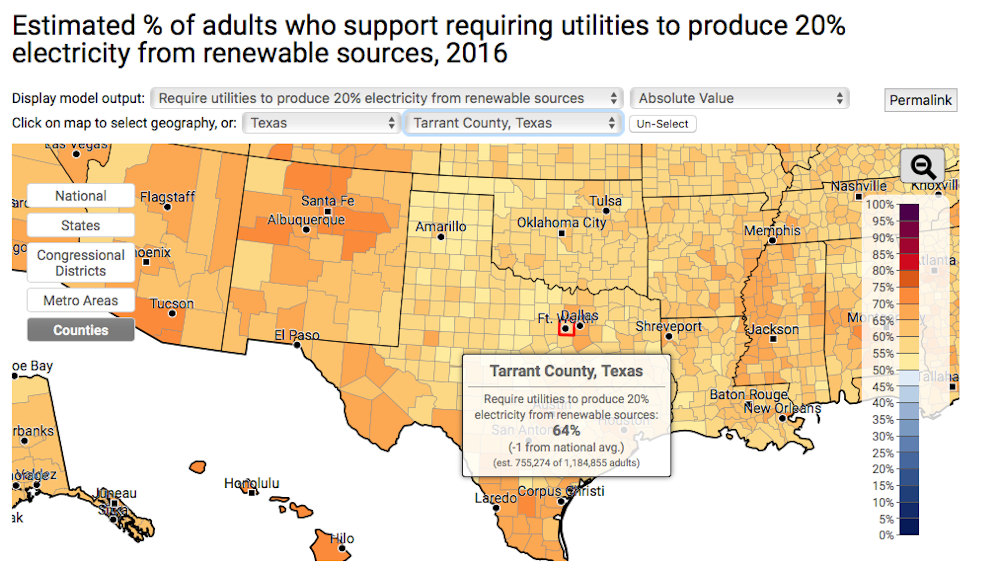
To tackle these questions, I cross-referenced Republican-led cities with data from the Yale Climate Opinion maps, which provide insight into county-level support for four climate policies:

Regulating carbon dioxide as a pollutant
Imposing strict carbon dioxide emission limits on existing coal-fired power plants
Funding research into renewable energy sources
Requiring utilities to produce 20 percent of their electricity from renewable sources

In all of the 10 largest U.S. cities that have Republican mayors and also voted Republican in the 2008 presidential election, county-level polling data showed majority support for all four climate policies. Examples included Jacksonville, Florida, and Fort Worth, Texas. None of these cities participated in any of the 10 climate networks that we reviewed in our report.

Yale Program on Climate Change Communication, CC BY-ND

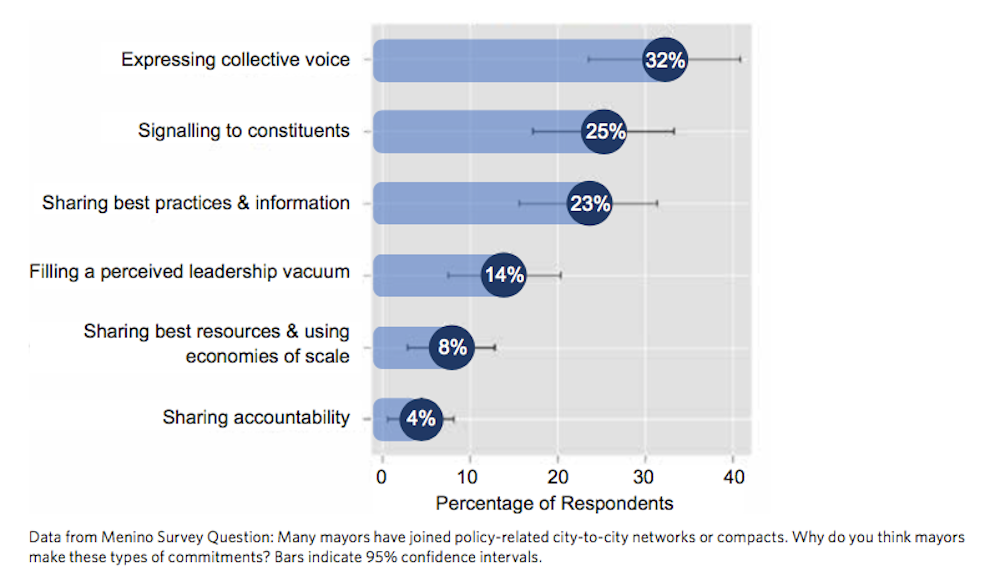
This finding suggests that popular support exists for action on climate change, and that residents of these cities who advocate acting could lobby their elected officials to join climate networks. Indeed, we have found that one of the top three reasons mayors join city policy networks is because it signals their priorities. A mayor of a medium-sized West Coast city told us: “Your constituents are expecting you to represent them, so we are trying politically to be their voice.”

Mayors join networks to amplify their message, signal priorities to constituents, and share information. BU Initiative on Cities, CC BY-ND.

Climate-friendly strategies, but few emissions targets

Next, I reviewed planning documents from the 29 largest U.S. cities that are led by Republican mayors. Among this group, 15 have developed or are developing concrete goals that guide their efforts to improve local environmental quality. Many of these actions reduce cities’ carbon footprints, although they are not primarily framed that way.

Rather, these cities most frequently cast targets for achieving energy savings and curbing local air pollution as part of their master plans. Some package them as part of dedicated sustainability strategies.

These agendas often evoke images of disrupted ecosystems that need to be conserved, or that endanger human health and quality of life. Some also spotlight cost savings from designing infrastructure to cope with more extreme weather events.

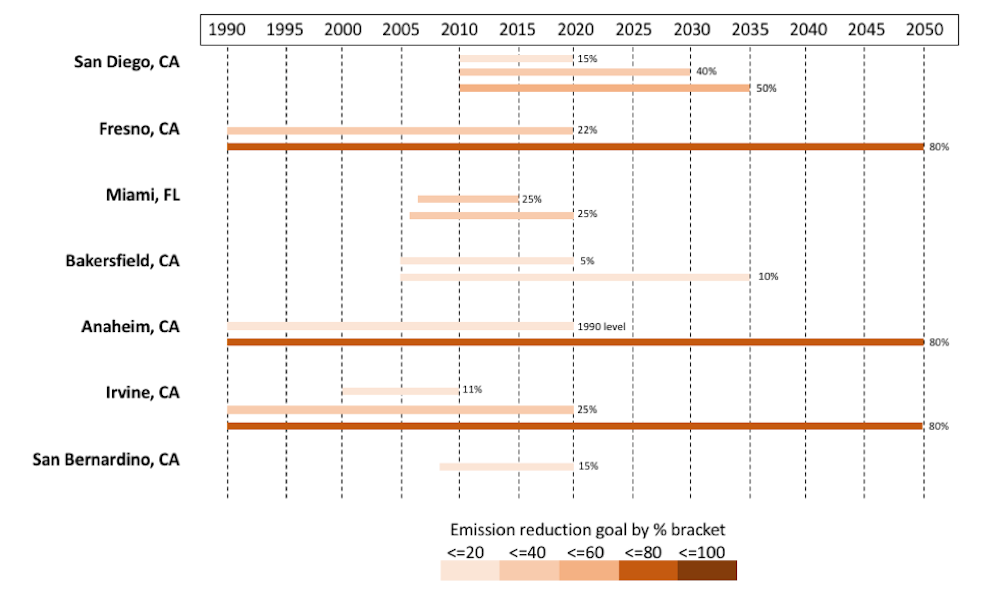
In contrast, only seven cities in this group had developed quantitative greenhouse gas reduction targets. Except for Miami, all of them are in California, which requires its cities to align their greenhouse gas reduction targets with state plans. From planning documents, it appears that none of the six Californian cities goes far beyond minimum mandated emission reductions set by the state for 2020.

Greenhouse gas reductions goals, with baselines, for the seven largest Republican-led cities. Nicolas Gunkel, CC BY-ND.

Watch what they do, not what they say

The real measure of Republican mayors taking action on climate change is not the number of networks they join but the policy steps they take, often quietly, at home. While few Republican mayors may attend the next round of subnational climate summits, many have set out policy agendas that mitigate climate change, without calling a lot of attention to it — much like a number of rural U.S. communities. Focusing narrowly on policy labels and public commitments by mayors fails to capture the various forms of local climate action, especially in GOP-led cities.

Carmel, Indiana Mayor James Brainard has suggested that some of his less-outspoken counterparts may fear a backlash from conservative opinion-makers. “There is a lot of Republicans out there that think like I do. They have been intimidated, to some extent, by the Tea Party and the conservative talk show hosts,” Brainard has said.

Indeed, studies show that the news environment has become increasingly polarized around accepting or denying climate science. Avoiding explicit mention of climate change is enabling a sizable number of big-city GOP mayors to pursue policies that advance climate goals.

See the original post:  

Republican mayors push climate action without saying ‘climate change’

Posted in alo, ALPHA, Anchor, FF, GE, LG, ONA, PUR, solar, Uncategorized | Tagged , , , , , , , , , | Comments Off on Republican mayors push climate action without saying ‘climate change’

Hurricane Maria was so much worse than we thought

People in Puerto Rico have endured the devastation left behind by Hurricane Maria since the storm hit 8 months ago, with many still struggling to get clean water and medical care. Now there’s evidence that the death toll from Maria and its aftermath has been far worse than previously thought

An independent analysis from public health experts at Harvard University estimates that 5,740 people likely died as a result of Hurricane Maria — 90 times higher than the official government estimate of 64 dead. The new estimate, published on Tuesday in the New England Journal of Medicine, would make Maria the deadliest U.S. natural disaster in more than a century — more than twice as deadly as Hurricane Katrina.

The enormous distance between the new estimate and the government’s official count can be blamed on the persistence of horrific living conditions and government neglect following the hurricane. The new study was based on a household survey conducted in the weeks and months following the storm. The storm’s winds and floods account for just 10 percent of Maria’s total deaths, according to the study — most of the dead perished from lack of medical care long after the water receded.

As a storm, Maria achieved a lot of “worsts”. It was one of the strongest hurricanes ever to make landfall in the United States. It caused the largest blackout in U.S. history and the second largest in world history. The loss of power meant many Puerto Ricans had to struggle for basic necessities — the storm shuttered hospitals and restricted access to fresh food and clean water for millions of people. In some cases, people resorted to drinking water from streams contaminated with toxic waste and raw sewage — simply because there was no other option. The result was one of the worst humanitarian crises in U.S. history.

“Interruption of medical care was the primary cause of sustained high mortality rates in the months after the hurricane,” wrote the study’s authors. Hundreds of thousands of people have left the island since the storm, one of the largest mass migrations in recent U.S. history — a possible preview of the kinds of shocks that might occur more frequently as climate change supercharges storms.

These conditions have been widely reported for months, but the federal government’s response has yet to match the scale of the challenge — leading to preventable deaths. The results of the new study “underscore the inattention of the U.S. government to the frail infrastructure of Puerto Rico,” according to its authors.

On his only visit to post-storm Puerto Rico back in October, President Donald Trump praised his administration’s response, saying that Puerto Ricans should be “proud” that the death toll wasn’t as large as “a real catastrophe like Katrina.”

The new study means that Maria is now the deadliest hurricane since 1900 in the United States, when a hurricane killed 8,000 people in Galveston, Texas. Hurricane Katrina’s official death toll was 1,833 people, though follow-up surveys conducted in the years following the 2005 storm showed that hundreds more likely died. There have been previous efforts at estimating the true scale of Maria’s death toll, but the Harvard survey is the most comprehensive so far. The truth is, we’ll probably never know exactly how many people died because of Hurricane Maria.

In a series of tweets in Spanish and English, San Juan Mayor Carmen Yulín Cruz, responded to the study’s findings. “It took too long to understand the need for an appropriate response was NOT about politics but about saving lives,” she wrote. “Now will the government believe it?”

Cruz has repeatedly called for more assistance for hurricane victims, but has been criticized directly by Trump for “poor leadership.”

The Harvard survey may still be an underestimate, in part because “mortality rates stayed high” through December, when its data collection process ended. Tens of thousands of people are still without clean water and electricity, according to the government’s latest numbers. By all accounts, the humanitarian crisis started by Hurricane Maria continues. It’s going on right now. And, more storms are on the way: a new hurricane season starts on Friday.

It’s a safe assumption that people are still dying because of a storm that hit in late September, last year.

Jump to original – 

Hurricane Maria was so much worse than we thought

Posted in alo, ALPHA, Anchor, FF, GE, LG, ONA, Safer, Uncategorized, Venta | Tagged , , , , , , , , , , , | Comments Off on Hurricane Maria was so much worse than we thought

How the fossil fuel industry drums up grassroots support

Over the past several months, scores of people showed up to public meetings in New Orleans in support of building a natural-gas power plant. It turns out that as many as 100 of them were paid to be there.

The Lens, an investigative news site, recently reported that people were paid $60 to attend and $200 to speak. Entergy, the company behind the power plant, said that it hadn’t authorized the payments, but it did take some responsibility. After an internal investigation, the company said that it had contracted with a public affairs firm, the Hawthorn Group, which then subcontracted another group, Crowds on Demand, to hire the supporters. Grist called and emailed Entergy for a comment and has yet to get a response.

It’s a prime example of astroturfing, the practice of creating an image of grassroots support for a cause. And while this case may seem shocking, maybe it shouldn’t. Astroturfing in the U.S. dates back nearly a century, and energy companies have a history of getting involved in it through public affairs firms.

“The energy sector has always been relatively active in this,” says Edward Walker, a sociology professor at University of California, Los Angeles who wrote a book about how public affairs consultants drum up grassroots support. He traces the roots of astroturfing back to the 1930s with Campaigns, Inc., the world’s first political consulting firm, which also worked for oil companies.

In the 1970s and 1980s, the number of public affairs consulting firms ballooned, Walker says. “Corporate America was really back on its heels during that period,” he explains, “and started to figure, well, we need to be doing a lot of the same things that the social movements and activist groups and labor unions have been doing.”

Astroturfing is supposed to stay hidden. But some companies have been exposed doing it. In 2009, Greenpeace obtained a memo detailing the American Petroleum Institute’s plans to recruit “Energy Citizens” for rallies opposing legislation to cut carbon dioxide emissions and promote cleaner energy. A few days later, Grist got a list of 21 planned “Energy Citizen” events and found that most were planned by lobbyists, many of whom worked for API or its local affiliates.

That same year, the lobbying group Bonner & Associates forged letters against American Clean Energy and Security Act of 2009, also known as the Waxman-Markey climate bill, which would have established a national cap-and-trade program. At least twelve letters were sent to Democrats in the House of Representatives, appearing to be signed by a number of groups, including a local chapter of the NAACP. In one, the firm assumed the identity of Creciendo Juntos, a nonprofit network that tackles issues in Charlottesville’s Latinx community, and sent it to House Representative Tom Perriello. It turned out the lobbying firm had been working for the American Coalition for Clean Coal Electricity, an industry-backed outfit working with Hawthorn Group — yup, the same one tied up in the recent New Orleans case — which contracted Bonner & Associates.

The cap-and-trade bill was passed by the House but eventually died in the Senate.

Climate Investigations Center director Kert Davies thinks astroturfing happens more often than people realize. “I would assume the best of it we never see,” he says. “That’s what it’s intended to be: invisible. So there’s probably a lot happening, or that has happened, to people that they’ve never known about.”

About 40 percent of Fortune 500 companies were clients of at least one of these so-called “grassroots lobbying” firms when Walker crunched the numbers back in 2007, he says. “The practices are incredibly widespread. That’s not to say that everyone’s doing astroturfing.” Sometimes corporations work with firms to mobilize their employees or shareholders — it’s not necessarily about generating the illusion of public support.

In the New Orleans case, The Lens couldn’t find any laws preventing the pro-power plant campaign. But the practice sure looks unethical, Davies says, according to the industry’s own code of ethics. The Public Relations Society of America’s code specifically rules out creating fake grassroots campaigns.

The New Orleans City Council approved Entergy’s plant in March, before reports revealed the astroturfing efforts. Community groups have pushed for an investigation and a re-hearing on the decision. The council has also decided to hire a third-party to investigate and has ordered the company to hand over documents that support their internal investigation.

Read this article: 

How the fossil fuel industry drums up grassroots support

Posted in alo, ALPHA, Anchor, Citizen, Everyone, FF, GE, LAI, ONA, Safer, Uncategorized | Tagged , , , , , , , | Comments Off on How the fossil fuel industry drums up grassroots support

Scott Pruitt introduced anti-abortion bills giving men ‘property rights’ over fetuses

This story was originally published by HuffPost and is reproduced here as part of the Climate Desk collaboration.

In 1999, Scott Pruitt, then an Oklahoma state senator, introduced a bill to grant men “property rights” over unborn fetuses, requiring women to obtain the would-be father’s permission before aborting a pregnancy.

Pruitt, now the embattled administrator of the Environmental Protection Agency, submitted the legislation again in 2005.

The bill, which did not pass either time, faded from Pruitt’s political legacy. But the legislation merits new examination as the EPA chief faces down an avalanche of corruption accusations. As HuffPost previously reported, Pruitt’s support from right-wing evangelical Christians, a group that largely opposes abortion, has helped him keep his job amid calls from droves of Democrats and a handful of Republicans to fire the administrator.

Dear reader, like what you see here?

Keep Grist’s green journalism humming along by supporting us with a donation today. Your gift will help us fight for a planet that doesn’t burn and a future that doesn’t suck.

Support Grist   

And while his current role atop the EPA does not give him any official control over abortion policy, he has appeared alongside President Donald Trump in meetings with evangelical leaders, and his draconian history on the issue is of a piece with the administration. In one of Trump’s first acts after taking office, he reinstated and expanded the Reagan-era “global gag rule,” withholding federal funding from charities and aid organizations that counsel women on family planning options that include abortion. Last week, the White House proposed a new “domestic gag rule” that would strip Planned Parenthood of funding.

“It’s not surprising that another member of Trump’s inner circle is hostile to women,” said Dawn Huckelbridge, a senior director at the progressive super PAC American Bridge, which opposes Pruitt and supports abortion rights. “But framing a fetus as a man’s property is a new low.”

American Bridge resurfaced the legislation and shared it with HuffPost. The EPA did not respond to a request for comment.

Pruitt has spent his 15 months at the EPA pushing to keep government out of the private sector. He’s sought to radically deregulate the fossil fuel and chemical industries, clear the way for companies to produce more asthma-triggering pollution, allow deadly chemicals to remain on the market, and revise restrictions on teenage workers handling dangerous pesticides.

By contrast, the bill from his time as a state legislator stated that “it is the responsibility of the state to ensure that no person shall be deprived of life, liberty, or property, without due process of law,” referring to a “fetus” as “property” that has been “jointly created by both father and mother.”

The legislation would have barred doctors from performing abortions without signed statements of permission from the father, or evidence that the man could not be located “after diligent effort.” If the pregnancy resulted from rape, the woman would be required to show “such assault has been reported to a law enforcement agency having the requisite jurisdiction.”

Doctors who performed the procedure without that documentation would have risked losing their medical licenses, been “civilly liable to the father of the aborted child for any damages caused thereby,” and had to pay punitive fines of $5,000.

In a statement to The Associated Press in 1999, Pruitt said a pregnant woman who were to obtain an abortion without meeting the bill’s criteria would face legal consequences. “She’ll be held accountable for it,” Pruitt said.

Pruitt also sought to restrict abortion in other ways. In 2001,when the legislature was considering a bill to require that pregnant minors show parental permission before obtaining an abortion, he introduced an amendment to define a “fetus” as “any individual human organism from fertilization until birth.”

The timing of the bills came nearly a decade after the Supreme Court issued its landmark decision in Planned Parenthood v. Casey, in which it ruled that provisions requiring a woman to obtain her husband’s permission for an abortion were unconstitutional.

“He doesn’t agree with the court’s not viewing women as property and also doesn’t believe in the intellectual concept that women should have agency over their own reproductive choices,” said Leslie McGorman, deputy director at the advocacy group NARAL Pro-Choice America. “Frankly there’s not a whole lot more to tell except that he is the guy who his record indicates he is.”

“He carries that lack of concern for the greater good throughout all of the things he’s done in his career,” she added, referring to his rollback of environmental safeguards.

Until 2017, Pruitt served on the board of trustees at the Southern Baptist Theological Seminary in Louisville, Kentucky, an institution that has said “a wife is to submit herself graciously” to her husband. Around the time he first introduced the abortion bill, in 1999, Pruitt served on the board of the MEND Medical Clinic and Pregnancy Resource Center. Its current executive director, Forrest Cowan, has said unwed mothers have been “failed” by a “boyfriend, who values his own selfish gratification over responsibility, and her father, who should have had her back.”

Pruitt’s crusade against abortion rights continued after he left the state senate to become Oklahoma’s attorney general. When a district court found a law requiring women to undergo an ultrasound before an abortion to be unconstitutional, Pruitt appealed the decision to the Oklahoma Supreme Court. After losing there, he unsuccessfully petitioned the U.S. Supreme Court to take the case.

In 2012, The Tulsa World excoriated Pruitt in an editorial for wasting “more taxpayer money … on this misguided effort to control doctor-patient interaction and the practice of medicine — but only when women are concerned.”

Link to original:

Scott Pruitt introduced anti-abortion bills giving men ‘property rights’ over fetuses

Posted in alo, ALPHA, Anchor, FF, GE, Landmark, ONA, solar, Uncategorized | Tagged , , , , , , , , , , , | Comments Off on Scott Pruitt introduced anti-abortion bills giving men ‘property rights’ over fetuses

A building El Niño in 2018 signals more extreme weather for 2019

In case you couldn’t get enough extreme weather, the next 12 months or so could bring even more scorching temps, punishing droughts, and unstoppable wildfires.

It’s still early, but odds are quickly rising that another El Niño — the periodic warming of the tropical Pacific Ocean — could be forming. The latest official outlook from NOAA and Columbia University gives better-than-even odds of El Niño materializing by the end of this year, which could lead to a cascade of dangerous weather around the globe in 2019.

That’s a troubling development, especially when people worldwide are still suffering from the last El Niño, which ended two years ago.

Dear reader, like what you see here?

Keep Grist’s green journalism humming along by supporting us with a donation today. Your gift will help us fight for a planet that doesn’t burn and a future that doesn’t suck.

Support Grist   

These early warnings come with a caveat: Predictions of El Niño at this time of year are notoriously fickle. If one comes, it’s impossible to know how strong it would be.

When it’s active, El Niño is often a catch-all that’s blamed for all sorts of wild weather, so it’s worth a quick science-based refresher of what we’re talking about here:

El Niño has amazingly far-reaching effects, spurring droughts in Africa and typhoons swirling toward China and Japan. It’s a normal, natural ocean phenomenon, but there’s emerging evidence that climate change is spurring more extreme El Niño-related events.

On average though, El Niño boosts global temperatures and redistributes weather patterns worldwide in a pretty predictable way. In fact, the Red Cross is starting to use its predictability to prevent humanitarian weather catastrophes before they happen.

All told, the the U.N. estimates the 2016 El Niño directly affected nearly 100 million people worldwide, not to mention causing permanent damage to the world’s coral reefs, a surge in carbon dioxide emissions from a global outbreak of forest fires, and the warmest year in recorded history.

In Ethiopia, it spawned one of the worst droughts in decades. More than 8.5 million Ethiopians continue to rely on emergency assistance, according to the UN. That includes some 1.3 million people — a majority of whom are children — who have been forced to migrate from their homes.

Initial estimates show that, if the building El Niño actually arrives, 2019 would stand a good chance at knocking off 2016 as the warmest year on record. With a strong El Niño, next year might even tiptoe across the 1.5 degree-Celsius mark — the first major milestone that locks in at least some of global warming’s worst impacts.

Recently, the United Kingdom’s Met Office — the U.K’s version of the National Weather Service — placed a 10-percent chance of the world passing the 1.5 degree Celsius target before 2022. That target was a key goal of the 2015 Paris climate agreement because a sharp upward spike in temperature that severe, if sustained, would be potentially catastrophic — causing, among other impacts, “fundamental changes in ocean chemistry” that could linger for millennia, according to a draft UN report due out later this year.

Another El Niño is bad news, but it has been inevitable that another one will happen eventually. Knowing exactly when the next one is coming will give those in harm’s way more time to prepare.

Continue reading here:  

A building El Niño in 2018 signals more extreme weather for 2019

Posted in alo, ALPHA, Anchor, Cascade, FF, G & F, GE, LG, ONA, PUR, Uncategorized | Tagged , , , , , , , , , , | Comments Off on A building El Niño in 2018 signals more extreme weather for 2019

For 400 months in a row, our planet has been unusually hot

Our overheating planet just reached another staggering — maybe even astronomical — new milestone.

In a report out Thursday, NOAA confirmed that April was the 400th consecutive month of warmer-than-average global temperatures. The last month cooler than the 20th century average was December 1984, back in the days of big hair and Michael Jackson’s “Thriller.”

We’ve come a long way since then. Somehow, though, we’re still debating whether human activity is behind the warmer atmosphere, not to mention what the hell we’re going to do about it.

Either the last 400 months were all an incredible coincidence — we’ll get to that in a second — or something else is going on. I’m thinking it’s the latter.

Sure, there is a tiny chance that Earth just pulled off the most impressively unlikely feat ever. If you assume the odds of a particular month being warmer than average are 50 percent — what you’d expect in a stable climate — then the odds of 400 warm months in a row would be approximately one in 1 x 10^120. The name for such a number is a “novemtrigintillion” — a value bigger than the number of atoms that exist in a trillion universes.

Thanks to science (and common sense) we know the real reason: People burning stuff for energy, something that — lucky us! — we really don’t have to do anymore.

Excerpt from: 

For 400 months in a row, our planet has been unusually hot

Posted in alo, Anchor, FF, G & F, GE, ONA, Uncategorized | Tagged , , , , , , , , | Comments Off on For 400 months in a row, our planet has been unusually hot

California is turning farms into carbon-sucking factories

In a grand experiment, California switched on a fleet of high-tech greenhouse gas removal machines last month. Funded by the state’s cap-and-trade program, they’re designed to reverse climate change by sucking carbon dioxide out of the atmosphere. These wonderfully complex machines are more high-tech than anything humans have designed. They’re called plants.

Seriously, though: Plants breathe in carbon dioxide and breathe out oxygen. They break open the tough CO2 molecule and use the carbon to build their leaves and roots. In the process, they deposit carbon into the ground. For years people have excitedly discussed the possibility of stashing carbon in the soil while growing food. Now, for the first time, California is using cap-and-trade money to pay farmers to do it on a large scale. It’s called the California Healthy Soils Initiative.

In April, trucks full of fertilizer trundled into Doug Lo’s almond orchards near Gustine, California, and spread composted manure around his trees. He then planted clover to cover the ground between the trunks. In theory, these techniques will pull 1,088 tons of carbon out of the atmosphere every year. Lo’s is one of about fifty farms getting money from the state of California to pull greenhouse gas from the air. California is paying him $50,000 to try it out.

Dear reader, like what you see here?

Keep Grist’s green journalism humming along by supporting us with a donation today. Your gift will help us fight for a planet that doesn’t burn and a future that doesn’t suck.

Support Grist   

“We’re trying to sequester some carbon,” Lo said. “It should also help with the water-holding capacity of the soil, and the flowers in the cover crop should feed bees after the almond bloom is over.”

This is the first major utilization of farms as state-sponsored carbon-sucking factories. (To be fair, Oklahoma, of all places, has been experimenting with soil carbon since 2001, albeit on a smaller scale.) Agriculture and climate nerds — we wonkiest of wonks — have been anticipating this for the last decade as the scientific evidence accumulated.

In 2014 we wrote about the people pushing this research in California. And Grist told the story last year of how scientist Jonathan Sanderman put together key pieces of this puzzle after finding jars of old dirt, long forgotten in storage. And just recently, the New York Times Magazine ran a story summarizing the state of the science. But for years it’s felt like a lot of talk and not much action. That’s changing with the Healthy Soils Initiative, which makes money available for farmers like Lo, and monitors the results.

So how do you turn a farm into a carbon-sucking machine? Lo figured the money from the state would allow him to experiment without risk. He made a deal with a compost company to truck manure from dairies across California’s central valley then spread precisely 5.3 tons per acre under his almond trees as required by the state guidelines. An inspector from the California Department of Food and Agriculture showed up on the day the trucks arrived in April to make sure Lo was actually doing the work and not just doing the paperwork. Next, Lo planted clover and other cover crops in the rows between the trees.

A lot is riding on this, but it’s not a foregone conclusion that it will work. In theory, compost and cover crops should get carbon out of the sky and into the ground. But will it work in practice on Lo’s farm? With the farm’s particular soil structure, irrigation pattern, as well as the dirt’s microbiome? We don’t know how fast carbon will accumulate in his soil, or how long it will stay there.

When I asked Lo how confident he was that he was going to get exactly 1,088 tons of carbon into the ground he responded: “Well, that’s just what the soil scientists said. We’re going to see I guess!”

As of last Thursday the soil samples on Lo’s farm haven’t shown an increase in carbon content, but it takes about three years for compost to break down, he said. Other farmers and state officials will be watching this rollout of carbon-sucking farms closely. And if it works, and these farms manage to capture enough carbon, program could scale up massively. California’s Healthy Soils Initiative could serve as a model for other states.

Continue reading here:  

California is turning farms into carbon-sucking factories

Posted in alo, Anchor, Citizen, FF, G & F, GE, ONA, Uncategorized | Tagged , , , , , , , , , , | Comments Off on California is turning farms into carbon-sucking factories