Tag Archives: year

CO2 in atmosphere poised to blow past 400 ppm mark

CO2 in atmosphere poised to blow past 400 ppm mark

Shutterstock

Sometime soon, the concentration of carbon dioxide in the atmosphere is expected to hit a scary new milestone: 400 parts per million. That would be higher than at any time in human history — and it’s bad news for anyone who cares about a livable climate.

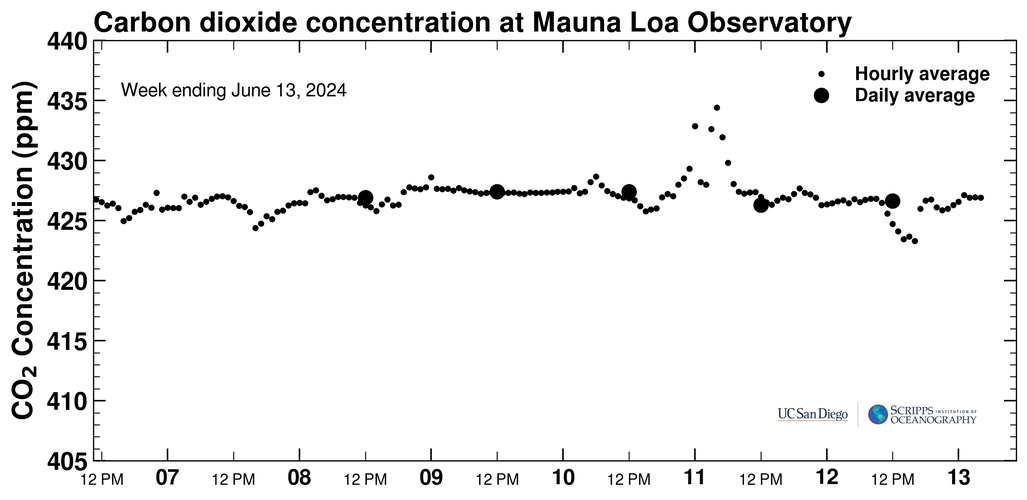
The latest daily average level recorded by Scripps Institution of Oceanography sensors at Mauna Loa, Hawaii, was 399.5 ppm, on Monday. The CO2 level fluctuates throughout the day, and hourly levels in excess of 400 ppm have already been recorded. The level also fluctuates throughout the year, with May being the month when CO2 reaches its highest concentrations.

The big thing to watch for is whether the average for the month of May will exceed 400 ppm.

Check out this graph showing data from the past week:

Scripps Institution of Oceanography

Click to embiggen.

You can follow @Keeling_curve on Twitter to keep up with the latest figures.

From The Guardian:

“I wish it weren’t true but it looks like the world is going to blow through the 400ppm level without losing a beat. At this pace we’ll hit 450ppm within a few decades,” said Ralph Keeling, a geologist with the Scripps Institution of Oceanography …

“Each year, the concentration of CO2 at Mauna Loa rises and falls in a sawtooth fashion, with the next year higher than the year before. The peak of the sawtooth typically comes in May. If CO2 levels don’t top 400ppm in May 2013, they almost certainly will next year,” Keeling said.

Here’s a graph showing that sawtoothed rise, also called the “Keeling Curve,” named for Ralph’s father, Charles Keeling, who began taking measurements at Mauna Loa in 1958:

Scripps Institution of Oceanography

Click to embiggen.

From a statement published by Scripps last week:

Scientists estimate that the last time CO2 was as high as 400 ppm was probably the Pliocene epoch, between 3.2 million and 5 million years ago, when Earth’s climate was much warmer than today. CO2 was around 280 ppm before the Industrial Revolution, when humans first began releasing large amounts of CO2 to the atmosphere by the burning of fossil fuels. By the time [Charles] Keeling began measurements in 1958, CO2 had already risen from 280 to 316 ppm. The rate of rise of CO2 over the past century is unprecedented; there is no known period in geologic history when such high rates have been found. The continuous rise is a direct consequence of society’s heavy reliance on fossil fuels for energy.

From another Guardian article:

Climate scientists have long maintained that concentrations need to be kept below 350ppm if the world is to stand a reasonable chance of meeting international targets to keep average temperature increases below 2C, while concentrations of above 400ppm put the planet on track for levels of warming deemed ‘dangerous’ by the international community.

Hence that whole 350.org thing.

Carbon dioxide levels of 400 ppm in the atmosphere aren’t much more threatening than levels of 399 ppm. But the zeros focus the mind (and the media) on an extremely dangerous trend: Failure to act on climate change has pushed the world into yet another new danger zone.

John Upton is a science aficionado and green news junkie who

tweets

, posts articles to

Facebook

, and

blogs about ecology

. He welcomes reader questions, tips, and incoherent rants:

johnupton@gmail.com

.

Find this article interesting? Donate now to support our work.Read more: Climate & Energy

Also in Grist

Please enable JavaScript to see recommended stories

Read this article: 

CO2 in atmosphere poised to blow past 400 ppm mark

Posted in Anchor, FF, G & F, GE, ONA, Pines, solar, solar panels, solar power, Uncategorized | Tagged , , , , , , , , , , | Comments Off on CO2 in atmosphere poised to blow past 400 ppm mark

Scientists Map Swirling Ocean Eddies for Clues to Climate Change

Can we read the future in the ocean’s movements? Guille Avalos/Flickr In January 2010, a crew of scientists voyaged by ship from the southern tip of Chile into the frigid Antarctic to search for clues to one of the great unknowns of climate change. They planned to crisscross a remote patch of sea near the spot where, a year earlier, another crew had injected a tankful of an inert chemical one mile below the surface. The new crew had seven weeks of funding and good weather to sample the seawater throughout the region and discover where the chemical went. By mapping its spread over the course of the year, the scientists hoped to disentangle the forces that drive the circulation of the Southern Ocean — one of the most important, but least understood, regulators of Earth’s climate. But four days from port, the ship’s captain died in the night. “There was a lot of confusion,” said Angel Ruiz-Angulo, a scientist on board. “Eventually, they said he died of heart failure.” Out of helicopter range, the crew had no choice but to put the captain’s body in a refrigerator designed for seawater samples and set course through gale-force winds for Punta Arenas, Chile, with the first mate at the helm. On shore, a short service was held, and the ship was examined. Then the scientists quickly returned to sea. To keep reading, click here. Link:  Scientists Map Swirling Ocean Eddies for Clues to Climate Change Related ArticlesAustralia Urged to Formally Recognise Climate Change Refugee StatusCHARTS: ‘Messy’ US Climate Policy is Kinda WorkingCHART: How Climate Change and Your Wine Habit Threaten Endangered Pandas

See the original post: 

Scientists Map Swirling Ocean Eddies for Clues to Climate Change

Posted in alo, eco-friendly, FF, G & F, GE, Monterey, ONA, solar, solar power, Uncategorized | Tagged , , , , , , | Comments Off on Scientists Map Swirling Ocean Eddies for Clues to Climate Change

Environmentalists and gas companies sing Kumbaya, create voluntary fracking standards

Environmentalists and gas companies sing Kumbaya, create voluntary fracking standards

Shutterstock

/ Alexander IshchenkoEnergy companies and enviros are totally holding hands and singing around a campfire in Pennsylvania.

Environmentalists struck a rare accord with oil and gas companies this week, agreeing on fracking standards that aim to protect air and water quality and the climate as the Marcellus Shale formation in the northeastern U.S. is mined.

The new and oxymoronically named Center for Sustainable Shale Development was created through an agreement struck by energy companies, the Environmental Defense Fund and other green groups, and Pennsylvania philanthropies. The center will provide certification for oil and gas companies that follow the new standards while fracking the expansive shale formation, which is centered in Pennsylvania and stretches from New York to Kentucky.

Oil and gas companies have no binding requirement to achieve certification from the new center, and environmentalists say it is no substitute for regulations. That said, both camps think its neat.

From the Los Angeles Times:

The center, which was developed over two years of sometimes contentious negotiations, hopes to address the widespread health and environmental concerns about hydraulic fracturing, or fracking, by holding companies to standards that exceed federal and state rules.

For instance, federal law currently permits companies to use diesel fuel as part of the fracking fluid they inject deep underground to break open shale formations and unlock the gas. The standards would require that companies certified by the center would not use diesel and would demand more detailed disclosure of other substances than called for in many states.

The center also would push companies to conform to new federal emissions standards at wellheads faster than established by the Environmental Protection Agency.

“These ideas didn’t come from left field,” said Andrew Place, the center’s interim executive director. “You look at the suite of good ideas out there in industry, federal agencies and the states and you adopt” the best of them.

Certification under the 15 standards [PDF] will be available to fracking companies beginning later this year. Areas addressed by the standards include:

Air and climate protection:
• Limitations on flaring
• Reduced emissions, including from storage tanks and engines

Surface and ground water protection:
• Maximizing water recycling
• Groundwater protection plans
• Well casing design
• Groundwater monitoring
• Wastewater disposal
• Reduced toxicity of fracking fluid

John Upton is a science aficionado and green news junkie who

tweets

, posts articles to

Facebook

, and

blogs about ecology

. He welcomes reader questions, tips, and incoherent rants:

johnupton@gmail.com

.

Read more:

Climate & Energy

Also in Grist

Please enable JavaScript to see recommended stories

Link:  

Environmentalists and gas companies sing Kumbaya, create voluntary fracking standards

Posted in ALPHA, Anchor, FF, G & F, GE, LG, Northeastern, ONA, Uncategorized | Tagged , , , , , , , , , , , | Comments Off on Environmentalists and gas companies sing Kumbaya, create voluntary fracking standards

It’s the first day of spring! Here comes the toxic green sludge

It’s the first day of spring! Here comes the toxic green sludge

Ohio Sea Grant and Stone LaboratoryA sign last year warned of poisonous algae in Sandusky Bay, part of Lake Erie.

Spring officially arrives today, and meteorologists are forecasting heavy rains this season in parts of the Midwest. That sounds lovely — better than a drought for sure. But those rains will wash fertilizer, animal waste, and other nutrient-rich pollution into Lake Erie, where they are expected to fuel another bumper season of toxic blue-green algae.

As we reported last year, the toxic algae blooms that coated the Great Lakes from the 1950s to the 1970s have returned. Last century’s blooms were fed with nutrients from human sewage; the latest iterations are caused by sloppy farming practices. As much as one-sixth of Lake Erie was coated with algae last year, killing wildlife and stinking out homes and holiday destinations.

With a wet spring forecast, those blooms are tipped to return this year. From The New York Times:

The spring rains reliably predict how serious the summer algae bloom will be: the more frequent and heavy the downpours, the worse the outbreak. And this year the National Weather Service says there is a higher probability than elsewhere of above-normal spring rains along the lake’s west end, where the algae first appear. The private forecaster Accuweather predicts a wetter than usual March and April throughout the region. …

“2002 was the last year that we didn’t have much of a bloom,” said Thomas Bridgeman, a professor at the Lake Erie Center at the University of Toledo. “2008, ’09 and ’10 were really bad years for algal blooms.

“And then we got 2011.”

2011 was the wettest spring on record. That summer’s algae bloom, mostly poisonous blue-green algae called Microcystis, sprawled nearly 120 miles, from Toledo to past Cleveland. It produced lake-water concentrations of microcystin, a liver toxin, that were 1,200 times World Health Organization limits, tainting the drinking water for 2.8 million consumers.

Welcome to spring, everybody.

John Upton is a science aficionado and green news junkie who

tweets

, posts articles to

Facebook

, and

blogs about ecology

. He welcomes reader questions, tips, and incoherent rants:

johnupton@gmail.com

.

Read more:

Food

,

Living

Also in Grist

Please enable JavaScript to see recommended stories

From: 

It’s the first day of spring! Here comes the toxic green sludge

Posted in alo, ALPHA, Anchor, FF, G & F, GE, LG, ONA, Uncategorized | Tagged , , , , , , , , , | Comments Off on It’s the first day of spring! Here comes the toxic green sludge

U.N. to poor people: Sorry, pollution and warming will hit you hardest

U.N. to poor people: Sorry, pollution and warming will hit you hardest

Shutterstock /

Hung Chung Chih

It’s that time of year again. You’re enjoying unseasonably warm weather / digging out from under an unexpected snow storm, looking forward to a summer full of invasive mosquitos, and oh, what’s this? Why, it’s another U.N. Human Development Report with terrible news about the planet!

The report celebrates advances in developing countries, improved conditions for the poor, and the “dramatic rebalancing of economic power” worldwide, i.e. the rise of Brazil, China, and India to crush Western white people. But it warns all that could be lost with climate change, deforestation, and air and water pollution. As usual, and as noted in past U.N. reports, the poor have the most to lose.

From The Guardian:

“Environmental threats are among the most grave impediments to lifting human development … The longer action is delayed, the higher the cost will be,” warns the report, which builds on the 2011 edition looking at sustainable development.

“Environmental inaction, especially regarding climate change, has the potential to halt or even reverse human development progress. The number of people in extreme poverty could increase by up to 3 billion by 2050 unless environmental disasters are averted by co-ordinated global action,” said the UN.

“Far more attention needs to be paid to the impact human beings are having on the environment. Climate change is already exacerbating chronic environmental threats, and ecosystem losses are constraining livelihood opportunities, especially for poor people. A clean and safe environment should be seen as a right, not a privilege.”

The notoriously toothless U.N. often has strong words about climate change. This report will be filed away with all the other U.N. reports, and then when the world is burning the U.N. can say, “We told you so!” Which will be at least a little vindicating. Except for the part where the world is burning.

Susie Cagle writes and draws news for Grist. She also writes and draws tweets for

Twitter

.

Read more:

Climate & Energy

Also in Grist

Please enable JavaScript to see recommended stories

Link – 

U.N. to poor people: Sorry, pollution and warming will hit you hardest

Posted in ALPHA, Anchor, FF, G & F, GE, Uncategorized | Tagged , , , , , , , | Comments Off on U.N. to poor people: Sorry, pollution and warming will hit you hardest

Solar power set to shine in 2013

Solar power set to shine in 2013

John UptonSolar panels in San Francisco.

This year is shaping up to be a bright one for solar power.

New solar generating capacity expected to be installed around the world in 2013 will be capable of producing almost as much electricity as eight nuclear reactors, according to Bloomberg, which interviewed seven analysts and averaged their forecasts.

That would be a rise of 14 percent over last year for a total of 34.1 gigawatts of new solar capacity, thanks in large part to rising demand in China, the U.S., and Japan. From Bloomberg:

Prices for silicon-based solar panels sank about 20 percent to 79 cents a watt in the past 12 months, after dropping by half in the previous year.

China, the biggest emitter of carbon dioxide, is forecast to unseat Germany as the largest solar market in 2013, according to analysts at [Bloomberg New Energy Finance]. Projects have multiplied as the nation provides financial support to its solar companies in a bid to diversify the coal-dependent energy industry.

The Chinese government expects 10 gigawatts of new solar projects in 2013, more than double its previous target and three times last year’s expansion. The country plans to install 35 gigawatts by 2015, compared with a previous goal of 21 gigawatts, government adviser Shi Dinghuan said Jan. 30.

Let’s just hope the sun’s energy can pierce through through that thick sheath of fossil-fuel-induced Chinese smog.

John Upton is a science aficionado and green news junkie who

tweets

, posts articles to

Facebook

, and

blogs about ecology

. He welcomes reader questions, tips, and incoherent rants:

johnupton@gmail.com

.

Read more:

Business & Technology

,

Climate & Energy

Also in Grist

Please enable JavaScript to see recommended stories

Original article – 

Solar power set to shine in 2013

Posted in ALPHA, Amana, G & F, GE, Uncategorized | Tagged , , , , , , , , , | Comments Off on Solar power set to shine in 2013

LEDs will soon light your home

LEDs will soon light your home

CreeLooks like a regular old lightbulb, but doesn’t suck energy like one.

Forget mercury-laden compact fluorescents. The efficient homes of tomorrow will be lit with LEDs.

Or so say executives at Cree, a lighting company that has started selling affordable LED lightbulbs that outwardly resemble the traditional, energy-hogging incandescent bulbs of old. The company claims that its new 60 watt-equivalent LED bulb, which costs $13 or $14 depending on which variety you buy, lasts 25 times longer and uses 84 percent less juice than does a traditional lightbulb.

Quick explainer: Light emitting diode (LED) bulbs use less energy to light a room than do compact fluorescent (CFL) bulbs (not to mention incandescents) and last longer, but they are more expensive. Fluorescent lights contain mercury, a toxic heavy metal that’s not found in LEDs or outdated incandescent bulbs.

“We have the first LED bulb that really looks like an [incandescent] lightbulb, and we’ve designed it in a way that it works like a lightbulb,” Cree CEO Chuck Swoboda told Co.EXIST. “Those two things combined with the price we think can get consumers to really try LED lighting.”

Cree is not the only company pushing the boundaries of the emerging consumer LED market. Philips says it expects its LED business to grow about 40 percent this year. From Bloomberg:

The company sees a “growth tipping point” with the debut this year of its 60-watt equivalent LED light bulb that will retail for about $10, [Philips North America CEO Greg] Sebasky said. That will help the energy-efficient technology make up about 50 percent of Philips’ lighting sales by 2015, up from 25 percent last year, he said.

“People are starting to see lighting as a durable good,” Sebasky said, taking lighting products with them when they move.

John Upton is a science aficionado and green news junkie who

tweets

, posts articles to

Facebook

, and

blogs about ecology

. He welcomes reader questions, tips, and incoherent rants:

johnupton@gmail.com

.

Read more:

Climate & Energy

,

Living

Also in Grist

Please enable JavaScript to see recommended stories

Read this article:

LEDs will soon light your home

Posted in ALPHA, Amana, G & F, GE, LG, Uncategorized | Tagged , , , , , , , , | Comments Off on LEDs will soon light your home

USDA says crops will do better but food prices will do worse

USDA says crops will do better but food prices will do worse

It’s more cold comfort for drought-stricken farmers this week, and I don’t mean the snow.

USDA chief economist Joe Glauber was all sunshine this Thursday in announcing that normal spring weather is expected to improve corn and soybean yields by huge percentages over last year’s tiny drought-stricken crops. Bigger yields mean tinier prices — Glauber said corn would be down about a third from last year, soy would drop more than a quarter, and wheat would be down about 11 percent.

From the South Dakota Argus Leader:

The recovery should send prices for most oilseeds and grains sharply lower, providing a much-needed reprieve for livestock, dairy and poultry producers struggling with high feed costs, and relief down the road for consumers who have paid more for food at their local grocery store. …

“The critical factor that people will be following is weather,” Glauber said at the department’s annual outlook forum. “While the outlook for 2013 remains bright, there are many uncertainties.”

Way to bury the lede, Glauber. No matter how many times Agriculture Secretary Tom Vilsack says “American agriculture is quite resilient,” there still remains the fact that American agriculture is also in crisis, and forecasters are expecting more hot and dry weather this year.

And even though industrial prices are dropping, the savings won’t trickle down to consumers for at least quite some time — the USDA anticipates food prices will rise this year between 3 and 4 percent.

Richard Volpe, an economist with USDA’s Economic Research Service, said the evidence of last year’s drought is just now starting to really have an effect on consumer prices at the retail level, resulting in higher costs for everything from meat to corn syrup.

Dammit, if it were only meat and corn syrup and not also everything in between…

Susie Cagle writes and draws news for Grist. She also writes and draws tweets for

Twitter

.

Read more:

Food

Also in Grist

Please enable JavaScript to see recommended stories

Link:  

USDA says crops will do better but food prices will do worse

Posted in GE, Hoffman, Uncategorized | Tagged , , , , , , , , , , , | Comments Off on USDA says crops will do better but food prices will do worse

Bloomberg proposes banning plastic foam containers, probably because they can hold soda

Bloomberg proposes banning plastic foam containers, probably because they can hold soda

When I was a kid, you could come to New York City and buy a big soda in a large styrofoam cup. (You could also get murdered a lot more easily or score some drugs or afford a place in Soho, but that’s not my point here.) Big soda kept cool in a nice big cup — paradise, in its way.

Reuters / Eduardo Munoz

Last year, Mayor Michael Bloomberg decided that the big soda had to go. And this year, according to reports, he’s got his eyes on that cup. From Bloomberg (the media company, not the mayor for whom the company is named) (New York is a complicated place) (the city, not the state from which the city is named):

In his final State of the City address today, the third-term mayor will attempt to cement his legacy as a leader who made the most-populous U.S. city healthier and more environmentally friendly. His office previewed portions of the speech that focused on three initiatives intended to boost air quality, recycling rates and sustainability.

A requirement that 20 percent of all newly constructed public parking spaces be outfitted to charge electric vehicles would create 10,000 such spots within seven years. The plan would need City Council approval. A pilot program to collect curbside food waste from Staten Island homes to use as compost for parks would expand citywide if successful, cutting down on the 1.2 million tons of scraps sent to landfills each year.

(Apparently the city could use more charging stations.)

These are significant initiatives but, as suggested above, it’s the mayor’s proposed ban on Styrofoam cups and containers that’s gotten much of the attention. It fits nicely with the image of Bloomberg as anti-fast-food, but he will note that it’s actually anti-trash. As the Bloomberg article notes, New Yorkers throw away 20,000 tons of plastic foam a year. While the city’s garbage production is in decline, that’s still a lot of waste.

Bloomberg gave his State of the City address on a stage at Brooklyn’s new, leaky Barclays Center under sports-arena-appropriate banners celebrating his accomplishments. “419: Record Low in Homicides in 2012.” “52 Million: Record Visitors in 2012.” And one he’s put specific focus on: “80.9: Record High Life Expectancy.”

Not listed: “7 million: Fewer pounds of garbage a day.” Perhaps because he’s waiting for that number to improve a little more.

Philip Bump writes about the news for Gristmill. He also uses Twitter a whole lot.

Read more:

Cities

,

Climate & Energy

,

Living

,

Politics

Also in Grist

Please enable JavaScript to see recommended stories

See the article here: 

Bloomberg proposes banning plastic foam containers, probably because they can hold soda

Posted in GE, Uncategorized | Tagged , , , , , , , , , , , | Comments Off on Bloomberg proposes banning plastic foam containers, probably because they can hold soda

Don’t worry about BP; it’s going to be fine

Don’t worry about BP; it’s going to be fine

BP’s logo is of an offshore rig exploding with money.

“BP” used to stand for “British Petroleum,” presumably until Britain got embarrassed. Well, not really — although British people weren’t very happy about people calling the company British Petroleum after its Gulf rig exploded and leaked and killed mammals of various types.

Anyway, here’s News About BP and Money and the Government, our new feature about BP and money and the government, part one in a series of one.

BP made a lot of money last year.

Big surprise. Annual profits for the company were $11.6 billion, only six or seven times what the average U.S. household makes (over the course of 33,000 years).

And of course we’ll bring back our favorite tool to make this figure hit home:

But not as much as states think it should pay for the Gulf spill.

BP doesn’t want to be rude or disrespectful, of course, but it thinks that the amount of money sought by state and local governments over the Deepwater Horizon disaster is a tad steep. From Reuters:

BP Plc has tallied up claims made by states and local governments on the U.S. Gulf Coast for economic and property damages from the Macondo oil spill, and come up with a figure of $34 billion, which it deems “substantially” overstated. …

The $34 billion total, provided for disclosure reasons with the company’s financial results on Tuesday, is based on claims made last month by Alabama, Mississippi and Florida as well as claims made by Louisiana and others from local governments, BP said.

Citing the Oil Pollution Act (OPA) underpinning the claims, the company said it considers the methods used to calculate them to be “seriously flawed, not supported by the legislation and to substantially overstate the claims.”

I am shocked and you are shocked and everyone is shocked that BP thinks this. But, really, how ungrateful can those states be? Have they already forgotten that the company ran this ad promoting Gulf Coast tourism over and over and over again? That’s like $30 billion worth of effort right there!

The government is doing its best to help BP pay its bills.

You may remember that the feds recently finalized a $4 billion penalty for BP for its role in the Gulf spill. But what the government taketh away, it also giveth, in spades.

From Bloomberg:

BP Plc’s Pentagon contracts have more than doubled since the year of the Gulf of Mexico oil spill, the biggest in U.S. history.

The company’s awards surged to $2.51 billion in the year ended Sept. 30 from $1.04 billion in fiscal 2010, the year of the oil rig explosion, according to data compiled by Bloomberg. BP’s share of the military’s petroleum market jumped to 12 percent from 8.5 percent during the period. …

The Pentagon “greatly rewarded the company for the oil spill,” said Charles Tiefer, a University of Baltimore law professor and former member of the U.S. Commission on Wartime Contracting. “This is alarming since the billions of dollars of environmental harm by BP make it the worst federal government contractor in history.”

Not sure “alarming” is the best word, but we’ll stick with it for now.

This past November, the EPA suspended BP’s ability to win new government contracts, but didn’t cancel the existing ones.  In fiscal years 2010 and 2011, BP got more than $3.5 billion from the Defense Department alone. It’s safe to assume that over the past year and up to now, the company’s existing government contracts brought in at least $500 million. So the company’s $4 billion fine from the feds will probably be completely covered by money the company got from the feds. The system works.

In summary.

BP should stand for “Bafflingly Profitable,” but only because “Bullshit Professionals” is rated R.

Philip Bump writes about the news for Gristmill. He also uses Twitter a whole lot.

Read more:

Business & Technology

,

Climate & Energy

,

Politics

Also in Grist

Please enable JavaScript to see recommended stories

Link to original – 

Don’t worry about BP; it’s going to be fine

Posted in GE, Uncategorized | Tagged , , , , , , , , , , | Comments Off on Don’t worry about BP; it’s going to be fine