Category Archives: ALPHA

Republican mayors push climate action without saying ‘climate change’

Leadership in addressing climate change in the United States has shifted away from Washington, D.C. Cities across the country are organizing, networking, and sharing resources to reduce their greenhouse gas emissions and tackle related challenges ranging from air pollution to heat island effects.

But group photos at climate change summits typically feature big-city Democratic mayors rubbing shoulders. Republicans are rarer, with a few notable exceptions, such as Kevin Faulconer of San Diego and James Brainard of Carmel, Indiana.

Faulconer co-chairs the Sierra Club’s Mayors for 100 Percent Clean Energy Initiative, which rallies mayors around a shared commitment to power their cities entirely with clean and renewable energy. Brainard is a longtime champion of the issue within the U.S. Conference of Mayors and the Climate Mayors network.

In our research at the Boston University Initiative on Cities, we found that large-city Republican mayors shy away from climate network memberships and their associated framing of the problem. But in many cases they advocate locally for policies that help advance climate goals for other reasons, such as fiscal responsibility and public health. In short, the United States is making progress on this issue in some surprising places.

Climate network members are mainly Democrats

In our initiative’s recent report, “Cities Joining Ranks,” we systematically reviewed which U.S. cities belong to 10 prominent city climate networks. These networks, often founded by mayors themselves, provide platforms to exchange information, advocate for urban priorities and strengthen city goverments’ technical capacities.

The networks we assessed included Climate Mayors; We Are Still In, which represents organizations that continue to support action to meet the targets in the Paris climate agreement; and ICLEI USA.

We found a clear partisan divide between Republican and Democrat mayors. On average, Republican-led cities with more than 75,000 residents belong to less than one climate network. In contrast, cities with Democratic mayors belonged to an average of four networks. Among the 100 largest U.S. cities, of which 29 have Republican mayors and 63 have Democrats, Democrat-led cities are more than four times more likely to belong to at least one climate network.

This split has implications for city-level climate action. Joining these networks sends a very public signal to constituents about the importance of safeguarding the environment, transitioning to cleaner forms of energy, and addressing climate change. Some networks require cities to plan for or implement specific greenhouse gas reduction targets and report on their progress, which means that mayors can be held accountable.

Constituents in Republican-led cities support climate policies

Cities can also reduce their carbon footprints and stay under the radar — a strategy that is popular with Republican mayors. Taking the findings of the “Cities Joining Ranks” report as a starting point, I explored support for climate policies in Republican-led cities and the level of ambition and transparency in their climate plans.

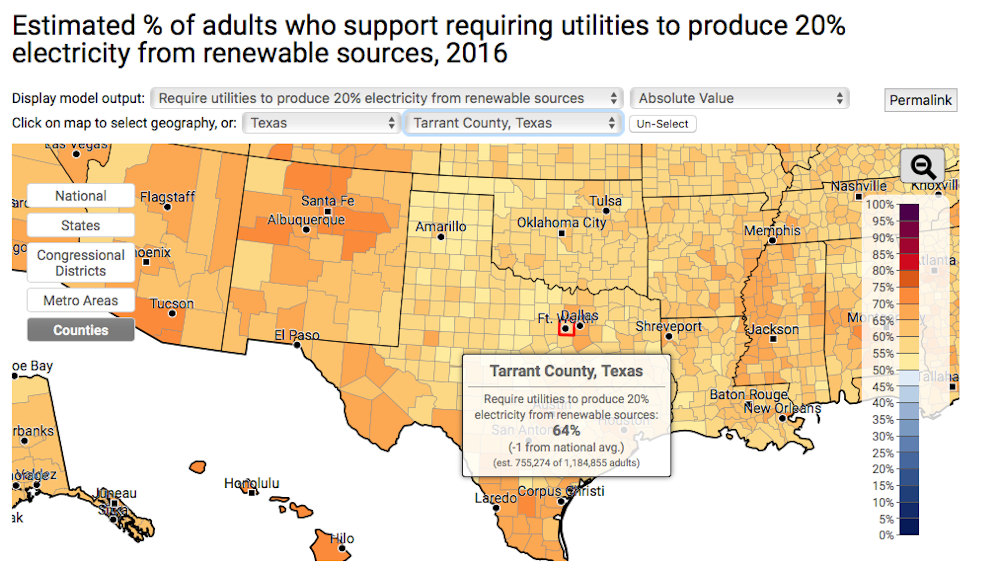
To tackle these questions, I cross-referenced Republican-led cities with data from the Yale Climate Opinion maps, which provide insight into county-level support for four climate policies:

Regulating carbon dioxide as a pollutant
Imposing strict carbon dioxide emission limits on existing coal-fired power plants
Funding research into renewable energy sources
Requiring utilities to produce 20 percent of their electricity from renewable sources

In all of the 10 largest U.S. cities that have Republican mayors and also voted Republican in the 2008 presidential election, county-level polling data showed majority support for all four climate policies. Examples included Jacksonville, Florida, and Fort Worth, Texas. None of these cities participated in any of the 10 climate networks that we reviewed in our report.

Yale Program on Climate Change Communication, CC BY-ND

This finding suggests that popular support exists for action on climate change, and that residents of these cities who advocate acting could lobby their elected officials to join climate networks. Indeed, we have found that one of the top three reasons mayors join city policy networks is because it signals their priorities. A mayor of a medium-sized West Coast city told us: “Your constituents are expecting you to represent them, so we are trying politically to be their voice.”

Mayors join networks to amplify their message, signal priorities to constituents, and share information. BU Initiative on Cities, CC BY-ND.

Climate-friendly strategies, but few emissions targets

Next, I reviewed planning documents from the 29 largest U.S. cities that are led by Republican mayors. Among this group, 15 have developed or are developing concrete goals that guide their efforts to improve local environmental quality. Many of these actions reduce cities’ carbon footprints, although they are not primarily framed that way.

Rather, these cities most frequently cast targets for achieving energy savings and curbing local air pollution as part of their master plans. Some package them as part of dedicated sustainability strategies.

These agendas often evoke images of disrupted ecosystems that need to be conserved, or that endanger human health and quality of life. Some also spotlight cost savings from designing infrastructure to cope with more extreme weather events.

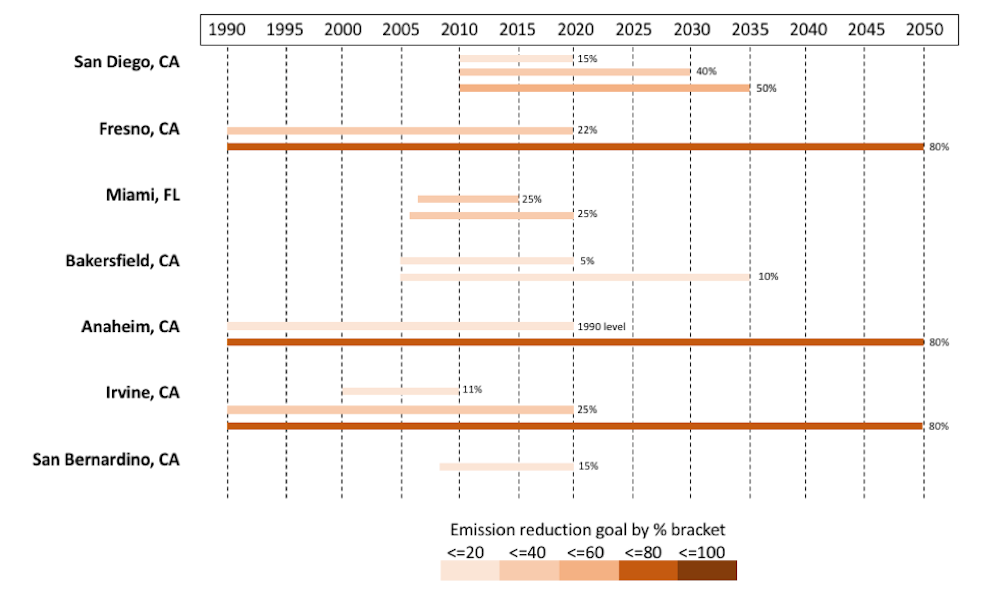
In contrast, only seven cities in this group had developed quantitative greenhouse gas reduction targets. Except for Miami, all of them are in California, which requires its cities to align their greenhouse gas reduction targets with state plans. From planning documents, it appears that none of the six Californian cities goes far beyond minimum mandated emission reductions set by the state for 2020.

Greenhouse gas reductions goals, with baselines, for the seven largest Republican-led cities. Nicolas Gunkel, CC BY-ND.

Watch what they do, not what they say

The real measure of Republican mayors taking action on climate change is not the number of networks they join but the policy steps they take, often quietly, at home. While few Republican mayors may attend the next round of subnational climate summits, many have set out policy agendas that mitigate climate change, without calling a lot of attention to it — much like a number of rural U.S. communities. Focusing narrowly on policy labels and public commitments by mayors fails to capture the various forms of local climate action, especially in GOP-led cities.

Carmel, Indiana Mayor James Brainard has suggested that some of his less-outspoken counterparts may fear a backlash from conservative opinion-makers. “There is a lot of Republicans out there that think like I do. They have been intimidated, to some extent, by the Tea Party and the conservative talk show hosts,” Brainard has said.

Indeed, studies show that the news environment has become increasingly polarized around accepting or denying climate science. Avoiding explicit mention of climate change is enabling a sizable number of big-city GOP mayors to pursue policies that advance climate goals.

See the original post:  

Republican mayors push climate action without saying ‘climate change’

Posted in alo, ALPHA, Anchor, FF, GE, LG, ONA, PUR, solar, Uncategorized | Tagged , , , , , , , , , | Comments Off on Republican mayors push climate action without saying ‘climate change’

Trans Mountain pipeline opponents vow to keep fighting

Canada is coughing up $3.5 billion to buy the floundering Trans Mountain pipeline expansion project from Kinder Morgan. Prime Minister Justin Trudeau had vowed “to get that pipeline built,” but pipeline resistance groups aren’t backing down, either.

“This is a declaration of war against indigenous people because they’re not recognizing our own sovereignty,” says Kanahus Manuel, a Secwepemc midwife and mother of four. “So we are putting on our war paint and we are putting on our battle gear and we’re going to fight.”

The Houston-based company had stopped all non-essential spending on the project last month after facing broad opposition from environmental groups, indigenous communities, and the province of British Columbia. Canada says it plans to fund construction of the project until it can find another buyer to take over. If completed, it would nearly triple the pipeline’s capacity to transport crude and refined oil from Alberta to B.C.

Manuel’s group, Tiny House Warriors, plans on physically blocking construction of the pipeline. The group has constructed 10 tiny houses on wheels that they’ll use to deter construction of the pipeline on Secwepemc land. “We’re going to stand with our bodies as our weapons to defend the last of our sacred lands from any type of further encroachment or invasion,” Manuel says.

Will George is a leader with the Tsleil-Waututh, which built a Watch House — traditionally used to monitor an enemy — atop Burnaby Mountain as part of their opposition to the pipeline. “If anything, we’re going to ramp up our demonstration and our movement,” George says. “We’ll do whatever it takes to stop this pipeline.”

Greenpeace, the Coast Salish Watch House, and other grassroots indigenous and environmental groups have already planned an emergency rally in Vancouver this evening.

Over the weekend, an oil spill at a pump station near Barriere, B.C., forced Kinder Morgan to temporarily shut down the existing Trans Mountain pipeline. Pipeline opponents are also calling out Trudeau for abandoning federal commitments to take action on climate change and respect the rights of indigenous nations.

“It’s an outrageous and reckless decision by the Canadian government. This was a government that stood up in Paris and promised climate action. It’s a government that committed to the U.N. declaration on the rights of indigenous peoples,” says Mike Hudema, climate and energy campaigner at Greenpeace Canada. “Today it is breaking both of those promises by not just supporting a pipeline but buying a new massive tar sands pipeline project.”

Taken from:  

Trans Mountain pipeline opponents vow to keep fighting

Posted in alo, ALPHA, Anchor, FF, GE, Jason, LG, ONA, Safer, Uncategorized | Tagged , , , , , , , | Comments Off on Trans Mountain pipeline opponents vow to keep fighting

New documentaries bring climate change to the big screen

Grist traveled to the tiny mountain town of Telluride, Colorado, to see some of the most talked-about environmental and climate change-related documentaries on the film-festival circuit. The films take on the challenge of addressing migration — both of humans and animals around the world — as well as the startling realities of communities facing climate change and environmental degradation today.

In all, there were more than 150 movies and shorts featured during the long weekend, but here’s the lowdown on a few noteworthy films.

Anote’s Ark

If you type “Kiribati” into Google Maps, it takes a while and requires multiple zooms to find it. That exercise is somewhat symbolic because the tiny Pacific island is literally trying to keep itself on the map. Rising sea levels are quickly drowning the home to almost 115,000 people.

Anote’s Ark


Courtesy of Mountainfilm

Anote’s Ark follows Kiribati’s former president, Anote Tong, and his frantic attempt to save the land for his people. A perfect example of how poorer nations are more likely to feel the brunt of climate change and extreme weather, the film effectively illustrates the heartbreak of losing one’s home to the ocean — as well as the staggering challenge of relocating an entire country’s population.

While the film is a powerful portrayal of how climate change is impacting communities right now, its various storylines don’t quite connect. The documentary also leaves viewers fairly hopeless — which is true of most films dealing with climate change. But for us at Grist, we’re all about holding out hope.

Story continues below

The Human Element

Tangier Island, off the coast of Virginia, is drowning amid rising sea levels. A school in Denver caters exclusively to students with health issues, specifically asthma caused by air pollution. These are two of the examples of how climate change is already impacting Americans that form the theme of James Balog’s (Chasing Ice) latest work, The Human Element.

Balog uses the four elements — air, earth, fire, and water — to frame how we look at the impact of humans on our climate. In addition to the plight of Tangier and the air pollution in the Mile High city, he follows forest firefighters in California and takes a trip back to the coal mines in Pennsylvania that killed his grandfather.

The dramatic realities of climate change are, well, very scary and honestly depressing. And The Human Element does an excellent job making that abundantly clear. It grounds our understanding of warming in real-world, close-to-home examples that don’t sugarcoat the present or the future. Sure it relies on some heavy-handed scare tactics; but upon reflection, that might be exactly what we need to get our asses into gear.

Brothers of Climbing

“If you don’t see any black people or any people of color climbing, you’re not going to think you can do it,” Brothers of Climbing cofounder Mikhail Martin says in this seven-minute minidoc. The organization seeks to reach underrepresented groups and inspire them to take up outdoor activities, starting with climbing.

The short film, presented by REI Co-op, traces the history of the organization, which started with a group of black friends at a New York City gym — not exactly climbing country. It follows the Brothers of Climbing’s trip to the mountains of Chattanooga, Tennessee, where they encounter disbelief from others that they are actually rock climbers.

The film is pretty inspiring, and it’s on YouTube, so you don’t even have to travel all the way to Telluride.

Silas

Silas Siakor is one of those people whose accomplishments, numerous accolades, and genuine humanity makes you feel like you’ve accomplished absolutely nothing in your life. An activist first and foremost, Silas fights relentlessly to hold the government of Liberia accountable for decades of corruption and environmental destruction. The West African country was once rich with forests, but international companies have demolished one-third of its timber for palm oil plantations, grabbing land from far-flung communities with the blessings of Liberian officials.

The film offers a genuine tale of human strength and resilience in a country still recovering from a 25-year civil war. Its intimate scenes of vulnerability leave the viewer invested in Silas’ mission, while its clips of international leaders heaping praise on former President Ellen Johnson Sirleaf leave the viewer awestruck at the outside world’s relatively rosy picture of a Liberian government stained with corruption.

Blue Heart

Blue Heart


Courtesy of Mountainfilm

Hot dam! That’s the crux of Blue Heart, a film about Balkan battles over hydropower. The story centers around activists in three countries fighting a handful of the roughly 3,000 proposed dams in the region.

Blue Heart, produced by the outdoor clothing company Patagonia, captures the struggle between environmental activists and energy developers in Albania, Macedonia, and Bosnia and Herzegovina. In one story, a group of 55 women blocking a construction project on the Kruščica River are violently removed by police — a scene which bears striking resemblance to recent pipeline fights in the United States.

Here’s the thing: If the world wants to transition away from fossil fuels, hydropower will likely play a role. But hydropower’s reliable renewable energy comes at the expense of river ecosystems and the surrounding communities. The film barely scratches the surface of this conflict between fighting climate change and protecting natural world, instead only focusing on the corporate-greed aspect of dam projects. But at its best, Blue Heart tells a classic underdog story of ordinary people fighting back against energy projects that disrupt and endanger communities — a struggle that’s playing out worldwide.

Read more:

New documentaries bring climate change to the big screen

Posted in alo, ALPHA, Anchor, FF, GE, ONA, Safer, Uncategorized | Tagged , , , , , , , | Comments Off on New documentaries bring climate change to the big screen

Hurricane Maria was so much worse than we thought

People in Puerto Rico have endured the devastation left behind by Hurricane Maria since the storm hit 8 months ago, with many still struggling to get clean water and medical care. Now there’s evidence that the death toll from Maria and its aftermath has been far worse than previously thought

An independent analysis from public health experts at Harvard University estimates that 5,740 people likely died as a result of Hurricane Maria — 90 times higher than the official government estimate of 64 dead. The new estimate, published on Tuesday in the New England Journal of Medicine, would make Maria the deadliest U.S. natural disaster in more than a century — more than twice as deadly as Hurricane Katrina.

The enormous distance between the new estimate and the government’s official count can be blamed on the persistence of horrific living conditions and government neglect following the hurricane. The new study was based on a household survey conducted in the weeks and months following the storm. The storm’s winds and floods account for just 10 percent of Maria’s total deaths, according to the study — most of the dead perished from lack of medical care long after the water receded.

As a storm, Maria achieved a lot of “worsts”. It was one of the strongest hurricanes ever to make landfall in the United States. It caused the largest blackout in U.S. history and the second largest in world history. The loss of power meant many Puerto Ricans had to struggle for basic necessities — the storm shuttered hospitals and restricted access to fresh food and clean water for millions of people. In some cases, people resorted to drinking water from streams contaminated with toxic waste and raw sewage — simply because there was no other option. The result was one of the worst humanitarian crises in U.S. history.

“Interruption of medical care was the primary cause of sustained high mortality rates in the months after the hurricane,” wrote the study’s authors. Hundreds of thousands of people have left the island since the storm, one of the largest mass migrations in recent U.S. history — a possible preview of the kinds of shocks that might occur more frequently as climate change supercharges storms.

These conditions have been widely reported for months, but the federal government’s response has yet to match the scale of the challenge — leading to preventable deaths. The results of the new study “underscore the inattention of the U.S. government to the frail infrastructure of Puerto Rico,” according to its authors.

On his only visit to post-storm Puerto Rico back in October, President Donald Trump praised his administration’s response, saying that Puerto Ricans should be “proud” that the death toll wasn’t as large as “a real catastrophe like Katrina.”

The new study means that Maria is now the deadliest hurricane since 1900 in the United States, when a hurricane killed 8,000 people in Galveston, Texas. Hurricane Katrina’s official death toll was 1,833 people, though follow-up surveys conducted in the years following the 2005 storm showed that hundreds more likely died. There have been previous efforts at estimating the true scale of Maria’s death toll, but the Harvard survey is the most comprehensive so far. The truth is, we’ll probably never know exactly how many people died because of Hurricane Maria.

In a series of tweets in Spanish and English, San Juan Mayor Carmen Yulín Cruz, responded to the study’s findings. “It took too long to understand the need for an appropriate response was NOT about politics but about saving lives,” she wrote. “Now will the government believe it?”

Cruz has repeatedly called for more assistance for hurricane victims, but has been criticized directly by Trump for “poor leadership.”

The Harvard survey may still be an underestimate, in part because “mortality rates stayed high” through December, when its data collection process ended. Tens of thousands of people are still without clean water and electricity, according to the government’s latest numbers. By all accounts, the humanitarian crisis started by Hurricane Maria continues. It’s going on right now. And, more storms are on the way: a new hurricane season starts on Friday.

It’s a safe assumption that people are still dying because of a storm that hit in late September, last year.

Jump to original – 

Hurricane Maria was so much worse than we thought

Posted in alo, ALPHA, Anchor, FF, GE, LG, ONA, Safer, Uncategorized, Venta | Tagged , , , , , , , , , , , | Comments Off on Hurricane Maria was so much worse than we thought

How the fossil fuel industry drums up grassroots support

Over the past several months, scores of people showed up to public meetings in New Orleans in support of building a natural-gas power plant. It turns out that as many as 100 of them were paid to be there.

The Lens, an investigative news site, recently reported that people were paid $60 to attend and $200 to speak. Entergy, the company behind the power plant, said that it hadn’t authorized the payments, but it did take some responsibility. After an internal investigation, the company said that it had contracted with a public affairs firm, the Hawthorn Group, which then subcontracted another group, Crowds on Demand, to hire the supporters. Grist called and emailed Entergy for a comment and has yet to get a response.

It’s a prime example of astroturfing, the practice of creating an image of grassroots support for a cause. And while this case may seem shocking, maybe it shouldn’t. Astroturfing in the U.S. dates back nearly a century, and energy companies have a history of getting involved in it through public affairs firms.

“The energy sector has always been relatively active in this,” says Edward Walker, a sociology professor at University of California, Los Angeles who wrote a book about how public affairs consultants drum up grassroots support. He traces the roots of astroturfing back to the 1930s with Campaigns, Inc., the world’s first political consulting firm, which also worked for oil companies.

In the 1970s and 1980s, the number of public affairs consulting firms ballooned, Walker says. “Corporate America was really back on its heels during that period,” he explains, “and started to figure, well, we need to be doing a lot of the same things that the social movements and activist groups and labor unions have been doing.”

Astroturfing is supposed to stay hidden. But some companies have been exposed doing it. In 2009, Greenpeace obtained a memo detailing the American Petroleum Institute’s plans to recruit “Energy Citizens” for rallies opposing legislation to cut carbon dioxide emissions and promote cleaner energy. A few days later, Grist got a list of 21 planned “Energy Citizen” events and found that most were planned by lobbyists, many of whom worked for API or its local affiliates.

That same year, the lobbying group Bonner & Associates forged letters against American Clean Energy and Security Act of 2009, also known as the Waxman-Markey climate bill, which would have established a national cap-and-trade program. At least twelve letters were sent to Democrats in the House of Representatives, appearing to be signed by a number of groups, including a local chapter of the NAACP. In one, the firm assumed the identity of Creciendo Juntos, a nonprofit network that tackles issues in Charlottesville’s Latinx community, and sent it to House Representative Tom Perriello. It turned out the lobbying firm had been working for the American Coalition for Clean Coal Electricity, an industry-backed outfit working with Hawthorn Group — yup, the same one tied up in the recent New Orleans case — which contracted Bonner & Associates.

The cap-and-trade bill was passed by the House but eventually died in the Senate.

Climate Investigations Center director Kert Davies thinks astroturfing happens more often than people realize. “I would assume the best of it we never see,” he says. “That’s what it’s intended to be: invisible. So there’s probably a lot happening, or that has happened, to people that they’ve never known about.”

About 40 percent of Fortune 500 companies were clients of at least one of these so-called “grassroots lobbying” firms when Walker crunched the numbers back in 2007, he says. “The practices are incredibly widespread. That’s not to say that everyone’s doing astroturfing.” Sometimes corporations work with firms to mobilize their employees or shareholders — it’s not necessarily about generating the illusion of public support.

In the New Orleans case, The Lens couldn’t find any laws preventing the pro-power plant campaign. But the practice sure looks unethical, Davies says, according to the industry’s own code of ethics. The Public Relations Society of America’s code specifically rules out creating fake grassroots campaigns.

The New Orleans City Council approved Entergy’s plant in March, before reports revealed the astroturfing efforts. Community groups have pushed for an investigation and a re-hearing on the decision. The council has also decided to hire a third-party to investigate and has ordered the company to hand over documents that support their internal investigation.

Read this article: 

How the fossil fuel industry drums up grassroots support

Posted in alo, ALPHA, Anchor, Citizen, Everyone, FF, GE, LAI, ONA, Safer, Uncategorized | Tagged , , , , , , , | Comments Off on How the fossil fuel industry drums up grassroots support

America’s fastest-growing urban area is stuck between a rock and a dry place

This story was originally published by CityLab and is reproduced here as part of the Climate Desk collaboration.

When Latter-day Saint migrants arrived in Utah in 1847, a verse in Isaiah served as consolation to them in the desiccated landscape: “The wilderness and the solitary place shall be glad for them; and the desert shall rejoice, and blossom as the rose.”

Lately, the desert has blossomed nowhere more than the St. George area, in the state’s southern reaches. The city is a picturesque outpost, with red-rock desert framing bright green lawns and golf courses, all built around the stark white Mormon temple in the center of town.

Brigham Young’s adherents came here to grow crops, primarily cotton — hence its reputation as Utah’s Dixie. Today, that ceaseless sunshine is luring so many tourists, retirees, and students that St. George has become the fastest-growing metropolitan area in the country. According to Census Bureau data released in March, the metro, home to 165,000 people, grew 4 percent between 2016 and 2017.

“Six million people visit the area every year. As people visit here, some of them decide to stay,” St. George Mayor Jon Pike said. The area remains a retirement community, “but we also have 33,000 students K through 12, and we have a fast-growing university [Dixie State University].” Healthcare is a booming industry, and, like many growing cities, St. George has a section of town earmarked for tech companies. Mixed-use developments are popping up downtown. The growth likely won’t slow any time soon: State demographers believe the area will surpass 500,000 residents by 2065.

As is the case with other growing desert burgs, St. George grapples with water-supply issues. But the challenge here is unique. Remarkably cheap rates mean that residents of an area with only eight inches of annual rainfall are using tremendous amounts of water. An average St. George resident uses more than twice as much water as the average citizen of Los Angeles.

Political leaders at the state and local level view this primarily as a supply issue. Their preferred solution is a gargantuan $1.4 billion pipeline that would connect the region with Lake Powell, a reservoir along the Colorado River. With the aid of pumping stations, the pipeline would shuttle water over 140 miles and 2,000 feet of elevation gain. The goal is to store 86,000 acre-feet a year in nearby reservoirs and aquifers — more than enough, officials say, to meet the demand of the growing population and decrease reliance on the dwindling Virgin River, currently Washington County’s primary water source.

“We certainly are committed to conservation, but we don’t think that gets you there alone, especially with the organic growth and the tremendous in-migration that’s occurring in the Southwest,” said Ronald Thompson, general manager of the Washington County Water Conservancy District, the wholesaler that supplies water to St. George and other cities in the county.

In 2006, the state legislature passed a bill to fund the Lake Powell project, but construction has been delayed since then by stop-and-go planning (at this point, pipeline approval is on hold due to uncertainty about which federal agency has jurisdiction over the project).

Multiple state and regional environmental groups say the pipeline is far too aggressive, and that basic conservation measures can meet the region’s water demand. Amelia Nuding, senior water analyst for Western Resource Advocates, believes regional leaders should focus on three strategies to achieve quick conservation success: better data collection, higher water rates, and building codes that require water-smart construction and landscaping. Not only would that meet St. George’s water needs, according to Nuding’s group, but it would avoid further depleting an already burdened Colorado River.

Utah typically uses less than its allotted share of Colorado River water, which is divvied up among Western states, but climate change and growing populations are taxing relations among the river’s interstate constituents. “Yes, [Utah residents] are legally entitled to that water from the Colorado River,” Nuding said. “But … I think that we should meet certain metrics of water stewardship before further depleting the Colorado River.”

Leaders have, for the most part, ignored environmentalists’ suggestions. Water-use data in Utah is scant; until recently, statewide water surveys took place only every five years. In 2010 — the latest state data available — the St. George region’s per-capita consumption was 325 gallons per day. More current numbers from the city suggest conservation; St. George proper uses 250 gallons per person per day. Nonetheless, it’s still consuming more water than other Southwest cities. Las Vegas takes about 220 gallons per person each day; Tucson, considered a regional leader, uses 120.

Water rates here don’t punish heavy use. A St. George household that goes through 16,000 gallons a month would see a $47 water bill; equivalent usage would cost a Tucson household $184. Washington County Water Conservancy District is in the process of raising rates 5 to 10 percent each year until baseline rates are tripled, but even then, they would be a bargain compared to some cities.

Utah’s water-delivery systems are largely gravity-fed, thus keeping costs down, and most homeowners have access to unmetered non-potable water for landscaping and irrigation. This, plus state oversight of water rates, keeps the rates low — and consumption high.

Any major reduction in consumption here will require a cultural shift. St. George is marketed as a desert oasis. Nine golf courses are located in the region, and it remains an agricultural stronghold. Local municipalities offer basic water-conservation rebates — St. George, for instance, helps cover the cost of replacing high-flow toilets — but nothing at the level of cities that, for instance, pay residents to replace sod with desert-appropriate landscaping.

Mayor Pike heralded developers who are voluntarily choosing water-smart appliances and landscaping, and cited the planned Desert Color community as an example. But that project’s water-wise cred has been questioned: Its centerpiece is an 18-acre artificial pond.

That said, St. George’s growth could inherently promote efficiencies. Apartment and townhouse construction is finally catching up with demand, which will keep some new residents from the sprawling single-family homes and yards that guzzle so much water. A good deal of new construction will take place on agricultural land where water is already allocated.

But per-person efficiency doesn’t mean less water use overall. Every St. George resident could cut her water use in half, but if the population more than doubles, the city is still using more water. Such is the conundrum of desert growth. “We’d be wise to diversify our sources,” Pike said. “If the Powell pipeline isn’t built, that would change things. … It would slow growth.”

Constructing the pipeline, oddly enough, might trigger cost increases that could curtail water use. While the state would cover the pipeline’s initial costs, locals are on the hook in the long run. In a letter to Utah’s governor, economists at state universities said that water rates would have to jump sixfold for the region to meet its repayment obligations. “Of course, increasing water rates this much would significantly decrease Washington County residents’ demand for water,” the economists wrote. “In our analysis, demand decreased so much that the [Lake Powell pipeline] water would go unused.”

If rates are going up anyway, conservation advocates think the pipeline talk is occurring too soon. “Why don’t they just try [raising rates] now, and see how much demand changes?” Nuding said. “From a water-management perspective, that makes all the sense in the world.”

In this blossoming desert city, leaders have a choice: Do they let the roses go brown, or pay exorbitantly to keep them?

Original source: 

America’s fastest-growing urban area is stuck between a rock and a dry place

Posted in alo, ALPHA, Anchor, Citizen, FF, GE, ONA, organic, solar, Uncategorized | Tagged , , , , , , , , , , | Comments Off on America’s fastest-growing urban area is stuck between a rock and a dry place

Scott Pruitt introduced anti-abortion bills giving men ‘property rights’ over fetuses

This story was originally published by HuffPost and is reproduced here as part of the Climate Desk collaboration.

In 1999, Scott Pruitt, then an Oklahoma state senator, introduced a bill to grant men “property rights” over unborn fetuses, requiring women to obtain the would-be father’s permission before aborting a pregnancy.

Pruitt, now the embattled administrator of the Environmental Protection Agency, submitted the legislation again in 2005.

The bill, which did not pass either time, faded from Pruitt’s political legacy. But the legislation merits new examination as the EPA chief faces down an avalanche of corruption accusations. As HuffPost previously reported, Pruitt’s support from right-wing evangelical Christians, a group that largely opposes abortion, has helped him keep his job amid calls from droves of Democrats and a handful of Republicans to fire the administrator.

Dear reader, like what you see here?

Keep Grist’s green journalism humming along by supporting us with a donation today. Your gift will help us fight for a planet that doesn’t burn and a future that doesn’t suck.

Support Grist   

And while his current role atop the EPA does not give him any official control over abortion policy, he has appeared alongside President Donald Trump in meetings with evangelical leaders, and his draconian history on the issue is of a piece with the administration. In one of Trump’s first acts after taking office, he reinstated and expanded the Reagan-era “global gag rule,” withholding federal funding from charities and aid organizations that counsel women on family planning options that include abortion. Last week, the White House proposed a new “domestic gag rule” that would strip Planned Parenthood of funding.

“It’s not surprising that another member of Trump’s inner circle is hostile to women,” said Dawn Huckelbridge, a senior director at the progressive super PAC American Bridge, which opposes Pruitt and supports abortion rights. “But framing a fetus as a man’s property is a new low.”

American Bridge resurfaced the legislation and shared it with HuffPost. The EPA did not respond to a request for comment.

Pruitt has spent his 15 months at the EPA pushing to keep government out of the private sector. He’s sought to radically deregulate the fossil fuel and chemical industries, clear the way for companies to produce more asthma-triggering pollution, allow deadly chemicals to remain on the market, and revise restrictions on teenage workers handling dangerous pesticides.

By contrast, the bill from his time as a state legislator stated that “it is the responsibility of the state to ensure that no person shall be deprived of life, liberty, or property, without due process of law,” referring to a “fetus” as “property” that has been “jointly created by both father and mother.”

The legislation would have barred doctors from performing abortions without signed statements of permission from the father, or evidence that the man could not be located “after diligent effort.” If the pregnancy resulted from rape, the woman would be required to show “such assault has been reported to a law enforcement agency having the requisite jurisdiction.”

Doctors who performed the procedure without that documentation would have risked losing their medical licenses, been “civilly liable to the father of the aborted child for any damages caused thereby,” and had to pay punitive fines of $5,000.

In a statement to The Associated Press in 1999, Pruitt said a pregnant woman who were to obtain an abortion without meeting the bill’s criteria would face legal consequences. “She’ll be held accountable for it,” Pruitt said.

Pruitt also sought to restrict abortion in other ways. In 2001,when the legislature was considering a bill to require that pregnant minors show parental permission before obtaining an abortion, he introduced an amendment to define a “fetus” as “any individual human organism from fertilization until birth.”

The timing of the bills came nearly a decade after the Supreme Court issued its landmark decision in Planned Parenthood v. Casey, in which it ruled that provisions requiring a woman to obtain her husband’s permission for an abortion were unconstitutional.

“He doesn’t agree with the court’s not viewing women as property and also doesn’t believe in the intellectual concept that women should have agency over their own reproductive choices,” said Leslie McGorman, deputy director at the advocacy group NARAL Pro-Choice America. “Frankly there’s not a whole lot more to tell except that he is the guy who his record indicates he is.”

“He carries that lack of concern for the greater good throughout all of the things he’s done in his career,” she added, referring to his rollback of environmental safeguards.

Until 2017, Pruitt served on the board of trustees at the Southern Baptist Theological Seminary in Louisville, Kentucky, an institution that has said “a wife is to submit herself graciously” to her husband. Around the time he first introduced the abortion bill, in 1999, Pruitt served on the board of the MEND Medical Clinic and Pregnancy Resource Center. Its current executive director, Forrest Cowan, has said unwed mothers have been “failed” by a “boyfriend, who values his own selfish gratification over responsibility, and her father, who should have had her back.”

Pruitt’s crusade against abortion rights continued after he left the state senate to become Oklahoma’s attorney general. When a district court found a law requiring women to undergo an ultrasound before an abortion to be unconstitutional, Pruitt appealed the decision to the Oklahoma Supreme Court. After losing there, he unsuccessfully petitioned the U.S. Supreme Court to take the case.

In 2012, The Tulsa World excoriated Pruitt in an editorial for wasting “more taxpayer money … on this misguided effort to control doctor-patient interaction and the practice of medicine — but only when women are concerned.”

Link to original:

Scott Pruitt introduced anti-abortion bills giving men ‘property rights’ over fetuses

Posted in alo, ALPHA, Anchor, FF, GE, Landmark, ONA, solar, Uncategorized | Tagged , , , , , , , , , , , | Comments Off on Scott Pruitt introduced anti-abortion bills giving men ‘property rights’ over fetuses

California is shattering renewable records. So why are greenhouse emissions creeping up?

The green beacon that is the state of California is making clean-energy strides, according to new stats out this week. It’s harnessing a record amount of solar power, building more turbines to capture wind power records, and closing in on the moment when the grid goes 100 percent carbon free.

And yet it’s also starting to generate more greenhouse gases. WTF?

Every month California’s electricity managers put out a report showing what that climate-conscious state is up to. And this one brings sunny signs of progress, unheralded achievements, and fun factoids. Earlier this month, for instance, California set a new record for solar power generated.

And on April 28, at precisely 1:25 p.m., renewables provided 72.7 percent of California’s electricity needs. That’s also a record, but not an aberration. It’s consistent with a longstanding trend as California’s policies connect more solar panels and wind turbines to the grid. As you can see in the next graph, California keeps hitting new records — usually around noon — when renewables provide the majority of the electricity for a few hours.

California Independent System Operator

Since 2015, renewables have helped California decrease the amount of greenhouse gases its power plants released into the atmosphere. But this past February, the state’s electricity was more carbon intensive than it was in 2017, and in March it was even worse:

California Independent System Operator

What’s that all about? There’s a hint in the report. California had to dump about 95,000 megawatt hours of renewable power in April, because all that power would otherwise have flooded onto the grid when people didn’t need it — blowing fuses, igniting fires, and melting every computer without a surge protector. That’s a lot of energy, enough to provide all of Guatemala’s electricity for the month.

Transporting electricity and storing it is expensive, so the people managing the electrical system ask power companies to stop putting power on the grid, to curtail their production. It’s called “curtailment” in electric-system jargon. As the number of solar panels feeding the grid increases, so do curtailments.

The thing is, every new panel sending electricity to the grid is still displacing fossil fuel electricity. So that can’t explain why California is burning more fossil fuels than in the last couple of years.

What’s the real problem, then? It’s almost certainly the lack of water. When wind and sun stop generating electrons, we’d like to have other low-carbon source of electricity that we could turn to — what some energy wonks call a “flexible base” of power generation.

California’s big source of reliable low-carbon electricity has been hydropower. But the state is bracing for a drought after a warm, dry winter. So California is hoarding water behind dams, rather than letting the water run through turbines to generate electricity. As a result, hydropower generation is down. And the state’s nuclear, geothermal and biomass plants are already running at capacity. As a result California is replacing the missing waterpower with fossil-fuel generation, namely natural gas.

All this serves as a good reminder that renewables can’t provide us with all of our electricity needs alone. We’ve also got to create bigger and better batteries, string up international transmission lines and build more low-carbon power plants that we can ramp up and down to complement those renewables. If California gets that done, its power grid will be cleaner and more energizing than a $5 shot of wheatgrass juice sold from a food truck by a man with a well-conditioned beard.

See the original article here: 

California is shattering renewable records. So why are greenhouse emissions creeping up?

Posted in alo, ALPHA, Anchor, FF, G & F, GE, LAI, LG, ONA, solar, solar panels, solar power, Uncategorized, wind power | Tagged , , , , , , , , , | Comments Off on California is shattering renewable records. So why are greenhouse emissions creeping up?

EPA guard physically shoved a reporter out of the building

This story was originally published by Mother Jones and is reproduced here as part of the Climate Desk collaboration.

Scott Pruitt convened an EPA national drinking water summit in response to criticism that the EPA and White House had intervened to block a report that disclosed the harmful effects of certain contaminants in drinking water. Now, the summit has become a center of a new controversy. The Associated Press, CNN, and E&E News were barred from covering Pruitt’s speech on Tuesday.

The summit was intended to solicit feedback on a class of chemicals, perfluorinated compounds, PFAS, that can be found in nonstick coatings and firefighting foam. The study, which has still not yet been released by the Trump administration, finds the chemicals can cause health problems and developmental defects at levels far below what the EPA officially considers to be safe.

Dear reader, like what you see here?

Keep Grist’s green journalism humming along by supporting us with a donation today. Your gift will help us fight for a planet that doesn’t burn and a future that doesn’t suck.

Support Grist   

When AP reporter Ellen Knickmeyer showed up at the EPA building to report on the day’s events, guards barred her “from passing through a security checkpoint inside the building.” When she asked “to speak to an EPA public-affairs person, the security guards grabbed the reporter by the shoulders and shoved her forcibly out of the EPA building.”

Several outlets still made it in, though they were only allowed to remain for Pruitt’s speech and not for the meetings. The outlets with reserved seats included Wall Street Journal, Politico, The Hill, The Washington Post, Bloomberg BNA, and one of Pruitt’s favorites, The Daily Caller.

“This was simply an issue of the room reaching capacity, which reporters were aware of prior to the event,” EPA spokesperson Jahan Wilcox said in a statement to Mother Jones. “We were able to accommodate 10 reporters, provided a livestream for those we could not accommodate and were unaware of the individual situation that has been reported.”

An hour after emailing this statement, the EPA announced it was opening the second portion of its summit to all reporters and invited Mother Jones to attend.

This is only the most recent event in Pruitt’s contentious history with press, blocking reporters from press lists and from attending the administrator’s events. Emails recently released under the Freedom of Information Act show Pruitt’s staff going to great lengths to limit public access to the administrator over the last 16 months. EPA staff determined whether reporters belonged to “friendly” and “unfriendly” outlets, and discussed strategies for blocking the so-called unfriendly press from events.

Source: 

EPA guard physically shoved a reporter out of the building

Posted in alo, ALPHA, Anchor, FF, G & F, GE, LG, ONA, solar, Uncategorized | Tagged , , , , , , , , , | Comments Off on EPA guard physically shoved a reporter out of the building

These Republicans say they’re ready for climate action. Can we believe them?

Three Republican representatives — Tom MacArthur of New Jersey, Peter Roskam of Illinois, and Erik Paulsen of Minnesota —  just joined a bipartisan climate change caucus. Given their voting records on environmental matters, these guys are unlikely messengers for climate action. But hey, this is 2018, and the climate will take what it can get!

The Climate Solutions Caucus was founded in 2016 by two Florida lawmakers, Democrat Ted Deutch and Republican Carlos Curbelo. The group has expanded to 78 members since then — a solid 18 percent of all House representatives. (By rule, a Democrat can only join if a Republican does too.)

But the requirements for joining the Climate Solutions Caucus are a bit wishy-washy. It’s become a safe space for House Republicans who want to “‘greenwash’ their climate credentials without backing meaningful action,” as Mother Jones’ Rebecca Leber and Megan Jula write.  The average Republican in the caucus voted in favor of the environment just 16 percent of the time last year, according to the League of Conservation Voters. (House Democrats averaged 94 percent.)

Dear reader, like what you see here?

Keep Grist’s green journalism humming along by supporting us with a donation today. Your gift will help us fight for a planet that doesn’t burn and a future that doesn’t suck.

Support Grist   

Many of the new Republican members are fighting for their seats in competitive districts, according to the Cook Political Report — including MacArthur, Roskam, and Paulsen. The theory is that these incumbents may want to distance themselves from Trump’s brand of climate denial right before election season.

As for whether joining the Climate Solutions Caucus marks a turning point in their careers or an empty badge of honor, only time will tell. Here’s how the newest Republican members have approached climate issues in the past.

Tom MacArthur, New Jersey

Like many other Republicans, MacArthur doesn’t want his state’s shores ruined by Trump’s offshore drilling plan.

“My district is home to the heart of the Jersey Shore, Barnegat Bay, the Pine Barrens, and the Delaware River,” MacArthur said in a press release about joining the caucus. “Climate change and other environmental issues directly impact our area and our South Jersey economy.”

On other environmental issues, MacArthur’s record isn’t as clean. He recently voted to exempt coal plants from meeting certain clean air standards and delay public health protections against toxic pollution from brick manufacturers. He voted for environmental legislation just 23 percent of the time last year, according to LCV.

But at least he’s spoken up for climate change before. After President Trump announced his intent to withdraw the U.S. from the Paris Agreement last summer, MacArthur responded on Facebook: “Climate change is a critical issue and it is vital that we act as good stewards of the environment.”

Peter Roskam, Illinois

Then there’s Roskam — the Illinois representative who earned a jaw-droppingly low score of 3 percent from LCV last year. What’s he doing in climate-friendly territory?

Roskam reportedly called global warming “junk science” in 2006, and his opponent in Illinois’ 6th District race, scientist Sean Casten, is giving him hell for it. Casten, who’s making climate change his main issue, is quick to point out that Roskam voted to prevent the EPA from regulating greenhouse gases and voted against renewing tax credits for people who install solar panels on their homes or buy electric cars.

Casten calls Roskam’s decision to join the climate caucus a “death-bed conversion designed to obscure his horrible record on environmental issues.”

Here’s Roskam’s version of why he’s signing up: “It is incumbent upon each and every one of us to understand the impacts and challenges that come from a changing climate. The Climate Solutions Caucus is a bipartisan venue to enact common sense solutions.”

Erik Paulsen, Minnesota

When a reporter asked Paulsen in 2008 if he believed humans were contributing to global warming, he said, “I’m not smart enough to know if that’s true or not.”

Maybe he’s gotten smarter since then. A bunch of Winter Olympians, including Minnesota’s cross-country gold medalist Jessie Diggins, met with Paulsen last month to express concerns about climate change’s threat to winter sports and urge him to join the Climate Solutions Caucus. Paulsen is an avid skier who only voted in the environment’s favor 14 percent of the time last year.

“I’m proud to team up with both Republicans and Democrats on ways to protect our country’s economy, security, water supply, and environment,” he said in a statement about joining the caucus.

That statement suspiciously lacks any mention of climate change, but you know. Baby steps.

Continued – 

These Republicans say they’re ready for climate action. Can we believe them?

Posted in alo, ALPHA, Anchor, FF, G & F, GE, LG, ONA, solar, solar panels, Uncategorized | Tagged , , , , , , , , , , , | Comments Off on These Republicans say they’re ready for climate action. Can we believe them?