Category Archives: global climate change

Moniz confirmed as energy secretary, McCarthy’s EPA nomination advances

Moniz confirmed as energy secretary, McCarthy’s EPA nomination advances

MIT

Here’s Ernest.

Sen. Lindsey Graham (R-S.C.) stopped throwing a temper tantrum and took a deep breath for long enough Thursday to allow the Senate to unanimously confirm Ernest Moniz as secretary of energy.

The Massachusetts Institute of Technology physics professor and fossil fuel-industry fan was confirmed with a 97-0 vote. The vote had been delayed more than three weeks by Graham in protest over $200 million of planned nuclear energy budget cuts in his state.

Moniz served as an energy undersecretary in the Clinton administration and he is replacing Steven Chu, also a physicist, who is stepping down from the department’s top job.

From the AP, via the Washington Post:

Obama hailed Moniz as “a world-class scientist with expertise in a range of energy sources and a leader with a proven record of bringing prominent thinkers and innovators together to advance new energy solutions.”

Moniz shares his belief that “the United States must lead the world in developing more sustainable sources of energy that create new jobs and new industries, and in responding to the threat of global climate change,” Obama said in a statement.

Environmentalists have warned that Moniz could place energy industry interests ahead of environmental protections. We told you in March about his links to BP, General Electric, Saudi Aramco, Shell, Chevron, and the King Abdullah Petroleum Studies and Research Center. Big Oil likes him, but so, too, does the cleantech sector, which straddles the energy industry and the climate movement. From a statement issued by Solar Energy Industries Association President Rhone Resch:

Ernest Moniz will be an outstanding Secretary of Energy.  As a Massachusetts Institute of Technology physics professor, an expert in energy issues and a veteran of Washington politics, he is uniquely qualified to tackle the many policy challenges facing our nation and the world.  In today’s combative political environment, his unanimous selection in the Senate stands as a testament to his abilities, as well as to the respect he brings to his new position.  We look forward to working with Secretary Moniz on policies and opportunities which will create new American jobs, expand the U.S. economy and provide energy security for our nation.

Oh, and about that three-week delay in the confirmation vote? Graham insists it was nothing personal. Just politics, ya know? From the AP again:

Graham made clear Thursday he had nothing against Moniz, calling him a “fine fellow.” Graham said he has other “leverage points” to continue putting pressure on the Obama administration to fully fund the Savannah River project.

Also Thursday, the Senate’s Environment and Public Works Committee cleared Obama’s nominee to lead the Environmental Protection Agency by a 10-8 vote along partisan lines. The full Senate will now consider Gina McCarthy’s nomination, though more trouble is brewing.

The committee vote was delayed last week by a different Republican tantrum, this one over claims that the EPA hasn’t answered all of the questions put to it by senators. And despite Thursday’s vote, Republicans are threatening to filibuster McCarthy’s nomination over the same complaint once the nomination reaches the Senate floor, The New York Times reported.

John Upton is a science fan and green news boffin who

tweets

, posts articles to

Facebook

, and

blogs about ecology

. He welcomes reader questions, tips, and incoherent rants:

johnupton@gmail.com

.

Find this article interesting? Donate now to support our work.Read more: Climate & Energy

,

Politics

Also in Grist

Please enable JavaScript to see recommended stories

Visit link: 

Moniz confirmed as energy secretary, McCarthy’s EPA nomination advances

Posted in alo, Anchor, FF, G & F, GE, global climate change, LG, ONA, oven, Plant !t, solar, Uncategorized | Tagged , , , , , , , | Comments Off on Moniz confirmed as energy secretary, McCarthy’s EPA nomination advances

A Friendly Reminder From Pretty Much Every Climate Scientist in the World: Climate Change Is Real

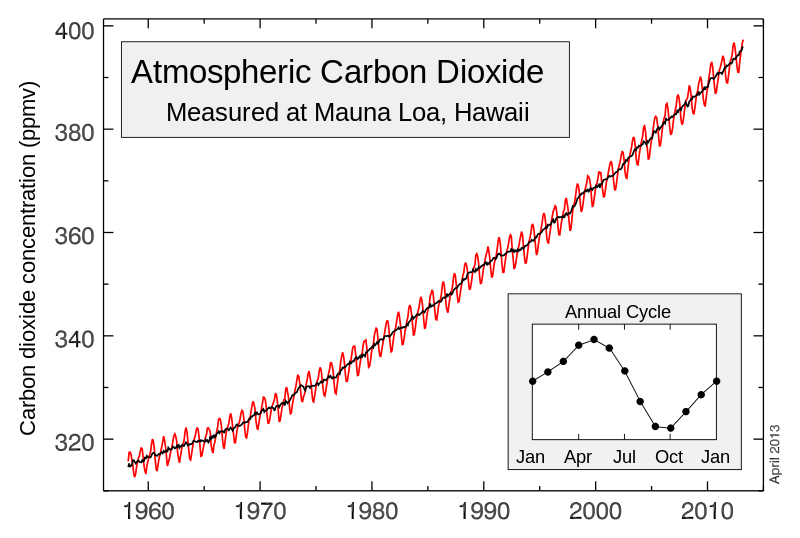
For the first time in human history the atmospheric concentration of carbon dioxide has reached 400 parts per million. Photo: Mauna Loa Observatory

There’s an interesting relationship, borne out in polling numbers, between the “general public’s” belief in global climate change and the weather. When it’s hot out, people believe in climate change. When it’s cold, they don’t.  When summer heat and drought and wildfires tore through the U.S. last summer, 74 percent of Americans believed that climate change was affecting the weather. Only 46 percent of Americans think that this climate change is caused by human activities – most directly the burning of fossil fuels.

The numbers are a little different when it is climate scientists, and the scientific research conducted on climate change, that are polled.

Writing in the GuardianDana Nuccitelli and John Abraham describe a new study that polled the recent research to see what scientists thought of climate change. (Nuccitelli is one of the voices behind the website Skeptical Science and one of the authors of the new scientific study.) They found that the vast, overwhelming majority of climate scientists agree that humans are causing climate change.

The team searched a database of scientific studies for the words “global climate change” or “global warming.” They found 11,944 relevant studies published between 1991 and 2012. Then, they read through the study’s summaries to figure out whether the study supported, rejected, was uncertain about or said nothing at all about our role in causing climate change. They also asked the scientists behind the papers whether their research supported or refuted the idea of man-made global warming.

Of the studies that expressed some sort of position on global warming, of which there were 4,000, the team write in their paper, “97.1% endorsed the consensus position that humans are causing global warming.” When the climate scientists themselves said whether or not their work supported the idea of anthropogenic climate change, “97.2% endorsed the consensus.”

For the papers that didn’t seem to have an opinion on whether humans were causing climate change, the reason, they write, is not that the scientists don’t know. Rather, it’s that the debate is so fully and completely settled within the scientific community that they aren’t going to use space re-hashing old fights.

Some people may mention that the scientific community is conflicted over the cause of climate change. This new survey would like to remind that that is not true.

More from Smithsonian.com:

Three Quarters of Americans Now Believe Climate Change Is Affecting the Weather
We’re About to Pass a Disheartening New Climate Change Milestone

Visit source:

A Friendly Reminder From Pretty Much Every Climate Scientist in the World: Climate Change Is Real

Posted in FF, GE, global climate change, Uncategorized | Tagged , , , , , , , | Comments Off on A Friendly Reminder From Pretty Much Every Climate Scientist in the World: Climate Change Is Real

Scientists Map Britain’s Most Famous Underwater City

Dunwich beach, across which storms pulled the ancient city. Image: modagoo

In 1066, the town of Dunwich began its march into the sea. After storms swept the farmland out for twenty years, the houses and buildings went in 1328. By 1570, nearly a quarter of the town had been swallowed, and in 1919 the All Saints church disappeared over the cliff. Dunwich is often called Britain’s Atlantis, a medieval town accessible only to divers, sitting quietly at the bottom of the ocean off the British Coast.

Now, researchers have created a 3D visualization of Dunwich using acoustic imaging. David Sear, a professor at the University of Southampton, where the work was done, described the process:

Visibility under the water at Dunwich is very poor due to the muddy water. This has limited the exploration of the site. We have now dived on the site using high resolution DIDSON ™ acoustic imaging to examine the ruins on the seabed – a first use of this technology for non-wreck marine archaeology.

DIDSON technology is rather like shining a torch onto the seabed, only using sound instead of light. The data produced helps us to not only see the ruins, but also understand more about how they interact with the tidal currents and sea bed.

Using this technology gives them a good picture of what the town actually looks like. Ars Technica writes:

We can now see where the local churches stood, and crumbling walls pinpoint the ancient town’s remits. A one kilometer (0.6 mile) square stronghold stood in the center of the 1.8km2space (about 0.7 square miles), with what looks like the remains of Blackfriars Friary, three churches, and the Chapel of St Katherine standing within it. The northern region looks like the commercial hub with lots of smaller buildings largely made of wood. It’s thought that the stronghold, as well as its buildings and a possible town hall, may date back to Saxon times.

Professor Sears sees this project as not just one of historical and archaeological importance, but also as a forecast of the fate of seaside cities. “It is a sobering example of the relentless force of nature on our island coastline. It starkly demonstrates how rapidly the coast can change, even when protected by its inhabitants. Global climate change has made coastal erosion a topical issue in the 21st Century, but Dunwich demonstrates that it has happened before. The severe storms of the 13th and 14th Centuries coincided with a period of climate change, turning the warmer medieval climatic optimum into what we call the Little Ice Age.”

So, in a million years, when aliens come to look at our planet, it might look a lot like Dunwich.

More from Smithsonian.com:

Underwater World
Underwater Discovery

Read the article: 

Scientists Map Britain’s Most Famous Underwater City

Posted in Brita, FF, GE, global climate change, Uncategorized | Tagged , , , , , , , | Comments Off on Scientists Map Britain’s Most Famous Underwater City

California Gov. Jerry Brown blames climate change for early wildfires

California Gov. Jerry Brown blames climate change for early wildfires

CAL FIRE

Jerry Brown tells journalists what’s what on Monday.

California’s governor was quick to blame climate change for the early-season wildfires that are already wreaking havoc in his state.

Gov. Jerry Brown (D) has been an advocate for climate action and a fiery critic of climate deniers. On Monday, he visited the state fire department’s aviation management unit as firefighters battled the remains of what a couple days earlier had been a raging blaze in the Santa Monica Mountains. While he was there, he shared some choice words with reporters about the causes and consequences of a fire season that’s shaping up to be a big one. From the Los Angeles Times:

“Our climate is changing, the weather is becoming more intense,” Brown said in an airplane hangar filled with trucks, airplanes and helicopters used by the state to fight fires. “It’s going to cost a lot of money and a lot of lives.

“The big issue (is) how do we adapt,” Brown said, “because it doesn’t look like the people who are in charge are going to do what it takes to really slow down this climate change, so we are going to have to adapt. And adapting is going to be very, very expensive.”

With the snowpack in the Sierra mountains at just 17% of normal, state officials are bracing for a long, destructive fire season. State Natural Resources Secretary John Laird, who joined Brown at Monday’s press conference, said he was preparing for “a deadly year.”

John Upton is a science aficionado and green news junkie who

tweets

, posts articles to

Facebook

, and

blogs about ecology

. He welcomes reader questions, tips, and incoherent rants:

johnupton@gmail.com

.

Find this article interesting? Donate now to support our work.Read more: Climate & Energy

,

Politics

Also in Grist

Please enable JavaScript to see recommended stories

From:  

California Gov. Jerry Brown blames climate change for early wildfires

Posted in Anchor, FF, G & F, GE, global climate change, LG, ONA, Pines, solar, solar power, Uncategorized | Tagged , , , , , , , , , | Comments Off on California Gov. Jerry Brown blames climate change for early wildfires

Climate-denying GOP rep wants to take science-funding decisions away from scientists

Climate-denying GOP rep wants to take science-funding decisions away from scientists

Rep. Lamar Smith, thinking deeply about science.

Rep. Lamar Smith (R-Texas), a climate skeptic who somehow became chair of the House Committee on Science, Space and Technology, wants Congress to meddle in decisions about which science research efforts should get government funding.

Perhaps that’s because scientists have a scary track record of finding out bothersome stuff. Like about climate change and whatnot.

From ScienceInsider:

The new chair of the House of Representatives science committee has drafted a bill that, in effect, would replace peer review at the National Science Foundation (NSF) with a set of funding criteria chosen by Congress. For good measure, it would also set in motion a process to determine whether the same criteria should be adopted by every other federal science agency.

The legislation, being worked up by Representative Lamar Smith (R-TX), represents the latest—and bluntest—attack on NSF by congressional Republicans seeking to halt what they believe is frivolous and wasteful research being funded in the social sciences. Last month, Senator Tom Coburn (R-OK) successfully attached language to a 2013 spending bill that prohibits NSF from funding any political science research for the rest of the fiscal year unless its director certifies that it pertains to economic development or national security. Smith’s draft bill, called the “High Quality Research Act,” would apply similar language to NSF’s entire research portfolio across all the disciplines that it supports.

The National Science Foundation, which has a $7 billion annual budget, funds a wide variety of research on climate change, among many other topics. From an NSF climate change report [PDF]:

NSF funding through the decades has led to many of the most fundamental discoveries and advances in human knowledge about the causes and consequences of global climate change and variability. Paleoclimate records, computational climate models, and economic models of climate change are just some examples of the major contributions of NSF’s investments in this area.

Fortunately, with Barack Obama in the White House and Democrats in control of the Senate, maneuvers like this generally turn out to be little more than time-wasting chest-thumping by anti-science charlatans. So long as that is the case, American scientists can continue to further our understanding of how fossil-fuel addiction is recasting our environment — and what we could do about it.

John Upton is a science aficionado and green news junkie who

tweets

, posts articles to

Facebook

, and

blogs about ecology

. He welcomes reader questions, tips, and incoherent rants:

johnupton@gmail.com

.

Find this article interesting? Donate now to support our work.Read more: Climate & Energy

,

Politics

Also in Grist

Please enable JavaScript to see recommended stories

Link to original – 

Climate-denying GOP rep wants to take science-funding decisions away from scientists

Posted in Anchor, ATTRA, FF, G & F, GE, global climate change, ONA, Pines, solar, solar power, Uncategorized | Tagged , , , , , , , | Comments Off on Climate-denying GOP rep wants to take science-funding decisions away from scientists

Keystone XL oil would be processed in sick East Texas community

Keystone XL oil would be processed in sick East Texas community

Tar Sands Blockade

Children play at a park in front of a Valero refinery in Houston, Texas.

For many, the battle over the Keystone XL pipeline is about national energy strategy and global climate change.

For residents of the Manchester neighborhood in Houston, it’s also about what will be processed and spewed into the air in their backyards.

Activist Doug Fahlbusch recently brought some attention to the community when he held up a sign at a Valero-sponsored golf tournament that said, “TAR SANDS SPILL. ANSWER MANCHESTER.” That protest got him carried away from the links by security guards and arrested.

What did Fahlbusch mean? Why are he and his colleagues at Tar Sands Blockade so concerned about Manchester?

Yes! magazine reporter Kristin Moe took a trip to the embattled neighborhood, where a refinery owned by Valero Energy Corp. could end up processing most of the tar-sands oil that flows south through the proposed Keystone XL pipeline. Here is a little of what Moe found in “Houston’s most polluted neighborhood”:

Yudith Nieto, 24, has lived in Manchester since her family came from Mexico when she was a small child. While it’s OK to visit the playground, she says, it’s not OK to bring her camera. On several occasions, security guards from the Valero refinery next door have appeared and asked her to leave, claiming that taking pictures in the park was “illegal.” They’ve even brought in Houston police as reinforcements. Valero, one of the major oil companies operating in this industrial part of Houston, keeps its security busy: Nieto says that they have harassed documentary filmmakers and journalists. And when college students participating in an “alternative spring break” program came to the park to talk to her about the neighborhood’s problems, a guard drove up in an unmarked vehicle and took video of the meeting on his cellphone. “I’m not afraid of the attention I’m getting from these people,” Nieto says, “because we want people to know that we’re aware.”

Manchester, one of Houston’s oldest neighborhoods, is surrounded by industry on all sides: a Rhodia chemical plant; a car crushing facility; a water treatment plant; a train yard for hazardous cargo; a Goodyear synthetic rubber plant; oil refineries belonging to Lyondell Basell, Valero, and Texas Petro-Chemicals; as well as one of the busiest highways in the city. Industrial development continues uninterrupted down the Houston Ship Channel for another 50 miles south to the Gulf of Mexico. The refineries around Houston have been called the “keystone to Keystone” because they’re expected to process 90 percent of tar sands crude from Alberta [PDF] if the controversial Keystone XL pipeline is completed.

It’s one of the most polluted neighborhoods in the U.S., one where smokestacks grace every backyard view. But it’s taking on a new significance as the terminus of Keystone because the pipeline is at the center of the highest-stakes environmental battle in recent years. As international pressure builds, residents are beginning to organize, educate themselves, and speak out for the health of their families. …

Manchester is in some ways typical of low-income urban neighborhoods: it’s almost entirely Latino and African American, with a large number of undocumented immigrants. A full third of residents live below the poverty line. Drugs, unemployment, and gangs are a problem. And there’s a strange smell in the air: sometimes sweet, sometimes sulfurous, often reeking of diesel. The most striking thing is that people here always seem to be sick. They have chronic headaches, nosebleeds, sore throats, and red sores on their skin that take months to heal.

Manchester is where the tar-sands rubber will hit the ground. Or where the bitumen will hit the air, if you will. To learn more about the community’s battles against Valero and Keystone XL, read the full article in Yes!

John Upton is a science aficionado and green news junkie who

tweets

, posts articles to

Facebook

, and

blogs about ecology

. He welcomes reader questions, tips, and incoherent rants:

johnupton@gmail.com

.

Find this article interesting? Donate now to support our work.Read more: Business & Technology

,

Climate & Energy

,

Politics

Also in Grist

Please enable JavaScript to see recommended stories

Read this article: 

Keystone XL oil would be processed in sick East Texas community

Posted in Anchor, FF, G & F, GE, global climate change, ONA, solar, solar panels, solar power, Uncategorized | Tagged , , , , , , , | Comments Off on Keystone XL oil would be processed in sick East Texas community

International Energy Agency calls for increased biofuels production to reduce greenhouse gases

back

International Energy Agency calls for increased biofuels production to reduce greenhouse gases

Posted 18 April 2013 in

National

Yesterday, the International Energy Agency (IEA) released their Tracking Clean Energy Progress report in New Delhi. The report explains that biofuels are playing a significant role in reducing greenhouse gases and in fact, IEA is calling for increased global biofuel production to further GHG reduction.

The IEA’s Climate Change Scenario endeavors to hold global climate change to 2⁰ C by 2022, but notes that we are not on track to obtain that goal. According to IEA, in order to reach the 2020 target the annual biofuels production needs to double and the capacity of advanced biofuels needs to increase six-fold. In order to succeed, IEA states that “this will require dedicated policy support for advanced biofuels and additional government funding for research and production.”

Currently, the United States is among the few regions to provide financial support for advanced biofuels as well as government policies to support such increases. Government policies like the Renewable Fuel Standard are a must to promote not only current production of biofuels but also provide a long-term policy framework to ensure investor confidence and aid in sustained production expansion.

As IEA notes, biofuels are actively reducing emissions from the transportation sector. Increased commitment to the production and expansion of renewable fuels are crucial to helping us mitigate and prevent further damaging impacts of climate change.

Fuels America News & Stories

Fuels
Read this article – 

International Energy Agency calls for increased biofuels production to reduce greenhouse gases

Posted in Anchor, FF, GE, global climate change, ONA, Uncategorized | Tagged , , , , , , | Comments Off on International Energy Agency calls for increased biofuels production to reduce greenhouse gases

Don’t Blame the Awful U.S. Drought on Climate Change

Drought in western Kentucky. Photo: CraneStation

For more than two years, a devastating drought has gripped a huge swath of the U.S.—drying up groundwater, killing crops and choking shipping lanes. One part of that drought, dubbed the “2012 Great Plains Drought” for its effect on middle America, says Climate Central, was worse than the Dust Bowl droughts of the 1930s. For many places, the drought is far from over.

With high temperatures and low rain taking a staggering economic toll—with billions of dollars in lossesa federal task force set out to figure out what caused the drought and to sort out if we should have seen it coming.

It seems that every time horrible weather hits, people turn and ask, “Is this climate change?” Typically, the answer you’ll get goes something like this: climate change is defined as a long-term statistical change in the weather, and so you can’t say that is any one disaster is “because of climate change.” That response is about as common as it is outdated.

In the past few years, a new concept has entered the discussion among climate scientists. Spear-headed in large part by the work of English scientist Peter Stott, the field of “event attribution” uses climate models to try to say how much we can attribute a natural disaster to global climate change. The famine-inducing drought that struck East Africa two years ago, a plight that lead to the deaths of hundreds of thousands of people, for instance, has been attributed to climate change: higher sea temperatures made the spring rains fail, driving the drought.

There’s never an all-or-nothing relationship between climate change and a particular extreme event. But what event attribution allows us to say is how much more likely a particular weather event was or how much stronger it ended up being because of shifts caused by climate change.

According to the Associated Press, the federal task force’s investigation says that the U.S. drought couldn’t be predicted by climate models and that the drought wasn’t due to climate change.

“This is one of those events that comes along once every couple hundreds of years,” said lead author Martin Hoerling, a research meteorologist at the National Oceanic and Atmospheric Administration. “Climate change was not a significant part, if any, of the event.”

“There was a change in the large-scale, slowly evolving climate that made drought severity more likely” in the past decade or so, Hoerling said” to Climate Central, “but nothing that pointed to a severe drought in 2012 specifically.”

The report may leave more open questions than answers, given that it found that no known source of natural climate variability can shoulder most of the blame for the drought, nor can man-made global warming, which over the long run is projected to make droughts more likely in some parts of the U.S., particularly the Southwest.

More from Smithsonian.com:

Brace Yourselves, the Drought’s Not Close to Over Yet

This article:  

Don’t Blame the Awful U.S. Drought on Climate Change

Posted in alo, FF, GE, global climate change, ONA, Uncategorized, Wiley | Tagged , , , , , , , , , , | Comments Off on Don’t Blame the Awful U.S. Drought on Climate Change