Tag Archives: democrats

The Green New Deal is quickly becoming a test for 2020 Democrats

Subscribe to The Beacon

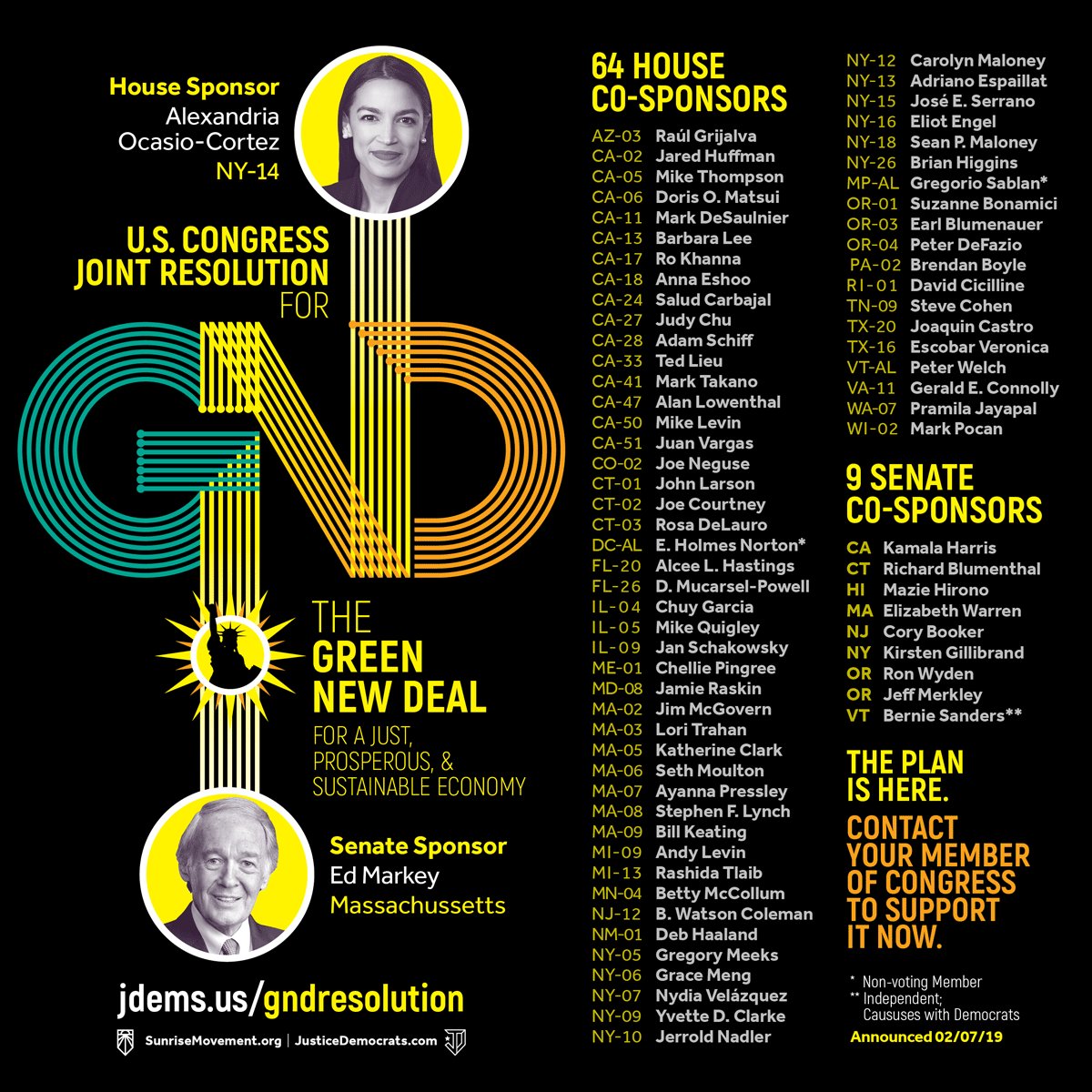
New York Representative Alexandria Ocasio-Cortez and Massachusetts Senator Ed Markey released their non-binding Green New Deal resolution Thursday morning; it outlines a vision of the future that’s a lot different from the one we’re in.

We’re talkin’ universal healthcare, a federal jobs guarantee, a transition to clean energy in a matter of decades, and more, much more. It’s a lot — and would have a tough slog becoming law in this Congress. House Speaker Nancy Pelosi has already labeled the ambitious proposal “a suggestion.”

But the vague scope of the deal is intended to be a feature, not a bug. Believe it or not, the policies that would make up a Green New Deal aren’t actually meant to pass Congress just yet. Gasp! No really, welcome to politics. The resolution serves up two big questions: The less central one is, can House Democrats rally behind this ambitious climate proposal?

Remember, Pelosi isn’t running for president, and if this deal ever comes to the table, its proponents are banking on a new president in the White House and Democratic leadership in both houses of Congress. Which brings us to the main question: Can 2020 Democrats throw their support behind this level of bold climate action?

What’s included in Thursday’s proposal is just as important as what’s left out, particularly when it comes to getting presidential candidates on board. The resolution doesn’t exclude a price on carbon — an emissions-reducing mechanism favored by liberals and some conservatives — nor is there a strict definition of what “100 percent renewable energy” means. So someone like Cory Booker, a 2020 presidential candidate who happens to support nuclear energy, can comfortably put his name down as a cosigner of the new resolution.

Including Booker, five presidential candidates have cosigned AOC and Markey’s resolution: Kamala Harris, Elizabeth Warren, Kirsten Gillibrand, Bernie Sanders. Former Housing Secretary Julián Castro hasn’t explicitly said he backs this proposal, but he has expressed support for a Green New Deal in the past. Indiana Mayor Pete Buttigieg, Hawaii Senator Tulsi Gabbard, and former Maryland Representative John Delaney haven’t indicated if they support the proposed resolution yet.

With heavyweights like Warren and Harris on board, it’s becoming clear that a progressive Green New Deal will likely be a central tenet of any Democrat’s 2020 agenda. “We’re going to press all elected officials, especially 2020 contenders, to support this resolution. Where they stand on the resolution will make it clear who is using the Green New Deal as a buzzword and who is serious about transforming our economy in line with what science and justice demand,” Stephen O’Hanlon, communications director of the youth-led climate advocacy group Sunrise Movement said in an emailed statement.

For the likes of Gillibrand and Booker, signing on now is a quick way to make inroads with parts of the Democratic base. For Warren and Sanders, this proposal is catnip for their supporters.

So what all are these candidates putting their names on? Even taking vague language into account, there are a lot of ambitious elements in the resolution:

A job for every American: “guaranteeing a job with a family-sustaining wage, adequate family and disability leave, paid vacations, and retirement security to all people of the United States.”
A right to unionize: “strengthening and protecting the right of all workers to organize, unionize, and collectively bargain free of coercion, intimidation, and harassment.”
Death to monopolies: “ensuring a commercial environment where every businessperson is free from unfair competition and domination by domestic or international monopolies.”
Healthcare for everyone! And … housing for everyone? “[P]roviding all members of society with high-quality health care, affordable, safe and adequate housing, economic security, and access to clean water, air, healthy and affordable food, and nature.”

As you can see, this isn’t your run-of-the-mill resolution. We’ll see how many of these ambitious plot points survive the journey through the Washington machine.

More:  

The Green New Deal is quickly becoming a test for 2020 Democrats

Posted in Accent, alo, Anchor, Casio, Everyone, FF, G & F, GE, LG, ONA, Radius, Uncategorized | Tagged , , , , , , , | Comments Off on The Green New Deal is quickly becoming a test for 2020 Democrats

Who stands to lose the most from climate change? Red states.

Subscribe to The Beacon

A new analysis from the Brookings Institution shows that many of the states and counties with the most to lose from climate change have been voting for candidates least likely to do something about it.

Of the 16 states facing the highest long-term losses of income from climate change — starting with Florida, Mississippi, and Louisiana — all but one voted for Donald Trump in 2016. That exception: Hawaii.

The data, sourced from Climate Impact Lab, tell a similar story when you look at counties and congressional districts. On average, the districts that voted Republican in November stand to lose 4.4 percent of their income this century, compared with a loss of 2.7 percent for those that backed Democrats. Those red districts tend to be less affluent, more rural, and more exposed to rising seas, stronger storms and punishing droughts, particularly in Florida and Texas.

Typically blue regions like the Pacific Northwest and New England could actually stand to gain from climate change, the report says. For chillier states, warmer temperatures could mean lower energy bills and a boost in crop yields. But a lot of other bad stuff too, don’t forget.

So, does this mean that red states are doomed, and liberal northerners will be left saying I told ya so? Well, it might not get to that if this new data — combined with the actual observable effects of climate change — changes people’s minds. Recent polls suggest that voters are coming around on the issue, as hurricanes, droughts, and wildfires get harder to ignore.

The Brookings Institution, for its part, offers this advice to climate activists: “A harder charging, grittier, and more palpable campaign focused on climate impacts in ‘red’ America could prove a lot more effective. And the data now exist to make that happen.”

Jump to original: 

Who stands to lose the most from climate change? Red states.

Posted in Accent, alo, Anchor, FF, G & F, GE, LAI, LG, ONA, Radius, Uncategorized | Tagged , , , , , , , , , | Comments Off on Who stands to lose the most from climate change? Red states.

Former U.N. leader Ban Ki-moon just endorsed Democrats’ fight for a Green New Deal

Subscribe to The Beacon

This story was originally published by the HuffPost and is reproduced here as part of the Climate Desk collaboration.

Former U.N. Secretary-General Ban Ki-moon became the first major international diplomat to throw his weight behind the so-called Green New Deal, a nascent effort by left-wing Democrats to zero out planet-warming emissions and end poverty over the next decade.

In an interview with HuffPost, Ban — now the co-chair of the newly launched Global Commission on Adaptation, a cadre of top world leaders slated to host a summit next year in the Netherlands — called the push “a very, very good initiative.”

“I would strongly support it,” Ban said by phone Wednesday afternoon from the World Economic Forum in Davos, Switzerland. “This kind of initiative is good.”

He held the movement in stark contrast to the climate agenda President Donald Trump has pursued, aggressively bolstering fossil fuel production and announcing a withdrawal from the Paris climate accord. He called the Trump administration “very worrisome.”

“It is very important that the people should speak out,” he said. “I have always been urging that there should be the policies of a civil society heard loud and clearly all around the world.”

Ban, 74, made climate change a priority during his term as the United Nations’ eighth secretary-general from January 2007 to December 2016. In 2008, as much of the developed world slid into the Great Recession, the South Korean diplomat urged international leaders to enact a Green New Deal, which he defined as “an investment that fights climate change, creates millions of green jobs, and spurs green growth.”

The concept caught on. Barack Obama, then a presidential candidate, called for a Green New Deal on the campaign trail. Labour Party activists began laying the groundwork for a government-run green investment bank in the United Kingdom. By 2009, the United Nations drafted a report calling for a Global Green New Deal.

But in 2010, austerity politics swept across the Atlantic. In the United States, Democrats came close to passing a cap-and-trade bill — a conservative market mechanism for curbing climate-altering emissions — but ultimately backed down. The term “Green New Deal” remained core to the U.S. Green Party’s platform, but away from the political fringe it all but disappeared.

That is, until 2018. A spate of left-wing Democrats revived the term and imbued it with a new sense of urgency and a much broader scope, calling for a rapid transition to 100 percent renewable energy and a guarantee of union-wage jobs for the millions of Americans struggling to survive as income inequality worsened. Representative Alexandria Ocasio-Cortez (a Democrat from New York) became the most prominent supporter, and at least two top Senate Democrats are now working on legislation. At least half the declared 2020 candidates for president now say they support a Green New Deal in some form.

On Wednesday, Ban stopped short of critiquing the longstanding dogma, among both Democrats and the few Republicans who acknowledge the realities of climate change, that says market-based tweaks, such as putting a price on carbon, are the only politically feasible paths to cutting emissions in the United States.

“There have been many discussions on how to address climate — cap-and-trade, carbon trading, carbon taxes,” he said. “Any such ideas which merit some deep discussions … that should continue.”

The remark bucked with the U.N. Intergovernmental Panel of Climate Change, which determined in October the world has roughly a decade to halve global emissions or face cataclysmic warming of at least 2.7 degrees Fahrenheit, and likely much more. At a news conference, two authors of the IPCC report laughed when asked if market-based policies alone could deliver the cuts needed.

Asked whether the fossil fuel industry should be barred from future climate talks, Ban said no, despite widespread criticism of oil and gas companies’ deep-pocketed efforts to upend climate policies in the United States and elsewhere.

“I don’t think those people should not be allowed to participate,” Ban said. “They should listen to the voices of the people. These climate talks and climate conferences are open to everybody, so … we should welcome them.”

View this article: 

Former U.N. leader Ban Ki-moon just endorsed Democrats’ fight for a Green New Deal

Posted in Accent, alo, Anchor, Casio, FF, G & F, GE, LG, ONA, PUR, Radius, The Atlantic, Ultima, Uncategorized | Tagged , , , , , , , , , , | Comments Off on Former U.N. leader Ban Ki-moon just endorsed Democrats’ fight for a Green New Deal

One more reason not to drive in New York (that could also save the planet)

Subscribe to The Beacon

New York could become the first U.S. city to charge people for driving a car downtown — that is, if Governor Andrew Cuomo gets his way.

During a “state of the state” speech to kick off his third term, Cuomo said a new congestion pricing plan would be part of his ambitious agenda over the next 100 days. The agenda also includes additional efforts like banning plastic bags and 100 percent carbon-free energy by 2040. Now that Democrats have unified control of New York government, this climate-friendly wish list could quickly become reality.

Congestion pricing would vault New York City towards a car-free future, and cement its leadership role on tackling climate change. But the fee wouldn’t kick in until sometime after 2021 and a lot could still change.

The idea of congestion pricing is simple: In a dense urban environment with great public transportation like lower Manhattan, operating a private passenger vehicle is actually harmful for society. Cars are dirty, loud, dangerous, and take up tons of space. If they get more expensive, fewer people will use them, carbon emissions will go down, and the streets will be safer — a win for everyone. Watch our video team explain the concept:

In New York, public backing for congestion pricing is on the rise. Public transit commuters outnumber auto commuters 30-to-1 in some parts of NYC, and there’s a growing support particularly among lower-income New Yorkers who want to see more investment in subways and buses as the system continues to literally fall apart in the aftermath of hurricanes and decades of deferred maintenance.

Congestion pricing isn’t new — it’s been in the works in NYC for a long time. When it first opened way back in 1883, the Brooklyn Bridge charged horse-drawn carriages a fee to limit traffic downtown but the practice was eventually abandoned after public outcry. A 2008 plan under former Mayor Michael Bloomberg to put a congestion price on automobiles didn’t make it through the state legislature.

Cuomo has proposed a $11.52 fee to limit vehicle traffic below 60th Street, and expects the plan to provide a “reliable funding stream” for public transit in the city, especially in underserved areas, raising $15 billion in an unspecified amount of time.

In other cities around the world, congestion pricing has proven effective at reducing vehicle use. London launched its system in 2003 and traffic has dropped by over 15 percent. More than 15 years later, London’s car surcharge has increased to around $15 per car, and if anything, critics say it doesn’t go far enough.

Charging cars about the price of a fully -loaded Chipotle steak burrito to enter the densest urban environment in America isn’t an all-out, breakneck, emergency-level mobilization on climate change — but it’s a start, and it will be an important testbed for expanding the common sense policy nationwide.

Jump to original:

One more reason not to drive in New York (that could also save the planet)

Posted in Accent, alo, Anchor, Everyone, FF, G & F, GE, LAI, ONA, oven, Radius, Safer, Uncategorized | Tagged , , , , , , , , , | Comments Off on One more reason not to drive in New York (that could also save the planet)

Trump’s border wall may cost Texas and Puerto Rico a chunk of their disaster aid

Subscribe to The Beacon

President Trump seems determined to find a way to fund a border wall between the U.S. and Mexico — even if it means diverting billions of dollars of aid originally earmarked for Puerto Rico and other communities recovering from disasters.

Now 21 days into the partial government shutdown (tied for the longest ever in U.S. history), it’s crunch time for Trump. Democrats remain unwilling to approve the $5 billion in wall funding that the president has requested to build a wall. One way around that political roadblock could be for Trump to declare a national emergency, which would allow him to use unspent Defense Department disaster recovery and military construction funds to start construction.

Construction of a 315-mile border wall would eat up a significant chunk of the nearly $14 billion worth of emergency funds, which had been set aside for numerous disaster relief projects including reconstruction in post-hurricane Puerto Rico, flood management along the hurricane-affected coastline in Texas, and wildfire management n California. The funding was allocated to the Army Corps of Engineers back in a February 2018 but never spent.

Considering that The Federal Emergency Management Agency has suspended disaster relief contracts thanks to the shutdown, it looks like it’ll be some time before these areas will see those dollars.

Representative Nydia Velazquez (D-N.Y), said in a statement that it would be “beyond appalling for the president to take money from places like Puerto Rico that have suffered enormous catastrophes, costing thousands of American citizens’ lives, in order to pay for Donald Trump’s foolish, offensive and hateful wall.”

“Siphoning funding from real disasters to pay for a crisis manufactured by the president is wholly unacceptable and the American people won’t fall for it,” she wrote.

While it’s unclear whether Trump will indeed declare a national emergency, he told Fox News host Sean Hannity on Thursday that without a deal with Congress, “most likely I will do that. I would actually say I would.”

Read article here: 

Trump’s border wall may cost Texas and Puerto Rico a chunk of their disaster aid

Posted in Accent, alo, Anchor, Citizen, FF, G & F, GE, ONA, Radius, Uncategorized | Tagged , , , , , , , , , , | Comments Off on Trump’s border wall may cost Texas and Puerto Rico a chunk of their disaster aid

Minnesota youth demand Green New Deal in meeting with governor

Subscribe to The Beacon

On Wednesday, more than 100 youth from across the state ascended the snow-free steps of the Minnesota capitol building to meet with newly inaugurated Governor Tim Walz and demand comprehensive action on climate change.

The group, Minnesota Can’t Wait, was there to push for a Green New Deal. Organizers called it the country’s first youth-led, state-level effort to demand the policy, which pairs labor and environmental justice efforts. In response to the meeting, Walz announced that he would immediately establish a statewide cross-agency working group on climate change.

Minnesota’s winters are warming faster than almost anywhere else in the country. In their conversation with the governor on Wednesday, youth spoke of their love of outdoor ice skating and dog sledding, but also their fear of the rise in infectious diseases and climate disasters.

Minnesota Can’t Wait wants state government to tackle the issue from all angles: In addition to pressuring the governor and legislature on Green New Deal legislation, the group calls for a ban on fossil fuel projects and executive action to regulate emissions. The demands are in line with what IPCC scientists say is necessary to stabilize global warming at 1.5 degrees C, the point above which change is expected to become large enough to disrupt society at a grand scale.

“The idea is that we stop making decisions based on what is politically possible and start doing what is necessary,” said Lia Harel, age 18, from Hopkins, Minnesota. “That’s been the driving force in getting these youth to act, because we don’t have time to wait any more.”

The event was inspired by sit-ins organized by the Sunrise Movement in congressional offices in Washington, D.C., and around the country in recent weeks, and wasn’t originally intended to include a meeting with the governor. However, a representative from Climate Generation, a Minnesota-based youth organization that helped plan the event, said that once they informed the governor’s office of the sit-in, they decided to invite the youth in for a meeting.

“What you’re asking for is concrete changes, which is what you should be asking for,” Walz told the youth. “This move is a tangible evidence of where we are going to go.”

Minnesota’s new state legislative session kicks off with Democrats just one Senate vote away from total control, and a new House committee explicitly focused on climate change for the first time.

“I met with youth climate leaders several weeks ago,” said Jean Wagenius, the state representative chairing the new House climate committee, in an email to Grist. “We will be working with them to rapidly accelerate efforts to reduce climate change gases.”

Lieutenant Governor Peggy Flanagan, who is a member of the White Earth Band of Ojibwe and the highest-ranking Native woman ever elected to executive office in U.S. history, attended the event, too. Flanagan said the issue of climate change was especially personal for her. Her tribe has fought for years to protect their lands from pipeline development, and now, she hopes the inclusive approach demonstrated on Wednesday could be a model for other states.

“We talk about having a table where the people who are directly affected by issues can pull up a chair and make sure that they’re seen, heard, and valued,” Flanagan said in an interview with Grist after the event.

That willingness from elected leaders to listen to youth describe the need for radical climate policy has been rare so far. With federal action toward a Green New Deal seemingly stalled for now, youth are hoping for quicker progress at the state level.

That could happen in Minnesota. In Walz’s inauguration address this week, he made a clear call for bold climate action. “Instead of burying our head in our hands when it comes to our changing climate or to providing affordable housing, accessible healthcare and good-paying jobs, we must tackle them head on,” Walz said.

Towards the end of his conversation with Minnesota Can’t Wait, Walz asked the youth to go back to their communities and make the case for the radical change that would benefit future generations as well as the state’s current economy.

It helped that his daughter, Hope, was also there, on her 18th birthday. At one point, she raised her hand, stood up behind her father, and said, “I’m just going to ask how I can get involved with the group, you know, so there’s a better chance of him following through.”

See original article here: 

Minnesota youth demand Green New Deal in meeting with governor

Posted in Accent, alo, Anchor, Casio, FF, G & F, GE, ONA, Radius, Uncategorized | Tagged , , , , , , , , , , | Comments Off on Minnesota youth demand Green New Deal in meeting with governor

Jay Inslee raises the stakes for 2020 presidential candidates

Subscribe to The Beacon

Washington State Governor Jay Inslee is considering running for president and he’s got one issue on the brain: climate change. On Wednesday, the Democrat took another step toward solidifying his green credentials by signing the No Fossil Fuel Money Pledge.

Big whoop, right? Wrong.

Unlike Bernie Sanders, Elizabeth Warren, Joe Biden, and other high-profile Democrats mulling (or already in the process of launching) presidential bids, Inslee isn’t exactly a household name. But the governor is betting that Americans have developed enough of an appetite for climate action to elect a candidate who puts it front and center — even if they haven’t heard of him.

Accepting or rejecting money from fossil fuels is developing into a sorting issue among Democrats. Progressives like Alexandria Ocasio-Cortez argue politicians working on crafting environmental policies shouldn’t accept money from Big Oil, while establishment Democrats like Frank Pallone — the new chair of the powerful Energy and Commerce Committee — argue fossil fuel money is a necessary evil.

Inslee has a sturdy solid environmental record, though he isn’t immune to some pointed criticism from a few folks to his left. And while more than 1,300 American politicians have taken the pledge not to accept fossil fuel donations, Inslee is only the second governor and the third of the many prospective 2020 presidential candidates from the Democratic Party to reject any such donations that are larger than $200. Bernie, Senator Jeff Merkley from Oregon, and Governor Tim Walz from Minnesota have also taken the vow.

“This challenge calls for the scale of national effort similar to when we went to the moon, similar to when we beat fascism,” Inslee told HuffPost about what it will take to defeat climate change. “The Democratic Party has to put a candidate forward who will make it the primary commitment to get this stuff done.”

Link: 

Jay Inslee raises the stakes for 2020 presidential candidates

Posted in Accent, alo, Anchor, Casio, FF, G & F, GE, ONA, Radius, Uncategorized | Tagged , , , , , , , , | Comments Off on Jay Inslee raises the stakes for 2020 presidential candidates

Bernie Sanders calls out Trump for ignoring the real crisis: climate change

Subscribe to The Beacon

President Trump addressed the nation from the Oval Office on Tuesday night about an issue he thinks is worth shutting down the government over: illegal immigration at the United States’ border with Mexico. The U.S., he said, is facing “a crisis of the heart and a crisis of the soul.” He called on Democrats to approve a $5.7 billion steel barrier — a move House Speaker Nancy Pelosi and Senate Minority Leader Chuck Schumer say they have no intention of making.

In response to Trump’s address, Pelosi said, “President Trump must stop holding the American people hostage, must stop manufacturing a crisis, and must reopen the government.”

She wasn’t alone in accusing the president of ginning up a fake emergency. Vermont Senator Bernie Sanders, who offered an unofficial response to Trump’s primetime address via YouTube and social media, levied the same charge.

Sanders hit back at Trump for the numerous falsehoods in the president’s speech, and for distracting the American people with politically-charged antics. He added that the U.S. is already facing an emergency of monumental proportions: It’s called climate change. The once-and-potentially-future presidential candidate referred to warming as “the biggest crisis of all.”

“The scientific community has made it very clear in telling us that climate change is real and is causing devastating harm to our country and the entire planet,” he said at the 11-minute mark in his speech. “Mr. President, we don’t need to create artificial crises. We have enough real crises.”

See the article here – 

Bernie Sanders calls out Trump for ignoring the real crisis: climate change

Posted in Accent, alo, Anchor, FF, G & F, GE, LG, ONA, Radius, Uncategorized | Tagged , , , , , , , | Comments Off on Bernie Sanders calls out Trump for ignoring the real crisis: climate change

Democrats send Trump a literal trash pile to protest government shutdown

Subscribe to The Beacon

The U.S. government has been partially shut down for 18 days and counting. Thousands of government employees are going without paychecks, the IRS is in chaos, and the national parks are filling up with human excrement and trash. President Trump says he’s prepared to play this shutdown game for months or years, but a couple of folks in Congress have had enough.

Representatives Jackie Speier and Jared Huffman, two Democrats from California, delivered a blue bin full of garbage collected from national parks to the White House on Tuesday afternoon. It was labeled “Trump Trash.”

The two representatives participated in a cleanup effort in national parks in the San Francisco area last weekend. “Let it never be said that I didn’t give anything to Donald Trump,” Huffman said in a live-streamed video in front of the White House, “because today I am bringing boxes of trash from that rainy Saturday in San Francisco to provide a reality check to the president.”

“There is no reason for this shutdown,” Speier said, thumping the top of a box of garbage for effect. Watch the video to catch Huffman joking that there might soon be enough trash to build that wall Trump wants so badly.

Trump is expected to deliver an address about immigration and the shutdown on Tuesday evening, but Huffman thinks that’s unnecessary. “We don’t need a nationally televised address from the White House to solve this problem tonight,” he said. “What we need is President Trump to wake up and smell the coffee cups and the diapers and burrito wrappers and the trash that is piling up.”

Link – 

Democrats send Trump a literal trash pile to protest government shutdown

Posted in Accent, alo, Anchor, FF, GE, ONA, Radius, Uncategorized | Tagged , , , , , , , , | Comments Off on Democrats send Trump a literal trash pile to protest government shutdown

Democrats might have put a roadblock on the path to a Green New Deal

Subscribe to The Beacon

Thursday was a big day in the U.S. House of Representatives: Democrats took control, Nancy Pelosi regained the gavel as House Speaker, the 116th class of freshman representatives was sworn in, and the new-look legislative body voted on a bill that will fund most government agencies through the 2019 fiscal year and potentially end a two-week government shutdown.

In her first speech as newly elected House Speaker on Thursday, Pelosi singled out climate change as a moral, health, and national security issue. “The American people understand the urgency,” she said. “The people are ahead of the Congress. The Congress must join them.”

But that new budget the House just voted to approve, engineered by Pelosi herself, includes a pay-as-you-go provision that some progressive critics say could hinder attempts at creating sweeping climate legislation. “PayGo,” as it’s known, is a rule that requires any new proposed spending to be balanced out with more taxes or budget cuts before it can come to a vote.

Progressives, environmental groups, and others are displeased with the potential effects of this provision; they say it will stifle the House’s ability to pass big-ticket items like “Medicare-for-all,” tuition-free public college, and, yes, a massive climate-targeted package like a Green New Deal. (Nevermind that such legislation would likely fare poorly in a Republican-controlled Senate.)

On Wednesday, high-profile progressives Alexandria Ocasio-Cortez of New York and Ro Khanna of California said they would vote against Pelosi’s package, arguing it kneecaps the liberal agenda they’ve been championing. “We shouldn’t hinder ourselves from the start,” Ocasio-Cortez tweeted on Wednesday. Vermont Senator Bernie Sanders agreed: “I’m concerned that the concept of PAYGO will make it harder for Congress to address the many crises facing our working families,” he tweeted.

Democratic leaders pushed back, arguing PayGo will decrease the deficit — which is set to balloon over the next decade thanks to the passage of 2017’s GOP-championed tax bill — and restore fiscal responsibility to Congress. They also promised members of the Congressional Progressive Caucus who were on the fence about the bill that PayGo wouldn’t stand in the way of major progressive priorities. Pelosi’s chief of staff, Drew Hammill, argued that a vote against the rules package would result in the Republican-controlled Office of Management and Budget defunding any Democratic initiatives that increased government spending.

Despite dissent from a vocal minority on the left, the Democratic rules package passed 234-197 on Thursday evening. Only three Democratic members, Ocasio-Cortez, Khanna, and Hawaii’s Tulsi Gabbard voted against — a fraction of the 18 votes needed to sink it.

So, does PayGo’s passage mean the end of the Green New Deal and other large-scale progressive legislation?

Not necessarily, according to Justin Talbot-Zorn, senior adviser at the progressive think tank the Center for Economic and Policy Research. “There is a procedural vote through which Congress can suspend the rules and pass legislation,” he said.

The rule could make it more difficult, however, to get people on board with big, expensive agenda items. “It does deter us from being able to do legislation at a scale necessary to do Green New Deal-type legislation,” Talbot-Zorn says. “It emboldens opponents of a Green New Deal; it gives them another argument against it.”

In other words, if progressive Democrats want to push for a large infrastructure investment in, say, green jobs, at some point in the future, they will have to expend more effort to bypass a rule package proposed and approved by their own party.

Or as Talbot-Zorn put it: “If the Green New Deal and major green infrastructure investment is going to be a central plank of the Democratic platform in the House — which it really needs to be — why would we adopt a rules package that would inhibit the passage of that central plank?”

View post: 

Democrats might have put a roadblock on the path to a Green New Deal

Posted in Accent, alo, Anchor, Casio, FF, GE, LG, ONA, Radius, Uncategorized | Tagged , , , , , , , , , | Comments Off on Democrats might have put a roadblock on the path to a Green New Deal