Tag Archives: drought

Are Fungus-Farming Ants the Key to Better Biofuel?

green4us

Secrets from their underground fungus fields could help fight climate change. DavidDennisPhotos.com/Flickr “If you have ants in your house,” the great Harvard ecologist EO Wilson once said, “be kind to them.” Keep this in mind the next time you want to flick one off the kitchen table: The tiny critters, which collectively weigh about as much as all of humanity, could wield a big weapon in the fight against climate change. In the US, corn-based ethanol is a big business, consuming 40 percent of the domestic corn crop and providing roughly 10 percent of the fuel supply, which would otherwise be dirty fossil fuels. But the practice of topping your tank off with corn is fraught with problems: Some argue that the crop should be used for food; it’s sensitive to drought; and the ethanol-making process might be contributing to an E coli epidemic, to name a few. That’s why the Obama administration recently announced a plan to invest $2 billion in organic fuels that rely on things other than corn, including switchgrass and gas from cattle poo. But this weekend, a group of scientists discovered a chemical key that could revitalize corn-based ethanol by allowing it to be made from stalks, leaves, and other bits beside the cob itself. This won’t help much with the drought problem (less corn is still less corn), but it could alleviate the food-vs-fuel debate and the E coli problem as more kernels are saved to go straight to livestock. Turns out, the savior of ethanol could be the South American leafcutter ant. Leafcutter ants make some of the largest underground colonies in the world, some with as many as seven million residents. And, as the name suggests, many of them spend their days combing the rainforest for bits of leaves, gathering half the weight of a cow per colony every year. They carry this mass back into their tunnels and use as fertilizer for a crop of fungus, which they then eat. Ant experts (“myrmecologists,” if you care to know) have long believed that the fungus acts as a kind of external stomach for the ants, breaking down sugars in the leaves that the ants aren’t equipped to handle themselves. In fact, it’s not the fungus itself that breaks down the leaves, but chemical enzymes within it, and Frank Aylward, a microbiologist at the University of Wisconsin-Madison, says those same enzymes could be used to help break down corn byproducts to make fuel. In a new study, Aylward sequenced the genome of the leafcutter ant’s symbiotic fungus, and identified for the first time the exact enzymes that have evolved over millennia to efficiently break down plant material stored in the ant’s underground tunnels. For making fuel, Aylward asks, “why don’t we use the rest of the corn plant? It’s because the sugars are tied up in cellulose and other things that are hard to break down. So we’re looking for enzymes that can help.” Enzymes are already used for this purpose, and a crop of businesses have sprung up in the biofuel boom to manufacture them, but Aylward believes his could be among the most efficient ever discovered. And using every part of the corn plant, including parts that typically go to waste, could make ethanol production more sustainable and boost its climate benefits. To study the ants, Aylward and his team traveled to Panama and Costa Rica to collect specimens (“The trick is to get the queen,” he says), then brought them to a lab in Wisconsin where they could take samples of the fungus as the ants cultivated it. While there are many microbes that can break down tough plant matter, he says, the ants do it exceptionally well: Collectively, they’re the largest herbivore on the continent. “We wanted to see if there was something that allowed them to do that so efficiently,” he said. Aylward’s findings pinpoint that secret ingredient enzyme, and he says he’s already been contacted by private businesses looking to manufacture the enzymes and get an early start on applying them to biofuel production; they could even be mixed and matched with other enzymes to take the ants work even further. “The ants are really successful at this,” he said, “and that’s the exact thing we want to do with plant biomass.”

See original: 

Are Fungus-Farming Ants the Key to Better Biofuel?

Related Posts

Obama’s New New Climate Plan
The Drought Is Drying Up All Our Ethanol
How To Fix the Climate, in One Simple Flowchart
VIDEO: What’s It Like to Land on an Aircraft Carrier?
This Cheat Sheet Will Make You Win Every Climate Argument

Share this:

Link to article: 

Are Fungus-Farming Ants the Key to Better Biofuel?

Posted in alo, eco-friendly, FF, G & F, GE, mixer, Monterey, ONA, organic, PUR, solar, solar power, Uncategorized | Tagged , , , , , , , , , , , | Comments Off on Are Fungus-Farming Ants the Key to Better Biofuel?

High Plains Aquifer Dwindles, Hurting Farmers

Parts of the vast High Plains Aquifer, once a prodigious source of water, are now so low that crops can’t be watered and bridges span arid stream beds. Link –  High Plains Aquifer Dwindles, Hurting Farmers ; ;Related ArticlesLack of Water Has Lasting Effects in Kansas and TexasDot Earth Blog: Who’s Escaping Climate Change ‘Mire and Muck’?Dot Earth Blog: A Plan to Bring Sun-Powered Irrigation to Poor Farmers ;

See the original post:

High Plains Aquifer Dwindles, Hurting Farmers

Posted in eco-friendly, FF, G & F, GE, Monterey, ONA, PUR, solar, solar power, Uncategorized | Tagged , , , , , , , , , , , | Comments Off on High Plains Aquifer Dwindles, Hurting Farmers

One Upside to Drought: the Fewest Tornadoes in the U.S. in At Least 60 Years

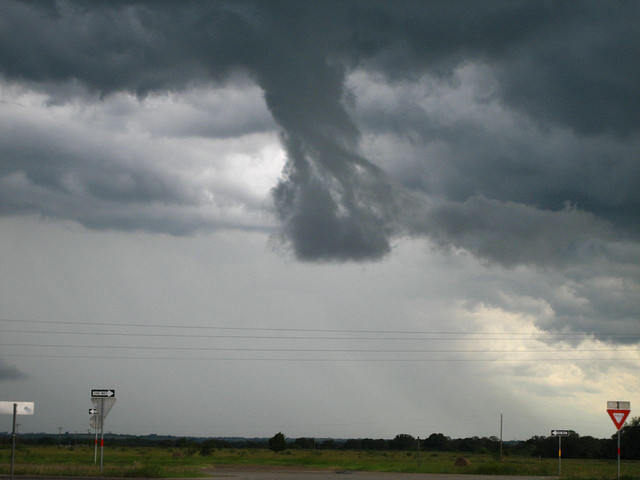
A funnel cloud in Texas. Photo: Charleen Mullenweg

For two years the majority of the continental U.S. has been plagued by drought, a confluence of natural cycles that have worked together to drive up temperatures and dry up the land. But for all the damage that has been done by the long-running drought, there’s been an upside as well. The lack of water in the atmosphere has also sent the U.S. toward a record low for tornadoes, says Climate Central‘s Andrew Freedman.

The National Severe Storms Laboratory (NSSL) in Norman, Okla., estimates that, between May 2012 and April 2013, there were just 197 tornadoes ranked EF-1 or stronger on the Enhanced Fujita scale. That beats the previous 12-month low, which was 247 tornadoes from June 1991 and May 1992.

That’s the lowest recorded tornado activity since 1954, when scientists first really started keeping track. The number of deaths connected to tornadoes went down, too:

The U.S. did set a record for the longest streak of days without a tornado-related fatality — at 220 days — between June 24, 2012 and Jan. 26, 2013. And July 2012, which was the hottest month on record in the U.S., saw the fewest tornadoes on record for any July.

But the tornadoes didn’t just up and disappear, says Freedman in an August story. Rather, some of them just moved to Canada.

More from Smithsonian.com:

Don’t Blame the Awful U.S. Drought on Climate Change
Surviving Tornado Alley
Tornado Power: Green Energy of the Future?

See original:

One Upside to Drought: the Fewest Tornadoes in the U.S. in At Least 60 Years

Posted in GE, green energy, ONA, Uncategorized | Tagged , , , , , , , | Comments Off on One Upside to Drought: the Fewest Tornadoes in the U.S. in At Least 60 Years

The Texas Tribune: Texas’ Sale of 100 Longhorns Stirs Debate on Breed’s Future

State Representative Charles Anderson has filed a bill to bar Texas Parks and Wildlife from further reducing the Big Bend herd. See the original article here: The Texas Tribune: Texas’ Sale of 100 Longhorns Stirs Debate on Breed’s Future ; ;Related ArticlesGreentech: Squeezing More From EthanolCalifornia Wildfire Drives Thousands From HomesBusiness Briefing | Company News: A Second Nuclear Plant in Turkey Is Approved ;

Link to article – 

The Texas Tribune: Texas’ Sale of 100 Longhorns Stirs Debate on Breed’s Future

Posted in ALPHA, aquaponics, Citadel, eco-friendly, FF, G & F, GE, Monterey, ONA, solar, solar power, Uncategorized | Tagged , , , , , , , , , | Comments Off on The Texas Tribune: Texas’ Sale of 100 Longhorns Stirs Debate on Breed’s Future

Drought hits Colorado ranchers, and polluting oil drillers deliver another blow

Drought hits Colorado ranchers, and polluting oil drillers deliver another blow

As of last week, 95 percent of Colorado was under severe drought conditions. A reminder: It is December.

DroughtMonitor

That’s an improvement since early September, when the entire state was in severe drought. At this rate, the problem will be resolved in … oh, five years.

The effects of the drought have been felt broadly — but the damage done to sheep farmers has been particularly acute.

From The New York Times:

“For the sheep industry, it’s the perfect storm,” [rancher John] Bartmann said, glancing out his office window here at a bleating sea of wool. “The money is just not there.”

Many ranchers are laying off employees, cutting their flocks and selling at a loss, and industry groups said a handful had abandoned the business entirely. Mr. Bartmann has trimmed his flock of 2,000 by one-third. With prices down more than half since last year and higher costs for gasoline and corn, Mr. Bartmann said he expected to lose about $100 for every lamb he sold. …

In a slow-motion disaster, a drought covering more than 60 percent of the country scorched corn stalks into parchment, dried up irrigation ponds and turned farm fields into brittle crust. Farmers begged local governments to let them tap aquifers. Scores of ranchers dumped their livestock at drought auctions.

Farmers say they are still paying near-record prices for corn and hay to feed their livestock through the winter. And if abundant snows do not come to replenish streams and coax new grass from the ground, they worry that next summer could be even worse than last.

J B Foster

The still-green White River Valley, Colo.

The drought struck at a particularly bad time — and as is often the case in food production, Big Ag played a role in how severely it affected ranchers.

The drought withered grazing grounds, killed off young lambs and dried up irrigation ditches, and a glut of meat and imported lambs from New Zealand helped send prices plummeting.

But some ranchers and officials in Washington believe that the deck was stacked against the sheep ranchers by the small number of powerful feedlots that buy lambs, slaughter them and sell them to grocery stores and restaurants. Even as prices farmers received fell to 85 cents a pound, consumers at supermarkets were paying $7 or more a pound for the same meat.

Meanwhile, some of the groundwater that’s left is being polluted by oil and gas extraction. From The Denver Post:

Oil and gas have contaminated groundwater in 17 percent of the 2,078 spills and slow releases that companies reported to state regulators over the past five years, state data show. …

Most of the spills are happening less than 30 feet underground — not in the deep well bores that carry drilling fluids into rock.

State regulators say oil and gas crews typically are working on storage tanks or pipelines when they discover that petroleum material, which can contain cancer-causing benzene, has seeped into soil and reached groundwater. Companies respond with vacuum trucks or by excavating tainted soil.

Contamination of groundwater — along with air emissions, truck traffic and changed landscapes — has spurred public concerns about drilling along Colorado’s Front Range. There are 49,236 active wells statewide, up 31 percent since 2008, with 17,844 in Weld County. …

“There is an impact,” [Colorado Oil and Gas Conservation Commission] environmental manager Jim Milne said, reviewing the groundwater data. “We don’t know if it is unreasonable or not.”

If it helps to clarify, here’s our assessment of unreasonable: a single drop of water polluted with benzene in the midst of an historic drought.

Colorado is increasingly on the front lines of the water wars. As the climate continues to warm and drought conditions become the norm, how states use and conserve water will become issues of life and death.

And not just for sheep.

Source

Drought and Economy Plague Sheep Farmers, New York Times
Drilling spills reaching Colorado groundwater; state mulls test rules, Denver Post

Philip Bump writes about the news for Gristmill. He also uses Twitter a whole lot.

Read more:

Climate & Energy

,

Food

Also in Grist

Please enable JavaScript to see recommended stories

Taken from: 

Drought hits Colorado ranchers, and polluting oil drillers deliver another blow

Posted in GE, LG, Uncategorized | Tagged , , , , , , , , , , , | Comments Off on Drought hits Colorado ranchers, and polluting oil drillers deliver another blow