Tag Archives: texas

Harvey pummels east Texas oil towns as Houston begins to dry out

At long last, skies are clearing over Houston. Yet the floodwaters have left an exacting mark, and human tragedy abounds. America’s fourth-largest city will never be the same.

After moving on from Houston, Harvey has wrought new devastation further east. The storm made a second landfall in Texas early Wednesday morning, bringing with it a fresh torrent of rain to the oil industry hubs of Port Arthur and Beaumont, 100 miles east of Houston.

Port Arthur and Beaumont are home to some 380,000 people — about the same population as the city of New Orleans — and Harvey dumped more rain on them than it did on Houston. Beaumont received more than 26 inches of rain on Tuesday alone, more than double what the city had ever seen on a single day — and about as much as Houston received during its rainiest 48 hours last weekend. Harvey has left the area’s residents stranded and its oil facilities battered.

In a Facebook post, the mayor of Port Arthur, Derrick Freeman, wrote, “Our whole city is underwater.” The county sheriff said most people couldn’t be reached to be rescued. The so-called “Cajun Navy” of fishing boats sprung into action, with a 60-mile convoy of boats departing Galveston, 100 miles southwest, toward the region. Even the designated evacuation center in Port Arthur flooded, complete with floating Red Cross cots, and residents forced to again flee. A local stretch of Interstate-10 looked like a lake, complete with waves and whitecaps. And north, in Beaumont, Harvey knocked out the municipal water system; local authorities say it will be out indefinitely.

Southeastern Texas is home to massive oil refineries and industry infrastructure — and Harvey has damaged much of it. In Crosby, east of Houston, a flooded chemical plant exploded early Thursday night, sending up plumes of black smoke. An ExxonMobil plant in Baytown, also an eastern suburb of Houston, reported a Harvey-related hazardous spill.

Now add facilities in the Beaumont and Port Arthur region to the list. There was a sulfur-dioxide release at an ExxonMobil refinery in Beaumont, which could cause respiratory issues for locals. And the nation’s largest refinery, run by Valero in Port Arthur, went offline on Wednesday.

About 20 percent of the nation’s refining capacity is now offline due to Harvey. Facilities have to file regulatory notices when floodwaters force them to shut down, a process that could result in releases of chemicals beyond what the law normally allows. ExxonMobil did that in association with its two damaged refineries. According to the Texas Tribune, “most of the other facilities belonging to major companies also filed notices with the Texas Commission on Environmental Quality,” meaning nearly every industry facility in the path of Harvey has the potential of a hazardous spill.

The scale of Harvey’s disaster across Texas remains nearly incomprehensible. More than 24 trillion gallons of water fell from the sky in five days, enough to cover Washington, D.C., in a 1,400-foot-high wall of water taller than the Empire State Building. Houston-area officials think it will take months to drain two key flood-protection reservoirs.

Meanwhile, it’s still peak hurricane season, and two new storms popped up on forecasters’ radars on Wednesday. (One meteorologist called them a “sick joke,” considering Harvey’s devastation.) Tropical Storm Irma, currently off the coast of West Africa, looks primed to grow into a large hurricane thanks in part to water temperatures in the tropical Atlantic that are currently near all-time highs. It may take nearly two weeks to cross the ocean, and its path is uncertain. It could make landfall anywhere from Texas to Bermuda.

The Gulf of Mexico has also spawned another area of interest to meteorologists. By early next week, it could become Tropical Storm Jose. One of its potential destinations: Texas.

View original: 

Harvey pummels east Texas oil towns as Houston begins to dry out

Posted in alo, Anchor, FF, G & F, GE, ONA, Uncategorized | Tagged , , , , , , , , | Comments Off on Harvey pummels east Texas oil towns as Houston begins to dry out

Harvey’s record rains just triggered Houston dams to overflow

In 1935, a storm swept through Houston, turning parts of the city into a lake. It was a wake-up call to city officials; they needed to get serious about flood control. About a decade later, the U.S. Army Corps of Engineers finished building two massive reservoirs west and upstream of the city. For the better part of a century, the Addicks and Barker dams have held back water that would have otherwise surged through Buffalo Bayou, the flood-prone waterway that snakes through downtown Houston before dumping into the Ship Channel.

This week, for the second time in as many years, a storm has pushed the Addicks and Barker dams to their limit. Early Monday morning, as Tropical Storm Harvey lingered over Houston and drowned whole swaths of the city, the Army Corps of Engineers began controlled releases from the dams, the first time they’ve done so during a major storm. By Monday afternoon, several neighborhoods near the reservoirs were under voluntary or mandatory evacuation as officials announced that releases from Addicks and Barker would continue for the foreseeable future. By early Tuesday morning, Addicks had topped the dam’s 108-foot spillway, leading to what officials call “uncontrolled releases” from the reservoir. Some homes could be inundated for a month.

Harris County Flood Control District meteorologist Jeff Linder called the releases the least-worst decision officials could make in light of floodwaters that continue to fill the reservoirs faster than they can safely drain. “If you are upstream of the reservoir, the worst is not over,” Linder said at a Monday afternoon press conference, warning that “water is going to be inundating areas that have currently not been inundated.” When someone asked him, via Twitter, whether the dams could break and trigger a Katrina-like disaster, Linder offered a one-word response: “No.”

That assurance comes despite the Corps of Engineers labeling the dams an “extremely high risk of catastrophic failure” after a 2009 storm that saw only a fraction of the rain Harvey poured on Houston this week. Officials insist that the hair-raising label has more to do with the breathtaking consequences of any major dam failure upstream of the country’s fourth-largest city than the actual likelihood of such a breach. In 2012, they detailed how a dam failure during a major storm would cause a multi-billion dollar disaster that turns the city into Waterworld.

Still, the Corps in recent years has implemented only piecemeal fixes to the earthen dams, including a $75 million upgrade that was underway before Harvey hit this weekend. Officials are barely even discussing how to fund a third reservoir that some experts say the region desperately needs.

This is the second year in a row that severe floodwaters have tested Addicks and Barker. Just last year, during 2016’s so-called Tax Day Flood, for the first time, the reservoirs hit and surpassed the level of a 100-year flood. That happened again this weekend, meaning the dams have seen two extremely rare flood events (at least one-in-a-100-year events) in just as many years. Last year was also the first time the National Weather Service ever issued a flood warning for the Addicks and Barker watersheds.

The dams are in some ways emblematic of how flood planning in the Bayou City hasn’t kept up with the region’s booming population and development, even as experts predict that climate change will dump increasingly severe storms on Houston’s doorstep with greater frequency. They were built in a region of water-absorbing prairie grasses that have in recent years been paved over by water-impermeable parking lots, driveways and suburban streets. The Sierra Club even sued the Corps in a failed attempt to stop construction on a nearby stretch of the Grand Parkway, a major toll road project that some opposed fearing it would coax development in an area that’s critical to the region’s flood control efforts.

Still, as the Texas Tribune and ProPublica pointed out in this 2016 investigation, Houston-area flood officials refuse to connect the region’s flooding problems to poorly planned development. As a result, every year people will keep building hundreds, if not thousands, of additional structures in Harris County’s 100-year floodplains, even as those “rare” storms start to hit year after year.

In a Monday press conference, Edmond Russo, an engineer with the Corps’ Galveston district, said officials wanted to keep high water from building up and going over the Addicks and Barker spillways, “because in that case, we do not have control over the water.” He’d hoped releases would stay low enough so that the already overtaxed Buffalo Bayou stays at the same level in the short term. In the long term, officials say it could take one to three months to totally drain the reservoirs.

Of course, that all depends on what happens in the coming days. Updating reporters on the reservoirs’ status Monday evening, Linder said more heavy rainfall or levee breaches upstream could change how fast the dams must release water downstream.

“Our infrastructure is certainly being tested to its limits,” Linder said.

Read article here: 

Harvey’s record rains just triggered Houston dams to overflow

Posted in alo, Anchor, FF, G & F, GE, LAI, ONA, ProPublica, Uncategorized | Tagged , , , , , , , , , , | Comments Off on Harvey’s record rains just triggered Houston dams to overflow

Hurricane Harvey will bring some of the heaviest downpours anyone has ever seen

Hurricane Harvey made landfall late Friday night on the Texas coast as one of the most intense hurricanes in U.S. history, spawning as many as 50 tornado warnings in the Houston area alone.

But its worst feature is still to come: several days of what could be some of the most intense rainfall this nation has ever recorded, a clear signal of climate change.

After a destructive storm surge washed away homes, and winds as strong as 132 mph blew away roofs and left hundreds of thousands without power, Harvey is expected to stall, drastically worsening the risk of catastrophic inland flooding from relentless rains.

As of Saturday morning, nearly 15 inches had already been recorded as bands of heavy thunderstorms streamed onshore from the warm Gulf of Mexico, with at least five more days of heavy rain on the way.

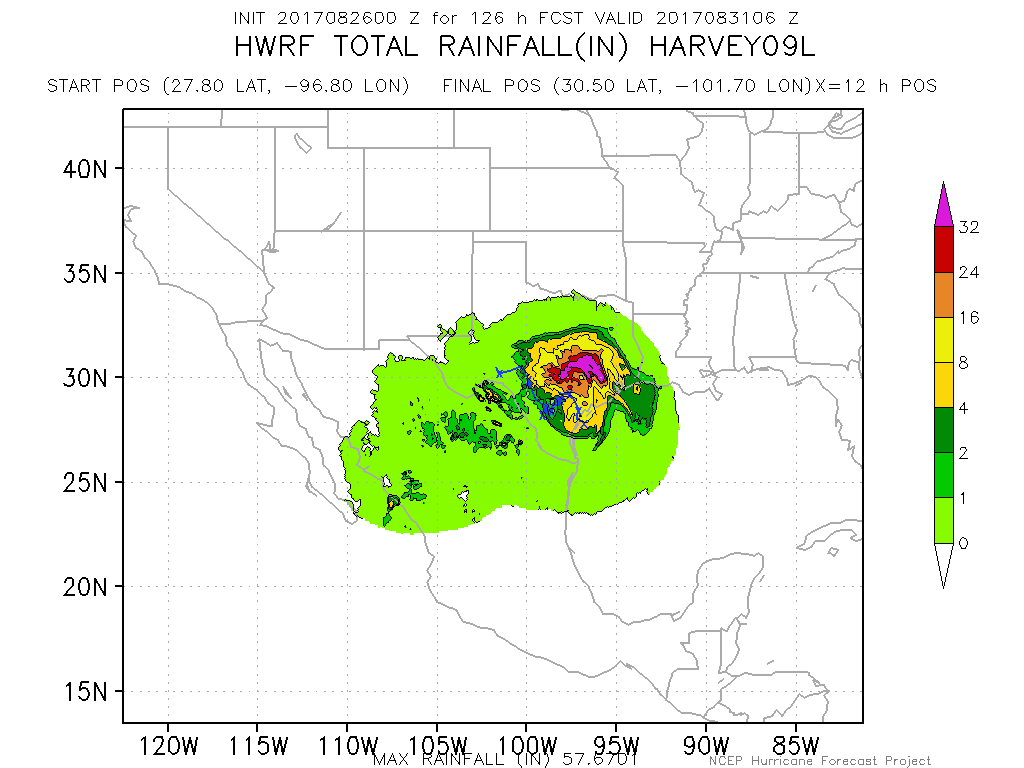
Through mid-week, Harvey is expected to move at an exceedingly slow 1 mph, pushing its rainfall forecast off the charts. For the first time in its history, the National Weather Service is forecasting seven-day rainfall totals as high as 40 inches in isolated pockets — equal to what’s normally a year’s worth or rain for coastal Texas.

Some high-resolution models predict even more. (For reference, the estimated 1-in-100-year seven-day rainfall total for the region is just 18 inches.) Meteorologist Ryan Maue estimated that 20 trillion gallons of water will fall on Texas over the next seven days, which is equal to about one-sixth of Lake Erie.

Virtually every river and stream between San Antonio and Houston is expected to experience record or near-record flooding over the next few days. Forecasters racked their brains to recall a scenario so dire anywhere in the world; a 2015 typhoon hitting the Philippines produced a similar amount of rain, but over a much smaller area.

Although the exact impact of global warming on the strength and frequency of hurricanes remains undetermined, there’s a clear climate connection when it comes to higher rainfall. All thunderstorms, including hurricanes, can produce more rain in a warmer atmosphere, which boosts the rate of evaporation and the water-holding capacity of clouds.

Heavy downpours have increased by 167 percent in Houston since the 1950s, and flooding there has been heightened by unfettered development and urban expansion. Some of the worst flooding in the region’s history has come from slow-moving storms like Harvey.

We don’t yet know if climate change will bring more slow-moving, rapidly intensifying tropical storms like Harvey. But flooding is what kills most people in hurricanes, and that will only get worse.

Taken from: 

Hurricane Harvey will bring some of the heaviest downpours anyone has ever seen

Posted in alo, Anchor, FF, G & F, GE, ONA, Pines, ProPublica, solar, Uncategorized | Tagged , , , , , , , , , | Comments Off on Hurricane Harvey will bring some of the heaviest downpours anyone has ever seen

Hurricane Harvey brings some of the heaviest downpours anyone has ever seen

This story has been updated. 

Hurricane Harvey made landfall late Friday night on the Texas coast as one of the most intense hurricanes in U.S. history, spawning as many as 50 tornado warnings in the Houston area alone.

But its worst feature is still unfolding: several days of what could be some of the most intense rainfall this nation has ever recorded, a clear signal of climate change.

After a destructive storm surge washed away homes, and winds as strong as 132 mph blew away roofs and left hundreds of thousands without power, Harvey is expected to stall, drastically worsening the risk of catastrophic inland flooding from relentless rains.

The dire National Weather Service forecast for catastrophic flooding appears to have come true. Overnight, parts of Houston received as much as two feet of rain, causing widespread devastation. Another two feet of rain is on the way, according to the latest forecasts.

Through mid-week, Harvey is expected to move at an exceedingly slow 1 mph, pushing its rainfall forecast off the charts. For the first time in its history, the National Weather Service is forecasting seven-day rainfall totals as high as 40 inches in isolated pockets — equal to what’s normally a year’s worth or rain for coastal Texas.

Some high-resolution models predict even more. (For reference, the estimated 1-in-100-year seven-day rainfall total for the region is just 18 inches.) Meteorologist Ryan Maue estimated that 20 trillion gallons of water will fall on Texas over the next seven days, which is equal to about one-sixth of Lake Erie.

Virtually every river and stream between San Antonio and Houston is expected to experience record or near-record flooding over the next few days. Forecasters racked their brains to recall a scenario so dire anywhere in the world; a 2015 typhoon hitting the Philippines produced a similar amount of rain, but over a much smaller area.

Although the exact impact of global warming on the strength and frequency of hurricanes remains undetermined, there’s a clear climate connection when it comes to higher rainfall. All thunderstorms, including hurricanes, can produce more rain in a warmer atmosphere, which boosts the rate of evaporation and the water-holding capacity of clouds.

Heavy downpours have increased by 167 percent in Houston since the 1950s, and flooding there has been heightened by unfettered development and urban expansion. Some of the worst flooding in the region’s history has come from slow-moving storms like Harvey.

We don’t yet know if climate change will bring more slow-moving, rapidly intensifying tropical storms like Harvey. But flooding is what kills most people in hurricanes, and that will only get worse.

From:  

Hurricane Harvey brings some of the heaviest downpours anyone has ever seen

Posted in alo, Anchor, FF, G & F, GE, ONA, Pines, ProPublica, solar, Uncategorized | Tagged , , , , , , , , | Comments Off on Hurricane Harvey brings some of the heaviest downpours anyone has ever seen

How the Cloud Is Going Green

Shares

You already know the many lauded benefits of the cloud — it saves paper, equipment and raw materials, while also providing employees and workplace teams an easier means to access important documents and files. But you may have also heard about how cloud data servers pack a punch in terms of environmental impact.

To minimize their carbon footprint, data centers are going green. Here are the ways companies behind some of the latest cloud-based technologies are working to reduce their environmental impact in the rollout of new products and services.

Starting Small

Like within many other industries, business owners who have previously invested in cloud data centers are starting small with their eco-friendly efforts. But this isn’t to say their current efforts aren’t making a difference. For example, many data centers are swapping out old, incandescent light bulbs for energy-efficient LEDs, which conserve energy and provide massive cost savings on monthly utility bills.

Cloud computing is also a more environmentally friendly practice compared to investing in on-site servers. That’s because these cloud data centers simply don’t need the same amount of infrastructure and space compared to their on-site server counterparts.

In fact, businesses that invest in on-site servers typically have more space than they need to house this bulky infrastructure, particularly if they plan to grow or expand operations. This leads to a number of drives sitting empty in the short or long term that still need to be powered and cooled.

In comparison, cloud data center operators can optimize the number of servers they own and use depending on their client and storage needs. For example, instead of running an on-site, physical customer service department, businesses can invest in a cloud contact center that requires less space and infrastructure.

Using Renewable Energy

Some leading cloud computing companies, like Facebook, Google and Apple, are also paving the way when it comes to investing in renewable energy in their data centers. In fact, all of Apple’s data centers are powered entirely by solar energy, while Facebook installed some of its newest servers in Iowa so the company could take advantage of the area’s wind energy. Microsoft is using both types of renewable energy for its cloud centers: solar energy in Virginia and wind energy in Texas.

These giant corporations have a lot of political power and community clout, and they’re using it to not only enforce stricter regulations on energy use, but to also move the entire industry toward renewable energy.

Optimizing Energy Use

One of the biggest electricity sucks for on-site servers includes maintaining cool temperatures in the spaces that house this infrastructure to prevent overheating. According to REIT.com, an average office space uses three to five watts of power per square foot, whereas a physical data center uses 100 to 300 watts per square foot.

That’s why many on-site data centers are housed in buildings or spaces specifically designed for their use. As the major tech giants have shown, locating operations near water and other renewable energy sources is optimal for conserving energy. However, if that’s not in the cards, some companies are going a different, forward-thinking route: working with contractors to build energy-efficient and even LEED-certified warehouses.

Data center operators have also been examining the airflow in their buildings, so they can separate hot and cold air streams. By keeping cool air near their servers — and moving hot air away from this expensive equipment — companies don’t need to run as many fans to maintain them.

The cloud continues to get greener. Not only is this technology saving companies space, time and money on hosting their own servers — and saving them a lot of paper and filing cabinets — it’s now leading the way in renewable energy and energy optimization. These are the first steps to a more connected, eco-conscious world.

Feature image courtesy of Shutterstock

Read More:
How 5G Technology Will Power a Greener Future
5 Top Tips for Recycling Old Technology
How to Finally Go Paperless in the Office

About
Latest Posts

Earth911

We’re serious about helping our readers, consumers and businesses alike, reduce their waste footprint every day, providing quality information and discovering new ways of being even more sustainable.

Latest posts by Earth911 (see all)

How the Cloud Is Going Green – August 14, 2017
Hacks to Stay Cool: Beat the Heat Using Less Energy – July 31, 2017
How to Shop for Clothes with the Earth in Mind – July 28, 2017

earth911

Source: 

How the Cloud Is Going Green

Posted in eco-friendly, FF, GE, LG, ONA, PUR, solar, Uncategorized, wind energy, wind power | Tagged , , , , , , , , , | Comments Off on How the Cloud Is Going Green

The fact is: Facts don’t matter to climate deniers

In an interview on CNBC’s Squawk Box this week, Energy Secretary Rick Perry falsely claimed that carbon dioxide was not the primary driver of the Earth’s climate. Instead, he offered, maybe it’s “the ocean waters and this environment that we live in.” (Umm, what?)

This is pure hogwash, and the largest professional organization for atmospheric science said as much. In a letter to Perry, Keith Seitter, the executive director of the American Meteorological Society, said that while it’s OK to be skeptical — that’s the heart of the scientific method — “skepticism that fails to account for evidence is no virtue.” Ouch.

His letter concluded that if Perry does not understand the drivers of climate change, “it is impossible to discuss potential policy changes in a meaningful way.” That’s where Seitter’s letter went wrong.

There’s just no reasoning with Perry’s kind of denial. After watching spats like this for more than a decade now, I’ve come to the realization that there is no graph, no chart, no international consensus statement, no engraved stone tablet lowered from heaven that could to convince someone who — by choice — refuses to believe a fact. It doesn’t matter to them how confident the scientific community is. And we’ve reached the point where debating denial is a waste of time. The need to fight climate change is just too urgent to wait for everyone to get on board.

The main problem I saw in the meteorologists’ letter (and, in general, with the current state of the climate debate) was its assumption that somehow climate deniers only need more information to see the light. Scientists have spent more than 30 years now trying to provide as much information in as many ways as possible and, if anything, climate denial is only getting more entrenched. What will it take for scientists to realize that this denial is a choice?

Decades of communications and psychology research shows that appeals to shared goals, values, and basic decency are a more effective way of working with conservatives on climate change. In red states across the country, renewable energy is booming, and it’s not because people there necessarily “believe” in climate change. It’s because renewable energy provides solutions that make sense. Scientists and liberal politicians need to move beyond trying to convince skeptics, and start working with them. There’s no time to lose.

In the 14 years that Perry served as governor, Texas grew into a wind superpower. It generates nearly a quarter of the entire country’s wind power, making Texas the top wind-producing state. (Of course, Texas is now the number one producer of natural gas, too.)

Other red states are producing a rapidly growing amount of wind power; in fact, most of the country’s wind-rich states are in the heartland. Of the 14 states that now produce more than 10 percent of their electricity from wind, eight are red states. The five states that now devote more than 20 percent of their grid to wind — Iowa, North Dakota, South Dakota, Kansas, and Oklahoma — all voted solidly for Donald Trump in 2016. The American Wind Energy Association reports that 99 percent of the country’s wind turbines stand in rural areas.

Climate denial is harmful in many ways, but it’s not preventing the spread of carbon-free power.

Maybe advocates for climate action should try to learn something from these red states. Judging by their quiet fondness for renewables, they’ve been doing a better job than the blue ones. The Texas wind boom came into being partly because Perry stayed out of the way and let investment dollars flow to the cheapest sources of power generation. In West Texas, that means wind — as it does in parts of at least 20 states right now.

But even Texas is not installing renewable energy fast enough. After accounting for the high cost of fossil-fuel pollution on public health, water, and other factors, people in nearly every state in the union would realize that wind is the cheapest option, according to an analysis by the University of Texas. If we want to get those wind turbines in the sky as quickly as possible, accurately accounting for those costs should be our bipartisan focus, not outing climate denial.

People in red states are already feeling the effects of climate change and acting to mitigate it. So let’s stop trying to persuade deniers and focus on ways to work together to reduce emissions and advance renewable energy. That’s the message that experts on weather and climate should be sending people like Perry. If some Republicans want to embarrass themselves by ignoring climate science, that’s their choice, and history will judge them harshly for it.

Originally from: 

The fact is: Facts don’t matter to climate deniers

Posted in alo, Anchor, Everyone, FF, G & F, GE, global climate change, LAI, LG, ONA, OXO, PUR, solar, solar panels, Uncategorized, wind energy, wind power | Tagged , , , , , , , , , | Comments Off on The fact is: Facts don’t matter to climate deniers

These Republicans Want to Put Ankle Monitors on the Sponsors of Undocumented Children

Mother Jones

<!DOCTYPE html PUBLIC “-//W3C//DTD HTML 4.0 Transitional//EN” “http://www.w3.org/TR/REC-html40/loose.dtd”>

Two top Texas Republican lawmakers have been working on a border security and immigration enforcement bill with input from the Trump administration, according to multiple reports—and it pulls few punches.

Most notably, Senate Majority Whip John Cornyn and House Homeland Security Committee Chairman Michael McCaul’s bill would force the sponsors of undocumented immigrants between the ages of 15 to 17 who show up unaccompanied at the border to wear ankle monitors so that the teens don’t skip out on deportation hearings. The sponsors are typically parents or other family members—many of whom are legal residents or citizens.

The use of ankle monitors on migrants themselves is already controversial. Mother Jones has previously reported that through for-profit companies, and at the cost of thousands of dollars, ankle monitors are offered as alternatives to long-term detention for migrants who can’t afford the lump sum of their bail, even though the monthly payments can eventually overshadow the original bail amounts. Requiring the sponsors, instead of the migrants, to wear the ankle bracelets appears to be an unprecedented step further.

The early “discussion draft” of the bill also calls to increase criminal prosecutions for immigrants who cross the border illegally, including establishing a five-year minimum prison sentence for those who re-enter the country after being deported. It would expand the use of mandatory detention for immigrants arrested within 100 miles of a border who are from countries other than Mexico or Canada—the overwhelming majority of migrants entering the United States come from Central America. It seeks an increase in detention space, allows for financial reimbursement to states that deploy their National Guard to the border, and calls for more immigration judges to speed up deportations. It calls for various border wall upgrades, but stops short of providing for Trump’s long-promised “big, beautiful” border wall.

On Tuesday, a congressional aide told Politico that the bill circulating is “really old” and “nowhere near the current draft.” But it’s unclear what has changed. While the bill is aimed at avoiding the pitfalls of the far right, hardline anti-immigrant groups have come out against it, arguing that because it lacks imposing sanctions on businesses that hire undocumented immigrants and does not provide for Trump’s border wall, it is toothless. “There’s not a single thing about worksite enforcement or anything at all against employers,” Jessica Vaughan, the director of policy studies for the Center for Immigration Studies, told the Washington Post. “It’s tinkering around the margins.”

Both the offices of Cornyn and McCaul declined to comment on the bill, including whether the latest draft still includes a mandate forcing undocumented children’s sponsors to wear ankle monitors.

Original link:

These Republicans Want to Put Ankle Monitors on the Sponsors of Undocumented Children

Posted in Citizen, FF, GE, LG, ONA, Radius, Uncategorized, Venta | Tagged , , , , , , , , | Comments Off on These Republicans Want to Put Ankle Monitors on the Sponsors of Undocumented Children

Republican Senator Doesn’t Want to Run Trump’s FBI

Mother Jones

<!DOCTYPE html PUBLIC “-//W3C//DTD HTML 4.0 Transitional//EN” “http://www.w3.org/TR/REC-html40/loose.dtd”>

One of the leading contenders to replace James Comey as the next director of the FBI withdrew from consideration on Tuesday.

“Now more than ever the country needs a well-credentialed, independent FBI Director,” Sen. John Cornyn (R-Texas) said in a statement. “I’ve informed the Administration that I’m committed to helping them find such an individual, and that the best way I can serve is continuing to fight for a conservative agenda in the US Senate.”

Cornyn was one of several candidates who interviewed for the position last weekend after President Donald Trump unceremoniously fired Comey on May 9. During an interview last week, the president said Comey was a “showboat” and a “grand-stander” and said that the “Russia thing” was on his mind as he decided to fire the head of the FBI.

The prospect of Cornyn—or any other partisan politician—running the FBI as it investigates the sitting president gave those on both sides of the aisle pause. “John Cornyn under normal circumstances would be a superb choice to be FBI director,” Sen. Lindsey Graham (R-S.C.) said last weekend. “But these are not normal circumstances.” Sen. Chuck Schumer (D-N.Y.) said, “The nominee should not be a partisan politician, not part of either party.”

Cornyn’s track record with the Trump/Russia matter justified those concerns, as Mother Jones reported Monday. Although the Texas senator has said the investigation should go on, he has devoted more of his attention to leaks from intelligence sources to the media. He’s also focused on the “unmasking” of disgraced former National Security Adviser Mike Flynn, which Trump supporters have said supports the argument that President Barack Obama had Trump under surveillance during the campaign. Cornyn has also said that the idea that Trump fired Comey because of the FBI’s Russia investigation was a “phony narrative.” He has resisted calls for a special prosecutor in the Russia case even though he wanted one for the Hillary Clinton email investigation.

Follow this link: 

Republican Senator Doesn’t Want to Run Trump’s FBI

Posted in FF, GE, LG, ONA, Radius, Uncategorized, Venta | Tagged , , , , , , , , | Comments Off on Republican Senator Doesn’t Want to Run Trump’s FBI

The Voting Rights Act May Be Coming Back From the Dead

Mother Jones

<!DOCTYPE html PUBLIC “-//W3C//DTD HTML 4.0 Transitional//EN” “http://www.w3.org/TR/REC-html40/loose.dtd”>

On June 25, 2013, the Supreme Court killed the core provision of the Voting Rights Act. Four years later, it may be coming back from the dead.

Before Shelby County v. Holder, the 2013 case, the 1965 Voting Rights Act barred nine states with a history of discrimination against minority voters, and portions of six others, from passing new voting laws without federal approval. The court’s 5-4 decision, written by Chief Justice John Roberts, found that the formula for determining which jurisdictions needed approval—or “preclearance”—was outdated and therefore unconstitutional.

“Coverage today is based on decades-old data and eradicated practices,” Roberts wrote, and “‘current burdens’ must be justified by ‘current needs.'” In other words, states couldn’t be subject to preclearance based on the pervasive discrimination of the Jim Crow era, which Roberts wrote was now firmly in the past. Implicit in that ruling was the idea that states could be brought back under preclearance if they showed new evidence of discrimination. The law contains a provision specifically for that purpose, allowing courts to place jurisdictions under preclearance if they demonstrate intentional discrimination.

Freed by the court’s ruling from oversight for the first time in decades, many of the formerly constrained state and local governments quickly began imposing new restrictions on voting. But by passing measures that curtail voting by minorities, these jurisdictions are essentially calling Roberts’ bluff—and could force the Supreme Court to consider restoring preclearance.

Texas is the likeliest setting for the return of preclearance. In the last two months, federal courts have three times ruled that the state intentionally discriminated against minority voters. Its 2011 voter ID law and two redistricting maps it drew that year—for the state House and for Congress—were intended to limit the voting power of minorities, the courts found. Plaintiffs in the cases are asking the courts to place Texas back under preclearance. One or more of the cases could reach the Supreme Court as early as its next term. If so, the Roberts Court will have to decide what to do with states that demonstrate that racial discrimination in voting laws is not just a thing of the past.

Shelby County said that any preclearance had to be based on current evidence,” says Rick Hasen, an election law expert at the University of California, Irvine School of Law. “And these trials are based on current evidence, not based on something that happened in the 1960s. And so one way of reading this is that the courts are being faithful to what the Supreme Court said in Shelby County, which is that in order to have the extraordinary remedy of preclearance, you need to show that there is a current problem with intentional race discrimination. That’s exactly what’s at stake in these cases.”

In 2010, a conservative backlash to President Barack Obama put Republicans in charge of legislatures and governorships across the country. They quickly passed new voter ID requirements, restrictions on early voting and same-day registration, and other measures that have been found to reduce voting among minorities, the poor, young people, and the elderly. According to the Brennan Center for Justice, by the time of the 2012 elections, 19 states had passed 25 restrictive voting laws.

Fourteen of those laws were blocked by the courts or the Justice Department under the Voting Rights Act’s preclearance rule, and the torrent of voting restrictions began to slow. Shelby changed that. It set in motion a new wave of voter suppression laws across the country. Weeks after the court’s ruling, for example, North Carolina passed a voter suppression bill that the 4th Circuit Court of Appeals, in striking it down, called “the most restrictive voting law North Carolina has seen since the era of Jim Crow,” targeting “African Americans with almost surgical precision.”

No state moved more quickly than Texas to implement a wish list of election reforms that had been blocked under preclearance. Hours after the court’s decision, the state’s attorney general, Gregg Abbott, announced, “With today’s decision, the state’s voter ID law will take effect immediately.” The next day, Gov. Rick Perry signed into law maps for congressional and state Legislature districts that were based on the ones that had been struck down by a federal court under preclearance in 2012 as deliberately discriminatory against minority voters.

Those moves have not fared well in the courts. In April, a federal judge in Corpus Christi ruled that the voter ID law was passed with discriminatory intent. In the past two months, a federal court in San Antonio found both the congressional and the statehouse maps from 2011 intentionally discriminatory. In July, a federal court will determine whether the maps Texas adopted after Shelby are also discriminatory; that case could result in court-drawn maps for the 2018 elections. The string of rulings might lead the courts to reimpose preclearance on Texas. After all, preclearance was intended to target repeat offenders so that the courts wouldn’t be left playing whack-a-mole to strike down discriminatory measures every time they emerged.

“You see the consequence of not having preclearance,” says Mark Gaber, an attorney on the plaintiffs’ legal team in the redistricting cases. “It’s 2017 and we’re still having to litigate about something that happened in 2011.” He adds, “In that period of time, we’ve now gone through three election cycles under maps that quite clearly are—the court’s going to find to be discriminatory.”

Any court that finds intentional discrimination could put Texas back under preclearance for up to 10 years. The courts can decide what types of election laws, if not all of them, would be subject to federal approval.

Wendy Weiser of the Brennan Center, who is part of the plaintiffs’ litigation team in the Texas voter ID case, says there’s a “reasonable chance” that one or more of the Texas cases will result in Texas being placed under preclearance. “The thing that persuades me that this is more likely than not is…the existence of multiple findings of discrimination in the state during this period,” she says. “So it really feels quite widespread.” Hasen concurs that there’s “a fair chance” that at least one of the Texas cases will result in preclearance. Texas would almost certainly appeal a preclearance order, putting the ultimate decision before the Supreme Court.

Texas is not the only place facing the potential return of preclearance. In the days and months after Shelby, Alabama and Mississippi enacted voter ID laws that had previously been held up by preclearance. North Carolina has stood out for the sheer number of voting bills Republicans have passed to preserve their power, including a redistricting map currently before the Supreme Court and a voter ID bill on which it could also rule. At least two cities have already been placed under preclearance in the aftermath of Shelby: Evergreen, Alabama, for gerrymandering its city council districts to produce a majority-white council in a city that is 62 percent African American, and Pasadena, Texas, which also restructured its city council to reduce the power of Hispanic voters. Pasadena is appealing that decision. But if a court places Texas under preclearance, it would mark the return on a much bigger level of a policy thought to be all but dead.

Original source: 

The Voting Rights Act May Be Coming Back From the Dead

Posted in FF, GE, LAI, LG, ONA, PUR, Radius, Ultima, Uncategorized, Venta | Tagged , , , , , , , , , , | Comments Off on The Voting Rights Act May Be Coming Back From the Dead

Federal Judge Rules That Texas Intentionally Discriminated Against Minority Voters

Mother Jones

<!DOCTYPE html PUBLIC “-//W3C//DTD HTML 4.0 Transitional//EN” “http://www.w3.org/TR/REC-html40/loose.dtd”>

A federal judge Monday ruled that the state of Texas intentionally discriminated against African American and Hispanic voters when it enacted a draconian voter ID law in 2011. The ruling could pave the way for courts to require Texas to get approval from federal authorities before making future changes to its voting laws.

This is the second time Judge Nelva Gonzales Ramos has found that state lawmakers purposefully engaged in illegal discrimination when it adopted the photo ID requirement in 2011. In 2014, Ramos found that the law had a discriminatory effect and intent. A finding of discriminatory effect is sufficient to force a voting law to be change, but a discriminatory intent finding can open a state up to more significant punishments. The Fifth Circuit Court of Appeals upheld Ramos’ finding of discriminatory effect but asked her to reconsider the question of intent. Her ruling on Monday reaffirmed her previous decision.

Critics of the photo ID law pointed to the fact that Texas lawmakers allowed voters to use concealed gun permits, which are more likely to be held by white voters. But the law disallowed identification cards issued to state employees and public university students, which are more likely to be used by minorities. In her opinion, Ramos pointed out that Republican lawmakers refused to include more forms of acceptable ID, reduce the cost of acquiring an ID, adopt a more lenient policy toward expired documents, or approve voter education about the new requirements. “These efforts revealed a pattern of conduct unexplainable on nonracial grounds, to suppress minority voting,” Ramos wrote in her opinion.

In 2013, the Department of Justice joined civil rights groups, Democratic lawmakers, and voters in challenging the law. On the day President Donald Trump was inaugurated, the department signaled that it might change its position. In February, the department’s lawyers asked the court to allow the US government to withdraw from the case and urged. The DOJ also urged Ramos not to rule on the intent question until the Texas legislature had taken steps this spring to amend the law, which the Fifth Circuit had ordered it to do. Ramos allowed the federal government to withdraw from this part of the case but rejected its request to hold off on the intent ruling. However, Ramos did indicate that she would wait until the legislature recessed to issue any remedy in conjunction with her findings.

The intent finding is a major victory for voting rights advocates because the courts have wide latitude to remedy intentional racial discrimination. Most importantly, a finding of intent allows the courts, if they choose, to put jurisdictions under federal oversight so that future changes to election procedures must be approved by the DOJ. Civil rights groups are requesting such a remedy and feel their argument for putting Texas back under federal supervision—which ended when the Supreme Court gutted a central provision of the Voting Rights Act in 2013—is strong. Last month, a three-judge panel in a federal district court in San Antonio found, in a separate case, that Republicans had racially gerrymandered congressional districts in order to weaken the growing power of minority voters. Taken together, voting rights attorneys believe the two findings of racially discriminatory intent make a convincing case that Texas should be placed under federal supervision.

“This is a great win for Texas voters, but it shouldn’t surprise anyone who looked seriously at the evidence,” Myrna Pérez, deputy director of the Democracy Program at the Brennan Center said in a statement after Ramos’ ruling. “Texas legislators crafted a law they knew would hurt minority voters, without any good justification or attempt to ameliorate the harms, and they mangled the legislative process to get it through.”

View original article:

Federal Judge Rules That Texas Intentionally Discriminated Against Minority Voters

Posted in FF, GE, LAI, LG, ONA, PUR, Radius, Uncategorized, Venta | Tagged , , , , , , , , , | Comments Off on Federal Judge Rules That Texas Intentionally Discriminated Against Minority Voters