Tag Archives: governor

Here’s how California could avoid wildfires (hint: It’s not raking)

Subscribe to The Beacon

Nine months ago, when California wasn’t in flames, government investigators warned Governor Jerry Brown that an inferno loomed.

“California’s forests are reaching a breaking point,” the report said.

The report got about little media attention at the time, but it’s still worth taking seriously even now. It came from an independent oversight commission set up by the California government to sniff out ways the state was going bad, then make recommendations to Brown and the legislature. The commission spent a year interviewing experts and holding hearings.

If California doesn’t want a future wreathed in wildfire smoke, the report suggests, it will need to permit more tree thinning, more prescribed fires, and more burning of wood for electricity.

Wait a sec, you say. Does that mean President Donald Trump is right to blame the fires on California’s forest management? Hardly. Trump’s suggestion that California needed to spend more time “raking” the forest is comically wrong. The Paradise Camp Fire started on National Forest Land, which is managed by Trump’s own Department of Agriculture, not by California. The severity of the recent fires, burning areas surrounded by brushy chaparral rather than forest, can be blamed more accurately on climate change and also the sprawling development that puts houses in the wilderness.

That said, it’s also true that California — and the rest of the West — needs to change how it manages forests. Ever since the United States took control of the West, people have been putting out fires. Before 1800, California was a pretty smoky place — an estimated 7,000 square miles burned every year (1,000 have burned so far this year. This history of fire suppression has left us with a massive backlog of fuels that we will have to deal with … somehow.

California’s fire report, recommended big changes. For starters, the state should flip its traditional mode of suppressing fires and shift to using fire as a tool, it said. That would mean burning in a controlled manner, lighting prescribed fires and firing up biomass electricity generation plants. All that would let the government control the air pollution from blazes, allowing someone to plan and space out fires, instead of having raging wildfires bathe the state in smoke all at once.

The commission also suggested that California supply a greater percentage of the wood it uses for everything from paper to houses. The state has strict sustainability rules for logging but ends up importing 80 to 90 percent of its wood from other places that may have “weaker or nonexistent regulations,” the report said.

In short, California has a lot of hard, dirty work to do in its forests to avoid choking Californians with smoke every year. But here’s the rub: The federal government owns nearly 60 percent of the forest in California. And that, as the authors of the report delicately put it, “complicates a state response.” California has already instituted a suite of programs to restore forests, but Trump has yet to take a rake to the land under federal authority.

Originally posted here: 

Here’s how California could avoid wildfires (hint: It’s not raking)

Posted in alo, Anchor, Casio, FF, G & F, GE, LG, ONA, Paradise, Radius, Uncategorized | Tagged , , , , , , , , , | Comments Off on Here’s how California could avoid wildfires (hint: It’s not raking)

Protecting public lands was a winning platform in elections out West

Subscribe to The Beacon

This story was originally published by HuffPost and is reproduced here as part of the Climate Desk collaboration.

Democrats notched wins in a number of key midterm races out West after running on platforms of protecting public lands and maintaining them under federal control — victories that conservation groups are celebrating as a repudiation of the Trump administration’s “energy dominance” agenda.

The administration’s “deeply unpopular” rollbacks of protected national monuments and its sweeping proposal to open up nearly all U.S. waters to offshore oil and gas development “fueled pro-conservation wins” in states like Nevada, New Mexico, and even South Carolina, Matt Lee-Ashley, a senior fellow at the Center for American Progress, said in a statement.

Story continues below

“We are seeing an unmistakable pattern of pro-conservation election outcomes in states and districts that are bearing the brunt of the Trump Administration’s attacks on parks, wildlife, and oceans,” he said.

Public lands were front and center in the contentious Montana Senate race between incumbent Jon Tester, a Democrat, and state auditor Matt Rosendale, a Republican. Though President Donald Trump traveled to Montana four times to campaign for Rosendale, Tester — a frequent critic of the president — defeated the self-proclaimed “Trump conservative.” And he did it in a state that Trump carried by 20 percentage points in the 2016 election.

In campaign advertisements featuring sportsmen and women with shotguns and fly-fishing rods, Tester’s team touted his record of voting to protect public lands, and pegged Rosendale as an East Coast developer who threatened the state’s wild spaces and way of life.

Rosendale, on the other hand, supported transferring federal lands to states during his 2014 bid for the U.S. House of Representatives. That year he told The Billings Gazette that “public lands were never intended to remain in control of the feds.” It’s clear Rosendale recognized that was not a winning stance in Big Sky Country, and promptly reversed course during the campaign to say the exact opposite.

Tracy Stone-Manning, the associate vice president for public lands at the National Wildlife Federation and former chief of staff of Montana Governor Steve Bullock, said Tester won in part because “voters didn’t buy Rosendale’s late and politically convenient conversion.”

While Tester has an 86 percent lifetime score from the League of Conservation Voters, the nonprofit advocacy group named Rosendale to its 2018 Senate “Dirty Dozen” list of candidates it calls anti-environment. And LCV spent just shy of $1 million on an ad campaign highlighting Rosendale’s support for rolling back federal land protections and his ties to fossil fuel billionaires Dan and Farris Wilks.

In New Mexico, Democratic incumbent Senator Martin Heinrich, a fierce critic of Trump’s national monument rollbacks who championed the creation of monuments and wilderness areas in the state, walloped Republican opponent Mick Rich, a commercial contractor who described Heinrich as the “foremost proponent of turning New Mexico into an environmentalists’ Disneyland.” In Nevada, Republican Senator Dean Heller, who called the Obama administration’s 2016 designation of Gold Butte National Monument an “extreme overreach” and urged the Trump administration to modify the boundary, lost his re-election bid to Democratic Representative Jacky Rosen. Rosen, who has a 97 percent lifetime score from LCV, campaigned on protecting public lands, including Gold Butte and Basin and Range national monuments, and pushing forward on renewable energy.

Strong support for public lands and environmental protection also appears to have helped boost several candidates in U.S. House races. In Arizona’s 1st Congressional District, incumbent Representative Tom O’Halleran, a Democrat, defeated Republican Wendy Rogers, who praised Trump’s decision to open offshore waters and the pristine Arctic National Wildlife Refuge to oil and gas drilling. In Nevada, Democrat Steven Horsford defeated Republican Cresent Hardy, and Democrat Susie Lee beat Republican Danny Tarkanian in the state’s 4th and 3rd Congressional Districts. Both Hardy and Tarkanian support transferring control of federal lands to the state. And in South Carolina’s 1st Congressional District, Democrat Joe Cunningham, an ocean engineer, upset Republican Katie Arrington by standing firmly against Trump’s offshore drilling plans.

Conservation groups, including CAP and Colorado-based Center for Western Priorities, also celebrated wins in a number of state races. Those included the victory by Colorado’s Jared Polis, the first openly gay man elected governor in the U.S., who during the campaign connected his opponent, Republican Walker Stapleton, to Interior Secretary Ryan Zinke and the administration’s efforts to roll back public lands protections.

“Voters across the West voted with their values and their wallets when they elected representatives that support public lands, access to them and the wise management of them,” Stone-Manning said.

Visit source:

Protecting public lands was a winning platform in elections out West

Posted in alo, Anchor, Casio, FF, GE, LAI, LG, ONA, Radius, Uncategorized | Tagged , , , , , , , , , , , | Comments Off on Protecting public lands was a winning platform in elections out West

What Washington and Oregon taught us about climate action on the ballot

Subscribe to The Beacon

Two climate-friendly taxes, two different results.

Washingtonians turned down another shot at having the country’s first “carbon fee” this week. Initiative 1631 was rejected by 56 percent of voters, faring only slightly better than the revenue-neutral carbon tax that met a similar fate two years ago.

Across the border in Portland, Oregon, the climate had better luck. Voters in the city backed the Portland Clean Energy Initiative, which aims to raise $30 million a year for renewables and clean-energy job training through a tax on big retailers.

Story continues below

What can we learn from comparing these two grassroots measures in one of the country’s blue strongholds, the Northwest? They have some key differences: Washington’s promised a whole-scale, state-level climate policy; Portland’s concerned a single step for climate action at the city level.

But the parallels are striking. They were both clean-energy campaigns that faced misleading tactics and an outpouring of money from corporate opposition. And they both showed that it’s possible to build a broad, diverse coalition of labor, environmental, and justice organizations behind climate policy — something activists have said needs to happen for years.

Their respective fates can’t be waved away as politics as usual. In King County, home to the progressive bastion of Seattle, 57 percent of voters supported I-1631, not enough backing to overcome opposition from conservative parts of the state. In hyper-progressive Portland, 64 percent went for the clean energy initiative. How do you explain that?

Money talks

Here’s one explanation: money. That’s certainly part of it. The campaign against Washington’s carbon fee raised $31 million, with 99 percent of that coming from oil and gas companies. That’s the most that’s been raised for a ballot initiative in state history. Supporters of the fee raised slightly less than half of that — around $15 million — with big donations from Bill Gates and Michael Bloomberg.

“We have just got to figure out a way for big corporations to not be able to buy elections,” said Nick Abraham, spokesperson for Yes on 1631.

In Portland, the spending was more evenly matched. The opposition campaign raised $1.4 million, with big donations from Amazon, Walmart, and other companies, according to the Oregon Secretary of State. Portland Clean Energy Initiative backers raised almost as much: $1.2 million.

What’s in a name?

Almost 70 percent of Washington voters, including a majority of the state’s Republicans, say they would support a measure to regulate carbon pollution — at least in the abstract, surveys show. But it’s still pretty hard to get people to vote for an actual tax, even if you call it something else.

Washington’s measure was technically a fee because its revenue would have gone straight to a designated purpose, as opposed to a general tax that raises revenue the legislature might spend on whatever it wants. The hope was that the “fee” language would be less off-putting for voters.

But you can’t run away from the t-word. “As soon as the opponents start organizing, they’re going to call it a tax,” Anthony Leiserowitz, director of the Yale Program on Climate Change Communication, told me in an interview earlier this year.

Boy, was he right. The No on 1631 campaign made sure that everyone in Washington saw the words “unfair energy tax” in the television ads and mailers that blanketed the state.

Lost in the details

I-1631 was a complex policy. That’s not necessarily a bad thing, but it likely made countering the opposition’s message much harder. It gave the No campaign plenty of lines of attack. It pointed out that gas prices would rise under the tax, that some big polluters would be exempted, and that the money would be handled by an unelected board. Yes on 1631 had responses to all of these points, but the No message resonated, even among some Democrats.

Portland’s measure was simpler. The opposition campaign similarly said the tax on big retailers would be passed to consumers and businesses. But that was pretty much it. Advocates had only one argument to refute, said Coalition of Communities of Color Advocacy Director Jenny Lee, making it less confusing for voters and easier to communicate their rebuttal (no, this will be paid by big corporations!).

“It’s hard to fight multiple fires,” Lee said. “It’s no comment on how the [Yes on 1631] campaign did, but there are challenges of putting complex policy before the voter.”

Back to the legislature

Would a complex climate policy have a better chance in front of elected officials? We may find out next year. The good news in the Northwest is that more climate champions are headed to office.

“Stepping back, I am truly more hopeful at any point than I have been since 2008 or 2009,” said Gregg Small, executive director of the Climate Solutions, a Pacific Northwest-based clean energy nonprofit. Small said support for action in both states looks stronger than it did before.

Some races are still shaking out as absentee ballots roll in, but it’s clear that Oregon will have a supermajority of Democrats in the Senate next year. Oregon legislators had already made passing a cap-and-trade bill a priority for 2019. And in Washington, there’s already talk of taking another carbon pricing bill to the state legislature. (A carbon tax failed in the state legislature this year by a single vote.)

Governor Jay Inslee assured me in an interview back in May that if I-1631 failed, there’d be another big push to enact a carbon tax, fee, price, or whatever you want to call it. “One way or another,” he explained, “we’re going to get this job done.”

Excerpt from:

What Washington and Oregon taught us about climate action on the ballot

Posted in alo, Anchor, Everyone, FF, GE, LAI, Landmark, ONA, Paradise, PUR, Radius, Uncategorized | Tagged , , , , , , , , , , | Comments Off on What Washington and Oregon taught us about climate action on the ballot

The election cleared the way for bold climate policy in these 6 states

Subscribe to The Beacon

Most of the climate-related coverage of this week’s midterm elections was pretty pessimistic. But if you dig down to the state level — the true hotbed of climate policy in the Trump era — the results were much brighter, even hopeful.

Climate-friendly Democrats won governorships and state legislatures across the country. In several key states, they managed to do both at once, achieving a “trifecta”: Unified control of the governor’s mansion and both branches of the statehouse. In most cases, that means there’s a wide-open lane for an expansion of renewable energy mandates and other climate-friendly policy from coast to coast — at a critical moment in planetary history.

Before the election, Democrats had trifectas in Washington, Oregon, California, Hawaii, New Jersey, Delaware, Connecticut, and Rhode Island. This week, they added Nevada, Colorado, New Mexico, Illinois, New York, and Maine. Combined, those 14 states are home to more than a third of the U.S. population.

Story continues below

Here’s a quick look at some of states that are gearing up to finally put climate change on the front burner:

New Mexico

Newly elected Governor Michelle Lujan Grisham is aiming to transform New Mexico — the third largest oil-producing state in the country, behind Texas and North Dakota — into an environmental leader. She wants the state to be able to produce so much renewable energy that they can export it to California.

Colorado

Incoming Governor Jared Polis campaigned on a promise of 100 percent renewable energy by 2040, which would be the boldest state-level policy in the country. That goal is so ambitious that even Polis admits it will be a heavy lift, but he’s got the backing of the legislature to help make it a reality.

Nevada

Voters in Nevada managed to pass a 50 percent renewables mandate by 2030 on Tuesday, one of the most aggressive in the country — and one of the few big direct democracy victories this week. Incoming Governor Steve Sisolak campaigned in support of the ballot measure, and will have the full support of his state legislature to roll out policies to make it happen.

Illinois

Newly elected Governor JB Pritzker has vowed to turn the most populous state in the Midwest into a renewables powerhouse, boosting its relatively weak 15 percent by 2025 mandate to 25 percent, and ally his state with others vowing to uphold commitments under Paris agreement.

New York

It was the state senate that flipped, not the governorship, in New York. That will free up Andrew Cuomo to answer his critics and pass legislation to put the state on a path to 50 percent renewables by 2030, something he’s been trying to do for a while now. This comes a year after New York City Mayor Bill de Blasio’s plan for the city to purchase 100 percent renewable energy “as soon as sufficient supply can be brought online.”

Maine

Janet Mills, the first woman elected governor in Maine, is aiming to reduce the state’s emissions 80 percent by 2030 and supports the development of offshore wind farms — widely seen as more efficient and reliable than onshore wind. Maine’s potential offshore wind resources are 75 times greater than its current statewide electricity use, meaning it could soon sell energy to other parts of New England and the East Coast.


In these state plans, it’s easy to get a glimpse of a future United States that’s actually on a path to holding global warming to less-than-catastrophic levels. Today’s bold state policies could quickly grow into regional hubs entirely reliant on renewable energy, leapfrogging the broken incrementalist approach of the past few decades at the national level and stealthily achieving the kind of world we need.

See the original post: 

The election cleared the way for bold climate policy in these 6 states

Posted in alo, Anchor, FF, GE, green energy, LAI, LeapFrog, ONA, PUR, Radius, Uncategorized, wind energy | Tagged , , , , , , , , | Comments Off on The election cleared the way for bold climate policy in these 6 states

North Carolina-sized Hurricane Florence makes its way to North Carolina

Hurricane Florence is heading straight for the Carolinas, on course to slam into a region that hasn’t seen anything like it in a generation.

Florence is already one of the worst hurricanes ever to threaten the East Coast, and there’s nearly unanimous consensus among the most reliable weather models that the storm will grow larger and more fierce before it hits land. When it arrives in North Carolina on Thursday, it could be about the same size as North Carolina.

On Monday, South Carolina Governor Henry McMaster ordered the complete evacuation of the state’s coastline, home to more than a million people, to prepare for what’s shaping up to be a historic storm. Large-scale evacuations have also been ordered in eastern North Carolina and southeast Virginia, home to a combined 3 million people, where states of emergency are already in effect. President Donald Trump cancelled a campaign rally in Mississippi and tweeted several messages urging people to prepare.

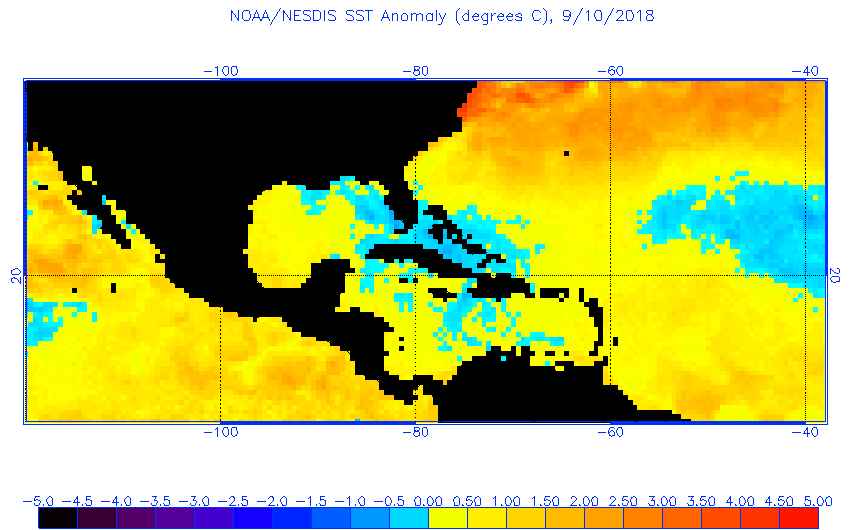
As of Tuesday evening, Florence had sustained winds of 140 mph — a strong Category 4. But it could soon get more powerful. On its current path, Florence will traverse the bathwater-warm Gulf Stream — source of rocket fuel for hurricanes — and likely strengthen further, perhaps reaching Category 5. That could turn Florence into one of the most powerful hurricanes in U.S. history.

Florence poses three main threats: wind, heavy rain, and storm surge (the wall of water pushed ashore when a storm makes landfall). All three could come in record quantities simultaneously.

Since 1851, only three other hurricanes have targeted the Carolinas at Category-4 strength or stronger, with Hugo in 1989 the most recent. In the generation since Hugo hit, millions more people have moved to the southeast coast — greatly increasing the region’s vulnerability. Winds as strong as Florence’s will produce “catastrophic” damage, according to the National Hurricane Center’s explanation of the Saffir-Simpson Wind Scale. “Most of the area will be uninhabitable for weeks or months.”

But the biggest risk to lives and infrastructure will come from the water. More than 80 percent of hurricane-related deaths are due to flooding, either by rising coastal waters or heavy rainfall. Florence will pack both.

At the coast, Florence could bring 15 to 20 feet of storm surge, enough to eclipse the East Coast record and overwhelm fragile and densely-populated barrier islands.

After making landfall, the most reliable weather models show Florence stalling over the Carolinas and Virginia for up to four days, similar to what happened in Texas with Hurricane Harvey last year. The deluge could extend for hundreds of miles inland.

Florence’s slow movement after landfall is expected to bring 20 to 40 inches of rain to inland parts of North Carolina and Virginia, with floodwaters enhanced by the rainfall-squeezing effect of the Appalachian Mountains. If that forecast holds, North Carolina’s state hurricane rainfall record of 27 inches set during Floyd in 1999 could be shattered.

All that rain would fall on already wet soil, worsening the potential deluge. Over the past 60 days, parts of the region have received nearly double the amount of rain seen in a typical summer.

In short, Florence is a recipe for an abject flooding disaster. Much of North Carolina and Virginia could be dealing with its worst floods in history. It will take a week or more for rainwater to drain from the hills and mountains, channeling all that rainfall into rivers and streams — scouring away homes and highways in floodplains along the way.

There’s good reason to believe that a storm like Florence is made more likely by the warming atmosphere. Warmer air can hold more water vapor, making rainfall in hurricanes more intense. At peak hurricane season, ocean temperatures in Florence’s path would probably be strong enough to support its current intensity even without global warming, but the extra degree or two has made the storm’s rapid intensification that much more likely. And the foot or so of sea level rise that’s already occurred — no matter what the North Carolina legislature says — will obviously worsen coastal flooding. The latest research also suggests that intense hurricanes will migrate further north as the climate warms this century.

As Miami-based meteorologist John Morales recently wrote on Twitter, “There’s more strong hurricanes, and they ain’t where they used to be.”

For a region unaccustomed to a storm like Florence, its impact will arrive as a harbinger of a warmer — and more dangerous — future.

View this article: 

North Carolina-sized Hurricane Florence makes its way to North Carolina

Posted in alo, Anchor, FF, G & F, GE, LAI, LG, ONA, Radius, Uncategorized | Tagged , , , , , , , , , | Comments Off on North Carolina-sized Hurricane Florence makes its way to North Carolina

Grandmothers stalled the police as climate protestors created the largest street mural ever

More than 3,000 demonstrators in San Francisco have created what’s thought to be the largest street mural ever made. On Saturday, the 2,500-foot-long, 50-foot-wide mural turned five blocks of city streets into scenes of community-proposed solutions for a warming world.

What’s more, the protesters didn’t have a permit to paint the streets — so a group of indigenous-led grandmothers faced off with police to block roads for five hours while the muralists completed their work. With the grannies from the Society of Fearless Grandmothers holding down ground, none of the protesters were arrested.

“You have to believe in a little magic and imagination to build the future that we want,” says Cata Elisabeth-Romo, an artist and one of the lead coordinators for the mural project.

San Francisco’s demonstration was part of a recent, international upwelling of art and activism. Last week, activists took to the streets in 91 countries with picket signs and paint for the “Rise for Climate, Jobs, and Justice” marches organized by 350.org and dozens of partners. The demonstrations came ahead of the much-anticipated Global Climate Action Summit that will begin in San Francisco on Wednesday.

Elisabeth-Romo working on the street mural in San Francisco.Cata Elisabeth-Romo

The summit is spearheaded by California Governor Jerry Brown and will bring together states, cities, businesses, and community groups to discuss how to achieve climate goals set by the Paris Agreement.

The San Francisco mural stitched together 50 scenes depicting solutions to climate injustices, each put together by a different community group. Indigenous artist and ecologist Edward Willie designed a border around the mural unifying all 50 scenes.

Anesti Vega / Survival Media Agency

The entire mural is temporary. As of Sunday night, four of the five blocks were still painted. The street art was made using charcoal from areas impacted by the recent devastating wildfires, along with tempera paint and raw clay sourced just outside of San Francisco.

Artist Nityalila Saulo designed the mural for the interfaith contingent, which included 2,000 footsteps surrounding the word “Live.” The footprints “remind us of the prints we leave behind as we live on this earth. It is meant to inspire us to value the choices we make every day,” she wrote on Instagram.

The artists’ and activists’ demands include racial and economic justice, and an end to fossil fuel production in favor of a transition to 100 percent renewable energy. From city to city, locals used creative expression to highlight their own priorities.

In New York on Thursday, the sea of protesters included artists and performers in costumes depicting creatures from the sea. No Longer Empty, an NYC group that curates exhibitions to spark community conversations in unconventional spaces, dressed as coral, jellyfish, and a leatherback turtle. It’s all part of a larger work by artist Laura Anderson Barbata called “Intervention: Ocean Blues.

“This work addresses the urgent need to transform our decisions, to influence policy, and to bring awareness to the importance of the ocean’s health and our dependency on it,” Anderson Barbata told Grist.

Justine Calma / Grist

In New Orleans, demonstrators used banners to call attention to Louisiana’s Cancer Alley, an industrial corridor that stretches from NOLA to Baton Rouge. Organizers say that on top of the plants and refineries in the area, the planned Bayou Bridge pipeline poses another health threat to residents in St. James Parish, where the march began.

Fernando Lopez / Survival Media Agency

350 commissioned protest artwork from artists in six different continents that demonstrators around the world could download and use in their campaigns.

Christi Belcourt

Christi Belcourt, a renowned Michif visual artist who traces her lineage to the Manitou Sakhigan of Alberta, Canada, contributed an image depicting a woman facing water, wielding lightning in one hand and holding a feather in the other. Belcourt has a message to accompany her artwork:

No amount of money can buy back a people’s river.
No amount of money can buy back the sea.
The Trans Mountain Pipeline cannot be built.
Because we love the rivers.
Because we love the sea.
Because we love this sacred earth.
We will defend our home.

With their art, Belcourt and others are mounting a creative defense against climate change.

Read this article – 

Grandmothers stalled the police as climate protestors created the largest street mural ever

Posted in alo, Anchor, Annies, FF, G & F, GE, LG, ONA, Radius, Uncategorized | Tagged , , , , , , , , , , , | Comments Off on Grandmothers stalled the police as climate protestors created the largest street mural ever

Hurricane Maria’s official death toll just jumped from 64 to 2,975

A new report commissioned by the Puerto Rico government estimated that 2,975 people died in the aftermath of Hurricane Maria.

On Tuesday, Governor Ricardo Rosselló officially raised the hurricane’s death toll to match the report’s findings, making Maria the deadliest U.S. hurricane since a 1900 storm that hit Texas. In an interview with CBS News, Rosselló said his administration will take concrete steps to address the report.

It’s now absolutely clear that Hurricane Maria was a humanitarian tragedy with little precedent in modern American history. Carmen Yulín Cruz, the mayor of San Juan and frequent critic of President Trump, called the new death toll “shameful” and a “violation of our human rights.”

The report has spurred renewed calls for a more complete understanding of just what went wrong in the storm’s aftermath, and justice for the victims and their families. Earlier this summer, lawmakers, including senators Elizabeth Warren and Kirsten Gillibrand, pushed for an independent commission to look into the government’s bungled response.

House candidate Alexandria Ocasio-Cortez has called for a “Marshall Plan” to rebuild the island to be carbon-neutral and address long-standing racial and economic inequalities. Many of Maria’s deaths were likely preventable, and Tuesday’s report, conducted by George Washington University, noted that the island was not adequately prepared for such a storm.

Maria was one of the strongest hurricanes ever recorded in the Atlantic, and caused a months-long breakdown in basic services on Puerto Rico, including a 328-day power outage, one of the worst in world history. As ocean waters warm, strong hurricanes like Maria are expected to become more common, and produce heavier downpours and more damaging coastal floods.

The death toll increase on Tuesday was nearly 50 times higher than the previous official count — 64, where it had been since the initial weeks after the storm. Trump, on his post-storm visit to Puerto Rico, held up a low death count to boast that it was not a “real catastrophe like Katrina.” For context, about 1,000 more people died in Maria than in Hurricane Katrina, the 2005 storm that hit New Orleans. According to the updated count, Hurricane Maria killed about the same number of people who died on 9/11.

Follow this link:  

Hurricane Maria’s official death toll just jumped from 64 to 2,975

Posted in alo, Anchor, Casio, FF, GE, LG, ONA, PUR, Radius, The Atlantic, Uncategorized, Venta | Tagged , , , , , , , , , , | Comments Off on Hurricane Maria’s official death toll just jumped from 64 to 2,975

John McCain was a climate hero, too

Dozens of epitaphs written over the weekend proclaim the late U.S. Senator John McCain as an American hero. But history may miss one of his greatest achievements: His decades-long call for climate action.

The death of McCain, Arizona’s senior senator, former prisoner of war, avid outdoorsman, and two-time Republican presidential candidate, marks the end of an era of free-thinking moderate conservatives who embraced conservation as a core value.

On the campaign trail in 2000, McCain received question after question from young people on climate change. After looking into it, he realized something major had to be done. In a 2007 interview with Grist, McCain explains his reasoning succinctly: “Suppose we’re wrong, and there’s no such thing as greenhouse gas emissions, and we adopt green technologies. All we’ve done is give our kids a better planet.”

Before Barack Obama’s environmental policies, before the Paris Agreement, there was McCain-Lieberman — the 2001 cap-and-trade proposal that McCain championed during a time when the country would soon be consumed with fighting a global war on terrorism. McCain-Lieberman never passed the Senate, but it remains the most important bipartisan U.S. climate legislation ever proposed, inspiring cap-and-trade schemes that have been implemented around the world.

On the 2008 campaign trail, this time as the GOP’s presidential nominee, he delivered what might be one of the most accurate, urgent, and passionate speeches ever given by a major American political figure on climate change. The entire address is worth reading in full, if only to lament how far his rhetoric seems from the realm of possibility today after a decade of Republican backsliding on this most-important of issues.

For example, the most stalwart of climate champions could have written this particular passage:

We have many advantages in the fight against global warming, but time is not one of them. Instead of idly debating the precise extent of global warming, or the precise timeline of global warming, we need to deal with the central facts of rising temperatures, rising waters, and all the endless troubles that global warming will bring. We stand warned by serious and credible scientists across the world that time is short and the dangers are great. The most relevant question now is whether our own government is equal to the challenge.

Of course, McCain also had his own share of backsliding on climate. His insistence on market-based climate solutions made him a frequent opponent of Obama’s regulatory approach. His nomination of Sarah Palin — the Alaska governor who popularized the “drill, baby, drill” chant — as his running mate in 2008 played a major role in unleashing a wave anti-science populism that led to our country’s present leadership. In his final days, McCain said picking Palin was one of his biggest regrets.

But McCain wasn’t afraid to bravely stand up to his own party and advocate for the environment, especially during the Trump era. McCain was one of the few Republicans strongly speaking out against the planned withdrawal from the Paris climate agreement — traveling to Australia’s Great Barrier Reef to make his plea that the U.S. keep its commitment. And last year, McCain was still cheering on climate activists and chose to buck his party’s anti-science stances and uphold an Obama-era methane rule.

In this moment of deep division and existential challenges facing our country and our world, we’d do well to emulate McCain’s spirit of courage and ability to stand up for urgent climate action even when other problems seem all-encompassing. In his final months, when asked what he’d like to be remembered for, he wanted people to say that “he served his country.”

John McCain served his planet, too.

See the article here – 

John McCain was a climate hero, too

Posted in alo, Anchor, FF, G & F, GE, LAI, ONA, Oster, Radius, Uncategorized, wind power | Tagged , , , , , , , | Comments Off on John McCain was a climate hero, too

Bigger, stronger, rainier: Is Hawaii’s Hurricane Lane a sign of what’s to come?

Hurricane Lane, one of the strongest hurricanes ever measured in the Central Pacific Ocean, is on a crash course with paradise.

At the peak of its intensity late Tuesday and early Wednesday, Lane had sustained winds of 160 mph and gusts up to nearly 200 mph — making it the most powerful hurricane to threaten Hawaii on record. The storm, now downgraded from Category 5 to 4, poses a colossal threat to the islands: The National Weather Service says that “life-threatening impacts are likely.”

On Lane’s current track, Hawaii could see torrential downpours, mudslides, and 20-foot waves. The desert-like parts of the tropical islands could witness a year’s worth of rain, up to 2 feet, in mere hours. Lane should weaken as it approaches, but it could still bring tropical-storm-force winds to almost every part of every island — winds strong enough to tear roofs off homes and cause widespread power outages that could last weeks or months.

Hawaii’s governor, David Ige, declared a state of emergency in advance of the hurricane, which is expected to arrive as soon as late Wednesday night. On Twitter, President Donald Trump urged those in its path to prepare. Hawaiians have taken those words to heart, clearing out grocery store shelves and filling up their gas tanks.

The vast majority of people in the state have never seen a storm like this. Since 1950, just two hurricanes have made official landfall in Hawaii, both hitting the island of Kauai. As of Wednesday afternoon, the most heavily populated islands were either under a hurricane watch or warning.

As the waters of the Central Pacific warm, hurricanes like Lane are expected to become more common — and indeed, the Pacific has seen a flurry of hurricanes near Hawaii in recent years. While the hurricane threat to Hawaii tends to peak during El Niño years, recent research shows that long-term ocean warming, not El Niño, is likely the dominant cause of Hawaii’s growing hurricane threat. And Hawaiian scientists have found these new hurricanes tend to be larger, stronger, and rainier.

A disaster response effort in Hawaii could be hindered by the Jones Act, as Puerto Rico experienced during the aftermath of Hurricane Maria. The act restricts foreign ships from delivering supplies from the mainland to the islands — meaning that Hawaiians pay inflated prices for basic supplies, which could make restocking shelves and rebuilding homes especially difficult.

In addition to sea-level rise and coral bleaching, hurricanes are increasingly part of Hawaii’s reality. For his part, the governor is putting Hawaii on a path to reduce its contribution to climate change. In 2015, Ige signed legislation making the state the first in the nation to mandate 100 percent renewable energy — a goal it plans to reach by 2045.

Credit – 

Bigger, stronger, rainier: Is Hawaii’s Hurricane Lane a sign of what’s to come?

Posted in alo, Anchor, Everyone, FF, GE, LG, ONA, Paradise, Radius, Uncategorized | Tagged , , , , , , , , , , | Comments Off on Bigger, stronger, rainier: Is Hawaii’s Hurricane Lane a sign of what’s to come?

Caribbean leaders beg Trump to act on climate change

This story was originally published by the Guardian and is reproduced here as part of the Climate Desk collaboration.

Caribbean states and territories have rounded on the Trump administration for dismantling the United States’ response to climate change, warning that greenhouse gas emissions must be sharply cut to avoid hurricanes and sea-level rise threatening the future of their island idylls.

The onset of this year’s hurricane season has seen leaders in the region tell the Guardian that President Trump needs to grasp the existential threat they face. Rising temperatures and increased precipitation caused by climate change is strengthening hurricanes, researchers have found, even as the overall number of storms remains steady.

“In 2017 we saw some of the most devastating and destructive hurricanes we’ve seen in our history,” said Selwin Hart, Barbados’ ambassador to the United States. “This needs to be recognized.

“This isn’t some scientific debate, it’s a reality with loss of life implications. We need the U.S. to be back at the table and engage. It’s imperative. We wouldn’t have a Paris climate agreement without the U.S. and we need them back now.”

Hurricane Irma strengthened to a Category 5 hurricane before slamming into the Caribbean and the United States in September, causing more than 130 deaths in places such as Barbuda, Saint Martin, Barbados, and the United States. This storm was swiftly followed by Hurricane Maria, which obliterated much of Dominica and caused a widespread, ongoing disaster in Puerto Rico, leaving thousands dead.

“Even before the passage of Hurricanes Irma and Maria, we could already see the effects of coastal erosion, and even the loss of some islands,” said Ricardo Rosselló, governor of Puerto Rico. The U.S. territory is part of an alliance with several states, including New York and California, that have committed to addressing climate change absent the federal government. “Puerto Rico remains in a more vulnerable situation than other states. It is expected that some of the initial effects of climate change will be seen in Puerto Rico,” said Rosselló, who called Trump’s climate policies “a mistake.”

During the 2015 Paris climate talks, Caribbean nations were among the loose coalition of low-lying countries that successfully pushed the international community to aim to limit the global temperature rise to 1.5 degrees C (2.7F) beyond pre-industrial levels.

This aspiration, which would provide many island states the hope of remaining viable in the face of sea-level rise, drought, and powerful storms, is currently far from likely, with a recent U.N. report warning the picture would be “even bleaker” if the Trump administration follows through with its vow to remove the United States from the Paris deal.

The withdrawal from Paris would take three years, but in the meantime the Trump administration is working to dismantle the Clean Power Plan, an Obama-era strategy to cut carbon dioxide, delay new vehicle emissions standards, open up new land and ocean to oil and gas drilling, and even put in place a set of subsidies that would prop up the ailing coal industry.

“The U.S. is a major player in the world and it needs to lead — we depend on it to be a moral voice on issues where people are vulnerable,” said Darren Henfield, foreign minister of the Bahamas. “We really hope the U.S. readjusts its position. It seems there will be doubters until we start completely losing islands.”

Henfield said Bahamians have become “dramatically aware” of climate change following a series of hurricanes that have hit or brushed the archipelago in recent years. The country has attempted to accelerate its transition to renewable energy although it faces the conundrum of relying economically upon tourists, borne on huge cruise ships that emit large amounts of carbon dioxide.

“We are being forced to put up sea walls to push back the rising tides,” Henfield said. “We are very exposed and we could see the swallowing of the Bahamas by sea-level rise. We don’t have much room for people, there’s nowhere for people to move. Climate change will exacerbate the issue of refugees.

“I don’t know what influences the mind of President Trump but the world will be negatively impacted by not dealing with climate change. We always talk to our neighbors in the North and part of our foreign policy is to sensitize them and the international community to the threat we face.”

But while Caribbean states plead for climate assistance, particularly from the United States, they are also looking at how to adapt to a new environment. The Organization of Eastern Caribbean States, a coalition of island countries that spread in an arc south of the British Virgin Islands, has turned its attention to looming challenges such as food security, coastal village relocation, and new building designs in order to deal with rising temperatures and seas.

“Dominica was a real wake-up call for us, it virtually got washed away,” said Didacus Jules, director general of the OECS. “We know the impacts are going to be increasingly catastrophic and we need to plan for that. We need to do things completely differently in order to protect life and limb.”

Didacus said he was alarmed by the U.S. reversal on climate change. “We are very disturbed by what is going on, it’s a matter we’ll deal with aggressively in terms of diplomacy,” he said. “We will work with other island nations to make ourselves heard.”

However, many in the Caribbean fear the window of time to avert the worst is rapidly closing. Roosevelt Skerrit, prime minister of Dominica, addressed the U.N. last September in strikingly bleak terms, describing himself as coming “straight from the front line of the war on climate change.”

“Heat is the fuel that takes ordinary storms — storms we could normally master in our sleep — and supercharges them into a devastating force,” Skerrit said. “Now, thousands of storms form on a breeze in the mid-Atlantic and line up to pound us with maximum force and fury. We as a country and as a region did not start this war against nature. We did not provoke it. The war has come to us.”

Skerrit said the hurricane left Dominica with flattened homes, smashed water pipes, hospitals without power, wrecked schools, and ruined crops. “The desolation is beyond imagination,” he said. “The stars have fallen. Eden is broken. We are shouldering the consequences of the actions of others.

“There is little time left for action. While the big countries talk, the small island nations suffer. We need action and we need it now.”

More – 

Caribbean leaders beg Trump to act on climate change

Posted in alo, Anchor, FF, GE, Hipe, LG, ONA, OXO, Uncategorized | Tagged , , , , , , , | Comments Off on Caribbean leaders beg Trump to act on climate change