Tag Archives: green

The latest Democratic contender is all climate all the time

Subscribe to The Beacon

Washington Governor Jay Inslee announced he was running for president on Friday from the warehouse of a solar company in South Seattle — a historically diverse area of the Pacific Northwestern hub.

The event was more press conference, less political rally, and almost strikingly devoid of bells and whistles — especially compared to the splashy announcements held by other presidential hopefuls, like Kamala Harris and Elizabeth Warren. Attendees followed the sound of chatter behind A&R Solar’s street-front office to a work yard out back, where the sun beat down on stacks of solar panel building materials. Journalists, Seattle-area politicians, A&R employees, and a few politically inclined citizens crowded onto the warehouse floor, where Inslee, positioned in front of a solar array, spoke for around 30 minutes about the issue he’s building his campaign around.

“We have one chance to defeat climate change, and it is right now,” he said. “It is my belief that when you have one chance, you take it.”

Always free, always fresh.

Ask your climate scientist if Grist is right for you. See our privacy policy

Inslee is hoping to set himself apart from the increasingly crowded 2020 Democratic field by running as the climate change candidate. “There is no other issue that touches so much of what we care about,” Inslee told the raucous crowd of roughly 100 people. “It’s just as much a matter of equity as it is a matter of ecology.”

By using climate as a lens for approaching issues that might hot closer to home for many voters — like health care, jobs, education — Inslee is positioning his platform to appeal beyond just the environmentally-inclined. “Climate change is not more important than the economy,” he said, noting that his focus on climate doesn’t make him a single-issue candidate. “It is the economy.”

His track record as Washington’s progressive, climate-oriented governor could help him galvanize support for his presidential bid. “If America wants to see a Washington that actually works,” Inslee said, “look West to Washington state.”

Case in point, as he made his announcement, the Washington state senate voted to approve clean energy legislation proposed by the governor. The bill will eliminate natural gas and coal from the state’s energy mix by 2045. A few hours after he left the stage, a second of his climate bills, a proposal to reduce hydrofluorocarbons — a group of especially powerful industrial greenhouse gases — passed the House 55 to 39. Still, Inslee has supported multiple failed efforts to pass a carbon tax in Washington, including a ballot measure that voters rejected this past November.

In his remarks, Inslee made reference to the Green New Deal — a plan to deal with warming and jumpstart the economy that is popular among progressives and a clutch of high-profile 2020 candidates — as evidence that climate is becoming a household issue. “Americans are calling for this,” he said. “Americans are mobilizing across the country.”

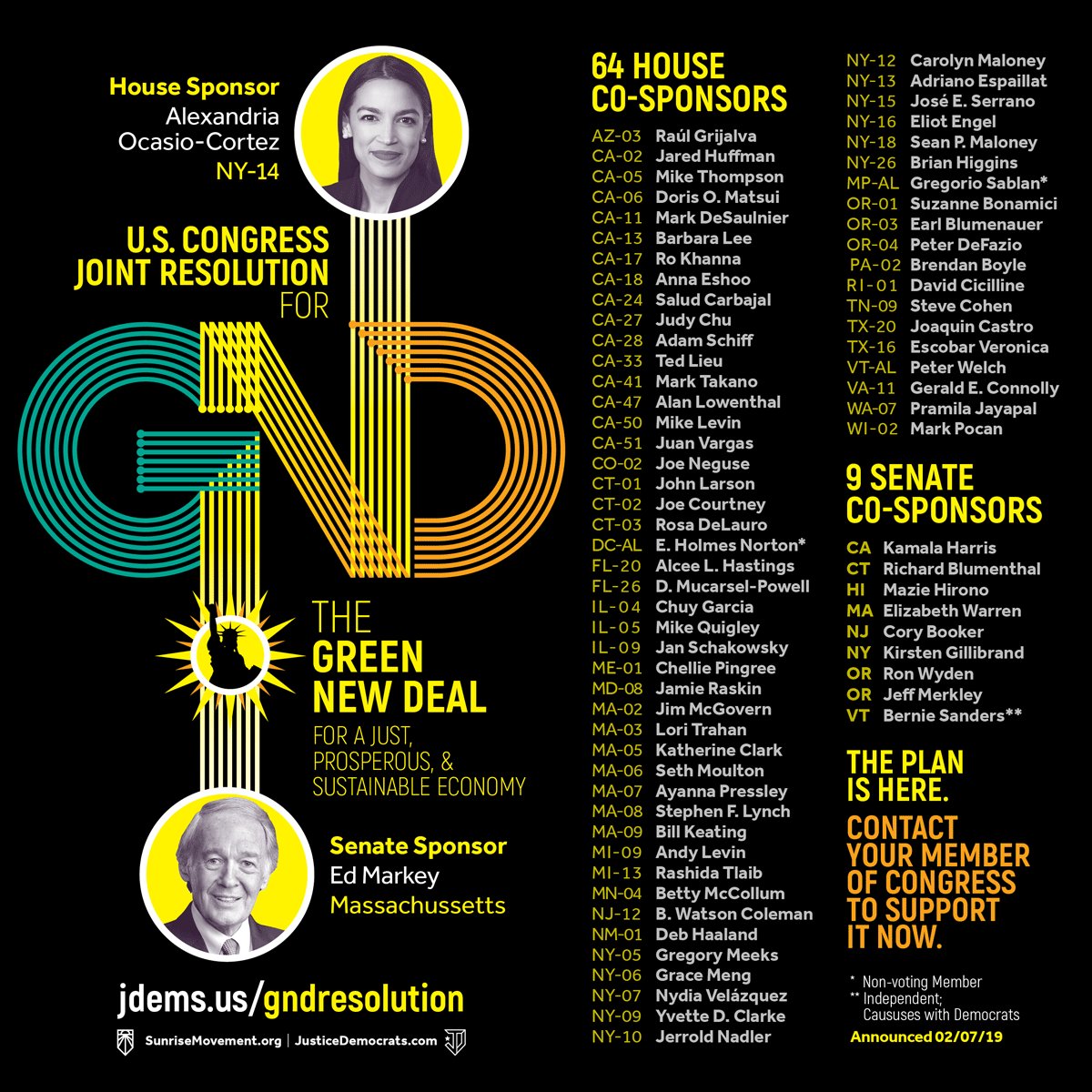
But the governor did not explicitly endorse the proposal. Instead, he unveiled a four-pronged plan to tackle rising temperatures that has a great deal in common with the Green New Deal resolution introduced into Congress earlier this month by Representative Alexandria Ocasio-Cortez and Senator Ed Markey last month.

  1. Power the economy with “100 percent clean, renewable, and carbon-free energy.” The governor did not say when such a goal would be accomplished or whether more controversial clean energy sources, like nuclear or hydro, are included in his vision of a green America.
  2. Create millions of jobs in green industries. Inslee laid out the outline of a green jobs plan that takes advantage of what each state has to offer. “We are going to build electric cars in Michigan, build and install wind turbines in Iowa,” he said, “and solar right here in Washington state.”
  3. Justice and inclusion. Communities of color are often on the frontlines of climate change and are frequently left out of the picture by politicians, Inslee said, adding, “Everyone benefits from new jobs and investment.”
  4. No more subsidies for fossil fuels. “I have a message for the oil and gas interests,” Inslee said, setting up one of the morning’s biggest applause lines. “That gravy train is over.”

Inslee pledged not to take any money from the fossil fuel industry throughout his campaign, and he upped the ante for his prospective presidency: “Not one nickel of taxpayer dollars will go toward subsidizing oil and gas.”

The Democrat, who until recently was chair of the Democratic Governors Association, took a break from climate change to discuss paid family leave, health care, taking on the NRA, and legalizing marijuana nationwide. But he quickly came back to his climate platform.

While the governor’s unyielding emphasis on climate change might be a turn-off for some, those who came to hear him speak seemed enthusiastic about his laser-focused platform. “I think it’s a great idea,” said Kim Mead, head of the Washington Education Association, an 82,000-member teachers union. “It’s something we haven’t been paying enough attention to, and it’s something that’s the future for our kids, too.”

Inslee’s bear-hugging of climate has won him the support of Charlie Lapham, the 28-year-old director of communications at the Martin Luther King County Labor Council. “There are a lot of candidates in the Democratic field supporting climate,” he said. “They say it’s this issue that’s going to threaten our existence, but then it’s their number-four or five priority.”

Jesse Anderson, a 34-year-old project engineer at A&R Solar, hasn’t quite made up his mind if he’s supporting Inslee for president, but he likes a lot of what he hears. “I feel like he supports the cause for the industry that I work for,” he said.

Still, Anderson isn’t quite on the same page as Inslee about climate change being the number one priority for the nation. That sentiment is among the biggest challenges to the Washington governor’s candidacy, in addition to low name recognition and the fact that he’s executive of one of the deepest of blue states.

“There’s a lot of priorities,” Anderson said. “I think it’s definitely up there.”

For Inslee, obviously, nothing else comes close to stopping climate change. To wit, as those assembled made their way out of the warehouse and onto the street, a man quipped about the governor’s speech: “It sure was easy to figure out what his priorities were.”

See the original article here: 

The latest Democratic contender is all climate all the time

Posted in Accent, alo, Anchor, Casio, Citizen, Everyone, FF, G & F, GE, LAI, ONA, OXO, Radius, solar, Uncategorized | Tagged , , , , , , , | Comments Off on The latest Democratic contender is all climate all the time

These Products Will Turn You into a Zero-Waste Superstar

Let’s not beat around the organic bush. Living a zero-waste lifestyle takes effort. I mean, you’re basically thumbing your nose at convenience.

The thing is, convenience comes at a price, and it’s a lot more than the cost of your Starbucks grand? double-mocha with extra cream.?Convenience?means leaving a trail of single-use plastic in your wake.

None of us sets out to do harm. We’re just opting for easy in a world that’s too busy. Unfortunately, easy invariably comes with consequences. Imagine knowing your straw was responsible for?this:

5 Zero-Waste?Products

Adopting a zero-waste lifestyle might take some effort, but it’s not hard. If everyone carried these five items with them, we’d stem the tide of trash that we’re washing into our rivers and?oceans.

1.?Collapsible Coffee Cup

Given the amount of coffee and tea we indulge in on a daily basis, keeping a cup in your bag is a no brainer. The problem is, most reusable cups are unwieldy, especially if you’re a grand? double-mocha kind of person (and who isn’t?).

The solution: Get a collapsible coffee mug. They’re leak-proof and much easier to stow than their bulky, full-sized cousins. How ingenious!

2.?Bamboo Straw

Biodegradable straws are de rigueur in a lot of hippie and health-conscious establishments, but most mainstream outlets are still all about the bottom line. That approach doesn’t allow for anything other single-use plastic straws.

The solution: Invest in some reusable straws. (One for you and the rest for your envious table mates.) You get all different types (stainless steel, silicon, glass, etc.), but I like bamboo, because it’s best for the environment.

3.?Filtered Water Bottle

More and more companies are turning plastic bottles into jackets, but that’s not a good enough reason to grab a bottle of Evian with your lunch. Plastic water bottle pollution is worse than you think, with only one in every six bottles being recycled (or downcycled, really). And that’s just the tip of a two million-ton iceberg.

The solution: A filtered water bottle is the perfect workaround. You get to be a better human and have filtered water on tap. There are plenty to choose from, so it’s up to your budget and personal taste.

4.?On-the-Go Cutlery Set

More and more restaurants and eateries are joining the sustainability movement. It’s gratifying to see them providing wooden utensils rather than the usual plastic cutlery we’re accustomed to. But, like with straws, the movement is still in its infancy.

The solution: Buy an on-the-go cutlery set. It’s worth spending the money on a quality kit, as a poorly made knife or fork that doesn’t do the job is enough to ruin a good lunch.

5.?Lunch Box/Food Container

Making your own food from scratch is better for your health, your budget and your zero-waste efforts. But let’s face it: not everyone has the time or the inclination to spend the weekend meal prepping.

Maybe going to your favorite deli for lunch is how you indulge in ‘me time.’ Perhaps enjoying a meal out with friends and family is your preferred way to socialize. I get it.

The solution: Get a lunch box/food container and ask the deli to serve your meal in there instead of their plastic takeout containers. And when you go out for dinner, guess where your leftovers go?

Using these five items will drastically reduce the amount of trash you create on a daily basis. If this is all you did, you’d make a significant difference to the environment. You could stop there and still feel really good about your zero-waste efforts.

If you want?take your mission?next level, though, you could switch up your beauty routine, shop at zero-waste stores and even try your hand at a little apartment composting.

The next thing you know you’ll have been living a zero-waste for a full year.

Photo Credit: Getty Images

Disclaimer: The views expressed above are solely those of the author and may not reflect those of Care2, Inc., its employees or advertisers.

Original source: 

These Products Will Turn You into a Zero-Waste Superstar

Posted in alo, bamboo, bigo, ECOlunchbox, Everyone, FF, GE, LAI, LG, ONA, organic, Uncategorized | Tagged , , , , , , , , , , , | Comments Off on These Products Will Turn You into a Zero-Waste Superstar

Mitch McConnell — yes, that Mitch McConnell — wants the Senate to vote on the Green New Deal

Subscribe to The Beacon

Senate Majority Leader Mitch McConnell has previously said that he wouldn’t bring legislation to a vote in the Senate that the president wouldn’t sign. But the senator from Kentucky announced on Tuesday that he will force a vote on the giant effort to tackle climate change and overhaul the economy known as the Green New Deal.

Have rising sea levels and worsening forest fires convinced the Republican leader to reassess his position on climate change? Not quite.

McConnell is eager to get Senate Democrats on the record about their support for the resolution introduced last week by Senator Ed Markey of Massachusetts and Representative Alexandria Ocasio-Cortez of New York. Republicans see the proposal as a big liability for Democrats, portraying it as a socialist plot to ban airplanes and cows. It’s the old red-baiting line of attack.

Always free, always fresh.

Ask your climate scientist if Grist is right for you. See our privacy policy

The proposal includes progressive agenda items like universal healthcare and a federal jobs guarantee. An outdated and since taken down FAQ on AOC’s website confused things by promising economic security for those “unwilling to work.” For the likes of McConnell, that sounds like the kind of left-wing proposal that could alienate moderate voters and give President Donald Trump a boost in the 2020 presidential election.

Trump is already testing out this approach. “I really don’t like their policy of taking away your car, of taking away your airplane rights, of ‘let’s hop a train to California,’ of you’re not allowed to own cows anymore!” he said of the Green New Deal at a rally in El Paso, Texas on Monday night.

It’s no wonder McConnell seemed uncharacteristically gleeful when he said he’d be bringing the Green New Deal to the Senate for a vote. If you’ve never seen him smile before, take a look:

Markey quickly hit back at McConnell on Tuesday, releasing a statement blasting Republicans for failing to have a climate plan of their own. “The Green New Deal resolution has struck a powerful chord in this country, and Republicans, climate deniers, and the fossil fuel industry are going to end up on the wrong side of history,” he said.

Ocasio-Cortez issued her own rebuke hours later. “McConnell thinks he can end all debate on the Green New Deal now and stop this freight train of momentum … all he’s going to do is show just how out of touch Republican politicians are with the American people,” she said in a statement.

It’s hard to say whether McConnell will be successful in his bid to rattle Democrats on the fence about a resolution that promises so much so quickly. But the majority leader, and the rest of the GOP for that matter, might be too hasty in thinking it’s an Achilles heel for Democrats.

The deal is gaining popularity in the House, where more than 15 percent of representatives have signed on as sponsors. And it’s picking up momentum in the Senate, too, especially among White House contenders such as Kamala Harris, Cory Booker, Elizabeth Warren, Amy Klobuchar, and Kirsten Gillibrand.

To be sure, not all Senate Dems are as enthusiastic. When asked about the Green New Deal on Tuesday, Senator Sherrod Brown of Ohio, who is reportedly considering a presidential run, said that he supports a Green New Deal but is “not going to take a position on every bill that’s coming out.”

Whatever happens next, it’s becoming increasingly clear that the Green New Deal is turning into something the two parties think they can use to their advantage.

View original:  

Mitch McConnell — yes, that Mitch McConnell — wants the Senate to vote on the Green New Deal

Posted in Accent, alo, Anchor, Casio, Everyone, FF, G & F, GE, LAI, LG, ONA, Radius, Uncategorized | Tagged , , , , , , , , , , , | Comments Off on Mitch McConnell — yes, that Mitch McConnell — wants the Senate to vote on the Green New Deal

The Green New Deal is quickly becoming a test for 2020 Democrats

Subscribe to The Beacon

New York Representative Alexandria Ocasio-Cortez and Massachusetts Senator Ed Markey released their non-binding Green New Deal resolution Thursday morning; it outlines a vision of the future that’s a lot different from the one we’re in.

We’re talkin’ universal healthcare, a federal jobs guarantee, a transition to clean energy in a matter of decades, and more, much more. It’s a lot — and would have a tough slog becoming law in this Congress. House Speaker Nancy Pelosi has already labeled the ambitious proposal “a suggestion.”

But the vague scope of the deal is intended to be a feature, not a bug. Believe it or not, the policies that would make up a Green New Deal aren’t actually meant to pass Congress just yet. Gasp! No really, welcome to politics. The resolution serves up two big questions: The less central one is, can House Democrats rally behind this ambitious climate proposal?

Remember, Pelosi isn’t running for president, and if this deal ever comes to the table, its proponents are banking on a new president in the White House and Democratic leadership in both houses of Congress. Which brings us to the main question: Can 2020 Democrats throw their support behind this level of bold climate action?

What’s included in Thursday’s proposal is just as important as what’s left out, particularly when it comes to getting presidential candidates on board. The resolution doesn’t exclude a price on carbon — an emissions-reducing mechanism favored by liberals and some conservatives — nor is there a strict definition of what “100 percent renewable energy” means. So someone like Cory Booker, a 2020 presidential candidate who happens to support nuclear energy, can comfortably put his name down as a cosigner of the new resolution.

Including Booker, five presidential candidates have cosigned AOC and Markey’s resolution: Kamala Harris, Elizabeth Warren, Kirsten Gillibrand, Bernie Sanders. Former Housing Secretary Julián Castro hasn’t explicitly said he backs this proposal, but he has expressed support for a Green New Deal in the past. Indiana Mayor Pete Buttigieg, Hawaii Senator Tulsi Gabbard, and former Maryland Representative John Delaney haven’t indicated if they support the proposed resolution yet.

With heavyweights like Warren and Harris on board, it’s becoming clear that a progressive Green New Deal will likely be a central tenet of any Democrat’s 2020 agenda. “We’re going to press all elected officials, especially 2020 contenders, to support this resolution. Where they stand on the resolution will make it clear who is using the Green New Deal as a buzzword and who is serious about transforming our economy in line with what science and justice demand,” Stephen O’Hanlon, communications director of the youth-led climate advocacy group Sunrise Movement said in an emailed statement.

For the likes of Gillibrand and Booker, signing on now is a quick way to make inroads with parts of the Democratic base. For Warren and Sanders, this proposal is catnip for their supporters.

So what all are these candidates putting their names on? Even taking vague language into account, there are a lot of ambitious elements in the resolution:

A job for every American: “guaranteeing a job with a family-sustaining wage, adequate family and disability leave, paid vacations, and retirement security to all people of the United States.”
A right to unionize: “strengthening and protecting the right of all workers to organize, unionize, and collectively bargain free of coercion, intimidation, and harassment.”
Death to monopolies: “ensuring a commercial environment where every businessperson is free from unfair competition and domination by domestic or international monopolies.”
Healthcare for everyone! And … housing for everyone? “[P]roviding all members of society with high-quality health care, affordable, safe and adequate housing, economic security, and access to clean water, air, healthy and affordable food, and nature.”

As you can see, this isn’t your run-of-the-mill resolution. We’ll see how many of these ambitious plot points survive the journey through the Washington machine.

More:  

The Green New Deal is quickly becoming a test for 2020 Democrats

Posted in Accent, alo, Anchor, Casio, Everyone, FF, G & F, GE, LG, ONA, Radius, Uncategorized | Tagged , , , , , , , | Comments Off on The Green New Deal is quickly becoming a test for 2020 Democrats

The Green New Deal is already at work in one Portland neighborhood

Subscribe to The Beacon

This story was originally published by High Country News and is reproduced here as part of the Climate Desk collaboration.

It’s a cloudy gray day in Cully, a neighborhood in northeastern Portland, and the air is thick with the smell of burnt tires. The culprit? An asphalt manufacturing plant, where black rubble is piled into one long heaping mound, waiting to be hauled off to areas across the city to fill in old potholes and pave new streets.

Cully is located in one of the city’s most culturally diverse pockets, but the predominantly low-income neighborhood is regularly subject to industrial pollution. Automobile salvage lots, including one that caught fire and spewed toxic chemicals into the air last year, litter entire city blocks with old car parts and used tires.

Across the street from the asphalt plant, a barren parking lot is cordoned off by a chain-link fence. This was formerly the site of the Sugar Shack, a notorious strip club and adult video store that was torn down less than two months ago. After the owners’ arrest in 2015 for tax fraud and running a prostitution ring, the lot became a meeting spot for neighborhood groups and community members. Now, thanks to a coalition of four local organizations that goes by the name Living Cully, the site will soon be home to a new affordable housing complex: Las Adelitas, named in honor of the women soldiers who fought during the Mexican Revolution.

With a large crowd of community members as an audience, the Sugar Shack in Cully neighborhood is destroyed to make room for a new affordable housing development, Las Adelitas.Living Cully

On the surface, this housing complex in one of the most rapidly gentrifying corners of the country will be much like any other development designed to help respond to the national housing crisis. But dig a little deeper, and Las Adelitas has the potential to become a model for much more — a solution not only to the displacement of longtime residents but to the lack of green investment in the low-income communities of color that are already on the front lines of the looming climate change crisis.

Dig deeper still, and Las Adelitas — together with the whole Living Cully framework — begins to look a lot like the much-touted Green New Deal: a preliminary plan touted by Democratic congressional members to create a “green workforce” that will build out green infrastructure and clean energy projects while bringing economic opportunities to vulnerable communities. The long-term success or failure of Living Cully could provide a window into an ambitious national program that’s still in the visionary stage today.

Now a landscape crew supervisor, Mateo Fletes, center, has specialized in habitat restoration at Verde Landscaping.Naim Hasan

When the Great Recession hit in 2008, Mateo Fletes Cortes, who lives in the town next to Cully, lost his job. Originally from Nayarit, Mexico, Fletes Cortes moved to Oregon with his uncle in 2002, picking up work in construction, building out wooden window frames, installing baseboards, and adding finishing touches to buildings and houses. But when the construction industry collapsed, so did Fletes Cortes’ job stability. He’d heard about opportunities in landscaping work but been reluctant to apply, associating landscaping with unskilled low-wage labor. Then he heard about Verde.

The area nonprofit, which is also the lead organizer of Living Cully, operates a landscaping company called Verde Landscaping. The business was started in 2005 in order to train and employ residents to do sustainable landscaping for affordable housing developments built by Hacienda CDC, a Latino Community Development Corporation. Hacienda is also a member organization of Living Cully, and the owner of Las Adelitas. At Verde, wages start at $13.50 an hour and increase to $18.50 by the third year of employment, with paid training sessions and certification provided, as well as medical and dental benefits. So far, the program has trained over 200 area residents in jobs like stormwater management and habitat restoration, according to Verde’s executive director, Tony DeFalco. Ironically, as the economy has picked up in recent years, it’s become harder to recruit labor for the training program, DeFalco said. “You’ve got historically low unemployment, and so it can be really challenging to be competitive.”

Through Verde’s workforce training program, Fletes Cortes took English classes, received industry certifications, and learned that landscaping was indeed for him. “As fate would have it, I started to work in habitat restoration,” something he’d previously known nothing about, Fletes Cortes said. “I saw that [landscaping] wasn’t just about working a lawnmower.” Rather, it could be about restoring wildlife habitats or redirecting stormwater to hydrate vegetation and native plants and shrubs.

These days, Fletes Cortes spends a lot more time in the office, having been promoted to landscape crew supervisor. Bidding for landscaping contracts and checking on equipment and crewmembers keep him busy. He’s been with Verde for a decade, and today, he manages other employees in the workforce program. When the Las Adelitas project gets fully underway, it will be highly skilled workers like Fletes Cortes who carry out the necessary landscaping and subsequent maintenance work for the planned 140 affordable housing units and ground-level commercial spaces.

Brenna Bailey and Linda Dentler volunteer to inventory Living Cully’s mobile home weatherization program supplies.

Living Cully’s motto can seem counterintuitive at first: “Sustainability as an anti-poverty strategy.” After all, it’s now widely believed that the more green investments like parks and vegetation appear in a neighborhood, the more desirable (and expensive) that place becomes, often pushing longtime residents out of their homes and neighborhoods. The phenomenon even has its own trendy name: “green gentrification.” This is certainly a challenge in Cully, where, despite anti-displacement efforts, housing prices are in fact rising. But DeFalco believes that pairing housing projects with environmental investments will be key to the project’s success. “[That] is a really simple recipe for proofing the community against green gentrification,” he said.

That experiment is coming together in Las Adelitas: Verde Builds will construct the building’s green features; green roofs and walls, solar panels, water reuse systems are all being considered in the design. Verde Landscaping will provide local skilled workers to build out green stormwater infrastructure as well as sustainable landscaping. The housing project is expected to be completed by 2020.

In addition to Las Adelitas, Living Cully partners are not only creating energy-efficient affordable housing but also preserving existing low-income housing, through initiatives like a mobile home weatherization program that aims to lower bills of low-income residents who pay a disproportionate amount of their paychecks to utilities. And there are other benefits: That weatherization allows low-income residents to lower their energy use and therefore, their carbon footprint. In August, Portland City Council passed a new zoning designation to protect mobile home parks in Portland from redevelopment, thanks to organizing efforts by Living Cully partners and other area organizations.

As Congress continues to figure out what a Green New Deal might look like on a national scale, Cully could become a valuable and tangible model community to turn to for inspiration. “We are at a place now, where — as a nation — we can no longer make an environmental investment without social and environmental justice outcomes,” DeFalco said. “What we’ve been able to do here at a smaller scale is basically to demonstrate how you do that.”

Read this article: 

The Green New Deal is already at work in one Portland neighborhood

Posted in Accent, alo, Anchor, FF, G & F, GE, LG, Northeastern, ONA, Radius, solar, solar panels, Uncategorized | Tagged , , , , , , , , , , , | Comments Off on The Green New Deal is already at work in one Portland neighborhood

Stock Up on These Foods with Exceptionally Long Shelf-Lives to Reduce Food Waste

Interested in saving money by buying in bulk, but nervous about your ability to consume large amounts of foods before the expiration date? rears its ugly head??I get it. Stocking up on staple ingredients is one of the best things?you can do when it comes to mindful eating and meal prep, but you’re not helping anyone?by buying more than?you can reasonably consume.

Enter these grocery staples. Keeping products with long shelf lives on-hand will enable you to construct a tasty and varied roster of meals around them, all while reducing unnecessary food waste.?Here are seven of those products to stock up on today.

1. Dried Beans

Dried beans are the ultimate product to buy in bulk, because they have a shelf-life listed as indefinite. However, they will begin to lose moisture around two years after their best-by date has passed. Don’t worry, though?that just means you’ll have to soak them a little longer, so they can reabsorb moisture when you finally get around to preparing them.

2. Peanut Butter

Natural peanut butter is the exception here, because it will expire after?two to three months in the pantry?or three to six months in the refrigerator. Other smooth and crunchy peanut butter varieties will keep for much longer?all the way up to a year past its printed date.

3. Coconut Oil

Good coconut oil should be able to last for nearly two years after opening before going rancid. Compare that to olive oil, which bottlers recommended?you use?within six months of?opening it.

4. Lentils and Peas

Much like beans, legumes such as dried lentils and peas have exceptionally long shelf-lives. As in, they won’t expire,?if you store them properly.

5. Rolled Oats

The shelf-life of oats, like most other foods, will depend on the variety and brand of the oats you purchase, but as a rule of thumb, a properly stored package of rolled oats will last for about 18 to 24 months at room temp. Once you prepare it, try to eat any leftovers within 48 hours.

6.?Dried?Fruits

Mix and match here. While buying frozen berries and veggies will also help ensure that your produce doesn’t spoil before you’re ready to eat it, most dried fruits have a shelf-life of about one year at 60?F after you open the package.?Most dried veggies will last about half of that time, except for carrots, which can last longer.

Fermented Foods

In theory, most fermented foods?things like sauerkraut, pickles and kimchi?have an incredibly long shelf-life. We’re talking years. The fermentation process was borne out of a need for a better system of food preservation, after all. For your typical grocery store purchased fermented foods, you’re looking at a shelf-life of anywhere between four and 18 months.

Are there any foods with long shelf lives that you like to stock up on? Share your favorites in the comments.

Related at Care2

These are the 7 Best Fermented Foods for Gut Health
10 Best Foods to Buy in Bulk to Save Money
27 Clever Ways to Reuse Food Scraps

Images via Getty

Disclaimer: The views expressed above are solely those of the author and may not reflect those of Care2, Inc., its employees or advertisers.

Read this article:

Stock Up on These Foods with Exceptionally Long Shelf-Lives to Reduce Food Waste

Posted in alo, bigo, FF, GE, LAI, LG, ONA, Oster, PUR, Ultima, Uncategorized | Tagged , , , , , , , , , , | Comments Off on Stock Up on These Foods with Exceptionally Long Shelf-Lives to Reduce Food Waste

Here’s where 2020 presidential candidate Julián Castro stands on the environment

Subscribe to The Beacon

Last week, President Obama’s former Secretary of Housing and Urban Development Julián Castro announced he is running for president. Castro is well known in San Antonio, Texas, where he served as mayor from 2009 to 2014, but he’s not exactly a household name elsewhere in the country just yet. The Latino Democrat’s 2020 policy agenda includes progressive crowd-pleasers like universal pre-K and Medicare-for-all, but where does he stand on the environment?

We don’t have to speculate about Castro’s environmental intentions. During his announcement speech on Saturday, Castro swore to reaffirm America’s commitment to the Paris climate agreement and pass some version of a Green New Deal.

There’s reason to believe he isn’t just jumping on the climate change bandwagon because other (rumored and official) 2020 contenders — such as Senator Elizabeth Warren, Senator Bernie Sanders, and Washington state Governor Jay Inslee — have made climate change a central component of their platforms. While he was the mayor of San Antonio, Castro pushed the city’s public utility to close a 900-megawatt coal-powered plant, adopt a 20 percent renewable energy by 2020 pledge, and offer green jobs training. The city also launched a small car-sharing program and a bike-share system aimed at making transportation greener under his leadership.

But Castro’s environmental record isn’t blemish-free. In 2011, during his time as mayor, he touted the economic benefits of fracked gas for his district. “This is the kind of moment that only comes once a century,” he said of a proposed fracking project in the Eagle Ford Shale. And the native Texan has not yet taken the No Fossil Fuel Money pledge — a vow to eschew donations from Big Oil PACs that has only been taken by a few 2020 contenders thus far, including Warren and Inslee.

So as 2020 presidential candidates keep pushing each other further left, will Castro draw a clearer line in the sand when it comes to climate? We’ll keep you posted.

Link to article:

Here’s where 2020 presidential candidate Julián Castro stands on the environment

Posted in Accent, alo, Anchor, FF, G & F, GE, ONA, Radius, Uncategorized | Tagged , , , , , , , , , , , | Comments Off on Here’s where 2020 presidential candidate Julián Castro stands on the environment

EPA nominee Andrew Wheeler wasn’t ready for the Senate’s questions on climate change

Subscribe to The Beacon

This story was originally published by Mother Jones and is reproduced here as part of the Climate Desk collaboration.

It was clear about halfway through Andrew Wheeler’s confirmation hearing to lead the Environmental Protection Agency that he wasn’t prepared for the number of questions he was getting on climate change.

Senator Ed Markey (a Democrat from Massachusetts) asked Wheeler on Wednesday whether he agreed with the fourth National Climate Assessment’s conclusions on how Americans will be affected by the world’s relative inaction on climate change, a report that was vetted by 13 federal agencies including the EPA.

Wheeler didn’t exactly answer, saying that he had not been fully briefed on the report because much of his agency’s staff isn’t working right now. “We’ve been shut down the last few weeks,” he said, explaining that he had only been briefed once by staff since the report was published in late November. He said his additional briefings were postponed; about 95 percent of his agency is furloughed.

The Republican majority gave Wheeler an unsurprising pass, defending his record as a lobbyist for an assortment of industries he now regulates, including his main old client, coal baron Bob Murray. But most of the Democratic members, which included several potential 2020 presidential contenders, grilled Wheeler on climate change.

Senator Bernie Sanders asked Wheeler if he considered climate change to be “one of the great crises that face our planet.”

“I would not call it the greatest crisis, no sir,” he answered. “I would call it a huge issue that needs to be addressed globally.”

When senators grilled him on climate change, Wheeler attempted to walk a fine line to sound more reasonable than the president’s talk of a “hoax,” but not go too far to suggest he would do much to crack down on rising greenhouse gas pollution.

“On a one to 10 scale, how concerned are you about the impact of climate change?” Senator Jeff Merkley (a Democrat from Oregon) asked Wheeler, saying that 10 would be an issue that keeps him “up at night.”

“I stay awake at night worrying about a lot of things at the agency,” Wheeler said, before volunteering an “eight or nine.”

Merkley didn’t hide his surprise. “Really?”

The senator challenged Wheeler on his go-to talking point that the EPA was taking action on pollution via its Affordable Clean Energy rule replacement for an Obama-era coal plant regulation and fuel efficiency standards. ACE doesn’t reduce carbon emissions from coal any more than market forces, and the EPA is weakening car standards and considering ending a waiver for California that implements more aggressive targets.

These policies already didn’t come close to the reductions needed to limit warming below a disastrous 2 degrees C (3.6 degrees F). But reversing them risks even more. Last year, greenhouse emissions continued to rise globally, including by 3.4 percent in the United States.

There was an even sharper focus on climate change than in past Trump-era EPA hearings. The conversation around climate change has shifted quite a bit since Wheeler last appeared before the Senate in August, a few weeks after he took the helm of the agency. Now Trump officials face more questions from the opposing party that dig deeper than the usual “Do you believe in climate change?”

The three senators who are considering presidential bids, Cory Booker of New Jersey, Sanders, and Merkley, all centered their questions around climate change. Since August, the issue has become a top item for the House Democratic majority, and progressives have talked of an ambitious “Green New Deal.” Meanwhile, the science has grown more alarming: In addition to the National Climate Assessment, an October report from the Intergovernmental Panel on Climate Change looked at the damaging effects from 1.5 degrees C (2.7 degrees F) of warming.

A protest interrupted Wheeler when he began on Wednesday, which never once mentioned the words “climate change,” as he ran through his greatest hits — deregulatory and otherwise — from his first year at the EPA.

The protests could still be heard faintly from the hallway when he continued his introductory remarks. “Shut down Wheeler! Not the EPA!”

Read article here:

EPA nominee Andrew Wheeler wasn’t ready for the Senate’s questions on climate change

Posted in Accent, alo, Anchor, FF, G & F, GE, LAI, ONA, Prepara, Radius, Uncategorized | Tagged , , , , , , , , , , , | Comments Off on EPA nominee Andrew Wheeler wasn’t ready for the Senate’s questions on climate change

Democrats might have put a roadblock on the path to a Green New Deal

Subscribe to The Beacon

Thursday was a big day in the U.S. House of Representatives: Democrats took control, Nancy Pelosi regained the gavel as House Speaker, the 116th class of freshman representatives was sworn in, and the new-look legislative body voted on a bill that will fund most government agencies through the 2019 fiscal year and potentially end a two-week government shutdown.

In her first speech as newly elected House Speaker on Thursday, Pelosi singled out climate change as a moral, health, and national security issue. “The American people understand the urgency,” she said. “The people are ahead of the Congress. The Congress must join them.”

But that new budget the House just voted to approve, engineered by Pelosi herself, includes a pay-as-you-go provision that some progressive critics say could hinder attempts at creating sweeping climate legislation. “PayGo,” as it’s known, is a rule that requires any new proposed spending to be balanced out with more taxes or budget cuts before it can come to a vote.

Progressives, environmental groups, and others are displeased with the potential effects of this provision; they say it will stifle the House’s ability to pass big-ticket items like “Medicare-for-all,” tuition-free public college, and, yes, a massive climate-targeted package like a Green New Deal. (Nevermind that such legislation would likely fare poorly in a Republican-controlled Senate.)

On Wednesday, high-profile progressives Alexandria Ocasio-Cortez of New York and Ro Khanna of California said they would vote against Pelosi’s package, arguing it kneecaps the liberal agenda they’ve been championing. “We shouldn’t hinder ourselves from the start,” Ocasio-Cortez tweeted on Wednesday. Vermont Senator Bernie Sanders agreed: “I’m concerned that the concept of PAYGO will make it harder for Congress to address the many crises facing our working families,” he tweeted.

Democratic leaders pushed back, arguing PayGo will decrease the deficit — which is set to balloon over the next decade thanks to the passage of 2017’s GOP-championed tax bill — and restore fiscal responsibility to Congress. They also promised members of the Congressional Progressive Caucus who were on the fence about the bill that PayGo wouldn’t stand in the way of major progressive priorities. Pelosi’s chief of staff, Drew Hammill, argued that a vote against the rules package would result in the Republican-controlled Office of Management and Budget defunding any Democratic initiatives that increased government spending.

Despite dissent from a vocal minority on the left, the Democratic rules package passed 234-197 on Thursday evening. Only three Democratic members, Ocasio-Cortez, Khanna, and Hawaii’s Tulsi Gabbard voted against — a fraction of the 18 votes needed to sink it.

So, does PayGo’s passage mean the end of the Green New Deal and other large-scale progressive legislation?

Not necessarily, according to Justin Talbot-Zorn, senior adviser at the progressive think tank the Center for Economic and Policy Research. “There is a procedural vote through which Congress can suspend the rules and pass legislation,” he said.

The rule could make it more difficult, however, to get people on board with big, expensive agenda items. “It does deter us from being able to do legislation at a scale necessary to do Green New Deal-type legislation,” Talbot-Zorn says. “It emboldens opponents of a Green New Deal; it gives them another argument against it.”

In other words, if progressive Democrats want to push for a large infrastructure investment in, say, green jobs, at some point in the future, they will have to expend more effort to bypass a rule package proposed and approved by their own party.

Or as Talbot-Zorn put it: “If the Green New Deal and major green infrastructure investment is going to be a central plank of the Democratic platform in the House — which it really needs to be — why would we adopt a rules package that would inhibit the passage of that central plank?”

View post: 

Democrats might have put a roadblock on the path to a Green New Deal

Posted in Accent, alo, Anchor, Casio, FF, GE, LG, ONA, Radius, Uncategorized | Tagged , , , , , , , , , | Comments Off on Democrats might have put a roadblock on the path to a Green New Deal

This is what a government shutdown over climate change would look like

Invest in nonprofit journalism today.Donate now and every gift will be matched through 12/31.

What issues are “worth” shutting down the government for? That, annoyingly, is the question America finds itself tackling again and again in recent years.

Our president was elected on a controversial platform of building a border wall to limit immigration. Now, he says he’s willing to shut down the government within days of Christmas in order to secure billions of dollars in funding for its construction.

On Sunday morning, Trump’s advisor, Stephen Miller, said the president would do “whatever is necessary” in order to build the wall — despite the fact that the general public feels that a government shutdown is pretty drastic. Still, one seems nearly inevitable and would begin this Friday — senators and representatives have already left for their home districts without a plan to avert it.

This seems as good a time as any to offer an important reminder: Climate change is an existential threat to human civilization and without radical action, we’re committing to irreversible destruction of the biosphere — the evolutionary equivalent of a meteor strike.

Which makes me wonder: What would it take for the Democrats to shut down the government — to do whatever is necessary — over climate change?

The first step would be making climate change a core and unrelenting talking point of the party’s platform — and then winning elections specifically with a populist mandate to take immediate, large-scale action on it.

We already have a glimpse of what that world looks like: Recently elected Justice Democrats like Alexandria Ocasio-Cortez, Ilhan Omar, Rashida Tlaib, and 2016 Grist 50 member Ayanna Pressley spoke incessantly about climate change in the runup to their midterm campaigns, rightly framing it as an intersectional justice issue.

The policy platform that has emerged from those electoral wins — the Green New Deal — has already pushed the larger Democratic Party to quickly consider positions that would have been deemed outright radical just a few months ago, like a nationwide 100 percent renewable energy mandate by 2030 and a green jobs guarantee. This kind of rapid shift in dialogue is consistent with the “moon shot” approach that scientists say is necessary to prevent catastrophic warming.

And those ideas have a lot of support: A recent New York Times poll shows that 98 percent of loyal Democrats and 66 percent of loyal Republicans would back a green jobs program.

Highly visible groups of young people, led by the Sunrise Movement, have already made clear that they’re not going to go easy on Democratic leadership if it ignores climate change. If the group’s protests escalate — if its members continue speaking with clear, moral language inspired by past civil rights struggles — there could suddenly be a hint in the air that transformative policy change could be imminent, also.

There are already signs that mainstream Democrats are listening. Likely incoming Speaker of the House Nancy Pelosi promised dialogue with Sunrise protesters, though she’s yet to agree to the protesters’ request to direct a special committee explicitly to develop a Green New Deal plan.

On the Senate side, where the rules ensure that the Democrats — still in the minority — could block the president’s infrastructure plans, Minority Leader Chuck Schumer has already made clear that a Green New Deal is the only way forward. (It remains to be seen how insistent he’s going to be on that point.) And just this past Friday, Senator Cory Booker of New Jersey became the second likely Democratic presidential contender (along with Vermont Senator Bernie Sanders) to endorse the idea of the sweeping program. “We must take bold action on climate change & create a green economy that benefits all Americans,” he tweeted.

In the months ahead, it’s not inconceivable that a few dozen Democrats could form a progressive bloc and effectively commandeer the House, refusing to pass legislation on anything until a Green New Deal is signed into law. That, of course, would require a massive push from voters at the same time. It would need to be obvious to Democrats that they’d risk losing elections by not supporting it.

Dig this article?

Support nonprofit journalism by making a donation today and all gifts will be matched

. A little bit goes a long way. 

Help us raise $50,000 by December 31!Donate today

.

Link to article: 

This is what a government shutdown over climate change would look like

Posted in alo, Casio, FF, GE, LAI, LG, ONA, Radius, Uncategorized | Tagged , , , , , , , , , | Comments Off on This is what a government shutdown over climate change would look like